November 25, 2011

1982: Taylor’s Long INT Return Lifts Giants Over Lions


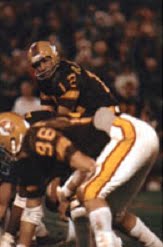
Following a promising 1981 season that had seen the New York Giants qualify for the playoffs for the first time since 1963, the club was struggling in ’82. As with all of the teams, the 57-day players’ strike had been a disruption. FB Rob Carpenter, who had been a big part of the resurgence in ’81, held out and injuries plagued the club, starting with QB Phil Simms, who missed the entire year with a knee injury. Head Coach Ray Perkins’ team came into the Thanksgiving Day game at the Pontiac Silverdome on November 25 at 0-3. In addition, star second-year LB Lawrence Taylor (pictured above) was originally expected to be out due to a knee injury suffered the week before in the first post-strike game, a loss to the Redskins.

The Lions (2-1), coached by Monte Clark, had won their first two games of the season prior to the strike and lost their first post-strike contest by three points at Chicago. The Lions had an outstanding defense against the ground game and were at their best running the ball on offense, especially with RB Billy Sims. Eric Hipple had taken the starting quarterback position away from Gary Danielson in ’81.

Hipple started at quarterback for the Lions but was ineffective in the first half, completing just 3 of 12 passes for 39 yards. However, Detroit took the early lead in the first quarter following an interception of a pass by Giants QB Scott Brunner (son of Lions offensive backfield coach Joe Brunner) by LB Garry Cobb. It led to a 46-yard Ed Murray field goal. It was 6-0 at halftime after Brunner was intercepted again, this time by LB Jimmy Williams, and Murray finished off that possession with another field goal, from 44 yards.

Danielson took over at quarterback for the second half, but things got off to a rocky start early in the third quarter when his second pass was intercepted by New York LB Harry Carson. It resulted in a 34-yard field goal by Joe Danelo.

Moments later, Sims fumbled and LB Brad Van Pelt recovered for the Giants. Following the pattern established by both clubs thus far, the turnover was converted into another Danelo field goal, this time from 40 yards. The score was tied at 6-6.

The Lions drove into New York territory in the fourth quarter, but in a third-and-goal situation, Danielson tried a pass to RB Horace King in the flat to his left. Lawrence Taylor, playing despite the injured knee, had been burned on a similar play earlier in the year, but on this occasion intercepted the throw at his three yard line and ran 97 yards for a touchdown with just over ten minutes left in the game. It would prove to be the decisive play of the contest.

There was an injury delay when HB Leon Bright was hit in the throat by the elbow of Detroit WR Leonard Thompson while fielding a punt and had to be taken off the field on a stretcher. Afterward, Coach Perkins blasted the officials for not adequately protecting the kick returner by exacting penalties or ejecting players who hit defenseless return men, although Bright, who had played in the Canadian Football League where fair catches were not allowed, rarely signaled for one and had taken several such hits since coming to the NFL.

There was plenty of time remaining and Detroit still had a shot late in the game as the Lions again drove into Giants territory. But CB Terry Jackson intercepted a Danielson pass to preserve the error-filled 13-6 win for New York.

The Lions outgained the Giants (321 yards to 206) and had more first downs (19 to 10). Detroit turned the ball over four times, leading indirectly to two field goals and directly to a touchdown, while New York suffered three, two of them resulting in a total of six points.

Scott Brunner had an ordinary day as he completed 12 of 28 passes for 136 yards and was intercepted twice. Rookie RB Butch Woolfolk led the running game with 87 yards on 21 carries and also caught four passes for 28 more yards. WR Johnny Perkins had 5 pass receptions for 80 yards.

For the Lions, Billy Sims (pictured below) was, except for the one costly fumble, the key player on offense as he rushed for 114 yards on 26 carries and had 6 receptions for 38 yards. Gary Danielson was successful on 12 of 19 passes for 125 yards but was intercepted three times. WR Mark Nichols had the most pass receiving yards with 49 on his three catches.


“The game highlights were that we won,” said Ray Perkins afterward. “That’s the bright spot - plus the fact that our defense played much better than it has.”

“The situation was similar to the one Green Bay had against us earlier in the season,” Lawrence Taylor explained about the key interception for the TD. “They called a time out and when they lined up, I recognized the formation as one similar to the Packers’. I was supposed to cover the man out of the backfield (Horace King) and when he went into the flat, I cut in front of him and got the pass.”

Meanwhile, an angry Monte Clark, frustrated with the performance of the Detroit offense, responded by calling a practice the next day and canceling a scheduled day off from practice on Monday. It would ultimately not resolve the Lions’ offensive woes.

Both clubs ended up at 4-5, although the Lions just qualified for the postseason tournament that replaced the usual playoff structure for the abbreviated season while the Giants came up short (despite New York winning the head-to-head matchup with the Lions, Detroit had the better conference record, and that was preeminent). Detroit was decimated in the first postseason round by the top-seeded Washington Redskins. The Giants also suffered the distraction in the last few weeks of the season of Coach Perkins announcing that he would be leaving the club to replace the legendary Paul “Bear” Bryant as the head coach at his college alma mater, Alabama.

Lawrence Taylor was not only a consensus first-team All-Pro selection and named to the Pro Bowl, but was also named NFL Defensive Player of the Year by the Associated Press for the second straight year – an amazing affirmation of how quickly the 1981 first round draft pick’s impact was felt. The interception against the Lions was his only one in ’82 and one of two that he returned for a touchdown during his Hall of Fame career.

Billy Sims ranked fifth in the league with 639 yards rushing on 172 carries with four touchdowns, although his average gain of 3.7 yards-per-carry was his career low. He also gained 342 more yards on a team-leading 34 pass receptions on his way to being chosen to the Pro Bowl for the third time in three years, having quickly established himself in 1980 when he was named NFL Offensive Rookie of the Year.

November 24, 2011

1949: Blocked Extra Point Preserves Win for Yankees Over Dons


The Los Angeles Dons still held out the faint hope of securing a postseason berth as they hosted the New York Yankees in an All-America Football Conference game on November 24, 1949. With the league down to seven teams, the divisions had been discarded in favor of a format in which the top four would qualify for the playoffs.

The Dons were known for their explosive offense and, under Head Coach Jimmy Phelan, the attack had been geared to the passing of star tailback Glenn Dobbs. However, Dobbs was suffering through an injury-plagued season and much of the time it was George Taliaferro at tailback, who was an outstanding runner but mediocre passer. As a result, and despite having good receivers, the Dons were a ground-oriented team with an inconsistent defense and were sporting a lackluster 4-7 record going into the season finale.

The Yankees, coached by Red Strader, were in a far better situation. After a down year in 1948, they had benefited from being combined with the Brooklyn Dodgers for the ’49 season and also picked up some outstanding rookie talent, including DHB Tom Landry. Having converted to the T-formation, New York was lacking at quarterback, and lost star tailback Spec Sanders to injury, but still had a good stable of running backs that included halfbacks Buddy Young and Sherman Howard and FB Bob Kennedy. The Yankees were 8-3 and certain of a playoff berth, and had beaten the Dons in a 10-7 defensive battle in New York.

There were 20,096 fans in attendance for the Thanksgiving Day game at the LA Memorial Coliseum. As had been the case in the first meeting, the first three quarters were again dominated by the defenses.

In the first quarter, Landry punted to the LA 11 and it was fielded by HB Tom McWilliams, who lateraled to C/LB “Big John” Brown, who in turn made it to the New York 49 for an overall 40-yard return. FB Hosea Rodgers gained five yards and then Taliaferro put the Dons ahead with a bolting 44-yard run off tackle for a touchdown. The 7-0 score stood up until the fourth quarter, but the last quarter was an exciting one.

45 seconds into the final period, Bob Kennedy plowed into the end zone from a yard out to conclude a 12-play, 52-yard drive for the Yankees. Harvey Johnson kicked the extra point to tie the contest. On the ensuing kickoff, HB Billy Grimes fumbled the ball and DB Otto Schnellbacher recovered at the LA 28. QB Don Panciera threw to Buddy Young for a 20-yard gain. Three runs into the line gained five yards to the three yard line and Johnson put New York ahead by 10-7 with a 16-yard field goal.

The Dons regained possession at their 29. With Taliaferro running and end Len Ford making an outstanding one-handed catch, they made it to the New York 19. The drive stalled and Bob Nelson kicked a 26-yard field goal to again tie the score at 10-10.

LA tried an onside kick but it failed disastrously when end Bruce Alford recovered for the Yankees and returned it to the Dons’ 47. Highlighted by a 27-yard gain on a pass from Kennedy to Alford that put the ball on the three yard line, New York drove down the field to another one-yard TD carry by Kennedy. Johnson’s 100th consecutive successful conversion made it 17-10.

The next Los Angeles possession ended with an interception, but New York had to punt as the clock ticked down to 30 seconds. On a spectacular play, Taliaferro ran the kick back 52 yards for a touchdown, but instead of salvaging a tie, the all-important extra point attempt by Nelson was blocked by New York end Jack Russell. There were just 13 seconds left and the Yankees came away with a hard-fought 17-16 win.

The statistics were as evenly matched as the final score. The Dons edged New York in total yardage by just a single yard, 246 to 245. LA outrushed the Yankees (151 to 138) while New York had more passing yards (107 to 95) and first downs (13 to 10). George Taliaferro accounted for 112 rushing yards on 14 carries.

While it was the season finale for the Dons, who ended up tied for fifth with the Chicago Hornets at 4-8, the Yankees had one more game to play. They headed up the coast to San Francisco, where they lost to the 49ers three days later to finish in third place with an 8-4 record. They fell again to the 49ers in the first playoff round.

With the merger with the NFL, the AAFC ceased to exist, and that included the Dons and Yankees. However, many of the players on both teams moved on to NFL clubs. 19 of the Yankees made the roster of the New York Yanks (a separate franchise from the AAFC club, they had played as the New York Bulldogs in ‘49), including Buddy Young, Bruce Alford, Bob Kennedy, Harvey Johnson, and Jack Russell. The Yanks also hired Red Strader to be head coach. Several other ex-Yankees went to the Giants, most notably Tom Landry, Otto Schnellbacher, and DT Arnie Weinmeister. Don Panciera played for the Detroit Lions.

Of the ex-Dons, George Taliaferro joined several of his former antagonists on the Yanks and Billy Grimes went to Green Bay. Len Ford joined the Browns, one of three AAFC clubs (along with the 49ers and Colts) that were taken in by the NFL, and moved on with his Hall of Fame career as a defensive end. Glenn Dobbs took his passing arm to Canada instead.

November 23, 2011

MVP Profile: Chuck Fusina, 1984

Quarterback, Philadelphia Stars


Age: 27 (May 31)
5th season in pro football, 2nd in USFL & with Stars
College: Penn State
Height: 6’1” Weight: 195

Prelude:
Fusina was chosen by the Tampa Bay Buccaneers in the fifth round of the 1979 NFL draft, but was activated for just one game during his rookie season and, in 1980 and ’81, threw a total of five passes for 20 yards. He was traded to San Francisco prior to the 1982 season but was released a week later and signed with the USFL Philadelphia Stars in December for the ’83 spring season. While not possessed of a strong arm, he was mobile and an able game manager for the Stars’ ball-control offense. Fusina completed 56.5 % of his passes for 2718 yards with 15 TDs against 10 interceptions and ran for 291 yards, averaging 4.6 yards per carry. Philadelphia went 15-3 and advanced to the USFL Championship game, losing by two points to the Michigan Panthers.

1984 Season Summary
Appeared and started in all 18 games
[Bracketed numbers indicate league rank in Top 20]

Passing
Attempts – 465 [6]
Most attempts, game – 35 vs. New Jersey 6/24
Completions – 302 [3]
Most completions, game – 24 vs. New Jersey 6/24
Yards – 3837 [3]
Most yards, game – 302 vs. Jacksonville 5/19
Completion percentage – 64.9 [1]
Yards per attempt – 8.3 [3]
TD passes – 31 [2]
Most TD passes, game – 5 vs. New Orleans 4/27
Interceptions – 9 [20, tied with Steve Young]
Most interceptions, game – 2 at Washington 3/4
Passer rating – 104.7 [1]
300-yard passing games – 1
200-yard passing games – 10

Rushing
Attempts – 40
Most attempts, game - 5 (for 52 yds.) at Memphis 2/26, (for 17 yards) vs. Tampa Bay 4/1
Yards – 251
Most yards, game – 52 yards (on 5 carries) at Memphis 2/26
Yards per attempt – 6.3
TDs – 1

Scoring
TDs – 1
Points - 6

Postseason: 3 G
Pass attempts – 58
Most attempts, game - 27 vs. Birmingham, Eastern Conf. Championship
Pass completions – 36
Most completions, game - 15 vs. Birmingham, Eastern Conf. Championship
Passing yardage – 414
Most yards, game - 158 vs. Arizona, USFL Championship
TD passes – 1
Most TD passes, game - 1 vs. New Jersey, USFL First Round playoff
Interceptions – 1
Most interceptions, game - 1 vs. Arizona, USFL Championship

Rushing attempts – 9
Most rushing attempts, game - 4 vs. New Jersey, USFL First Round playoff, vs. Arizona, USFL Championship
Rushing yards – 49
Most rushing yards, game - 24 vs. New Jersey, USFL First Round playoff
Average gain rushing – 5.4
Rushing TDs – 1

Awards & Honors:
USFL Player of the Year: Sporting News
1st team All-USFL: Sporting News

Stars went 16-2 to win the USFL Atlantic Division. Won First Round playoff over New Jersey Generals (28-7), Eastern Conference Championship over Birmingham Stallions (20-10), and USFL Championship over Arizona Wranglers (23-3).

Aftermath:
The team moved to Baltimore in 1985, and Fusina had another solid season as he completed 61.1 % of his passes for 3496 yards and 20 TDs. The team struggled early but again won the USFL Championship. With the demise of the league, Fusina joined the NFL Green Bay Packers, appearing in seven games and throwing 32 passes in 1986, his last season. Overall in the USFL, Fusina completed 843 passes (61.0 %) for 10,051 yards with 66 TDs against just 33 INTs. He also ran for 774 yards on 161 carries (4.8 avg.) and 4 TDs. However, he threw just 37 passes in four NFL seasons for 198 yards with 1 TD.

--

MVP Profiles feature players who were named MVP or Player of the Year in the NFL, AAFC (1946-49), AFL (1960-69), WFL (1974), or USFL (1983-85) by a recognized organization (Associated Press, Pro Football Writers Association, Newspaper Enterprise Association, United Press International, The Sporting News, Maxwell Club – Bert Bell Award, or the league itself).

[Updated 2/12/14]

November 22, 2011

1951: Christiansen’s 2 Punt Return TDs Cap Detroit Win Over Packers


The Detroit Lions had gotten off to a rocky start in the 1951 NFL season, winning their first two games but then losing two of their next three, with a tie in between. However, by the time they hosted the Green Bay Packers on November 22 the Lions had won three consecutive road games and, at 5-2-1, was in contention in the National Conference.

Detroit had a new head coach in Buddy Parker and plenty of rising talent on both sides of the ball. 25-year-old QB Bobby Layne, in his second season with the club, was thriving under Parker’s direction. Halfbacks Doak Walker and Bob “Hunchy” Hoernschemeyer were effective cogs in the backfield, big (6’5”, 262) end Leon Hart provided an excellent target for Layne’s passes, and the line had been revamped just before the winning streak commenced. The defensive line was anchored by middle guard Les Bingaman and the backfield, which over the course of the decade would become the unit’s special strength, was taking shape with the addition of rookie safety Jack Christiansen (pictured above), who also was an outstanding punt returner.

Meanwhile, the Packers, under Head Coach Gene Ronzani, were in trouble. They had lost three straight, including at home against the Lions, and were 3-5. Second-year QB Tobin Rote was a capable passer and outstanding runner – he was far more productive than any of the team’s running backs, which was at the root of Green Bay’s offensive problems.

There were 33,452 in attendance at Briggs Stadium for the Thanksgiving Day game. Detroit started off the scoring in an eventful first quarter with Walker kicking a 20-yard field goal. Green Bay responded by driving 75 yards, capped by a touchdown pass from Rote to end Carl Elliott that covered 15 yards.

The Lions came right back as Layne threw to Hoernschemeyer for a 17-yard TD, but the Packers scored again when Rote connected once more with Elliott for a 43-yard gain that set up a one-yard scoring run by the quarterback. Green Bay was ahead by 14-10 after one period of play.

In the second quarter, Rote tossed another scoring pass, this time covering 48 yards to HB Don Moselle, and Fred Cone’s extra point extended the Packers’ margin to 21-10. The rest of the half was all Detroit, however, as Layne completed two touchdown passes to Hart, of 33 and 19 yards, and in between connected with Walker for a 35-yard TD. At halftime, Layne had tossed four scoring passes and the Lions were ahead by ten points at 31-21.

The game turned into a rout in the third quarter. Three plays into the second half, Hoernschemeyer ran around left end and then cut back for an 82-yard touchdown. The Packers finally got on the board again when Rote threw to end Ray Pelfrey for a 42-yard TD.

However, with the score at 38-28, any hopes for a Green Bay comeback were extinguished by two big punt returns by Christiansen. First, the rookie fielded a kick at his 29 and returned it 71 yards for a TD. A few minutes later, and still in the third quarter, he returned another punt all the way, this time going 89 yards.

The Packers scored one more touchdown in the fourth quarter, on a 35-yard pass from QB Bobby Thomason to Elliott, but the result had been rendered a foregone conclusion by Christiansen’s punt returns. Detroit set a new franchise record for points in a game in winning by a score of 52-35.

The statistics were closer than the final score as the Lions outgained Green Bay by 478 yards to 458 and the Packers had the edge in first downs, 20 to 19. Green Bay actually had more rushing yards (179 to 172) and Detroit’s lead in passing yardage was not all that great (306 to 279). However, the two big punt returns for touchdowns, combined with four turnovers (to one by Detroit) and 10 penalties (the Lions were flagged four times) made the difference.

Bobby Layne completed 20 of 36 passes for 296 yards and the 4 touchdowns with one intercepted. Thanks to the long scoring run, Bob Hoernschemeyer gained 99 yards on just seven carries and also caught 5 passes for 48 yards and a TD. Jack Christiansen tied his own record for punts returned for touchdowns in a game with two and also set records with 175 yards on punt returns and a 43.8-yard average (both long since broken).


For the Packers, Tobin Rote (pictured above) was productive on the ground, rushing 15 times for 131 yards and a TD, and also threw for 201 yards and three touchdowns. Ray Pelfrey caught 4 passes for 103 yards and a touchdown.

The Lions just came up short of winning the National Conference as they lost two of their last three games, both to the 49ers. Their 7-4-1 record tied for second with San Francisco, a half game behind the Rams at 8-4. Green Bay kept on losing and finished fifth in the conference at 3-9.


Bobby Layne (pictured at left) had 24 TD passes after his four-touchdown performance and ended up with a league-leading 26, which put him just two short of the existing NFL record. He also led the league in pass attempts (332), completions (152), yards (2403), percentage of TD passes (7.8) and, reflecting his gambling style of play, interceptions (23, tied with Adrian Burk of the Eagles). He was named to the Pro Bowl for the first time in his Hall of Fame career.

Doak Walker, who scored 16 points in the game, had 82 after the win over the Packers to put him in the league lead. While he led the NFL in scoring as a rookie in 1950, in the end he finished third in ’51 with 97 points. His 1270 all-purpose yards ranked third as well.

Tobin Rote set a season rushing record for quarterbacks with 523 yards that lasted until 1971. He also passed for 1540 yards with 15 touchdowns and 20 interceptions.

With the two touchdowns on punt returns against the Packers, Jack Christiansen, who had already had a two-TD day returning punts against the Rams, became the first player in NFL history to return two punts for touchdowns in a game as well as do it twice in a season. He ranked second in the league with a 19.1 average (Buddy Young of the New York Yanks barely beat him out with a 19.3-yard average). Christiansen went on to average 12.8 yards over the course of his Hall of Fame career and scored eight touchdowns returning punts. He also intercepted the first two of an eventual 46 passes.

November 21, 2011

1974: Sun Lose Key Players, Then Lose WFL Playoff Game to Hawaiians


Befitting the state of the World Football League as it staggered toward the end of its first (and only complete) season, the outcome of the first round playoff game between the Southern California Sun and The Hawaiians was significantly determined by off-field events before the teams took the field on November 21, 1974.

Prior to the season, the Sun had made a splash with the signing of three prize rookies, FB James McAlister and RB Kermit Johnson from UCLA and OT Booker Brown out of USC. It was good publicity for the team, especially with all three players coming out of local major college programs. Indeed, the Sun was the most aggressive of the WFL clubs in pursuing their draft choices, with considerable success.

Coached by Tom Fears, a Hall of Fame end with the Rams who had also been the first head coach of the New Orleans Saints, Southern California had former Utah State QB Tony Adams running the offense that included several players with NFL experience, most notably WR Dave Williams, formerly of the Cardinals; TE Dave Parks, previously with the 49ers and Saints; and 13-year-veteran OT Joe Carollo, who had been with the Rams, Eagles, and Browns. The Sun easily won the Western Division with a 13-7 record.

For the WFL’s Honolulu-based team, the road to the playoffs had been more difficult. Coached by Mike Giddings, a former assistant with the NFL 49ers, The Hawaiians were also a young club with many players from West Coast schools. They had begun the season with rookie Norris Weese starting at quarterback, with predictable problems. The receiving corps was good, however, although the running game was lacking, and there was experience on defense. There was also a grueling round of travel, not helped by The Hawaiians insisting on playing Sunday afternoon home games while the rest of the league took the field on Wednesday and Thursday nights.

They got off to a 2-8 start, but the addition of several veteran players who were released from NFL contracts had a good effect in the second half of the year, in particular QB Randy Johnson (pictured at top), previously of the Falcons and Giants. By season’s end, The Hawaiians were 9-11, which was nothing special but enough to finish second in the Western Division and qualify to appear in the much-revamped postseason.

Just before the game, it was announced that McAlister (who was injured in any case), Johnson (the team’s leading rusher), and Brown would not be playing for the Sun. Because owner Larry Hatfield had missed a week’s payroll, the agent for the three players, Mike Trope, said that their contracts had thus been violated and they were now free agents. It was a huge blow for the club.

There was a disappointing crowd of 11,430 on hand at Anaheim Stadium. The Sun started 20-year-old Ralph Nelson and 258-pound Greg Herd at running back in place of the missing rookies.

In the first quarter, Tony Adams threw to Dave Parks for a 23-yard gain that set up a 47-yard field goal attempt by Rod Garcia, but it was missed with 9:47 to go in the period.

The Hawaiians had difficulty moving the ball on offense and finally scored thanks to a turnover. LB Jim Sniadecki picked off an Adams pass intended for Parks at the Sun 43 and returned it to the 23. Randy Johnson passed to TE John Kelsey for a 20-yard gain and HB Al Davis ran in for a touchdown from three yards out. The score remained 7-0 as Davis was stopped short on the action point attempt (touchdowns counted for seven points in the WFL and were followed by an action point, which could not be kicked).

The Hawaiians stopped the Sun on offense and got the ball back at their own 38. Johnson completed a 12-yard pass to WR Tim Delaney, who led the WFL in pass receptions during the season, and throws of 12 and 19 yards to Kelsey to set up a 23-yard field goal by R.A. Coppedge at just under three minutes into the second quarter.

Again Southern California couldn’t move the ball and Adams was sacked for a 14-yard loss on a third down play to force another punt from deep in Sun territory. CB Willie Williams returned the kick 27 yards to the Southern California nine yard line.

The Sun briefly got a break when a holding penalty backed The Hawaiians up ten yards, but gave it right back with a pass interference call that gave the visitors a first down at the five. Kelsey, running a crossing pattern, caught a touchdown pass from Johnson that gave The Hawaiians a 17-0 advantage (they again failed on the action point attempt, which consisted of Weese tossing an incomplete pass).

Southern California fought back thanks to the throwing of Adams and running and receiving of Herd, who gained 18 yards on a pass. Their next possession was finally stopped at The Hawaiians’ 20 yard line and Garcia kicked a 37-yard field goal with 3:54 left in the half to finally get the Sun on the board.

The Sun got the ball back as the clock ticked down to 41 seconds remaining before halftime and ran the ball, prompting boos from the crowd. Adams called a timeout and then threw to Nelson for 18 yards and 46 yards to WR Keith Denson for a touchdown. A pass was completed to HB Clay Jeffries for the action point and the score was 17-11 at the intermission.

The Sun still had the momentum as the third quarter began. The defense held The Hawaiians to a short possession and the offense then drove to The Hawaiians’ 16. However, they had to settle for a field goal when Adams was sacked for a nine-yard loss on third down. Garcia was successful on the 42-yard attempt and it was a three-point game with 9:07 remaining in the third quarter. It was the high point of the contest for Southern California.

The Hawaiians took the ensuing kickoff and went 72 yards in 12 plays. Davis capped the drive by diving into the end zone from two yards out for the TD. Weese ran for the action point, increasing the visitors’ lead to 25-14.

To make matters worse for the Sun, Adams was knocked out of the game with a knee injury after being tackled by DT Ron East early in the fourth quarter and backup Gary Valbuena came in to replace him. He was not up to the task of engineering a comeback as he was sacked three times and tossed three interceptions.

The second of the interceptions, by LB John Douglas, was returned 37 yards to the Southern California 14. Three plays later, Johnson threw to WR John Isenbarger for an eight-yard touchdown which not only sealed the win but started a fight when CB Jim Bowman of the Sun took a swing at Isenbarger. The Hawaiians again failed to convert the action point, but it no longer mattered.

Valbuena threw to WR Ike Harris for a 49-yard gain late in the game, but followed up with his third interception. Ex-USC and Philadelphia Eagles LB Adrian Young picked it off at the six. That was the last gasp for Southern California, and The Hawaiians advanced to the second round of the playoffs with a 32-14 win.

The Sun, playing catch-up for almost the entire game, outgained The Hawaiians (402 yards to 254) and had more first downs (23 to 17). However, Southern California’s running game accumulated just 99 yards on 30 carries without Johnson and McAlister in the backfield; The Hawaiians sacked the Sun quarterbacks six times, at a loss of 58 yards, while Johnson was only dumped once; and the Sun turned the ball over four times while he visitors suffered no turnovers.


Randy Johnson completed 14 of 24 passes for 148 yards and two touchdowns. John Kelsey caught 6 passes for 82 yards and a TD while Tim Delaney contributed 5 receptions for 40 yards. Al Davis (pictured at left) was the team’s top ground gainer with 49 yards on 12 carries that included two scores.

For the Sun, Tony Adams was successful on 11 of 21 passes for 189 yards with a touchdown and an interception. Gary Valbuena went to the air 17 times and had 10 completions along with three interceptions. Keith Denson caught 6 passes for 122 yards and the one long TD. Greg Herd ran for 52 yards on 10 attempts and Ralph Nelson added 39 yards on his 14 carries.

Afterward, there was plenty of frustration over the off-field issues expressed by Coach Tom Fears and the Southern California players.

“It sure as hell didn't help any not having Kermit and Booker,” said Fears.

“If management had done their part, we would have gone all the way,” complained DT Dave Roller. “You can’t win if you can’t concentrate and you can’t concentrate if you don’t get paid.”

The Hawaiians lost a close contest to the eventual-champion Birmingham Americans in the next playoff round. Both franchises returned for the abbreviated 1975 season, but James McAlister, Kermit Johnson, and Booker Brown jumped to the NFL and never played for the Sun again.

None of the three distinguished themselves post-WFL. McAlister played for two seasons with the Philadelphia Eagles and one with the Patriots, gaining a total of 677 yards rushing, catching 30 passes for 218 more, and returning kickoffs for an average of 20.5 yards. Johnson spent two years with the San Francisco 49ers and ran for just 124 yards, caught one pass, and had a 24.9 average on his 10 kickoff returns. Booker Brown also played just two seasons in the NFL, with the San Diego Chargers.

Both starting quarterbacks also defected to the NFL in 1975. Tony Adams, the league’s top passer and a co-MVP in ’74, became a backup with the Kansas City Chiefs. Randy Johnson joined the Washington Redskins, where he played behind Bill Kilmer along with Joe Theismann.

November 20, 2011

1978: Campbell Leads Oilers Past Dolphins in Monday Night Thriller


The Houston Oilers were a team on the rise as they hosted the Miami Dolphins at the Astrodome on November 20, 1978. Under Head Coach Bum Phillips, the Oilers were 7-4 and coming off a dramatic come-from-behind win at New England the previous week. The key to their resurgence was rookie RB Earl Campbell (pictured above), the 1977 Heisman Trophy-winner out of Texas, whose power running fueled the ball-control offense.

The visiting Dolphins, under Head Coach Don Shula, had missed the postseason the past three years but were 8-3 and winners of their previous three contests. QB Bob Griese had missed the first five games with a knee injury, but was back in action. The proficient running attack was led by offseason-addition RB Delvin Williams, who was leading the league in rushing coming into the game at Houston.

There were 50,290 fans on hand as well as a national television audience for the Monday night contest. In the first quarter, Miami drove to the first score of the game with the help of Griese’s passing (he hit on four of five attempts), including one of 27 yards down the middle to WR Nat Moore that, in turn, set up a ten-yard touchdown throw to Moore

The Oilers responded with Pastorini completing passes to TE Mike Barber for gains of 29 and 12 yards, the latter to the Miami four yard line, setting up Campbell’s first TD from a yard out with 3:32 to play in the opening period.

Moving into the second quarter, DE Elvin Bethea sacked Griese on a third down play that forced the Dolphins to punt. Houston drove 87 yards in seven plays, helped along by a 38-yard pass interference call. WR Mike Renfro gained nine yards on an end-around run and then caught a pass from Pastorini for eight more. A completion to WR Ken Burrough gained 13 yards to the Miami 18 and on a third-down play, Pastorini avoided the blitz and connected on a 15-yard touchdown pass to Barber.

Down 14-7, Griese completed five of six passes on a drive that ended with a one-yard scoring plunge by Williams with 21 seconds remaining in the second quarter. The score was tied at 14-14 at the half. After thirty minutes of play, the Dolphins defense had held Campbell to 44 yards on the ground, but it would be a different matter in the second half.

The Oilers went back in front at 21-14 in the third quarter when Campbell ran for a six-yard TD, but the Dolphins drove 89 yards and FB Leroy Harris scored from a yard out to again knot the score at 21-21.

The evenly-matched teams had scored a touchdown apiece for the first three quarters. The tie was broken once again early in the fourth quarter, this time as the result of a safety as Miami DE A.J. Duhe sacked Pastorini in the end zone for two points. The Dolphins then got the ball back on the free kick with excellent field position at the Houston 45 and seemed poised to put the game away. But in a key series, the Oilers defense held and Miami was forced to punt.

Houston got the ball back and put together an 80-yard drive in which Pastorini connected with WR Ken Burrough on a 24-yard pass play and Campbell twice converted third downs with runs of six and eight yards, respectively. With less than five minutes to go, Campbell capped the possession as he ran around right end for a 12-yard touchdown that put the Oilers back in front at 28-23

The Dolphins responded by driving into Houston territory, with WR Duriel Harris gaining 31 yards on a pass reception along the way, but FS Mike Reinfeldt deflected a Griese pass intended for TE Andre Tillman at the eleven yard line and LB Steve Kiner intercepted. The turnover proved to be decisive. After running the ball three times to gain another first down, Campbell took off on a sweep to the right, got a key block from OT Greg Sampson, made a move on SS Tim Foley, and charged down the sideline for an electrifying 81-yard touchdown run, his fourth of the game. While Griese threw to WR Jimmy Cefalo for an 11-yard score at the end, it only narrowed Houston’s winning margin of 35-30.

Miami outgained the Oilers (454 yards to 406) and had more first downs (27 to 23). However, the Dolphins turned the ball over twice, including the big interception that set up the decisive touchdown run, while Houston turned the ball over once.

Earl Campbell was the game’s biggest star as he ran for 199 yards on 28 carries with four touchdowns. Dan Pastorini made good use of slip screen passes (passes to a wide receiver who has stepped back behind the line of scrimmage), going to the air 15 times and completing 10 for 156 yards with a TD and an interception. Mike Barber led the Oilers in pass receiving with 3 catches for 56 yards, including a score.

For Miami, Bob Griese (pictured below) was in top form as he completed 23 of 33 passes for 349 yards with two touchdowns and one intercepted. Delvin Williams was well-contained as he rushed for 73 yards on 18 attempts that included one TD. Nat Moore caught 3 passes for 84 yards and a score while Duriel Harris had 4 pass receptions for 79 yards and Leroy Harris grabbed 5 passes out of the backfield for 25 yards (he also rushed 12 times for 51 yards and a TD).


“I just try and do my best, that's all,” said the soft-spoken Earl Campbell afterward, who passed Williams as the NFL’s leading rusher. “Sometimes my best looks like my worst, but it's not important how it looks. What matters is how we do, whether we win.”

“After the safety we got the ball in good position and didn’t do anything,” said Bob Griese. “That was the key series. They have a good defense and you’re not going to score every time you get the ball.”

“Give credit to Don Shula for making my night a track meet,” said veteran CB Willie Alexander. “He's one of the greatest of all time. His game plan was magnificent. We didn't know where they were coming from next.”

“It was two great offenses on the field tonight and they really carried it to each other,” summed up Steve Kiner.

Houston ended up second in the AFC Central with a 10-6 record and qualified for a wild card slot, as did 11-5 Miami in the AFC East. The two clubs met again in the Wild Card playoff round and the Oilers again came away winners, this time by a score of 17-9. Houston won again at the Divisional level over New England but lost decisively to the division-rival Pittsburgh Steelers in the AFC title game.

Earl Campbell led the NFL with a then-rookie record 1450 yards on 302 carries with 13 touchdowns. The player nicknamed “The Tyler Rose” (he was from Tyler, Texas) was a consensus first-team All-Pro and Pro Bowl selection, and received league MVP honors from the Pro Football Writers Association and Newspaper Enterprise Association, as well as being named Offensive Player of the Year and Offensive Rookie of the Year by the Associated Press. It was the beginning of a relatively brief but brilliant pro career in which Campbell led the league in rushing in each of his first three seasons, and the AFC in his first four.

November 19, 2011

1961: Jim Brown Ties Rushing Record as Browns Crush Eagles


By the 1961 NFL season, Jim Brown of the Cleveland Browns was well-established as the top runner in pro football. He had led the league in ground-gaining in each of his first four years and set both a single-game record of 237 yards in 1957 and season record of 1527 yards in ’58. On November 19 against the Philadelphia Eagles the 25-year-old fullback added to his list of accomplishments.

The Browns were 6-3 and trying to keep pace with the Eagles and New York Giants in the Eastern Conference. While players were becoming increasingly restive under autocratic Head Coach Paul Brown, the team was still a regular contender. QB Milt Plum was the most accurate passer in the NFL and Brown was complemented in the backfield by HB Bobby Mitchell, an outstanding outside runner. Plum had been suffering from a hand injury but appeared to now be completely healthy. Mitchell had been called up to active military duty a few weeks before, but was on a weekend pass and available against the Eagles.

The Eagles were the defending NFL Champions and defeated Cleveland in the season-opening game in Philadelphia. They were a team in transition as both Head Coach Buck Shaw and star QB Norm Van Brocklin retired after the title-winning campaign. Nick Skorich was now the coach and 27-year-old Sonny Jurgensen the quarterback. The largely-untested Jurgensen had been nothing short of spectacular as he stepped out of Van Brocklin’s shadow. Philadelphia got off to a 7-1 start, but the loss of CB Tom Brookshier to a season-ending broken leg hindered the pass defense and the Eagles were coming off of a loss to the Giants the previous week.

There was a crowd of 68,399 in attendance at Cleveland’s Municipal Stadium and they saw the Eagles start off the scoring in the first quarter with a 34-yard field goal by Bobby Walston. Jim Brown put Cleveland ahead on the fourth play of the second quarter with a three-yard touchdown run that made it 7-3. The Eagles rebounded with a 68-yard drive, 46 of them on passes by Jurgensen, and HB Ted Dean scored from two yards out.

The Browns came right back with another three-yard TD by Brown that put them back in front at 14-10, which remained the score at halftime. They never trailed again.

Cleveland took the second half kickoff and went 73 yards in eight plays, with Plum throwing to Mitchell for a 28-yard touchdown. Lou Groza added a 17-yard field goal late in the third quarter that made it a 14-point game at 24-10.

The fourth quarter was eventful. Brown started things off with a one-yard TD on the period’s second play. The Eagles were forced to punt on their next possession and the Browns went 68 yards in eight plays for another TD, Brown’s fourth of the contest on an eight-yard sweep around left end.

Philadelphia responded with a five-play, 74-yard drive to finally get on the board again. Flanker Tommy McDonald caught a six-yard touchdown pass from Jurgensen, but at 38-17, the game was out of reach.

On the ensuing kickoff, Mitchell extinguished any remaining hopes for the Eagles by returning it 91 yards for a TD. The Eagles scored one last touchdown, on a Jurgensen pass to Timmy Brown that covered 39 yards, but it only made the score marginally closer. Cleveland came away with a convincing 45-24 win.

The only remaining drama pertained to Jim Brown’s pursuit of his own single-game rushing record. The Browns got the ball with less than two minutes remaining and Brown carried three times to tie the record (Brown was originally credited with a record-breaking 242 yards, but the official scorer admitted a mistake in addition the following day).

For the day, Brown’s total was 237 yards on 34 carries with four touchdowns. He also gained another 52 yards on three pass receptions and returned a kickoff 24 yards, giving him 313 total yards. He also threw a pass, but it fell incomplete.

“I've played some better all-around games this year,” Brown said afterward. “I missed a few blocks today, and a couple of times I went the wrong way when I got a good block. The blocking was tremendous. I don't think I ran any better than usual. You always go all out and sometimes you gain and sometimes you don’t.”

The Browns dominated statistically across the board, outgaining the Eagles by 505 yards to 327 and rolling up 30 first downs to Philadelphia’s 19. In addition, Cleveland didn’t turn the ball over at all, as opposed to two turnovers by the Eagles, and the Browns only punted once.

In addition to missing Tom Brookshier, Philadelphia’s defensive backfield suffered a further blow when FS Don Burroughs was lost with a slight concussion in the second quarter. Meanwhile, Browns CB Bernie Parrish had an exceptional game, holding star flanker Tommy McDonald to two catches for 25 yards (one of which was a short TD) and intercepting a pass in the third quarter.


Milt Plum completed 16 of 21 passes for 246 yards and a touchdown. Adding to Jim Brown’s output, Bobby Mitchell (pictured at left) ran for 43 yards on 8 carries, caught 4 passes for 54 more yards and a touchdown, and of course scored on a kickoff return. Flanker Ray Renfro gained 73 yards on his 4 pass receptions.

Sonny Jurgensen went to the air 32 times for the Eagles and completed 18 for 230 yards and two TDs with one intercepted. Timmy Brown led the club in rushing with 49 yards on just two attempts and also had the most pass receiving yards with 58 on his two catches that included a score. Ted Dean caught 6 passes for 51 yards to go along with his 31 yards on 9 rushing attempts with one TD. Only seven of Jurgensen’s completions went to an end or flanker.

“We had to win or else,” said Paul Brown afterward. “There was nothing left for us if we didn't win it.”

The Browns moved into a second place tie with Eagles at 7-3 as result of the win. But any hopes of finishing atop the Eastern Conference were dashed as they lost two of the next three games, including a showdown with the Giants the week after hosting Philadelphia. Cleveland’s final record was 8-5-1, which resulted in a third-place finish.

The Eagles ended up in second at 10-4, recovering from the loss to the Browns to win three of their last four. However, the loss was to the Giants, who came in a half-game ahead of Philadelphia at 10-3-1.

Jim Brown won his fifth consecutive rushing title with 1408 yards on 305 carries (a record at the time) for a 4.6-yard average and eight touchdowns. He also caught 46 passes for another 459 yards and two TDs, giving him a league-leading 1867 yards from scrimmage and, with a pair of kickoff returns added in, 1917 all-purpose yards.

The record-tying rushing performance was the second of an eventual four 200-yard games during his brilliant career (he came closest to topping his own mark again with 232 yards against Dallas in a 1963 contest). Buffalo’s Cookie Gilchrist ran for 243 yards in an AFL game in ’63 and Willie Ellison of the Rams topped Brown’s mark with 247 in a 1971 NFL contest.