June 3, 2012

1984: Wranglers Pull Away in 4th Quarter to Upset Stallions


The Arizona Wranglers came into the United States Football League game on June 3, 1984 against the Birmingham Stallions as ten-point underdogs. Head Coach George Allen’s team was 6-8 and barely staying alive in the Pacific Division (Due to what was, in essence, a trade of franchises, the Wranglers were for the most part the same veteran-laden club that played as the Chicago Blitz under Allen in 1983). Meanwhile the Stallions, under Head Coach Rollie Dotsch, were leading the Southern Division with a 12-2 record and had won their last three games in impressive fashion. Furthermore, star RB Joe Cribbs would be back in uniform for Birmingham following a two-week walkout over a contract dispute.

There were 32,500 fans at Birmingham’s Legion Field and they saw the home team score first. An interception by CB Ricky Ray that was returned 24 yards – and had an additional 15 tacked on at the end thanks to a facemask penalty – gave the Stallions the ball on the Arizona 15 yard line and set up an eight-yard touchdown pass from QB Cliff Stoudt to WR Ken Toler late in the first quarter. However, Arizona no sooner got the ball back when RB Tim Spencer took off on an 81-yard scoring run that, with the successful extra point, tied the score at 7-7.

The Wranglers scored twice in the second quarter, first on a 32-yard field goal by Frank Corral and then, in the final minute before the half, on a 25-yard touchdown pass play from 16-year QB Greg Landry to WR Larry Douglas. Arizona went into halftime with a surprising 17-7 lead.

However, the Stallions mounted a comeback in the third quarter. First, RB Leon Perry dove into the end zone from three yards out for a touchdown and then Birmingham took the lead when Stoudt threw to WR Jim Smith for a 21-yard TD. It was 21-17 heading into the final period.

Early in the fourth quarter, the Wranglers went back in front thanks to a 17-yard scoring pass from Landry to WR Lenny Willis. They got a further, and ultimately decisive, break when Stoudt fumbled and DT Joe Ehrmann recovered at the Birmingham 15. Landry hit WR Trumaine Johnson for a touchdown from 12 yards out and, with the extra point, Arizona once again held a ten-point lead.

Birmingham kept it close when Stoudt threw to WR Joey Jones for a 10-yard TD in the last two minutes, but an onside kick attempt was recovered by the Wranglers who proceeded to deliver the final blow as Spencer ran for a 43-yard touchdown. Arizona came away with a big 38-28 win.

The Wranglers outgained Birmingham, 416 to 361, with 246 of those yards coming on the ground (as opposed to 196 yards rushing for the Stallions). Birmingham led in first downs, 25 to 17. However, Arizona sacked Cliff Stoudt seven times, with three accounted for by DT Mark Buben and two by DT Kit Lathrop. Both teams suffered many penalties, as the Wranglers were flagged 15 times at a cost of 105 yards and the Stallions were penalized on 9 occasions for 79 yards.

Tim Spencer ran for 177 yards on just 12 carries thanks to the two long scoring runs and FB Kevin Long added another 12 rushes for 62 yards. Greg Landry completed 12 of 21 passes for 185 yards with three touchdowns and one interception. Trumaine Johnson led the team’s receivers with 4 catches for 71 yards and a TD.

In his return to the lineup, Joe Cribbs had 110 yards on 16 rushing attempts. Cliff Stoudt was successful on 21 of 27 passes for 225 yards and three scoring passes of his own along with one interception, and also rushed for 43 yards on five carries – however, he also suffered the seven sacks. Lost in the defeat was a big day by Jim Smith, who caught 9 passes for 120 yards and a touchdown.

“This was unquestionably our biggest win,” said a happy George Allen. “We cam in here ten-point underdogs and beat them in their own backyard by ten points. We showed a lot of character, toughness and guts.”

“It’s not the end of the world, but it’s always depressing when you lose,” summed up Coach Dotsch of the Stallions.

Arizona didn’t lose again the rest of the regular season, winning the next three contests to finish at 10-8 and qualifying for the playoffs as a Wild Card. The Wranglers kept up the momentum by upsetting Houston in the first round and beat the Lost Angeles Express in the Conference Championship to advance to the league title game, where they fell to the Philadelphia Stars. Birmingham closed out the regular season atop the Southern Division with a 14-4 record, handily beating Tampa Bay in the first round but losing to the Stars in the Eastern Conference Championship game.

Despite leaving the team for two games, Joe Cribbs ended up leading the USFL in rushing with 1467 yards. Tim Spencer was fifth with 1212 yards on 227 carries for a 5.3-yard average and 17 rushing touchdowns.

June 1, 2012

Rookie of the Year: Wally Chambers, 1973

Defensive Tackle, Chicago Bears


Age: 22
College: Eastern Kentucky
Height: 6’6”    Weight: 250

Prelude:
Chambers received All-American recognition as a senior at Eastern Kentucky, where he led the team in tackles and assists in three straight seasons. Chosen in the first round of the 1973 NFL draft (eighth overall) by the Bears, he moved directly into the starting lineup.

1973 Season Summary
Appeared and started in all 14 games
(Bracketed numbers indicate league rank in Top 20)

Sacks – N/A
Interceptions – 0
Fumble recoveries – 2
Tackles – 101
Assists – 31

Awards & Honors:
NFL Defensive Rookie of the Year: AP, PFWA
Pro Bowl

Bears went 3-11 to finish fourth in the NFC Central as the defense ranked 17th overall and tied for 12th with 32 sacks.

Aftermath:
Chambers followed up his outstanding rookie season by receiving second-team All-NFL recognition from UPI and the Associated Press and first-team All-NFC honors from AP and The Sporting News in 1974. While he was not named to the Pro Bowl in ’74, he was in 1975 and ’76 and was a consensus first-team All-Pro in 1976, his peak season. However, a major knee injury limited Chambers to four games in 1977 and contract issues caused him to be traded to the Tampa Bay Buccaneers for 1978. Injuries and illness hampered him in his first season with the Bucs but, moved to right end opposite Lee Roy Selmon, Chambers again became a big-play lineman in a 1979 season in which defense carried the team all the way to the NFC Championship game, after which he retired. Overall, he was named to the Pro Bowl three times in seven years, but injuries cut short a career that began with great promise.

--

Rookie of the Year Profiles feature players who were named Rookie of the Year in the NFL (including NFC/AFC), AFL (1960-69), or USFL (1983-85) by a recognized organization (Associated Press – Offense or Defense, Newspaper Enterprise Association, United Press International, The Sporting News, or the league itself – Pepsi NFL Rookie of the Year). 

May 30, 2012

MVP Profile: Jack Kemp, 1965

Quarterback, Buffalo Bills


Age:  30
8th season in pro football (7th active), 6th in AFL, 4th (3rd complete) with Bills
College: Occidental
Height: 6’1”    Weight: 201

Prelude:
The road to pro football success was a difficult one for Kemp, taken in the 17th round of the 1957 NFL draft by the Detroit Lions after playing collegiately at little Occidental College. He saw scant action in the preseason but, after Head Coach Buddy Parker resigned and then took over in Pittsburgh, he was traded to the Steelers and threw a total of 18 passes during his rookie year. Waived a game into the 1958 season, he caught on with the New York Giants and saw no action as a member of the taxi squad. Failing to catch on with Calgary of the CFL in ’59, he sat out the season and went back to college, but appeared to get another chance at the NFL with the 49ers before being declared ineligible due to his having signed earlier with the CFL. With the advent of the AFL in 1960, Kemp finally got his chance with the Los Angeles Chargers and led the league in passing while throwing for 3018 yards and 20 TDs (along with 25 interceptions) and a league-leading 7.4 yards per attempt. The Chargers won the Western Division and he was named All-AFL. The Chargers moved to San Diego for ’61 and repeated as division champs while Kemp was selected to the AFL All-Star Game. A finger injury suffered during the 1962 season caused him to be waived by the Chargers in an attempt to save a roster spot, but he was claimed by several clubs and awarded to the Buffalo Bills. Kemp was an AFL All-Star in 1963 and ’64 and the team tied for the Eastern Division title in ’63, losing to the Patriots in the resulting playoff, and then won the AFL Championship in 1964. Highly mobile and quick to take off from the pocket, Kemp also had a strong arm, good leadership skills, and was tough, playing through injuries throughout his career, although also prone to throwing interceptions.

1965 Season Summary
Appeared in all 14 games
[Bracketed numbers indicate league rank in Top 20]

Passing
Attempts – 391 [3]
Most attempts, game – 49 at Denver 9/19
Completions – 179 [2]
Most completions, game – 22 vs. NY Jets 9/26, vs. Kansas City 12/12
Yards – 2368 [4]
Most yards, game – 295 vs. Kansas City 12/12
Completion percentage – 45.8 [5]
Yards per attempt – 6.1 [5]
TD passes – 10 [7]
Most TD passes, game – 3 vs. Kansas City 12/12
Interceptions – 18 [4]
Most interceptions, game – 2 on 7 occasions
Passer rating – 54.8 [6]
200-yard passing games – 6

Rushing
Attempts – 36
Most attempts, game - 6 (for 5 yds.) vs. NY Jets 9/26
Yards – 49
Most yards, game – 20 yards (on 4 carries) at Oakland 11/14
Yards per attempt – 1.4
TDs – 4 [9, tied with Matt Snell, Billy Joe & Pete Beathard]

Pass Receiving
Receptions – 1
Yards – -9
TDs - 0

Points
TDs – 4
Points – 24

Postseason: 1 G (AFL Championship at San Diego)
Pass attempts – 19
Pass completions – 8
Passing yards – 155
TD passes – 1
Interceptions – 1

Awards & Honors:
AFL Player of the Year: AP
1st team All-AFL: League, AP, UPI, NEA, NY Daily News
AFL All-Star Game

Bills went 10-3-1 to finish first in the Eastern Division. Won AFL Championship over San Diego Chargers (23-0).

Aftermath:
The Bills won a third straight Eastern Division title in 1966, and Kemp was again an AFL All-Star, but the team lost to Kansas City in the league title game. The club declined quickly thereafter, and Kemp missed all of 1968 with a knee injury. He came back for one last year in ’69 before retiring to go into politics. Overall, for his pro career he passed for 21,218 yards with 114 TDs and 183 interceptions, but while he tossed more interceptions than touchdowns in every season of his career, the statistics didn’t tell the whole story as he was also successful with a 65-37-3 record as a starter, compiling two AFL championships, six AFL All-Star Game selections and two All-AFL selections. He went on to a long second career as a Congressman, cabinet member, and Vice Presidential nominee. His son Jeff became a quarterback in the NFL.

--

MVP Profiles feature players who were named MVP or Player of the Year in the NFL, AAFC (1946-49), AFL (1960-69), WFL (1974), or USFL (1983-85) by a recognized organization (Associated Press, Pro Football Writers Association, Newspaper Enterprise Association, United Press International, The Sporting News, Maxwell Club – Bert Bell Award, or the league itself). 

[Updated 2/8/14]

May 29, 2012

1984: Bengals Obtain James Brooks from Chargers for Pete Johnson


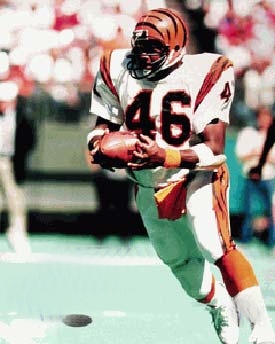
On May 29, 1984 the Cincinnati Bengals and San Diego Chargers made a straight-up trade of disgruntled running backs, with the Bengals sending Pete Johnson to San Diego for James Brooks (pictured at right).

Johnson was 30 and had been taken by the Bengals in the second round out of Ohio State in 1977. He led Cincinnati in rushing in all seven years that he was with the team, totaling 5421 yards and making him the franchise’s all-time rushing leader at the time. He also was the club leader in career touchdowns with 70. A classic fullback at 6’0” and 252 pounds, Johnson’s best season came in 1981 as he rushed for 1077 yards, caught 46 passes for 320 more yards, and scored 16 TDs. He was named to the Pro Bowl and the offensively-potent Bengals won their first AFC title. 

In 1983, Johnson was suspended for the first four games of the season due to cocaine use (he and a teammate, DE Ross Browner, received immunity to testify in a federal trial regarding their purchase of cocaine from a Cincinnati plumber). He had reported late and overweight for training camp, but still rushed for 763 yards and tied for the AFC lead in rushing touchdowns (along with Seattle’s Curt Warner) with 14.

Johnson (pictured below) was insisting on a contract re-negotiation and made clear that he would not stay in Cincinnati past its expiration in ’84, looking at the USFL as a possible alternative. He skipped a mandatory minicamp, likely the final straw for the front office.

GM Paul Brown of the Bengals had been angered by Johnson’s behavior but was gracious in sending him off: “Pete Johnson has contributed greatly for us over the years, and now the time has come for us to part and go separate ways. We wish him well.”


As for the 25-year-old Brooks, he was San Diego’s first draft choice in 1981 out of Auburn and led the NFL in all-purpose yardage in ’81 and ’82. Small and fast at 5’10” and 177 pounds, Brooks had been critical of his use by Head Coach Don Coryell in San Diego. “It started about the second game last season,” he explained. “I didn’t want them to put me at fullback…San Diego wanted me to block instead of letting me go one-on-one with linebackers in passing situations.” While he had received assurances from Coryell in minicamp that the team would run the ball more often, he was instead dealt to Cincinnati.

In ’83, the Chargers were coming off their first losing season under Coryell, who had taken over as head coach during the 1978 season. The team went 6-10 and, among the many problems, star RB Chuck Muncie had a substandard performance. While he gained 886 yards and scored 13 touchdowns, he averaged 3.8 yards per carry, his lowest total with the Chargers and second-lowest of his eight-season career that began in New Orleans, and also fumbled eight times (as did Brooks).  

Meanwhile, the Bengals had a new head coach in the unorthodox Sam Wyche and were looking to open up the offense and provide a more varied running attack.

The trade ended up being very one-sided in Cincinnati’s favor. Johnson failed to last the season in San Diego, performing badly over the course of three games (19 carries for 46 yards). He was dealt off to Miami where he finished up the year – and his career.

James Brooks went on to have a long and outstanding stint with the Bengals. He started off slowly in ’84, still used more as the change-of-pace back that he had been in San Diego and running the ball just 103 times for 396 yards and catching 34 passes for 268 more while another big fullback, Larry Kinnebrew, and veteran Charles Alexander received more of the carries. But in 1985 Brooks was used more extensively and set a team record for total yards in a season as he rushed for 929 yards on 192 attempts (4.8 avg.) and caught 55 passes for 576 yards while scoring 12 touchdowns.

In four of the next five years, Brooks was selected to the Pro Bowl and gained over a thousand yards rushing on three occasions, with a high of 1239 in ’89. His 1773 total yards in 1986 were also a career high in a season in which he led the NFL in average gain per carry (5.3 on 205 attempts for 1087 yards). He stayed in Cincinnati through 1991 and ended up rushing for 6447 yards (surpassing Johnson’s team mark) with a 4.8-yard average (he averaged over five yards per carry in each of his thousand-yard rushing seasons) and gaining another 3012 yards on 297 pass receptions (a fine 10.1 average out of the backfield) while totaling 64 touchdowns.

The Bengals also won a conference title along the way, in 1988, with Brooks effective but overshadowed by power-running rookie sensation Ickey Woods (who proved to have far less staying power). The combination of the two made Cincinnati the top running team in the NFL that season. But when Woods was lost to injury in ’89, the Bengals still led the league in rushing with Brooks carrying most of the load. He proved in Cincinnati that, despite the small size that had been considered a limiting factor in San Diego, he was a tough and dependable runner as well as an outstanding pass receiver. He also ended up having surprising longevity (he was 32 when last selected to the Pro Bowl for the 1990 season) and was one of the most productive all-around backs of his era. 

May 27, 2012

Rookie of the Year: Jerry Butler, 1979

Wide Receiver, Buffalo Bills


Age: 22 (Oct. 12)
College: Clemson
Height: 6’0”    Weight: 178

Prelude:
One of Buffalo’s two first-round draft picks in 1979 (the other was LB Tom Cousineau, who went to the CFL instead), Butler was considered the top-rated wide receiver in the draft. He moved into the starting lineup across from veteran WR Frank Lewis and added an explosive element that soon had him facing double coverages.

1979 Season Summary
Appeared in 13 of 16 games
[Bracketed numbers indicate league rank in Top 20]

Pass Receiving
Receptions – 48       
Most receptions, game – 10 (for 255 yds.) vs. NY Jets 9/23
Yards – 834
Most yards, game - 255 (on 10 catches) vs. NY Jets 9/23
Average gain – 17.4 [18]
TDs – 4
200-yard receiving games – 1
100-yard receiving games – 2

Rushing
Attempts – 2
Yards – 13
Average gain – 6.5
TDs – 0

Scoring
TDs – 4
Points – 24

Awards & Honors:
AFC Rookie of the Year: UPI, Sporting News

Bills went 7-9 to finish fourth in the AFC East while ranking 9th in the NFL in passing offense (3216 yards).

Aftermath:
Butler followed up his outstanding rookie season with a Pro Bowl performance in 1980 as he caught 57 passes for 832 yards and six TDs. He was also a second-team All-AFC selection by UPI. While still productive, Butler was nagged by injuries in ’81, was a contract holdout prior to the strike-shortened 1982 season, and then suffered a knee injury in ’83 that required major surgery and cost him all of 1984. He came back with a 41-catch, 770-yard season in 1985 (18.8 avg.) However, he caught 15 passes in 11 games in ‘86 before another leg injury effectively finished his career. Overall, Butler caught 278 passes for 4301 yards (15.5 avg.) and 29 touchdowns.

--

Rookie of the Year Profiles feature players who were named Rookie of the Year in the NFL, AFL (1960-69), or USFL (1983-85) by a recognized organization (Associated Press – Offense or Defense, Newspaper Enterprise Association, United Press International, The Sporting News, or the league itself – Pepsi NFL Rookie of the Year). 

[Updated 2/9/14]

May 25, 2012

MVP Profile: J.J. Jennings, 1974

Running Back, Memphis Southmen


Age: 22 (Aug. 16)
1st season in pro football
College: Rutgers
Height: 6’1”    Weight: 220

Prelude:
A college star at Rutgers who led the nation in scoring in 1973, Jennings was chosen by the Kansas City Chiefs in the ninth round of the ’74 NFL draft and tenth round by the then-Toronto Northmen of the new WFL. He signed with Toronto, and a month later the franchise was shifted to Memphis. Jennings became part of an outstanding running game that included John Harvey and Willie Spencer.

1974 Season Summary
Appeared in all 20 games
[Bracketed numbers indicate league rank in Top 20]

Rushing
Attempts – 322 [2]
Yards – 1524 [2]
Average gain – 4.7 [3]
TDs – 11 [3, tied with Tommy Reamon & Bubba Wyche]

Pass Receiving
Receptions – 46       
Yards – 431
Average gain – 9.4
TDs – 2

Kickoff Returns
Returns – 4   
Yards – 80
Average per return – 20.0
TDs – 0
Longest return – 25 yards

Scoring
TDs – 13 [6, tied with Don Highsmith]
Action Points – 3
Points – 94 [6, tied with John Land]
(Note: Touchdowns counted for 7 points in the WFL)

Postseason: 1 G (Second Round playoff vs. Florida)
Rushing attempts – 24
Rushing yards – 106
Average gain rushing – 4.4
Rushing TDs – 1

Pass receptions – 1
Pass receiving yards - 7
Average yards per reception – 7.0
Pass Receiving TDs - 0

Awards & Honors:
WFL MVP: League (co-winner)
1st team All-WFL: League, Sporting News

Southmen went 17-3 to finish first in the WFL Central Division. Lost Second Round playoff to Florida Blazers (18-15).

Aftermath:
With the arrival of FB Larry Csonka and HB Jim Kiick from the Miami Dolphins, and despite his success in ’74, Jennings was dealt to the Philadelphia Bell for the 1975 season, where it was hoped that his having been a college star in New Jersey would be a plus in terms of drawing fans. He rushed for 345 yards on 82 carries (4.2 avg.) and caught 12 passes for 95 more yards before the WFL folded. While he signed with the Chiefs, he ran into injury problems, spent 1976 on injured reserve, and never made it to the regular season in the NFL.

--

MVP Profiles feature players who were named MVP or Player of the Year in the NFL, AAFC (1946-49), AFL (1960-69), WFL (1974), or USFL (1983-85) by a recognized organization (Associated Press, Pro Football Writers Association, Newspaper Enterprise Association, United Press International, The Sporting News, Maxwell Club – Bert Bell Award, or the league itself). 

[Updated 2/9/14]

May 23, 2012

Rookie of the Year: Eddie Brown, 1985

Wide Receiver, Cincinnati Bengals


Age: 23 (Dec. 17)
College: Miami (FL)
Height: 6’0”    Weight: 185

Prelude:
Following an outstanding college career in which he was part of the 1983 National Championship team and caught 59 passes for 1114 yards and 9 TDs in ‘84, Brown was chosen by the Bengals in the first round of the 1985 NFL draft (13th overall). The retirement of 12-year WR Isaac Curtis opened a starting spot across from fifth-year veteran Cris Collinsworth, and Brown moved immediately into the lineup.

1985 Season Summary
Appeared in all 16 games
[Bracketed numbers indicate league rank in Top 20]

Pass Receiving
Receptions – 53       
Most receptions, game – 7 (for 124 yds.) at Houston 10/20
Yards – 942 [16]
Most yards, game - 129 (on 5 catches) at New England 12/22
Average gain – 17.8 [19]
TDs – 8 [8, tied with four others]
100-yard receiving games - 3

Rushing
Attempts – 14
Most attempts, game – 3 (for 7 yds.) at Cleveland 11/24, (for 60 yds.) vs. Houston 12/1
Yards – 129
Most yards, game – 60 (on 3 attempts) vs. Houston 12/1
Average gain – 9.2
TDs – 0

Kickoff Returns
Returns – 1
Yards – 6
TDs – 0

Scoring
TDs – 8
Points – 48

Awards & Honors:
NFL Rookie of the Year: NEA, Sporting News
NFL Offensive Rookie of the Year: AP

Bengals went 7-9 to finish second in the AFC Central.while placing third in the NFL in total offense (5900 yards), fourth in passing offense (3717), and third in scoring (441 points).

Aftermath:
Having added to Cincinnati’s explosive passing offense as a rookie, Brown accumulated 58 catches for 964 yards in 1986. Following the strike-interrupted ’87 season, he had his best year in 1988, catching 53 passes for 1273 yards (24.0 avg.) and 9 TDs as the Bengals advanced to the Super Bowl. Brown was named to the Pro Bowl and received first-team All-NFL recognition from the NEA, second-team from the Associated Press, and was a first-team All-AFC selection of Pro Football Weekly and UPI. Brown played another three years before a neck injury cost him the entire 1992 season and effectively ended his career. While criticized for dropping passes on occasion, his big-play ability was undeniable. Over the course of his seven seasons with the Bengals, Brown caught 363 passes for 6134 yards (16.9 avg.) and 41 touchdowns.

--

Rookie of the Year Profiles feature players who were named Rookie of the Year in the NFL, AFL (1960-69), or USFL (1983-85) by a recognized organization (Associated Press – Offense or Defense, Newspaper Enterprise Association, United Press International, The Sporting News, or the league itself – Pepsi NFL Rookie of the Year). 

[Updated 2/9/14]