Showing posts with label 1965 AFL season. Show all posts

December 26, 2015

1965: Bills Shut Out Chargers to Repeat as AFL Champions


The American Football League Championship game on December 26, 1965 featured a rematch of the previous year’s participants. This time it was the Buffalo Bills, now defending champs, going on the road to face the San Diego Chargers.

The Bills easily topped the Eastern Division with a 10-3-1 record. They were still coached by Lou Saban and QB Jack Kemp (pictured at right), a former Charger, was again lining up behind center and coming off of a season in which he received AFL Player of the Year recognition. But temperamental star FB Cookie Gilchrist had been dealt to Denver and not adequately replaced and injuries cost the offense the services of flanker Elbert Dubenion and split end Glenn Bass for most of the season. Flanker Bo Roberson and rookie TE Paul Costa helped to fill the void, but it was once again the rugged defense that allowed Buffalo to dominate its division. The unit that contained AFL All-Stars in DT Tom Sestak, LB Mike Stratton, CB Butch Byrd, and safety George Saimes was solid throughout. In addition, pioneering soccer-style PK Pete Gogolak led the AFL with 28 field goals.

San Diego won the Western Division for a third consecutive season by going 9-2-3. Under the direction of Head Coach Sid Gillman, the Chargers had the league’s highest-scoring offense. QB John Hadl was developing into a top passer and flanker Lance Alworth was the premier player at his position, possibly in either league. HB Paul Lowe led the AFL in rushing and versatile FB Keith Lincoln was formidable when healthy, which had not been the case through much of ‘65. The defense was strongest on the line, featuring DE Earl Faison and DT Ernie Ladd, and linebackers Chuck Allen and Frank Buncom led a capable group. Moreover, the Chargers had beaten and tied the Bills during the regular season and, playing for the championship at home, were 6.5-point favorites to win.

There were 30,361 fans in attendance on a pleasant day at Balboa Stadium. The game settled into a defensive battle with no scoring in the first quarter. CB Speedy Duncan of the Chargers intercepted a Jack Kemp pass at the San Diego 33, but San Diego had to punt from midfield. On their next series, starting from deep in their own territory, Paul Lowe took off on a 47-yard run, but the Bills tossed John Hadl for consecutive losses and the home team had to punt again. Coach Gillman chose to have rookie FB Jim Allison handle the punting rather than Hadl, in order to keep the quarterback rested, but when the first two kicks went just 19 and nine yards, respectively, Hadl took over that chore.

Early in the second quarter, a promising series for the Chargers reached the Buffalo 28 but Herb Travenio missed a 35-yard field goal attempt that was partially deflected. The teams exchanged punts until late in the period when the Bills put together a six-play, 80-yard drive. FB Wray Carlton had two eight-yard carries and Kemp passed to Paul Costa, who made an outstanding catch for a 22-yard gain. Following two short running plays, Kemp then threw down the middle to TE Ernie Warlick in the end zone for an 18-yard touchdown. Pete Gogolak kicked the extra point.

Following a short possession, the Chargers punted and Butch Byrd gathered in the 40-yard kick at his 26, evaded two tackles, and sped down the right sideline for a 74-yard touchdown. Gogolak converted again and the visitors were staked to a 14-0 lead.

On San Diego’s next offensive play, Hadl’s pass was intercepted by LB Harry Jacobs, who returned it to the Chargers’ 20, but the Bills were unable to pad their lead when Gogolak missed on a 24-yard try for a field goal. The Chargers advanced to the Buffalo 24 in the waning seconds of the first half as Hadl threw to Lance Alworth for 22 yards, ran for another 13, and completed two more short passes. But Travenio was wide on a 31-yard field goal attempt to close out the half.


The Chargers had the first possession in the third quarter and punted. The Bills went right to the air and a Kemp pass to Bo Roberson gained 49 yards to the San Diego 24, and while the Bills didn’t reach the end zone, they came away with an 11-yard field goal by Gogolak (pictured at left) that expanded Buffalo’s margin to 17-0.

Duncan returned the ensuing kickoff 49 yards to the Buffalo 48 and Keith Lincoln ran for 10 yards on first down. But after advancing to the 29, the Chargers tried to convert a fourth-and-one situation and a mix-up in the backfield caused them to lose five yards and turn the ball over on downs. It proved to be their last opportunity to get back into the game.

Following a punt by Buffalo’s Paul Maguire that pinned the Chargers back at their one yard line, the Bills blitzed Hadl, who hurried a long pass from his end zone that Byrd intercepted and returned to the San Diego 23. The Chargers continued to play tough on defense, but the Bills further added to their lead with a 39-yard Gogolak field goal.

Down by 20-0 as the game headed into the fourth quarter, the Chargers again turned the ball over on downs in their own territory and Buffalo capped the scoring with a Gogolak field goal from 32 yards. San Diego never again threatened in the remaining time and Buffalo won by a final score of 23-0.

The Bills led in total yards (260 to 223) and first downs (23 to 12). They also recorded five sacks, at a loss of 45 yards, to two by San Diego. The Chargers turned the ball over twice, to one by Buffalo, and were unable to take advantage of scoring opportunities.

Jack Kemp was not especially efficient with his passing, completing 8 of 19 throws, but they were good for 155 yards and a touchdown against one interception. Bo Roberson had three catches for 88 yards and Ernie Warlick contributed three receptions for 35 yards and a TD. Wray Carlton led the Bills with 63 rushing yards on 16 carries. Butch Byrd (pictured below) made significant contributions with an interception that he returned 24 yards and the touchdown on the punt return. Pete Gogolak was successful on three of his five field goal attempts.


For the Chargers, John Hadl, harried by the fierce pass rush, was successful on 11 of 23 throws for 140 yards and gave up two interceptions. Lance Alworth, who was double-teamed throughout the contest, caught four passes for 82 yards and Paul Lowe gained 57 yards on 12 carries, although most of that total came on one play.

“I can’t believe it,” said Jack Kemp regarding the final score. “Nobody expects to shut out the Chargers.”

“We just got beat,” stated a disappointed Coach Gillman of the Chargers. “We lost to a fine football team. The Bills have excellent personnel and coaching. What else is there to say?”

The AFL Championship game triumph proved to be the end for Coach Saban, who resigned to become head coach at the University of Maryland. Joel Collier, the assistant coach who had been in charge of the defense, was elevated to the top job. The Bills once again finished first in the Eastern Division but lost the title game to Kansas City and went into decline, not posting another winning record until 1973. The defeat for the AFL Championship also marked a transition for the Chargers. After having appeared in five of the league’s first six title contests, they did not appear in another. San Diego remained a respectable team but was blocked by the Chiefs and Raiders in the Western Division even while posting records above .500 for the remaining four AFL seasons before the merger with the NFL in 1970. The Chargers did not reach the postseason again until 1979.

December 2, 2015

Highlighted Year: Butch Byrd, 1965

Cornerback, Buffalo Bills


Age: 24 (Sept. 20)
2nd season in pro football & with Bills
College: Boston Univ.
Height: 6’0”   Weight: 211

Prelude:
Byrd was an outstanding runner, pass receiver, and kick returner in college in addition to his play on defense. He was chosen by the Bills in the fourth round of the 1964 AFL draft and immediately moved into the starting lineup, intercepting 7 passes, one of which he returned for a touchdown. He received second-team All-AFL honors from the NEA and was chosen to the AFL All-Star Game while the Bills won the AFL Championship.

1965 Season Summary
Appeared in all 14 games
[Bracketed numbers indicate league rank in Top 20]

Interceptions – 5 [9, tied with six others]
Most interceptions, game – 2 at Oakland 11/14
Int. return yards – 119 [5]
Most int. return yards, game – 66 (on 2 int.) at Oakland 11/14
Int. TDs – 0
Fumble recoveries – 0

Punt Returns
Returns – 22 [3]
Yards – 220 [4]
Most yards, game – 42 (on 3 ret.) at San Diego 11/25
Average per return – 10.0 [4]
TDs – 0
Longest return – 30 yards

Postseason: 1 G (AFL Championship at San Diego)
Interceptions – 1
Int. return yards – 24
TDs – 0

Punt returns – 3
Punt return yards – 87
TDs – 1
Longest return – 74 yards

Awards & Honors:
1st team All-AFL: League, AP, NY Daily News
2nd team All-AFL: UPI
AFL All-Star Game

Bills went 10-3-1 to finish first in the AFL Eastern Division while leading the league in interceptions (32) and fewest points allowed (226). Won AFL Championship over San Diego Chargers (23-0).

Aftermath:
Byrd followed up with another outstanding season in 1966, intercepting six passes, returning one for a touchdown, and averaging 8.1 yards on his 23 punt returns that also included a TD. He played another four years for the Bills and continued to perform at a high level, even as the team’s record dropped off. He was named to two more AFL All-Star Games, was a consensus first-team All-AFL choice in 1969 and a second-team selection in ’68. After starting 143 consecutive games through 1970, he was dealt to Denver just prior to the ’71 season, his last. Overall, Byrd intercepted 40 passes for 666 yards, all with Buffalo and both team records, and returned five of them for touchdowns. He also returned 86 punts for a 7.0 average and one TD, with another score on a punt return in the postseason. Byrd was a consensus All-AFL first-team choice three times and was named to five AFL All-Star Games.

--

Highlighted Years features players who were consensus first-team All-League* selections or league* or conference** leaders in the following statistical categories:

Rushing: Yards, TDs (min. 10)
Passing: Yards, Completion Pct., Yards per Attempt, TDs, Rating
Receiving: Catches, Yards, TDs (min. 10)
Scoring: TDs, Points, Field Goals (min. 5)
All-Purpose: Total Yards
Defense: Interceptions, Sacks
Kickoff Returns: Average
Punt Returns: Average
Punting: Average

*Leagues include NFL (1920 to date), AFL (1926), AFL (1936-37), AAFC (1946-49), AFL (1960-69), WFL (1974-75), USFL (1983-85)

**NFC/AFC since 1970

April 30, 2014

Rookie of the Year: Joe Namath, 1965

Quarterback, New York Jets


Age: 22
College: Alabama
Height: 6’2”   Weight: 194

Prelude:
Despite appearing in just three full games as a senior due to torn ligaments in his right knee that required surgery, Namath was a highly-sought player coming out of college. He passed for 2713 yards and 24 touchdowns under Head Coach Paul “Bear” Bryant at Alabama and was chosen by both the NFL Cardinals and AFL Jets in the first round of their respective 1965 drafts. Namath signed a then-huge $427,000 contract with New York. Head Coach Weeb Ewbank announced that lightly-experienced veteran Mike Taliaferro would start the season at quarterback, but Namath saw his first action in Week 2 and, for the most part, moved into the lineup thereafter.

1965 Season Summary
Appeared in 13 of 14 games
[Bracketed numbers indicate league rank in Top 20]

Passing
Attempts – 340 [5]
Most attempts, game – 44 vs. Buffalo 12/19
Completions – 164 [5]
Most completions, game – 19 at Buffalo 9/26, at Oakland 12/12
Yards – 2220 [6]
Most yards, game – 287 at Buffalo 9/26
Completion percentage – 48.2 [4]
Yards per attempt – 6.5 [3]
TD passes – 18 [4, tied with Babe Parilli]
Most TD passes, game – 4 vs. Houston 11/21
Interceptions – 15 [5]
Most interceptions, game – 3 at San Diego 12/4, at Oakland 12/12
Passer rating – 68.7 [3]
200-yard passing games – 5

Rushing
Attempts – 8
Most attempts, game – 3 (for -3 yds.) at Boston 11/14
Yards – 19
Most yards, game – 15 yards (on 2 carries) vs. Oakland 10/16
Yards per attempt – 2.4
TDs – 0

Awards & Honors:
AFL Rookie of the Year: UPI
AFL All-Star Game

Jets went 5-8-1 to finish second in the AFL Eastern Division.

Aftermath:
Knee and mobility issues would be significant throughout Namath’s career, but he had a quick release and strong arm. He was also charismatic (he quickly became a celebrity off the field) and a good leader. Namath led the league in pass attempts and completions, yards, and TD passes in 1966 and ’67 – in the latter season, he became the first 4000-yard passer in NFL/AFL history (4007). Prone to trying to force passes into coverage, however, he also led the AFL in passes intercepted in both years. In 1968, Namath had lesser numbers but more success and received Player of the Year honors as the Jets won not only the AFL Championship but defeated the NFL Champion Colts in a huge Super Bowl upset. He passed for 2734 yards and 19 TDs as the Jets again topped the Eastern Division in 1969, but a broken wrist that sidelined him five games into the ’70 season became the first of a series of injuries that dogged the remainder of his career. After appearing in just nine games in 1970 and ’71, he came back in 1972 to lead the NFL in passing yards (2816), TD passes (19), and yards per attempt (8.7) and was named to the Pro Bowl. However, a separated shoulder limited him to six games in 1973 and, with the team deteriorating around him, he had only sporadic success while leading the league in interceptions in 1974 and ’75. Namath finished his career with the Rams in 1977 and ended up throwing for 27,663 yards with 173 TDs and 220 interceptions. His #12 was retired by the Jets and he was inducted into the Pro Football Hall of Fame, Class of 1985.

--


Rookie of the Year Profiles feature players who were named Rookie of the Year in the NFL, AFL (1960-69), or USFL (1983-85) by a recognized organization (Associated Press – Offense or Defense, Newspaper Enterprise Association, United Press International, The Sporting News, or the league itself – Pepsi NFL Rookie of the Year). 

January 20, 2014

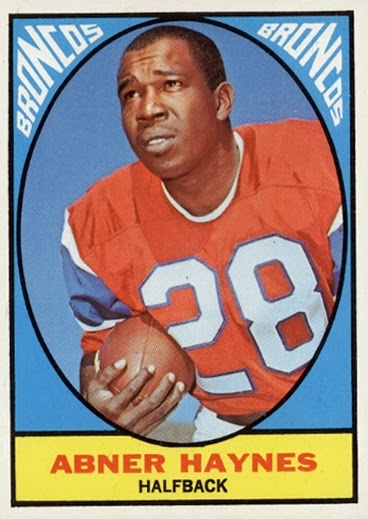
1965: Broncos Obtain Abner Haynes from the Chiefs


On January 20, 1965 the Kansas City Chiefs traded HB Abner Haynes straight-up to the Denver Broncos for LB/P Jim Fraser.

Haynes was considered the American Football League’s first home-grown star. A native Texan, he had played college football at North Texas State, where he was an outstanding performer. The Dallas Texans of the new league won a bidding war with the NFL’s Pittsburgh Steelers and Winnipeg of the CFL to get him for the 1960 season, and were rewarded when Haynes led the AFL in rushing (875 yards), punt returns (15.4 avg.), and all-purpose yards (2100). At 6’0” and 185 pounds, he was fairly small and lacked power, but was fast and shifty with excellent running instincts. He was a fine receiver out of the backfield (55 catches, 576 yards) and kick returner as well as runner from scrimmage. With his tendency to hold the ball away from his body when running, he was also prone to fumbling, but he made up for it with his exciting all-around play and quickly became a favorite of the fans. Haynes was named AFL Player of the Year as well as Rookie of the Year for ’60.

He continued to be an outstanding performer in 1961 and ’62, the latter being his greatest season. He rushed for over a thousand yards (1049) and led the league in yards from scrimmage (1622) and touchdowns (19). The Texans won the AFL Championship in a game that featured Haynes starting off at flanker before moving back to halfback and scoring a touchdown on a pass play. Dallas won in overtime, although Haynes nearly was the goat when, after winning the coin toss for OT, as a captain for the team he mistakenly elected to kick rather than choose an end of the field to defend, as instructed by Coach Hank Stram due to the windy weather conditions. Fortunately, it didn’t cost the Texans the game and Haynes crowned an outstanding three years in Dallas with being member of a Championship team.

The franchise may have achieved the pinnacle of success in Dallas, but had lost money in competition with the NFL’s Cowboys. Owner Lamar Hunt moved it to Kansas City, where the team was rechristened the Chiefs. However, during the preseason, a tragedy occurred which profoundly affected the team, and in particular Haynes. HB Stone Johnson, a sprinter with tremendous speed, was drafted by the Chiefs and suffered a fatal neck injury while attempting a tackle on a preseason kickoff return. Haynes had befriended the younger player and Johnson’s death had a profound effect on him. His style of play was more restrained and, in what became a lesser season for the entire club, Haynes rushed for just 352 yards on 99 carries (3.6 avg.) and his overall total of 1196 yards was well below his prior standards.

Haynes bounced back somewhat from the bad year in 1963 with 697 rushing yards on 139 attempts, 562 more yards on 38 catches, and a total of 1548 all-purpose yards in ’64. He was shifted to split end at the beginning of the year, when veteran Chris Burford was injured, but moved back to halfback with good results.

However, Haynes felt he was not being used properly by the Chiefs and welcomed the trade, saying “I think it will be better for me and for Kansas City.” The Chiefs were looking for depth at linebacker, especially after star MLB E.J. Holub underwent knee surgery. In addition, rookie FB Mack Lee Hill had played well, in addition to HB Bert Coan, which factored in the decision to deal Haynes.


As for the 28-year-old Jim Fraser (pictured at left), he had led the AFL in punting average for two straight years while also starting at outside linebacker. In Kansas City he was strictly a backup at linebacker and unneeded as a punter, with Jerrel Wilson ably handling that department. After one season, he was traded once again, this time to the Patriots.

The Broncos had been a perennially lackluster team and the trade for Haynes, along with a deal that brought in the temperamental but highly talented FB Cookie Gilchrist from Buffalo, was part of an effort to revive the franchise. Haynes was expected to compete with HB Charley Mitchell, who was coming off a good year in ’64, gaining 815 yards from scrimmage (590 rushing, 225 pass receiving). But it was HB Wendell Hayes who had an outstanding rookie year in ’65 and relegated Haynes to a backup role (Mitchell missed virtually the entire season with a thigh injury). Haynes ran the ball just 41 times for 166 yards (4.0 avg.) and caught 26 passes for 216 yards. He had a bigger impact as a kick returner, running back 34 kickoffs for 901 yards and a league-leading 26.5 average and also averaging 8.6 yards on 14 punt returns that included a touchdown.

Haynes moved back into the starting lineup in 1966 when Hayes was shifted to fullback. His rushing numbers were unimpressive as he gained just 304 yards on 129 carries for a 2.4-yard average. However, as a receiver out of the backfield he led the club with 46 pass receptions, gaining 480 yards. He was used less often as a kick returner, but still averaged 11.9 yards on 10 punt returns and had a total of 1132 all-purpose yards. On the downside, he also led the AFL by fumbling 11 times.

With the arrival of HB Floyd Little, the All-American out of Syracuse who was taken by the Broncos in the first round of the ’67 combined AFL/NFL draft, Haynes was dealt to the second-year Miami Dolphins. He had a big day in the season-opening game, which happened to be against Denver, and ran for 151 yards on 12 carries (his only hundred-yard rushing performance after leaving the Chiefs). However, he was used sparingly thereafter and was waived 11 games into the season. The Jets picked him up to shore up an injury-depleted backfield, but he saw little action and, at age 30, retired following the season.

An electrifying performer in his early years, Haynes showed flashes of that form in his two years in Denver. But with a poor team (the Broncos went 4-10 in each season), and no longer able to produce with the same consistency, his time in Denver was largely undistinguished. He left the AFL after having gained a career total of 12,065 all-purpose yards, 2536 of which were generated with the Broncos.

September 18, 2013

1965: Namath Sees First Pro Action, But Chiefs Hold Off Jets


The American Football League’s New York Jets were coming off a 5-8-1 record in 1964 and slowly but steadily improving under the guidance of Head Coach Weeb Ewbank. Rookie FB Matt Snell made a big impact on the offense and, in the offseason, the Jets made a big splash by drafting and signing QB Joe Namath out of Alabama. His then-huge $400,000 contract, used to lure him away from the St. Louis Cardinals, the team holding his NFL draft rights, was enough to bring notoriety. While the Jets invested in other rookies, including Heisman-winning QB John Huarte of Notre Dame, it was Namath who got the big publicity and buildup. The only concern was that, while he had tremendous potential, he already had a bad knee that had required surgery.

Ewbank was determined to not rush his star rookie into the lineup and announced that QB Mike Taliaferro, a backup in ’64, would start the 1965 season behind center. Taliaferro went the distance in a Week 1 loss to the Oilers at Houston.

On September 18, 1965 the Jets played their home-opening game against the Kansas City Chiefs. The Chiefs, coached by Hank Stram, were 7-7 in ’64 and coming off a bad loss to the Raiders in their first game. The Chiefs had talent but had underachieved since moving from Dallas to Kansas City following a title-winning campaign in 1962. QB Len Dawson was a precision passer who led the AFL in that category for the second time in ’64. Curtis McClinton and Mack Lee Hill were productive running backs. The offensive line was solid and the defense, if all hands stayed healthy, was sound as well.

There was a crowd of 53,658 on hand at Shea Stadium for the Saturday contest. The Chiefs went three-and-out on their first possession and the Jets, getting into scoring territory on a series highlighted by FB Matt Snell’s 15-yard run, came up empty when Jim Turner was short on a field goal attempt.

Neither offense was moving effectively but a pass interference penalty gave the Jets a first down at the Kansas City 15 on their next possession. Mike Taliaferro overthrew flanker Don Maynard twice and was loudly booed by the home fans. This time they got points, however, as Turner booted a 19-yard field goal.

Early in the second quarter, the Jets again failed to move well on offense as Taliaferro missed receivers and Turner suffered a blocked field goal try. But following a punt by the Chiefs, Joe Namath entered the game to an ovation from the crowd.

The first series was quiet as the rookie quarterback handed off three times and the Jets had to punt. Kansas City CB Willie Mitchell returned the kick 54 yards to the New York 30. The Chiefs made the most of the great starting field position five plays later as Len Dawson connected with split end Chris Burford in the back of the end zone for a 19-yard touchdown. Tommy Brooker’s extra point was good and the Chiefs were in front by 7-3.


On the next series for the Jets, Namath immediately went to the air and hit Maynard for 18 yards, but the play was nullified by a holding penalty. Namath’s first official completion was to Snell and actually lost four yards as New York again failed to move effectively and had to punt.

The Chiefs moved the ball well on offense but, with a third down at the New York 47, Dawson was sacked for a 15-yard loss by DT Paul Rochester and they had to punt. The score remained 7-3 at the half.

The Jets started off the third quarter by driving into Kansas City territory, primarily thanks to Snell’s three carries for 21 yards, but dropped passes caused the series to stall and Jim Turner’s field goal try was partially blocked.

Following a trade of punts, the Chiefs had another short series and had to kick the ball away. However, Jerrel Wilson’s punt was deflected back to him by Rochester and his second kick went only 11 yards to give New York the ball at the KC 28. Snell ran for 9 yards on first down but the Jets could get no further. On fourth-and-one, they went for it and Snell was stopped for no gain by DE Jerry Mays and LB Sherrill Headrick.

The Chiefs moved well offensively until the drive finally stalled at the New York 48 early in the fourth quarter and they punted. Namath threw to Maynard for 14 yards but was again victimized by dropped passes. Following a penalty on the Chiefs, the rookie quarterback faded back and had the ball knocked out of his hand by LB Bobby Bell, who recovered and carried to the New York 24. Kansas City wasted no time in capitalizing as on the next play Dawson threw to Burford for a touchdown.

The teams once again traded punts before the Jets put together a scoring drive. Namath threw a pass to split end Bake Turner that gained 10 yards and then, looking deep for Turner again, the Chiefs were called for interference. Namath went long for Maynard and it was complete for a 37-yard touchdown. Jim Turner’s successful conversion made it a four-point game.

The Chiefs managed to eat up valuable time on the following series and the Jets got the ball back with just over two minutes remaining. Namath completed two passes but a long throw on fourth-and-three fell incomplete to effectively end the game. Kansas City held on to win by a score of 14-10.

The statistics reflected the closeness of the score – and the difficulty both offenses had in moving the ball. The Jets led in total yards (231 to 224) and first downs (14 to 9). They also sacked Dawson four times, while allowing just one sack themselves. However, New York gave up the game’s only turnover, and it led to a touchdown for the Chiefs. KC was penalized 7 times, at a cost of 117 yards, while New York was flagged only once. Kansas City also punted the ball 11 times, to just five by the Jets, but Jim Turner was unsuccessful on three of his four field goal attempts.

Len Dawson had a rather ordinary day by his standards as he completed 10 of 20 passes for 118 yards, but two of them were good for touchdowns and none were intercepted. Chris Burford had four catches for 58 yards and both TDs. Mack Lee Hill gained 65 yards on 13 carries and Curtis McClinton added 58 yards on 15 attempts.

For the Jets, Joe Namath was successful on 11 of his 23 passes for 121 yards and a TD, also without an interception. Several of his misses were on target but dropped. Mike Taliaferro was a woeful 4-of-12 for 24 yards. Bake Turner had 5 catches for 41 yards while Don Maynard gained 83 yards on four receptions that included a score. Matt Snell ran the ball 19 times for 82 yards.

Kansas City ended up at 7-5-2 to place third in the AFL Western Division. The Jets continued to struggle, losing two games, tying one, and then losing again before reeling off four straight wins (including one over the Chiefs in their second meeting at Kansas City). They went on to finish second in the Eastern Division, although they cooled off down the stretch and again produced a 5-8-1 record.

Joe Namath took over the starting job at quarterback for all intents, although Mike Taliaferro continued to see action. While Namath completed only 48.2 percent of his passes (he would never have high completion percentages throughout his career), they were good for 2220 yards and 18 touchdowns with 15 interceptions. He received Rookie of the Year recognition and was chosen for the AFL All-Star Game.  The big investment the Jets had made in the quarterback known as “Broadway Joe” would pay off in big years to come.

September 11, 2012

1965: Alworth Stars as Chargers Overcome Feisty Broncos


The San Diego Chargers had topped the American Football League’s Western Division in 1963 and ’64, winning the league title in the first year, and were still considered the team to beat in the division as they opened the 1965 season on September 11 at home against the Denver Broncos.

While Head Coach Sid Gillman’s Chargers were a good defensive team, they were best known for their high-powered offense. Fourth-year QB John Hadl had split time with veteran Tobin Rote in ’64 and, with Rote gone, was now the full-time starter – despite any misgivings on Coach Gillman’s part. He had formidable weapons to throw to in All-AFL flanker Lance Alworth (pictured above) plus split end Don Norton and TE Dave Kocurek. There were concerns about the running game, however, as star HB Paul Lowe was coming off an injury-plagued year in 1964 and FB Keith Lincoln, a formidable all-purpose talent, would be sitting out the opening game with an injury.

The Broncos had struggled both on the field and at the gate since the franchise’s inception and were coming off a 2-11-1 record the previous year. Former Cleveland Browns star receiver Mac Speedie was elevated from assistant to head coach during the ’64 season and there had been other significant changes. Brothers Allan and Gerald Phipps went from minority stockholders to majority owners with the promise of keeping the team in Denver, and the fans had responded by buying a record 22,000 season tickets. Two big names were also added to the roster in FB Cookie Gilchrist, who had worn out his welcome in Buffalo, and HB Abner Haynes, obtained from the Chiefs. There were still plenty of holes, especially at quarterback where third-year veteran Mickey Slaughter would be drawing the opening-game start.

There was a crowd of 27,022 in attendance for the Saturday night game at Balboa Stadium. They saw the Broncos take the early lead on a two-yard run by Haynes. While Herb Travenio kicked a 32-yard field goal to get the home team on the board, Denver was ahead by 14-3 at the end of the first quarter following a 33-yard touchdown pass from Slaughter to flanker Bob Scarpitto.

The momentum shifted significantly in the second quarter as the Chargers exploded with 24 points in 12 minutes. FB Gene Foster, subbing for Keith Lincoln, started off the barrage with a two-yard touchdown run. Travenio, who was successful on all of his extra point attempts, added a 25-yard field goal and then Paul Lowe showed he was back in good form with a 41-yard scoring run. Foster added a second TD carry of 17 yards and, while Gary Kroner booted a 37-yard field goal for the visitors, the Chargers held a 27-17 lead at the half.


There was no scoring in the third quarter, but early in the final period the Broncos cut San Diego’s lead to three points after Slaughter threw a screen pass to Gilchrist that the big fullback turned into a 29-yard touchdown.

The Chargers responded by scoring what would prove to be the decisive points of the contest. Lance Alworth, who had been making big catches all night, raced into the end zone to outmaneuver rookie CB Nemiah Wilson for a 38-yard touchdown pass from Hadl. With the successful conversion, it was back to being a 10-point game.

Still, the Broncos had time and with 10 minutes left, they again closed to three points on a five-play, 66-yard drive highlighted by passes to star split end Lionel Taylor and Scarpitto and ending with Slaughter throwing again to Scarpitto for a 13-yard touchdown.

Late in the game, the Broncos threatened but Gilchrist fumbled at the San Diego 40 when hit by DT Ernie Ladd and DE Earl Faison recovered for the Chargers. Hadl threw one last long pass to Alworth, covering 46 yards, and San Diego was then able to run out the clock and win by a score of 34-31.

With a preponderance of big plays on offense, the Chargers outgained the Broncos (459 yards to 330), but Denver led in first downs (21 to 19). San Diego turned the ball over three times, to two suffered by the Broncos, but also came up with four quarterback sacks while Hadl was dumped just once. Kicking also was a factor as Herb Travenio was successful on two of his three field goal attempts but Gary Kroner missed on two of his three tries.

Lance Alworth had a huge performance, catching 7 passes for 211 yards and a touchdown. John Hadl completed 11 of 25 throws for 246 yards with a TD and an interception. Paul Lowe rushed for 124 yards and a touchdown on 18 carries and also completed an option pass to Alworth that covered 42 yards. Gene Foster played commendably in place of Keith Lincoln, running for 49 yards on 11 carries that included two scores and also tossing an option pass for 21 yards.


For the Broncos, Mickey Slaughter was successful on 16 of 27 throws for 214 yards and three touchdowns with none picked off; he also gained 24 yards rushing on four carries. Bob Scarpitto (pictured at right) was his top receiver with 5 catches for 108 yards and two TDs. Cookie Gilchrist ran the ball 17 times for 49 yards and scored on his one 29-yard reception while Abner Haynes contributed 43 yards and a touchdown on 8 carries.

The win signaled another division-winning year for San Diego. The Chargers went 5-0-2 before losing and ended up with a 9-2-3 record. However, they were stunned in the AFL Championship game at Balboa Stadium, losing for the second straight year to the Buffalo Bills by the improbable score of 23-0.

Lance Alworth received All-AFL honors for the third consecutive year as he led the league in receiving yards (1602) and touchdowns (14, tied with Don Maynard of the Jets) while catching 69 passes. Paul Lowe set a new AFL rushing record with 1121 yards on 222 carries (5.0 avg.). John Hadl proved to be a worthy starting quarterback, leading the league in passing yards (2798) and yards per attempt (8.0).

The Broncos struggled once again to finish at 4-10. Cookie Gilchrist was productive, ranking second to Lowe in rushing with 954 yards. Abner Haynes failed to hold onto the starting job at halfback while Mickey Slaughter shared the quarterbacking with John McCormick and Jacky Lee. Bob Scarpitto’s two receiving touchdowns against the Chargers were the first of five overall as he caught 32 passes for 585 yards (18.5 avg.) and also proved to be an able punter.

May 30, 2012

MVP Profile: Jack Kemp, 1965

Quarterback, Buffalo Bills


Age:  30
8th season in pro football (7th active), 6th in AFL, 4th (3rd complete) with Bills
College: Occidental
Height: 6’1”    Weight: 201

Prelude:
The road to pro football success was a difficult one for Kemp, taken in the 17th round of the 1957 NFL draft by the Detroit Lions after playing collegiately at little Occidental College. He saw scant action in the preseason but, after Head Coach Buddy Parker resigned and then took over in Pittsburgh, he was traded to the Steelers and threw a total of 18 passes during his rookie year. Waived a game into the 1958 season, he caught on with the New York Giants and saw no action as a member of the taxi squad. Failing to catch on with Calgary of the CFL in ’59, he sat out the season and went back to college, but appeared to get another chance at the NFL with the 49ers before being declared ineligible due to his having signed earlier with the CFL. With the advent of the AFL in 1960, Kemp finally got his chance with the Los Angeles Chargers and led the league in passing while throwing for 3018 yards and 20 TDs (along with 25 interceptions) and a league-leading 7.4 yards per attempt. The Chargers won the Western Division and he was named All-AFL. The Chargers moved to San Diego for ’61 and repeated as division champs while Kemp was selected to the AFL All-Star Game. A finger injury suffered during the 1962 season caused him to be waived by the Chargers in an attempt to save a roster spot, but he was claimed by several clubs and awarded to the Buffalo Bills. Kemp was an AFL All-Star in 1963 and ’64 and the team tied for the Eastern Division title in ’63, losing to the Patriots in the resulting playoff, and then won the AFL Championship in 1964. Highly mobile and quick to take off from the pocket, Kemp also had a strong arm, good leadership skills, and was tough, playing through injuries throughout his career, although also prone to throwing interceptions.

1965 Season Summary
Appeared in all 14 games
[Bracketed numbers indicate league rank in Top 20]

Passing
Attempts – 391 [3]
Most attempts, game – 49 at Denver 9/19
Completions – 179 [2]
Most completions, game – 22 vs. NY Jets 9/26, vs. Kansas City 12/12
Yards – 2368 [4]
Most yards, game – 295 vs. Kansas City 12/12
Completion percentage – 45.8 [5]
Yards per attempt – 6.1 [5]
TD passes – 10 [7]
Most TD passes, game – 3 vs. Kansas City 12/12
Interceptions – 18 [4]
Most interceptions, game – 2 on 7 occasions
Passer rating – 54.8 [6]
200-yard passing games – 6

Rushing
Attempts – 36
Most attempts, game - 6 (for 5 yds.) vs. NY Jets 9/26
Yards – 49
Most yards, game – 20 yards (on 4 carries) at Oakland 11/14
Yards per attempt – 1.4
TDs – 4 [9, tied with Matt Snell, Billy Joe & Pete Beathard]

Pass Receiving
Receptions – 1
Yards – -9
TDs - 0

Points
TDs – 4
Points – 24

Postseason: 1 G (AFL Championship at San Diego)
Pass attempts – 19
Pass completions – 8
Passing yards – 155
TD passes – 1
Interceptions – 1

Awards & Honors:
AFL Player of the Year: AP
1st team All-AFL: League, AP, UPI, NEA, NY Daily News
AFL All-Star Game

Bills went 10-3-1 to finish first in the Eastern Division. Won AFL Championship over San Diego Chargers (23-0).

Aftermath:
The Bills won a third straight Eastern Division title in 1966, and Kemp was again an AFL All-Star, but the team lost to Kansas City in the league title game. The club declined quickly thereafter, and Kemp missed all of 1968 with a knee injury. He came back for one last year in ’69 before retiring to go into politics. Overall, for his pro career he passed for 21,218 yards with 114 TDs and 183 interceptions, but while he tossed more interceptions than touchdowns in every season of his career, the statistics didn’t tell the whole story as he was also successful with a 65-37-3 record as a starter, compiling two AFL championships, six AFL All-Star Game selections and two All-AFL selections. He went on to a long second career as a Congressman, cabinet member, and Vice Presidential nominee. His son Jeff became a quarterback in the NFL.

--

MVP Profiles feature players who were named MVP or Player of the Year in the NFL, AAFC (1946-49), AFL (1960-69), WFL (1974), or USFL (1983-85) by a recognized organization (Associated Press, Pro Football Writers Association, Newspaper Enterprise Association, United Press International, The Sporting News, Maxwell Club – Bert Bell Award, or the league itself). 

[Updated 2/8/14]

May 1, 2012

MVP Profile: Paul Lowe, 1965

Halfback, San Diego Chargers


Age:  29 (Sept. 27)
6th season in pro football (5th active) & with Chargers
College: Oregon State
Height: 6’1”    Weight: 205

Prelude:
After failing to catch on as a free agent rookie with the San Francisco 49ers, Lowe joined the Chargers of the new AFL in 1960. Starting off as a reserve, he moved into the starting lineup with outstanding results, placing second in the league with 855 yards rushing and first with a 6.3-yard per carry average. He received consensus first-team All-AFL recognition. Another good year in ’61 was followed by his sitting out all of 1962 with a broken wrist suffered in training camp. But he came back strong in ’63, forming an outstanding backfield tandem with FB Keith Lincoln and gaining 1010 yards on the ground while averaging 5.7 yards. The Chargers won the league title and Lowe was chosen for the AFL All-Star Game. Lowe had a lesser, injury-plagued year in 1964, rushing for 496 yards as the team again topped the Western Division.

1965 Season Summary
Appeared in all 14 games
[Bracketed numbers indicate league rank in Top 20]

Rushing
Attempts – 222 [2]
Most attempts, game - 21 (for 91 yds.) at Boston 10/17
Yards – 1121 [1]
Most yards, game – 157 yards (on 20 carries) vs. Houston 10/3
Average gain – 5.0 [1]
TDs – 6 [1, tied with Cookie Gilchrist, Curtis McClinton & Wray Carlton]
100-yard rushing games - 4

Pass Receiving
Receptions – 17       
Most receptions, game – 4 (for 31 yds.) at Boston 10/17, (for 57 yds.) at Denver 11/7
Yards – 126
Most yards, game - 57 (on 4 catches) at Denver 11/7
Average gain – 7.4
TDs – 1

Passing
Pass attempts – 4
Pass completions – 3
Passing yards – 81
TD passes – 0
Interceptions – 0

Scoring
TDs – 8 [7, tied with Willie Frazier]
Points – 48 [14, tied with Willie Frazier]

Postseason: 1 G (AFL Championship vs. Buffalo)
Rushing attempts – 12
Rushing yards – 57
Average gain rushing – 4.8
Rushing TDs – 0

Pass receptions – 3
Pass receiving yards - 3
Average yards per reception – 1.0
Pass Receiving TDs - 0

Awards & Honors:
AFL Player of the Year: UPI, Sporting News
1st team All-AFL: League, AP, NEA, UPI, NY Daily News
AFL All-Star Game

Chargers went 9-2-3 to finish first in the Western Division while leading the AFL in total yards (5101), passing yards (3103), rushing (1998), scoring (340 points), and TDs (41). Lost AFL Championship to Buffalo Bills (23-0).

Aftermath:
Lowe was effective in 1966, running for 643 yards, but his career declined quickly thereafter. Suffering with a leg injury in ’67, he lost his starting job to Dickie Post and fell out with Head Coach Sid Gillman, with whom he had an uneasy relationship. Released early in the 1968 season, he caught on with the Kansas City Chiefs but saw little action. Upon his retirement, Lowe had rushed for 4995 yards on 1026 carries (4.9 avg.) and scored 38 TDs and added another 1045 yards on 111 pass receptions for 7 more scores.

--

MVP Profiles feature players who were named MVP or Player of the Year in the NFL, AAFC (1946-49), AFL (1960-69), WFL (1974), or USFL (1983-85) by a recognized organization (Associated Press, Pro Football Writers Association, Newspaper Enterprise Association, United Press International, The Sporting News, Maxwell Club – Bert Bell Award, or the league itself). 

[Updated 2/9/14]

February 24, 2010

1965: Buffalo Trades Cookie Gilchrist to Denver


The Buffalo Bills had won the AFL championship in 1964 in no small part to the efforts of their 250-pound battering ram fullback Cookie Gilchrist, the league’s leading rusher with 981 yards on 230 carries. But on February 24, 1965 they traded Gilchrist to the Denver Broncos for a lesser fullback, Billy Joe.

Gilchrist had been a mainstay of the Buffalo backfield since joining the team in 1962 after six years in the Canadian Football League. He had been an outstanding all-around player north of the border, but wore out his welcome with three teams before heading back to the US and the American Football League. With the Bills, he was both a powerful and productive runner, twice leading the league in rushing and setting a single-game record of 243 yards while gaining a well-earned reputation as an outstanding pass blocker. He was also outspoken and assertive in ways that sometimes annoyed teammates and most certainly led to disputes with Head Coach Lou Saban and the front office.

Prior to the ’64 season, Gilchrist had openly requested a trade to New York, where he saw greater potential for off-field business opportunities. He was often late for practice and openly disagreed with QB Jack Kemp, who wanted to throw the ball more. The situation came to a head during a game on November 15 against the Boston Patriots. The Bills were trailing late in the first half and had been passing far more often than running (Gilchrist had five carries for 23 yards, while Kemp had gone to the air 22 times). With the offense driving, Gilchrist suddenly pulled himself out of the game and sent in rookie Willie Ross to replace him.

The team lost for the first time all year, and an angry Coach Saban placed Gilchrist on waivers two days later. Not surprisingly, three teams claimed him, but a group of players interceded with Saban to have him recall the big fullback from waivers. Kemp had played a part – whatever their differences regarding offensive philosophy, the two were friends off the field – and convinced Gilchrist to apologize to the team and request a reinstatement. Whatever annoyances he had caused, his teammates were well aware that he always showed up motivated to play and they needed him if they were to win the division and league titles.

Saban agreed to allow Gilchrist back on the team, but once the season was over and a championship won, he was ready to take action. There were plenty of explanations offered by the club as to why they dealt him – most notably, although he had played in the AFL for just three years, he was 30 years old and, combined with his years in the CFL when he had also played linebacker on defense, his body had taken a beating. But in reality, he had simply become too difficult to handle.

Billy Joe was about the same size as Gilchrist, at 6’2” and 235 pounds and had been the league’s Rookie of the Year in 1963 after arriving as an 11th round draft choice out of Villanova. But his 646 yards in that first season ended up being his career high. He wasn’t the punishing and productive runner that Gilchrist had been, nor nearly as effective a blocker. In ’65, he contributed 377 yards with just a 3.1 average gain per carry (HB Wray Carlton led the team with 592 rushing yards), although he caught a career-high 27 passes. The Bills, with Kemp still at quarterback, an outstanding offensive line, and excellent defense, still had more than enough to win another championship.

Gilchrist gained 954 yards for the lowly Broncos (4-10) in 1965, which ranked second in the AFL, on 230 carries. It was a last hurrah for the big fullback with the big personality, and he refused to report to the club for the ’66 season. Placed on reserve to start the season, he ended up being dealt to the expansion Miami Dolphins midway through the campaign.

Ironically, Gilchrist and Joe were teammates in Miami in 1966 – the Dolphins had selected Joe from Buffalo in the expansion draft. Appearing in eight games, Gilchrist gained 262 yards on 72 carries (30 more yards than Billy Joe gained over the course of the entire season). He went back to Denver, where, in another irony, he was reunited with Lou Saban, but played in just one game before it was apparent that his knees could no longer provide the power needed to continue as an effective power back.

Cookie Gilchrist was certainly one of the most memorable characters in the AFL, and one of its best players. He was a force on the football field and a larger-than-life personality off of it – charming and intelligent, but also brazen and defiant. As a general manager of the CFL’s Toronto Argonauts put it, “Put up with him for a season or two, he’ll be great. But then get rid of him before you have a nervous breakdown.”

The Bills got three good years out of him, including a key role in a league championship season.