September 21, 2010

1975: Rick Upchurch Gains 284 All-Purpose Yards as Broncos Defeat Chiefs


Rick Upchurch had been chosen by the Denver Broncos in the fourth round of the 1975 draft out of the University of Minnesota primarily due to his reputation as a kick returner. Small at 5’10” and 170 pounds, it was hoped that his speed could add needed depth at wide receiver as well. In his first regular season game on September 21, 1975 Upchurch contributed mightily.

The Broncos hosted the Kansas City Chiefs at Mile High Stadium in their season-opening contest. Under Head Coach John Ralston, they had put together the first two winning records in the franchise’s history in 1973 and ’74 and were looking to improve further. Veteran QB Charley Johnson had revived his career in Denver and the running game, led by RB Otis Armstrong, the NFL’s leading rusher in ’74, was strong. They also had an All-Pro in TE Riley Odoms. But there were questions regarding the offensive line and defense as the club entered the new season.

There was plenty of excitement and big plays by both the Broncos and Chiefs. Kansas City had started off the scoring in the first quarter with a 69-yard touchdown pass play from QB Mike Livingston to TE Walter White. WFL refugee Jack Dolbin, another new wide receiver on the Broncos, scored touchdowns on a 39-yard pass from Johnson in the second quarter and a fumble recovery in the fourth quarter. Chiefs placekicker Jan Stenerud booted four field goals, three of them from over 40 yards. Moreover, Denver overcame a 33-24 fourth quarter deficit to defeat Kansas City, 37-33.

However, the biggest star of the game was Upchurch, who touched the ball seven times and accumulated 284 total yards. In the second quarter, he ran for a 13-yard touchdown on a reverse, and in the third quarter scored again when he gathered in a pass from Johnson and went 90 yards for a TD. The rookie caught two more passes, covering 33 and 30 yards apiece. He returned a punt 30 yards as well. Overall, Upchurch gained 153 yards on the three pass receptions, 13 yards on one running play, 88 yards on three kickoff returns, and 30 yards on the punt return. It was a total yardage record for a player in his first NFL game.

Not surprisingly, Upchurch was Denver’s leading receiver in the contest. Charley Johnson passed for 329 yards with three TDs and two interceptions while completing 12 of 20 passes. Otis Armstrong was the leading rusher with 82 yards on 18 carries. While the Broncos compiled 425 total yards to Kansas City’s 312, they also led in turnovers (4 to 2) and penalties (9 to 5).

The Chiefs had the most first downs (18 to 15), rushing yards (146 to 127), and sacks (5 to 4). Mike Livingston went to the air 27 times with 13 completions for 221 yards with two touchdowns and no interceptions. Thanks to the long TD catch, Walter White led KC in receiving yards with 79 on two receptions. HB Ed Podolak caught three passes, for 29 yards. FB Jeff Kinney was the team’s leading rusher with 59 yards on 18 attempts.

Ultimately, it was a disappointing season for the Broncos, who fell back under .500 at 6-8 to rank second in the AFC West. The Chiefs were in third at 5-9.

Charley Johnson suffered through a difficult final season, splitting time with Steve Ramsey while completing just 45.8 percent of his passes while tossing five touchdown passes against 12 interceptions. Otis Armstrong played in only four games due to injury and ran for a mere 155 yards. 33-year-old Floyd Little, also in his last season, gained 445 yards rushing and caught 29 passes.

Rick Upchurch, however, was a significant bright spot and had the greatest impact over the course of the season as a kick returner. He ranked third in the AFC with a 27.1-yard average on his 40 kickoff returns (which led the conference) and his 11.6 average on 27 punt returns ranked fourth. Backing up at wide receiver, Upchurch caught 18 passes for 436 yards (24.2 yards-per-catch) with two TDs. He also ran the ball 16 times for 97 yards for a 6.1-yard average with the one TD. Altogether, the rookie’s 1929 all-purpose yards ranked third in the NFL.

While Upchurch would eventually get an opportunity to start at wide receiver, his nine-season career would be most notably defined by his kick returning ability. He was particularly adept at returning punts, averaging 12.1 yards on 248 returns with eight touchdowns. On three occasions, he was the league leader in punt return average – the first was in his second season, 1976, when he averaged 13.7 yards and scored four TDs – an NFL record matched only by Detroit’s Jack Christiansen in 1951 and Devin Hester of the Bears in 2007.

Used less often to return kickoffs (he primarily did so in his first three seasons and never after the fifth), Upchurch averaged 24.8 yards on 95 returns with no scores. He was a competent pass receiver whose best year came in 1979 when he snagged 64 passes for 937 yards and seven touchdowns. But it was as a punt returner that Upchurch received consensus first-team All-Pro honors on three occasions and selection to four Pro Bowls.

September 20, 2010

1987: 49ers Defeat Bengals with Montana to Rice TD on Final Play


The San Francisco 49ers were coming off of a bad opening game loss to the Steelers as they took on the Cincinnati Bengals at Riverfront Stadium on September 20, 1987. Star QB Joe Montana (pictured at right) had passed for over 300 yards but was also intercepted three times and the 49ers trailed throughout. The Niners, under Head Coach Bill Walsh, had won at least ten games in five of the previous six seasons and had two Super Bowl victories and it was anticipated that they would contend once more.

The Bengals had won their opening game at Indianapolis. In their fourth season under Head Coach Sam Wyche, they had not won nearly as steadily as the 49ers but were coming off of a 10-6 record in ’86.

It certainly seemed that Cincinnati would keep up the momentum as they scored on their first possession, driving 80 yards in 13 plays capped by a two-yard touchdown run by FB Larry Kinnebrew. The next time they got the ball, the Bengals again put together a sustained scoring drive that ended with a 23-yard field goal by Jim Breech. The 49ers had just two short possessions that ended in punts and Cincinnati led by 10-0 after the opening quarter.

San Francisco finally put together an eight-play, 80-yard drive in the second quarter that resulted in Montana’s 38-yard touchdown pass to WR Mike Wilson. But the Bengals came back as QB Boomer Esiason tossed a 46-yard TD pass to TE Rodney Holman seven plays later. After another punt by the Niners, Breech capped the Cincinnati possession with a field goal, this time from 42 yards, and the Bengals took a 20-7 lead into halftime.

However, the 49ers dominated the third quarter. On their first possession, Montana passed to WR Jerry Rice for a 34-yard touchdown to narrow Cincinnati’s margin to 20-14. Then LB Keena Turner picked off an Esiason pass that led to Ray Wersching kicking a 24-yard field goal. The Bengals went three-and-out when they got the ball back and San Francisco responded with an 11-play drive that resulted in Wersching’s tying field goal from 31 yards.

In the fourth quarter, Cincinnati got a break when S David Fulcher recovered a fumble by Niners TE Ron Heller; four plays later Breech put them back in front with a 41-yard field goal. After the 49ers went three-and-out, the Bengals held onto the ball for ten plays that resulted in Breech’s fourth field goal of the day, this time from 46 yards.

When San Francisco went nowhere in three plays and had to punt with less than a minute remaining, it appeared that Cincinnati’s 26-20 lead was safe. The Bengals ran the clock down to six seconds. With fourth down on their own 30 yard line, Coach Wyche elected to run the ball rather than punt or take a safety, figuring that keeping the ball on the ground would use up the remaining time. RB James Brooks began to run a sweep but was stopped immediately by 49ers DE Kevin Fagan for a five-yard loss.

The play took up just four seconds, giving San Francisco one shot with 0:02 remaining and the ball on the Bengals’ 25 yard line. Montana lobbed the ball into the end zone where Rice leaped high to make the catch for a touchdown. Wersching kicked the extra point and the 49ers came away with a stunning 27-26 win.

Cincinnati outgained San Francisco in total yards (292 to 261) and significantly in rushing yardage (128 to 56), although both teams averaged less then three yards-per-carry.


Joe Montana hit on 21 of 37 passes for 250 yards with three touchdowns and no interceptions. Mike Wilson led the receivers with 7 catches for 104 yards and a score, while Jerry Rice (pictured at left) had four receptions for 86 yards and two TDs. RB Roger Craig was the team’s top rusher with 35 yards on 12 carries.

For the Bengals, Boomer Esiason completed 14 of his 29 passes for 180 yards with a TD and one picked off. James Brooks and WR Cris Collinsworth caught three passes apiece, for 28 and 32 yards respectively, while Rodney Holman had the most receiving yards with 55 on his two catches that included the one long touchdown. Larry Kinnebrew gained 84 yards on 22 carries with a score to lead all runners.

In a season that was affected by a strike and games utilizing replacement players, the 49ers ended up with a 13-2 record to win the NFC West. They were upset by Minnesota in the Divisional round of the playoffs. Cincinnati had a disappointing 4-11 tally to place at the bottom of the AFC Central. These teams would next meet in the Super Bowl following the 1988 season.

Jerry Rice’s game-ending touchdown was just one of many highlights in a season (his third) in which he scored an astounding 22 touchdowns in just 12 games (due to missing the three games with replacement players, plus one that was eliminated altogether, during the strike) while catching 65 passes for 1078 yards. The total of receiving TDs set a new record that lasted 20 years, until 2007 – when New England’s Randy Moss had the advantage of playing in all 16 games to exceed Rice’s total by one. To further put it in perspective, Philadelphia’s Mike Quick was second to Rice in touchdown receptions in ’87 with 11 – exactly half as many.

31-year-old Joe Montana, in his ninth year, led the NFL in passing (102.1 rating), completion percentage (66.8), and touchdown passes (31); he tied with Seattle’s Dave Krieg in percentage of TD passes (7.8). Both he and Rice were consensus first team All-NFL selections.

September 19, 2010

2005: Two Late Brunell to Moss TD Passes Pull Redskins Past Cowboys


The rivalry between the Washington Redskins and Dallas Cowboys has produced numerous close contests and exciting finishes over the years. Such was the case when the two teams met at Texas Stadium in a Monday night game on September 19, 2005.

The Redskins had lost 14 of the previous 15 meetings with the Cowboys dating back to 1997. Hall of Fame Head Coach Joe Gibbs returned to the club in ’04 after an absence of twelve years amid high hopes of reversing the current dry spell, but Washington finished with a 6-10 record. Veteran QB Mark Brunell (pictured at right), obtained after spending nine years in Jacksonville, had labored through a difficult season and split time with third-year QB Patrick Ramsey. He was back for another year, and there was a newcomer at the head of the receiving corps in WR Santana Moss, obtained from the New York Jets for WR Laveranues Coles. They won their opening game against the Bears with Brunell playing well in relief of an injured Ramsey, who had started.

Dallas had also gone 6-10 in 2004 after reaching the postseason in ’03 in the first year under Head Coach Bill Parcells. The Cowboys had made acquisitions designed to improve a leaky defense in 2005, and also brought in an experienced veteran quarterback in 33-year-old Drew Bledsoe. They, too, had won their ’05 opener, beating San Diego with a late score and solid defensive play.

There were 65,207 fans on hand (the largest Cowboys home crowd in ten years) for the home-opening game that also featured the induction to the club’s Ring of Honor of three stalwarts of the 1990’s championship teams, QB Troy Aikman, RB Emmitt Smith, and WR Michael Irvin.

The Cowboys started off with a long 13-play drive that ended in a missed 41-yard field goal attempt by Jose Cortez. Early in the second quarter, Cortez made up for it by connecting on a 33-yard attempt. But by and large neither team could move the ball and the score stood at 3-0 at halftime.

Bledsoe connected with WR Terry Glenn for a 70-yard touchdown early in the third quarter to give the Cowboys a 10-0 lead, and when Cortez extended the margin to 13-0 nine minutes into the fourth period it seemed as though Dallas had the game safely in hand. Washington’s possessions had ended in seven punts and two turnovers and their closest penetration had been to the Dallas 28 yard line. Moreover, the Redskins had lost 25 consecutive games when behind after three quarters.

However, on the possession following the second Dallas field goal, the Redskins’ offense came alive. They drove 76 yards in 10 plays, highlighted by Brunell scrambling for 25 yards and then completing a fourth-and-two pass to WR James Thrash for 20 more. The possession ended with a 39-yard TD pass to Moss.

The Cowboys needed to run the clock down, and seemed bound to do that when Bledsoe completed a 17-yard pass to WR Keyshawn Johnson to the Washington 37. However, a holding penalty on OT Flozell Adams negated the play and, instead of first-and-ten in scoring position, Dallas faced third-and-18 back at its own 36. Bledsoe was able to regain only 13 yards on a pass to TE Jason Witten and the Cowboys were forced to punt.

The resulting kick by Mat McBriar went into the Redskins end zone for a touchback. With 2:52 remaining on the clock, Brunell completed a 10-yard pass to RB Clinton Portis. His next pass was deep for Moss and resulted in a 70-yard touchdown. With the successful extra point, the Redskins were suddenly clinging to a one-point lead.

That lead appeared tenuous when RB Tyson Thompson returned the ensuing kickoff 49 yards to the Washington 48. But the Cowboys couldn’t get a first down and when Glenn was stopped short on a fourth-and-four play, they were forced to turn the ball over on downs with under two minutes remaining. Dallas was able to get the ball back once more with 36 seconds left, but time ran out with Glenn tackled on the Redskins 43 after taking a lateral from RB Julius Jones, who had caught Bledsoe’s final pass of the game. Washington came away with a stunning 14-13 win.

Joe Gibbs was dumped with ice-water by his team on the sideline and pronounced the win “one of the greatest moments in sports for me.”

However, a frustrated Bill Parcells said afterward, “You’ve got to learn to close the show. We didn’t do that.” It was the first time that a Parcells-coached team had lost a game in which it led by 13 points in the fourth quarter, going back through 77 such instances.

The statistics reflected the closeness of the final score. Dallas outgained the Redskins by 351 yards to 346 and had the edge in net passing yards (261 to 242). Washington outrushed the Cowboys with 104 yards on 25 attempts to 90 yards on 29 carries. The Redskins gave up the only two turnovers and were penalized 12 times while Dallas drew 7 flags.


Mark Brunell went to the air 34 times with 20 completions for 291 yards, including the two late touchdowns; he was intercepted once. Santana Moss (pictured at left) caught 5 passes for 159 yards and both of the scores. Clinton Portis was Washington’s leading rusher with 52 yards on 17 carries.

Drew Bledsoe completed 21 of 36 passes for 261 yards and a TD with none picked off. Terry Glenn had 6 pass receptions for 157 yards and the one long touchdown. Julius Jones gained 81 yards on 22 carries.

The Redskins went on to sweep the season series with Dallas for the first time in ten years, and the games had a decisive effect on the final standings. Washington finished second in the NFC East with a 10-6 record and qualified for a wild card spot in the postseason, defeating Tampa Bay in the first round before falling to Seattle in the Divisional playoff. Dallas came in third in the division at 9-7 and failed to make the playoffs.

Mark Brunell, who had just turned 35 two days before the game at Dallas, had a comeback season in which he completed 57.7 percent of his passes for 3050 yards with a career-high 23 touchdown passes against just 10 interceptions. Santana Moss caught 84 passes for 1483 yards (17.7 average) including 9 touchdowns and was selected to the Pro Bowl.

September 18, 2010

1972: Plays by Special Teams Key Redskins Win Over Vikings


Among the notable achievements of George Allen’s football coaching career, he was an innovator in the development of special teams play and had been the first to hire an assistant coach specifically to handle special teams (Dick Vermeil, who would go on to have a prominent coaching career of his own, in 1969 while with the Rams). On September 18, 1972 special teams play led the way to an opening game win for the Allen-coached Washington Redskins against the Minnesota Vikings.

Allen had come to Washington in 1971 after being fired a second time by Rams owner Daniel Reeves (the first time a revolt by the players led to his rehiring). Despite a 49-17-4 record and two playoff appearances over five years, Allen’s intensity and penchant for total control of the organization led to friction with the Rams owner. Allen was hired by the Redskins, who had posted winning records only four times since last appearing in the postseason following the 1945 season. With his attention to detail, motivational skills, and win-now approach exemplified by committing to veteran players who came to be known as the “Over-the-Hill Gang”, Allen guided Washington to a 9-4-1 record and wild card playoff spot in ’71.

The Redskins faced a significant challenge in taking on the Vikings at Metropolitan Stadium in a Monday Night Football contest. Under Head Coach Bud Grant, Minnesota had won the NFC Central for the second consecutive year in ’71 (fourth straight counting the pre-merger 1968 and ’69 seasons) and now had QB Fran Tarkenton back on the team after a five-year hiatus with the Giants. The defense was already well established as one of the league’s best, and it was anticipated that upgrading the offense could only make the Vikings an even more formidable contender.

Washington won, 24-21, and to be sure their ground-oriented offense played a big part by gaining 146 yards. RB Larry Brown (105 yards on 21 carries) and FB Charley Harraway (42 yards on 9 attempts) each scored a fourth quarter touchdown to seal the victory. However, Minnesota outgained the Redskins, 382 yards to 203, had more first downs (26 to 11), and sacked QB Billy Kilmer four times while Washington’s defense failed to get to Tarkenton at all. Indeed, Kilmer completed just 7 of 17 passes for 57 yards with an interception while WR Roy Jefferson led the club’s receivers with 4 catches for 38 yards.

By comparison, Tarkenton completed 18 of 31 passes for 233 yards with two touchdowns and no interceptions; he connected with WR John Gilliam on an 11-yard TD pass that put the Vikings ahead in the third quarter, and threw a four-yard touchdown pass to FB Bill Brown late in the game that pulled Minnesota to within three points. WR Gene Washington gained 70 yards on three receptions, Gilliam pulled in four passes for 53 yards and the TD, and Brown caught 5 passes for 47 yards and a score.

The Vikings also did well rushing, with 182 total yards on 43 attempts. FB Oscar Reed led the team with 68 yards on 12 carries, Clint Jones added 66 yards on 21 rushes that included a TD, and the mobile Tarkenton ran three times for 35 yards.

What made the crucial difference for the Redskins were key plays by the special teams. Less than three minutes into the game, Bill Malinchak (pictured at top), a marginal seven-year backup wide receiver who had only been activated from the taxi squad a few days earlier, blocked a Minnesota punt and returned it 16 yards for a touchdown and early 7-0 lead for Washington.

With eight seconds left in the second quarter, DB Ted Vactor blocked a 44-yard field goal attempt by the Vikings’ Fred Cox. Then in the fourth quarter, it was Malinchak making another big play when he recovered a fumble on a kickoff return by Clint Jones at the Minnesota 18 yard line to set up a nine-yard touchdown run by Harraway that proved to be the game-clinching score (Brown had just capped a 58-yard drive with a three-yard TD run to give the Redskins the lead).

It was no accident that Malinchak had been playing on special teams against the Vikings; when asked afterward why he had been reactivated for the game, Coach Allen said “because he’s a good special teams man.”

Minnesota’s Grant was well aware afterward of how the special teams plays had affected the game when he summed up that “giving up two fumbles, a blocked punt, a missed field goal, a blocked field goal – the accumulation of that was too much to overcome.”

It was the beginning of a big year for Washington’s “Over the Hill Gang”. They posted an 11-3 record to win the NFC East and advanced to the Super Bowl, although they lost to the undefeated Miami Dolphins. Minnesota had a disappointing 7-7 tally, finishing third in the NFC Central.


Larry Brown (pictured at left) led the NFC in rushing with 1216 yards in an MVP season (Associated Press, NEA, Bert Bell Trophy) in which he also was selected to the Pro Bowl for the fourth consecutive year. He was second in the league in all-purpose yards (1689). Bill Kilmer may not have thrown the prettiest passes, but he operated well enough in Allen’s conservative offense to lead the league in passing (84.8 rating), touchdown tosses (19, tied with Joe Namath of the Jets), and TD percentage (8.4).

Fran Tarkenton performed well even though the Vikings offense as a whole didn’t, ranking second in the NFL in pass attempts (378) and completions (215) and third in passing yards (2651) and passer rating (80.2). He tossed 18 touchdown passes (just behind Kilmer) against 13 interceptions. However, the running game was beset by injuries and the vaunted defense suffered something of a letdown as Minnesota lost five games by a field goal or less.

Bill Malinchak managed to play ten seasons in the NFL, six with Washington, and it was his ability to make plays on special teams that kept him around for so long.

September 17, 2010

1989: Packers Come From Behind to Defeat Saints


The Green Bay Packers had not been over .500 in the six consecutive seasons prior to 1989, and that had been in the strike-shortened 1982 campaign. In their first year under Head Coach Lindy Infante in ’88, they had gone 4-12. The club had signed 20 free agents in the offseason, more than any other team in the NFL. Of the holdovers, WR Sterling Sharpe had led the Packers in pass receiving as a rookie and LB Tim Harris had 13.5 sacks and led the team in tackles.

The Packers lost their opening game in ’89 to Tampa Bay and on September 17 hosted the New Orleans Saints at Lambeau Field. After years of underachieving, New Orleans had gone to the postseason for the first time in 1987 under Head Coach Jim Mora and followed up with a 10-6 record in ’88. They missed the playoffs, but it was still a respectable showing for a club that had not posted a winning record in its first 20 seasons.

The Saints took control from the start, scoring on their first three possessions. After receiving the opening kickoff, they drove 77 yards in eight plays with QB Bobby Hebert throwing a 32-yard touchdown pass to WR Lonzell Hill. The Packers went three-and-out and the Saints took eight plays to score again, in a 56-yard possession that was highlighted by a 15-yard pass from Hebert to WR Floyd Turner and 21-yard carry by RB Dalton Hilliard. Hilliard capped the drive with a three-yard TD run. Packers QB Don Majkowski (pictured above) tossed an interception to end the next possession shortly before the conclusion of the first quarter, which finished with New Orleans ahead by 14-0.

Two plays into the second quarter, the Saints extended their lead to 21-0 when Hebert tossed a one-yard touchdown pass to TE Hoby Brenner. After an exchange of punts, Green Bay finally got on the board. Majkowski threw passes of 11 yards to WR Perry Kemp and 20 yards to TE Ed West and RB Brent Fullwood ran in for a TD from a yard out. But New Orleans managed one more drive prior to the end of the half that culminated in a 38-yard Morten Andersen field goal and the Saints took a 24-7 lead into halftime.

The Packers began to climb out of the hole with their first possession in the third quarter. Majkowski completed all seven of his passes in a 14-play, 80-yard drive that ended with Fullwood scoring his second touchdown of the game on a four-yard run. After New Orleans went three-and-out in its possession and punted, Majkowski completed five more passes in a six-play drive with West hauling in a three-yard touchdown catch. Green Bay was now only down by three points, 24-21.

The Saints weren’t done yet, however, as Hebert led them on a six-play possession of their own that included passes of 13 and 28 yards to WR Eric Martin and concluded early in the fourth quarter with a 24-yard scoring throw to Hill. The Packers responded with yet another scoring possession, going 78 yards in five plays as West caught a 17-yard touchdown pass from Majkowski. It was again a three-point game at 31-28.


New Orleans came back with a long, 12-play possession that ran more than eight minutes off the clock and resulted in a 32-yard Andersen field goal. Green Bay struck quickly when they got the ball back with Majkowski passing to WR Jeff Query
(pictured at right) for a 35-yard gain to the Saints’ 45 yard line. But three plays later they faced a fourth-and-17 situation with under two minutes remaining to play. Majkowski again went to Query along the sideline, and the resulting 23-yard gain kept the drive alive. It ended with Majkowski throwing a three-yard touchdown pass to Sharpe, and with the successful extra point, Green Bay took the lead at 35-34 with 1:31 left on the clock.

The one-point margin held up when Hebert immediately went to the air and his long pass was intercepted by CB Van Jakes; Green Bay was able to run out the clock.


The Packers accumulated 490 total yards in their comeback victory to 367 for New Orleans. Don Majkowski completed 25 of 32 passes for 354 yards with three TDs and an interception. There were plenty of pass receiving stars as Sterling Sharpe (pictured at left) caught 8 passes for 107 yards and a touchdown, Ed West contributed 6 receptions for 87 yards and two scores, and Jeff Query made four catches for 84 yards, including the big plays in the final drive. Brent Fullwood also had a notable game rushing, gaining 125 yards on 18 carries with two TDs.

In defeat, Bobby Hebert tossed 32 passes, completed 23 of them for 282 yards and, like his Green Bay counterpart, with three touchdowns and one picked off. Lonzell Hill had 6 pass receptions for 90 yards and two TDs. However, the Saints didn’t gain as much on the ground, as Dalton Hilliard led the club with 43 yards on 13 attempts with a score.

It was the first sign of rejuvenation for the Packers, who ended up going 10-6 and finishing second (due to tiebreakers) in the NFC Central. They just missed the postseason. Meanwhile, New Orleans fell to a disappointing 9-7 and third place in the NFC West.

Don Majkowski had easily the best season of his career. He led the league in pass attempts (599), completions (353), and yards (4318) while firing 27 touchdown passes (third in the NFL) against 20 interceptions. The third-year quarterback out of Virginia was named to the Pro Bowl and received second-team All-NFL recognition from the Associated Press.

Sterling Sharpe led the NFL with 90 pass receptions and ranked second with 1423 yards and 12 touchdowns. He received All-Pro and Pro Bowl recognition, but unlike Majkowski there were better years ahead.

The Packers would regress to being a losing club again in 1990 and ’91, Infante’s last year as head coach. It would take the arrival of Infante’s successor, Mike Holmgren, and a young quarterback named Brett Favre in 1992 before Green Bay would begin to win again with consistency.

September 16, 2010

2007: Browns Outduel Bengals 51-45 in Wild Offensive Battle


It didn’t look good for the Cleveland Browns as they prepared to face their cross-state rivals, the Cincinnati Bengals, on September 16, 2007 at Cleveland Browns Stadium. They had been beaten badly in the opening game, 34-7 by the Steelers, and starting QB Charlie Frye not only was pulled from the game but traded to the Seattle Seahawks two days later. Second-year backup Derek Anderson (pictured at right), considered a placeholder until rookie QB Brady Quinn was ready, would be starting for just the fourth time in his career and had not yet led the Browns to a victory. The Bengals, meanwhile, were coming off of a Monday night win over the Baltimore Ravens. Compared to the Browns, the Cincinnati club seemed stable and solid.

The 6’6”, 220-pound Anderson started slowly, misfiring on his first five passes during the initial two Cleveland possessions. Meanwhile, the Bengals methodically moved the ball 63 yards in eight plays to take the early lead on a 13-yard TD pass from QB Carson Palmer to RB Rudi Johnson.

On Cincinnati’s next possession, Palmer threw an interception and the Browns capitalized as Phil Dawson kicked a 39-yard field goal. Dawson kicked another field goal just before the end of the first period to put the Browns a point behind the Bengals at 7-6.

Both offenses came alive in the second quarter, totaling five touchdowns. Anderson started things off with his first touchdown pass of the game, connecting with WR Joe Jurevicius from 17 yards out. Seven plays later it was Palmer hitting WR T.J. Houshmandzadeh for a 23-yard TD.

WR Josh Cribbs returned the ensuing kickoff 85 yards to the Cincinnati 11 yard line, and Anderson again threw a scoring pass to Jurevicius of nine yards on the third play of the possession. Cleveland was now in front, 20-14, but the Bengals drove down the field, this time for 88 yards in seven plays and aided by three penalties on the Browns. Palmer tossed his third touchdown of the game, 22 yards to WR Chad Johnson (who legally changed his name to Chad Ochocinco in 2008).

The Browns weren’t finished yet as they took over following the kickoff at their 12 yard line. Just before the two-minute warning, RB Jamal Lewis took off on a 31-yard run. Anderson followed with three straight pass completions, including a 25-yard touchdown throw to TE Kellen Winslow Jr. Cleveland had a 27-21 lead at halftime.

The third quarter started badly for the Browns when, on their first play after receiving the second half kickoff, Anderson was intercepted by safety Dexter Jackson. The Bengals capitalized as Shayne Graham kicked a 20-yard field goal. Cleveland was undeterred, however, driving 78 yards in eight plays that included two passes from Anderson to WR Braylon Edwards, the first for 19 yards in a third-and-six situation and the second for a 34-yard touchdown that lengthened the Browns’ lead to 34-24.

The Bengals came back quickly as WR Glenn Holt returned the kickoff 65 yards to the Cleveland 34 yard line. Four plays later Palmer connected with Johnson for the second time with a 14-yard TD pass. The Browns responded with even greater speed when, on the first play after the kickoff, Lewis ran 66 yards for a touchdown. Once again, Cleveland had a ten-point lead at 41-31.

Cincinnati utilized the no-huddle offense almost exclusively in its next possession, and Palmer completed five passes in the resulting nine-play, 63-yard drive that ended with Houshmandzadeh scoring from five yards out on Palmer’s fifth TD pass. The 31-point third quarter ended shortly thereafter with the Browns ahead by 41-38.

The offensive onslaught slowed as the fourth quarter got underway. The Bengals were stopped for no gain on a fourth-and-one play at midfield but Cleveland went three-and-out in response. However, the Browns regained the momentum as, first, Anderson connected with TE Steve Heiden on a 27-yard pass play and Lewis followed up with a 14-yard run to the Cincinnati 48. Two passes later Anderson hit Edwards for a 37-yard touchdown and, with the successful PAT, the Browns were ahead by ten again at 48-38.

After the Bengals were forced to punt on their next possession, Lewis took off on another long run, this time of 47 yards down to the Cincinnati 23. Anderson threw an 18-yard pass to Winslow and, while the Browns weren’t able to get the ball into the end zone, Dawson extended the lead with an 18-yard field goal.

Once more the Cincinnati offense drove down the field, with a Palmer to Johnson pass play that covered 32 yards highlighting an 11-play possession that went 64 yards and resulted in Palmer’s sixth touchdown pass of the contest - Holt hauled in the seven-yard scoring throw.

Cleveland was able to run the clock down to just over a minute as Dave Zastudil punted the ball 45 yards and it went out of bounds at the Bengals’ 9. Needing a touchdown and with no timeouts remaining, Palmer completed two short passes before hitting Johnson for a 30-yard completion to midfield. However, his attempt to pass to Johnson once again along the sideline was intercepted by CB Leigh Bodden with 21 seconds left. The Browns had successfully held on to win by the improbable score of 51-45.

The offensive numbers were as staggering as the score implied. The teams combined for 1085 total yards (Cleveland had the edge by 554 to 531). Cincinnati led in first downs (33 to 23) and time of possession (31:20 to 28:40); the Bengals also suffered the most turnovers (three to one).


In defeat, Carson Palmer (pictured at left) had put up the greater passing numbers, completing 33 of 50 passes for 401 yards with 6 TDs and two interceptions. Likewise, Chad Johnson caught 11 passes for 209 yards and two scores; T.J. Houshmandzadeh contributed another 8 receptions for 69 yards and two TDs. Rudi Johnson ran for 118 yards on 23 carries.

Derek Anderson’s statistics were certainly impressive, all the more so because so much less was anticipated: 20 completions of 33 passes for 328 yards with 5 touchdowns and one picked off. Jamal Lewis, an offseason acquisition who had been a top ground gainer for six years with the Baltimore Ravens, ran for 216 yards on 27 carries and a touchdown. Top receiver for the Browns was Braylon Edwards with 8 catches for 146 yards and two TDs; Kellen Winslow Jr. accumulated an even 100 yards on 6 receptions with a score. Thus, the Browns had a 300-yard passer, two 100-yard receivers, and a 200-yard rusher in the same game – a franchise first.

In tying a Cleveland team record with five touchdown passes, Anderson doubled his career total to date. The game also marked the third time in NFL history that both quarterbacks in a game threw at least five touchdown passes. However, it was not the highest scoring game ever between the two division rivals – the Bengals had beaten the Browns 58-48 in a 2004 contest.

The Browns went on to finish the season with a 10-6 record, the best since the re-formed team had joined the NFL in 1999, to place second in the AFC North and just miss the playoffs (division-winning Pittsburgh was also 10-6, but swept both games of the season series). Cincinnati was in third place, with a disappointing 7-9 tally.

Derek Anderson went on to have a career year, leading the league in yards per completion (12.7) while throwing for 3787 yards and 29 touchdowns. However, he also tied for second in interceptions thrown with 19. He was selected to the Pro Bowl. But thus far, he has not come close to duplicating those numbers.

Jamal Lewis (pictured below) gained 1304 yards on 298 carries (a 4.4-yard average gain) with nine TDs. It was his best showing since his 2066-yard season in 2003 with the Ravens.

Carson Palmer had a career high with 4131 yards through the air and ended up with 26 touchdown passes. However, he was also co-leader in passes intercepted (20, along with Detroit’s Jon Kitna and Eli Manning of the Giants).

September 15, 2010

1963: Tittle Leads Giants to Come-From-Behind Win Over Colts


The Baltimore Colts opened the 1963 season on September 15 against the New York Giants at Memorial Stadium in a state of transition under a new head coach. Weeb Ewbank, who had built the Colts into a championship team in 1958 and ’59, was fired after posting a 7-7 record in ’62 and replaced by 33-year-old Don Shula. Shula had been a defensive back for the Colts for four years, in between stints with the Cleveland Browns and Washington Redskins. He had moved into coaching upon his retirement as a player and, for the past three seasons, he had been the defensive coordinator in Detroit.

The Giants, under Head Coach Allie Sherman, had placed first in the Eastern Conference for the second consecutive year but had again failed to win the league championship as they fell both times to the Green Bay Packers. QB Y.A. Tittle had been outstanding since arriving through a trade with the 49ers prior to the 1961 season while the veteran defense was one of the NFL’s best. But just as age and injuries had caught up with the Colts, so the window of opportunity was beginning to close in New York.

It was a gray and rainy day in Baltimore, but the home fans had something to cheer about early on when the Giants fumbled on the third play of the game and star DE Gino Marchetti picked up the loose football and rumbled 40 yards for a touchdown. Two possessions later and still in the first quarter, New York fumbled the ball away again. This time QB Johnny Unitas, despite still suffering the effects of an injury to his throwing shoulder, threw a 34-yard TD pass to flanker Jimmy Orr (pictured below) for a 14-0 lead.


Don Chandler kicked a 42-yard field goal before the first quarter was over to narrow the margin to 14-3, but the Colts came back in the second period after yet another New York fumble, this by veteran HB Hugh McElhenny after a good run on a screen pass. Unitas connected with rookie TE John Mackey for a 32-yard touchdown and the Colts were up by 21-3.

The Giants began to climb out of the hole as Tittle threw to HB Phil King on a play-action pass that produced a 46-yard touchdown. When they scored again on a four-yard TD pass from Tittle to TE Joe Walton, the Baltimore margin was narrowed to 21-17. However, the Colts came back with a scoring drive that ended with FB Jerry Hill running for a three-yard touchdown. Just before the end of the half, McElhenny made up for the earlier fumble by catching a seven-yard TD pass from Tittle and the tally stood at 28-24 at the intermission.

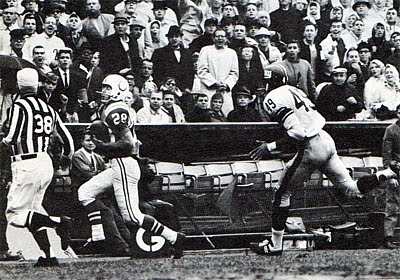
The Giants took the lead in the third quarter with two key plays. Tittle passed to split end Del Shofner for a 43-yard gain to the Baltimore nine yard line and, when the Colts blitzed on first-and-goal, the 37-year-old quarterback ran for the touchdown (pictured at top). The extra point attempt failed, but New York was ahead by 30-28. The Giants scored one more TD in the third quarter, on a one-yard run by FB Alex Webster, and that provided the final margin of 37-28.


The three lost fumbles in the first half had nearly done the Giants in, but they outgained the Colts by 362 total yards to 295. Tittle completed 16 of 23 passes for 243 yards with three touchdowns and no interceptions and ran for 24 yards on five carries, including the game-winning TD. Phil King (pictured at right) and Del Shofner each caught five passes, with King gaining 101 yards and scoring the team’s first TD and Shofner gaining 85 and setting up the game-winning score. New York also ran effectively, gaining a total of 119 yards on 37 rushes, with Webster leading the way at 60 yards on 15 carries.

For Baltimore, Johnny Unitas completed 19 of 33 passes for 219 yards with two TDs and two interceptions. Jimmy Orr was the leading receiver with five catches for 83 yards and a touchdown. The Colts were missing the outstanding HB Lenny Moore due to an appendectomy; he was replaced by Tom Matte, who gained 26 yards on 10 attempts and caught four passes for 37 more yards, while FB J.W. Lockett was Baltimore’s leading ground gainer with 37 yards on 9 carries.

The Giants went on to win the Eastern Conference for a third straight year with an 11-3 record, and once again lost the title game, this time to the Chicago Bears. It would indeed be a last hurrah for the aging club, as they dropped into the cellar in ’64 and would not return to the postseason until 1981. Baltimore suffered through an injury-plagued season in Don Shula’s first year but ended up at 8-6 and third place in the Western Conference. They would win the conference title in 1964. Shula would go on to win 347 games as an NFL head coach (328 regular season, 19 postseason).

Y.A. Tittle, in his next-to-last season, led the NFL in passing as he tossed a then-record 36 touchdown passes (already accomplished by Houston’s George Blanda in the AFL in 1961). He also topped the league in yards per attempt (8.6) and completion percentage (60.2); his 3145 yards ranked third and he was intercepted just 14 times (3.8 INT percentage, also third in the NFL). Tittle was a consensus first team All-Pro and was named league MVP by the Associated Press and NEA.

Johnny Unitas led the league in passes completed (237), yards (3481), and lowest percentage of interceptions (2.9). He was selected to the Pro Bowl for the seventh consecutive season (of an eventual 11). Both of his favorite two veteran receivers, Orr and split end Raymond Berry, missed time due to injury, but the rookie John Mackey put together a Pro Bowl season as he caught 35 passes for 726 yards and led the club in yards per reception (20.7) and receiving touchdowns (7).