Showing posts with label Allie Sherman. Show all posts

October 25, 2016

1964: Browns Pull Away in Fourth Quarter to Defeat Giants


For years during the 1950s and early 60s, games between the Cleveland Browns and New York Giants were often battles for control in the NFL Eastern Conference. The meeting on October 25, 1964 was different, however, in that while the Browns were contending once again with a 4-1-1 record, New York had fallen on hard times and was at 1-4-1.

Cleveland was coached by Blanton Collier for the second year and coming off of a 10-4 second-place finish in ’63. FB Jim Brown, in the eighth season of his career, remained the key player on offense, but QB Frank Ryan (pictured above) had emerged as a capable field general and there was an impressive new target available for his passes in rookie split end Paul Warfield.

Head Coach Allie Sherman’s Giants had won three straight conference titles, but age and injuries had caught up to the team. QB Y.A. Tittle, whose passing had fueled so much success, had just turned 38 and was taking a beating. Other offensive stalwarts such as FB Alex Webster and flanker Frank Gifford were injured. The defense was missing MLB Sam Huff, who had been dealt to Washington in a controversial deal, as well as DT Dick Modzelewski, who was proving helpful to the Browns.

There were 81,050 fans in attendance at Cleveland’s Municipal Stadium for the latest installment in the fierce rivalry. In the first quarter, the Giants struck first with a drive that covered 63 yards in 13 plays. Y.A. Tittle completed two passes and HB Dick James finished it off with a one-yard touchdown carry. Don Chandler missed the extra point attempt, but New York was ahead by 6-0.

Defensively, New York was proving surprisingly effective at stopping the Browns, in particular keeping Jim Brown in check. The home team finally got on the board midway through the second quarter when rookie HB Leroy Kelly returned a punt 68 yards for a TD and Lou Groza added the point after. The Giants had an opportunity to score again before halftime, but after covering 60 yards in seven plays, Tittle’s pass into the end zone was picked off by CB Bernie Parrish. Cleveland maintained the 7-6 halftime advantage.

In the third quarter, LB Galen Fiss intercepted a pass to give the Browns possession at their 40, and six plays later Frank Ryan threw to Paul Warfield for an 11-yard touchdown. Groza booted the point after to put the home team up by 14-6. New York responded with a five-play series that covered 80 yards. HB Steve Thurlow tossed an option pass to flanker Aaron Thomas for 33 yards and Tittle surprised the Browns by rolling out and carrying the ball for a seven-yard touchdown. Chandler made good on the point after and the third quarter ended with the Browns clinging to a narrow 14-13 lead.

The situation changed dramatically early in the fourth quarter. The Giants regained possession in their territory due to an interception, but Cleveland DE Paul Wiggin picked up a fumble by Dick James and returned it two yards for a touchdown. Groza’s conversion lengthened the Cleveland lead to 21-13.


Five plays into the next New York series, LB Jim Houston intercepted a Tittle pass and returned it 44 yards to the New York 31. Jim Brown ran 22 yards to the nine and from there Ryan threw to flanker Gary Collins for a TD, Groza again adding the extra point. On the ensuing kickoff, HB Clarence Childs fumbled and backup FB Charlie Scales (pictured at left) grabbed it in the air and ran 23 yards for yet another Cleveland touchdown. Groza converted once more and, within the period of four minutes and 24 seconds, the Browns had scored 21 points and the once-close contest was now a 35-13 runaway.

New York put rookie QB Gary Wood in the game, and he passed to FB Ernie Wheelwright for a 20-yard TD. With the conversion, the score was narrowed to 35-20, but that was the last gasp for the Giants. Relieving Ryan, QB Jim Ninowski tossed a pass to TE John Brewer for 41 yards and hit Brewer again for an 11-yard touchdown. Groza’s PAT ended the scoring as the Browns won by a final tally of 42-20.

New York had big leads in total yards (426 to 225) and first downs (23 to 15). The Giants even out-rushed Cleveland by 166 yards to 97, but they also turned the ball over six times, which proved disastrous in the fourth quarter, to three turnovers by the Browns.

Frank Ryan completed just 8 of 17 passes for 86 yards and two touchdowns while giving up three interceptions. Jim Brown, who was 90 rushing yards short of 10,000 for his career coming into the game, was held to 56 yards on 12 carries. John Brewer led the Browns with four catches for 80 yards and a TD.


For the Giants, Y.A. Tittle was successful on 19 of 31 throws for 177 yards with no TDs and three interceptions.  In relief, Gary Wood was three-of-three for 44 yards and a touchdown. Ernie Wheelwright (pictured at right) rushed for 94 yards on 20 attempts and also had 5 pass receptions for 68 yards and a score. Split end Del Shofner also had five catches, for 31 yards, while Aaron Thomas gained 83 yards on his four receptions.

The Browns won their next three games on the way to a 10-3-1 record that topped the Eastern Conference, and they upset the Baltimore Colts for the NFL Championship. New York won the next week but didn’t again the rest of the way, ending up in last place at 2-10-2.

September 29, 2016

1946: Eagles Dominate Second Half to Defeat Rams in LA Debut


The Los Angeles Rams were making their West Coast regular season debut as they hosted the Philadelphia Eagles on September 29, 1946. They were coming off of a NFL Championship the previous year as the Cleveland Rams, also their first year under Head Coach Adam Walsh, who installed the T-formation and put QB Bob Waterfield in charge of it with outstanding results. Despite the success, owner Dan Reeves lost money and chose to move the franchise to LA. There were newcomers in HB Tom Harmon, a former Heisman Trophy winner, as well as HB Kenny Washington and end Woody Stode, the first African-American players to appear in the NFL since 1933.

The Eagles had gone 7-3 the previous year, barely missing the Eastern Division title, and one of their wins was against the Rams (the only defeat inflicted on them). Head Coach Earle “Greasy” Neale was assembling a good team that most notably featured HB Steve Van Buren and there were excellent linemen in MG Bucko Kilroy and tackles Al Wistert and Vic Sears. Philadelphia had added promising newcomers in halfbacks Bosh Pritchard and Russ Craft in addition to veteran C/LB Alex Wojciechowicz.

There were 30,553 fans in attendance at the Memorial Coliseum on a hot day with temperatures in the nineties. The Rams scored first, putting together a 75-yard drive in the first quarter, with the biggest play a pass from Bob Waterfield to HB Jack Banta that covered 24 yards. FB Pat West ran the last two yards for a touchdown and Waterfield added the extra point.

The Eagles responded with a 21-yard field goal by Roy Zimmerman to narrow the margin to 7-3. The Rams, moving effectively on the ground, reached the Philadelphia eight, but a holding penalty moved them back and a pass was intercepted by LB Ben Kish. The Eagles scored once more before the first quarter was over when Augie Lio booted a 42-yard field goal.


Early in the second quarter, West (pictured at left) broke away for a 72-yard gain down the middle to the Philadelphia eight. From there, FB Mike Holovak scored a TD, Waterfield converted, and the score remained 14-6 at halftime.

The Eagles started off the third quarter with a drive that resulted in Zimmerman kicking a 19-yard field goal to narrow the score to 14-9. The Rams lost Waterfield, who completed 6 of 9 passes in the first half, due to a rib injury suffered when hit hard by Bucko Kilroy while passing, and he played sparingly for the remainder of the contest. The Rams bogged down on offense as Jim Hardy and Kenny Washington, normally a halfback but being given a trial at quarterback, took turns behind center.

Philadelphia was on the move later in the period, and following a 24-yard run by Russ Craft, QB Allie Sherman (pictured at top) passed to end Larry Cabrelli for a 38-yard touchdown. Zimmerman added the extra point to put the Eagles ahead by 16-14.

Early in the fourth quarter, and following a turnover in which G Duke Maronic hit Holovak behind the line and grabbed the ball away from him, the visitors struck again. Sherman threw for another TD two plays later, this time to end Jack Ferrante that covered 28 yards, and Zimmerman’s point after put the Eagles ahead by nine points.

Midway through the final period, Waterfield re-entered the contest and completed a pass to end Steve Pritko but, after Holovak ran the ball down to the Philadelphia 20, the Rams came up empty. It proved to be their last gasp. The Eagles picked up two more points when Washington, attempting to pass from his own end zone, stepped out of bounds for a safety, and that was it. Philadelphia dominated the second half and came away with a 25-14 win.

The Eagles led in total yards (316 to 233) as well as first downs (16 to 15), topping Los Angeles both in rushing (141 to 116) and through the air (175 to 117). The Rams turned the ball over four times, to two suffered by Philadelphia, but the Eagles were penalized nine times, with six flags thrown on LA.

Allie Sherman was the most productive passer for the Eagles, hitting on 7 of 11 throws for 113 yards and two touchdowns while giving up no interceptions. Steve Van Buren, who had a quiet day running the ball from scrimmage with 33 yards, contributed kickoff returns of 54 and 46 yards.

For the Rams, Bob Waterfield ended up completing 7 of 13 passes for 78 yards with two intercepted. Jim Hardy was 2 of 12 for 23 yards and an interception and Kenny Washington completed just one of seven for 16 yards. Pat West, who left the game due to injury shortly after his long scoring carry, gained 83 yards on five rushing attempts that included a TD. As for Tom Harmon, he had a quiet debut, being held to negative yardage on three carries.

The Eagles won their next game before losing two and they ended up with a 6-5 record to place second in the Eastern Division. Los Angeles followed up with two wins and a tie on the way to going 6-4-1 and finishing second in the Western Division.

Allie Sherman, the future head coach of the New York Giants, was typically a backup and, for the year, ended up completing 17 of 33 passes for 264 yards and four touchdowns while giving up three interceptions.

Bob Waterfield recovered to lead the NFL in pass attempts (251), completions (127), and TD passes (17, tied with Sid Luckman of the Bears) and, for good measure, in extra points (37). He received first-team All-NFL honors from the Associated Press and UPI.

November 26, 2015

1961: Giants Take Control in Second Half to Defeat Browns


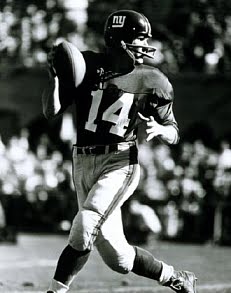
Two fierce rivals in the NFL Eastern Conference, the New York Giants and Cleveland Browns, faced off on November 26, 1961 in Cleveland. Having dropped to third in ’60 after winning the conference in three of the preceding four seasons, the Giants had a first-year head coach in Allie Sherman who, at age 39, was the NFL’s youngest. Two preseason acquisitions were paying off in rejuvenating the offense, with 35-year-old QB Y.A. Tittle (pictured at right), formerly of the 49ers, and split end Del Shofner, an ex-Ram, proving to be a particularly potent passing combination. The defense, dominated by savvy veterans, continued to be one of the league’s toughest units. New York had won its last three games and was 8-2.

The Browns were under the guidance of Head Coach Paul Brown for the 16th year, going back to the years of domination in the All-America Football Conference. Cleveland had won four AAFC titles and three NFL Championships under Brown, but none since 1955. FB Jim Brown was the key to the offense that was directed by efficient, if unspectacular, QB Milt Plum. The line was excellent and the receivers capable while the defense was particularly strong up front. The Browns were coming off a big win over the Eagles in which Jim Brown gained a record 237 rushing yards and, at 7-3, could catch up to their New York rivals with a win at home.

There were 80,455 fans in attendance at Municipal Stadium. The Browns took the opening kickoff and accumulated three first downs. Milt Plum completed three straight passes at one point to reach the New York 45, but the drive stalled when Plum missed on a throw intended for wide-open end Rich Kreitling and Cleveland was forced to punt.

The Giants punted in turn and the home team put together a 73-yard series in six plays. Facing third-and-15, Plum threw to Jim Brown for the necessary yardage and Brown then swept around left end for a 16-yard gain. Two plays later, Plum connected with flanker Ray Renfro (pictured below) for a 43-yard touchdown and, with Lou Groza adding the extra point, the Browns were ahead by 7-0.


The visitors again punted following their next possession and, as the game entered the second quarter, Cleveland was driving. Plum threw to Renfro for 11 yards and a first down and Brown gained 28 yards on a carry around end to the New York 43. However, DE Jim Katcavage sacked Plum on the next play and the Browns were unable to advance further, forcing them to punt.

The Giants proceeded to advance 80 yards in seven plays. Y.A. Tittle completed all four of his passes, two to TE Joe Walton for 11 and 12 yards and the last two to Del Shofner for 17 and 30 yards. Tittle carried the ball himself around end for a five-yard TD and Pat Summerall converted to tie the score at 7-7.

On the first play after the ensuing kickoff, Plum went to the air and his pass was intercepted by safety Jim Patton, who returned it 21 yards to the Cleveland 38. Tittle completed passes to split end Kyle Rote for 19 yards and FB Alex Webster for 17 before a pass interference penalty on the Browns gave the Giants a first down at the one. From there, HB Bob Gaiters ran for a touchdown, Summerall added the point after, and the visitors were ahead by 14-7.

The Browns responded with an 85-yard drive in eight plays. Plum threw to Renfro for a 57-yard gain to the New York 29 and Brown ran for another 11. Another running play lost nine yards, but on second-and-19, Plum tossed a flare pass to HB Bobby Mitchell that gained 25 yards and, three plays later, Brown scored a TD from a yard out. Groza added the extra point and the halftime score was tied at 14-14. Thus far, Cleveland had outgained the Giants both on the ground (68 to 18) and through the air (181 to 133) but was not in the lead.

The Giants had the first possession in the third quarter and drove to a score. The big play was a Tittle screen pass to Webster that gained 22 yards, but the series stalled after reaching the Cleveland 25. Summerall kicked a 34-yard field goal that put the Giants in front by 17-14.

The Browns went three-and-out on their next series and the Giants, regaining possession at their 25, advanced to another score. Gaiters had runs of 8 and 11 yards and Tittle completed passes to Rote for 25 yards and Shofner for 15. Summerall booted another field goal, this time from 17 yards despite being partially deflected by DE Jim Houston, and New York’s lead was extended to 20-14.

The Browns punted once again but got the ball back on the next play when Gaiters fumbled and LB Galen Fiss recovered at the New York 22. But a pass intended for Renfro, who was wide open after CB Erich Barnes slipped and fell, was far off target. A sack of Plum by Katcavage and DE Andy Robustelli cost Cleveland 10 yards on a third down play and, attempting to convert on fourth down, Plum’s pass fell incomplete.

The failure to take advantage of the break proved costly to the Browns. As the game headed into the fourth quarter, the Giants were driving thanks to a Tittle pass to Shofner for 15 yards and an option throw by Gaiters to Webster that picked up 27 yards to the Cleveland 23. Gaiters ran for an 11-yard touchdown, Summerall converted, and New York was ahead by 27-14.

On the next Cleveland series, Coach Brown sent backup QB Len Dawson into the game. The move went awry when Barnes intercepted Dawson’s second pass and returned it 34 yards for a TD. Summerall again converted and, for all intents, with 12 minutes remaining the game was over. The Browns managed to score once more on a 15-yard TD pass from Plum to Renfro while Summerall capped the scoring for the Giants with an 11-yard field goal. New York came away with a convincing 37-21 win.

Thanks to their second half domination, the Giants led in total yards (369 to 334) and first downs (24 to 20). Cleveland managed just 66 rushing yards, to 116 for New York. Both teams turned the ball over twice.


Y.A. Tittle completed 17 of 26 passes for 233 yards with one interception, and while he threw for no touchdowns, he ran for one and his passing set up the other scores. Del Shofner caught 6 passes for 97 yards and Kyle Rote contributed five receptions for 58 yards. Bob Gaiters (pictured at right) topped the Giants with 63 yards on 15 carries that included two touchdowns and also completed a 27-yard pass. Alex Webster rushed for 49 yards on 15 attempts and caught four passes for another 65 yards.

For the Browns, Milt Plum was successful on 19 of 33 throws for 284 yards and two TDs while giving up an interception, but was just one-of-seven during the crucial third quarter. Likewise, Jim Brown gained just 68 rushing yards on 20 attempts with a TD and was effectively shut down in the last two quarters. He also had five pass receptions for 46 yards and his backfield mater, HB Bobby Mitchell, also had five catches, for 54 yards, but was virtually invisible as a ball carrier with two yards on two attempts. Ray Renfro led the club with 7 catches for 166 yards and two scores.

“This was our greatest game of the season,” said Coach Sherman for the Giants. “It was our greatest game because this was our greatest challenge. This is a team with a soul. They come back when they’re behind. They never let up.”

“My guys tried hard enough, we’re not good enough,” summed up Paul Brown from the Cleveland perspective.

It was the seventh win in the last eight meetings with the Browns for New York. The Giants lost to Green Bay the following week but defeated the Eagles and tied Cleveland in the rematch in New York to top the Eastern Conference with a 10-3-1 record. They lost badly to the Packers in the NFL Championship game. The Browns ended up in third at a disappointing 8-5-1.

Y.A. Tittle was one of the NFL’s top-ranked passers as he threw for 2272 yards and 17 touchdowns. He received MVP honors from the Newspaper Enterprise Association as well as being a first-team All-NFL selection of UPI and The Sporting News and a Pro Bowl participant. Del Shofner placed second in the league with 1125 yards on a career-high 68 pass receptions and scored 11 TDs. He also was a consensus first-team All-NFL and Pro Bowl choice. While rookie Bob Gaiters had a strong outing against the Browns, he struggled with consistency and had a tendency to fumble. He rushed for 460 yards on 116 carries and scored six touchdowns in what proved to be his most successful NFL season.  

October 18, 2014

1964: Old Pro Matson Runs for 100 Yards as Eagles Beat Giants


The Philadelphia Eagles were 2-3 and missing star HB Timmy Brown as they traveled to New York to face the Giants on October 18, 1964. A refurbished team under Head Coach/GM Joe Kuharich, the Eagles had started the year by thrashing the Giants 38-7, and they had great success blitzing on defense, with FS Don Burroughs having a particularly notable outing. Brown, who led the NFL in all-purpose yards the two previous years, was out with a thigh injury, and in his place would be a past all-purpose star, 34-year-old Ollie Matson (pictured above).

Matson had played under Kuharich in college with the legendary Univ. of San Francisco team that went undefeated in 1951 before moving on to the Cardinals, where he was a consensus first-team All-NFL selection five times and was selected to six Pro Bowls. With both size (6’2”, 220) and speed, he was a record-setting kick returner in addition to being an excellent runner from scrimmage. However, after being traded to the Rams in a celebrated deal for nine players (including two draft picks), Matson began to fade from view, being used as a flanker and defensive back as well as halfback and fullback with a losing club. After a year in Detroit in which he ran the ball just 13 times, caught two passes, and returned three kickoffs, he was packaged to the Eagles along with DT Floyd Peters in a trade for OT J.D. Smith. There were questions as to whether he still could contribute, and now with Brown sidelined he would get his chance.

In addition to Brown’s injury, another key player on the offense, TE Pete Retzlaff, was hobbled by a rib injury and kicker Sam Baker, also newly-acquired by the Eagles for 1964, was suffering from a sprained ankle. Backup QB King Hill took over the punting and LB Dave Lloyd handled kickoffs, but the 35-year-old Baker was still available for extra points and field goals.

As for the Giants, coached by Allie Sherman and winners of the Eastern Conference title in each of the three previous seasons, things had not gotten better since the opening loss at Philadelphia. They were 1-3-1, coming off a tie at Dallas the previous week, and the once-mighty offense was notably lacking. Age had taken its toll as QB Y.A. Tittle, just days short of his 38th birthday, was struggling, in addition to other veteran stalwarts such as FB Alex Webster and flanker Frank Gifford.  The defense was missing MLB Sam Huff and DT Dick Modzelewski, who were traded away during the offseason.

There were 62,978 fans in attendance at Yankee Stadium and they saw things start off quickly for the Eagles when Giants HB Dick James fumbled after catching a pass on the first play from scrimmage and LB Mike Morgan recovered at the New York four yard line. Ollie Matson breezed off tackle for a touchdown and, with Sam Baker’s extra point, Philadelphia was ahead by 7-0 just 35 seconds into the contest.

The Giants went three-and-out on the ensuing series and punted, with Don Chandler’s short kick giving the Eagles good field position at the New York 45. Following an incomplete pass on first down, Matson ran twice for seven yards and Baker kicked a 45-yard field goal to put the visitors ahead by 10-0.

New York responded with a scoring drive, advancing 67 yards in ten plays. Y.A. Tittle completed four passes and James plunged the last yard for a TD. Don Chandler added the point after to narrow Philadelphia’s lead to 10-7.

The Eagles punted following a short series but got the ball right back when CB Nate Ramsey intercepted Tittle’s pass on first down at the New York 40. Philadelphia kept the ball on the ground with Matson and FB Earl Gros pounding away, and when the drive finally stalled at the three, Baker kicked another field goal, this time of 10 yards.

With time running down in the opening period, the Giants had to punt, and on the first play of the second quarter Matson broke away for a 54-yard touchdown as Gros threw a devastating block to help clear the way. Baker’s conversion had the Eagles in front by 20-7.


Another punt by the Giants was followed by a series in which the visitors advanced into New York territory, but Gros fumbled the ball away at the 26 and DE Andy Robustelli recovered and returned it to the 45. With rookie Gary Wood (pictured at right) now in at quarterback for New York, the Giants drove to a score. Wood showed off his scrambling ability by picking up ten yards on a third-and-six play to the Philadelphia 41 and converted another third down with a nine-yard carry. However, he was also sacked by the blitzing Ramsey and the Giants settled for a 42-yard Chandler field goal to make it a ten-point game.

There were still over three minutes remaining in the first half and FB Israel “Izzy” Lang returned the ensuing kickoff 49 yards to the New York 45. The Eagles got another Baker field goal, from 46 yards, and went into halftime with a 23-10 lead.

The third quarter was scoreless, with the closest either team came to putting points on the board a 43-yard Chandler field goal attempt that was wide to the left. Tittle returned to the game in the fourth quarter and helped pull the home team closer after a punt was fumbled by Lang, giving New York possession at the Philadelphia 34. A pass interference call in the end zone on a third-and-12 toss put the Giants at the one, from where Alex Webster ran in for the score. Chandler added the extra point to make it a six-point game.

The Giants went three-and-out after regaining possession following an Eagles punt, and when Philadelphia punted again, James apparently lost track of King Hill’s kick in the glare of the sun and the visitors were able to down it at the one. In the last two minutes, New York was unable to get out of its end of the field and the Eagles came away with a 23-17 win and season sweep of the Giants – the first since 1960, when Philadelphia won the NFL Championship.

New York had the edge in total yards (194 to 167) and first downs (18 to 8), with the Eagles far more successful on the ground (149 yards) than through the air (a net total of just 18 yards). However, Philadelphia’s heavy blitzing recorded seven sacks, to none by the Giants, and New York turned the ball over four times, as opposed to two turnovers by the Eagles.

Ollie Matson gained an even 100 yards on 19 carries that included two touchdowns. QB Norm Snead completed only 5 of 13 passes for 18 yards and TE Ralph Smith, in place of Pete Retzlaff, topped the Eagles with a mere two catches for 12 yards. Sam Baker (pictured below) was successful on all three of his field goal attempts, and it was thus the highly-experienced tandem of Matson and Baker, with a total of 20 NFL seasons between them prior to ’64, that accounted for all of Philadelphia’s points.


For the Giants, Y.A. Tittle made good on 14 of 27 throws for 147 yards and had one intercepted and Gary Wood contributed three completions in seven attempts for 29 yards, also tossing an interception, while gaining 24 yards on four runs. FB Ernie Wheelwright ran for 42 yards on 12 attempts to lead the team’s runners. Flanker Joe Morrison caught 6 passes for 45 yards and split end Del Shofner accumulated 62 yards on his four receptions.

The Eagles won again the next week but only twice more the rest of the way, finishing in a tie for third in the Eastern Conference with a 6-8 record. To be sure, it marked improvement after back-to-back last place finishes. New York’s collapse continued with the once-mighty Giants falling all the way to the bottom at 2-10-2.

Ollie Matson continued to play well in place of Timmy Brown and after, rushing for 404 yards on 96 carries (4.2 avg.) and catching 17 passes for another 242 yards (14.2 avg.), scoring a total of five touchdowns. He also saw action on kick returns and gained 760 all-purpose yards, his best output since he was with the Rams in 1961. Matson lasted two more seasons as a valuable reserve in Philadelphia to cap his Hall of Fame career.

September 30, 2014

1962: Tittle’s 4 TD Passes Propel Giants Past Steelers


The New York Giants, defending champions of the NFL Eastern Conference, were 1-1 as they met the Pittsburgh Steelers, who had the same record, on September 30, 1962. In their second year under Head Coach Allie Sherman, the Giants were an outstanding passing team, with a rejuvenated QB Y.A. Tittle (pictured at right), in his 15th pro season but second in New York, throwing to split end Del Shofner and Frank Gifford, once a star halfback but, following a year missed due to injury, back as a flanker. The ground game was led by 31-year-old FB Alex Webster, operating behind a good veteran line. The defense was also experienced and a tough and cohesive unit.

Pittsburgh, coached by Buddy Parker for a sixth season, still had QB Bobby Layne, who was a worn but savvy veteran. The offense also featured FB John Henry Johnson and split end Buddy Dial while the defensive line was anchored by DT Ernie Stautner. However, Pittsburgh’s normally good corps of linebackers was depleted by injury and Parker started only two against the Giants, George Tarasovic and Tom Bettis, until Ken Kirk joined them midway through the second quarter while Gene “Big Daddy” Lipscomb, normally a defensive tackle, lined up at middle guard.

There were 40,916 fans in attendance on a sunny afternoon at Pitt Stadium. Pittsburgh had first possession and drove 84 yards in 12 plays, the highlight of which was a 36-yard carry by John Henry Johnson. HB Joe Womack ran for the last seven yards and a touchdown. Lou Michaels added the extra point and the Steelers held the early 7-0 advantage.


The Giants responded with a good drive of their own, but it stalled in Pittsburgh territory and Don Chandler kicked a 23-yard field goal. CB Brady Keys returned the ensuing kickoff 55 yards with a sensational run to give the Steelers good field position at the New York 40. A two-yard loss on an end-around was followed by a 15-yard penalty against the Giants for defensive holding. Bobby Layne (pictured at left) finished the series off with a throw to flanker Red Mack in the corner of the end zone for a 28-yard TD. Michaels again converted and the home team was up by a 14-3 lead at the end of a quarter of play.

Early in the second quarter, safety Jim Patton intercepted a Layne pass and returned it ten yards to the Pittsburgh 38. The Giants advanced to the two, but after being backed up five yards by a penalty, Y.A. Tittle threw to HB Paul Dudley for an 11-yard touchdown. Chandler added the PAT and Pittsburgh’s lead was narrowed to 14-10.

Once again Keys made an outstanding kickoff return for the Steelers, running it back 57 yards this time to the New York 39. They moved inside the ten but they lost sizable yardage to a holding penalty and sack, and settled for a 41-yard Michaels field goal.


In the final two minutes of the half, the Giants came up with a big play when Tittle connected with Alex Webster (pictured at right) on a screen pass, and he went the distance for a 58-yard touchdown. Chandler’s extra point tied the score at 17-17.

The Steelers fought back in what proved to be a wild close to the first half. End Harlon Hill dropped a pass at the New York two and Michaels attempted a 53-yard field goal that was blocked, but HB Dick Hoak recovered for Pittsburgh and ran to the New York 17. With the clock down to seven seconds, the Steelers again lined up for an apparent kick, but instead tried a fake. The resulting pass by holder and backup QB Ed Brown was intercepted in the end zone by safety Allan Webb and the score remained tied at halftime.

Early in the third quarter, Keys intercepted a Tittle pass at his own 43 and the Steelers took advantage as Michaels capped the ensuing series with a 33-yard field goal. The home team was back in front by 20-17. 

New York responded with a scoring drive of its own. Tittle passed the Giants down the field and threw to a well-covered Frank Gifford, who pulled the pass away from safety Clendon Thomas for a 27-yard TD. Chandler’s conversion put the visitors in front for the first time by a score of 21-20. The Steelers threatened again late in the period, but a Michaels field goal try from 42 yards was short.

In the early seconds of the fourth quarter, Tittle threw to split end Del Shofner for a 16-yard touchdown. The Steelers fought back, helped by penalties on New York for roughing the passer and pass interference, and Johnson leaped the last yard for a TD. Michaels was good on the extra point to put Pittsburgh four points behind.

As the time wound down in the game, and with the home crowd cheering wildly, the Steelers again drove into scoring position. But after reaching the New York 16, a Layne pass into the end zone that was intended for Buddy Dial was instead intercepted by CB Erich Barnes to seal the 31-27 win for the Giants.

New York accumulated the most total yards (427 to 317) although the Steelers held the edge in first downs (23 to 19). Pittsburgh did a good job defensively against New York’s running game, at least until the fourth quarter, holding the Giants to 95 yards on 27 attempts while gaining 175 yards themselves. However, the Steelers also turned the ball over three times, including the climactic interception in the fourth quarter, to one suffered by New York. The Giants also recorded three sacks while Pittsburgh had none.

Y.A. Tittle completed 17 of 29 passes for 332 yards and four touchdowns while giving up one interception. Alex Webster led the Giants with 77 rushing yards on nine carries and also in pass receiving with 5 catches for 101 yards and a TD. Frank Gifford gained 99 yards on four receptions that included a score. 
  
For the Steelers, Bobby Layne was successful on 12 of 23 throws for 166 yards and a TD as well as two interceptions. John Henry Johnson rushed for 113 yards on 20 attempts that included a touchdown. TE Preston Carpenter had 5 receptions for 44 yards while Buddy Dial accumulated 70 yards on his four catches. Brady Keys (pictured below) averaged 36.8 yards on five kickoff returns that included two of 55 and 57 yards.


Two weeks later, the teams met again at Yankee Stadium and Pittsburgh prevailed, but it was the only loss for the Giants the rest of the way. New York posted a 12-2 record to again top the Eastern Conference, although the Giants still came up short against Green Bay in the NFL title game. The Steelers were a mediocre 3-4 at the season’s halfway point before catching fire and winning six of their last seven games to place second in the conference at 9-5. They appeared in the Playoff Bowl, the postseason exhibition game for second place teams during that era, and lost to Detroit.

Y.A. Tittle received MVP honors from United Press International as well as consensus first-team All-NFL and Pro Bowl recognition as he passed for 3224 yards and a league-record 33 touchdown passes (Houston’s George Blanda passed for 36 in the AFL in 1961, a mark that Tittle would match in ’63). Alex Webster rushed for 743 yards on 207 carries (3.6 avg.) and caught 47 passes for another 477 yards (10.1 avg.), for 1220 yards from scrimmage and a total of nine TDs.

In his last season, Bobby Layne threw for 1686 yards and nine touchdowns and left the NFL as the career leader in several major passing categories. John Henry Johnson enjoyed a big year in his ninth season, rushing for 1141 yards and gaining selection to the Pro Bowl.

October 27, 2013

1963: Giants Dominate Browns in Key Eastern Showdown


The Cleveland Browns seemed poised to take control of the NFL Eastern Conference race as they hosted the New York Giants on October 27, 1963. The Browns were undefeated at 6-0 and had looked very good in defeating the Giants at Yankee Stadium two weeks earlier. Under first-year Head Coach Blanton Collier, they had the league’s top rusher in FB Jim Brown, who was leading the NFL with 931 yards on the ground and had compiled 209 yards from scrimmage in the previous meeting with the Giants. QB Frank Ryan was also leading the NFL with a completion percentage of 62.1.

The Giants, coached by Allie Sherman, had topped the Eastern Conference in each of the last two years but, at 4-2, were in danger of falling out of contention unless they could derail Cleveland. 37-year-old QB Y.A. Tittle (pictured above) had been a sensation since arriving from San Francisco in 1961 and had a fine receiving corps led by split end Del Shofner. The veteran group of running backs included FB Alex Webster and HB Hugh McElhenny. The defense also had a well-seasoned core that was anchored by MLB Sam Huff and included such stalwarts as DEs Andy Robustelli and Jim Katcavage, DT Dick Modzelewski, cornerbacks Dick Lynch and Erich Barnes, and FS Jim Patton.

There were 84,213 fans at Municipal Stadium, the second-largest crowd for a regular season game to date in the history of the huge venue. The tone was set on the second play from scrimmage when Jim Brown fumbled after picking up seven yards and Sam Huff recovered for the Giants at the Cleveland 30. Four plays later, Don Chandler kicked a 29-yard field goal to give New York the early lead.

On the next play following the kickoff, Frank Ryan threw a pass that was intercepted by Jim Patton and the Giants again took possession in Cleveland territory. They immediately capitalized when Y.A. Tittle threw to Del Shofner for a 23-yard touchdown. Chandler added the extra point and less than three minutes into the game, the visitors were ahead by 10-0. Cleveland had run only three offensive plays.

The Browns went three-and-out on their next series and were forced to punt. The Giants, taking over at their 14, put together an 86-yard drive in 15 plays. Tittle completed seven passes along the way, two of which converted third downs, including one to TE Aaron Thomas for 19 yards in a third-and-10 situation and another to TE Joe Walton for 13 yards on a third-and-six play. Hugh McElhenny and Alex Webster ran effectively and Tittle finished the series off with a six-yard scoring pass to McElhenny. New York’s lead was 17-0 after a quarter of play.

The Browns again had to punt and once more New York responded by putting points on the board. This time the Giants moved the ball 34 yards in eight plays capped by Chandler booting a 34-yard field goal. Tittle again came through with a third down completion to keep the drive going, connecting with Shofner for 16 yards to the Cleveland 31 on a third-and-seven play.

Another short series by the Browns was followed by another New York scoring drive. Tittle completed four more passes, Cleveland was flagged for pass interference on one he didn’t complete, and Chandler kicked another field goal, this time from 33 yards. The Giants had scored on every first half possession and took a commanding 23-0 lead into halftime. The statistics were as lopsided as the score - New York had outgained the Browns by 195 yards to 35 and Cleveland had run just 20 plays.

The Giants kept pouring it on as the third quarter began. McElhenny took the second half kickoff 51 yards and they ended up with a fourth Chandler field goal, of 42 yards. The Browns still remained stymied on offense and punted, and New York remained unstoppable. The offense put together another methodical scoring drive that ended with Webster running the last two yards for a TD.

The outcome was not in doubt in the fourth quarter as the Giants finally failed to score on a possession. After reaching the Cleveland 37, Tittle’s deflected pass was intercepted. Jim Ninowski was now at quarterback for the Browns, but had no better luck at moving the team until his second series, after Chandler missed on a 44-yard field goal attempt. Ninowski threw to split end Tom Hutchinson for 70 yards and two plays later finally got the Browns on the board with a 10-yard touchdown pass to end Rich Kreitling. However, Groza’s extra point attempt was blocked by Huff. The final score was a resounding 33-6 win for the Giants.

New York had a huge lead in total yards (387 to 142) and first downs (26 to 6). The Giants sacked Cleveland’s quarterbacks four times and Cleveland turned the ball over on three occasions, to just the one late and insignificant turnover suffered by New York. The Giants only punted twice, both coming in the final period.


Y.A. Tittle completed 21 of 31 passes for 214 yards and two touchdowns with one intercepted. Del Shofner (pictured at left) had 7 catches for 108 yards and a TD. Alex Webster rushed for 53 yards and a touchdown on 16 carries and Hugh McElhenny also ran for 53 yards, on 13 attempts, while contributing a TD on his lone pass reception. Don Chandler helped out with his four field goals in five attempts.

For the Browns, Frank Ryan was successful on only one of 9 throws for a startling minus six passing yards and was intercepted once. Jim Ninowski hit on 4 of 11 passes for 120 yards and a TD with one picked off. Jim Brown was held to just 40 yards on 9 carries and had the critical early fumble. He was also ejected after getting into an altercation with New York LB Tom Scott, who was also tossed, in the game’s last minute. Tom Hutchinson, thanks to the long reception in the fourth quarter, had two catches for 97 yards to lead the club.

The Giants continued on to win their next four games and lost only once more on the way to once again topping the Eastern Conference with an 11-3 record. However, they lost to the Bears in the NFL title game, falling short for the third straight time. Cleveland won the next week at Philadelphia but then lost two straight, faltering down the stretch and ending up in second place at 10-4.

Y.A. Tittle broke his own NFL record with 36 touchdown passes and also led the league in overall passing (104.8 rating in current system), completion percentage (60.2), yards per attempt (8.6), and percentage of TD passes (9.8, tied with Frank Ryan). Del Shofner ranked third in pass receiving yards (1181) and fourth in pass receptions (64). Don Chandler led the NFL in scoring (106 points) and was third in field goals (18) and first in extra points (52).

September 26, 2013

1965: Stynchula Field Goals Propel Giants Past Eagles


The New York Giants were a team in transition – and an 11-point underdog – as they faced the Philadelphia Eagles on September 26, 1965. After winning the Eastern Conference for three straight years under Head Coach Allie Sherman, they crashed to 2-10-2 in 1964. Gone were many of the star players, such as QB Y.A. Tittle, flanker Frank Gifford, and MLB Sam Huff, who had played key roles in the team’s success. While some aging veterans remained, there were many new names on the roster. A group of running backs referred to as “The Baby Bulls” had begun to emerge in ’64 and were now joined by first draft choice FB Tucker Frederickson out of Auburn. A trade was swung with Detroit for veteran QB Earl Morrall (pictured above). But the Giants also had four rookies starting on defense and had been beaten badly by the Cowboys in their opening game the previous week.

Another cause of concern was placekicking. The reasonably dependable Don Chandler had been traded to the Packers in the offseason and no clear alternative had emerged to replace him. One of the candidates, FB Chuck Mercein, was unavailable due to a leg injury, leaving DE Andy Stynchula (pictured below), who had not kicked since high school, and rookie Bob Timberlake, also the team’s third-string quarterback. Stynchula had been a star lineman at Penn State and was drafted third by the Redskins in 1960, moving on to New York in ’64 as part of the deal that sent Sam Huff to Washington. The Giants were using him only for short field goals and extra points, with Timberlake handling longer field goal tries.


As for the Eagles, coached for the second year by Joe Kuharich, they were coming off a promising 6-8 season in 1964 and had beaten the Cardinals in Week 1. QB Norm Snead had ideal size and a strong arm, HB Timmy Brown was an outstanding runner and receiver out of the backfield, and TE Pete Retzlaff was one of the league’s best at his position.

There were 57,154 fans in attendance at Franklin Field. The teams traded punts to start the game. On Philadelphia’s second possession, Norm Snead finished off a 73-yard drive in the first quarter with a one-yard touchdown carry. The big plays along the way were passes by Snead in third-and-ten situations to FB Earl Gros for 27 yards and to Timmy Brown for 18.

The Eagles put together another promising drive in the second quarter that also included a long third down conversion on a Snead-to-Brown completion for 16 yards from deep in their own territory, but they were backed up by a holding penalty and had to punt. The Giants got good field position when safety Henry Carr, a rookie who was an Olympic 200-meter champ, returned the kick 17 yards to the Philadelphia 45. With HB Steve Thurlow and Tucker Frederickson (pictured below) running the ball effectively, the Giants scored in seven plays. Flanker Joe Morrison took a pitchout and went 11 yards around left end for a TD. Andy Stynchula added the extra point to tie the score at 7-7 with just over a minute remaining in the half.


The Eagles went to the air in the time remaining. Snead went long for flanker Ron Goodwin, but rookie CB Carl Lockhart leaped high and batted the ball away to prevent a sure score. Sam Baker tried for a 43-yard field goal on the last play before halftime but it was unsuccessful and the score remained tied.

Early in the third quarter, the Giants got a break when Timmy Brown fumbled and DT Mike Bundra recovered at the Philadelphia 25. The resulting possession ended with Stynchula’s first pro field goal, from 24 yards, and New York was in front by a 10-7 margin.

The Eagles responded by putting together a long drive that covered 67 yards in 12 plays. At one point they were forced to punt but King Hill was run into while kicking to draw a penalty and keep the series alive. Snead threw to Pete Retzlaff for 14 yards to the one to set up another quarterback keeper for a touchdown.

New York went 52 yards on its next possession that included back-to-back completions by Earl Morrall of 20 yards to TE Aaron Thomas and 16 yards to HB Smith Reed. The series finally stalled at the Philadelphia 8 and Stynchula booted a 20-yard field goal to make it a one-point game.

The teams traded punts before the Eagles moved into scoring territory. Brown caught two key passes for 27 yards and, on a third-and-one play, ran 18 yards to the New York 20. With 5:30 left to play, the Eagles attempted a field goal but Baker’s kick from 26 yards was blocked by Giants CB Dick Lynch and Carr returned it 19 yards to the New York 32.

A long pass completion was nullified by a penalty, but Morrall came right back with a throw to split end Del Shofner for 31 yards. Four plays later, and facing fourth-and-inches, Morrall sneaked two yards for a first down and then threw to Thomas for 16 yards. Frederickson ran the ball three times for 25 yards down to the four and from there, Stynchula kicked an 11-yard field goal to put the Giants ahead with 15 seconds left on the clock. They held on to win by a final score of 16-14.

The Eagles outgained New York (296 yards to 280) and also had the edge in first downs (18 to 14). Philadelphia suffered the game’s only turnover but the Giants hurt themselves with ten penalties, to three flags thrown on the Eagles. Ultimately, it came down to placekicking as the normally dependable Sam Baker missed both of his field goal attempts, including the crucial blocked kick in the fourth quarter, while Andy Stynchula was a perfect three-for-three.

Earl Morrall completed 12 of 18 passes for 154 yards with no touchdowns but also had none intercepted. Tucker Frederickson rushed for 76 yards on 17 carries. Aaron Thomas had three catches for 62 yards while Smith Reed also pulled in three for 30 yards along with his 13 rushing yards on three attempts and Joe Morrison, whose lone run was the 11-yard TD, gained 19 yards on his three receptions.


For the Eagles, Norm Snead was successful on 17 of 32 throws for 238 yards, also with no TDs or interceptions. Timmy Brown (pictured at right) gained 45 yards on 11 rushing attempts and added 8 catches for 106 yards. Pete Retzlaff contributed 68 yards on his four pass receptions.

“I always have practiced field goals, every day,” said Andy Stynchula, “and with Don Chandler gone this year I went to camp hoping I’d get the kicking job.”

The Giants broke even the rest of the way, finishing at 7-7 and tied with the Cowboys for second in the Eastern Conference. Philadelphia had a disappointing 5-9 record and placed fifth in the conference, along with the Cardinals.

Earl Morrall, in his tenth season, had a good year as he ranked fifth in the NFL in passing with 2446 yards, averaging a healthy 8.1 yards per attempt, with 22 touchdowns as opposed to 12 interceptions. Tucker Frederickson rushed for 659 yards and was named to the Pro Bowl.

As for Andy Stynchula, the three field goals against the Eagles ended up being his only ones of the season. He missed on all four of his remaining attempts while going 12-for-13 on extra point attempts. Bob Timberlake was far worse – he was successful on only one of 15 field goal attempts as the Giants ended up with only four for the entire year. It would spur them to sign pioneering soccer-style PK Pete Gogolak away from the AFL’s Buffalo Bills in the off-season, which dramatically improved their placekicking but also was a key occurrence in the battle between the two leagues.

December 30, 2012

1962: Packers Defeat Giants to Repeat as NFL Champions


The NFL Championship game on December 30, 1962 featured the same two teams who had faced off for the title in ’61 – the Green Bay Packers and New York Giants. In that instance, the Packers had blown the Giants out by a 37-0 score at Green Bay. Now they were meeting on New York’s home turf in the rematch.

The Packers, under Head Coach Vince Lombardi, had gone 13-1 in placing at the top of the Western Conference for the third straight year. Hard-hitting FB Jim Taylor had a MVP season as he led the NFL in rushing with 1474 yards (the first NFL runner not named Jim Brown to do so since 1956) and scored a record 19 touchdowns. QB Bart Starr was the league’s top-rated passer and the offensive line was outstanding. Even the off-year for HB Paul Hornung, who had won three straight scoring titles from 1959 to ’61 but was hampered by a bad knee, could not derail the offense, and All-Pro G Jerry Kramer (pictured above) had taken over Hornung’s placekicking responsibilities. The defense was just as strong and yielded the fewest points in the NFL.

Head Coach Allie Sherman’s Giants came in first in the Eastern Conference at 12-2, winning their last nine games in doing so. The brilliant passing of QB Y.A. Tittle was the key to the offense – he had set a new NFL record with 33 TD passes and had excellent targets in split end Del Shofner, flanker Frank Gifford, and TE Joe Walton. FB Alex Webster was effective both running the ball and as a receiver out of the backfield. The veteran defense was solid.

There were 64,892 in attendance at frigid Yankee Stadium. Temperatures were in the teens and with winds gusting as high as 45 mph, the wind chill was below zero. Traction was difficult on the frozen turf and whirlwinds of dust occasionally blew about.

The Giants had first possession and reached their own 46 before having to punt.  Jerry Kramer put the Packers on the board with a 26-yard field goal midway through the first quarter after Green Bay drove 61 yards to the 19 yard line and Jim Taylor was stopped for no gain on third down and short.

The Giants threatened, driving to the Green Bay 15. However, MLB Ray Nitschke deflected a Tittle pass that was intercepted by LB Dan Currie to end the threat and returned it 30 yards before falling. Following the interception, the Packers advanced to the New York 30 but Kramer missed a field goal try from 37 yards.

A punt by Max McGee was nearly blocked by CB Erich Barnes but the rushed kick went only 23 yards. Two plays later, HB Phil King fumbled when hit by Currie and Nitschke recovered at the New York 28. The Packers capitalized as Paul Hornung tossed an option pass to flanker Boyd Dowler for 21 yards and Taylor followed up with a seven-yard touchdown run up the middle (pictured below).


Now late in the second quarter, the Giants responded by moving into Green Bay territory. However, Don Chandler attempted a 47-yard field goal for the Giants that went wide of the mark. The Packers took a 10-0 lead into halftime.

Early in the third quarter, Green Bay’s offense couldn’t advance the ball while backed up deep in its own territory. With the Packers punting from their own 15 yard line, Barnes broke through this time to block McGee’s kick and end Jim Collier fell on the loose ball in the end zone for a New York touchdown after LB Bill Forester was unable to scoop it up at the five (picture below shows Barnes at right just before blocking the punt). With the successful extra point, it was a three-point game.


Once again the Packers couldn’t move on offense, but McGee’s line-drive punt was muffed by DB Sam Horner and Nitschke recovered at the New York 42. The five-play series culminated in a 29-yard field goal by Kramer.

The Giants, now down by six, drove into Green Bay territory with the help of penalties. From the Green Bay 47, Tittle threw a pass intended for Del Shofner that fell incomplete. However, FS Willlie Wood was charged with pass interference and when he leaped up to protest he inadvertently knocked the official, back judge Thomas Kelleher, to the ground. It resulted in Wood’s ejection and another 15 yard penalty on the Packers that advanced the ball to the 18. Tittle overthrew Shofner and the Giants followed up with a double reverse in which King lateraled back to Tittle who was under pressure from DE Willie Davis and threw a bad pass that was almost picked off by Currie. Two holding calls on the Giants moved the ball all the way back to the 40. On third-and-52, Tittle threw short for flanker Frank Gifford, who dropped it. The Giants came up empty.

Early in the fourth quarter, HB Elijah Pitts returned a punt 36 yards and nearly broke it all the way. Bart Starr passed the Packers down to the New York 27 but they lost ground from there and Kramer was unsuccessful on a 40-yard field goal try.

The Giants were unable to move on offense and punted. Taking over at their 28, the Packers kept the ball on the ground and reached the New York 24. With 1:50 remaining in the game, Kramer kicked his third field goal to effectively seal the win for the Packers. The Giants drove to the Green Bay seven on their last possession before time ran out. Green Bay was the champion once again by a score of 16-7.

The Giants outgained Green Bay (291 yards to 244) and the clubs were even in first downs with 18 apiece. The Packers were more successful at running the ball (148 yards to 94) and New York turned the ball over three times while Green Bay’s offense suffered none.

Jim Taylor had a hard-earned 85 yards on 31 carries that included a touchdown and gained 20 more yards on three pass receptions. Moreover, he engaged in a personal battle in the trenches with New York’s defense (most notably star MLB Sam Huff), often exchanging words and exemplifying the game’s intensity. Bart Starr completed just 9 of 21 passes for 85 yards while Paul Hornung, who contributed 35 yards on 8 rushing attempts, also tossed a key halfback option pass for a 21-yard gain. Boyd Dowler led the Green Bay receivers with 4 catches for 48 yards. Ray Nitschke recovered two fumbles and had the pass deflection that was intercepted and was named MVP of the game by Sport Magazine.

As if the wind was not enough, Y.A. Tittle (pictured below) was under constant pressure throughout the game. He was successful on 18 of 41 throws for 197 yards with no TDs and one interception. Joe Walton and Del Shofner had 5 catches apiece, for 75 and 69 yards, respectively. Alex Webster ran for 56 yards on 15 carries and Phil King added 38 yards on 11 attempts.


Summing up, Vince Lombardi stated that his team’s “defense was superb and so was New York’s.”

“Green Bay is obviously a worthy champion, because they have things they had to overcome and they went out there and overcame them and got the points,” said Allie Sherman from the losing side.

The Packers barely missed out on winning the Western Conference again in 1963, finishing a close second to the Chicago Bears. They would win their next league title in 1965. New York topped the Eastern Conference yet again in ’63, but once more fell short in the Championship game.  In two title games, the Giants failed to score a single offensive touchdown against Green Bay.

April 10, 2012

1964: Giants Trade Sam Huff to Redskins


The New York Giants had largely dominated the NFL Eastern Conference from 1956 through ’63, coming in first in six of those eight seasons and winning one championship. The string had begun under Head Coach Jim Lee Howell, who retired following the 1960 season, and continued under his successor, Allie Sherman. While the offense, guided by QB Y.A. Tittle, had been highly productive from 1961 to ’63, it was the strong and savvy defensive unit that had consistently made the Giants a contender.

Thus, it was shocking on April 10, 1964 when New York traded one of the key players on the defense, MLB Sam Huff, along with rookie defensive lineman George Seals to the lowly Washington Redskins for DE Andy Stynchula, HB Dick James, and a fifth round draft choice for 1965. Coming after the retirement of DE Andy Robustelli and trade of DT Dick Modzelewski to Cleveland, the deal was a shock to fans and players alike.

“It’s kind of like getting hit with a bomb,” said Huff in reaction. “It’s so unexpected I haven’t gotten over the shock.”

As Huff pointed out at the time of the trade, the Giants defense had been not only effective but a close-knit unit as well. The 6’1”, 230-pound West Virginia native had been one of the most visible and popular members of that platoon since joining the club as a third-round draft pick in 1956. With deceptive speed and great strength, he had been selected to four straight Pro Bowls from 1958 to ’61, was a consensus first-team All-Pro on two occasions, and received some first-team All-Pro recognition in two others. Moreover, he had appeared on the cover of TIME magazine and gained additional notoriety from a television documentary that aired in 1960 called “The Violent World of Sam Huff.” While there were complaints that Huff received more publicity than he was due and was not the equal of contemporary middle linebackers such as Detroit’s Joe Schmidt or Green Bay’s Ray Nitschke, he was a fan favorite, prone to making big plays, durable, and unquestionably talented – his one-on-one battles with the two greatest fullbacks of the era, Cleveland’s Jim Brown and Jim Taylor of the Packers, were particularly noteworthy.

However, Huff was 29 at the time of the trade and the defense was already developing holes during the offseason. Robustelli’s apparent retirement and the Modzelewski trade created concerns regarding the line, making Andy Stynchula attractive. A star at Penn State, the 6’3” and 250-pound Stynchula had played at defensive end in four years with the Redskins but was versatile enough to play tackle.

In addition, the running backs were aging and injuries had plagued the group in 1963. The 30-year-old Dick James (pictured at right) was an all-purpose halfback who had been with the Redskins for eight seasons and returned kicks as well as appeared in the backfield. He had never gained more than 384 yards rushing in a season – and never carried the ball more than 105 times – but was selected to the Pro Bowl in 1961. It was hoped he could provide needed depth.

“We felt we had to strengthen both our defensive line and our offensive backfield, and the price came high,” explained Sherman.

For Washington, it was the second major deal in ten days, following the exchange of QB Norm Snead for QB Sonny Jurgensen of Philadelphia. Head Coach/GM Bill McPeak was looking to obtain proven veterans in the hope of winning immediately – he was facing a “win-or-else” edict. In three seasons under his guidance, the Redskins had gone 9-30-3.

Linebacker had been a problem area for the Redskins, and together with Jimmy Carr, a defensive back that they intended to convert to outside linebacker who was obtained in the trade with the Eagles, Huff offered a major upgrade. Rod Breedlove, the starting RLB in ’63, was to compete with Bob Pellegrini and Allen Miller for the LLB starting spot (veteran John Reger was picked up prior to the season and filled the position capably). The 275-pound George Seals had been chosen by the Giants in the fourth round of the ’64 draft out of Missouri and was considered to be a defensive line prospect, replacing the departed Stynchula.

Hopes that Allie Sherman’s deal-making would put the Giants over the top in 1964 were shattered as the team collapsed instead. Andy Robustelli came out of retirement for one more year as a player-coach, but like many of his aging teammates on both sides of the ball, was no longer a stellar performer. Lou Slaby, in his first season after spending’63 on the taxi squad, filled in surprisingly well at middle linebacker, but was not of Huff’s caliber (and did not prove long-lasting). Stynchula started but, likewise, did not remind anyone of Modzelewski. Dick James was the primary punt returner, averaging 7.3 yards on his 21 returns, and ran back 23 kickoffs for a 22.4-yard average, but gained just 189 yards on 55 carries (3.4 avg.) and caught 12 passes for 101 more.

New York fell to the bottom of the Eastern Conference with a 2-10-2 record and Sherman’s trades were heavily criticized, especially since Modzelewski helped to solidify the defensive line for the Browns, who went on to win the ’64 NFL Championship, and Huff was selected to the Pro Bowl.

Indeed, Huff provided both the outstanding play and leadership that had been anticipated. He intercepted passes in each of the first three games and the defense overall improved from last (14th) in the NFL in 1963 to seventh. They also defeated the Giants for the first time in seven seasons. While Washington was still a losing team, the record was an improved 6-8 (Bill McPeak was able to hold on for another year).

The Giants were unable to fully right the ship during the remainder of Sherman’s coaching reign, which ended following the 1968 season. The club had three 7-7 records during that time, but the trades of the 1963-64 offseason haunted him to the end. Andy Stynchula handled some of the placekicking as well as starting on the defensive line in 1965, his last in New York. He was dealt to the Colts prior to the 1966 season. Dick James didn’t make it that far as he was rendered expendable by a rising group of young running backs (called the “Baby Bulls” and led by HB Steve Thurlow and FB Ernie Wheelwright) and finished up his career in Minnesota in ’65.

Sam Huff played another three years for the Redskins, retired following the 1967 season, and then was coaxed back into action for one last year in 1969 when Vince Lombardi arrived as head coach and general manager. He played well with Washington, perhaps partly motivated by the bitterness that he maintained toward the Giants organization for trading him – reportedly, he called the field goal unit onto the field to add a final three-point nail in New York’s coffin near the end of a wild 72-41 Washington victory in 1966.

Huff was eventually enshrined in the Pro Football Hall of Fame, gaining admission in 1982. While arguments persisted as to how much the publicity he received in New York enhanced his reputation, there could be no question that his departure was keenly felt by the Giants defense and his play in Washington remained at a high level.

As footnotes, George Seals was moved to offensive tackle in 1964 and then was traded to Chicago just before the ’65 season, where he played for seven years and appeared both at guard on offense and tackle on defense. The 1965 fifth round draft choice that the Giants obtained along with Stynchula and James was used to take Frank Lambert, an end/punter out of Mississippi who spent two years as a punter for the Steelers.

December 15, 2011

1963: Giants Beat Steelers to Win Eastern Conference Title


First place in the NFL Eastern Conference and a spot in the league title game were on the line as the Pittsburgh Steelers faced the New York Giants at Yankee Stadium on December 15, 1963. The Giants came into the contest with a 10-3 record while Pittsburgh was 7-3-3. At that time, ties did not figure into a team’s won-lost percentage, so a win by the Steelers would give them the conference title by .727 to .714 despite having fewer victories than the Giants (the method for determining won-lost percentage was changed in 1972, so that a tie counts as half of a win and half of a loss).

Head Coach Allie Sherman’s Giants had won the conference the previous two seasons but started off slowly in ’63, losing two of the first five games before putting together seven wins in the next eight contests. The veteran club featured the passing of QB Y.A. Tittle (pictured above) on offense and a sound defense.

The Steelers, coached by Buddy Parker, were a franchise that had never won a division title since coming into the NFL thirty years earlier. The ball-control offense was directed by QB Ed Brown and centered on the running of FB John Henry Johnson. Flanker Gary Ballman and split end Buddy Dial were capable receivers, and DE Lou Michaels was also one of the league’s better placekickers. The Steelers had stunned the Giants by a score of 31-0 when the clubs met in Week 2 at Pitt Stadium, and they were a confident and emotionally-charged team coming into the season finale.

There was a big crowd of 63,240 on hand for the showdown on a bitterly cold day. HB Theron Sapp fumbled on Pittsburgh’s first play from scrimmage and safety Jim Patton recovered for the Giants. It led to a 34-yard field goal by Don Chandler for the first points of the game.

Shortly thereafter, it seemed as though the Steelers would score in turn. Ballman returned the kickoff 57 yards but, after Brown overthrew his receiver on a third-and-four play, Michaels missed a field goal attempt. Pittsburgh quickly regained possession on a fumble recovery and Brown went deep right away, completing a pass to Ballman, but the receiver fumbled into the end zone when hit by CB Dick Lynch just a stride short of the goal line. CB Erich Barnes, coming across the field, picked up the loose ball and returned it to the New York 34. Tittle threw to end Aaron Thomas for a first down and then went deep to split end Del Shofner for a 41-yard touchdown. While Chandler’s extra point attempt hit the goal post and was no good, the Giants were ahead by 9-0 and had blunted Pittsburgh’s early momentum.

Brown continued to have trouble hitting his receivers, throwing a pass that was intercepted by Lynch and then, on the next series, overthrowing Ballman on a potential scoring play. Facing third-and-one, Johnson was stopped cold by the Giants defense, and going for it on fourth down, Sapp was held to no gain as well. New York made the most of it as Tittle once again threw long to Shoftner for a 44-yard gain and, now into the second quarter, the Giants extended their lead when Joe Morrison, a versatile player who was covering for injured FB Alex Webster, scored on a three-yard pass from Tittle. This time the PAT was good and New York was up by 16-0. Pittsburgh finally put points on the board when Michaels kicked a 27-yard field goal, although it was after Brown had again misfired on a pass to Ballman, having beaten Lynch on a post pattern.

The star receiver Shofner suffered bruised ribs in the second quarter and left the game. Still, the Giants held a 16-3 lead at halftime.

In the third quarter, the Steelers battled back as Johnson took off on a 48-yard run and Brown connected with Ballman for a 21-yard TD that, with the extra point, put the Steelers just six points behind at 16-10. With the momentum seeming to shift, the next series proved crucial for the Giants. On a third-and-eight play from his own territory, Tittle threw a pass that, due to the onrushing Michaels, lacked the usual accuracy, but flanker Frank Gifford made a spectacular one-handed catch for a 30-yard gain to the Pittsburgh 47. Tittle hit Gifford again for 25 more yards and then found Morrison for a 22-yard touchdown that broke the game open.

On New York’s next series, now up 23-10, Tittle connected with Thomas for 31 yards and 14 yards to Gifford to set up a short scoring run of one yard by Morrison. While Brown threw to Dial for a 40-yard TD with 29 seconds remaining in the third quarter, that was it for Pittsburgh. Chandler kicked a 41-yard field goal in the final period and the Giants came away with a convincing 33-17 win.

New York outgained the Steelers (423 yards to 400) and had more first downs (21 to 17). And while the Giants turned the ball over four times, the Steelers missed five scoring opportunities as they turned the ball over five times, three on interceptions and twice on fumbles.


Y.A. Tittle completed 17 of 26 passes for 308 yards with three touchdowns and one intercepted. Joe Morrison had an outstanding performance as he rushed for 68 yards and a TD on 15 carries and caught 6 passes for 40 yards and two scores. HB Phil King also gained 68 rushing yards, on 18 attempts. Frank Gifford (pictured at left) had 5 receptions for 94 yards and Del Shofner gained 110 yards on his three catches with the one long TD before he had to leave the game.

For the Steelers, QB Ed Brown went to the air 33 times and completed just 13 for 217 yards with two TDs and three interceptions. Gary Ballman had 6 catches for 104 yards and a touchdown and Buddy Dial pulled in 5 passes for 92 yards and a score. John Henry Johnson, thanks to the one long gain, accumulated 104 yards on 14 carries.

The Giants finished at 11-3 but lost their third straight NFL Championship game, falling 14-10 to the Bears. The defeat in the season finale dropped Pittsburgh all the way to fourth place with a 7-4-3 record. The Steelers would not win a division title until 1972.

Y.A. Tittle set a new NFL record with 36 touchdown passes (Houston’s George Blanda had already done so in the AFL in 1961) while also leading the league in passing (104.8 rating by the current standard), completion percentage (60.2), and yards per attempt (8.6). In addition to receiving first-team All-Pro and Pro Bowl recognition, the 37-year-old veteran was also named MVP by the Associated Press and Newspaper Enterprise Association.


Frank Gifford, formerly an outstanding running halfback, was named to the Pro Bowl as a flanker after catching 42 passes for 657 yards (15.6 avg.) and seven touchdowns. Joe Morrison (pictured at right) rushed for 568 yards with a 4.8 average while also catching 31 passes for 284 more and a total of 10 touchdowns. It was all part of a 14-year career in which the multitalented player out of Cincinnati would often be called upon in a reserve role to fill in at halfback, flanker, and defensive back as well as fullback.