Showing posts with label Pittsburgh Steelers. Show all posts

June 1, 2017

Highlighted Year: Dean Derby, 1959

Defensive Halfback, Pittsburgh Steelers


Age: 24
3rd season in pro football & with Steelers
College: Washington
Height: 6’0”   Weight: 185

Prelude:
After a college career in which he starred on offense as well as defense, Derby was chosen by the Los Angeles Rams in the fifth round of the 1957 NFL draft with the intention of utilizing his speed in the defensive backfield. After reporting to training camp significantly underweight, he was traded to the Steelers where he made an impact on defense. He picked off four passes in 1958.


1959 Season Summary
Appeared in all 12 games
[Bracketed numbers indicate league rank in Top 20]

Interceptions – 7 [1, tied with Milt Davis & Don Shinnick]
Int. return yards – 127 [2]
Int. TDs – 0
Fumble recoveries – 0

Kickoff Returns
Returns – 2
Yards – 32
Average per return – 16.0
TDs – 0
Longest return – 22 yards

Punt Returns
Returns – 9
Yards – 16
Average per return – 1.8
TDs – 0
Longest return – 10 yards

Awards & Honors:
1st team All-NFL: UPI, NY Daily News
2nd team All-NFL: AP
Pro Bowl


Steelers went 6-5-1 to finish fourth in the NFL Eastern Conference.


Aftermath:
Derby followed up with three interceptions in 1960 and was considered to be a sure tackler as well as effective in pass coverage. He struggled in 1961 and was waived and picked up by the expansion Minnesota Vikings. He spent one last NFL season with Minnesota in 1962. Overall, Derby intercepted 21 passes, 14 of them with Pittsburgh. His loutstanding 1959 season remained his best.


--

Highlighted Years features players who were consensus first-team All-League* selections or league* or conference** leaders in the following statistical categories:

Rushing: Yards, TDs (min. 10)
Passing: Yards, Completion Pct., Yards per Attempt, TDs, Rating
Receiving: Catches, Yards, TDs (min. 10)
Scoring: TDs, Points, Field Goals (min. 5)
All-Purpose: Total Yards
Defense: Interceptions, Sacks
Kickoff Returns: Average
Punt Returns: Average
Punting: Average

*Leagues include NFL (1920 to date), AFL (1926), AFL (1936-37), AAFC (1946-49), AFL (1960-69), WFL (1974-75), USFL (1983-85)

December 8, 2016

1963: Big Fourth Down Play Spurs Steelers to Defeat of Cowboys


The Pittsburgh Steelers were fighting to remain in the NFL Eastern Conference race as they faced the Dallas Cowboys on December 8, 1963. Coached by Buddy Parker, the Steelers featured a capable offense led by strong-armed QB Ed Brown (pictured above) throwing primarily to split end Buddy Dial and flanker Gary Ballman and a running game led by FB John Henry Johnson. The defense was particularly strong at linebacker, where MLB Myron Pottios anchored a capable unit. Pittsburgh had gotten off to a 6-3-1 start but was coming off of two straight ties to be at 6-3-3 and in desperate need of a win to have any chance at finishing first in the conference.

Dallas was a struggling fourth-year expansion team under Head Coach Tom Landry.  QB Don Meredith was still in the developmental stage, splitting time with veteran Eddie LeBaron, and other players who would be part of the team’s future success were on the roster. But at 3-9, the Cowboys were not yet a formidable NFL presence.


It was a clear but windy day at the Cotton Bowl with 24,136 fans in attendance. The Cowboys scored the first two times they had the ball. On their first series, QB Eddie LeBaron completed a pass to TE Pettis Norman for 32 yards to the Pittsburgh 45. While a holding penalty hindered the advance, Dallas came away with a 53-yard field goal by Sam Baker (pictured at left), taking advantage of the brisk wind at his back.

The Steelers responded with a promising drive but a fumble by Ed Brown was recovered by DE George Andrie at the Dallas 37. The Cowboys drove 63 yards in ten plays and Don Meredith ran the last two yards for a touchdown. LeBaron fumbled the snap on the extra point attempt, thus causing the kick to be aborted, but the home team was ahead by 9-0.

Four plays into the second quarter, Brown went long for Buddy Dial, who made a leaping catch along the right sideline and eluded two defenders to go the distance for a 55-yard touchdown. Lou Michaels converted and the Dallas lead was cut to 9-7.

Late in the period, the Steelers came through with consecutive long passes to score again. Brown threw to Gary Ballman for 32 yards and then hit TE Preston Carpenter in the right corner of the end zone for a 28-yard TD. Michaels added the point after and the visitors were up by 14-9. The Steelers got one more shot with time running down in the first half as Brown connected with Dial for 48 yards and, with two seconds remaining, that set up a 24-yard Michaels field goal that made the score 17-9 at halftime.

In the third quarter, the Cowboys got a break when a 15-yard face mask penalty on the Steelers moved them into scoring position. Baker was successful with a field goal from 46 yards to narrow the margin to 17-12. Later in the period, Dallas put together a 76-yard advance in eight plays. The biggest was a Meredith throw to Norman that gained 42 yards to the Pittsburgh five and, two plays later, it was Meredith again carrying around end for a four-yard touchdown. Baker converted and the Cowboys were back in front with a 19-17 lead. As the period was coming to a close, it appeared that the Steelers might score, but CB Don Bishop intercepted a Brown pass at the Dallas two to snuff out the threat.

In the fourth quarter, the Cowboys were called for having too many players on the field during a punt by the Steelers, but while the resulting five-yard pickup brought Michaels on to the field to try for a 49-yard field goal, the kick was blocked by Bishop, thus preserving the two-point Dallas lead.


Pittsburgh got the ball back following a punt by the Cowboys, but the situation looked bleak. With the game, and season, on the line, and backed up to his own 16 with four minutes left to play and facing fourth-and-14, Brown passed to end Red Mack (pictured at right) out of punt formation for a gain of 42 yards. Four plays later and facing fourth-and-one, Coach Parker gambled on passing up a field goal attempt and John Henry Johnson picked up the needed yardage. Finally, HB Theron Sapp, in for the injured Dick Hoak, broke away for a 24-yard touchdown with 1:53 remaining. Michaels added the field goal and, in a dramatic turn of events, the visitors were in front by five points.

The Cowboys went to the shotgun formation on the ensuing series but flanker Frank Clarke fumbled after catching a pass from Meredith at the Dallas 34 and SS Clendon Thomas recovered to nail down Pittsburgh’s 24-19 win.

The Steelers led in total yards (426 to 263) and first downs (19 to 15). Their attack was balanced, with 211 yards coming on the ground and 219 through the air. Pittsburgh turned the ball over twice, to one suffered by the Cowboys. The difference nearly came down to placekicking, as Lou Michaels was one of three on field goals with one blocked and Sam Baker was a perfect two-for-two from long distances.

Ed Brown completed just 8 of 18 passes, but they were good for 219 yards and two touchdowns along with one interception. Theron Sapp, picked up from the Eagles during the season, rushed for 119 yards on 20 carries that included the winning TD while John Henry Johnson contributed 68 yards on 21 attempts. Preston Carpenter had three catches for 42 yards and a touchdown and Buddy Dial caught two passes that were good for 103 yards and a score.

For the Cowboys, Don Meredith saw most of the action at quarterback and was five-of-10 for 105 yards with no TDs or interceptions, and he also ran the ball six times for 18 yards and two touchdowns. HB Amos Bullocks topped the runners with 85 yards on 24 attempts and FB Amos Marsh ran the ball 9 times for 48 yards and had a 35-yard catch. Pettis Norman led the club with two pass receptions for 74 yards.

“We knew it was more important than ever to win this one, but it seemed like we just couldn’t get going,” said Theron Sapp. “The turning point was that pass to Red Mack from punt formation. We found new life from that play.”

Pittsburgh’s win set up a showdown with the New York Giants the following week for the Eastern Conference Title. This was a controversial development because the ties, which were not counted in the won-lost percentage at that time, would potentially allow the 7-3-3 Steelers to finish ahead of the 10-3 Giants. However, it became a moot point when the Giants won handily and Pittsburgh dropped all the way to fourth place at 7-4-3. Dallas finished up fifth with a 4-10 record.

As for the two unlikely heroes in Pittsburgh’s dramatic win at Dallas, Theron Sapp’s 119-yard rushing performance was his career high in what was the most productive of seven NFL seasons. He gained a total of 431 yards in 10 games with the Steelers, giving him 452 on 104 carries on the year when combined with his time with the Eagles. In his remaining two seasons with Pittsburgh, he accumulated a total of just 69 rushing yards. Red Mack also had his best season in 1963, catching 25 passes for 618 yards and three touchdowns. He had caught eight passes apiece in each of his first two years with the Steelers in 1961 and ’62 and, in his remaining three seasons that included stints with Philadelphia, Green Bay, and Atlanta, had a total of 11 more pass receptions.

November 18, 2016

1973: Broncos Rally to Upset Battered Steelers


The Denver Broncos were fighting to stay in the AFC West playoff hunt as they faced the Pittsburgh Steelers on November 18, 1973. Coached by John Ralston, the Broncos had overcome a slow start to compile a 4-3-2 record thus far. Veteran QB Charley Johnson effectively directed the offense that included HB Floyd Little (pictured at right) and TE Riley Odoms, who was breaking out in his third season.

The Steelers, under Head Coach Chuck Noll, were at 8-1 and had won four straight games and 13 in a row at home. However, they were also having injury problems and were without QB Terry Bradshaw and HB John “French” Fuqua, while DT “Mean Joe” Greene was suffering from a back injury and would not be in the starting lineup for the first time in his career (he did enter the game in the fourth quarter to spell his replacement, DT Tom Keating).

There were 48,580 fans in attendance at Three Rivers Stadium and they saw the home team run into trouble at the very start. HB Rocky Bleier fumbled while returning the opening kickoff and DB Maurice Tyler recovered to give the Broncos possession at the Pittsburgh 15. They weren’t able to move the ball, but Jim Turner kicked a 32-yard field goal to give Denver the early 3-0 advantage.

The Steelers responded with a series in which QB Terry Hanratty completed passes of nine yards to HB Preston Pearson and 22 yards to WR Ron Shanklin, but after reaching the Denver 16 they came up empty when Roy Gerela was wide on a 23-yard field goal try. Later in the period, Pittsburgh again advanced deep into Denver territory, the key plays being a Hanratty completion to TE John McMakin for 44 yards and a 17-yard run by FB Franco Harris on a sweep. This time Gerala tied the score with a 15-yard field goal.

Turner attempted a long field goal for the Broncos from 52 yards early in the second quarter, but it was short. The Steelers were on the move again when Hanratty threw to WR Frank Lewis for a 40-yard gain. Again having to try for a field goal, Gerela was successful from 18 yards but DE Lyle Alzado was penalized for roughing-the-kicker and Pittsburgh chose to take the points off the board and keep the ball. Shortly thereafter they ended up having to call on Gerela again, and he was again good from 13 yards. Late in the period, the Broncos threatened, reaching the Pittsburgh four with a 69-yard advance before having to settle for a Turner field goal from 11 yards and the teams were tied at 6-6 going into halftime.

Denver HB Otis Armstrong returned the second half kickoff 32 yards and that spurred the Broncos to a 10-play, 67-yard drive, helped along by a 25-yard pass interference penalty on CB Mel Blount. Floyd Little ran the last ten yards for a touchdown and Turner converted to put the visitors up by 13-6.


Early in the fourth quarter, the Steelers finished off an 80-yard advance in just four plays. Hanratty (pictured at left) threw to Lewis for 19 yards, Harris ran for four yards around end, and it was then Hanratty to McMakin for 15 yards and to Shanklin for a 42-yard TD. Gerela added the game-tying point after.

A 41-yard drive in ten plays by the Broncos that featured Little’s running and short completions by Charley Johnson ended when Turner kicked a field goal from 46 yards that hit the cross bar but bounced over, putting them ahead by 16-13.

On the ensuing kickoff, HB Steve Davis fumbled and the Broncos recovered at the Pittsburgh 27. Little was stopped for a three-yard loss on first down, but FB Joe Dawkins ran for 25 and, three plays later, Denver capitalized when Johnson tossed a two-yard touchdown pass to TE Riley Odoms. Turner converted to put the visitors ahead by ten. It was too much for the Steelers to recover from and the Broncos held on to win by a final score of 23-13.

Pittsburgh led in total yards (300 to 257) while the Broncos had more first downs (20 to 12). Denver outrushed the Steelers (184 to 83) while the home team compiled far more net passing yards (217 to 73). Pittsburgh turned the ball over three times, to none by the Broncos.


Charley Johnson (pictured at right) completed 13 of 20 passes for 86 yards and a touchdown with no interceptions. Floyd Little rushed for 88 yards on 27 carries that included a TD and also had four catches for 23 yards. Riley Odoms topped the Denver receivers with 6 pass receptions for 47 yards and a touchdown.

For the Steelers, Terry Hanratty was successful on 10 of 19 throws for 217 yards and a TD while also not being picked off. Franco Harris gained 53 yards on 11 rushing attempts. John McMakin caught three passes for 64 yards and Ron Shanklin also accumulated 64 yards on his two receptions that included a touchdown.

“In all fairness to Pittsburgh, I think we were fortunate to be in the right spot on their schedule,” said Denver’s Coach Ralston. “They’d just had three hard wins over Cincinnati, Washington, and Oakland, and games like that take something out of you.”

The Broncos split their last four games and, while they failed to make it to the playoffs, the resulting 7-5-2 record placed second in the AFC West and was the first winning season in franchise history. The hobbled Steelers lost their next two contests but won the last two to end up at 10-4 and second in the AFC Central, although still good enough for a Wild Card playoff berth. Pittsburgh lost to Oakland in the Divisional round.

October 31, 2016

Highlighted Year: Lynn Chandnois, 1951

Tailback/Halfback, Pittsburgh Steelers


Age: 26
2nd season in pro football & with Steelers
College: Michigan State
Height: 6’2”   Weight: 195

Prelude:
Following two years of military service during World War II, Chandnois was an all-purpose star at Michigan State, rushing for 885 yards on 129 carries, intercepting 7 passes, and accumulating 1382 total yards as a senior in 1949, when he received some All-American recognition. Overall, he gained 3535 all-purpose yards, including 2103 rushing with a 6.6-yard average, and set school career records for interceptions (20) and interception return yards (410). Chandnois was chosen by the Steelers in the first round of the 1950 NFL draft (eighth overall). With speed and excellent running ability in the open field, he made his biggest mark as a rookie returning kickoffs as he averaged 29.3 yards on 12 returns. His numbers were more modest on offense, where he gained 216 yards on 71 rushing attempts (3.0 avg.) and caught 7 passes for 158 yards (22.6 avg.).

1951 Season Summary
Appeared in all 12 games
[Bracketed numbers indicate league rank in Top 20]

Rushing
Attempts – 108 [12]
Most attempts, game – 17 (for 60 yds.) vs. San Francisco 10/14
Yards – 332
Most yards, game – 76 yards (on 16 carries) at Green Bay 10/7
Yards per attempt – 3.1
TDs – 2

Pass Receiving
Receptions – 28 [20, tied with Fred Cone, John Hoffman & Elbie Nickel]
Most receptions, game – 6 (for 89 yds.) at Washington 12/16
Yards – 440
Most yards, game – 104 (on 3 catches) vs. NY Giants 10/1
Yards per catch – 15.7 [13]
TDs – 4 [12, tied with four others]
100-yard receiving games – 1

Passing
Attempts – 43
Completions – 16
Yards – 256
Completion percentage – 37.2
Yards per attempt – 6.0
TD passes – 2 [19, tied with five others]
Most TD passes, game – 1 at Chi. Cards 10/28, vs. Green Bay 11/11
Interceptions – 4
Passer rating – 34.6

Kickoff Returns
Returns – 12 [15]
Yards – 390 [10]
Average per return – 32.5 [1]
TDs – 0
Longest return – 55 yards

Punt Returns
Returns – 12 [18, tied with Buddy Young & Vitamin Smith]
Yards – 55
Average per return – 4.6 [19]
TDs – 0
Longest return – 20 yards

All-Purpose yards – 1217 [6]

Scoring
TDs – 6         
Points – 36

Steelers went 4-7-1 to finish fourth in the NFL American Conference.

Aftermath:
Chandnois again led the NFL by averaging 35.2 yards on 17 kickoff returns in 1952, two of which were touchdowns. He also rushed for 298 yards and caught 28 passes for 370 on his way to accumulating 1378 total yards and was selected to the Pro Bowl. His most productive season came in 1953, when he achieved career highs in rushing attempts (123), yards (470), and pass receptions (43), and averaged 29.0 yards on 21 kickoff returns, leading the league with 1593 all-purpose yards. Chandnois was again named to the Pro Bowl. He spent three more seasons with the Steelers, with declining numbers due to injuries, until 1956. Overall, he averaged 29.6 yards on 92 kickoff returns, still among the highest marks in NFL history. Chandnois also rushed for 1934 yards on 593 carries (3.3 avg.), caught 162 passes for 2012 yards (12.4 avg.), and averaged 4.7 yards on 66 punt returns. In all, Chandnois accumulated 6978 all-purpose yards and scored a total of 26 touchdowns. He was a two-time Pro Bowl selection.

--

Highlighted Years features players who were consensus first-team All-League* selections or league* or conference** leaders in the following statistical categories:

Rushing: Yards, TDs (min. 10)
Passing: Yards, Completion Pct., Yards per Attempt, TDs, Rating
Receiving: Catches, Yards, TDs (min. 10)
Scoring: TDs, Points, Field Goals (min. 5)
All-Purpose: Total Yards
Defense: Interceptions, Sacks
Kickoff Returns: Average
Punt Returns: Average
Punting: Average

*Leagues include NFL (1920 to date), AFL (1926), AFL (1936-37), AAFC (1946-49), AFL (1960-69), WFL (1974-75), USFL (1983-85)

**NFC/AFC since 1970

October 1, 2016

1967: Eagles Defeat Steelers with Snead to Hawkins Combination


The Philadelphia Eagles were at 1-1 as they hosted the Pittsburgh Steelers on October 1, 1967. Coached by Joe Kuharich for the fourth year, the Eagles had looked impressive in an opening-week win against Washington but decidedly less so in being flattened by the Colts in their second game. QB Norm Snead was talented but inconsistent, although the arrival of two veteran receivers, split end Gary Ballman and TE Mike Ditka, helped and flanker Ben Hawkins (pictured at right), a disappointment as a rookie the previous year, was showing signs of improvement. The defense lacked a strong pass rush and had given up lots of passing yards in both contests.

The Eagles would not be seeing the likes of Washington’s Sonny Jurgensen or Johnny Unitas of the Colts lining up against them with Pittsburgh coming to town. With starting QB Bill Nelsen injured, backup Kent Nix would be making his first pro start for the Steelers. They would also be without TE John Hilton, further hampering the passing game. But Head Coach Bill Austin’s club had a tough defense and was also at 1-1, having whipped the Bears in the first week before losing to the Cardinals.

There were 60,335 fans in attendance at Franklin Field. The Steelers shuttled running backs to bring in plays in an effort to help the inexperienced quarterback, but the receiving corps was depleted further when flanker Roy Jefferson went out with a leg injury in the early going. Nevertheless, Pittsburgh scored first after flanker Chuck Hughes of the Eagles was nicked by a punt and FS Paul Martha recovered at the Philadelphia 43. Four plays later, FB Willie Asbury ran 25 yards for a touchdown and Mike Clark added the extra point for the early 7-0 advantage.

The Eagles responded with a 79-yard drive in seven plays. Norm Snead completed four passes and FB Israel “Izzy” Lang added an option toss to Gary Ballman for a gain of 26 yards to the Pittsburgh seven. Two plays later, Snead rolled to his right and connected with Lang in the corner of the end zone for a five-yard TD. Sam Baker added the game-tying point after.

Prior to the end of the period, Clark attempted a 36-yard field goal into the wind that fell short, but early in the second quarter, Baker was successful from the same distance to put the Eagles ahead by 10-7. Shortly thereafter, a Nix pass was intercepted by FS Joe Scarpati at the Pittsburgh 29. Snead immediately went long to Ben Hawkins, who outmaneuvered SS Clendon Thomas for a TD. Baker converted and the home team was up by 17-7.

The Steelers got a break on their next possession when, forced to punt, DE Mel Tom was flagged for roughing-the-kicker. A third down pass by Nix was complete to Asbury for 21 yards to the Philadelphia 25 and, with Hoak and Asbury carrying, the visitors ground away to another touchdown, this time on Hoak’s three-yard run. Clark added the extra point to narrow the score to 17-14.


The Eagles responded quickly, advancing 68 yards in six plays. Snead (pictured at left) threw to Hawkins for 40 yards to the Pittsburgh 28 and again on a third-and-10 play for 19. He then lobbed a throw to TE Jim Kelly, who caught it over LB Andy Russell for a four-yard touchdown. Baker converted, and with 33 seconds remaining in the first half Philadelphia was ahead by 24-14. Pittsburgh got one last shot to add points before halftime, but Clark missed a 52-yard field goal try and the tally remained unchanged.

The Eagles were forced to punt following their first series of the third quarter and Baker’s kick was shanked, traveling just 29 yards to give Pittsburgh the ball at the Philadelphia 49. The Steelers reached the 15 before Clark kicked a 24-yard field goal to make it a seven-point game.

Neither team scored again during the period. The Steelers missed two opportunities, the first after reaching the Philadelphia 34 when CB Jim Nettles picked off a Nix pass and the second when an apparent 76-yard scoring run by Hoak was nullified by a holding penalty. The Eagles also missed out when Snead barely overthrew Hawkins near the Pittsburgh goal line.

Heading into the fourth quarter, the Steelers put together their most impressive drive of the game, moving 93 yards as Nix completed two passes along the way and Hoak tossed an option pass to Asbury for 21 yards. The long series ended with Nix completing a TD throw to split end J.R. Wilburn, who made a leaping catch from 18 yards out. Clark converted to tie the score at 24-24 with 11 minutes to play.

With the game knotted, Hawkins returned the ensuing kickoff 41 yards to give the Eagles good starting field position in Pittsburgh territory. Snead threw to Hawkins for 19 yards and FB Tom Woodeshick ran the ball effectively on four plays before Snead connected with Hawkins once again on a post pattern for an eight-yard touchdown. Baker again booted the PAT and the Eagles were back in the lead at 31-24.

There was still time for the visitors but, following an interception of a Nix pass by LB Mike Morgan, Snead threw to Hawkins for 24 yards and the possession resulted in Baker adding a game-clinching field goal from 35 yards. Philadelphia came away with a hard-fought 34-24 win.

Total yards were almost even, with the Eagles having the edge (319 to 318) while Pittsburgh had more first downs (19 to 17). The Steelers were effective running the ball, gaining 153 yards, while Philadelphia accumulated just 48 yards on 29 carries. But the Eagles had far more net passing yards (271 to 165) and turned the ball over once, to three by Pittsburgh. Philadelphia mistakes on special teams proved beneficial to the Steelers and the Eagles were also hurt by committing eight penalties, at a cost of 71 yards, as opposed to three flags that were thrown on Pittsburgh.

Norm Snead completed 16 of 24 passes for 258 yards and four touchdowns while giving up no interceptions. Ben Hawkins had a huge performance with 8 catches for 187 yards and two of the TDs. Tom Woodeshick, who caught three passes for 33 yards, topped the Philadelphia runners with 30 yards on 16 carries.


For the Steelers, Kent Nix (pictured at right) had a respectable showing as he succeeded on 12 of 26 throws for 159 yards and a TD while giving up three interceptions. HB Jim “Cannonball” Butler rushed for 81 yards on 17 attempts and Willie Asbury contributed 54 yards on 7 carries that included a touchdown while also gaining 42 yards on two pass receptions. Split ends Dick Compton and J.R. Wilburn caught a team-leading four catches apiece, for 70 and 50 yards, respectively, and Wilburn scored a TD.

“They gave us single coverage on Hawkins and appeared to be more worried about (Gary) Ballman,” explained Norm Snead. “I called three-man patterns most of the time but ended up going to him (Hawkins) pretty much.”

“Nix ran the team well enough to win,” said Coach Bill Austin of his quarterback. “When you score 24 points, you should have enough to win.”

Philadelphia won again the next week to rise to 3-1, but could not do so consistently and finished at 6-7-1 and second in the Capitol Division of the Eastern Conference. The Steelers lost their next three games before edging the first-year Saints on the way to a 4-9-1 record that put them at the bottom of the Eastern Conference’s Century Division.

Norm Snead had the biggest statistical year of his long career, achieving career highs in pass attempts (434), completions (240), yards (3399), and TD passes (29). The big performance by Ben Hawkins proved to not be a fluke as he broke out with 59 catches for a league-leading 1265 yards (21.4 avg.) and 10 touchdowns. He had five hundred-yard performances and his 187 yards against the Steelers were not his highest total – thanks to an 87-yard TD catch, Hawkins compiled 197 yards on six receptions in a game at St. Louis (albeit one that the Eagles lost by a score of 48-14).

Kent Nix started a total of nine games for the Steelers , continuing to see action even after Bill Nelsen’s return. He completed 136 of 268 passes (50.7 %) for 1587 yards and 8 TDs, but also gave up 19 interceptions. The son of Emery Nix, who had a brief career with the Giants in the 1940s, he spent another two years with Pittsburgh, but saw decreasingly less action before departing for the Bears and Oilers.

September 24, 2016

1950: Layne & Walker Lead Lions to Win Against Steelers


The Detroit Lions were coming off of a big opening-week win as they hosted the Pittsburgh Steelers on September 24, 1950. Coached by Bo McMillin, the Lions had not had a winning season in five years, but there were several promising newcomers on the roster. QB Bobby Layne (pictured above) was obtained from the New York Bulldogs, HB Bob “Hunchy” Hoernschemeyer came over from the defunct AAFC, and the rookie crop included the last two Heisman Trophy winners, HB Doak Walker and end Leon Hart. There were also good young veterans such as end Cloyce Box, MG Les Bingaman, and DHB Don Doll. Detroit thrashed Green Bay the previous week by a score of 45-7.

The Steelers, under the guidance of Head Coach John Michelosen, were operating out of the NFL’s last remaining single-wing offense. They also had a tough defense with a line anchored by DE Bill McPeak who was joined by rookie DT Ernie Stautner. Pittsburgh put up seven points in losing to the Giants in the opening game.

There were 19,600 fans in attendance at Briggs Stadium. The contest was a defensive struggle, although Detroit moved the ball more effectively. In the first quarter, the Lions missed a scoring opportunity when Doak Walker missed a 35-yard field goal attempt. Interceptions of Bobby Layne passes in Pittsburgh territory, at the two and the 20, kept the Lions off the board as well. Finally, Detroit advanced the ball to the Pittsburgh five when time ran out and the game remained scoreless at halftime.

In the third quarter, and following a fumble by Detroit FB Ollie Cline at the Pittsburgh 28, the Steelers struck for the game’s first score. TB Bob Gage had runs of 10 and 18 yards before passing to end Elbie Nickel for a 43-yard touchdown. Joe Geri added the extra point.

The Steelers had another shot when DB Jim Finks intercepted a pass by QB Fred Enke at midfield and returned it to the Detroit 25. A second-down pass by back Charlie Seabright for Gage in the end zone just missed the mark and, on fourth down, Geri was wide on a 27-yard field goal attempt.

Now the Lions put together an 80-yard drive that culminated in a touchdown on the first play of the fourth quarter when Layne threw to Walker, who just pulled away from safety Lynn Chandnois for an 11-yard touchdown. Walker also added the game-tying point after.

Neither team seemed capable of adding points during the final period, and when the Lions were forced to punt with three minutes remaining to play, a tie appeared likely. But, in the game’s pivotal play, Gage fumbled after fielding the kick when hit by Detroit end Dick Rifenberg and end Barney Hafen recovered at the Pittsburgh 15. The home team managed to pick up three yards in three plays before Doak Walker came on to boot a 20-yard field goal and the Lions held on to win by a final score of 10-7.

Detroit had significant edges in total yards (372 to 176) and first downs (24 to 8). But while the Lions outgained Pittsburgh’s single-wing attack on the ground (265 to 54), the Steelers had more yards through the air (122 to 107). Detroit also turned the ball over five times, to two by Pittsburgh.


Bobby Layne completed 10 of 24 passes for 78 yards but also ran for 118 yards on 15 carries. Doak Walker (pictured at right), who scored all of Detroit’s points, contributed 87 yards on 16 rushing attempts. For the Steelers, Bob Gage was successful on 8 of 22 passes with a touchdown while rushing for 45 yards on 11 carries, although the pivotal fumble on the punt diminished an otherwise solid performance.

The Lions split their next two games and were at 3-1 before losing four straight. They finished strong for a 6-6 record that placed fourth in the National Conference. Pittsburgh also went 6-6, tying for third with the Eagles in the American Conference. With the league’s lowest-scoring offense, the Steelers maintained the pattern established in the contest against Detroit as the defense typically kept games close.  

Bobby Layne led the league in pass attempts (336) and yards (2323). His 16 touchdown passes ranked fourth, and he added another four TDs carrying the ball as he ran for 250 yards. Doak Walker continued to be a prolific scorer, leading the NFL with 128 points. He accounted for 11 touchdowns, 8 field goals, and 38 extra points and received first-team All-NFL honors from the Associated Press and UPI as well as selection to the Pro Bowl.  

September 22, 2016

1997: Jaguars Avoid Defeat with Blocked FG Return Against Steelers


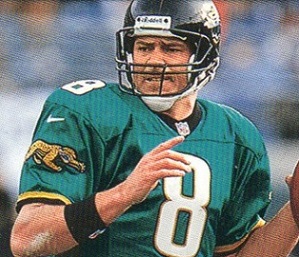
The Jacksonville Jaguars were 2-0 and coming off of their bye week as they hosted the Pittsburgh Steelers on September 22, 1997. Moreover, Head Coach Tom Coughlin’s team had won those games with two different backup quarterbacks at the helm due to a knee injury suffered by QB Mark Brunell (pictured above), who led the NFL with 4367 passing yards in 1996, and he was now returning to action. Overachievers who went all the way to the AFC title game the previous year, the third-year expansion team had won six straight regular season games dating back to the previous November.

Pittsburgh, coached by Bill Cowher, was accustomed to contending. Third-year QB Kordell Stewart was new to the starting lineup but the ground game was led by dependable RB Jerome Bettis and the defense was typically tough. The Steelers split their first two games.

There were 73,016 fans in attendance at Alltel Stadium for the Monday night game. The Jaguars had the game’s first possession and drove 68 yards in ten plays. Mark Brunell converted a third-and-10 situation with a pass to WR Keenan McCardell for 15 yards and RB Natrone Means ran for five yards on a third-and-three play. Consecutive throws by Brunell were complete to McCardell for 15 yards and to WR Jimmy Smith for 23 to reach the Pittsburgh three yard line and two plays later Means gained the final yard for a touchdown. Mike Hollis added the extra point.

Pittsburgh WR Will Blackwell returned the ensuing kickoff 99 yards, but the play was nullified by a holding penalty. However, the Steelers proceeded with an 80-yard scoring series that took six plays. The biggest was a third down throw by Kordell Stewart to WR Charles Johnson that picked up 49 yards to the Jacksonville 12 and, following a six-yard run by RB Jerome Bettis, Stewart scrambled for a six-yard TD. Norm Johnson’s kick tied the score at 7-7.

A short Jacksonville series ended with a punt but the Jaguars got the ball back three plays later when Stewart fumbled when sacked by DE Tony Brackens and LB Eddie Robinson recovered at the Pittsburgh 38. In a possession that stretched into the second quarter, Means ran for nine yards on first down and Brunell completed three passes, the last to Smith for an 11-yard TD. Hollis converted to give the home team a 14-7 lead.

The Steelers started off with the ball at their 42 following a 40-yard kickoff return by Blackwell, but after reaching the Jacksonville 39 they were forced to punt. A long series by the Jaguars started off with Brunell being sacked by LB Levon Kirkland for a loss of 11 yards but Brunell threw to Smith for 29 yards and, a few plays later and facing third-and-20, connected with RB James Stewart for 29 yards to the Pittsburgh 43. It appeared that the drive was finally thwarted when Brunell was sacked for a seven-yard loss by DT Oliver Gibson and then threw an incomplete pass when facing third-and-15 at the Pittsbugh 38. But punter Bryan Barker passed instead of kicking and it was complete to DB Dana Hall for a 22-yard gain. However, after getting to the 11, the home team came up empty when Hollis missed a 29-yard field goal attempt.

Jacksonville got the ball back two plays later when Stewart’s pass was intercepted by CB Aaron Beasley, who returned it five yards to the Pittsburgh 35 with 1:21 remaining in the first half. Brunell completed four passes and Hollis was successful on a 20-yard field goal to give the Jaguars a 17-7 halftime lead. Jacksonville had thus far dominated time of possession, holding onto the ball for 21 of the game’s first 30 minutes.


Down by ten, the Steelers started off the third quarter with a 13-play, 80-yard drive. Bettis (pictured at right) ran for 44 yards on 7 carries, with a long of 16, RB George Jones contributed an 18-yard run, and Stewart completed three passes, the last to WR Yancey Thigpen for a four-yard touchdown. Norm Johnson’s point after narrowed the score to 17-14.

The Jaguars, helped along by a pass interference penalty on the Steelers, came back with a series that resulted in Hollis kicking a 45-yard field goal. Another long Blackwell kickoff return that covered 52 yards put the Steelers at the Jacksonville 48 and, on a seven- play drive that featured a 19-yard run by Bettis and a Stewart toss to Charles Johnson for 26 yards, they scored on the first play of the fourth quarter as Stewart connected with TE Mark Bruener for a one-yard TD. Norm Johnson’s extra point put the visitors in front by 21-20.

The Jaguars again reached Pittsburgh territory as Brunell passed to Smith for a 41-yard pickup but, after the drive was stopped at the 19, Hollis failed on a 38-yard try for a go-ahead field goal. The Steelers had to punt on their next series and Jacksonville again had a long possession that ran over six minutes off the clock and was helped along by a critical unnecessary roughness penalty on DE Nolan Harrison to nullify a third down sack. Brunell completed six passes, three of them to Smith and the longest to WR Reggie Barlow for 18 yards, and this time Hollis came through with a 27-yard field goal that put the Jaguars back on top by 23-21 with 4:14 remaining to play.

Starting from their 40 following Blackwell’s 30-yard kickoff return, the Steelers kept the ball on the ground and also received help with a five-yard penalty on the Jaguars on a fourth-and-one play. Stewart threw to Thigpen for a 21-yard gain to the Jacksonville 25 and Pittsburgh was at the 22 when Norm Johnson came on to attempt a final-play field goal from 40 yards to win the game. However, the snap was low and the holder, QB Mike Tomczak, had difficulty in getting the ball set, placing it at a bad angle. Johnson’s kick was blocked by DE Clyde Simmons and safety Chris Hudson recovered and ran 58 yards for a touchdown. Hollis added the superfluous extra point and the Jaguars not only avoided a last-second defeat but won in stunning fashion by a final score of 30-21.

Jacksonville led in total yards (343 to 306), first downs (23 to 19), and time of possession (33:55 to 26:05), although Pittsburgh was much better at controlling the ball in the second half. The Jaguars were stifled on the ground as Pittsburgh outgained them, 153 to 40, but had a big lead in net passing yards (303 to 153). The Steelers turned the ball over twice, to none by Jacksonville. Pittsburgh led in sacks (three to two) but also in penalties (6 for 82 yards, against four for 35 yards against Jacksonville). The teams combined for just three punts (two by Pittsburgh, one for the Jaguars) although both clubs had trouble on field goals, with Mike Hollis missing two from under 40 yards and Norm Johnson’s lone attempt being botched at the end.

Mark Brunell completed 24 of 42 passes for 306 yards and a touchdown with none intercepted. Jimmy Smith had a big performance with 10 catches for 164 yards and a TD and Keenan McCardell contributed 6 receptions for 51 yards. Natrone Means rushed for 40 yards on 24 carries that included a score.

For the Steelers, Kordell Stewart was successful on 11 of 16 throws for 155 yards and two TDs while giving up an interception, and also ran the ball 7 times for 19 yards and a touchdown. Jerome Bettis, who came on strong in the second half, gained 114 yards on 21 rushing attempts. Yancey Thigpen caught 5 passes for 53 yards and a TD and Charles Johnson gained 88 yards on his four receptions. Will Blackwell averaged 37.8 yards on four kickoff returns. 

“This was a big win for us because it was on Monday night, it was against the Steelers, and because of the way we won,” said Mark Brunell.

“We just found a way to win,” said Coach Coughlin. “I told the team on Sunday night to never take anything for granted because a lot of teams had trouble this season with field goals.”

Jacksonville lost the following week but was at 5-1 before losing two more, including the rematch with the Steelers. The pattern of a flashy passing game and mediocre ground attack held throughout the season. The Jaguars ended up with an 11-5 record, as did Pittsburgh, and the Steelers won the AFC Central title due to the net division points tiebreaker. Jacksonville was demolished by Denver in the Wild Card playoff round while Pittsburgh reached the AFC Championship before also losing to the Broncos in a closer contest.

Mark Brunell went on to lead the AFC in passing with a 91.2 rating as he completed 60.7 percent of his passes for 3281 yards and 18 touchdowns while giving up just seven interceptions. He was selected to a second straight Pro Bowl where he was joined by Jimmy Smith, who accumulated 82 catches for 1324 yards (16.1 avg.) and four TDs.

September 13, 2016

1982: Third Quarter Surge Lifts Steelers to Win Against Cowboys


With the threat of an impending players’ strike looming, the Pittsburgh Steelers and Dallas Cowboys met in a first-week Monday night game on September 13, 1982. There were streaks on the line as the Steelers had beaten Dallas four straight times, including twice in Super Bowl meetings, while the Cowboys had won 18 consecutive season-opening games.

Pittsburgh was entering its 14th season under Head Coach Chuck Noll, and four of those campaigns had ended with NFL Championships. However, the Steelers missed the postseason the previous two years, including 1981 when they broke even at 8-8. Many of the aging stalwarts of the title-winning years were still on the roster, including QB Terry Bradshaw, FB Franco Harris, WR John Stallworth (pictured above), LB Jack Ham, and CB Mel Blount.  But DT “Mean Joe” Greene had retired and MLB Jack Lambert was injured and would be replaced by David Little, one of several rookies debuting on defense.

The Cowboys were coached by Tom Landry, as they had been since 1960, and coming off back-to-back 12-4 seasons that had concluded with losses in the NFC title game. QB Danny White was solid, if not spectacular, and there were dependable targets in wide receivers Tony Hill and Drew Pearson plus tight ends Billy Joe DuPree and Doug Cosbie. RB Tony Dorsett was coming off of a 1646-yard rushing season that nearly topped the NFL. The defense remained tough from front to back, even with the retirements of SS Charlie Waters and OLB D.D. Lewis.

There were 63,431 fans in attendance for the nationally-televised contest at Texas Stadium with the game-time temperature at 85 degrees. On the opening kickoff, DB Fred Bohannon of the Steelers fumbled after returning it 33 yards and the Cowboys recovered at the Pittsburgh 41. However, after driving to the 15, they turned the ball over when an errant handoff was recovered by David Little.

The Steelers struck back, gaining 26 yards on three plays before Terry Bradshaw threw to John Stallworth for a 48-yard pickup to the Dallas six yard line. A running play lost yardage, but Bradshaw again connected with Stallworth, this time in the corner of the end zone where he outmaneuvered CB Dennis Thurman for an eight-yard touchdown. The extra point attempt failed when rookie holder Rick Woods muffed the snap, but the visitors held the early lead.

The Cowboys advanced 66 yards in eight plays that featured Danny White falling at one point but recovering to throw to Doug Cosbie for a 30-yard gain. The drive ended with White passing to Drew Pearson for a four-yard TD and, with Rafael Septien successfully converting, the home team was up by 7-6.

Pittsburgh responded with a nine-play, 61-yard series that stretched into the second quarter. It concluded with Bradshaw firing a pass to WR Jim Smith, who made a diving catch in the end zone for a seven-yard touchdown. Gary Anderson, appearing in his first regular season game, was successful on the point after this time and the visitors were back on top by 13-7.

Dallas came back with an 80-yard drive in 10 plays. Facing third-and-two at the Pittsburgh 12, a scrambling White connected with Cosbie in the end zone for a TD. Septien booted the extra point and the Cowboys led by 14-13. Each club had a chance to add three points before the end of the half, but Septien missed wide on a 52-yard field goal attempt and Anderson’s 35-yard try for the Steelers was blocked by DT John Dutton. Dallas maintained a one-point edge at halftime.

On the first possession of the third quarter, the Cowboys were forced to punt from their 16. DE Keith Willis charged in from the left side to block Danny White’s kick and Pittsburgh took possession at the 19. Five plays later, Thurman was called for pass interference at the goal line and RB Frank Pollard powered in from the one for a touchdown. Anderson added the extra point and the visitors were in front by 20-14.

On the next Dallas possession, a third down pass by White was deflected and intercepted by Rick Woods, playing at safety, who returned it 12 yards to the Dallas 35. The Steelers took five plays to reach the end zone as Franco Harris started off with an eight-yard carry and Pollard ran 11 yards around end. Bradshaw threw to Jim Smith for a 15-yard TD and Anderson converted to extend the lead to 27-14.

Three plays into the next Cowboy series, White was again picked off, this time by Jack Ham. Bradshaw threw to Stallworth for a gain of 21 yards but the Pittsburgh drive was halted short of a touchdown this time, although Anderson booted a 26-yard field goal. Down by a point at the half, the Steelers were now ahead by 30-14.

The Cowboys went three-and-out on the ensuing possession and punted from their 21. Taking over at the Dallas 48, Pittsburgh advanced 22 yards and, early in the fourth quarter, Anderson added a 43-yard field goal to expand the lead to 33-14.


Now in a deep hole, the Cowboys fought back on a five-play, 76-yard drive that concluded with White throwing long for Tony Hill (pictured at left) and a 45-yard touchdown. Septien converted to make the score 33-21.

The Cowboys regained possession at their 32 and White connected with Cosbie for a 26-yard gain and, on a trick play, White tossed the ball to Pearson who fired long to Hill for 26 yards to the Pittsburgh 15. A pass by White to Hill in the end zone was dropped but the Steelers were penalized for illegal contact. Now with a first down at the Pittsburgh 10, an offside penalty moved the ball five yards further and White tossed another scoring pass, this time to Billy Joe DuPree. The Pittsburgh lead was narrowed to 33-28 with 5:47 remaining in regulation.

The Steelers, needing to run the clock down, put together a long drive of 49 yards in 10 plays that featured Bradshaw connecting with RB/WR Greg Hawthorne for 22 yards on a first-and-20 play following a holding penalty and with TE Bennie Cunningham for a three-yard completion to convert a third-and-three situation at the Dallas 36. After three running plays, Anderson came in kick a 40-yard field goal that clinched the 36-28 win for Pittsburgh.

Dallas accumulated more total yards (436 to 388) and first downs (28 to 23). However, the Cowboys also turned the ball over four times, to one by the Steelers, and in the crucial third quarter that was the key to Pittsburgh building a big lead. The Steelers also recorded three sacks, to one for Dallas, but were penalized eight times while three flags were thrown on the Cowboys.


Terry Bradshaw (pictured at right) completed 17 of 28 passes for 246 yards and three touchdowns while giving up no interceptions. John Stallworth had a big night with 7 catches for 137 yards and a TD. Jim Smith caught two passes for 22 yards and both were good for touchdowns. Franco Harris rushed for 103 yards on 24 carries, the fortieth hundred-yard game of his career, and also had three pass receptions for 29 yards.

For the Cowboys, Danny White was successful on 25 of 36 throws for 347 yards and four TDs while being intercepted twice. Two receivers reached the hundred yard threshold with Tony Hill pulling in 6 passes for 130 yards and a touchdown and Doug Cosbie caught 5 for 102 yards and a score. Tony Dorsett topped the club with 30 yards on 11 rushing attempts and also had 5 receptions for 44 yards.

“We lost it in the third quarter,” said Coach Tom Landry in defeat. “You can’t expect to give a team what we gave them and expect to beat them. You can’t expect to give a team like that five turnovers and do anything. The whole game was the third quarter.”

Both teams won the following week, after which the players’ strike materialized and wiped out the next two months. When they returned to action in November, each went on to finish at 6-3 in the abbreviated season. With divisions eliminated for the year, for Pittsburgh that meant a fourth-place ranking in the AFC. The Steelers lost to San Diego in the first round of the resulting postseason tournament. Dallas was second in the NFC and again reached the NFC Championship game, losing to the Washington Redskins.

August 5, 2016

Highlighted Year: Jack Butler, 1957

Defensive Halfback, Pittsburgh Steelers


Age: 30 (Nov. 12)
7th season in pro football & with Steelers
College: St. Bonaventure
Height: 6’0”   Weight: 195

Prelude:
Butler, who originally intended to study for the priesthood, didn’t play football until college where he made the team as an end. Undrafted by the NFL, he signed with the Steelers in 1951 and was shifted to defensive halfback (modern cornerback) where he intercepted 5 passes as a rookie, one of which he returned for a touchdown. Butler followed up with 7 in 1952 and 9 in ’53 but he did not gain his first Pro Bowl selection until 1955 (oddly enough, the only season of his career in which he had no interceptions). He received first-team All-NFL honors from The Sporting News, second-team recognition from the Associated Press and NEA, and was a Pro Bowl selection again in ’56, when he picked off 6 passes to give him a total of 31 through his first six seasons.

1957 Season Summary
Appeared in all 12 games
[Bracketed numbers indicate league rank in Top 20]

Interceptions – 10 [1, tied with Jack Christiansen & Milt Davis]
Int. return yards – 85 [10]
Int. TDs – 0
Fumble recoveries – 1

Punt Returns
Returns – 1
Yards – 10
TDs – 0

Awards & Honors:
1st team All-NFL: AP, UPI, NEA, NY Daily News, Sporting News
Pro Bowl

Steelers went 6-6 to finish third in the NFL Eastern Conference while leading the league in fewest yards allowed (2791).

Aftermath:
Butler was a consensus first-team All-NFL selection in 1958 and ’59, when his career came to a sudden end late in the season due to a knee injury. An outstanding all-around athlete who played safety as well as defensive halfback throughout his career, he combined excellent instincts with rugged tackling ability. Overall, over the course of 103 games Butler intercepted 52 passes, which ranked second in NFL history at the time, returning them for 877 yards and four touchdowns. He also recovered 10 fumbles, one of which he returned for a TD. Butler was a consensus first-team All-NFL selection three times, received second-team honors after one other season, and was chosen to four straight Pro Bowls. He was inducted into the Pro Football Hall of Fame, Class of 2012.

--

Highlighted Years features players who were consensus first-team All-League* selections or league* or conference** leaders in the following statistical categories:

Rushing: Yards, TDs (min. 10)
Passing: Yards, Completion Pct., Yards per Attempt, TDs, Rating
Receiving: Catches, Yards, TDs (min. 10)
Scoring: TDs, Points, Field Goals (min. 5)
All-Purpose: Total Yards
Defense: Interceptions, Sacks
Kickoff Returns: Average
Punt Returns: Average
Punting: Average

*Leagues include NFL (1920 to date), AFL (1926), AFL (1936-37), AAFC (1946-49), AFL (1960-69), WFL (1974-75), USFL (1983-85)

**NFC/AFC since 1970