Showing posts with label Franco Harris. Show all posts

September 13, 2016

1982: Third Quarter Surge Lifts Steelers to Win Against Cowboys


With the threat of an impending players’ strike looming, the Pittsburgh Steelers and Dallas Cowboys met in a first-week Monday night game on September 13, 1982. There were streaks on the line as the Steelers had beaten Dallas four straight times, including twice in Super Bowl meetings, while the Cowboys had won 18 consecutive season-opening games.

Pittsburgh was entering its 14th season under Head Coach Chuck Noll, and four of those campaigns had ended with NFL Championships. However, the Steelers missed the postseason the previous two years, including 1981 when they broke even at 8-8. Many of the aging stalwarts of the title-winning years were still on the roster, including QB Terry Bradshaw, FB Franco Harris, WR John Stallworth (pictured above), LB Jack Ham, and CB Mel Blount.  But DT “Mean Joe” Greene had retired and MLB Jack Lambert was injured and would be replaced by David Little, one of several rookies debuting on defense.

The Cowboys were coached by Tom Landry, as they had been since 1960, and coming off back-to-back 12-4 seasons that had concluded with losses in the NFC title game. QB Danny White was solid, if not spectacular, and there were dependable targets in wide receivers Tony Hill and Drew Pearson plus tight ends Billy Joe DuPree and Doug Cosbie. RB Tony Dorsett was coming off of a 1646-yard rushing season that nearly topped the NFL. The defense remained tough from front to back, even with the retirements of SS Charlie Waters and OLB D.D. Lewis.

There were 63,431 fans in attendance for the nationally-televised contest at Texas Stadium with the game-time temperature at 85 degrees. On the opening kickoff, DB Fred Bohannon of the Steelers fumbled after returning it 33 yards and the Cowboys recovered at the Pittsburgh 41. However, after driving to the 15, they turned the ball over when an errant handoff was recovered by David Little.

The Steelers struck back, gaining 26 yards on three plays before Terry Bradshaw threw to John Stallworth for a 48-yard pickup to the Dallas six yard line. A running play lost yardage, but Bradshaw again connected with Stallworth, this time in the corner of the end zone where he outmaneuvered CB Dennis Thurman for an eight-yard touchdown. The extra point attempt failed when rookie holder Rick Woods muffed the snap, but the visitors held the early lead.

The Cowboys advanced 66 yards in eight plays that featured Danny White falling at one point but recovering to throw to Doug Cosbie for a 30-yard gain. The drive ended with White passing to Drew Pearson for a four-yard TD and, with Rafael Septien successfully converting, the home team was up by 7-6.

Pittsburgh responded with a nine-play, 61-yard series that stretched into the second quarter. It concluded with Bradshaw firing a pass to WR Jim Smith, who made a diving catch in the end zone for a seven-yard touchdown. Gary Anderson, appearing in his first regular season game, was successful on the point after this time and the visitors were back on top by 13-7.

Dallas came back with an 80-yard drive in 10 plays. Facing third-and-two at the Pittsburgh 12, a scrambling White connected with Cosbie in the end zone for a TD. Septien booted the extra point and the Cowboys led by 14-13. Each club had a chance to add three points before the end of the half, but Septien missed wide on a 52-yard field goal attempt and Anderson’s 35-yard try for the Steelers was blocked by DT John Dutton. Dallas maintained a one-point edge at halftime.

On the first possession of the third quarter, the Cowboys were forced to punt from their 16. DE Keith Willis charged in from the left side to block Danny White’s kick and Pittsburgh took possession at the 19. Five plays later, Thurman was called for pass interference at the goal line and RB Frank Pollard powered in from the one for a touchdown. Anderson added the extra point and the visitors were in front by 20-14.

On the next Dallas possession, a third down pass by White was deflected and intercepted by Rick Woods, playing at safety, who returned it 12 yards to the Dallas 35. The Steelers took five plays to reach the end zone as Franco Harris started off with an eight-yard carry and Pollard ran 11 yards around end. Bradshaw threw to Jim Smith for a 15-yard TD and Anderson converted to extend the lead to 27-14.

Three plays into the next Cowboy series, White was again picked off, this time by Jack Ham. Bradshaw threw to Stallworth for a gain of 21 yards but the Pittsburgh drive was halted short of a touchdown this time, although Anderson booted a 26-yard field goal. Down by a point at the half, the Steelers were now ahead by 30-14.

The Cowboys went three-and-out on the ensuing possession and punted from their 21. Taking over at the Dallas 48, Pittsburgh advanced 22 yards and, early in the fourth quarter, Anderson added a 43-yard field goal to expand the lead to 33-14.


Now in a deep hole, the Cowboys fought back on a five-play, 76-yard drive that concluded with White throwing long for Tony Hill (pictured at left) and a 45-yard touchdown. Septien converted to make the score 33-21.

The Cowboys regained possession at their 32 and White connected with Cosbie for a 26-yard gain and, on a trick play, White tossed the ball to Pearson who fired long to Hill for 26 yards to the Pittsburgh 15. A pass by White to Hill in the end zone was dropped but the Steelers were penalized for illegal contact. Now with a first down at the Pittsburgh 10, an offside penalty moved the ball five yards further and White tossed another scoring pass, this time to Billy Joe DuPree. The Pittsburgh lead was narrowed to 33-28 with 5:47 remaining in regulation.

The Steelers, needing to run the clock down, put together a long drive of 49 yards in 10 plays that featured Bradshaw connecting with RB/WR Greg Hawthorne for 22 yards on a first-and-20 play following a holding penalty and with TE Bennie Cunningham for a three-yard completion to convert a third-and-three situation at the Dallas 36. After three running plays, Anderson came in kick a 40-yard field goal that clinched the 36-28 win for Pittsburgh.

Dallas accumulated more total yards (436 to 388) and first downs (28 to 23). However, the Cowboys also turned the ball over four times, to one by the Steelers, and in the crucial third quarter that was the key to Pittsburgh building a big lead. The Steelers also recorded three sacks, to one for Dallas, but were penalized eight times while three flags were thrown on the Cowboys.


Terry Bradshaw (pictured at right) completed 17 of 28 passes for 246 yards and three touchdowns while giving up no interceptions. John Stallworth had a big night with 7 catches for 137 yards and a TD. Jim Smith caught two passes for 22 yards and both were good for touchdowns. Franco Harris rushed for 103 yards on 24 carries, the fortieth hundred-yard game of his career, and also had three pass receptions for 29 yards.

For the Cowboys, Danny White was successful on 25 of 36 throws for 347 yards and four TDs while being intercepted twice. Two receivers reached the hundred yard threshold with Tony Hill pulling in 6 passes for 130 yards and a touchdown and Doug Cosbie caught 5 for 102 yards and a score. Tony Dorsett topped the club with 30 yards on 11 rushing attempts and also had 5 receptions for 44 yards.

“We lost it in the third quarter,” said Coach Tom Landry in defeat. “You can’t expect to give a team what we gave them and expect to beat them. You can’t expect to give a team like that five turnovers and do anything. The whole game was the third quarter.”

Both teams won the following week, after which the players’ strike materialized and wiped out the next two months. When they returned to action in November, each went on to finish at 6-3 in the abbreviated season. With divisions eliminated for the year, for Pittsburgh that meant a fourth-place ranking in the AFC. The Steelers lost to San Diego in the first round of the resulting postseason tournament. Dallas was second in the NFC and again reached the NFC Championship game, losing to the Washington Redskins.

December 24, 2015

1977: Broncos Defeat Steelers in AFC Divisional Playoff


The AFC Divisional playoff game on December 24, 1977 featured the Denver Broncos, champions of the AFC West at 12-2 and newcomers to the postseason, hosting the Pittsburgh Steelers, AFC Central champs for the fourth straight year with a 9-5 record.

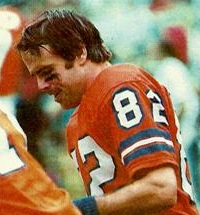
The Broncos, coached by Red Miller, were appearing in the postseason for the first time in a franchise history dating back to 1960 in the American Football League. They had made it with a conservative offense directed by QB Craig Morton (pictured above), who was new to Denver but a 35-year-old veteran previously with Dallas and the Giants. The key to success was the rugged “Orange Crush” defense that included DE Lyle Alzado, linebackers Randy Gradishar and Tom Jackson, CB Louis Wright, and SS Bill Thompson.

Pittsburgh had enjoyed great success under Head Coach Chuck Noll, winning back-to-back Super Bowls following the 1974 and ’75 seasons and reaching the AFC title game in 1976. However, there had been off-field turmoil heading into the 1977 season and the team was uncharacteristically turnover-prone on offense and less dominating on defense, and they lost to Denver during the regular season. Still, the nucleus of QB Terry Bradshaw, FB Franco Harris, and wide receivers Lynn Swann on offense and DT “Mean Joe” Greene, linebackers Jack Lambert and Jack Ham, and CB Mel Blount on defense was intact.

It was a sunny day at Mile High Stadium with over 75,000 fans in attendance and they saw the teams exchange punts to start the game. The Steelers had to punt again following their second possession but the kick by Rick Engles was blocked by WR John Schultz and Denver had the ball at the Pittsburgh 17. HB Rob Lytle carried four straight times, the last for a seven-yard touchdown, and Jim Turner added the extra point for a 7-0 lead.

The clubs resumed trading punts as the game moved into the second quarter. The Steelers finally mounted a scoring drive that covered 56 yards in 11 plays. Terry Bradshaw converted a third-and-nine situation with a pass to TE Bennie Cunningham that covered 19 yards and Franco Harris (pictured below) ran effectively, including a 14-yard run on a fourth-and-one play at the Denver 27. Two carries by HB Rocky Bleier and a Bradshaw throw to Lynn Swann had the visitors facing first-and-goal at the two, and while it took three plays, the Steelers got a TD when Bradshaw leaped into the end zone from just inches away. Roy Gerela converted to tie the score.


The Broncos had to punt again and the Steelers advanced to their 45 before Harris fumbled after being hit by DE Lyle Alzado and LB Tom Jackson recovered and returned it 30 yards. On the next play, HB Otis Armstrong ran 10 yards for a touchdown and, with Turner’s point after, the home team was back on top by 14-7.

The Steelers started their next series with 4:04 remaining in the first half and drove 65 yards in nine plays. Bradshaw completed four passes, the longest to John Stallworth for 21 yards, and just after the two-minute warning Harris took a handoff, started to his right, and then reversed field for a 20-yard gain to the Denver two. Two plays later, Harris ran to the right for a one-yard TD and, with Gerela’s kick, the score was once more knotted at 14-14, and that was the tally at the half. The Steelers had outgained Denver by 183 yards to 44, but the ability of the Broncos to capitalize on the blocked punt and fumble to stay even on the scoreboard.

The teams again exchanged punts to start the third quarter. Denver advanced deep into Pittsburgh territory on its second series, with the big plays passes by Craig Morton to WR Haven Moses for 27 yards and TE Jim Jensen for 29. That gave the Broncos a first-and-goal at the two, but the Steelers kept them out of the end zone as Armstrong ran for a yard, Morton had a pass batted down, and Lytle was stopped three inches short of the goal. Jensen gained nothing on a fourth down run and the Broncos turned the ball over on downs.

The Steelers were pinned back at their one and the resulting short possession led to a punt that gave the ball back to Denver at the Pittsburgh 41. Four plays later, Morton passed to TE Riley Odoms, who gathered the ball in at the six and ran the remaining distance for a 30-yard touchdown. Turner converted and the Broncos again had a seven-point lead at 21-14.

Pittsburgh had to punt on the last play of the period and Denver’s first series of the fourth quarter resulted in a punt as well. WR Jim Smith returned the kick 17 yards to the Pittsburgh 39 and, following a short run by Bleier, Bradshaw fired passes to Cunningham for 11 yards and Stallworth for 48 yards to the Denver one. From there on the next play, Bradshaw threw to Larry Brown, a tackle lined up at end, for a TD. Gerela kicked the extra point and the score again was tied.

The Broncos responded with a 39-yard drive in seven plays. Morton threw to Armstrong for a nine-yard gain and followed with a pass to Moses for 18 yards to the Pittsburgh 36. Lytle ran for three yards and a Morton bootleg picked up six. While a third-and-one pass was tipped and fell incomplete, Turner kicked a 44-yard field goal that staked Denver to a 24-21 lead.

Smith returned the ensuing kickoff 34 yards to give the Steelers good starting field position at their 40, but on their second play a Bradshaw pass was intercepted by Jackson, who returned it 32 yards to the nine yard line. The Broncos couldn’t reach the end zone from there but came away with another Turner field goal, this time from 25 yards, to extend the lead to 27-21.


Pittsburgh took over again on offense with just over five minutes to play and Bradshaw came out throwing. He had four completions, one to Cunningham for 12 yards to convert a third down and another to Bleier for seven yards in a third-and-six situation. But his next pass was picked off at midfield by Jackson, making yet another big play on defense, and the linebacker ran it back 17 yards. Two plays later, with the defense anticipating that the Broncos would keep the ball on the ground, Morton fired long to WR Jack Dolbin (pictured at right) in the end zone for a 34-yard touchdown. While the Steelers had one more possession, the game was effectively over. Denver won by a final score of 34-21.

The Steelers had more total yards (304 to 258) and first downs (18 to 15), but also turned the ball over four times, to one by Denver. Pittsburgh also was hurt by 10 penalties, at a cost of 67 yards, to three flags for 20 yards thrown on the Broncos.

Craig Morton completed 11 of 23 passes for 164 yards and two touchdowns with no interceptions. Otis Armstrong topped the Broncos with 44 rushing yards on 11 carries that included a TD and Rob Lytle contributed 26 yards and a score on his 12 attempts. Riley Odoms had 5 catches for 43 yards and a touchdown and Haven Moses gained 45 yards on his two pass receptions. Tom Jackson (pictured below) was the defensive star with the two big interceptions plus a fumble recovery.


For the Steelers, Terry Bradshaw was successful on 19 of 37 throws for 177 yards and a TD, but gave up three interceptions. Franco Harris gained 92 yards on 28 carries that included a touchdown and also caught four passes for another 20 yards. John Stallworth also had four receptions, for a team-leading 80 yards.

Denver, having achieved its first playoff victory, went on to defeat the division-rival Oakland Raiders for the AFC Championship but was dominated in the Super Bowl by the Dallas Cowboys. The Steelers, with many commentators suggesting that they were a fading club following the disappointing 1977 season, bounced back to win the next two Super Bowls and defeated the Broncos at the Divisional level in ’78.

January 6, 2015

1980: Steelers Defeat Oilers for Second Straight Year in AFC Title Game


The AFC Championship game on January 6, 1980 featured a rematch of the previous year’s participants, the Pittsburgh Steelers and Houston Oilers. The clubs were rivals in the AFC Central, where the Steelers had finished first with a 12-4 record and then thrashed the Dolphins in a Divisional playoff game and Houston came in second at 11-5 to qualify for the postseason as a Wild Card, defeating Denver in the first round and then upsetting the Chargers in their Divisional game. The teams had split their games during the regular season, each winning at home.

Under Head Coach Chuck Noll, the Steelers had won the Super Bowl the previous season and three in five years. At 31, QB Terry Bradshaw (pictured above) was at the height of his abilities and directed the NFL’s highest-scoring offense that included wide receivers Lynn Swann and John Stallworth plus the running of FB Franco Harris, who crossed the thousand-yard rushing threshold for the seventh time in eight years. HB Rocky Bleier was splitting time with Sidney Thornton, but remained a capable performer. The top-rated defense was still anchored by DT Joe Greene and contained such stalwarts as DE L.C. Greenwood, OLB Jack Ham, MLB Jack Lambert, CB Mel Blount, and SS Donnie Shell.

Houston was coached by O.A. “Bum” Phillips and featured an offense centered around second-year RB Earl Campbell, who rushed for 1697 yards and 19 TDs. QB Dan Pastorini had an outstanding deep threat in WR Ken Burrough (40 catches, 752 yards, 18.8 avg.). However, Campbell was playing hurt and had missed the Divisional playoff game and Burrough was below par and ended up seeing little action against the Steelers. The heart of Houston’s 3-4 defense was NT Curley Culp and linebackers Robert Brazile and Gregg Bingham, and there were other notable performers in DE Elvin Bethea and FS Mike Reinfeldt, who led the NFL with 12 interceptions, plus SS Vernon Perry, who intercepted four passes in the previous week’s game.

There were 50,475 fans in attendance at Three Rivers Stadium on a bitterly cold day. The Steelers had the first possession and advanced into Houston territory thanks to a pass from Terry Bradshaw to John Stallworth for 17 yards, but after reaching the 35, a throw intended for TE Bennie Cunningham was intercepted by Vernon Perry, who returned it 75 yards for a touchdown. Toni Fritsch added the extra point.

The teams exchanged punts, but the Oilers started off at their 17 and lost yards when Dan Pastorini was sacked on third down back to his 10 by L.C. Greenwood. Cliff Parsley’s 31-yard punt gave Pittsburgh the ball at the Houston 40 and Bradshaw immediately threw to Lynn Swann for 15 yards. A penalty moved the Steelers back and they were facing a third-and-14 situation when Bradshaw, unable to find an open receiver, scrambled for 25 yards to the four yard line. They couldn’t penetrate the end zone from there, but Matt Bahr kicked a 21-yard field goal to narrow Houston’s margin to 7-3.

The Oilers made a big play on their next series when Pastorini completed a screen pass to FB Tim Wilson that gained 41 yards to the Pittsburgh 44. Two plays netted a loss of a yard, but on third-and-14 Pastorini threw to HB Ronnie Coleman for 32 yards. Two plays into the second quarter, Fritsch kicked a 27-yard field goal to put the Oilers up by 10-3.


The Steelers responded with a 67-yard drive in 10 plays. Bradshaw completed five passes, starting the series with a 17-yard completion to Swann, keeping it going with third down throws to Rocky Bleier for eight yards and Swann for 11, and finishing it off with a seven-yard pass to Cunningham for a touchdown (pictured at left). Bahr kicked the point after to tie the score at 10-10.

Houston’s next series ended with a third-and-19 pass from Pastorini to WR Mike Renfro that was complete, but the receiver fumbled and Mel Blount recovered for the Steelers. Pittsburgh advanced 49 yards in six plays as Harris and Bleier ran effectively and Harris also gained 15 yards on a swing pass. Bradshaw threw to Stallworth for a 20-yard TD, Bahr converted, and Pittsburgh was in front by 17-10.

The Oilers regained possession with 2:25 to go in the first half, and on the third play CB Dwayne Woodruff intercepted a Pastorini pass to give the Steelers the ball at their 45. However, after reaching the Houston 23 with seven seconds to go, Bahr’s 40-yard field goal attempt was wide and the score remained unchanged at halftime.

The teams traded punts throughout the third quarter, with neither able to mount a drive until the Oilers, starting from their own 14 with 6:39 remaining in the period, advanced methodically down the field. Pastorini completed three passes, with one to Renfro (pictured below) for a 21-yard gain to the Pittsburgh 23 and a third-and-seven throw to Coleman for 14 yards to the six. The visitors could get no farther, with a pass to Renfro in the corner of the end zone ruled incomplete because the receiver failed to maintain possession before going out of bounds (a call that was vigorously disputed), and on the first play of the fourth quarter, Fritsch kicked a 23-yard field goal to narrow Pittsburgh’s lead to 17-13.


The Steelers came back with an 11-play, 55-yard possession. Franco Harris ran for 13 yards on first down and Bradshaw completed a pass to Swann for 21 yards on a third-and-21 play. The series finally stalled at the Houston 22 and Bahr was successful on a 39-yard field goal attempt, once more putting the defending champs ahead by seven points.

A penalty on the ensuing kickoff had the Oilers starting from their 11 and, while Pastorini completed five passes, the last one to WR Guido Merkens resulted in a fumble that Donnie Shell recovered for the Steelers at the Houston 45. Harris ran twice for eight yards and, on third-and-two, Bradshaw threw to Bleier for a 20-yard gain. With Harris and Bleier picking away, Pittsburgh reached the four, and from there it was Bleier running for a touchdown. Bahr added the extra point, but with less than a minute remaining on the clock, the result was not in doubt. The Steelers won by a final score of 27-13.

Pittsburgh led in total yards (358 to 227) and first downs (22 to 11), grinding out 161 yards on the ground and holding the Oilers to 24 rushing yards. Houston turned the ball over three times, to two suffered by the Steelers, although the Oilers had a three to one edge in sacks.


Terry Bradshaw completed 18 of 30 passes for 219 yards and two touchdowns while giving up one interception. Franco Harris (pictured at left) rushed for 85 yards on 21 carries and also caught six passes for 50 yards. Lynn Swann gained 64 yards on four pass receptions and John Stallworth added three catches for 52 yards that included a TD. Rocky Bleier contributed 52 yards on 13 rushing attempts and caught three passes for 39 yards.

For the Oilers, Dan Pastorini was successful on 19 of 28 throws for 203 yards and no TDs while being picked off once. Earl Campbell was well defensed by the Steelers, who did an excellent job of closing off his running lanes, and he was held to just 15 yards on 17 carries. Tim Wilson, who gained nine yards on four rushing attempts, led the team with 7 catches for 60 yards. Mike Renfro had three receptions for 52 yards, but it was the one that was ruled incomplete in the end zone late in the third quarter that drew the most comments afterward.

Of that controversial call on the non-catch in the end zone, Houston’s Bum Phillips summed up by saying “The officials are human. We had fifty-nine other minutes to beat Pittsburgh.”

The Steelers went on to defeat the Rams in the Super Bowl, giving them back-to-back titles and a total of four in six years. Houston again went 11-5 in 1980, finishing second to the Browns this time (Pittsburgh fell to third place at 9-7). The Oilers didn’t make it to the conference title game, as they were routed by Oakland in the Wild Card playoff round (a defeat that cost Coach Phillips his job).

December 10, 2014

1977: TDs Off Turnovers Lead Bengals to Win Against Steelers


The Cincinnati Bengals and Pittsburgh Steelers were both fighting for supremacy in the AFC Central as they met on December 10, 1977. The Bengals, coached by Bill Johnson, had gotten off to a 2-4 start and were 4-5 before a three-game winning streak pulled them up to 7-5 and a chance to win the division. QB Ken Anderson, normally a precision passer, was having a less stellar year but was still formidable. He was missing star WR Isaac Curtis due to a knee injury but second-year backup WR Billy Brooks (pictured above) was proving to be a good deep threat in his place and Pat McInally, the punter, was also effective in the other spot. Two ex-Ohio State stars, FB Pete Johnson and HB Archie Griffin, were the ball carriers. The Bengals had lost six consecutive games to the Steelers, including earlier in the season, and that made the difference in their placing second in each of the previous two years.

Pittsburgh had won three straight division titles, and twice went on to win the Super Bowl. The Steelers were coached by Chuck Noll, who had broken his arm due to slipping on ice and falling the night before the game and was wearing a cast. It was symbolic of a season in which Pittsburgh, while still formidable, was having difficulties, getting off to a 4-4 start before also turning hot and winning four straight games prior to the rematch with Cincinnati. There were off-field distractions that seemed to affect the club’s performance, which showed in the offense turning the ball over with greater frequency and the defense giving up more points.  

It was a bitterly cold Saturday for the game at Riverfront Stadium with temperatures down to single digits. Attendance was low at 36,133, with 23,518 no-shows. While the sky was clear, the artificial surface was frozen and in poor condition.

The Steelers had the game’s first possession, but on their third play CB Lemar Parrish intercepted a pass by QB Terry Bradshaw and returned it 47 yards for a touchdown. Chris Bahr added the extra point and the home team had a quick 7-0 lead.

On the next series, and following a holding penalty on the kickoff return that had the Steelers starting from their 12 yard line, HB Rocky Bleier fumbled and the Bengals gained possession at the Pittsburgh 7. However, Cincinnati came up empty when, facing fourth-and-goal at the one, Pete Johnson was stopped short of the goal line by linebackers Jack Ham and Jack Lambert.

The teams exchanged punts before the Bengals, starting from their 29, drove to the Pittsburgh 20. A pass interference penalty on a third-and-eight play gave Cincinnati 17 yards as well as a first down and Ken Anderson threw to TE Bob Trumpy for a 13-yard gain. But Bahr’s 37-yard field goal attempt was wide to the left and yet another scoring opportunity was for naught.

The Steelers were driving as the opening period drew to a close. Bradshaw completed a pass to TE Bennie Cunningham for 22 yards and FB Franco Harris ran effectively. On the first play of the second quarter, Harris picked up the last five yards for a TD and Roy Gerela’s point after tied the score.

The Bengals punted after a short series and Pittsburgh put together another promising drive as Bradshaw completed passes to WR Lynn Swann for 17 yards and Cunningham for 23. But a holding penalty backed the visitors up and the series stalled at the Cincinnati 42, forcing a punt.

Another Cincinnati punt was followed by another long possession by the Steelers. Harris rushed for 45 yards on six carries, Bleier had a 16-yard run, and Bradshaw completed two passes. A fourth down was converted when Bradshaw threw to Swann for 19 yards. With 51 seconds remaining in the first half, Gerela kicked a 32-yard field goal and Pittsburgh took a 10-7 lead into halftime.


On the first series of the third quarter, the Bengals advanced into Pittsburgh territory, but an Anderson pass was intercepted by CB Mel Blount. The Steelers were forced to punt but got the ball back three plays later when Billy Brooks fumbled after catching a pass for 35 yards and CB Jim Allen recovered. Bradshaw completed passes to rookie WR Jim Smith (pictured at left), subbing for the injured Swann, on consecutive plays and the Steelers reached the Cincinnati 24 before Harris fumbled the ball back to the Bengals.

Anderson immediately threw to Brooks for a big gain of 57 yards and, after the series stalled at the Pittsburgh seven, Bahr tied the game with a 24-yard field goal. On the ensuing kickoff, Smith fumbled on the return and Anderson again went to the air on first down, connecting with Pat McInally for a 43-yard touchdown. Bahr added the extra point to put the Bengals, who had scored ten points in just 18 seconds of playing time, ahead by seven points.

Early in the fourth quarter, the Steelers had a promising series following a Cincinnati punt. Bradshaw threw to Smith for a 27-yard pickup and a personal foul on the Bengals following a completion to WR John Stallworth gave Pittsburgh a first down at the Cincinnati 20. But Harris again fumbled after catching a short pass and CB Ken Riley recovered to end the threat.

With just under ten minutes to play, the Bengals put together another good drive. Anderson threw to McInally for 21 yards on a third-and-seven play, Johnson had a 17-yard run and Archie Griffin a 13-yard catch on a screen pass and 15-yard carry in a second-and-13 situation. But the Bengals couldn’t gain any further ground after reaching the Pittsburgh six and Bahr’s 24-yard field goal attempt hit the right upright and was no good.

A three-and-out series by the Steelers was followed by a Cincinnati possession that ended with Griffin fumbling and FS Glen Edwards recovering at the Pittsburgh 21. With the clock down to 1:51, Bradshaw threw to Harris for a gain of 17 yards and to Stallworth for 20 yards to the Cincinnati 40. But a sack by DE Gary Burley lost seven yards and, while an offsides penalty on the Bengals regained five yards, Bradshaw was unable to complete any more passes. A fourth-and-12 throw fell incomplete to clinch the 17-10 win for the Bengals.

Cincinnati had the edge in total yards (413 to 362) although the Steelers accumulated more first downs (21 to 17). Pittsburgh turned the ball over five times, to three suffered by the Bengals, and the Steelers were penalized 11 times, at a cost of 95 yards, to five flags for 55 yards thrown on Cincinnati.


Ken Anderson was successful on 15 of 33 throws, but they generated 303 yards and he had a touchdown as well as an interception. Billy Brooks caught 6 passes for 166 yards and Pat McInally (pictured at right) contributed 71 yards on three receptions that included the game-deciding TD. Archie Griffin topped the Bengals with 61 rushing yards on 13 carries and added another 31 on four catches.  Pete Johnson had 51 yards on 15 attempts.

For the Steelers, Franco Harris rushed for 101 yards in the first half, but was held to minus-six yards in the second and ended up with a net of 95 yards on 25 carries that included one touchdown. Terry Bradshaw completed 20 of 39 passes for 246 yards and had no touchdowns while giving up one interception. Four receivers caught four passes apiece, with Jim Smith gaining 80 yards on his first four pro receptions (although he also had the critical fumble on a kickoff return) and Bennie Cunningham generating 64 yards on his four.

“We beat them, and we beat them right,” exclaimed a jubilant Coach Johnson to his celebrating players in the locker room.

“It was a hell of a game between two good teams under lousy circumstances,” said Chuck Noll from the Pittsburgh side. “But it wasn’t exactly a fun afternoon out there for us today.”

The win put Cincinnati in the driver’s seat in the race for the AFC Central title, but the Bengals failed to cash in when they lost to Houston in the season finale. They finished at 8-6, falling to third place. Pittsburgh ended up on top at 9-5 with a win at San Diego. The Steelers were ousted by Denver in the Divisional playoff round.

Billy Brooks caught 39 passes for 772 yards (19.8 avg.) and four touchdowns in what was the most productive of his five NFL seasons. Pat McInally had 17 receptions for 258 yards (15.2 avg.) and three TDs. He also punted 67 times for a 41.8-yard average.

Jim Smith had no more pass receptions for the Steelers in ‘77, being used almost exclusively on kick returns in his rookie season. He would go on to catch 110 passes for 2075 yards and 24 touchdowns in six years with Pittsburgh before departing for the USFL.

January 7, 2014

1979: Steelers Bury Oilers to Win AFC Championship


The AFC Championship game on January 7, 1979 featured the Pittsburgh Steelers, seeking to return to the Super Bowl after falling short the previous two seasons, against the division-rival Houston Oilers. Under Head Coach Chuck Noll, the Steelers were in the playoffs for the seventh straight year. In his ninth season, QB Terry Bradshaw (pictured above) was at his best and had wide receivers Lynn Swann and John Stallworth to pass to while FB Franco Harris was a consistent ground-gainer, in tandem with HB Rocky Bleier. The “Steel Curtain” defense was well-seasoned and still sound, featuring DT “Mean Joe” Greene, DE L.C. Greenwood, MLB Jack Lambert, OLB Jack Ham, and CB Mel Blount. Pittsburgh topped the AFC Central with a 14-2 record, splitting the season series with the Oilers, and easily dispatched Denver in the Divisional playoff round.

Houston was coached by O.A. “Bum” Phillips for the fourth year and was in the postseason for the first time since 1969, the last year of the American Football League. The key player on offense was FB Earl Campbell, the power-running Heisman Trophy winner out of Texas who led the league in rushing as a rookie (1450 yards). QB Dan Pastorini had a good year and benefited not only from Campbell’s running but the break-out season of TE Mike Barber. The defense was solid and included DE Elvin Bethea, MG Curley Culp, and LB Robert Brazile. The Oilers went 10-6 to finish second in the division to Pittsburgh and defeated Miami in the Wild Card playoff game and the Patriots at the Divisional level to advance to the AFC title game.

It promised to be a rugged contest. The last time the teams met during the regular season, 13 players were injured during the course of the game, including Earl Campbell, who suffered a broken rib.

49,417 fans were in attendance on a wet day at Three Rivers Stadium, with a cold rain leaving puddles scattered on the artificial surface. The precipitation occurred throughout the contest, but the partisan crowd was enthusiastic and waved their “Terrible Towels” in earnest.

The tempo was set on Houston’s first play when Earl Campbell took a handoff and was tackled by Jack Ham for a loss of two yards. The Oilers went three-and-out and punted, with WR Theo Bell returning the kick 12 yards to give the Steelers good field position at their own 43. They went 57 yards in five plays, the biggest a pass from Terry Bradshaw to Lynn Swann for 34 yards. Franco Harris ran for a seven-yard touchdown, Roy Gerela kicked the extra point, and Pittsburgh had the early lead.

Following another Houston series that ended with a punt, Bradshaw completed back-to-back passes to TE Randy Grossman that picked up 29 and 14 yards, respectively, to reach the Houston 21, but two plays later CB Willie Alexander came up with an interception. The Oilers weren’t able to take advantage – two plays after that, Mel Blount returned the favor by picking off a throw by Pastorini, and his 16-yard return gave Pittsburgh the ball at the Houston 26.


The Steelers couldn’t move in three plays and Gerela’s 40-yard field goal attempt fell short. Once again the Oilers gave the ball back as Campbell fumbled and Ham recovered for Pittsburgh at the Houston 17. Harris fumbled the slippery ball on the next play, but the Steelers maintained possession and Rocky Bleier (pictured at right) went around right end for 15 yards and a TD. Gerela added the PAT and Pittsburgh took a 14-0 lead into the second quarter.

The ball was hard to handle and, at one point in the second quarter, there were fumbles on three consecutive plays. Bradshaw fumbled on first down from his own 32 and, while the Steelers recovered, it was at a cost of 20 yards. Harris carried and lost the handle on the ball, with Robert Brazile recovering for the Oilers at the Pittsburgh 19. Campbell then fumbled on Houston’s first play, but managed to recover, and the Oilers, helped by a pass interference penalty, advanced to first-and-goal at the four. They couldn’t reach the end zone and settled for a Toni Fritsch field goal of 19 yards to at least get on the board.

The Steelers responded by driving into Houston territory, with Bradshaw scrambling for 13 yards and then passing to Swann for 18. But two plays after Bradshaw connected with Bleier for a 16-yard gain to the five yard line, he was again intercepted, this time by CB Greg Stemrick in the end zone.

L.C. Greenwood sacked Pastorini on the next play and Houston went three-and-out and had to punt. Harris fumbled twice on the ensuing series, the second recovered by the Oilers at their own 30. The clock showed 2:16 remaining in the half, but before it was over the Steelers put the game out of reach.

Pastorini threw to HB Ronnie Coleman, but after he gained 15 yards, Ham stripped the ball away and made the recovery. Four plays later, and with the clock down to 52 seconds, Bradshaw connected with Swann for a 29-yard touchdown. The extra point put the Steelers ahead by 21-3.

On the ensuing kickoff, WR Johnnie Dirden fumbled the return and HB Rick Moser recovered for Pittsburgh at the Houston 17. After a run by Harris gained nothing, Bradshaw threw to John Stallworth for a touchdown from that distance. However, the first half scoring still wasn’t over. On Houston’s next play, Coleman again fumbled and DT Steve Furness recovered at the Oilers’ 24. Gerela kicked a 37-yard field goal and, in a matter of less than two minutes, the Steelers had scored 17 points and taken a commanding 31-3 lead.

The second half was only a formality. The Steelers had the first possession in the third quarter and punted, but two plays later Ham intercepted a Pastorini pass and it set up another Gerela field goal, this time from 22 yards.

MG Ken Kennard recovered a fumbled handoff for Houston at the Pittsburgh 20, but SS Donnie Shell intercepted a Pastorini throw that gave the Steelers the ball at their one yard line. The Oilers did come up with points when LB Ted Washington tackled Bleier in the end zone for a safety, but that was it. Houston’s next two possessions ended in interceptions as the Steelers continued to dominate on defense. Pittsburgh won the AFC title by a final score of 34-5 and moved on to the Super Bowl.

The teams combined for 12 fumbles, breaking a 45-year-old NFL record. The Oilers lost four of their six fumbles and also gave up five interceptions (four in the second half alone) on the way to a staggering total of nine turnovers. Pittsburgh turned the ball over five times, three on fumbles and twice on intercepted passes. The Steelers outgained Houston by 379 yards to 142, running for 179 yards while holding the Oilers to 72 rushing yards – their seventh straight contest in which they held their opponent to under a hundred yards on the ground. Pittsburgh also recorded four sacks, to none by Houston.

Terry Bradshaw completed 11 of 19 passes for 200 yards and two touchdowns with two intercepted. Franco Harris ran for 51 yards on 20 carries that included a TD, and fumbled four times in the first half, losing two. Rocky Bleier contributed 45 yards and a score on 10 rushing attempts and also caught four passes for another 42 yards. Lynn Swann also had four pass receptions, for a total of 98 yards and a touchdown. Defensively, Jack Ham (pictured below, tackling Earl Campbell) had a sack, an interception, and recovered two fumbles while Jack Lambert was credited with 11 tackles.


Earl Campbell was held to 62 yards on 22 carries and fumbled three times, losing one. Dan Pastorini was successful on 12 of 26 throws for 96 yards with the five interceptions. TE Rich Caster had 5 catches for 44 yards and FB Tim Wilson also caught 5, for 33 yards.

Responding after the game to a pre-game comment by Bum Phillips that the Oilers were breaking off diplomatic relations with the Steelers and declaring war, Coach Chuck Noll wryly commented, “Our football team wanted an unconditional surrender. And we got it.”

“The big thing was the fact that we got up on them so fast,” explained Jack Ham. “To try to play catch-up football in that weather was about impossible.”

The Steelers went on to defeat the Dallas Cowboys in the Super Bowl and repeated the next year. The Oilers again finished second in the AFC Central in 1979 and advanced once more to a showdown with Pittsburgh for the AFC Championship, which the Steelers won by a score of 27-13.

September 20, 2013

Rookie of the Year: Franco Harris, 1972

Fullback, Pittsburgh Steelers


Age: 22
College: Penn State
Height: 6’2”   Weight: 230

Prelude:
Following a college career in which he played in the shadow of HB Lydell Mitchell at Penn State, Harris was chosen by the Steelers in the first round (13th overall) of the 1972 NFL draft. It was hoped that he would provide needed depth at running back and he was also valued for his blocking ability.

1972 Season Summary
Appeared in all 14 games
[Bracketed numbers indicate league rank in Top 20]

Rushing
Attempts – 188 [15]
Most attempts, game - 21 (for 61 yds.) at Houston 12/10
Yards – 1055 [6]
Most yards, game – 138 yards (on 15 carries) at Buffalo 10/29
Average gain – 5.6 [4]
TDs – 10 [3]
100-yard rushing games – 7

Pass Receiving
Receptions – 21      
Most receptions, game – 4 (for 26 yds.) vs. Cleveland 12/3
Yards – 180
Most yards, game - 39 (on 2 catches) vs. Cincinnati 11/5
Average gain – 8.6
TDs – 1

Kickoff Returns
Returns – 8
Yards – 183
Average per return – 22.9
TDs – 0
Longest return – 32 yards

Scoring
TDs – 11 [7]
Points – 66

Postseason: 2 G
Rushing attempts – 34
Most rushing attempts, game – 18 vs. Oakland, AFC Divisional playoff
Rushing yards – 140
Most rushing yards, game - 76 vs. Miami, AFC Championship
Average gain rushing – 4.1
Rushing TDs – 0

Pass receptions – 7
Most pass receptions, game - 5 vs. Oakland, AFC Divisional playoff
Pass receiving yards - 99
Most pass receiving yards, game - 96 vs. Oakland, AFC Divisional playoff
Average yards per reception – 14.1
Pass Receiving TDs - 1

Awards & Honors:
NFL Rookie of the Year: NEA
NFL Offensive Rookie of the Year: AP, PFWA
AFC Rookie of the Year: UPI, Sporting News
2nd team All-NFL: AP, NEA
1st team All-AFC: Sporting News
2nd team All-AFC: UPI
Pro Bowl

Steelers went 11-3 to finish first in the AFC Central while ranking second in the NFL in rushing yards (2520). Won AFC Divisional playoff over Oakland Raiders (13-7). Lost AFC Championship to Miami Dolphins (21-17).

Aftermath:
Harris had a lesser year in 1973 due to nagging injuries, rushing for 698 yards and averaging almost two yards less per carry than during his rookie season (3.7). Still, he was again chosen to the Pro Bowl. Harris overcame early injuries in ’74 to rush for 1006 yards and was outstanding in the postseason, in particular with 158 yards in a MVP performance as the Steelers won the Super Bowl over Minnesota. It was the first of six straight thousand-yard seasons and eight overall. He was selected to nine straight Pro Bowls, was a consensus first-team All-NFL selection once, and received at least some All-NFL or All-AFC recognition in five other years. Harris played 12 seasons with the Steelers and finished up in 1984 with a year in Seattle. At the time of his retirement, his 12,120 rushing yards ranked third in NFL history (with 11,950 of that coming with Pittsburgh, the most in franchise history). His 100 touchdowns ranked fifth and he added 1556 rushing yards and 17 TDs in playoff games. Harris was inducted into the Pro Football Hall of Fame, Class of 1990. 

--


Rookie of the Year Profiles feature players who were named Rookie of the Year in the NFL, AFL (1960-69), or USFL (1983-85) by a recognized organization (Associated Press – Offense or Defense, Newspaper Enterprise Association, United Press International, The Sporting News, or the league itself – Pepsi NFL Rookie of the Year). 

September 12, 2013

1976: Late Rally Propels Raiders Over Steelers


Two of the strongest teams in the NFL’s American Football Conference faced off in a season-opening game on September 12, 1976. The Oakland Raiders had won their fourth straight AFC West title in ’75 under Head Coach John Madden, although they had once again come up short of reaching the Super Bowl. QB Ken “The Snake” Stabler (pictured at right) guided a talented offense and the defense was a tough veteran unit. One notable change was that, after nine years with the Raiders and 26 as a pro, 48-year-old placekicker and reserve QB George Blanda had finally been forced into retirement by rookie PK Fred Steinfort.

The visiting Pittsburgh Steelers were coming off back-to-back NFL titles. Coached by Chuck Noll, they were solid in every way, with QB Terry Bradshaw, the running of FB Franco Harris and HB Rocky Bleier, the talented young wide receiver tandem of Lynn Swann and John Stallworth, and the best overall defense in the NFL featuring such stalwarts as DT “Mean Joe” Greene (coming off an injury in ’75), DE L.C. Greenwood, MLB Jack Lambert, OLB Jack Ham, and CB Mel Blount.

There were 51,371 fans in attendance at the Oakland-Alameda County Coliseum for the big opening week matchup. The Raiders drove to the Pittsburgh 30 on the first series of the game, but Fred Steinfort’s 47-yard field goal attempt was blocked. Following a punt by the Steelers, Oakland again drove into Pittsburgh territory. Ken Stabler converted a third-and-five situation at his own 33 with a pass to WR Cliff Branch that gained 16 yards and three plays later, facing third-and-13, “The Snake” again went to Branch, this time for 26 yards to the Pittsburgh 28. But after advancing to the 14, Stabler tried for Branch in the end zone and was intercepted by FS Glen Edwards. The Raiders once more came up empty.

The Steelers advanced to the Oakland 35 with Rocky Bleier and Franco Harris running effectively and Terry Bradshaw completing one pass, to Bleier for 21 yards. But on a second down play, Bleier fumbled after making another good run and LB Monte Jackson recovered for the Raiders.


Finishing off the opening period, Stabler completed passes to HB Clarence Davis for nine yards and FB Mark van Eeghen for 16 yards to the Pittsburgh 45. Five plays into the second quarter, Stabler connected with TE Dave Casper (pictured at left) for a 30-yard touchdown. Steinfort’s extra point put the home team up by 7-0.

After the teams traded punts, the Steelers drove down the field, once again thanks to the solid running of Harris and Bleier. An 18-yard gain by Harris on a draw play put the visitors on the Oakland six, but the Steelers were finally halted at the two yard line. They came away with nothing when Roy Gerela was wide on the short 20-yard field goal try.

After the Raiders punted again, the Steelers took over at their 14 and put together a nine-play, 86-yard series. A pass on third-and-eight from Bradshaw to Bleier picked up 24 yards and was followed by an 11-yard completion to Lynn Swann to the Oakland 49. Three plays later, another Bradshaw pass down the middle to Harris picked up 39 yards to the five yard line and Bleier finished off the possession with a two-yard touchdown carry. Gerela tied the score at 7-7 and that was the tally at the half.

Neither team was able to mount much offense in the third quarter until midway through the period when, with the ball at the Pittsburgh 37, Bradshaw threw to Harris who ran for 25 yards before FS Jack Tatum grabbed him around the legs. As Harris was being tackled, he lateraled to John Stallworth, and he proceeded to the end zone for a 63-yard touchdown.

Stabler threw interceptions to end each of the next two Oakland possessions. The second one gave Pittsburgh the ball at the Raiders’ 39 and on the third play of the fourth quarter Bradshaw connected with WR Theo Bell for an 11-yard touchdown. The Steelers were up by 21-7.

The Raiders responded by driving 67 yards in seven plays. Stabler completed three passes, the last one to WR Fred Biletnikoff making a diving catch for a 21-yard TD. But Pittsburgh came back with a series that included two Bradshaw completions to Stallworth, for 25 and 20 yards, and helped by two penalties on the Raiders, reached the Oakland three from where Harris ran up the middle for a touchdown.

Stabler was picked off by Mel Blount on Oakland’s next play from scrimmage and, with less than six minutes left on the clock, the Steelers were ahead by 28-14 and driving. But with a first down at the Oakland 19, Harris fumbled and Monte Johnson recovered for the Raiders at the 25.

Making the most of the break, Stabler completed three straight passes and, following a facemask penalty on the Steelers and an 11-yard run by RB Pete Banaszak, he completed one more to Casper for a ten-yard TD.

The reeling Steelers had a short series followed by a punt that was partially blocked and gave Oakland the ball at the Pittsburgh 29. Stabler tossed three straight incomplete passes before, on a fourth-and-ten play, he hit Branch for 27 yards to the two. “The Snake” rolled out on the next play and ran the last two yards and, with Steinfort’s successful conversion, the game was tied at 28-28.

With time running out and the Steelers trying to win the game in regulation, Bradshaw fired a pass intended for rookie WR Ernie Pough that was deflected by DT Dave Rowe and picked off by LB WIllie Hall, who returned it to the Pittsburgh 12. Steinfort kicked a 21-yard field goal to put the Raiders ahead with 21 seconds remaining. Time ran out for the Steelers following two Bradshaw completions to the Oakland 48, and the Raiders came away with a dramatic 31-28 win.

Statistically, the game was as even as the final score. Oakland had a slight edge in total yards (440 to 438) and first downs (28 to 24). The Steelers gained more yards on the ground (196 to 116) while the Raiders were more proficient through the air (324 to 242). Each team recorded two sacks apiece. Oakland turned the ball over four times, to three suffered by Pittsburgh.

Ken Stabler completed 21 of 38 passes for 342 yards and three touchdowns, but also gave up four interceptions. Dave Casper had 7 catches for 124 yards and two TDs and Cliff Branch and Fred Biletnikoff had four receptions apiece, for 83 and 67 yards, respectively. Pete Banaszak led the Raiders with 41 rushing yards on 10 carries and Mark van Eeghen was right behind as he gained 40 yards on 13 attempts.


For the Steelers, Terry Bradshaw was successful on 15 of 27 throws for 253 yards with a TD and an interception. Rocky Bleier (pictured at right) ran for 73 yards and a touchdown on 20 carries and Franco Harris added 68 yards on 18 attempts that also included a score, although he also had the big fumble. John Stallworth caught 6 passes for 94 yards.

“It changed the game around,” said Franco Harris of his key fumble in the fourth quarter. “It’s hard to say what happened, I was just trying to get by one man.”

The Raiders lost only one game all season as they topped the AFC West at 13-1 and advanced to a Super Bowl win over the Vikings. They met Pittsburgh again for the AFC Championship, the Steelers having recovered from a slow 1-4 start to finish first in the AFC Central at 10-4. Pittsburgh had been Oakland’s nemesis in the postseason, having eliminated them in the previous two years on their way to the top, and three times in four meetings commencing with the “Immaculate Reception” win in 1972. But in 1976, it was the Raiders stopping Pittsburgh’s drive to a potential third straight NFL title and grabbing the Lombardi Trophy for themselves.

Ken Stabler went on to be a first-team All-NFL and Pro Bowl selection, as well as winning the Bert Bell Trophy as NFL Player of the Year. He led the league in passing (103.4 rating), completion percentage (66.7), yards per attempt (9.4), and touchdown passes (27). Cliff Branch (46 catches, 1111 yards, 12 TDs) and Dave Casper (53 catches, 691 yards, 10 TDs) joined him with the All-NFL and Pro Bowl honors.

Fred Steinfort, however, lasted just half the season after converting on only four of eight field goal attempts and 16 of 19 extra points. He would catch on with Atlanta the next year and go on to a seven-season career, with his greatest success coming as a member of the Denver Broncos.

January 20, 2013

1980: Steelers Make Big Plays to Overcome Rams and Win Super Bowl XIV


It looked to be a mismatch in Super Bowl XIV on January 20, 1980 as the Pittsburgh Steelers prepared to defend their NFL title against the Los Angeles Rams. Head Coach Chuck Noll’s Steelers had won the AFC Central with a 12-4 record and blew past the Dolphins and Oilers to reach the Super Bowl for the second straight year and fourth time in six seasons. QB Terry Bradshaw (pictured at right), running backs Franco Harris and Rocky Bleier, and wide receivers Lynn Swann and John Stallworth, and the line anchored by All-Pro C Mike Webster were familiar cogs on offense and the defense still contained DE L.C. Greenwood, DT “Mean Joe” Greene, MLB Jack Lambert, OLB Jack Ham, CB Mel Blount, and SS Donnie Shell. This was a well-seasoned club that slumped briefly during the regular season but was getting the job done when the games counted most and was strongly favored to retain its title.

Meanwhile the Rams, coached by Ray Malavasi, had topped the NFC West at just 9-7 and then defeated the Cowboys and upstart Buccaneers on the road to advance to the Super Bowl for the first time. To be sure, LA was no stranger to the postseason, having topped the division in each of the previous six seasons under Chuck Knox and then Malavasi, who was at the helm for the second year. The Rams had even reached the NFC Championship game four times, as recently as 1978, and had lost in each instance. Now, following their worst regular season showing since 1972, they had finally broken through in the playoffs. Injuries had played a big role in ’79, most notably when QB Pat Haden went down with a broken finger. But unproven backup QB Vince Ferragamo proved capable in relief and, relying on the sound running game and a very tough defense, the Rams won their last four games of the regular season and were at their best in the playoffs.

There was a huge crowd of 103,985 at the Rose Bowl in Pasadena, California for the Super Bowl. Los Angeles went nowhere in the game’s first series and punted. The Steelers then drove 55 yards on their initial possession, with Franco Harris and Rocky Bleier carrying the ball on eight of the ten plays and Harris gaining 32 yards after catching a swing pass from Bradshaw. However, a pass into the end zone intended for Lynn Swann was broken up by CB Pat Thomas and the series ended with Matt Bahr kicking a 41-yard field goal for the early lead.

Following a short kickoff, the Rams had good starting field position at their 41 and made the most of it, going 59 yards in eight plays. A short completion by Vince Ferragamo to HB Wendell Tyler was followed by seven runs, including one by Tyler that covered 39 yards to the Pittsburgh 14, and the last was for a touchdown from a yard out by FB Cullen Bryant.

Pittsburgh came right back as CB Larry Anderson returned the ensuing kickoff 45 yards. The Steelers took nine plays to score, with Harris running for a one-yard TD and, with the successful extra point, it was 10-7 two minutes into the second quarter. Along the way, Bradshaw completed passes of 12 yards to Swann and to TE Bennie Cunningham for 13.

LA put together another scoring possession, driving 67 yards and tying the game with a 31-yard Frank Corral field goal. The series was helped along by a pass interference penalty on Donnie Shell that picked up 20 yards.

The scoring subsided as the teams traded punts until SS Dave Elmendorf intercepted a Bradshaw pass to give the Rams the ball at the Pittsburgh 39. They were only able to advance 12 yards in eight plays, with Ferragamo sacked twice, including one by DE John Banaszak for a 14-yard loss on a third-and-10 play, but Corral kicked another field goal, this time from 45 yards with 14 seconds left before halftime. LA was on top by 13-10 at the intermission. The first half had been remarkably even on both sides, with the one turnover accounting for the difference in the score.

The Steelers got off to a fast start in the third quarter. Anderson returned the kickoff 37 yards and five plays later Bradshaw connected with a double-covered Swann who made a leaping grab for a 47-yard touchdown. However, Los Angeles responded in kind. It took just four plays as Ferragamo threw to WR Billy Waddy for a 50-yard gain to the Pittsburgh 24 and, on the next play, Ferragamo handed off to RB Lawrence McCutcheon who, sweeping to the right, held up and tossed an option pass to WR Ron Smith that resulted in a TD. Corral shanked the extra point attempt but the Rams were back in front by 19-17.


Near the end of the period, CB Rod Perry intercepted a Bradshaw pass deep in his own territory to snuff out a promising Pittsburgh drive. After advancing to its 23, Los Angeles had to punt it back. Three plays later, and early in the fourth quarter, the Steelers struck back as a heavily-pressured Bradshaw passed to John Stallworth, the ball barely making it over Perry’s outstretched hand, for an electrifying 73-yard touchdown (pictured at left).

After the teams traded punts, the Rams again drove into Steelers territory but Jack Lambert intercepted a Ferragamo pass at the Pittsburgh 14 to snuff out the threat. The Steelers drove 70 yards for another score. Bradshaw again went long for Stallworth, who gained 45 yards to the LA 22. Four plays later, and with the help of a pass interference penalty on Thomas, Harris scored a second TD from a yard out.

The last gasp by the Rams ended when they had to give up the ball on downs at the Pittsburgh 37. The Steelers were once again league champions by a score of 31-19.

Pittsburgh led in total yards (393 to 301) and first downs (19 to 16), although the Rams defense performed remarkably well against the vaunted ground attack of the Steelers, which compiled just 84 yards on 37 running plays. The Steelers sacked Ferragamo four times, while the Rams pressured but failed to sack Bradshaw. Pittsburgh turned the ball over three times, all on interceptions (neither team fumbled during the game), to one by the Rams.

Terry Bradshaw, the contest’s MVP, completed 14 of 21 passes for 309 yards and two touchdowns as well as the three interceptions. Lynn Swann caught 5 of those throws for 79 yards and a TD while John Stallworth, thanks to the two big plays in the fourth quarter, gained 121 yards on his three receptions that included a score. Franco Harris had two short touchdown carries but gained only 46 yards on 20 attempts while Rocky Bleier contributed 25 yards on 10 carries. Also of note, Larry Anderson (pictured below) gained 162 yards on five kickoff returns, a Super Bowl record at the time.


For the Rams, Vince Ferragamo was successful on 15 of 25 throws for 212 yards with no TDs and had one picked off while Lawrence McCutcheon had the one option scoring pass. Wendell Tyler, who took such a beating during the game that he had to leave periodically due to bouts of nausea, topped the running game with 60 yards on 17 carries and was one of three LA receivers with three catches. His gained 20 yards while Billy Waddy totaled 75 yards on his three receptions and Cullen Bryant picked up 21 to go along with his 30 yards on 6 running attempts that included a touchdown.

With the fourth NFL Championship in six years, the Steelers were at the pinnacle of their success during the Chuck Noll era. The club slipped from its perch in 1980, dropping to 9-7 and missing the playoffs. While the decline would not be precipitous – Pittsburgh returned to the postseason in 1983 and did not post a losing record until 1985 - the players who were keys to the four titles began to age and depart and their successors were not as talented. The Steelers did not appear in another Super Bowl until the 1995 season.

The Rams, who moved from the Memorial Coliseum to Anaheim Stadium in 1980, failed to win the NFC West but still made it into the playoffs again as a Wild Card entry with an improved 11-5 tally. They were eliminated in the opening round of the postseason, however, and fell under .500 in ’81. They would not participate in another NFC title game until 1985 or reach the Super Bowl until 1999, when the franchise was in St. Louis. 

November 25, 2012

1979: Bradshaw Out-Duels Sipe as Steelers Edge Browns in Overtime


The Pittsburgh Steelers were defending NFL Champions and off to a 9-3 start in 1979 but found themselves in a dogfight in the AFC Central with the Houston Oilers, also 9-3, and Cleveland Browns at 8-4. On November 25 they hosted the Browns. Head Coach Chuck Noll’s team was coming off a humiliating loss at San Diego the previous week but still contained the key players that made the Steelers a champion three times in the previous five seasons, including future Hall of Famers QB Terry Bradshaw (pictured above), RB Franco Harris, DT “Mean Joe” Greene, MLB Jack Lambert, and CB Mel Blount.

The Browns, under Head Coach Sam Rutigliano, were a resurgent and exciting team, prone to playing in games that weren’t decided until the last seconds. QB Brian Sipe had emerged as a fine passer and clutch performer and had good receivers to throw to in wide receivers Dave Logan and Reggie Rucker and TE Ozzie Newsome.

There were 48,773 fans at Three Rivers Stadium. The Browns went 75 yards in 11 plays on their opening possession despite Sipe being sacked once for a nine-yard loss. Sipe completed 5 of 6 passes, including three that converted third downs and the last a scoring toss of 21 yards to Newsome.

DB Larry Anderson fumbled when returning the ensuing kickoff and CB Ron Bolton recovered for the Browns at the three yard line. Cleveland couldn’t penetrate the end zone from there and settled for a 20-yard Don Cockroft field goal to go up by 10-0.

Pittsburgh came back with Bradshaw throwing to WR John Stallworth for a 34-yard gain to the Cleveland 35. It set up a 45-yard field goal by Matt Bahr and the score was 10-3.

HB Dino Hall returned the next kickoff 33 yards to give the Browns good starting field position at their 44. In a series that continued into the second quarter, Cleveland went 56 yards in 13 plays, helped along by a defensive holding penalty that converted a punting situation into a first down. Sipe completed a pass to Newsome for 20 yards and Cockroft kicked another field goal, this time from 32 yards, to make it 13-3.

Pittsburgh moved into scoring territory on its next possession but Bahr was wide on a 39-yard field goal attempt. Getting the ball back, RB Rocky Bleier gained 31 yards on four carries and Franco Harris (pictured below) had another for 11 yards. After TE Bennie Cunningham just missed scoring on a pass into the end zone – he was stripped before gaining possession – Bahr was successful on a 34-yard field goal try.


Another good kickoff return of 28 yards by Hall once again gave Cleveland good field position and the Browns made the most of it as Sipe threw to Newsome for seven yards and then to HB Calvin Hill for 30. On a third-and-seven play, Sipe threw to Dave Logan for a 16-yard touchdown and 20-6 lead.

The Steelers, down by 14 points, came back on a drive highlighted by a sensational catch by Cunningham for a 10-yard gain, another Bradshaw throw to WR Lynn Swann for 17 yards, back to Cunningham for 20, and throws to Bleier and Harris that picked up a total of 15 yards. The 76-yard series ended with a short scoring throw to Harris. It was 20-13 at halftime.

The Browns put together a scoring series in the third quarter. Sipe threw to Logan for gains of 20 and 18 yards and to Reggie Rucker for 18. On a third-and-18 play at the Pittsburgh 33, Sipe connected with Logan for 23 yards to the 10. The possession ended with Sipe’s three-yard scoring pass to Hill.

Pittsburgh again fought back with an 89-yard drive in 10 plays. A third down was converted with a Bradshaw pass to TE Randy Grossman for 47 yards. Harris scored for the Steelers from a yard out on the first play of the fourth quarter.

Pittsburgh’s defense forced the Browns to punt on the next series and it seemed as though the momentum was with the Steelers. However, the Browns got breaks when they recovered a fumble by Harris, who was stripped by SS Clarence Scott after picking up eight yards, and then Jack Lambert kept Cleveland’s ensuing drive alive by roughing Sipe on a third down play. It resulted in a field goal of 40 yards by Cockroft that put the Browns ahead by ten points.

Down by 30-20, the Steelers fought back and had a first down on the one yard line when Bradshaw was sacked. But they came back to score a touchdown on a three-yard run by Harris that, with Bahr’s extra point, made it a three-point contest.

On their ensuing possession, the Browns got a first down at midfield thanks to a face mask penalty on LB Robin Cole. However, DE L.C. Greenwood, who had an unofficial 4.5 sacks on the day (individual sacks were not officially compiled until 1982), combined with DT Steve Furness to dump Sipe shortly thereafter to force a punt. WR Theo Bell returned it 27 yards to the 50 to set up Pittsburgh’s drive to the tying points. Bahr kicked a 21-yard field goal to knot the game with 24 seconds left in regulation.

In overtime, Mel Blount and Ron Bolton both had interceptions. The game turned on a Cleveland decision to accept an illegal motion penalty on the Steelers in a second-and-ten situation. Rather than facing third-and-nine, it was second-and-fifteen, giving Pittsburgh an extra down. It proved significant when, on third down, Bradshaw took off on a 28-yard scramble to the Cleveland 38. Five plays later, Bahr booted the game-winning field goal from 37 yards with just nine seconds remaining in the extra period. Pittsburgh won by a final score of 33-30.

The Steelers led in total yards (606 to 345) and first downs (36 to 22) – indeed, Pittsburgh’s yardage total was the second-highest in club history at the time and the 36 first downs were a new franchise record. The edge was particularly notable in the ground game as Pittsburgh accumulated 255 rushing yards to Cleveland’s 62. But the Steelers also hurt themselves by turning the ball over three times (to one by the Browns) and committing 10 penalties at a cost of 95 yards (as opposed to Cleveland’s 8 for 65 yards). However, they also sacked Brian Sipe seven times, including three in the fourth quarter alone.

Terry Bradshaw completed 30 of 44 passes for 364 yards and a touchdown with one intercepted – he also ran the ball three times for 43 yards. Franco Harris rushed for 151 yards on 32 carries with two TDs and caught a career-high 9 passes for 81 yards and another score. Rocky Bleier contributed 10 carries for 61 yards and pulled in 7 passes for 45 more yards. WR John Stallworth caught 6 passes for 75 yards. Rookie Matt Bahr kicked four field goals in five attempts.

For the Browns, Brian Sipe (pictured below) was successful on 23 of 38 throws for 333 yards with three touchdowns and an interception and was also the team’s leading rusher with 30 yards on three carries. Dave Logan topped the receivers with 7 catches for 135 yards and a TD.


“This was more satisfying than blowing them out,” said Terry Bradshaw. “It has to be the most gratifying win of the year. Let that stuff about the mighty Steelers and all of that garbage die. We’re in a tough division. We could have given up several times and said the defense wasn’t playing well, but we kept coming back.”

“It was a very demanding game,” added an exhausted Franco Harris. “We had no big plays. It was nothing but long drives. That takes a lot out of you.”

“This was one of the toughest games I’ve ever played in,” said a dejected DE Lyle Alzado from the Cleveland side. “This was the toughest one to lose, too.”

The win put the Steelers in a first place tie atop the division with Houston while Cleveland fell two games back. Ultimately, Pittsburgh went on to win the AFC Central with a 12-4 record and defeat the Rams in the Super Bowl – the fourth such win since 1974. The Browns defeated the Oilers the next week but lost their remaining two contests to finish in third at 9-7.

Terry Bradshaw placed second in the league by averaging 7.9 yards per attempt, third with 3724 passing yards and fourth with 26 TD passes, although his 25 interceptions ranked second. He ended up with a fourth championship under his belt and was selected to the Pro Bowl for the third time.

Franco Harris rushed for 1186 yards on 267 carries (4.4 avg.) and 11 touchdowns. He was named to the Pro Bowl for the eighth straight year.

Brian Sipe placed second in passing yards (3793) and tied for first in TD passes (28, along with New England’s Steve Grogan). However, reflecting his gambling style of play, he also led the NFL with 26 interceptions.

In his first NFL season, Matt Bahr (pictured below) was successful on 18 of 30 field goal attempts (60 %) and led the league with 50 extra points in 52 tries. He played one more year with the Steelers but lasted a total of 17 seasons – 8.5 of them with the Browns.