Showing posts with label 1997 NFL season. Show all posts

September 22, 2016

1997: Jaguars Avoid Defeat with Blocked FG Return Against Steelers


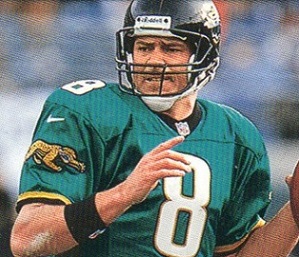
The Jacksonville Jaguars were 2-0 and coming off of their bye week as they hosted the Pittsburgh Steelers on September 22, 1997. Moreover, Head Coach Tom Coughlin’s team had won those games with two different backup quarterbacks at the helm due to a knee injury suffered by QB Mark Brunell (pictured above), who led the NFL with 4367 passing yards in 1996, and he was now returning to action. Overachievers who went all the way to the AFC title game the previous year, the third-year expansion team had won six straight regular season games dating back to the previous November.

Pittsburgh, coached by Bill Cowher, was accustomed to contending. Third-year QB Kordell Stewart was new to the starting lineup but the ground game was led by dependable RB Jerome Bettis and the defense was typically tough. The Steelers split their first two games.

There were 73,016 fans in attendance at Alltel Stadium for the Monday night game. The Jaguars had the game’s first possession and drove 68 yards in ten plays. Mark Brunell converted a third-and-10 situation with a pass to WR Keenan McCardell for 15 yards and RB Natrone Means ran for five yards on a third-and-three play. Consecutive throws by Brunell were complete to McCardell for 15 yards and to WR Jimmy Smith for 23 to reach the Pittsburgh three yard line and two plays later Means gained the final yard for a touchdown. Mike Hollis added the extra point.

Pittsburgh WR Will Blackwell returned the ensuing kickoff 99 yards, but the play was nullified by a holding penalty. However, the Steelers proceeded with an 80-yard scoring series that took six plays. The biggest was a third down throw by Kordell Stewart to WR Charles Johnson that picked up 49 yards to the Jacksonville 12 and, following a six-yard run by RB Jerome Bettis, Stewart scrambled for a six-yard TD. Norm Johnson’s kick tied the score at 7-7.

A short Jacksonville series ended with a punt but the Jaguars got the ball back three plays later when Stewart fumbled when sacked by DE Tony Brackens and LB Eddie Robinson recovered at the Pittsburgh 38. In a possession that stretched into the second quarter, Means ran for nine yards on first down and Brunell completed three passes, the last to Smith for an 11-yard TD. Hollis converted to give the home team a 14-7 lead.

The Steelers started off with the ball at their 42 following a 40-yard kickoff return by Blackwell, but after reaching the Jacksonville 39 they were forced to punt. A long series by the Jaguars started off with Brunell being sacked by LB Levon Kirkland for a loss of 11 yards but Brunell threw to Smith for 29 yards and, a few plays later and facing third-and-20, connected with RB James Stewart for 29 yards to the Pittsburgh 43. It appeared that the drive was finally thwarted when Brunell was sacked for a seven-yard loss by DT Oliver Gibson and then threw an incomplete pass when facing third-and-15 at the Pittsbugh 38. But punter Bryan Barker passed instead of kicking and it was complete to DB Dana Hall for a 22-yard gain. However, after getting to the 11, the home team came up empty when Hollis missed a 29-yard field goal attempt.

Jacksonville got the ball back two plays later when Stewart’s pass was intercepted by CB Aaron Beasley, who returned it five yards to the Pittsburgh 35 with 1:21 remaining in the first half. Brunell completed four passes and Hollis was successful on a 20-yard field goal to give the Jaguars a 17-7 halftime lead. Jacksonville had thus far dominated time of possession, holding onto the ball for 21 of the game’s first 30 minutes.


Down by ten, the Steelers started off the third quarter with a 13-play, 80-yard drive. Bettis (pictured at right) ran for 44 yards on 7 carries, with a long of 16, RB George Jones contributed an 18-yard run, and Stewart completed three passes, the last to WR Yancey Thigpen for a four-yard touchdown. Norm Johnson’s point after narrowed the score to 17-14.

The Jaguars, helped along by a pass interference penalty on the Steelers, came back with a series that resulted in Hollis kicking a 45-yard field goal. Another long Blackwell kickoff return that covered 52 yards put the Steelers at the Jacksonville 48 and, on a seven- play drive that featured a 19-yard run by Bettis and a Stewart toss to Charles Johnson for 26 yards, they scored on the first play of the fourth quarter as Stewart connected with TE Mark Bruener for a one-yard TD. Norm Johnson’s extra point put the visitors in front by 21-20.

The Jaguars again reached Pittsburgh territory as Brunell passed to Smith for a 41-yard pickup but, after the drive was stopped at the 19, Hollis failed on a 38-yard try for a go-ahead field goal. The Steelers had to punt on their next series and Jacksonville again had a long possession that ran over six minutes off the clock and was helped along by a critical unnecessary roughness penalty on DE Nolan Harrison to nullify a third down sack. Brunell completed six passes, three of them to Smith and the longest to WR Reggie Barlow for 18 yards, and this time Hollis came through with a 27-yard field goal that put the Jaguars back on top by 23-21 with 4:14 remaining to play.

Starting from their 40 following Blackwell’s 30-yard kickoff return, the Steelers kept the ball on the ground and also received help with a five-yard penalty on the Jaguars on a fourth-and-one play. Stewart threw to Thigpen for a 21-yard gain to the Jacksonville 25 and Pittsburgh was at the 22 when Norm Johnson came on to attempt a final-play field goal from 40 yards to win the game. However, the snap was low and the holder, QB Mike Tomczak, had difficulty in getting the ball set, placing it at a bad angle. Johnson’s kick was blocked by DE Clyde Simmons and safety Chris Hudson recovered and ran 58 yards for a touchdown. Hollis added the superfluous extra point and the Jaguars not only avoided a last-second defeat but won in stunning fashion by a final score of 30-21.

Jacksonville led in total yards (343 to 306), first downs (23 to 19), and time of possession (33:55 to 26:05), although Pittsburgh was much better at controlling the ball in the second half. The Jaguars were stifled on the ground as Pittsburgh outgained them, 153 to 40, but had a big lead in net passing yards (303 to 153). The Steelers turned the ball over twice, to none by Jacksonville. Pittsburgh led in sacks (three to two) but also in penalties (6 for 82 yards, against four for 35 yards against Jacksonville). The teams combined for just three punts (two by Pittsburgh, one for the Jaguars) although both clubs had trouble on field goals, with Mike Hollis missing two from under 40 yards and Norm Johnson’s lone attempt being botched at the end.

Mark Brunell completed 24 of 42 passes for 306 yards and a touchdown with none intercepted. Jimmy Smith had a big performance with 10 catches for 164 yards and a TD and Keenan McCardell contributed 6 receptions for 51 yards. Natrone Means rushed for 40 yards on 24 carries that included a score.

For the Steelers, Kordell Stewart was successful on 11 of 16 throws for 155 yards and two TDs while giving up an interception, and also ran the ball 7 times for 19 yards and a touchdown. Jerome Bettis, who came on strong in the second half, gained 114 yards on 21 rushing attempts. Yancey Thigpen caught 5 passes for 53 yards and a TD and Charles Johnson gained 88 yards on his four receptions. Will Blackwell averaged 37.8 yards on four kickoff returns. 

“This was a big win for us because it was on Monday night, it was against the Steelers, and because of the way we won,” said Mark Brunell.

“We just found a way to win,” said Coach Coughlin. “I told the team on Sunday night to never take anything for granted because a lot of teams had trouble this season with field goals.”

Jacksonville lost the following week but was at 5-1 before losing two more, including the rematch with the Steelers. The pattern of a flashy passing game and mediocre ground attack held throughout the season. The Jaguars ended up with an 11-5 record, as did Pittsburgh, and the Steelers won the AFC Central title due to the net division points tiebreaker. Jacksonville was demolished by Denver in the Wild Card playoff round while Pittsburgh reached the AFC Championship before also losing to the Broncos in a closer contest.

Mark Brunell went on to lead the AFC in passing with a 91.2 rating as he completed 60.7 percent of his passes for 3281 yards and 18 touchdowns while giving up just seven interceptions. He was selected to a second straight Pro Bowl where he was joined by Jimmy Smith, who accumulated 82 catches for 1324 yards (16.1 avg.) and four TDs.

June 24, 2016

Highlighted Year: Terrell Davis, 1997

Running Back, Denver Broncos


Age: 25 (Oct. 28)
3rd season in pro football & with Broncos
College: Georgia
Height: 5’11” Weight: 200

Prelude:
Unheralded coming out of college, Davis was taken by the Broncos in the sixth round of the 1995 NFL draft and emerged to rush for 1117 yards and catch 49 passes. In 1996 he ran for 1538 yards to lead the AFC and was named NFL Offensive Player of the Year by the Associated Press as well as being a consensus first-team All-Pro and selected to the Pro Bowl.

1997 Season Summary
Appeared and started in 15 of 16 games
[Bracketed numbers indicate league rank in Top 20]

Rushing
Attempts – 369 [2]
Most attempts, game – 42 (for 207 yds.) at Buffalo 10/26
Yards – 1750 [2, 1st in AFC]
Most yards, game – 215 yards (on 27 carries) vs. Cincinnati 9/21
Average gain – 4.7 [7]
TDs – 15 [1, tied with Karim Abdul-Jabbar]
200-yard rushing games – 2
100-yard rushing games – 10

Pass Receiving
Receptions – 42      
Most receptions, game – 7 (for 70 yds.) at Oakland 10/19
Yards – 287
Most yards, game – 70 (on 7 catches) at Oakland 10/19
Average gain – 6.8
TDs – 0

All-purpose yards – 2030 [4, 1st in AFC]

Scoring
TDs – 15 [2]
2-pt conversions – 3 [1, tied with Cris Carter]
Points – 96 [20, tied with Karim Abdul-Jabbar]

Postseason: 4 G
Rushing attempts – 112
Most rushing attempts, game – 31 vs. Jacksonville, AFC Wild Card playoff
Rushing yards – 581
Most rushing yards, game – 184 vs. Jacksonville, AFC Wild Card playoff
Average gain rushing – 5.2
Rushing TDs – 8
100-yard rushing games – 4

Pass receptions – 8
Most pass receptions, game – 4 vs. Jacksonville, AFC Wild Card playoff
Pass receiving yards – 38
Most pass receiving yards, game – 17 at Kansas City, AFC Divisional playoff
Average yards per reception – 4.8
Pass Receiving TDs – 0

Awards & Honors:
1st team All-NFL: AP, PFWA, Sporting News
1st team All-AFC: Pro Football Weekly
Pro Bowl

Broncos went 12-4 to finish second in the AFC West and qualified for the postseason as a Wild Card while leading the NFL in total yards (5872), touchdowns (55), and scoring (472 points). Won AFC Wild Card playoff over Jacksonville Jaguars (42-17), AFC Divisional playoff over Kansas City Chiefs (14-10), AFC Championship over Pittsburgh Steelers (24-21) & Super Bowl over Green Bay Packers (31-24).

Aftermath:
Davis rushed for 2008 yards and 21 touchdowns in 1998 and received consensus league MVP honors while the Broncos repeated as NFL Champions. But after rushing for 6413 yards in four years, Davis gained just 211 yards on the ground in ‘99 as he sustained a major knee injury in the fourth game. Returning in 2000, he struggled, appearing in only five contests and rushing for 282 yards. Davis ran for 701 yards in one last injury-riddled season in 2001. For his career, he gained 7607 yards on 1655 carries and added another 1280 yards on 169 pass receptions. Davis was a consensus first-team All-NFL selection three times and was selected to as many Pro Bowls in his short but productive career.

--

Highlighted Years features players who were first-team All-League* selections or league* or conference** leaders in the following statistical categories:

Rushing: Yards, TDs (min. 10)
Passing: Yards, Completion Pct., Yards per Attempt, TDs, Rating
Receiving: Catches, Yards, TDs (min. 10)
Scoring: TDs, Points, Field Goals (min. 5)
All-Purpose: Total Yards
Defense: Interceptions, Sacks
Kickoff Returns: Average
Punt Returns: Average
Punting: Average

*Leagues include NFL (1920 to date), AFL (1926), AFL (1936-37), AAFC (1946-49), AFL (1960-69), WFL (1974-75), USFL (1983-85)

**NFC/AFC since 1970

January 31, 2016

Highlighted Year: Joey Galloway, 1997

Wide Receiver, Seattle Seahawks


Age: 26 (Nov. 20)
3rd season in pro football & with Seahawks
College: Ohio State
Height: 5’11” Weight: 188

Prelude:
Galloway caught 108 passes for 1894 yards (17.5 avg.) and 19 touchdowns in college. He was chosen by the Seahawks in the first round of the 1995 NFL draft (eighth overall), who were looking to add speed at wide receiver, and moved directly into the starting lineup. Galloway caught 67 passes for 1039 yards (15.5 avg.) and seven TDs as a rookie and also returned 36 punts for a 10.0 average with one touchdown. He followed up with 57 receptions for 987 yards (17.3 avg.) and seven more TDs in 1996.

1997 Season Summary
Appeared in 15 of 16 games
[Bracketed numbers indicate league rank in Top 20]

Pass Receiving
Receptions – 72 [15, tied with Andre Rison & Shannon Sharpe]     
Most receptions, game – 8 (for 75 yds.) at St. Louis 10/19, (for 98 yds.) at Denver 11/2
Yards – 1049 [16]
Most yards, game – 117 (on 7 catches) vs. Oakland 10/26
Average gain – 14.6
TDs – 12 [2, tied with James Jett, Rod Smith & Antonio Freeman, 1st in AFC]
100-yard receiving games – 3

Rushing
Attempts – 9
Yards – 72
Yards per attempt – 8.0
TDs – 0

Scoring
TDs – 12 [5, tied with four others]
Points – 72

Seahawks went 8-8 to finish third in the AFC West while leading the NFL in passing yards (3959).

Aftermath:
Galloway had another strong year in 1998, catching 65 passes for 1047 yards (16.1 avg.) and 10 touchdowns, but a long contract holdout in ’99 cost him half the season, as well as good will with the organization, and he was traded to the Dallas Cowboys in 2000. A knee injury suffered in the first week cost him the remainder of the season and he had a mediocre year in 2001, averaging a then-career-low 13.4 yards on 52 catches. He bounced back in ’02 with 61 receptions for 908 yards (14.9 avg.) and six TDs and led the NFL by averaging 19.8 yards, although on just 34 catches, in 2003. Traded to Tampa Bay for WR Keyshawn Johnson in ’04, Galloway spent the next five seasons with the Buccaneers and, following an injury-plagued year in which he was limited to ten games, he achieved career highs with 83 receptions for 1287 yards in 2005. It was the first of three straight thousand-yard receiving seasons in his mid-thirties. A foot injury hindered his performance in 2008 and he was released, finishing up with brief stints with New England and Washington in 2009 and ’10. Overall, Galloway caught 701 passes for 10,950 yards (15.6 avg.) and 77 touchdowns, with 283 of those catches for 4457 yards and 37 TDs coming with the Seahawks. He also returned 141 punts for a 9.6-yard average and five TDs.

--

Highlighted Years features players who were consensus first-team All-League* selections or league* or conference** leaders in the following statistical categories:

Rushing: Yards, TDs (min. 10)
Passing: Yards, Completion Pct., Yards per Attempt, TDs, Rating
Receiving: Catches, Yards, TDs (min. 10)
Scoring: TDs, Points, Field Goals (min. 5)
All-Purpose: Total Yards
Defense: Interceptions, Sacks
Kickoff Returns: Average
Punt Returns: Average
Punting: Average

*Leagues include NFL (1920 to date), AFL (1926), AFL (1936-37), AAFC (1946-49), AFL (1960-69), WFL (1974-75), USFL (1983-85)

**NFC/AFC since 1970

December 14, 2015

Highlighted Year: Richie Cunningham, 1997

Placekicker, Dallas Cowboys


Age: 27
1st season in pro football
College: Louisiana - Lafayette
Height: 5’10” Weight: 167

Prelude:
Cunningham was undrafted coming out of college and first tried to make the Cowboys in 1994, losing out in training camp to Chris Boniol. He sat out the next two seasons before receiving an invitation to try out for the Packers in ’96, and while he had a good preseason, he again was cut prior to the regular season. Invited to try out again with the Cowboys in 1997, Cunningham made the team.

1997 Season Summary
Appeared in all 16 games
[Bracketed numbers indicate league rank in Top 20]

Kicking
Field goals – 34 [1]
Most field goals, game – 5 at Arizona 9/7, vs. Philadelphia 9/15
Field goal attempts – 37 [3, tied with Jeff Wilkins]
Most field goal attempts, game – 6 at Arizona 9/7
Field goal percentage – 91.9 [2]
PATs – 24
PAT attempts – 24
Longest field goal – 52 yards at Pittsburgh 8/31

Scoring
Field Goals – 34
PATs – 24
Points – 126 [2, 1st in NFC]

Awards & Honors:
1st team All-NFL: AP, Sporting News

Cowboys went 6-10 to finish fourth in the NFC East.   

Aftermath:
Cunningham followed up by kicking 29 field goals in 35 attempts in 1998 and, with a perfect 40-of-40 in extra points, scored 127 points. An ankle injury caused his performance to drop off during the ’99 season and he was let go and finished up the year with Carolina, where he also appeared in four games in 2000. Cunningham was waived by the Bengals prior to the 2001 season and had a brief stint with Jacksonville in 2002, his last year. Overall, over five active NFL seasons he kicked 84 field goals out of 105 attempts (80 %) and 119 of 120 tries for extra point for a total of 371 points. 75 field goals, 95 PATs, and 320 points came with the Cowboys.

--

Highlighted Years features players who were consensus first-team All-League* selections or league* or conference** leaders in the following statistical categories:

Rushing: Yards, TDs (min. 10)
Passing: Yards, Completion Pct., Yards per Attempt, TDs, Rating
Receiving: Catches, Yards, TDs (min. 10)
Scoring: TDs, Points, Field Goals (min. 5)
All-Purpose: Total Yards
Defense: Interceptions, Sacks
Kickoff Returns: Average
Punt Returns: Average
Punting: Average

*Leagues include NFL (1920 to date), AFL (1926), AFL (1936-37), AAFC (1946-49), AFL (1960-69), WFL (1974-75), USFL (1983-85)

**NFC/AFC since 1970

October 5, 2015

Highlighted Year: Mike Hollis, 1997

Placekicker, Jacksonville Jaguars


Age: 25
3rd season in pro football & with Jaguars
College: Idaho
Height: 5’7”   Weight: 176

Prelude:
Hollis made all 68 of his college extra point attempts and kicked a 56-yard field goal against Arizona in 1993. Undrafted by the NFL, he was with the San Diego Chargers during the 1994 preseason and then caught on with the expansion Jaguars in ’95. Hollis was successful on 20 of 27 field goal attempts and 27 of 28 extra point tries and improved in 1996 to 30 of 36 in field goals and made all 27 PAT attempts as the team reached the postseason, where he was successful on 8 of 9 field goal attempts in the three-game run through the AFC title contest.

1997 Season Summary
Appeared in all 16 games
[Bracketed numbers indicate league rank in Top 20]

Kicking
Field goals – 31 [3]
Most field goals, game – 5 vs. Baltimore 11/30
Field goal attempts – 36 [5, tied with Gary Anderson, Olindo Mare & Jason Elam]
Most field goal attempts, game – 5 vs. Pittsburgh 9/22, vs. Baltimore 11/30
Field goal percentage – 86.1 [7]
PATs – 41 [3, tied with Doug Pelfrey]
PAT attempts – 41 [4]
Longest field goal – 52 yards vs. NY Giants 9/7, vs. Kansas City 11/9

Scoring
Field Goals – 31
PATs – 41
Points – 134 [1]

Postseason: 1 G (AFC Wild Card playoff at Denver)
Field goals – 1
Field goal attempts – 1
PATs – 2
PAT attempts – 2
Longest field goal – 38 yards

Awards & Honors:
Pro Bowl

Jaguars went 11-5 to finish second in the AFC Central while ranking third in the NFL in scoring (394 points) and qualified for the postseason as a Wild Card. Lost AFC Wild Card playoff to Denver Broncos (42-17).

Aftermath:
Hollis spent four more seasons with the Jaguars and had his best field goal percentage (92.3) in 2000 when he was successful on 24 of 26 attempts. While he sometimes had difficulty on kickoffs, he was generally accurate on field goals. After faltering in 2001, when he missed ten field goals and his accuracy dropped to 64.3 percent after never being below 80 percent since his first year with the team, Hollis departed for the Buffalo Bills in 2002. He made good on 25 of 33 field goal attempts (75.8 %) and all 40 tries for extra point. Hollis moved on to the New York Giants in ’03 but was placed on injured reserve with a back injury in the preseason and retired the following year. Overall, Hollis kicked 200 field goals out of 250 attempts (80.0 %), with 175 of 217 (80.6) coming with the Jaguars, and added 279 PATs for a total of 879 points scored (764 with Jacksonville). He added another 16 field goals, out of 18 attempts, and 22 extra points in eight postseason games, all with the Jaguars.

--

Highlighted Years features players who were consensus first-team All-League* selections or league* or conference** leaders in the following statistical categories:

Rushing: Yards, TDs (min. 10)
Passing: Yards, Completion Pct., Yards per Attempt, TDs, Rating
Receiving: Catches, Yards, TDs (min. 10)
Scoring: TDs, Points, Field Goals (min. 5)
All-Purpose: Total Yards
Defense: Interceptions, Sacks
Kickoff Returns: Average
Punt Returns: Average
Punting: Average

*Leagues include NFL (1920 to date), AFL (1926), AFL (1936-37), AAFC (1946-49), AFL (1960-69), WFL (1974-75), USFL (1983-85)

**NFC/AFC since 1970

May 23, 2015

Highlighted Year: Jermaine Lewis, 1997

Wide Receiver, Baltimore Ravens


Age: 23 (Oct. 16)
2nd season in pro football & with Ravens
College: Maryland
Height: 5’7”   Weight: 172

Prelude:
Lewis starred in track as well as football in college, where he caught 193 passes, returned 24 punts for a 12.0-yard average and two touchdowns and averaged 24.0 yards on 22 kickoff returns. He was chosen by the Ravens in the fifth round of the 1996 NFL draft and was used almost exclusively as a kick returner during his rookie year. Small but very fast, he averaged 21.5 yards on 41 kickoff returns and 9.4 yards on 36 punt returns.

1997 Season Summary
Appeared in 14 of 16 games
[Bracketed numbers indicate league rank in Top 20]

Pass Receiving
Receptions – 42      
Most receptions, game – 8 (for 124 yds.) at Tennessee 9/21
Yards – 648
Most yards, game – 124 (on 8 catches) at Tennessee 9/21
Average gain – 15.4 [17]
TDs – 6 [20, tied with twelve others]
100-yard receiving games – 2

Rushing
Attempts – 3
Yards – 35
Average gain – 11.7
TDs – 0

Kickoff Returns
Returns – 41 [16]
Yards – 905 [17]
Most yards, game – 140 (on 6 ret.) vs. Pittsburgh 10/5
Average per return – 22.1
TDs – 0
Longest return – 51 yards

Punt Returns
Returns – 28 [20]
Yards – 437 [12]
Most yards, game – 184 (on 5 ret., 2 TDs) vs. Seattle 12/7
Average per return – 15.6 [1]
TDs – 2 [3]
Longest return – 89 yards

All-Purpose yards – 2025 [5]

Scoring
TDs – 8
Points – 48

Ravens went 6-9-1 to finish fifth in the AFC Central.  

Aftermath:
Lewis followed up in 1998 by receiving consensus first-team All-NFL and Pro Bowl honors. Used less on kickoffs, he returned 32 punts for a 12.7-yard average and two TDs and also caught 41 passes for 784 yards (19.1 avg.) and six touchdowns. His numbers dropped in ’99, with 25 pass receptions and a 7.9-yard punt return average, but he bounced back in 2000 to average 16.1 yards and score two TDs on 36 punt returns and added an 84-yard kickoff return for a touchdown in the Super Bowl win over the Giants. Lewis topped the NFL in punt returns (42) and punt return yards (519) while averaging 12.4 yards in 2001 and was chosen for the Pro Bowl. Left unprotected in the expansion draft, he was taken by the Houston Texans in ’02 and had a lesser performance, dropping to 7.8 yards on punt returns and 20.9 yards on kickoffs. Lewis moved on to the Jacksonville Jaguars and went down with a major knee injury two games into the 2003 season. He came back in ’04 to average 9.9 yards on 23 punt returns and 18.4 yards on 21 kickoffs in what was his final season. Overall, Lewis ran back 295 punts for an 11.1-yard average and six touchdowns, 212 kickoffs for a 21.8-yard average, and caught 143 passes for 2129 yards (14.9 avg.) and 17 TDs. He received first-team All-NFL honors following two seasons and was selected to as many Pro Bowls.

--

Highlighted Years features players who were consensus first-team All-League* selections or league* or conference** leaders in the following statistical categories:

Rushing: Yards, TDs (min. 10)
Passing: Yards, Completion Pct., Yards per Attempt, TDs, Rating
Receiving: Catches, Yards, TDs (min. 10)
Scoring: TDs, Points, Field Goals (min. 5)
All-Purpose: Total Yards
Defense: Interceptions, Sacks
Kickoff Returns: Average
Punt Returns: Average
Punting: Average

*Leagues include NFL (1920 to date), AFL (1926), AFL (1936-37), AAFC (1946-49), AFL (1960-69), WFL (1974-75), USFL (1983-85)

**NFC/AFC since 1970

April 28, 2015

Highlighted Year: Mike Alstott, 1997

Fullback, Tampa Bay Buccaneers


Age: 24 (Dec. 21)
2nd season in pro football & with Buccaneers
College: Purdue
Height: 6’1”   Weight: 244

Prelude:
Alstott rushed for a school-record 3635 yards at Purdue, with a season high of 1436 in 1995, and also scored 42 touchdowns (39 rushing, three receiving). He was chosen by the Buccaneers in the second round of the 1996 NFL draft and rushed for 377 yards on 96 carries as a rookie while catching 65 passes for 557 more yards. He split time with RB Errict Rhett, but had a new backfield mate in ’97 in rookie RB Warrick Dunn, creating a highly effective tandem.

1997 Season Summary
Appeared and in 15 of 16 games
[Bracketed numbers indicate league rank in Top 20]

Rushing
Attempts – 176
Most attempts, game – 18 (for 95 yds.) vs. Miami 9/21
Yards – 665
Most yards, game – 95 yards (on 18 carries) vs. Miami 9/21
Average gain – 3.8
TDs – 7 [13, tied with eight others]

Pass Receiving
Receptions – 23      
Most receptions, game – 4 (for 20 yds.) vs. Miami 9/21, (for 34 yds.) at Green Bay 10/5
Yards – 178
Most yards, game – 50 (on 3 catches) vs. San Francisco 8/31
Average gain – 7.7
TDs – 3

Kickoff Returns
Returns – 1
Yards – 0
TDs – 0

Scoring
TDs – 10 [12, tied with Jamal Anderson, Corey Dillon & Raymont Harris]
Points – 60

Postseason: 2 G
Rushing attempts – 18
Most rushing attempts, game – 11 vs. Detroit, NFC Wild Card playoff
Rushing yards – 89
Most rushing yards, game – 68 vs. Detroit, NFC Wild Card playoff
Average gain rushing – 4.9
Rushing TDs – 2

Pass receptions – 1
Pass receiving yards – 12
Average yards per reception – 12.0
Pass Receiving TDs – 0

Awards & Honors:
1st team All-NFL: AP
Pro Bowl

Buccaneers went 10-6 to finish second in the NFC Central and qualify for the postseason as a Wild Card. Won NFC Wild Card playoff over Detroit Lions (20-10). Lost NFC Divisional playoff to Green Bay Packers (21-7).

Aftermath:
Alstott followed up with consensus first-team All-NFL selections in 1998 and ’99, rushing for a career-high 949 yards in the latter year. While not a particularly good blocker, he provided a power-running alternative to Dunn and was named to six straight Pro Bowls. His running style led to injuries that lowered his production from 2000 on, although he remained effective between the tackles and a good receiver out of the backfield. A neck injury limited Alstott to five games in 2003 and, in his last four years, he didn’t carry the ball more than 67 times or gain more than 230 yards, although he was still useful in spots. Overall, in an 11-year career that was spent entirely with the Bucs, Alstott ran for 5088 yards on 1359 carries (3.7 avg.) and caught 305 passes for 2284 more yards (7.5 avg.), scoring a franchise-record total of 71 touchdowns. He gained another 341 rushing yards, with seven TDs, and 161 pass receiving yards on 21 catches in the postseason. Alstott received first-team All-NFL honors three times in addition to the six Pro Bowl selections.

--

Highlighted Years features players who were consensus first-team All-League* selections or league* or conference** leaders in the following statistical categories:

Rushing: Yards, TDs (min. 10)
Passing: Yards, Completion Pct., Yards per Attempt, TDs, Rating
Receiving: Catches, Yards, TDs (min. 10)
Scoring: TDs, Points, Field Goals (min. 5)
All-Purpose: Total Yards
Defense: Interceptions, Sacks
Kickoff Returns: Average
Punt Returns: Average
Punting: Average

*Leagues include NFL (1920 to date), AFL (1926), AFL (1936-37), AAFC (1946-49), AFL (1960-69), WFL (1974-75), USFL (1983-85)

**NFC/AFC since 1970

February 24, 2015

1997: Falcons Obtain Chris Chandler from Oilers


On February 24, 1997 the Atlanta Falcons took a step toward resolving their need for a new starting quarterback. QB Chris Chandler was obtained from the Houston (soon to be Tennessee) Oilers for fourth- and sixth-round draft picks in the upcoming 1997 draft.

Chandler had originally entered the NFL as a third round draft choice of the Indianapolis Colts out of Washington in 1988. Mobile and with a strong arm, as well as highly intelligent with a cocky self-confidence, he took over as starting quarterback when Jack Trudeau suffered a season-ending knee injury. Helped by the presence of RB Eric Dickerson in the backfield to attract the attention of opposing defenses, Chandler showed promise and the previously-winless club was 9-4 with him behind center. However, in what would become a recurring theme throughout his career, a knee injury limited him to three games in 1989 and the club traded up to get Illinois QB Jeff George in the first round of the 1990 draft.

Traded to Tampa Bay for a first draft pick, Chandler backed up QB Vinny Testaverde for a year and was waived during the ’91 season, at which point he was picked up by the Cardinals. He had a good year with a mediocre team in 1992, taking over for the injured Timm Rosenbach, but played in only four games in ’93 and moved on to the Rams and, after one season, to the Oilers for 1995, where he was reunited with offensive coordinator Jerry Rhome, who had held the same role with Phoenix. Installed as the starting quarterback while rookie Steve McNair was kept on the bench to learn, Chandler put together two good years but, with McNair judged ready to take over the starting job, the rebuilding Oilers chose to deal him away. Intelligent and capable, Chandler had also gained a reputation for being fragile (thus earning the unfortunate nickname “Crystal Chandelier”) and quick to complain when not starting.

The Falcons were coming off of a dreadful 3-13 record in 1996 under June Jones, which was a hugely disappointing following a 9-7 record that resulted in a playoff spot in ’95. Jones had installed a version of the run-and-shoot offense that QB Jeff George, obtained from the Colts in 1994, was highly productive in operating. However, George had been suspended and later released by the Falcons following a shouting match with Jones on the sideline during a nationally televised game in September. He moved on to the Oakland Raiders and Bobby Hebert, who took over for George, chose to retire (which was expected but not yet confirmed at the time of the trade for Chandler). The Falcons had also talked to San Francisco’s backup QB Elvis Grbac, who went on to sign with the Chiefs.

“We believe he gives us a chance where we can win immediately,” said Dan Reeves, Atlanta’s new head coach. “We feel like he gives us the ability to compete. He’s a guy who can get the job done.”

Those words seemed overly optimistic when the Falcons got off to a 1-7 start, including losses in the first five games, and Chandler missed two starts and was knocked out of four other games with assorted injuries. However, both he and the team rebounded to go 6-2 the rest of the way for a 7-9 overall record. Chandler ranked second in NFL passing with a 95.1 rating as he threw for 2692 yards and 20 touchdowns while giving up just seven interceptions. He was named to the Pro Bowl.

The stage was set for a bigger year in 1998. This time the Falcons started strong (5-2) and finished even stronger (nine straight wins to close out the regular season) on the way to a 14-2 record and the Western Division title. Chandler again missed two games due to injury but had another Pro Bowl year as he threw for 3154 yards and 25 TDs, compiling a 100.9 rating. To be sure, the running game, led by All-Pro RB Jamal Anderson (1846 yards to lead the NFC) was a key component of the offense’s success, but Chandler showed improvement as a team leader and, surrounded by capable performers, he excelled. Atlanta edged the 49ers in the Divisional playoff round and then upset the Minnesota Vikings in overtime to win the NFC Championship before being soundly beaten by Denver in the Super Bowl.

The ’98 season proved to be the pinnacle of Chandler’s career and the Falcons failed to post a winning record during the remaining three years that he was with them. The loss of Jamal Anderson early in the 1999 season severely hindered the offense and Chandler again had trouble with injuries, missing four full games. He also clashed with Coach Reeves as the team sputtered to a 5-11 record and the complaints resurfaced about the quarterback’s fragility and poor attitude when facing adversity.

The record fell to 4-12 in 2000 and Chandler threw more interceptions (12) than TD passes (10) for the first time in nine years. He was benched in favor of backup QB Doug Johnson at one point late in the season and after taking a significant battering due to offensive line deficiencies, but showed maturity in accepting the demotion. The Falcons traded up in the 2001 NFL draft to select Virginia Tech QB Michael Vick and Chandler, at age 36, was placed in the role of mentor to the young quarterback – much as he had done in Houston previously. He finished out his Atlanta stint by starting 14 games and completing 61.1 percent of his passes for 2847 yards and 16 touchdowns, against 14 interceptions, for a 7-9 club.

Following his release by the Falcons after the season, Chandler moved on to the Bears for two years, where he started occasionally, and finished his career as a backup with the St. Louis Rams in 2004. He had his most productive seasons in Atlanta, where he completed 981 of 1672 passes (58.7) for 13,268 yards and 87 touchdowns while giving up 56 interceptions and being sacked 197 times. His overall career completion percentage was 58.1 as he totaled 28,484 passing yards and 170 TDs against 146 interceptions. But he never appeared in all 16 games in any season, a product of his chronic injury problems.

As for the draft choices that the Oilers received in exchange for Chandler in 1997, the fourth round pick was used to take WR Derrick Mason from Michigan State and the choice in the sixth round was in turn traded to New Orleans, where it went for TE Nicky Savoie out of LSU. Mason had a productive career over the course of eight seasons with the relocated Oilers (they moved to Tennessee in ’97 and were renamed the Titans in 1999), catching 453 passes for 6114 yards and 37 touchdowns. He garnered consensus first-team All-NFL honors in 2000 and was twice selected to the Pro Bowl.

December 7, 2014

1997: Packers Defeat Buccaneers in NFC Central Showdown


Two strong defensive teams, the Green Bay Packers and Tampa Bay Buccaneers, met on December 7, 1997 in Tampa with the NFC Central title on the line.

The Packers, coached by Mike Holmgren, were the defending NFL Champions and had a 10-3 record thus far. QB Brett Favre (pictured at right) was the key to the offense and was helped by the presence of wide receivers Robert Brooks and Antonio Freeman as well as capable RB Dorsey Levens. Star DE Reggie White was hindered by back pain but overall, the defense was tough and aggressive.

Tampa Bay was right behind the Packers at 9-4, having gotten off to a 5-0 start before losing three straight contests, starting with a defeat at Green Bay. No longer a perennial loser with the arrival of Head Coach Tony Dungy, the offense benefited from the presence of rookie RB Warrick Dunn, who teamed well with RB Mike Alstott in the conservative offense that was directed by QB Trent Dilfer. DT Warren Sapp anchored a solid defensive line and linebackers Hardy Nickerson and Derrick Brooks were outstanding. 

There were a franchise-record 73,523 fans in attendance at Houlihan’s Stadium on a clear afternoon. The Buccaneers had the opening possession and advanced into Green Bay territory as Trent Dilfer threw to WR Karl Williams for a 35-yard gain, but the drive stalled at the 39 and they punted. The Packers gave the ball right back on their first play when TE Mark Chmura fumbled when hit hard by SS John Lynch and CB Donnie Abraham after catching a short pass and LB Hardy Nickerson (pictured below) recovered at the Green Bay 13. Two carries by Mike Alstott picked up seven yards and the Bucs got on the board when Michael Husted kicked a 24-yard field goal.


The Packers had to punt following a short series, but it was their turn to benefit from a turnover when Alstott fumbled the ball away at the Tampa Bay 36, FS Eugene Robinson recovering. A loss on a running play and false start penalty backed the visitors up, but Brett Favre, scrambling away from pressure, threw deep to Robert Brooks for a 43-yard touchdown. Ryan Longwell added the extra point and the Packers were in front by 7-3.

The teams exchanged punts as the game headed into the second quarter. Tampa Bay got a break when Dorsey Levens fumbled and Abraham recovered at his 40, and while the Bucs lost ground and again had to punt, they got the ball back on yet another turnover when Lynch intercepted an overthrown Favre pass and returned it 28 yards to the Green Bay 30. The home team still wasn’t able to move the ball on offense, and Dilfer suffered a sprained ankle when sacked on third down by Reggie White, but they managed to not come up empty when Husted kicked a 48-yard field goal to narrow the score to 7-6.

Taking over with 1:52 remaining in the first half, the Packers moved into Tampa Bay territory as Favre completed six straight passes, the longest to Antonio Freeman for 27 yards to the Bucs’ 14. But Longwell’s 31-yard field goal attempt was blocked by Nickerson and the tally remained unchanged at halftime.

The teams traded punts to start the third quarter until the Packers put together a 10-play, 73-yard series. Favre again completed six passes, including one of 18 yards to Freeman to convert a third down and two to Chmura that picked up 20 and 10 yards to reach the Tampa Bay 15. Favre’s last completion was to Levens for an eight-yard touchdown and, with Longwell’s point after, Green Bay was ahead by 14-6.

The Buccaneers advanced methodically to the Green Bay 47, but once again a third down sack, this time by Robinson, forced another punt. As the game entered the final period, the Packers put together a long possession that covered 88 yards in 16 plays and used up over ten minutes of playing time. Levens started the drive off with runs of 17 and 15 yards and Favre completed five passes. Longwell kicked a 27-yard field goal and Green Bay’s lead was up to 11 points with 6:24 to play.

With Dilfer finally forced from the game by his injured ankle, Steve Walsh was at quarterback when the Buccaneers got the ball back, and he converted a third-and-12 situation with a completion to Williams (pictured below) that picked up 38 yards to the Green Bay 36. But three plays later, an interception snuffed out the threat.


Tampa Bay got one last shot with the clock down to 2:37 following a punt by the Packers, but three passes netted nine yards and an incompletion on fourth down effectively ended the game. Green Bay came away the winner by a final score of 17-6.

The Packers generated far more offense than the Buccaneers, reflected in their lead in total yards (362 to 161) and first downs (20 to 8). While Green Bay was held to 82 yards on the ground, Tampa Bay’s normally robust running game was held to 67. The Packers had more turnovers, with three to the Bucs’ two, but theirs all came in the first half and Green Bay also recorded all of the game’s four sacks.

Brett Favre completed 25 of 33 passes for 280 yards and two touchdowns, giving up one interception. Dorsey Levens rushed for 54 yards on 22 carries but also led the Packers in pass receptions with 8, good for 64 yards and a TD. Antonio Freeman gained 73 yards on 5 catches and Robert Brooks (pictured below) was right behind with 71 yards on his three receptions that included a score.


For the Buccaneers, Trent Dilfer was successful on just 6 of 17 throws for 67 yards and no TDs, although also no interceptions. Steve Walsh was four-of-nine for 50 yards and was picked off once. Karl Williams caught 5 passes for 87 yards, by far the biggest performance of any of the Tampa Bay receivers, while Mike Alstott gained just 34 yards on 10 carries and Warrick Dunn was held to 33 yards on 12 attempts.

“In my 43 years, I’m not sure I’ve been around a better effort than the one today,” said Green Bay defensive coordinator Fritz Shurmur regarding his unit’s performance.

“We had some chances, some turnovers,” said Coach Dungy of his Buccaneers. “We couldn’t convert. They converted theirs. That was pretty much the difference.”

The win clinched a third straight NFC Central title for the Packers, who ended the regular season with a 13-3 record. Tampa Bay placed second at 10-6, the franchise’s best record since 1979, and qualified for the playoffs as a Wild Card. A win over Detroit in the first round set up another meeting for the Buccaneers with the Packers at the Divisional level, and for a third time they lost to Green Bay. The Packers went on to win the NFC Championship, losing a close contest to Denver in the Super Bowl.

Brett Favre led the NFL in touchdown passes (35) and the NFC in passing yards (3867). He was Associated Press MVP, consensus first-team All-NFL, and a Pro Bowl selection for the third consecutive year. Dorsey Levens was also named to the Pro Bowl as he placed second in NFC rushing with 1435 yards, in addition to catching 53 passes for another 370 yards and scoring a career-high 12 touchdowns.

November 3, 2014

Highlighted Year: Karim Abdul-Jabbar, 1997

Running Back, Miami Dolphins


Age: 23
2nd season in pro football & with Dolphins
College: UCLA
Height: 5’10” Weight: 194

Prelude:
Abdul-Jabbar set a season rushing record at UCLA with 1571 yards in 1995 and was chosen by the Dolphins in the third round of the ‘96 NFL draft. Appearing tentative during preseason, he drew the ire of Head Coach Jimmy Johnson, but Abdul-Jabbar ran for 115 yards in the season-opening game and went on to become the team’s first thousand-yard rusher since 1978 as he gained 1116 yards on 307 carries (3.6 avg.) and scored 11 touchdowns. While having good balance, he did not accelerate quickly and lacked breakaway potential.

1997 Season Summary
Appeared in all 16 games
[Bracketed numbers indicate league rank in Top 20]

Rushing
Attempts – 283 [9]
Most attempts, game – 26 (for 83 yds.) vs. Buffalo 11/17
Yards – 892 [19]
Most yards, game – 108 yards (on 22 carries) at Baltimore 10/19
Average gain – 3.2
TDs – 15 [1, tied with Terrell Davis]
100-yard rushing games – 2

Pass Receiving
Receptions – 29
Most receptions, game – 6 (for 60 yds.) vs. New England 12/22
Yards – 261
Most yards, game – 60 (on 6 catches) vs. New England 12/22
Average gain – 9.0
TDs – 1

Scoring
TDs – 16 [1]
Points – 96 [20, tied with Terrell Davis]

Postseason: 1 G (AFC Wild Card playoff at New England)
Rushing attempts – 5
Rushing yards – 16
Average gain rushing – 3.2
Rushing TDs – 0

Dolphins went 9-7 to finish second in the AFC East and qualify for the postseason as a Wild Card entry. Lost AFC Wild Card playoff to New England Patriots (17-3).

Aftermath:
Abdul-Jabbar rushed for 960 yards in 1998 but, after scoring 27 touchdowns in his first two seasons (26 on the ground), his total dropped to six. He was traded to Cleveland during the ’99 season and ran for 350 yards in 10 games for the reconstituted Browns franchise. Moving on to the Colts in 2000, he appeared in just one game as wear on his knees ended his career after just five years. Overall, he gained 3411 yards on 1004 rushing attempts (3.4 avg.) and caught 90 passes for 586 yards (6.5 avg.), scoring a total of 35 touchdowns. Controversy surrounding similarities to basketball great Kareem Abdul-Jabbar led to a lawsuit and a change of name to Abdul-Karim al-Jabbar.

--

Highlighted Years features players who were consensus first-team All-League* selections or league* or conference** leaders in the following statistical categories:

Rushing: Yards, TDs (min. 10)
Passing: Yards, Completion Pct., Yards per Attempt, TDs, Rating
Receiving: Catches, Yards, TDs (min. 10)
Scoring: TDs, Points, Field Goals (min. 5)
All-Purpose: Total Yards
Defense: Interceptions, Sacks
Kickoff Returns: Average
Punt Returns: Average
Punting: Average

*Leagues include NFL (1920 to date), AFL (1926), AFL (1936-37), AAFC (1946-49), AFL (1960-69), WFL (1974-75), USFL (1983-85)

**NFC/AFC since 1970