Showing posts with label Jerome Bettis. Show all posts

September 22, 2016

1997: Jaguars Avoid Defeat with Blocked FG Return Against Steelers


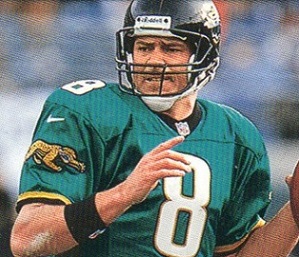
The Jacksonville Jaguars were 2-0 and coming off of their bye week as they hosted the Pittsburgh Steelers on September 22, 1997. Moreover, Head Coach Tom Coughlin’s team had won those games with two different backup quarterbacks at the helm due to a knee injury suffered by QB Mark Brunell (pictured above), who led the NFL with 4367 passing yards in 1996, and he was now returning to action. Overachievers who went all the way to the AFC title game the previous year, the third-year expansion team had won six straight regular season games dating back to the previous November.

Pittsburgh, coached by Bill Cowher, was accustomed to contending. Third-year QB Kordell Stewart was new to the starting lineup but the ground game was led by dependable RB Jerome Bettis and the defense was typically tough. The Steelers split their first two games.

There were 73,016 fans in attendance at Alltel Stadium for the Monday night game. The Jaguars had the game’s first possession and drove 68 yards in ten plays. Mark Brunell converted a third-and-10 situation with a pass to WR Keenan McCardell for 15 yards and RB Natrone Means ran for five yards on a third-and-three play. Consecutive throws by Brunell were complete to McCardell for 15 yards and to WR Jimmy Smith for 23 to reach the Pittsburgh three yard line and two plays later Means gained the final yard for a touchdown. Mike Hollis added the extra point.

Pittsburgh WR Will Blackwell returned the ensuing kickoff 99 yards, but the play was nullified by a holding penalty. However, the Steelers proceeded with an 80-yard scoring series that took six plays. The biggest was a third down throw by Kordell Stewart to WR Charles Johnson that picked up 49 yards to the Jacksonville 12 and, following a six-yard run by RB Jerome Bettis, Stewart scrambled for a six-yard TD. Norm Johnson’s kick tied the score at 7-7.

A short Jacksonville series ended with a punt but the Jaguars got the ball back three plays later when Stewart fumbled when sacked by DE Tony Brackens and LB Eddie Robinson recovered at the Pittsburgh 38. In a possession that stretched into the second quarter, Means ran for nine yards on first down and Brunell completed three passes, the last to Smith for an 11-yard TD. Hollis converted to give the home team a 14-7 lead.

The Steelers started off with the ball at their 42 following a 40-yard kickoff return by Blackwell, but after reaching the Jacksonville 39 they were forced to punt. A long series by the Jaguars started off with Brunell being sacked by LB Levon Kirkland for a loss of 11 yards but Brunell threw to Smith for 29 yards and, a few plays later and facing third-and-20, connected with RB James Stewart for 29 yards to the Pittsburgh 43. It appeared that the drive was finally thwarted when Brunell was sacked for a seven-yard loss by DT Oliver Gibson and then threw an incomplete pass when facing third-and-15 at the Pittsbugh 38. But punter Bryan Barker passed instead of kicking and it was complete to DB Dana Hall for a 22-yard gain. However, after getting to the 11, the home team came up empty when Hollis missed a 29-yard field goal attempt.

Jacksonville got the ball back two plays later when Stewart’s pass was intercepted by CB Aaron Beasley, who returned it five yards to the Pittsburgh 35 with 1:21 remaining in the first half. Brunell completed four passes and Hollis was successful on a 20-yard field goal to give the Jaguars a 17-7 halftime lead. Jacksonville had thus far dominated time of possession, holding onto the ball for 21 of the game’s first 30 minutes.


Down by ten, the Steelers started off the third quarter with a 13-play, 80-yard drive. Bettis (pictured at right) ran for 44 yards on 7 carries, with a long of 16, RB George Jones contributed an 18-yard run, and Stewart completed three passes, the last to WR Yancey Thigpen for a four-yard touchdown. Norm Johnson’s point after narrowed the score to 17-14.

The Jaguars, helped along by a pass interference penalty on the Steelers, came back with a series that resulted in Hollis kicking a 45-yard field goal. Another long Blackwell kickoff return that covered 52 yards put the Steelers at the Jacksonville 48 and, on a seven- play drive that featured a 19-yard run by Bettis and a Stewart toss to Charles Johnson for 26 yards, they scored on the first play of the fourth quarter as Stewart connected with TE Mark Bruener for a one-yard TD. Norm Johnson’s extra point put the visitors in front by 21-20.

The Jaguars again reached Pittsburgh territory as Brunell passed to Smith for a 41-yard pickup but, after the drive was stopped at the 19, Hollis failed on a 38-yard try for a go-ahead field goal. The Steelers had to punt on their next series and Jacksonville again had a long possession that ran over six minutes off the clock and was helped along by a critical unnecessary roughness penalty on DE Nolan Harrison to nullify a third down sack. Brunell completed six passes, three of them to Smith and the longest to WR Reggie Barlow for 18 yards, and this time Hollis came through with a 27-yard field goal that put the Jaguars back on top by 23-21 with 4:14 remaining to play.

Starting from their 40 following Blackwell’s 30-yard kickoff return, the Steelers kept the ball on the ground and also received help with a five-yard penalty on the Jaguars on a fourth-and-one play. Stewart threw to Thigpen for a 21-yard gain to the Jacksonville 25 and Pittsburgh was at the 22 when Norm Johnson came on to attempt a final-play field goal from 40 yards to win the game. However, the snap was low and the holder, QB Mike Tomczak, had difficulty in getting the ball set, placing it at a bad angle. Johnson’s kick was blocked by DE Clyde Simmons and safety Chris Hudson recovered and ran 58 yards for a touchdown. Hollis added the superfluous extra point and the Jaguars not only avoided a last-second defeat but won in stunning fashion by a final score of 30-21.

Jacksonville led in total yards (343 to 306), first downs (23 to 19), and time of possession (33:55 to 26:05), although Pittsburgh was much better at controlling the ball in the second half. The Jaguars were stifled on the ground as Pittsburgh outgained them, 153 to 40, but had a big lead in net passing yards (303 to 153). The Steelers turned the ball over twice, to none by Jacksonville. Pittsburgh led in sacks (three to two) but also in penalties (6 for 82 yards, against four for 35 yards against Jacksonville). The teams combined for just three punts (two by Pittsburgh, one for the Jaguars) although both clubs had trouble on field goals, with Mike Hollis missing two from under 40 yards and Norm Johnson’s lone attempt being botched at the end.

Mark Brunell completed 24 of 42 passes for 306 yards and a touchdown with none intercepted. Jimmy Smith had a big performance with 10 catches for 164 yards and a TD and Keenan McCardell contributed 6 receptions for 51 yards. Natrone Means rushed for 40 yards on 24 carries that included a score.

For the Steelers, Kordell Stewart was successful on 11 of 16 throws for 155 yards and two TDs while giving up an interception, and also ran the ball 7 times for 19 yards and a touchdown. Jerome Bettis, who came on strong in the second half, gained 114 yards on 21 rushing attempts. Yancey Thigpen caught 5 passes for 53 yards and a TD and Charles Johnson gained 88 yards on his four receptions. Will Blackwell averaged 37.8 yards on four kickoff returns. 

“This was a big win for us because it was on Monday night, it was against the Steelers, and because of the way we won,” said Mark Brunell.

“We just found a way to win,” said Coach Coughlin. “I told the team on Sunday night to never take anything for granted because a lot of teams had trouble this season with field goals.”

Jacksonville lost the following week but was at 5-1 before losing two more, including the rematch with the Steelers. The pattern of a flashy passing game and mediocre ground attack held throughout the season. The Jaguars ended up with an 11-5 record, as did Pittsburgh, and the Steelers won the AFC Central title due to the net division points tiebreaker. Jacksonville was demolished by Denver in the Wild Card playoff round while Pittsburgh reached the AFC Championship before also losing to the Broncos in a closer contest.

Mark Brunell went on to lead the AFC in passing with a 91.2 rating as he completed 60.7 percent of his passes for 3281 yards and 18 touchdowns while giving up just seven interceptions. He was selected to a second straight Pro Bowl where he was joined by Jimmy Smith, who accumulated 82 catches for 1324 yards (16.1 avg.) and four TDs.

April 14, 2015

Highlighted Year: Jerome Bettis, 1996

Running Back, Pittsburgh Steelers


Age:  24
4th season in pro football, 1st with Steelers
College: Notre Dame
Height: 5’11” Weight: 243

Prelude:
After gaining over a thousand all-purpose yards in his last college season, Bettis was taken by the Rams in the first round (10th overall) of the 1993 NFL draft. Head Coach Chuck Knox anticipated that the classic fullback would be the key to the team’s running game with his hard-running style and demonstrated ability to hold onto the football. Bettis had an immediate impact, rushing for 1429 yards and receiving first-team All-NFL and Pro Bowl recognition in addition to numerous Rookie of the Year honors. In 1994, Bettis tailed off badly during the second half of the season and, while he still gained 1025 rushing yards and was selected to the Pro Bowl (and also caught a career-high 31 passes), averaged just 3.2 yards per carry. After running for only 637 yards behind a poor line following the shift of the Rams to St. Louis in ’95, Bettis was traded to the Steelers. “The Bus” rejuvenated his career in Pittsburgh, where his power-running style was a perfect fit.

1996 Season Summary
Appeared in all 16 games
[Bracketed numbers indicate league rank in Top 20]

Rushing
Attempts – 320 [6]
Most attempts, game – 29 (for 115 yds.) vs. Houston 9/29
Yards – 1431 [3]
Most yards, game – 133 yards (on 20 carries) vs. Buffalo 9/16
Average gain – 4.5 [7]
TDs – 11 [6, tied with Barry Sanders & Karim Abdul-Jabbar]
100-yard rushing games – 10

Pass Receiving
Receptions – 22      
Most receptions, game – 5 (for 40 yds.) at Kansas City 10/7
Yards – 122
Most yards, game – 40 (on 5 catches) at Kansas City 10/7
Average gain – 5.5
TDs – 0

Scoring
TDs – 11 [9, tied with four others]
Points – 66

Postseason: 2 G
Rushing attempts – 38
Most rushing attempts, game – 25 vs. Indianapolis, AFC Wild Card playoff
Rushing yards – 145
Most rushing yards, game – 102 vs. Indianapolis, AFC Wild Card playoff
Average gain rushing – 3.8
Rushing TDs – 2

Pass receptions – 3
Most pass receptions, game – 2 at New England, AFC Divisional playoff
Pass receiving yards – 3
Most pass receiving yards, game – 4 vs. Indianapolis, AFC Wild Card playoff
Average yards per reception – 1.0
Pass Receiving TDs – 0

Awards & Honors:
1st-team All-NFL: AP
1st-team All-AFC: UPI, Pro Football Weekly
Pro Bowl

Steelers went 10-6 to finish first in the AFC Central while ranking second in the NFL in rushing (2299 yards). Won AFC Wild Card playoff over Indianapolis Colts (42-14). Lost AFC Divisional playoff to New England Patriots (28-3).

Aftermath:
The 1996 season was the first of six straight 1000-yard performances for Bettis. He reached his career high in rushing with 1665 yards in 1997, again being selected to the Pro Bowl and garnering first-team All-AFC honors from Pro Football Weekly. Bettis received Pro Bowl honors for the last time at age 32 in 2004, when he rushed for a career-high 13 touchdowns, and capped his career in ’05 in a backup role on a team that won the Super Bowl. Overall, he played a total of 13 years, the last 10 with the Steelers, and rushed for 13,662 yards, which ranked fifth all-time, and scored a total of 94 touchdowns (91 rushing, 3 receiving). “The Bus” was selected to the Pro Bowl six times and gained election to the Pro Football Hall of Fame, Class of 2015.

--

Highlighted Years features players who were consensus first-team All-League* selections or league* or conference** leaders in the following statistical categories:

Rushing: Yards, TDs (min. 10)
Passing: Yards, Completion Pct., Yards per Attempt, TDs, Rating
Receiving: Catches, Yards, TDs (min. 10)
Scoring: TDs, Points, Field Goals (min. 5)
All-Purpose: Total Yards
Defense: Interceptions, Sacks
Kickoff Returns: Average
Punt Returns: Average
Punting: Average

*Leagues include NFL (1920 to date), AFL (1926), AFL (1936-37), AAFC (1946-49), AFL (1960-69), WFL (1974-75), USFL (1983-85)

**NFC/AFC since 1970

July 28, 2013

Rookie of the Year: Jerome Bettis, 1993

Running Back, Los Angeles Rams


Age:  21
College: Notre Dame
Height: 5’11” Weight: 243

Prelude:
After gaining over a thousand all-purpose yards in his last college season, Bettis was taken by the Rams in the first round (10th overall) of the 1993 NFL draft. Head Coach Chuck Knox anticipated that the classic fullback would be the key to the team’s running game with his hard-running style and demonstrated ability to hold onto the football.

1993 Season Summary
Appeared in all 16 games
[Bracketed numbers indicate league rank in Top 20]

Rushing
Attempts – 294 [3]
Most attempts, game - 39 (for 146 yds.) vs. Chicago 1/2
Yards – 1429 [2]
Most yards, game – 212 yards (on 28 carries) at New Orleans 12/12
Average gain – 4.9 [3]
TDs – 7 [9, tied with four others]
200-yard rushing games – 1
100-yard rushing games – 7

Pass Receiving
Receptions – 26      
Most receptions, game – 5 (for 71 yds.) vs. Chicago 1/2
Yards – 244
Most yards, game - 71 (on 5 catches) vs. Chicago 1/2
Average gain – 9.4
TDs – 0

Scoring
TDs – 7 [19, tied with nine others]
Points – 42

Awards & Honors:
NFL Rookie of the Year: Sporting News
NFL Offensive Rookie of the Year: AP, PFWA
NFC Rookie of the Year: UPI
1st-team All-NFL: AP, PFWA
1st-team All-NFC: UPI, Pro Football Weekly
Pro Bowl

Rams went 5-11 to finish fourth in the NFC West.

Aftermath:
Bettis tailed off badly during the second half of the 1994 season and, while he still gained 1025 rushing yards and was selected to the Pro Bowl (and also caught a career-high 31 passes), averaged just 3.2 yards per carry. After running for 637 yards behind a poor line following the shift of the Rams to St. Louis in ’95, Bettis was traded to the Steelers. “The Bus” rejuvenated his career in Pittsburgh, where his power-running style was a perfect fit, and ran for 1431 yards, his first of six straight 1000-yard performances. He returned to the Pro Bowl as well as gaining consensus first-team All-NFL honors. Bettis reached his career high in rushing with 1665 yards in 1997. Overall, he played a total of 13 years, the last 10 with the Steelers, going out with a Super Bowl win following the 2005 season. Bettis rushed for 13,662 yards, which ranked fifth all-time, and scored a total of 94 touchdowns (91 rushing, 3 receiving). He was selected to the Pro Bowl six times.

--


Rookie of the Year Profiles feature players who were named Rookie of the Year in the NFL, AFL (1960-69), or USFL (1983-85) by a recognized organization (Associated Press – Offense or Defense, Newspaper Enterprise Association, United Press International, The Sporting News, or the league itself – Pepsi NFL Rookie of the Year). 

January 27, 2013

2002: Bledsoe Comes Off Bench to Lead Patriots Over Steelers for AFC Title


The AFC Championship game on January 27, 2002 featured the overachieving New England Patriots against the defensively-solid Pittsburgh Steelers. In their second season under Head Coach Bill Belichick, and coming off a 5-11 record in 2000, the Patriots started off 2001 at 5-5 before reeling off six straight wins to finish first in the AFC East at 11-5. A key development along the way had been an injury to QB Drew Bledsoe that resulted in unheralded backup Tom Brady moving into the lineup and remaining there even after the 29-year-old veteran had recovered. Overall, the Patriots were not an overwhelmingly talented team, but they did jell under Belichick’s coaching. They defeated the Raiders in a snowy overtime Divisional playoff game that featured a controversial reversal of an apparent fumble due to the tuck rule to advance to the conference title game.

The Steelers, in their tenth year under Head Coach Bill Cowher, came into the game as nine-point favorites. After missing the postseason in the three previous seasons, Pittsburgh went 13-3 in ’01 to top the AFC Central and gain top seed in the playoffs. Guided on offense by talented but erratic QB Kordell Stewart, the Steelers were adept at running the ball, although Pro Bowl RB Jerome Bettis had been slowed by a groin injury that had kept him out of action since Week 12. Still, they had two thousand-yard wide receivers in Hines Ward, another Pro Bowler, and Plaxico Burress. But the key to their success was the league’s top-ranked defense that featured linebackers Jason Gildon, Kendrell Bell, and Joey Porter. The Steelers had easily dispatched the defending league champions, the Ravens, in the Divisional round of the playoffs.

There was a crowd of 64,704 at Heinz Field, and they saw a quiet start to the contest as both teams traded punts back and forth. With just over four minutes remaining in the opening period, the Steelers had to punt from their own 13 and Josh Miller got off a 64-yard boot, but had to kick again when WR Troy Edwards was flagged for stepping out of bounds and returning to the field. It made a big difference as the second kick was returned 55 yards for a touchdown by WR Troy Brown to give the Patriots a lead.

In a series that extended into the second quarter, the Steelers drove into New England territory. After reaching the 11 yard line, Kris Brown kicked a 30-yard field goal to get the home team on the board. The contest again settled into a defensive battle until the Patriots took possession at their own 30 with less than three minutes remaining in the half. On the third play, Brady passed to Troy Brown for a 28-yard gain, but the quarterback was hit hard by SS Lee Flowers. Brady left the game with an injured left leg.

In to replace him was the quarterback who had been relegated to the bench, Drew Bledsoe (pictured at top). Four plays later, after hitting WR David Patten for gains of 15 and 10 yards and then running for four yards, Bledsoe threw again to Patten for an 11-yard touchdown. The Patriots were up by 14-3 at halftime.

In their second possession of the third quarter, the Steelers drove to the New England 16, but a 34-yard field goal attempt was blocked by DT Brandon Mitchell and Troy Brown picked up the loose ball, ran 11 yards, and then lateraled to DB Antwan Harris who carried it the remaining 49 yards for a TD.

Pittsburgh came back with a long 79-yard series in eight plays that featured Stewart completions to Ward for 24 yards and RB Amos Zereoue for 19 and culminated in a one-yard scoring run by Jerome Bettis. New England’s lead was cut to 21-10 with over five minutes to go in the third quarter.

The Steelers closed the gap even more following a 28-yard punt return by Troy Edwards to the New England 32. They went 32 yards, the final 11 coming on a run by Zereoue. It was a four point game heading into the fourth quarter.

A long, methodical drive by the Patriots added more points less than four minutes into the final period on a 44-yard Vinatieri field goal. The Steelers had plenty of time, but their remaining three possessions ended in a punt and two interceptions, by FS Tebucky Jones and SS Lawyer Milloy. Vinatieri missed a 50-yard field goal try in an effort to extend the lead, but it didn’t matter. The Patriots were AFC Champions by a final score of 24-17.

The Steelers had the edge in both total yards (306 to 259) and first downs (23 to 15). However, they also turned the ball over four times, to none by New England. Linebackers Willie McGinest and Ted Johnson did a great job of shutting down Pittsburgh’s running game, as the Steelers gained only 58 yards on 22 carries. Pittsburgh also recorded more sacks (four to three) and the Patriots hurt themselves with 12 penalties, at a cost of 87 yards, as opposed to three flags thrown on the home team.

In his relief effort, Drew Bledsoe completed 10 of 21 passes for 102 yards and a touchdown with no interceptions. Before exiting, Tom Brady was successful on 12 of 18 throws for 115 yards. Troy Brown (pictured below) had a big day, catching 8 passes for 121 yards, returning a punt for a TD, and contributing to the score on the blocked field goal. Antowain Smith rushed for 47 yards on 15 attempts.


For the Steelers, Kordell Stewart went to the air 42 times and completed 24 of those passes for 255 yards and no touchdowns along with three interceptions. He also led the club in rushing with 41 yards on 8 carries while the hobbled Jerome Bettis was held to 8 yards on 9 attempts that included a short TD and Amos Zeroue gained 11 yards and scored once on four carries, although he also caught 4 passes for 50 yards. Hines Ward had 6 pass receptions for 64 yards and Plaxico Burress gained 67 yards on 5 catches.

“I’ve done this for a long time and at times at a pretty high level,” said Drew Bledsoe of his performance off the bench. “I felt confident coming out. I’ve been working out and preparing for this exact scenario.”

Tom Brady was back for the Super Bowl and the upstart Patriots defeated the St. Louis Rams in a stunning upset. They missed out on the postseason in 2002 but came back to win the first of back-to-back NFL titles in ’03. Pittsburgh again reached the playoffs in ’02 and lost in the Divisional playoff round.

The relief appearance by Drew Bledsoe marked the end of his nine-year career in New England. He moved on to the division-rival Buffalo Bills for 2002. 

January 15, 2013

2005: Steelers Beat Jets in Divisional Playoff with FG in Overtime


The AFC Divisional Playoff game at Pittsburgh’s Heinz Field on January 15, 2005 appeared to be a mismatch. The Pittsburgh Steelers were perennial contenders under Head Coach Bill Cowher and had gone 15-1 during the 2004 regular season. Rookie QB Ben Roethlisberger took over as the starting quarterback three games into the schedule when veteran Tommy Maddox was injured and was nothing short of sensational – the team won all 13 of his starts and he set rookie records by completing 66.4 % of his passes and compiling a 98.1 passer rating. He was helped by an outstanding ground game that featured the aging Jerome Bettis (pictured above) and newcomer Duce Staley, signed away from the Eagles. Pro Bowl WR Hines Ward was the most productive passing target. Most of all, the defense was the league’s best and contained Pro Bowlers in DE Aaron Smith, ILB James Farrior, OLB Joey Porter, and SS Troy Polamalu.

The visiting New York Jets placed second in the AFC East with a 10-6 record and had just gotten past the Chargers in overtime in the Wild Card Playoff round to advance to the Divisional level. Under Head Coach Herman Edwards, the backfield contained the NFL’s leading rusher in RB Curtis Martin (1697 yards) and the Jets utilized a West Coast passing offense that was directed by QB Chad Pennington, who made up for a weak arm with accuracy and toughness (he was battling a sore shoulder that would require rotator cuff surgery in the offseason). The defense was not on a par with Pittsburgh’s but was aggressive and tough against the run. However, the Jets had scored just six points in each of their prior two games against the Steelers, including a few weeks earlier during the regular season, and were clear underdogs.

Neither offense was able to get out of its own side of the field until midway through the first quarter when the Steelers drove 36 yards in seven plays. Jerome Bettis gained 17 yards in three carries and Ben Roethlisberger completed a pass to Hines Ward for 14 yards. Jeff Reed kicked a 49-yard field goal to give Pittsburgh the early 3-0 advantage.

On the second play of New York’s next series, Chad Pennington was intercepted by Troy Polamalu, who returned it 15 yards to give the Steelers excellent field position at the Jets’ 25. Five plays later, Bettis ran three yards up the middle for a touchdown and, with the successful extra point, it was a 10-0 game.

The Jets responded with a drive that extended into the second quarter and went 39 yards in 11 plays. Doug Brien’s 42-yard field goal attempt was successful and narrowed the score to 10-3. The Steelers went three-and-out in their next possession but, following a penalty on the punt return, New York started its next series at its own ten yard line. Pennington threw to WR Justin McCareins for a 30-yard gain but the promising drive finally stalled at the Pittsburgh 34 and the Jets punted. The Steelers also punted following a drive that netted 15 yards and WR Santana Moss (pictured below) returned it 75 yards for a touchdown that, combined with the successful PAT, tied the score at 10-10. That was still the tally at halftime.


The teams traded punts to start the third quarter but the Steelers drove into New York territory in their second possession. Roethlisberger completed passes to Ward for 12 yards, WR Plaxico Burress for 17, and WR Lee Mays for eight yards in a third-and-three situation. But after reaching the New York 34, a pass by Roethlisberger was picked off by SS Reggie Tongue, who returned it 86 yards for a TD. Thanks to the big plays on the punt and interception returns, the Jets were ahead by 17-10 heading into the fourth quarter.

The Steelers again advanced into New York territory but another turnover blunted a promising drive as Bettis uncharacteristically fumbled and FS Erik Coleman recovered at the 23. The Jets failed to get a first down and kicked the ball back to the Steelers, who started off from their 34 with 12:41 left in regulation. Pittsburgh put together another good drive, going 66 yards in 12 plays, and this time there were no turnovers. Roethlisberger took off for a 20-yard run to start the series which, with the exception of three short passes, stayed on the ground. Bettis and Duce Staley both carried the ball and the third of the passes was to Ward for a four-yard TD. Reed’s extra point tied the score at 17-17.

The Jets now moved the ball effectively as Pennington connected with McCareins for a 22-yard gain and Curtis Martin for 17. However, after reaching the Pittsburgh 28 the resulting 47-yard field goal try by Brien struck the goal post and was unsuccessful. But the Jets got the ball back right away when a Roethlisberger pass was intercepted by CB David Barrett and returned 25 yards to the Pittsburgh 36. It seemed as though the Jets had the game in hand as they chipped away to the 24 and, with time running out in regulation, lined up for another field goal attempt by Brien. The 43-yard kick, sailing far off the mark, was no good and the contest proceeded into overtime.

The Jets had the first possession in overtime and had to punt from their 41. Following WR Antwaan Randle El’s eight-yard return, the Steelers started off from their 13 yard line and went 72 yards in 14 plays. Along the way, Roethlisberger threw to Ward for a 17-yard gain on a third-and-six play and Pittsburgh converted a third-and-five situation thanks to a nine-yard run by RB Verron Haynes. Staley followed up with three carries for 17 yards to get the ball to the New York 24 and, after advancing further to the 15, Reed booted a 33-yard field goal – his 19th straight successful three-pointer – to give the Steelers a 20-17 win.

Pittsburgh accumulated more total yards (364 to 275) and first downs (23 to 17). 193 of those yards came on the ground. However, the Steelers also turned the ball over three times, to one by the Jets, which nearly proved fatal.


Ben Roethlisberger (pictured above) completed 17 of 30 passes for 181 yards and a touchdown but with two interceptions. Jerome Bettis led the running game with 101 yards and a TD on 27 carries while Duce Staley added 54 yards on 11 attempts. Hines Ward caught 10 passes for 105 yards and a score.

For the Jets, Chad Pennington was successful on 21 of 33 throws for 182 yards with none for TDs and one intercepted. Curtis Martin rushed for 77 yards on 19 carries and caught four passes for 29 more yards. Justin McCareins led the club with 5 pass receptions for 82 yards. Thanks to the long return for a score, Santana Moss had 83 yards on punt returns to go along with his four catches for 31 yards.


Doug Brien (pictured at right) achieved the dubious distinction of being the first placekicker in NFL history to miss two field goal attempts in the last two minutes of the fourth quarter of a playoff game; just the week before he had booted a field goal in overtime to beat the Chargers.

“I had confidence in him,” said Herman Edwards of the kicker. “He made the one last week and I thought he could make it…He’s been a good kicker for us. It was just a tough day.”

Brien was let go by the Jets during the offseason, after they drafted PK Mike Nugent in the second round out of Ohio State. He was signed by the Bears but appeared in just three games before being dropped to thus end his 12-year NFL career.

The Steelers advanced to the AFC Championship game, which they lost to the New England Patriots. They came back in 2005 with a lesser record, finishing the regular season as a Wild Card team, but went all the way to win the Super Bowl. The Jets dropped to 4-12 in an injury-plagued year before bouncing back to the postseason in ’06.

October 24, 2010

1993: Rubley Rallies Rams, But Lions Prevail in Final Seconds

(NOTE TO READERS: Today's post marks the first anniversary of the launch of Today in Pro Football History. For regular readers, thank you, I hope you have enjoyed it and will continue to do so. For newcomers, I encourage you to take a look at the archived material. Feedback and suggestions are always welcome - there is an e-mail link on my profile page. And now, back to the game...)


The Los Angeles Rams were off to a 2-4 start as they hosted the Detroit Lions (4-2) at Anaheim Stadium on October 24, 1993. The Rams had fallen on hard times since going 11-5 in 1989 and making it to the NFC Championship game. In the intervening three seasons they were a combined 14-34. Nine-year Head Coach John Robinson had been replaced by Chuck Knox in ’92 – it was a second stint in LA for the coach who had led the club to a 57-20-1 mark and five division titles from 1973-77. A 6-10 tally in 1992 had been considered progress.

Los Angeles added quality with first round draft choices DT Sean Gilbert in 1992 and RB Jerome Bettis in ’93. But while Gilbert was putting together a Pro Bowl season and Bettis had gained 187 yards in the previous two games, eighth-year veteran QB Jim Everett was still in a prolonged slump and had thrown 9 interceptions as opposed to 7 touchdowns.

The Lions, under Head Coach Wayne Fontes, relied most heavily on star RB Barry Sanders. With an improved defense under the guidance of defensive coordinator Hank Bullough, Detroit had held its opponents to 20 or fewer points in five of the six games thus far.

The first quarter was scoreless. Detroit’s offense drove to the LA 28 yard line on its second possession, with QB Rodney Peete connecting with WR Herman Moore on passes that covered 15 and 18 yards, but Jason Hanson missed a 45-yard field goal attempt.

The Rams got a break in the second quarter when CB Todd Lyght intercepted a Peete pass at midfield. But a drive to the Detroit 23 ended with Everett being intercepted by CB Tim McKyer. In the last two minutes of the half, another Rams drive ended when Everett fumbled at the Detroit 44 and NT Lawrence Pete recovered for the Lions. Eight plays later, Hanson was successful on a 25-yard field goal attempt as time ran out and the Lions went into halftime with a 3-0 lead.

Bettis had run well for the Rams, gaining 85 yards on 16 carries, but Everett was a dismal two of nine for 12 yards passing. Sanders gained 50 yards on 15 attempts for the Lions.

The third quarter promised more futility for the Rams as they went three-and-out on their first possession, which ended with Everett being sacked. But following a 12-play drive by the Lions that resulted in another Hanson field goal, this time from 24 yards, Knox benched the ineffective veteran quarterback and replaced him with second-year backup T.J. Rubley (pictured at top).

Rubley had been selected by the Rams in the ninth round of the 1992 draft out of Tulsa. He had played well in the preseason but saw no action during his rookie year and was making his regular season NFL debut against the Lions.

In his first series, Rubley largely kept the ball on the ground, handing off to Bettis five times for 25 yards. He took off on a six-yard run himself and completed one of three passes before the Rams were forced to punt.

Taking over on the last play of the third quarter, Detroit’s offense methodically drove down the field. The big play was a 40-yard pass completion from Peete to WR Aubrey Matthews to get to the LA 25 yard line. Six plays later, Sanders ran around end for a five-yard touchdown and the Lions had what appeared to be a safe 13-0 lead.

However, Rubley completed five of six passes on the next possession, took off on an 11-yard run along the way, and with the last completion hit WR Ernie Jones for a four-yard touchdown.

The Lions went three-and-out on their next possession and Rubley and the Rams took over at their own 32 with 3:39 left to play. The young quarterback tossed two completions to veteran WR Henry Ellard that totaled 17 yards and then found WR Todd Kinchen for 24 to the Detroit 21 yard line. Two plays later, and just after the two-minute warning, Rubley connected with Jones once again for a 21-yard touchdown. While Tony Zendejas missed the extra point attempt, the score was now tied at 13-13.

There would be no storybook ending for LA on this day, however. Peete completed two passes, including a key 25-yard completion to TE Rodney Holman that set up an 18-yard field goal by Hanson and the Lions prevailed, 16-13.


In relief of Everett, T.J. Rubley completed 12 of 17 passes for 151 yards with two touchdowns and none intercepted. Jerome Bettis had another outstanding day as he gained 113 yards on 23 carries. Todd Kinchen was the leading receiver with four catches for 60 yards (Henry Ellard also caught four passes, for 32 yards).

For Detroit, Barry Sanders ran for 91 yards on 26 carries, including the one TD. Rodney Peete was successful on 15 of 25 pass attempts for 249 yards and an interception. Herman Moore gained 120 yards on 6 pass receptions.

Rubley’s magic wore off over the remainder of the season. While he led Los Angeles to two wins, overall the team went 5-11 to finish at the bottom of the NFC West. Rubley completed 57.1 % of his passes for 1338 yards with eight touchdowns and six interceptions. In the offseason, Everett was dealt to New Orleans but Chris Miller was obtained from Atlanta to take over the starting role, and another veteran, Chris Chandler, arrived to be the backup. Rubley became an afterthought.

More lasting success came to Jerome Bettis, who ranked second in the NFL with 1429 yards rushing on 294 carries. He outrushed Barry Sanders, who gained 1115 yards on 243 carries for the Lions. Detroit went 10-6 and won the NFC Central but fell to the Packers in the Wild Card playoff round.

As a footnote, T.J. Rubley’s NFL career came to a bad – and abrupt – end. After seeing no action with the Rams in 1994, he moved on to become the number three quarterback in Green Bay in ’95. In a game against Minnesota, both starter Brett Favre and primary backup Ty Detmer were injured and Rubley entered with the score tied at 38-38. On a third-and-one play, Head Coach Mike Holmgren called for a quarterback sneak, but Rubley audibled and passed instead. The throw was bad and the Vikings intercepted and drove to the winning score. Holmgren cut Rubley the following week, and while he saw action with the World League of American Football and Canadian Football League, he was done in the NFL.