Showing posts with label Drew Bledsoe. Show all posts

September 8, 2016

2002: Morton’s Kickoff Returns Propel Jets to Overtime Win Over Bills


The overhauled New York Jets faced rivals from the AFC East, the Buffalo Bills, in a Week 1 contest on September 8, 2002. The Jets had gone 10-6 and reached the playoffs in their first year under Head Coach Herman Edwards, but had made significant roster moves, especially on defense. The offense still had 38-year-old QB Vinny Testaverde behind center to start the season, even if not best suited for a West Coast-style offense, and RB Curtis Martin was a highly productive ball carrier.

The Bills were coming off of a miserable 3-13 record under Head Coach Gregg Williams but had also done some retooling, most notably in acquiring a new veteran quarterback.  Drew Bledsoe was obtained from the Patriots, where he had been displaced by the previously-unknown Tom Brady. In addition, RB Travis Henry was healthy following a promising rookie year that ended with a knee injury.

There were 72,751 fans in attendance at Ralph Wilson Stadium on an 86-degree afternoon. The Bills started the game off with a drive that was kept alive by a roughing-the-kicker penalty on a punt. Drew Bledsoe completed four passes, two of them to Travis Henry, and Mike Hollis finished it off with a 52-yard field goal.

The Jets punted twice, with an interception of a Bledsoe pass by CB Aaron Beasley at the New York 20 in between, before Buffalo went 80 yards in seven plays that stretched into the second quarter and included three penalties on the New York defense. Following consecutive pass completions by Bledsoe to get the ball down to the Jets’ five, Henry ran up the middle from there for a touchdown. Hollis added the extra point for a 10-0 lead.

The ten-point margin didn’t last for long when diminutive RB Chad Morton (pictured above) returned the ensuing kickoff 98 yards for a TD. John Hall converted to make it a 10-7 contest. On Buffalo’s third play of the next series, a poorly thrown Bledsoe pass was picked off by CB Donnie Abraham, who returned it 13 yards to the Buffalo 19. While two penalties pushed the Jets back ten yards, Vinny Testaverde passed to TE Anthony Becht for a 21-yard gain and, helped further by a pass interference call, it was Testaverde to Becht once again for a one-yard touchdown. Hall booted the point after and, in short order, the visitors were in front by a score of 14-10.

The Bills responded with a drive of 74 yards in 11 plays. Bledsoe connected on four passes, with two of them to WR Peerless Price that included a 19-yard gain on a third-and-seven play to the New York 29, and Henry finished the series off with four straight runs, the last for three yards and a TD. Hollis added the PAT and Buffalo was up by 17-14 with 2:41 remaining in the first half.

Testaverde passed the Jets down the field, hitting Curtis Martin five times out of the backfield, including a 12-yard gain that converted third-and-nine and a 16-yard play that set up Hall’s 34-yard field goal. The teams went into halftime with the score tied at 17-17.

New York had the ball first to start the third quarter and was without Martin, who had suffered a sprained ankle at the end of the first half. Testaverde completed a pass to WR Santana Moss and RB LaMont Jordan, Martin’s replacement, ran for 14 yards to reach the Buffalo 32. After advancing to the 27, a third down pass to Morton that was first credited as a catch to the one was overturned upon review, but the Jets regained the lead on a 45-yard Hall field goal.

The Jets took possession soon after at their own 46 following a fumble by Henry, but lost ground and had to punt, and the Bills punted in return. On the second play of the next New York series, Jordan fumbled when hit by DT Pat Williams, LB Keith Newman recovered, and Buffalo took over at the Jets’ 29. Three runs by Henry picked up 20 yards and, after a short completion to WR Eric Moulds, it was Henry again to complete the six-play possession with a two-yard touchdown carry. Hollis converted to make it 24-20 in favor of the Bills entering the fourth quarter.

The Jets had the ball heading into the final period but Hall’s 48-yard field goal attempt was wide to the right. However, a short series by the Bills resulted in a punt that was blocked by LB Jason Glenn. Gaining possession at the Buffalo 24, Testaverde completed a pass to Becht for eight yards and Hall was successful on a 33-yard field goal try that narrowed the home team’s lead to 24-23.

The Bills came through with a big play on their next series as Bledsoe passed to Moulds for a gain of 52 yards to the New York 28, but a sack by DE John Abraham pushed Buffalo back and Hollis missed the resulting long field goal attempt from 50 yards.

Testaverde came out throwing in response, connecting with WR Laveranues Coles for eight yards, Jordan for seven, and FB Richie Anderson for nine yards. An interception was wiped out by a pass interference penalty and Testaverde made the most of the reprieve as he threw to WR Wayne Chrebet for an 18-yard TD and then passed to Becht for a two-point conversion that gave the Jets a 31-24 lead with 4:47 left in regulation.

The Bills appeared to be stymied at their own 33 after Bledsoe was sacked by NT Jason Ferguson for a seven-yard loss on a third-and-ten play, but the resulting punt drew a roughing-the-kicker penalty and Buffalo remained alive at its 48. Four plays later, Bledsoe converted fourth-and-two with a completion to Price for 14 yards and the drive finally ended with a dramatic fourth-and-nine pass from Bledsoe to Moulds for a 29-yard touchdown. Hollis added the all-important extra point and the game was tied at 31-31 with 34 seconds remaining on the clock.

The contest went into overtime, and the Jets won the toss. Hollis kicked toward the sideline, but Morton fielded it, made a cutback against the grain and, 96 yards and 14 seconds later, crossed the goal line to win the game for the Jets in stunning fashion by a final score of 37-31.  

The Bills led in total yards (384 to 266), first downs (26 to 18), and time of possession (39:08 to 21:06). However, Buffalo also turned the ball over three times, to one by the Jets, and the special teams gave up the two touchdowns on kickoff returns plus a blocked punt that set up another New York score. There were many penalties, with each team being flagged ten times apiece.

Chad Morton was the headliner for the Jets as he averaged 46.3 yards on six kickoff returns that included the two touchdowns, making him the fifth player in NFL history to do so in a single game. Vinny Testaverde completed 24 of 30 passes for 210 yards and two TDs while giving up no interceptions. Wayne Chrebet had five catches for 58 yards and a score and Curtis Martin also caught five, for 35 yards, although he was held to only six yards on four carries before being forced to leave the game. LaMont Jordan led the team with 32 rushing yards on 7 attempts.


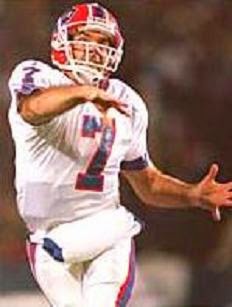
For the Bills, Drew Bledsoe (pictured at left) was successful on 26 of 39 throws for 271 yards and a touchdown, but he also was intercepted twice. Travis Henry rushed for 149 yards on 31 carries that included three TDs and caught 6 passes for 29 yards. Eric Moulds topped the receivers with 8 catches for 112 yards and the game-tying touchdown that sent the game into overtime while Peerless Price contributed 7 receptions for 80 yards.

“This was a game that was obviously, for a spectator, fun to watch,” summed up Coach Edwards of the Jets. “For a coach it was a nightmare on our part of it.”

The nightmare followed for the Jets, who lost their next four games but, with QB Chad Pennington taking over for Testaverde, finished strong to end up at 9-7 and first in the NFC East. They thrashed the Colts in the Wild Card playoff round before losing to Oakland at the Divisional level. Buffalo won two of its next three games, both in overtime, but after reaching 5-3 a midseason slump that included another, more decisive, loss to New York sent them to an 8-8 record and fourth in the division.

Chad Morton averaged 26.0 yards, which ranked second in the AFC, on his 58 kickoff returns that included his two first-week touchdowns. For his seven-season career with four teams, he averaged 23.6 yards returning 229 kickoffs, scoring a total of three TDs, and 9.2 yards on 155 punt returns with one score.

Both Drew Bledsoe and Travis Henry went on to have Pro Bowl seasons for the Bills. Bledsoe started every game and passed for 4359 yards and 24 touchdowns. Henry rushed for 1438 yards and 13 TDs in his finest season.  

September 4, 2016

1994: Marino Passes for 473 Yards & 5 TDs as Dolphins Defeat Patriots


The Miami Dolphins had QB Dan Marino (pictured above) back behind center as they hosted the New England Patriots in a season-opening game on September 4, 1994. After ten years of highly-productive, and often record-setting, passing while remaining injury free, Marino had been lost to a ruptured Achilles tendon five games into the ’93 season.

Head Coach Don Shula’s team had initially weathered the loss of Marino well and was at 9-2 before losing five straight games to close out the season and miss the playoffs at 9-7. The receiving corps, led by WR Irving Fryar, was capable while the running attack was mediocre, with RB Terry Kirby more productive as a receiver out of the backfield. However, it was key injuries on the defensive side that ultimately sank the Dolphins, and improvement was anticipated.

New England was coming off of a 5-11 record in its first year under Head Coach Bill Parcells, but after five straight losing seasons there was reason for optimism. QB Drew Bledsoe had a year of action under his belt, TE Ben Coates emerged as an outstanding receiver, and the defense, led by MLB Vincent Brown, was much better. 

There were 69,613 fans in attendance at Joe Robbie Stadium and there was a heavy downpour an hour before kickoff that turned the baseball infield portion of the field into a muddy mess. The game started off quietly enough as the Patriots went three-and-out on their first possession and Dan Marino misfired on his first two passes before Miami moved to the New England 39. However, in attempting to convert a fourth-and-one play, Terry Kirby fumbled and FS Myron Guyton recovered for the Patriots.

New England drove 59 yards in 11 plays. Drew Bledsoe started off with a completion to RB Leroy Thompson for 20 yards and, after the loss of a yard on a running play, connected with WR Michael Timpson for 12 yards. It was RB Marion Butts carrying most of the load from there as the Patriots kept the ball on the ground and FB Kevin Turner gained the last yard for a touchdown. Matt Bahr added the extra point and the home team was ahead by 7-0.

The Dolphins responded with a long series that stretched into the second quarter. Marino completed six passes along the way, four of them to Kirby, but after reaching the New England six his throw intended for FB Keith Byars was intercepted by LB Dwayne Sabb.

The teams exchanged punts before the Patriots advanced into Miami territory, fueled by a 28-yard Bledsoe-to-Timpson pass play. Bledsoe had two more completions before being picked off in the end zone by CB Troy Vincent. Three plays later, Marino fired a pass to WR Mark Ingram for a 64-yard touchdown. Pete Stoyanovich booted the point after and the score was tied.

The Patriots responded with a scoring drive of eight plays that covered 68 yards. Bledsoe had four pass completions, the two biggest to TE Ben Coates for 26 yards and Turner for 19, to reach the Miami two and from there he tossed a TD pass to Coates. Bahr again converted to put the visitors up by seven with 2:15 left in the first half.

There was still time for Marino to pass the Dolphins into scoring position and, on the final play of the half, Stoyanovich kicked a 42-yard field goal and the New England lead was 14-10 at halftime.


A short Miami series to start the third quarter ended with a punt but, on their second play, the Patriots came through with a big one as Bledsoe (pictured at left) threw to Coates for a 62-yard touchdown. Bahr’s conversion stretched the New England lead to 21-10.

The teams again traded punts before the Dolphins, striking quickly, got back on the board. Taking over from their 39, Marino went long to WR Irving Fryar for 40 yards to the New England 21. A run for five yards that was followed by a holding penalty and then an incomplete pass had the home team facing third-and-15. Marino then connected with TE Keith Jackson for a TD from 26 yards out. Kirby dove into the end zone for a two-point conversion (the first in team history) and the New England lead was cut to 21-18.

FS Gene Atkins intercepted a Bledsoe pass on the next series to give the ball back to the Dolphins, but a fumble by Marino on the next play gave the ball back to the Patriots at the Miami 24. Five plays later, Bledsoe connected with Timpson for a five-yard touchdown and, with Bahr’s extra point, the visitors were ahead by ten at 28-18. Helped along by a pass interference penalty, the Dolphins responded with another long Marino TD pass, this time to Fryar for 54 yards. Stoyanovich’s kick made it a three-point game at 28-25.

The Patriots had the ball for the remainder of the period and punted to start the fourth quarter. Two plays later, Kirby took a handoff and then tossed the ball back to Marino on a flea-flicker that resulted in another scoring pass to a wide-open Fryar, this time covering 50 yards. Stoyanovich converted and the Dolphins had their first lead of the day at 32-28.

New England was far from finished and advanced 67 yards in seven plays. Bledsoe completed a pass to WR Vincent Brisby for six yards to convert a third-and-six situation at midfield and WR Ray Crittenden put the Patriots back in front with a leaping catch in the corner of the end zone of a Bledsoe pass for a 23-yard touchdown. Bahr’s successful conversion made the score 35-32 with 10:12 left to play.

Following an exchange of punts, the Dolphins took over on their 20 with 8:50 remaining on the clock. Marino passed to Kirby for 21 yards on a third-and-12 play and, shortly thereafter facing third-and-seven, he connected with WR Scott Miller for 18 yards. Four plays later, and facing fourth-and-five, Marino correctly surmised that the Patriots were in single coverage and threw to Fryar for a 35-yard touchdown. Stoyanovich’s PAT put Miami ahead by four points.

Bledsoe came out throwing following the ensuing kickoff and hit Thompson for eight yards and Brisby for 19 to reach the New England 47. The next two passes fell incomplete before Coates caught a pass for a 23-yard gain, but the tight end fumbled when hit by Atkins at the end and SS Michael Stewart recovered for the Dolphins at the Miami 26 to nail down the 39-35 win.

Both teams piled up yards, with the Dolphins compiling the most (525 to 472), although New England led in first downs (25 to 21) and time of possession (32:42 to 27:18). Each club turned the ball over three times.


Dan Marino showed that he was back in good form as he completed 23 of 42 passes for 473 yards and five touchdowns while giving up one interception. Irving Fryar (pictured above) had a huge performance with 211 yards on his five catches that included three touchdowns. Mark Ingram contributed 87 yards and a TD on his three receptions and Terry Kirby, who rushed for 56 yards on 19 carries, also caught 7 passes for 61 yards.

For the Patriots, Drew Bledsoe was successful on 32 of 51 throws for 421 yards and four TDs while being intercepted twice. Ben Coates topped the receivers by catching 8 passes for 161 yards and two touchdowns. Marion Butts led the miniscule running attack with 25 yards on 15 attempts, closely followed by Leroy Thompson’s six carries for 22 yards.

“Dan is back,” said Miami’s Coach Shula. “All week I’ve never seen him more intense than he’s been this week. This game probably meant as much as any he has played in for a while.”

The Dolphins won four of their first five games on the way to a 10-6 record and first place in the AFC East. They defeated Kansas City in the Wild Card playoff round before losing a close contest to the Chargers at the Divisional level. New England also went 10-6, losing both of its games to Miami to thus finish second in the division, and qualified for the postseason as a Wild Card entry. The Patriots lost to Cleveland in the Wild Card round.

As the opening game foreshadowed, both quarterbacks had productive passing seasons. Dan Marino finished second in the NFL in pass attempts (615), completions (385), and yards (4453) and third in touchdown passes (30) and passer rating (89.2, best in the AFC). It was the emergent Drew Bledsoe placing first in attempts (691), completions (400), and yards (4555), although also interceptions (27), which were two more than his touchdown passing total (25). Both were chosen to the Pro Bowl (the eighth such honor for Marino, the first for Bledsoe).

Likewise, the game’s top receivers remained productive all year. Irving Fryar, whose 211 yards against the Patriots were his career high, caught 73 passes for 1270 yards, both totals exceeding any of the previous ten years of his career, and seven TDs. Ben Coates topped the AFC with 86 pass receptions, for 1174 yards and seven scores. Like Marino and Bledsoe, both were Pro Bowl selections.

January 1, 2015

1995: Browns Defeat Patriots in AFC Wild Card Playoff Game


Two teams that had not recently been to the postseason, the Cleveland Browns and New England Patriots, met in an AFC Wild Card game on January 1, 1995. The Browns had endured four straight losing seasons since last making it to the playoffs in 1989, and New England had also gone through some rough times after their last appearance in 1986.

Cleveland was in its fourth year under Head Coach Bill Belichick and placed second in the AFC Central with an 11-5 record, qualifying for the playoffs as a Wild Card. Eighth-year QB Vinny Testaverde (pictured above) was proving more successful in Cleveland than he had been in six seasons with Tampa Bay, but was still prone to throw too many interceptions, and FB Leroy Hoard was coming off a Pro Bowl season. But it was the defense, which gave up the fewest points in the NFL in ’94 (204), that was the key to the team’s success. The line contained Pro Bowlers in DE Rob Burnett and DT Michael Dean Perry while two ex-Giants, Pepper Johnson and Carl Banks, performed ably at linebacker and FS Eric Turner was a consensus first-team All-Pro.  

The Patriots were in their second year under Head Coach Bill Parcells, who had previously guided the Giants to two NFL titles. Second-year QB Drew Bledsoe was named to the Pro Bowl after passing for 4555 yards and 25 TDs, although he also tossed 27 interceptions. He had an outstanding target in All-Pro TE Ben Coates. The running game was problematic, where RB Marion Butts averaged only 2.9 yards per carry and was being benched against the Browns in favor of Corey Croom, a faster back but one who did not have any carries during the regular season. The defense steadily improved over the course of the season and led the league in takeaways (40). New England had won its last seven games to finish out the regular season after getting off to a 3-6 start and that resulted in a final tally of 10-6 and a second place finish in the AFC East.

There were 77,452 fans in attendance at Cleveland’s Municipal Stadium in a light drizzle that turned to snow. Following a punt by the Patriots, the Browns drove 74 yards in 10 plays on their first possession. Vinny Testaverde completed a pass to WR Michael Jackson for 27 yards in a third-and-five situation and also had tosses to WR Derrick Alexander for 23 yards and Jackson again for 12. Matt Stover kicked a 30-yard field goal to give the home team the early 3-0 lead.

On New England’s second play following the kickoff, Drew Bledsoe’s pass was intercepted by safety Louis Riddick. With his 16-yard return, the Browns had the ball at the New England 33, but they were unable to advance from there and punted.

The teams exchanged punts into the second quarter until the Patriots put together a 60-yard drive in nine plays. Bledsoe  (pictured below) completed a pass to WR Vincent Brisby for 18 yards on a second-and-ten play and, facing third-and-ten at the Cleveland 31, he connected with TE Ben Coates, also for 18 yards. A completion to RB Leroy Thompson resulted in a 13-yard touchdown and, with Matt Bahr adding the extra point, New England was in front by 7-3.


The Browns responded with a scoring drive of their own that went 51 yards in seven plays, helped by a short kickoff that TE Brian Kinchen returned 24 yards. Testaverde carried twice for 14 yards and threw to Jackson for 18 yards and Jackson for 11 to set up a five-yard completion for a TD to WR Mark Carrier. Matt Stover’s conversion put Cleveland ahead by three points.

New England came back with a long 16-play, 71-yard series that was helped along when, dropping into punt formation on fourth-and-ten at the Cleveland 43, punter Pat O’Neill instead threw to safety Corwin Brown for a pickup of 21 yards. Bledsoe completed three passes in all and RB Corey Croom twice converted third downs with short runs. The possession finally stalled at the four yard line and Bahr kicked a 23-yard field goal with 34 seconds remaining in the first half. In the remaining time, Testaverde completed a pass to Jackson for 36 yards and the Browns reached the New England 32 before Stover attempted a 50-yard field goal that was blocked by DE Mike Pitts. The halftime score remained tied at 10-10.

Opening the third quarter, the Browns advanced to the New England 24 before RB Eric Metcalf fumbled and Pitts recovered for the Patriots. A short possession resulted in a punt and Cleveland, starting from its own 21, drove 79 yards in 10 plays. Testaverde completed four passes, the longest to RB Leroy Hoard for 25 yards, and Hoard ran for a 10-yard touchdown to cap the drive. Stover added the extra point and the Browns were ahead by 17-10.

As the game headed into the fourth quarter, the teams traded punts until Pepper Johnson picked off a Bledsoe pass to give Cleveland the ball at the New England 31. The Browns came up empty, however, as three plays gained nothing and Stover’s 49-yard field goal attempt was wide to the right.

The home team got the ball back two plays later when Bledsoe’s pass bounced off of FB Kevin Turner and was picked off by Eric Turner, who returned it 28 yards to the New England 36. Hoard and RB Earnest Byner chipped away on the ground and Testaverde completed a pass to TE Frank Hartley for 12 yards. This time the possession yielded results as Stover booted a 21-yard field goal to extend the lead to 20-10 with 3:36 remaining in regulation.

Bledsoe came out passing on the next series and connected on his first three throws to pick up 35 yards to the Cleveland 43. He completed two more and ran for three yards to convert a third down, and a throw to Brisby on a fourth-and-five play gained 12 yards. The drive stalled at the 15 and Bahr kicked a 33-yard field goal to make it a seven-point contest.

There was hope for the Patriots when the second try for an onside kick was successful (the first went out of bounds), but after completing two short passes to reach the New England 48, Bledsoe missed on his last four. The Browns held on to win by a final score of 20-13. 

Cleveland led in total yards (379 to 303) and first downs (22 to 20), controlling the ball for 21 of the last 30 minutes. 125 of the yards for the Browns came on the ground, to just 57 for New England, and the Patriots were hurt by three turnovers, to one suffered by Cleveland.


In his first postseason game, Vinny Testaverde completed 20 of 30 passes for 268 yards and a touchdown, and gave up no interceptions. Michael Jackson had 7 catches for 122 yards and Derrick Alexander contributed 5 receptions for 69 yards. Leroy Hoard (pictured at right) rushed for 66 yards on 17 carries that included a TD and also had a 25-yard pass reception.

For the Patriots, Drew Bledsoe, who was sacked only once but took many hits, was successful on just 21 of 50 throws for 235 yards and a TD while tossing three interceptions. Most significantly, he was 10-of-26 for 96 yards and gave up all of the interceptions in the second half. Vincent Brisby and Ben Coates each caught six passes, for 83 and 79 yards, respectively. Corey Croom gained 35 yards on 9 rushing attempts while Leroy Thompson, who rushed for 16 yards on four carries, had 33 yards on four pass receptions that included a score.

“This was the biggest game of my career, and next week will be even bigger,” said Vinny Testaverde. “I am satisfied with the way I played and with the way the team played.”

“The turnovers obviously killed us,” summed up Drew Bledsoe.

The Browns came back down to earth the next week as they were thrashed by the division-rival Pittsburgh Steelers in the Divisional playoff round. With expectations high for 1995, Cleveland dropped to 5-11 in a season in which owner Art Modell announced that the franchise would move to Baltimore. Bill Belichick was dismissed but would become head coach of the Patriots in 2000, with far greater success. The franchise that became the Baltimore Ravens won the Super Bowl that same season, but Cleveland had broken all ties with that team and, in 1999, became host to a new Cleveland Browns club that inherited the history as well as the name. New England, meanwhile, dropped to 6-10 in 1995 but won the AFC Championship in ’96 in what was the last season with Bill Parcells at the helm.

November 29, 2014

1998: Last-Play TD Gives Patriots Win Over Bills


The New England Patriots were 6-5 and fighting to stay in the playoff hunt as they hosted the division-rival Buffalo Bills on November 29, 1998. To add to New England’s concerns, QB Drew Bledsoe (pictured above) was playing with a splint on his throwing hand due to a broken finger suffered the previous week, when he had still managed to toss a late scoring pass to pull out a win. Prior to that, Head Coach Pete Carroll’s team had lost four of five games, but the offense was helped by the return from injury of WR Terry Glenn.

Buffalo, coached by Wade Phillips, was 7-4 and had beaten the Patriots at home two weeks earlier. Diminutive QB Doug Flutie, former Boston College star and CFL legend, replaced Rob Johnson, the young quarterback the team had swung a deal with Jacksonville to obtain, with good results. WR Eric Moulds was a big-play talent across from 34-year-old WR Andre Reed and, with RB Thurman Thomas entering the twilight of his great career, RB Antowain Smith emerged as a productive starter. DE Bruce Smith was still a key player on the defensive line, along with NT Ted Washington.

There were 58,304 fans in attendance at Foxboro Stadium. Buffalo had the first possession and Doug Flutie completed his first three passes, but the drive stalled at the New England 45 and the Bills punted. They got the ball back in short order when CB Thomas Smith intercepted a pass by Drew Bledsoe at the Buffalo 12. Flutie completed a throw to Eric Moulds for 33 yards and the long series finally ended at the New England 17 where the Bills came up empty when Steve Christie missed a 35-yard field goal attempt.

The teams exchanged punts as the game headed into the second quarter. The Patriots then put together a 66-yard drive in eight plays. Bledsoe threw to Terry Glenn for 15 and 33 yards and TE Ben Coates for 12 to reach the Buffalo nine. A pass interference penalty moved the ball to the one, and after two carries by RB Robert Edwards netted a loss of a yard, Bledsoe passed to him for a two-yard touchdown. Adam Vinatieri added the extra point for the 7-0 lead.

Once again the Bills had to punt following their next possession, and once again the Patriots drove to a score. This time it took them seven plays to advance 53 yards, having gotten a 30-yard punt return from CB Chris Canty to give them good starting field position. Bledsoe completed five passes, with gains of 12 yards to Glenn, 13 to Coates, and finally a 12-yard TD throw to RB Derrick Cullors. Vinatieri kicked the point after to expand the New England lead to 14-0.

 Down by two touchdowns, the Bills got a break on the next series when the Patriots were flagged for pass interference on a third-and-10 play that picked up 26 yards. Antowain Smith followed up with three runs that totaled 22 yards to the New England 38. A Flutie pass and another run by Smith picked up another ten yards, but that was it and Christie came on to kick a 34-yard field goal.

With 1:16 remaining in the first half, the Patriots responded with Bledsoe completing three straight short passes. However, a third-down sack forced a punt and the Bills, starting from their 37 with the clock now down to 18 seconds, got a 55-yard gain on a pass from Flutie to WR Kevin Williams. Christie kicked a 26-yard field goal on the last play before halftime and the score stood at 14-6 at the game’s midpoint.


Following a punt by the Patriots to finish off the first series of the third quarter, Buffalo struck quickly when Flutie (pictured at left) connected with Moulds for an 84-yard touchdown. The pass for a two-point conversion failed, but the visitors were now only two points behind.

Short Bledsoe passes and the running of Edwards moved the Patriots down the field on the next possession, and Vinatieri booted a 44-yard field goal to expand New England’s lead to 17-12. But the Bills came back with another score of their own on a series in which Flutie completed passes to Andre Reed for 23 yards and Moulds for 17. With a second-and-goal at the four, they were unable to reach the end zone, but Christie kicked a 22-yard field goal to again narrow the margin to two points at 17-15.

As the contest entered the fourth quarter, the Patriots again had to punt and Buffalo put together a long, penalty-filled drive of 67 yards. A defensive holding penalty converted a third-and-16 situation and an illegal-use-of-hands call turned a third-and-four play into a first down. Flutie completed four passes, one to Williams to convert yet another third and long that picked up 22 yards, although an apparent 23-yard completion to Reed was called back for holding. Finally, Flutie threw to Reed for a touchdown from four yards out and, while the two-point conversion attempt again failed, the Bills were in front by 21-17.

The Patriots came up empty on their next series when Vinatieri missed a 47-yard field goal attempt. After Buffalo’s next possession resulted in a punt just after the two-minute warning, New England started off at its 18 and had no remaining timeouts. Bledsoe completed four of five passes, two of them to Coates, as the Patriots advanced to the Buffalo 37. However, the drive stalled there until, on fourth-and-nine, a pass lofted toward Glenn in the end zone was incomplete but Buffalo was called for pass interference. The ball was moved to the one, much to the fury of the Bills. With no time left on the clock, Bledsoe connected with Coates for a touchdown and, with the angry Bills having already departed for the locker room, Vinatieri ran for an unopposed two-point conversion rather than kicking. The Patriots came away with a dramatic 25-21 win.

Buffalo had a sizable lead in total yards (428 to 259) and time of possession (34:01 to 24:59), although New England had the edge in first downs (24 to 23). The Bills also recorded four sacks, to one by the Patriots, and New England suffered the only turnover. But Buffalo was penalized 12 times, at a cost of 107 yards, which in the end proved fatal, while the Patriots drew 9 flags for 80 yards.


Drew Bledsoe completed 28 of 43 passes for 246 yards and three touchdowns while giving up one interception. Ben Coates (pictured at right) had 10 catches for 70 yards and the game-winning TD and Terry Glenn gained 104 yards on 8 receptions. Robert Edwards led New England in rushing with 40 yards on 13 carries.

For the Bills, Doug Flutie was successful on 21 of 39 throws for 339 yards and two TDs and no interceptions. He also ran for 30 yards on five carries. Eric Moulds caught 8 passes for 177 yards and the long touchdown. Kevin Williams contributed 74 yards on his four receptions and Andre Reed accounted for 53 yards and a TD on his four. Antowain Smith rushed for 58 yards on 21 attempts.

“We were robbed,” said SS Henry Jones, who was called for the crucial pass interference penalty at the end. “Terry Glenn jumped for the ball, but no one even grabbed him.”

“Well, [the officials] gave them the game, they might as well give them the extra point,” added Coach Phillips, also making reference to the unopposed two-point conversion at the end.

“He [Jones] wasn’t playing the ball, but he did make contact with the receiver,” countered referee Walt Coleman. “That’s pass interference.”

The win tied the Patriots with the Bills as they remained in the playoff mix, but they split their last two contests, including a loss to the division-winning Jets in the finale, to finish fourth in the AFC East at 9-7. It was still enough to make it in to the postseason with the last Wild Card spot and they lost to Jacksonville in the first round. Buffalo was third with a 10-6 record and lost to Miami, the second-place team, in the Wild Card playoff.

Drew Bledsoe, who missed the last two games and the playoff loss due to injury, ended up passing for 3633 yards and 20 touchdowns. Ben Coates led the team with 67 pass receptions, for 668 yards (10.0 avg.) and six TDs. He was named to the Pro Bowl for the fifth straight year.

Doug Flutie and Eric Moulds were also selected to the Pro Bowl. The 36-year-old Flutie threw for 2711 yards and 20 touchdowns and ran for another 248 yards while the team went 7-3 with him as the starting quarterback. Moulds (pictured below) averaged 20.4 yards on his 67 catches for an AFC-leading 1368 yards with nine TDs.


November 17, 2014

Highlighted Year: Drew Bledsoe, 1994

Quarterback, New England Patriots


Age:  22
2nd season in pro football & with Patriots
College: Washington State
Height: 6’5”   Weight: 233

Prelude:
In college, Bledsoe set single-season school records for passing yards (3946) and completions (241) and had a 476-yard passing performance. He was named Pac-10 Offensive Player of the Year following the 1992 season. Bledsoe entered the NFL draft following his junior year and was picked first overall by the Patriots. Bledsoe moved directly into the starting lineup as a rookie and passed for 2494 yards and 15 touchdowns as well as 15 interceptions, although he missed four games due to a sprained knee. A classic dropback passer with little mobility, he displayed poise and intelligence as well as a quick release and strong arm.

1994 Season Summary
Appeared in all 16 games
[Bracketed numbers indicate league rank in Top 20]

Passing
Attempts – 691 [1]
Most attempts, game – 70 vs. Minnesota 11/13
Completions – 400 [1]
Most completions, game – 45 vs. Minnesota 11/13
Yards – 4555 [1]
Most yards, game – 426 vs. Minnesota 11/13
Completion percentage – 57.9 [18]
Yards per attempt – 6.6
TD passes – 25 [4]
Most TD passes, game – 4 at Miami 9/4
Interceptions – 27 [1]
Most interceptions, game – 4 at Cleveland 11/6, vs. Indianapolis 12/11
Passer rating – 73.6
400-yard passing games – 2
300-yard passing games – 6
200-yard passing games – 13

Rushing
Attempts – 44
Most attempts, game – 5 (for -4 yds.) at Cincinnati 9/18, (for 2 yds.) at Detroit 9/25
Yards – 40
Most yards, game – 9 yards (on 2 carries) vs. Green Bay 10/2, (on 4 carries) vs. LA Raiders 10/9
Yards per attempt – 0.9
TDs – 0

Postseason: 1 G (AFC Wild Card playoff at Cleveland)
Pass attempts – 50
Pass completions – 21
Passing yardage – 235
TD passes – 1
Interceptions – 3

Rushing attempts – 2
Rushing yards – 2
Average gain rushing – 1.0
Rushing TDs – 0

Awards & Honors:
2nd team All-AFC: UPI
Pro Bowl

Patriots went 10-6 to finish second in the AFC East, qualifying for a Wild Card berth in the postseason while leading the NFL in passing yards (4444). Lost AFC Wild Card playoff to Cleveland Browns (20-14).

Aftermath:
Bledsoe again led the NFL in pass attempts in 1995 with 636, but averaged only 5.5 yards per attempt and again had a negative TD-to-interception ratio (13 to 16). He came back in ’96 to throw for 4086 yards and 27 touchdowns, against 15 interceptions, and topped the league once more in pass attempts (623) as well as completions (373) as the Patriots won the AFC title. Bledsoe was chosen to the Pro Bowl, and again in 1997 when he achieved career highs for TD passes (28) and passer rating (87.7). There was a drop-off over the next three years, however, as Bledsoe’s performance declined along with the team and he took many sacks. Still, he was given a huge contract extension, but two games into the 2001 season, an injury caused him to lose his starting job to unheralded Tom Brady, and while Bledsoe rallied the Patriots to a win in the AFC Championship game, it was the younger quarterback who assured his starting spot with an upset victory in the Super Bowl. Bledsoe was dealt to the Buffalo Bills in 2002 and had a Pro Bowl year, passing for 4359 yards and 24 TDs while compiling a career-best 61.5 completion percentage for the 8-8 team. He played two more years in Buffalo with lesser results and moved on to Dallas for the last two seasons of his 14-year career in 2005 and ’06, yielding the starting job to Tony Romo. Overall, Bledsoe was named to the Pro Bowl four times and passed for a total of 44,611 yards and 251 touchdowns, against 206 interceptions. While not quite achieving the anticipated level of success, Bledsoe remained a classy team player throughout his career.

--

Highlighted Years features players who were consensus first-team All-League* selections or league* or conference** leaders in the following statistical categories:

Rushing: Yards, TDs (min. 10)
Passing: Yards, Completion Pct., Yards per Attempt, TDs, Rating
Receiving: Catches, Yards, TDs (min. 10)
Scoring: TDs, Points, Field Goals (min. 5)
All-Purpose: Total Yards
Defense: Interceptions, Sacks
Kickoff Returns: Average
Punt Returns: Average
Punting: Average

*Leagues include NFL (1920 to date), AFL (1926), AFL (1936-37), AAFC (1946-49), AFL (1960-69), WFL (1974-75), USFL (1983-85)

**NFC/AFC since 1970

December 15, 2013

1996: Cowboys Shut Down Patriots & Clinch NFC East


The Dallas Cowboys, defending NFL Champions, were seeking to clinch a fifth straight NFC East title as they hosted the New England Patriots on December 15, 1996. Head Coach Barry Switzer’s Cowboys were still a strong team with an offense based around the troika of QB Troy Aikman, RB Emmitt Smith, and WR Michael Irvin and a defense that was top-ranked against the pass. But Smith was playing hurt much of the year and Irvin missed time due to a drug suspension, one of many off-field distractions that dogged the club. DE Leon Lett would be missing the contest against the Patriots, also due to a drug suspension. But despite the problems, Dallas was 9-5 and, at the very least, still the best team in its division.

The Patriots, coached by Bill Parcells, had a 10-4 record and were already assured of a playoff berth. QB Drew Bledsoe directed a pass-oriented offense and had WR Terry Glenn, who quickly established himself as an impact player in his rookie season despite playing with a nagging hamstring injury, as his main target. Second-year RB Curtis Martin was outstanding running the ball. The defense had been unimpressive earlier in the season but appeared to be coming together as the postseason approached.

There were 64,578 fans in attendance Texas Stadium. The Cowboys had the first possession and punted. New England responded by driving 61 yards in 10 plays. Curtis Martin started things off with a 21-yard carry and Drew Bledsoe threw to Terry Glenn for 19 yards to the Dallas 25. A 10-yard run by RB Dave Meggett converted a third-and-10 situation but, after getting first-and-goal from the four yard line, Bledsoe threw three incomplete passes in the end zone and the Patriots settled for a 21-yard field goal by Adam Vinatieri.

The Cowboys no sooner got the ball again when CB Ty Law intercepted an Aikman pass to give New England possession at the Dallas 30. Bledsoe completed three short passes and the Patriots again ended up with a Vinatieri field goal, this time from 30 yards. The Patriots were up by 6-0, but that would prove to be the high point of the game for them.

Dallas responded quickly when RB Herschel Walker returned the ensuing kickoff 70 yards to the New England 19. While the Cowboys had difficulty moving the ball from there on offense, Chris Boniol booted a 23-yard field goal.

The Patriots came back on a series that extended into the second quarter. Bledsoe threw a screen pass to FB Keith Byars for a 19-yard gain and, two plays later, hit Byars again for 16 yards. But after reaching the Dallas 16, Martin fumbled on a third down carry and DT Chad Hennings recovered for the Cowboys.

The teams traded punts before Dallas put together a nine-play, 51-yard scoring drive. Aikman threw to Emmitt Smith on a third-and-two play to gain 21 yards as he broke two tackles along the way and the star running back followed up with three consecutive eight-yard carries before being shaken up and having to leave the game. Boniol kicked a 36-yard field goal to tie the score at 6-6.

New England drove to just past midfield as the game moved into the last two minutes of the first half, but a pass was intercepted by safety Roger Harper to end the threat. The score remained tied at halftime.

Following a punt by the Patriots after their first series of the third quarter, the Cowboys advanced 69 yards in 13 plays. Aikman had completions to Michael Irvin for 15 yards and WR Kevin Williams for 19 yards along the way, Smith had six carries for 26 yards, and a defensive holding penalty converted a second-and-10 situation before the drive ended at the New England 17 and Boniol kicked his third field goal, from 35 yards.

On New England’s third play after receiving the ensuing kickoff, SS Darren Woodson (pictured at top) intercepted a Bledsoe pass and returned it 21 yards to the New England four. The Patriots held on defense, actually backing the Cowboys up seven yards, and Boniol booted a 29-yard field goal.

The visitors reached the Dallas 48 on their last series of the period, but Bledsoe threw an incomplete pass on fourth-and-one to give the ball back to the home team. Aikman threw to Irvin for 20 yards and the Cowboys reached the New England seven, but on the second play of the fourth quarter Aikman threw into the end zone and Law intercepted for the second time.

The teams exchanged punts before the Patriots again threatened, advancing to the Dallas 23. The big play was a Bledsoe pass to Glenn for 29 yards, but once again New England came up empty when trying to convert a fourth down.

After the Cowboys managed to burn over three minutes off the clock before punting, the Patriots took over at their 18 with 2:33 remaining. Bledsoe threw to WR Troy Brown for nine yards but then was picked off by Woodson. It turned out to be their last chance – Williams gained nine yards on a third-and-seven end-around to clinch the surprisingly low-scoring 12-6 win for Dallas.

In a game dominated by the defenses, the Patriots had the edge in total yards (279 to 251) while the clubs were even with 16 first downs apiece. New England turned the ball over four times, to two suffered by the Cowboys. Moreover, the Patriots had come into the game leading the league by scoring an average of 28 points-per-game, but were held to just six points and no touchdowns by the Dallas defense.


Troy Aikman completed 16 of 28 passes for 169 yards and gave up two interceptions. Emmitt Smith rushed for 85 yards on 27 carries and added another 55 yards on 5 pass receptions. Michael Irvin led the club with 6 catches for 76 yards. Darren Woodson had two big interceptions on defense and Chris Boniol (pictured at left) was successful on all four of his field goal attempts.

For the Patriots, Drew Bledsoe was successful on 20 of 40 throws for 178 yards and was picked off three times. Curtis Martin had 91 rushing yards on 20 attempts. Terry Glenn caught 8 passes for 83 yards and Keith Byars contributed 5 receptions for 46 yards. On defense, Ty Law accounted for both of the team’s interceptions.

“I told the team they ought to be damn proud of the fact they’re the first team to ever win five consecutive NFC East titles,” said Coach Switzer.

On a different note, Michael Irvin said, “We’ve had to fight and struggle all year. But our defense won it for us. If we play like this on offense we’ll be out of the playoffs as soon as they start. It was flat-out embarrassing the way we played. I just about cried.”

Irvin’s pessimism was not fully justified as the Cowboys, who finished with a 10-6 record, easily got past Minnesota in the Wild Card playoff round. However, they lost to the upstart Carolina Panthers in the Divisional round – the club’s earliest departure from the postseason since 1991. New England ended up winning the AFC East at 11-5 and advanced all the way to the Super Bowl before losing to Green Bay.

October 6, 2013

2002: Buchanon INT is Key Play as Raiders Overcome Bills


The Oakland Raiders were undefeated at 3-0 as they traveled to Buffalo to take on the Bills on October 6, 2002. The Raiders had a first-year head coach in Bill Callahan, elevated from offensive coordinator following the departure of Jon Gruden, who had led the club to back-to-back division titles. Former journeyman QB Rich Gannon had blossomed in Oakland, directing a pass-oriented attack that included veteran wide receivers Tim Brown and Jerry Rice plus the far younger Jerry Porter. Small but highly effective RB Charlie Garner led the ground game and also was a proficient receiver out of the backfield. The defense had a smattering of proven veterans along with rookie CB Phillip Buchanon (pictured above) added to the mix, who would be filling in for injured star CB Charles Woodson against Buffalo.

The Bills, coached by Gregg Williams, were a revamped team coming off a disastrous 3-13 year in 2001. The biggest change had been at quarterback, where Drew Bledsoe had been obtained after nine years in New England. He had fine wide receivers in Eric Moulds and Peerless Price and second-year RB Travis Henry was showing promise.

There was a crowd of 73,038 at Ralph Wilson Stadium. The teams traded punts until late in the first quarter as the Raiders put together a 10-play, 60-yard scoring drive. Along the way, they converted three third downs, most notably with a pass from Rich Gannon to Tim Brown for 17 yards to the Buffalo 43 in a third-and-six situation and a 24-yard run by Gannon on a third-and-10 play. The series ended with Gannon throwing to Joey Porter for a 29-yard touchdown.

In a possession that extended into the second quarter, Buffalo responded by going 80 yards in 11 plays. Drew Bledsoe completed six passes along the way including a two-yard toss to Peerless Price for a TD. Mike Hollis added the extra point to tie the score at 7-7.

With the offenses now asserting themselves, Gannon immediately threw to Jerry Rice for a 33-yard gain on the first play of the next series. Two plays later, Charlie Garner took off for a 35-yard gain down the middle and two plays after that Gannon ran around end to score a touchdown from a yard out. Sebastian Janikowski added another extra point and Oakland was up by 14-7.

The teams kept up the scoring pace. A big penalty on the Raiders moved the ball to their 39 on Buffalo’s next play from scrimmage and from there Bledsoe tossed three straight completions, including one to WR Josh Reed for 38 yards. TE Dave Moore gathered in a two-yard scoring pass and, with Hollis adding the PAT, the score was again knotted at 14-14. However, Oakland came right back, needing just five plays to cover 75 yards. Gannon threw to Porter for 25 yards and Garner ran to his right for a 36-yard touchdown that put the visitors back in the lead.

Buffalo finally had a series end with a punt and Oakland did so in turn. With 1:32 remaining in the half, the Bills, seemingly pinned down at their two yard line following a Shane Lechler punt, marched 98 yards in five plays. The big ones were three straight completions by Bledsoe (pictured below), to Price for 14 yards and again for 54 yards, and to FB Larry Centers for 25 yards to the Oakland five. From there, Centers carried for a touchdown, Hollis added the extra point, and the game was tied at 21-21 at halftime.


Buffalo took the second half kickoff and drove 62 yards in nine plays. Bledsoe completed three passes and Travis Henry ran effectively before the Bills were finally forced to kick a field goal and Hollis was successful from 30 yards. The home team was on top for the first time at 24-21.

A short series by the Raiders ended with a punt, but on Buffalo’s next play Bledsoe was intercepted by CB Tory James. Starting at the Bills’ 32, the Raiders took five plays to regain the lead on a one-yard touchdown carry by FB Zack Crockett. Janikowski’s PAT made the score 28-24.

The Bills responded by driving 80 yards in eight plays. Bledsoe was successful on five passes, including one to Eric Moulds in a third-and-three situation that gained 22 yards to the Oakland two. From there, Henry ran for a TD and, with Hollis adding the extra point, the Bills were back in front by 31-28.

That remained the tally as the game entered the fourth quarter. Early in the period, the Raiders came through with a big play as, facing second-and-15 at their own 31, Gannon connected with Garner for a 69-yard touchdown. Janikowski added the PAT to again make it a four-point game with the visitors in the lead.

It seemed as though the back-and-forth nature of the game would continue as the Bills responded by moving methodically into Oakland territory. Bledsoe completed passes of 19 yards to Price, 17 yards to Reed, and 13 yards to Moulds and, following a two-yard carry by Henry, Buffalo was at the 27 yard line. But on the next play, CB Phillip Buchanon intercepted a Bledsoe pass and returned it 81 yards for a touchdown. With the extra point added, it put Oakland ahead by 11 points and proved to be the key play of the game.

Bledsoe was sacked twice as the Bills went nowhere on their next series. Following the punt, the Raiders padded their lead in just four plays, the last two Gannon throws to Porter for 36 yards and to Rice for a 20-yard touchdown.

Buffalo put together one last desperation drive that ended with James intercepting a Bledsoe pass at the Oakland seven to effectively finish the contest. The Raiders came away with a 49-31 win.

Oakland had the edge over the Bills in total yards (495 to 479) while Buffalo had more first downs (29 to 24). The Bills turned the ball over three times, to none by the Raiders, and Oakland sacked Bledsoe five times while Buffalo’s defense got to Gannon just once. The Raiders were also flagged for 10 penalties, at a cost of 120 yards, as opposed to 7 for 43 yards called on the Bills.


Rich Gannon completed 23 of 38 passes for 357 yards and three touchdowns with none intercepted. Charlie Garner rushed for 94 yards on just 8 carries that included one TD and gained another 83 yards on four pass receptions that included the one long score (although he was injured on the play and didn’t return). Jerry Porter (pictured at right) caught 7 passes for 117 yards and a touchdown while Jerry Rice and Tim Brown each had four receptions, for 77 and 55 yards, respectively.

For the Bills, Drew Bledsoe went to the air 53 times and had 32 completions for 417 yards and two TDs, but also three interceptions. Eric Moulds caught 8 of those passes for 112 yards and Peerless Price gained 126 yards and scored a touchdown on his 7 receptions.  Travis Henry gained 58 yards on 15 rushing attempts that included a score and also caught 7 passes for 47 yards.

After getting off to a 4-0 start, the Raiders lost their next four games but won seven of eight to finish the season at 11-5 and atop the AFC West for the third consecutive year. However, after winning the AFC Championship they were beaten badly by Tampa Bay in the Super Bowl. Buffalo, on the other hand, won three straight games after the loss to the Raiders but then collapsed during the second half of the season. The Bills broke even at 8-8 to place at the bottom of the AFC East.

Rich Gannon had a MVP year as he led the NFL in pass attempts (618), completions (418), and yards (4689) and ranked second in completion percentage (67.6) and passing overall (97.3 rating). Charlie Garner rushed for 962 yards and caught 91 passes for 941 more yards to rank fifth in the league in yards from scrimmage (1903). While Tim Brown and Jerry Rice remained the featured receivers, Jerry Porter had 51 catches for 688 yards (13.5 avg.) and nine touchdowns.

Drew Bledsoe placed second to Gannon in pass attempts (610) and yards (4359) and was chosen to the Pro Bowl. Travis Henry also was picked after rushing for 1438 yards and so was Eric Moulds, who finished with an even 100 catches for 1292 yards and 10 TDs. Peerless Price didn’t go to the Pro Bowl but had a career year in which he caught 94 passes for 1252 yards and 9 scores.

April 21, 2013

2002: Bills Obtain Drew Bledsoe from Patriots


The 2001 NFL season went very differently for QB Drew Bledsoe of the New England Patriots than he certainly could have anticipated going into it. Following eight years with the Patriots, he had received a ten-year, $103 million contract extension that was the richest in league history at the time and seemed to secure his future in New England. But after sustaining a hit by LB Mo Lewis of the Jets two weeks into the season that resulted in a chest injury, he was replaced by unheralded backup QB Tom Brady, who performed well enough that the veteran was unable to regain the starting job once he was cleared to return to action.

Bledsoe handled the demotion with characteristic class and, when Brady was injured during the AFC title game against the Steelers, he stepped in to rally the team to victory. But it was Brady going all the way in the stunning Super Bowl win over the Rams and it was clear that the veteran’s days with the Patriots were numbered. On April 21, 2002 speculation as to where the 30-year-old Bledsoe would play next was ended when he was dealt to the Buffalo Bills for a conditional first-round draft choice in 2003.

Bledsoe’s career started with great promise when he was taken by New England as the first overall pick of the 1993 NFL draft out of Washington State. At 6’5” and 233 pounds, he had ideal size and passing ability, although limited mobility as a traditional pocket quarterback. He gained the starting job as a rookie and in his second year led the league in pass attempts (691), completions (400), yards (4555), and, more unfortunately, interceptions (27). In one game against the Vikings, he set NFL records with 70 passes and 45 completions. For his efforts, he was named to the Pro Bowl and the team’s record, under the direction of Head Coach Bill Parcells, improved to 10-6, its best in eight seasons.

Bledsoe again led the NFL in pass attempts in 1995 (636) but otherwise had a lesser year. However, the Patriots reached the Super Bowl in ’96 as Bledsoe led the league in attempts (623) and completions (373) while throwing for 4086 yards and 27 touchdowns. He was selected once more to the Pro Bowl and, while he had a rough Super Bowl performance in a loss to the Packers, he and the team appeared to be heading in the right direction.

Parcells departed the club following the AFC Championship season and was replaced by Pete Carroll. While the Patriots made it to the postseason in 1997 and ’98, they didn’t advance any farther than the Divisional playoff round and Bledsoe took criticism for tossing ill-timed interceptions and not stepping up in pressure situations. The departure of star RB Curtis Martin to the Jets in 1998 added further to the demands on the quarterback. The Patriots collapsed during the second half of the 1999 season, when they went 2-6 to conclude with an 8-8 record. Bledsoe had an especially difficult time, tossing 17 interceptions in that eight-game stretch to just six TD passes and enduring 33 sacks.

Bill Belichick was the new head coach during a 5-11 rebuilding season in 2000. While Bledsoe displayed a great deal of toughness and heart, he also took a tremendous beating along the way. He threw for only 17 touchdowns and was sacked 45 times. Still, the club gave him the big contract in the offseason, believing that with a better line and more effective playmakers around him, he could regain his form.  

Meanwhile, the Buffalo Bills were coming off a 3-13 year in 2001 with Rob Johnson and Alex Van Pelt at quarterback. Johnson had been a disappointment as a starting quarterback since being obtained from Jacksonville in 1998 and was let go while Van Pelt was nothing more than a capable backup. With Bledsoe behind center, the Bills improved to 8-8 in ’02, although they faltered down the stretch after getting off to a 5-3 start.

Bledsoe had a big year, completing a career-high 61.5 percent of his passes for 4359 yards with 24 touchdowns against 15 interceptions. Both starting wide receivers went over a thousand yards with a rejuvenated Eric Moulds catching 100 passes for 1292 yards and 10 TDs and Peerless Price adding 94 catches for 1252 yards and 9 scores. Bledsoe and Moulds were chosen to the Pro Bowl, the first selection for the ten-year quarterback in five seasons.

Things did not go as well for the team or its quarterback in 2003, who suffered through a dreadful season. The loss of Price to free agency and then Moulds to injury did not help matters. Bledsoe’s passing yardage total dipped to 2860 and his touchdown throws to 11, with a passer rating of 73.0, and he was sacked 49 times.  Buffalo dropped to 6-10.

The Bills finished strong in 2004 to end up with a 9-7 record, helped greatly on offense by the performance of RB Willis McGahee. Bledsoe threw for 2932 yards and 20 touchdowns but was released following the season to make way for 2004 first draft choice J.P. Losman to take over as the starting quarterback.

Bledsoe moved on to Dallas, where he was reunited with Head Coach Bill Parcells and played his final two NFL seasons. In all, he passed for 44,611 yards and 251 touchdowns, with 206 interceptions and 467 sacks. Of those totals, 10,151 yards, 55 TDs, 43 pickoffs, and 140 sacks came with the Bills.

The Patriots continued to prosper with Tom Brady at quarterback during the same time period that Bledsoe was in Buffalo, winning the Super Bowl following the 2003 and ’04 seasons. Bledsoe’s earlier contributions to the club were not forgotten, however, as he was inducted into the Patriots Hall of Fame in 2011.

As a footnote, the 2003 first draft choice that the Patriots received from Buffalo for Bledsoe was in turn sent on to the Chicago Bears, who used to take DE Michael Haynes from Penn State.  New England, moving up a spot as a result of trading picks, took DT Ty Warren out of Texas A & M.

January 27, 2013

2002: Bledsoe Comes Off Bench to Lead Patriots Over Steelers for AFC Title


The AFC Championship game on January 27, 2002 featured the overachieving New England Patriots against the defensively-solid Pittsburgh Steelers. In their second season under Head Coach Bill Belichick, and coming off a 5-11 record in 2000, the Patriots started off 2001 at 5-5 before reeling off six straight wins to finish first in the AFC East at 11-5. A key development along the way had been an injury to QB Drew Bledsoe that resulted in unheralded backup Tom Brady moving into the lineup and remaining there even after the 29-year-old veteran had recovered. Overall, the Patriots were not an overwhelmingly talented team, but they did jell under Belichick’s coaching. They defeated the Raiders in a snowy overtime Divisional playoff game that featured a controversial reversal of an apparent fumble due to the tuck rule to advance to the conference title game.

The Steelers, in their tenth year under Head Coach Bill Cowher, came into the game as nine-point favorites. After missing the postseason in the three previous seasons, Pittsburgh went 13-3 in ’01 to top the AFC Central and gain top seed in the playoffs. Guided on offense by talented but erratic QB Kordell Stewart, the Steelers were adept at running the ball, although Pro Bowl RB Jerome Bettis had been slowed by a groin injury that had kept him out of action since Week 12. Still, they had two thousand-yard wide receivers in Hines Ward, another Pro Bowler, and Plaxico Burress. But the key to their success was the league’s top-ranked defense that featured linebackers Jason Gildon, Kendrell Bell, and Joey Porter. The Steelers had easily dispatched the defending league champions, the Ravens, in the Divisional round of the playoffs.

There was a crowd of 64,704 at Heinz Field, and they saw a quiet start to the contest as both teams traded punts back and forth. With just over four minutes remaining in the opening period, the Steelers had to punt from their own 13 and Josh Miller got off a 64-yard boot, but had to kick again when WR Troy Edwards was flagged for stepping out of bounds and returning to the field. It made a big difference as the second kick was returned 55 yards for a touchdown by WR Troy Brown to give the Patriots a lead.

In a series that extended into the second quarter, the Steelers drove into New England territory. After reaching the 11 yard line, Kris Brown kicked a 30-yard field goal to get the home team on the board. The contest again settled into a defensive battle until the Patriots took possession at their own 30 with less than three minutes remaining in the half. On the third play, Brady passed to Troy Brown for a 28-yard gain, but the quarterback was hit hard by SS Lee Flowers. Brady left the game with an injured left leg.

In to replace him was the quarterback who had been relegated to the bench, Drew Bledsoe (pictured at top). Four plays later, after hitting WR David Patten for gains of 15 and 10 yards and then running for four yards, Bledsoe threw again to Patten for an 11-yard touchdown. The Patriots were up by 14-3 at halftime.

In their second possession of the third quarter, the Steelers drove to the New England 16, but a 34-yard field goal attempt was blocked by DT Brandon Mitchell and Troy Brown picked up the loose ball, ran 11 yards, and then lateraled to DB Antwan Harris who carried it the remaining 49 yards for a TD.

Pittsburgh came back with a long 79-yard series in eight plays that featured Stewart completions to Ward for 24 yards and RB Amos Zereoue for 19 and culminated in a one-yard scoring run by Jerome Bettis. New England’s lead was cut to 21-10 with over five minutes to go in the third quarter.

The Steelers closed the gap even more following a 28-yard punt return by Troy Edwards to the New England 32. They went 32 yards, the final 11 coming on a run by Zereoue. It was a four point game heading into the fourth quarter.

A long, methodical drive by the Patriots added more points less than four minutes into the final period on a 44-yard Vinatieri field goal. The Steelers had plenty of time, but their remaining three possessions ended in a punt and two interceptions, by FS Tebucky Jones and SS Lawyer Milloy. Vinatieri missed a 50-yard field goal try in an effort to extend the lead, but it didn’t matter. The Patriots were AFC Champions by a final score of 24-17.

The Steelers had the edge in both total yards (306 to 259) and first downs (23 to 15). However, they also turned the ball over four times, to none by New England. Linebackers Willie McGinest and Ted Johnson did a great job of shutting down Pittsburgh’s running game, as the Steelers gained only 58 yards on 22 carries. Pittsburgh also recorded more sacks (four to three) and the Patriots hurt themselves with 12 penalties, at a cost of 87 yards, as opposed to three flags thrown on the home team.

In his relief effort, Drew Bledsoe completed 10 of 21 passes for 102 yards and a touchdown with no interceptions. Before exiting, Tom Brady was successful on 12 of 18 throws for 115 yards. Troy Brown (pictured below) had a big day, catching 8 passes for 121 yards, returning a punt for a TD, and contributing to the score on the blocked field goal. Antowain Smith rushed for 47 yards on 15 attempts.


For the Steelers, Kordell Stewart went to the air 42 times and completed 24 of those passes for 255 yards and no touchdowns along with three interceptions. He also led the club in rushing with 41 yards on 8 carries while the hobbled Jerome Bettis was held to 8 yards on 9 attempts that included a short TD and Amos Zeroue gained 11 yards and scored once on four carries, although he also caught 4 passes for 50 yards. Hines Ward had 6 pass receptions for 64 yards and Plaxico Burress gained 67 yards on 5 catches.

“I’ve done this for a long time and at times at a pretty high level,” said Drew Bledsoe of his performance off the bench. “I felt confident coming out. I’ve been working out and preparing for this exact scenario.”

Tom Brady was back for the Super Bowl and the upstart Patriots defeated the St. Louis Rams in a stunning upset. They missed out on the postseason in 2002 but came back to win the first of back-to-back NFL titles in ’03. Pittsburgh again reached the playoffs in ’02 and lost in the Divisional playoff round.

The relief appearance by Drew Bledsoe marked the end of his nine-year career in New England. He moved on to the division-rival Buffalo Bills for 2002. 

January 12, 2013

1997: Late Turnovers Help Patriots Defeat Jaguars for AFC Title


Both of the teams meeting for the AFC Championship on January 12, 1997 had overcome slow starts during the ’96 regular season to get there. The New England Patriots, in their fourth season under Head Coach Bill Parcells, were 3-3 after a close loss to the Redskins but then went 8-2 the rest of the way to top the AFC East at 11-5. Second-year RB Curtis Martin rushed for 1152 yards and 14 touchdowns and WR Terry Glenn set a rookie record with 90 catches. QB Drew Bledsoe (pictured at right) had his flaws but was also highly productive as he threw for 4086 yards and 27 TDs and earned selection to the Pro Bowl. The defense had started off as slowly as the early record indicated but came together during the second half of the season and allowed just one offensive touchdown in the preceding three games, which included a win over the Steelers in the Divisional round of the playoffs.

Even more surprising to see vying for the AFC title were the Jacksonville Jaguars. In just their second year of existence, Head Coach Tom Coughlin’s team had overcome a 4-7 start to win five straight contests and finish the regular season at 9-7 for second place in the AFC Central and a Wild Card spot. From there they won two more games, in the Wild Card round over the Buffalo Bills and at the Divisional level against the Denver Broncos. QB Mark Brunell, a mobile lefthander, led the NFL in passing yards (4367) while throwing primarily to talented wide receivers Jimmy Smith and Keenan McCardell. RB Natrone Means gained 315 yards rushing in the two postseason wins. Defensive ends Clyde Simmons and Tony Brackens and LB Kevin Hardy gave the Jaguars a potent pass rush.

There were 60,190 fans in attendance on a cold late afternoon at Foxboro Stadium. Things started off badly for the Jaguars when, punting from their own 20 following the opening series of the game, Bryan Barker tried to run after fielding a high snap and the Patriots got the ball at the Jacksonville four yard line. Two plays later, Curtis Martin ran for a one-yard touchdown.

The teams traded punts until the Patriots put together a drive into Jacksonville territory thanks to a 23-yard pass play from Drew Bledsoe to WR Shawn Jefferson. But a Bledsoe pass that was picked off by CB Aaron Beasley at the eight snuffed out the threat and the score remained 7-0 after a quarter of play.

The first quarter ended with the Jaguars in possession and they went 62 yards in 13 plays. They converted two third downs along the way and Mike Hollis finished the series off with a 32-yard field goal. A short New England series ended with a punt by Tom Tupa, but the Patriots got a break when safety Chris Hudson fumbled when hit by LB Marty Moore and TE Mike Bartrum recovered at the Jacksonville 19. They couldn’t reach the end zone, but, following an eleven-minute delay caused by a power outage, Adam Vinatieri kicked a 29-yard field goal to make it a 10-3 score.

Neither offense was able to move the ball effectively for the remainder of the half until, taking possession with 1:29 remaining, the Patriots went 68 yards in nine plays. Bledsoe had three key completions, to Jefferson (pictured below) for 19 yards to start the drive, to TE Ben Coates for five yards in a fourth-and-three situation, and then again to Jefferson for a 38-yard gain to the Jacksonville three. The half ended with Vinatieri booting another field goal, from 20 yards out, and the Patriots led by 13-3 at the intermission.


New England went three-and-out to start the third quarter and, following the punt, the Jaguars advanced from their 36 to the Patriots’ 31. Along the way, Mark Brunell completed a pass to Keenan McCardell for 13 yards on a third-and-ten play. But in a fourth-and-one situation, Brunell kept the ball himself and was stopped for no gain.

Three plays later Jacksonville got a break when Bledsoe fumbled when hit by Kevin Hardy and the Jaguars recovered at the New England 37. Almost exclusively keeping the ball on the ground, with Natrone Means carrying five times, they drove to the ten yard line from where Hollis booted a 28-yard field goal.

It was 13-6 as the Patriots took possession and advanced to the Jacksonville 43 early in the fourth quarter. Tupa’s punt pinned the Jaguars back at their 14 and they had to punt in turn. Bledsoe completed five straight passes in the ensuing series that reached the Jacksonville 23. But he was sacked for a six-yard loss and, while his resulting fumble was recovered by the Patriots, Vinatieri was unsuccessful with a field goal try from 46 yards that sailed wide to the left.

Now it was Brunell with the hot passing hand and the Jaguars drove into New England territory. But on a second down play at the five yard line, a pass into the end zone was intercepted by FS Willie Clay to end the threat. Another short series by the Patriots resulted in a punt and, with 2:36 to play the Jaguars still had a chance. But on the first play from scrimmage RB James Stewart fumbled and CB Otis Smith picked up the ball and ran 47 yards for a touchdown. For all intents the Jaguars were finished, and Brunell tossed an interception on the next series (the third Jacksonville turnover in a four-minute span) to make certain of it. New England won the AFC title by a score of 20-6.

The Jaguars led in total yards (289 to 234) and first downs (18 to 13), but they also turned the ball over four times to two by New England.

Drew Bledsoe completed 20 of 33 passes for 178 yards with no touchdowns and one interception. Terry Glenn caught 5 passes for 33 yards while Shawn Jefferson gained 91 yards on his four receptions. Curtis Martin was held to 59 yards on 19 carries that included a TD.


For the Jaguars, Mark Brunell was under heavy pressure throughout the game (most notably from DE Willie McGinest)  and thus was successful on just 20 of 38 throws for 190 yards with no scores and two interceptions. TE Pete Mitchell (pictured at right) caught 7 of those passes for 63 yards and Keenan McCardell contributed 62 yards on 6 pass receptions. Natrone Means gained just 43 yards on 19 rushing attempts while James Stewart had 40 yards on 7 carries, although also a key fumble.

“We were unable to run the ball and unable to get that good balance we’ve had the past few weeks that had allowed us to have the success,” said Mark Brunell.  “Overall, the Patriots had a great defensive effort. They outplayed us.”

The Patriots went on to lose to the Green Bay Packers in the Super Bowl – the Packers had beaten the other 1995 expansion team, the Carolina Panthers, in the NFC title game to eliminate the possibility of either of the new clubs vying for top honors in the NFL. It was the last game for Bill Parcells as the team’s head coach. Citing differences with owner Robert Kraft, he left the club and resurfaced with the Jets (with the help of a deal brokered by Commissioner Paul Tagliabue to satisfy Kraft). Under successor Pete Carroll, New England went 10-6 to again top the AFC East but lost in the Divisional round of the playoffs. The Jaguars, meanwhile, proved that the strong showing in ’96 was no fluke as they came back strong at 11-5, again placing second in the AFC Central and gaining a Wild Card slot. They lost convincingly to Denver in the first round of the postseason.