Showing posts with label Wade Phillips. Show all posts

October 11, 2016

1998: Flutie & Bills Dominate Second Half to Defeat Colts


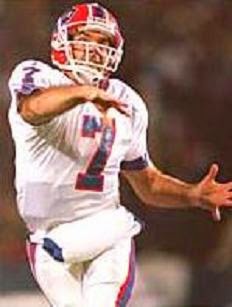
The Buffalo Bills were off to a slow 1-3 start as they faced the Indianapolis Colts on October 11, 1998. The Bills were in transition as key players in conference-topping seasons such as QB Jim Kelly, RB Thurman Thomas, and WR Andre Reed were either gone or in the twilight of great careers. Marv Levy had retired as head coach and was replaced by Wade Phillips, and the team invested heavily in QB Rob Johnson, who was obtained from Jacksonville and viewed as a young passer with great potential. The Bills also picked up 35-year-old QB Doug Flutie (pictured at right), the diminutive former Heisman Trophy winner who came from the CFL following eight outstanding seasons after faltering in the NFL. Johnson had the starting job and initially struggled, but performed well in an upset of the 49ers the previous week.

The Colts were at 1-4 and also won for the first time the week before. Head Coach Jim Mora’s team had a young quarterback of its own in Peyton Manning, the first overall pick in the NFL draft. He had been put directly into the starting lineup and, as to be expected, was struggling in the early going. RB Marshall Faulk was highly productive as a runner and receiver out of the backfield, but Indianapolis was a young team and very much a work in progress.

There were 52,938 fans in attendance at the RCA Dome in Indianapolis. Following a short series by the Bills that ended with a punt, and with Rob Johnson having to exit due to bruised ribs suffered when he was sacked on third down, the Colts started with good field position at their 48. Marshall Faulk took off around left end for a 40-yard gain to the Buffalo 12, and after three more Faulk carries picked up seven yards, Mike Vanderjagt kicked a 22-yard field goal to give the home team an early 3-0 lead.

Doug Flutie was at quarterback for the Bills in place of Johnson on the next series and he completed four passes, the longest to WR Eric Moulds for 16 yards. The drive stalled at the Indianapolis 35 and the visitors came up empty when Steve Christie missed on a 53-yard field goal attempt.

The Colts went 42 yards in seven plays on their next possession. Peyton Manning completed a pass to TE Ken Dilger for 21 yards on first down to move the ball back into Buffalo territory and a pass interference penalty on a third down play advanced the ball to the Buffalo 18. Once again the Colts couldn’t reach the end zone but Vanderjagt added another field goal, from 33 yards, to put them ahead by 6-0.

Following a punt by the Bills early in the second quarter, the Colts put together a nine-play, 54-yard drive that was helped along by a roughing-the-passer penalty on DE Bruce Smith. Manning converted a third-and-nine situation with a completion to WR Marvin Harrison and Vanderjagt kicked a 43-yard field goal, his third, to put Indianapolis up by 9-0.

Taking possession with 8:17 remaining in the first half, the Bills advanced 71 yards in nine plays. Five of them were pass completions by Flutie, with three to WR Andre Reed. The third was for 24 yards to reach the Indianapolis six and, two plays later, a scrambling Flutie connected with TE Jay Riemersma for a seven-yard TD. Christie added the extra point to make it a two-point contest. The Colts responded with a scoring drive that included Manning passes to Faulk that covered 26, 11, and five yards and once again ended with a field goal by Vanderjagt, this time covering 41 yards. Indianapolis took a 12-7 lead into halftime, but after dominating play in the first half, the Colts led by only five points.

In their second possession of the third quarter, the Bills moved 59 yards in 11 plays. Flutie converted three third downs along the way, with a 20-yard completion to FB Sam Gash while facing third-and-three, a four-yard toss to WR Kevin Williams when again in a third-and-three situation, and the last was again to Williams on third-and-goal for a six-yard TD. Christie added the point after and Buffalo was in front for the first time by 14-12.

A three-and-out possession by the Colts gave the Bills the ball at their 43 and resulted in a seven-play, 57-yard drive that stretched into the fourth quarter. The big plays along the way were passes to Reed for 20 and 15 yards, and Flutie had a 12-yard run as well. RB Antowain Smith gained the last four yards for a touchdown and Christie converted.

It quickly got worse for the Colts when, on their second play of the ensuing series, Manning was intercepted by NT Ted Washington, who batted the ball into the air at the line and gathered it in to give Buffalo the ball at the Indianapolis 25. Four plays later, it was Smith scoring another touchdown from a yard out and, with Christie’s kick, the Bills had a commanding 28-12 lead with eleven minutes to play.

The Colts were unable to get out of their end of the field on the next series, resulting in a punt, and with Smith running the ball five straight times, the big one for a gain of 30 yards, Buffalo was able to add a 39-yard Christie field goal.

In a deep 31-12 hole, the Colts fought back as Manning filled the air with passes. A 14-play drive covered 83 yards and resulted in a touchdown pass to WR Torrance Small from three yards out. The try for a two-point conversion failed and Indianapolis remained behind by 31-18. The home team got their next shot with 55 seconds left on the clock and Manning tossed to Harrison for a 25-yard TD. Again the try for a two-point conversion failed, but the outcome was already decided. Buffalo won by a final score of 31-24.
  
The Bills led in total yards (381 to 341), first downs (24 to 21), and time of possession (36:41 to 23:19). However, during Buffalo’s 24-point surge in the second half, the visitors outgained Indianapolis by 150 yards to 28. The Colts also turned the ball over twice, to none by the Bills. Buffalo led in penalties with 9 at a cost of 77 yards to four for 18 yards on the Colts.

Doug Flutie was highly efficient, especially in the second half, as he completed 23 of 28 passes for 213 yards and two touchdowns with none intercepted. Antowain Smith rushed for 130 yards on 31 carries that included two TDs. Thurman Thomas gained 23 yards on six rushing attempts and 5 catches for 32 yards while Sam Gash contributed 45 yards on his 5 receptions. Andre Reed also pulled in 5 passes and led the Bills with 76 yards.

For the Colts, Peyton Manning was successful on 20 of 41 throws for 235 yards and two TDs while being intercepted twice. Marshall Faulk gained 93 rushing yards on 18 carries and also led the club with 6 pass receptions for 80 yards. Mike Vanderjagt was a perfect four-for-four on field goal attempts.

“We had opportunities to score touchdowns and weren’t able to do that, and that hurt us,” summed up Coach Jim Mora in defeat. “We were playing well and had good field position and couldn’t get it in the end zone. In the second half, they took over offensively and defensively, and we couldn’t get anything going.”

The win for Buffalo marked the second of five straight on the way to a 10-6 record and third place finish in the AFC East. That was enough to secure a Wild Card playoff spot, but the Bills lost to the club that came in second, Miami, in the first round. The Colts were at 1-8 before they won again and ended up at 3-13 for the second consecutive year. However, the groundwork was laid for significant improvement.

Doug Flutie ended up having a Pro Bowl year as he passed for 2711 yards and 20 touchdowns, and provided a spark to the offense, although the competition with Rob Johnson proved to be rancorous. Antowain Smith also continued to perform well, rushing for 1124 yards on 300 carries (3.7 avg.) with eight TDs.

Peyton Manning played every down at quarterback for the Colts and while he led the NFL by tossing 28 interceptions, he also threw 26 TD passes and accumulated 3739 passing yards, foreshadowing much bigger seasons to come.

December 19, 2015

1998: Jets Defeat Bills to Clinch AFC East


The New York Jets had a 10-4 record and were looking to wrap up the AFC East title as they faced the Buffalo Bills on December 19, 1998. In their second season under Head Coach Bill Parcells, the Jets were a far cry from the 1-15 club of two years earlier. Newcomers to the offense, most notably QB Vinny Testaverde (pictured at right) and RB Curtis Martin, were having a major impact, as were wide receivers Keyshawn Johnson, a flashy third-year player, and Wayne Chrebet, a classic overachiever in his fourth season. The defense was strongest at linebacker, where Mo Lewis was joined by Bryan Cox, let go by the Bears but revitalized with the Jets.

Buffalo was coached by Wade Phillips and came into the contest at 9-5. Diminutive 36-year-old QB Doug Flutie had turned the club around in his return to the NFL from the CFL, taking over for QB Rob Johnson after a slow start. Retooling from the squad that had started the decade with four straight AFC Championships, the offense now also featured RB Antowain Smith and WR Eric Moulds while RB Thurman Thomas and WR Andre Reed had reduced roles. The tough defense was still anchored by DE Bruce Smith, who was beginning to slow down at age 36, as well as NT Ted Washington.

There were 79,056 fans in attendance at Rich Stadium on a windy Saturday. The Bills had the first possession and advanced into New York territory thanks to a pass from Doug Flutie to Eric Moulds that picked up 28 yards. Another throw to WR Quinn Early gained eight more yards to the 23, but on the next play the usually sure-handed Antowain Smith fumbled and LB Pepper Johnson recovered for the Jets.

New York drove 79 yards in eight plays. Vinny Testaverde threw to Keyshawn Johnson (pictured below) for 16 yards on first down and, after the series appeared to be stymied at the Jets’ 37, Testaverde ran for 14 yards on a third-and-10 play. Two plays later, RB Dave Meggett, who had only recently joined the team, gained 18 yards on a carry up the middle, Johnson picked up another 25 yards on an end-around, and it was Testaverde to Wayne Chrebet for a seven-yard touchdown. John Hall added the extra point and the visitors had the early 7-0 lead.


On the next possession, the Bills converted a third-and-nine situation with a Flutie pass to Moulds for 27 yards, but a 15-yard taunting penalty on the receiver at the end of the play erased most of the gain and Buffalo was ultimately forced to punt. Chris Mohr’s kick traveled 47 yards and pinned the Jets back at their one yard line, and a short series resulted in a punt in return. A 30-yard kick by John Kidd went just 30 yards and gave the Bills good starting field position at the New York 40. But after a short Flutie pass to Smith gained five yards, two more throws were incomplete and, facing fourth-and-five, another pass intended for Moulds also was unsuccessful.

The teams continued to exchange punts as the game entered the second quarter. Finally, Buffalo put together an 11-play drive that covered 79 yards. Flutie completed passes to FB Sam Gash for nine yards and WR Kevin Williams for 22 yards in a third-and-six situation. Smith ran effectively and Flutie himself had a nine-yard run. Flutie connected with Thurman Thomas for a 25-yard TD to complete the series and Steve Christie added the point after to tie the score.

Following a punt by the Jets, the Bills drove from their one to the New York 10 as Flutie completed three passes, the longest to Moulds (pictured below) for 35 yards, but they ultimately came up empty when Christie was wide to the left on a 28-yard field goal attempt in the final seconds of the half. The score remained unchanged at 7-7 although Buffalo had already accumulated 266 yards.


The Jets started off the third quarter by advancing into Buffalo territory. Testaverde completed consecutive passes to Keyshawn Johnson for 16 and six yards and Curtis Martin had a nine-yard run. Hall kicked a 48-yard field goal to put the visitors back in the lead by 10-7.

Buffalo responded with a long scoring drive. Smith carried most of the load, picking up 35 yards on eight attempts and Flutie converted two third downs, one on a pass to Williams for seven yards and another on a three-yard run. The advance finally faltered at the New York 26 and Christie tied the score once more with a 44-yard field goal into the wind. But two plays after the ensuing kickoff, Testaverde threw to WR Dedric Ward, who beat CB Donovan Greer, an injury replacement, for a 71-yard touchdown. Hall’s kick gave the visitors a seven-point lead.

The Bills had to punt following the next series and the Jets moved into Buffalo territory, helped by a defensive holding penalty in a third-and-nine situation. But they were again forced to try for a field goal and Hall’s attempt from 46 yards was no good.

Following another exchange of punts, the Bills had good starting field position at the New York 49. Keeping the ball on the ground, they reached the 21, but a Flutie pass was bobbled by Williams and barely picked off by diving CB Victor Green (television replays were inconclusive as to whether he maintained possession) with just under four minutes remaining in regulation.

The Jets went three-and-out, with Kidd’s punt sailing 57 yards. Starting from their 20, the Bills had one last chance and Flutie immediately threw to Moulds for 17 yards. But following a short run by Thomas, the next three passes fell incomplete to turn the ball over to New York on downs. There was still 1:32 left on the clock, but a Testaverde throw to Johnson for seven yards on a third-and-six play nailed down the 17-10 win for the Jets.

Buffalo had the edge in total yards (366 to 269), although the Bills gained only 100 yards in the second half. They also had more first downs (21 to 14) and ran far more plays (74 to 51). However, the home team also turned the ball over twice, to none suffered by the Jets.

Vinny Testaverde completed 14 of 23 passes for 184 yards and a touchdown while giving up no interceptions. Keyshawn Johnson had 7 catches for 66 yards while Dedric Ward gained a team-leading 71 yards on his one long scoring reception. Curtis Martin was held to 38 rushing yards on 20 attempts.

For the Bills, Doug Flutie had a rough outing, completing just 14 of 38 throws for 220 yards and a TD as well as an interception. While he was only sacked once, he faced heavy pressure and was knocked down often. Antowain Smith (pictured below) gained 82 yards while running the ball 20 times. Eric Moulds topped the receivers with four catches for 107 yards.


The Jets won the season finale to finish at 12-4 with their first division title since they were an AFL team in 1969. They reached the AFC Championship game before losing to Denver. Buffalo ended up in third place in the AFC East with a 10-6 record and qualified for the playoffs as a Wild Card. The Bills lost to Miami, the club that finished second in the division, in the first round.

Vinny Testaverde ended up with an AFC-leading 101.6 passer rating, throwing for 3256 yards and 29 TDs with just seven interceptions. He was selected to the Pro Bowl along with Keyshawn Johnson, who caught 83 passes for 1131 yards and 10 touchdowns, and Curtis Martin, who had many more productive games on his way to 1287 rushing yards.

Doug Flutie also was chosen for the Pro Bowl as he started ten games, seven of them wins, and threw for 2711 yards and 20 touchdowns against 11 interceptions. Eric Moulds led the AFC with 1368 pass receiving yards on his 67 catches with 9 TDs and was another Pro Bowl selection. Antowain Smith, in his second season, rushed for 1124 yards while averaging 3.7 yards per attempt and scored eight TDs. 

November 29, 2014

1998: Last-Play TD Gives Patriots Win Over Bills


The New England Patriots were 6-5 and fighting to stay in the playoff hunt as they hosted the division-rival Buffalo Bills on November 29, 1998. To add to New England’s concerns, QB Drew Bledsoe (pictured above) was playing with a splint on his throwing hand due to a broken finger suffered the previous week, when he had still managed to toss a late scoring pass to pull out a win. Prior to that, Head Coach Pete Carroll’s team had lost four of five games, but the offense was helped by the return from injury of WR Terry Glenn.

Buffalo, coached by Wade Phillips, was 7-4 and had beaten the Patriots at home two weeks earlier. Diminutive QB Doug Flutie, former Boston College star and CFL legend, replaced Rob Johnson, the young quarterback the team had swung a deal with Jacksonville to obtain, with good results. WR Eric Moulds was a big-play talent across from 34-year-old WR Andre Reed and, with RB Thurman Thomas entering the twilight of his great career, RB Antowain Smith emerged as a productive starter. DE Bruce Smith was still a key player on the defensive line, along with NT Ted Washington.

There were 58,304 fans in attendance at Foxboro Stadium. Buffalo had the first possession and Doug Flutie completed his first three passes, but the drive stalled at the New England 45 and the Bills punted. They got the ball back in short order when CB Thomas Smith intercepted a pass by Drew Bledsoe at the Buffalo 12. Flutie completed a throw to Eric Moulds for 33 yards and the long series finally ended at the New England 17 where the Bills came up empty when Steve Christie missed a 35-yard field goal attempt.

The teams exchanged punts as the game headed into the second quarter. The Patriots then put together a 66-yard drive in eight plays. Bledsoe threw to Terry Glenn for 15 and 33 yards and TE Ben Coates for 12 to reach the Buffalo nine. A pass interference penalty moved the ball to the one, and after two carries by RB Robert Edwards netted a loss of a yard, Bledsoe passed to him for a two-yard touchdown. Adam Vinatieri added the extra point for the 7-0 lead.

Once again the Bills had to punt following their next possession, and once again the Patriots drove to a score. This time it took them seven plays to advance 53 yards, having gotten a 30-yard punt return from CB Chris Canty to give them good starting field position. Bledsoe completed five passes, with gains of 12 yards to Glenn, 13 to Coates, and finally a 12-yard TD throw to RB Derrick Cullors. Vinatieri kicked the point after to expand the New England lead to 14-0.

 Down by two touchdowns, the Bills got a break on the next series when the Patriots were flagged for pass interference on a third-and-10 play that picked up 26 yards. Antowain Smith followed up with three runs that totaled 22 yards to the New England 38. A Flutie pass and another run by Smith picked up another ten yards, but that was it and Christie came on to kick a 34-yard field goal.

With 1:16 remaining in the first half, the Patriots responded with Bledsoe completing three straight short passes. However, a third-down sack forced a punt and the Bills, starting from their 37 with the clock now down to 18 seconds, got a 55-yard gain on a pass from Flutie to WR Kevin Williams. Christie kicked a 26-yard field goal on the last play before halftime and the score stood at 14-6 at the game’s midpoint.


Following a punt by the Patriots to finish off the first series of the third quarter, Buffalo struck quickly when Flutie (pictured at left) connected with Moulds for an 84-yard touchdown. The pass for a two-point conversion failed, but the visitors were now only two points behind.

Short Bledsoe passes and the running of Edwards moved the Patriots down the field on the next possession, and Vinatieri booted a 44-yard field goal to expand New England’s lead to 17-12. But the Bills came back with another score of their own on a series in which Flutie completed passes to Andre Reed for 23 yards and Moulds for 17. With a second-and-goal at the four, they were unable to reach the end zone, but Christie kicked a 22-yard field goal to again narrow the margin to two points at 17-15.

As the contest entered the fourth quarter, the Patriots again had to punt and Buffalo put together a long, penalty-filled drive of 67 yards. A defensive holding penalty converted a third-and-16 situation and an illegal-use-of-hands call turned a third-and-four play into a first down. Flutie completed four passes, one to Williams to convert yet another third and long that picked up 22 yards, although an apparent 23-yard completion to Reed was called back for holding. Finally, Flutie threw to Reed for a touchdown from four yards out and, while the two-point conversion attempt again failed, the Bills were in front by 21-17.

The Patriots came up empty on their next series when Vinatieri missed a 47-yard field goal attempt. After Buffalo’s next possession resulted in a punt just after the two-minute warning, New England started off at its 18 and had no remaining timeouts. Bledsoe completed four of five passes, two of them to Coates, as the Patriots advanced to the Buffalo 37. However, the drive stalled there until, on fourth-and-nine, a pass lofted toward Glenn in the end zone was incomplete but Buffalo was called for pass interference. The ball was moved to the one, much to the fury of the Bills. With no time left on the clock, Bledsoe connected with Coates for a touchdown and, with the angry Bills having already departed for the locker room, Vinatieri ran for an unopposed two-point conversion rather than kicking. The Patriots came away with a dramatic 25-21 win.

Buffalo had a sizable lead in total yards (428 to 259) and time of possession (34:01 to 24:59), although New England had the edge in first downs (24 to 23). The Bills also recorded four sacks, to one by the Patriots, and New England suffered the only turnover. But Buffalo was penalized 12 times, at a cost of 107 yards, which in the end proved fatal, while the Patriots drew 9 flags for 80 yards.


Drew Bledsoe completed 28 of 43 passes for 246 yards and three touchdowns while giving up one interception. Ben Coates (pictured at right) had 10 catches for 70 yards and the game-winning TD and Terry Glenn gained 104 yards on 8 receptions. Robert Edwards led New England in rushing with 40 yards on 13 carries.

For the Bills, Doug Flutie was successful on 21 of 39 throws for 339 yards and two TDs and no interceptions. He also ran for 30 yards on five carries. Eric Moulds caught 8 passes for 177 yards and the long touchdown. Kevin Williams contributed 74 yards on his four receptions and Andre Reed accounted for 53 yards and a TD on his four. Antowain Smith rushed for 58 yards on 21 attempts.

“We were robbed,” said SS Henry Jones, who was called for the crucial pass interference penalty at the end. “Terry Glenn jumped for the ball, but no one even grabbed him.”

“Well, [the officials] gave them the game, they might as well give them the extra point,” added Coach Phillips, also making reference to the unopposed two-point conversion at the end.

“He [Jones] wasn’t playing the ball, but he did make contact with the receiver,” countered referee Walt Coleman. “That’s pass interference.”

The win tied the Patriots with the Bills as they remained in the playoff mix, but they split their last two contests, including a loss to the division-winning Jets in the finale, to finish fourth in the AFC East at 9-7. It was still enough to make it in to the postseason with the last Wild Card spot and they lost to Jacksonville in the first round. Buffalo was third with a 10-6 record and lost to Miami, the second-place team, in the Wild Card playoff.

Drew Bledsoe, who missed the last two games and the playoff loss due to injury, ended up passing for 3633 yards and 20 touchdowns. Ben Coates led the team with 67 pass receptions, for 668 yards (10.0 avg.) and six TDs. He was named to the Pro Bowl for the fifth straight year.

Doug Flutie and Eric Moulds were also selected to the Pro Bowl. The 36-year-old Flutie threw for 2711 yards and 20 touchdowns and ran for another 248 yards while the team went 7-3 with him as the starting quarterback. Moulds (pictured below) averaged 20.4 yards on his 67 catches for an AFC-leading 1368 yards with nine TDs.


October 14, 2014

2007: Patriots Defeat Cowboys in Battle of Unbeaten Teams


Both the New England Patriots and Dallas Cowboys sported unblemished 5-0 records as they faced off at Texas Stadium on October 14, 2007. The Patriots had yet to score fewer than 34 points in any of their games, or give up more than 17, while Dallas had been only a bit less dominant.

Under Head Coach Bill Belichick, the Patriots had been molded into perennial contenders, reaching the playoffs in five of the previous six seasons that included three NFL Championships. They were guided on offense by QB Tom Brady (pictured above), who was at the height of his abilities at age 30. There were no stars among the running backs, but WR Randy Moss had been added to the receiving mix with outstanding results thus far, WR Wes Welker was a reliable possession receiver, and there was good depth behind them. The defensive line was excellent and the linebackers an experienced and savvy group.

Dallas, coached by Wade Phillips, also had a talented quarterback in Tony Romo, who had come out of nowhere the previous year to take over the starting job, and excellent receivers in WR Terrell Owens and TE Jason Witten. The running duties were shared by Julius Jones and Marion Barber, with good results. On defense, the corps of linebackers, led by DeMarcus Ware, was effective, but the backs were vulnerable to being spread out – as the Patriots would show.

The Cowboys had first possession and punted. New England went 74 yards in 14 plays in response. After misfiring on his first two passes, Tom Brady connected with Wes Welker for 16 yards on third-and-ten and was successful on his next four throws, three of them to WR Donte’ Stallworth that totaled 25 yards. Facing third-and-seven at the Dallas 26, Brady again completed a pass to Welker for 20 yards and, three plays later, hit Randy Moss for a six-yard touchdown. Stephen Gostkowski added the extra point.

The teams traded punts until the Patriots again put together another scoring drive, this time advancing 69 yards in six plays. Once again Brady made big plays on third down, throwing deep to TE Ben Watson for 28 yards in a third-and-seven situation to reach the Dallas 38 and then, on third-and-seven, to Welker for a 35-yard TD. Gostkowski again successfully converted and New England took a 14-0 lead into the second quarter.

The Cowboys moved into New England territory on their next series and Nick Folk got them on the board with a 38-yard field goal. They scored again a short time later when Brady fumbled while being sacked by LB Greg Ellis and DE Jason Hatcher recovered and it returned it 29 yards for a touchdown. Folk’s PAT narrowed the visitors’ lead to 14-10.

The Patriots responded with another long series. Falling quickly into a second-and-20 hole, Brady passed to Stallworth for 17 yards and an offside call on the Cowboys gave New England a first down. Another completion to Stallworth gained 15 yards and, in a third-and-ten situation at the Dallas 42, Brady’s short toss to RB Kevin Faulk picked up 18 yards. The series ended with Brady once again throwing to Welker for a touchdown, this time from 12 yards out. Gostkowski’s extra point extended New England’s lead to 21-10.

Dallas regained possession with 3:28 remaining in the first half. Tony Romo immediately connected with TE Anthony Fasano for 26 yards, the first of seven completions that included three to Jason Witten for 11, 25, and 11 yards. A pass to Terrell Owens that was ruled complete but overturned on review was followed by a 12-yard TD pass to Owens and, with Folk’s extra point, the score stood at 21-17 at halftime.


New England’s first possession of the third quarter ended with a punt and the Cowboys put together a seven-play, 74-yard drive. Julius Jones (pictured above) had back-to-back runs of 25 and 18 yards along the way and Romo was successful on all four of his passes, the last to WR Patrick Crayton for an eight-yard touchdown. Folk added the point after and Dallas was in the lead by 24-21.

The Patriots responded with a scoring drive of their own, covering 77 yards in ten plays. Brady completed six passes, a pair each to Moss and Welker, and when Moss was interfered with by safety Pat Watkins, New England was at the one yard line. Brady tossed to TE Kyle Brady from there for a TD, Gostkowski added the PAT, and the visitors were back in front by 28-24.

The Cowboys were unable to move beyond their 12 yard line on the next possession and Mat McBriar’s punt, which was returned 18 yards by Welker, gave the Patriots good field position at the Dallas 43. An apparent touchdown pass was overturned by review, but a roughing-the-passer penalty advanced New England 15 yards and, while the drive stalled at that point, Gostkowski added a 45 yard field goal to make it a seven-point game.

 As the period came to a close, Dallas had fourth-and-one at its own 47, but an attempt to convert was nullified by a holding penalty and the Cowboys had to punt. Four plays later, Brady went long for Stallworth and the result was a 69-yard touchdown. Gostkowski’s extra point put New England ahead by 38-24.

RB Tyson Thompson returned the ensuing kickoff 72 yards to the New England 23, but after Romo threw to Owens for 13 yards, the Cowboys were unable to reach the end zone and had to settle for a 23-yard Folk field goal.

Ahead by 11 points, the Patriots put together a long drive that burned six minutes off the clock. Brady completed four passes, Faulk ran the ball six times, and Gostkowski kicked a 22-yard field goal to extend New England’s lead to 41-27 with just over four minutes remaining on the clock.

On the first play of the next Dallas series, LB Junior Seau intercepted Romo’s pass to effectively extinguish any hopes for the Cowboys. The Patriots added one last touchdown on a one-yard carry by FB Kyle Eckel and came away with a decisive 48-27 win.

New England was statistically dominant, leading in total yards (448 to 285) and first downs (28 to 13). Each team turned the ball over once. The Cowboys recorded three sacks, to two by the Patriots. They also were penalized 12 times, at a cost of 100 yards, compared to five flags thrown on New England.

Tom Brady completed 31 of 46 passes for 388 yards and five touchdowns while giving up no interceptions. Wes Welker (pictured below) had 11 catches for 124 yards and two TDs and Donte’ Stallworth gained 136 yards on 7 receptions that included a score. They benefited from Dallas’ coverage of Randy Moss, who still caught 6 passes for 59 yards and a touchdown. Kevin Faulk was New England’s leading rusher with 47 yards on 12 attempts.


For the Cowboys, Tony Romo was successful on 18 of 29 throws for 199 yards and two TDs with one interception. Terrell Owens topped the receivers with 6 catches for 66 yards and a touchdown and Julius Jones ran for 51 yards on six carries, followed closely by RB Marion Barber who had 49 yards on 9 runs. Mat McBriar averaged 53.8 yards on his five punts.

“The reality is we got a win on the road and we’re 6-0. That’s what is important,” summed up Tom Brady. “Any time you win you’re doing just fine. It’s another step in the process. We have to continue to make improvements.

The Patriots improved all the way to a 16-0 record in the regular season, but came short of ultimate perfection with an upset loss to the New York Giants in the Super Bowl. Dallas recovered to win its next seven straight games on the way to a NFC-best 13-3 tally. However, they lost in the Divisional playoff round to the Super Bowl-bound Giants.

Tom Brady led the NFL in passing yards (4806), completion percentage (68.9), yards per attempt (8.3), and overall rating (117.2) as well as a then-record 50 touchdown passes and received consensus MVP honors as well as All-NFL and Pro Bowl recognition. Randy Moss caught a record 23 TD passes among his 98 receptions for 1493 yards and Wes Welker tied for the league lead with 112 catches, good for 1175 yards and eight scores.

Tony Romo passed for 4211 yards and a NFC-high 36 touchdowns, although his 19 interceptions ranked among the league leaders as well. 

January 2, 2014

1994: Raiders Rally to Beat Broncos in OT and Secure Playoff Spot


The Los Angeles Raiders had a 9-6 record and needed a win to make the postseason as they hosted the Denver Broncos in the season finale on January 2, 1994. Coached by Art Shell, the Raiders were lightly regarded coming into the season and, indeed, were an inconsistent team, capable of beating strong clubs and falling to far weaker ones. QB Jeff Hostetler, in his first year with the team, was a fine addition to the offense and he had a good receiving corps led by WR Tim Brown (pictured above). However, the running game was mediocre and while the defense had solid performers in DE Anthony Smith, DT Chester McGlockton, and CB Terry McDaniel, the unit was prone to giving up points.

Denver, in its first year under Head Coach Wade Phillips, also had trouble running the football but had outstanding 33-year-old QB John Elway and a rising talent in TE Shannon Sharpe. The defense featured a tremendous hybrid pass rushing DE/LB in Simon Fletcher, but was vulnerable against the pass. The Broncos were also 9-6 and had lost to the Raiders in Denver.

It was a hazy but sunny day at the LA Memorial Coliseum with 66,904 fans in attendance. Following a three-and-out possession by the Raiders to start the game, Denver drove 55 yards in 12 plays. John Elway threw to WR Arthur Marshall for 23 yards in a third-and-13 situation and Jason Elam put the Broncos on the board with a 52-yard field goal.

On the Raiders’ next series, RB Randy Jordan fumbled when hit by LB Mike Croel, who recovered at the LA 31. Three plays later, Elway passed to WR Cedric Tillman for a 27-yard touchdown and, with Elam adding the extra point, a 10-0 Denver lead.

Another short Los Angeles possession ended with a punt and the Broncos were driving as the first quarter ended with Elway running for 18 yards on a third-and-10 play. The 11-play series ended with Elam kicking another field goal, this time from 24 yards.


The Raiders put together a scoring series of 82 yards in eight plays. Jeff Hostetler (pictured above) completed four passes, the last to Tim Brown for a four-yard TD. RB Tyrone Montgomery ran the ball three times for 24 yards along the way. Jeff Jaeger added the extra point that cut Denver’s lead to 13-7.

However, the Broncos responded by going 83 yards in seven plays to score once again. Elway threw to Shannon Sharpe for a 54-yard touchdown and Elam added the PAT to again put the Raiders behind by 13 points.

Hostetler completed back-to-back passes to fleet rookie WR James Jett for 22 yards and to Brown for 24 yards to the Denver 31 as Los Angeles advanced 53 yards in eight plays. The series finally stalled at the 25 and Jaeger kicked a 43-yard field goal.

There was a minute remaining in the first half but the back-and-forth nature of the game continued as RB Robert Delpino returned the ensuing kickoff 49 yards to give the Broncos good field position at the LA 43, and they made the most of it. RB Glyn Milburn ran for 13 yards, Elway threw to Sharpe for another 28 yards, and three plays later he connected with Sharpe again from a yard out for a touchdown. Elam added the extra point. The Raiders, in the last 24 seconds, benefited from three Hostetler pass completions that set up a 50-yard Jaeger field goal. Denver led by 27-13 at halftime.

The Broncos took the second half kickoff and put together a nine-play, 71-yard drive to put more points on the board. Elway threw to Sharpe for 21 yards and to WR Kitrick Taylor for another 28. The series stalled at the LA 17 and Elam booted a 27-yard field goal to give the visitors an imposing 17-point lead.

The Raiders fought back as Hostetler completed three passes to Brown that highlighted an 82-yard drive. The first was good for 26 yards to the Denver 45, the second gained 15 yards on a second-and-11 play, and the third covered 24 yards and scored a touchdown. Jaeger’s extra point made it a ten-point game at 30-20.

The Broncos reached the LA 44 before having to punt on their next series. The Raiders opened the fourth quarter with a 52-yard Jeff Gossett punt that pinned the Broncos back at their 15. Denver punted in turn and, with LA getting the better of the field position battle, the Raiders started off at their 49 and advanced 31 yards in seven plays, the biggest of which was a Hostetler to Brown completion that picked up 25 yards. Jaeger kicked a 39-yard field goal and Denver’s lead was down to seven points.

The Broncos had to punt following their next possession and Tom Rouen’s kick was blocked, but the Raiders were unable to move the ball on offense and had to punt it back. Another short series ending with a punt gave the ball to the Raiders at their 30 with just under three minutes left in regulation.

With Montgomery both running and catching the ball, the Raiders reached the Denver 40. Hostetler completed two passes of 13 yards apiece to Brown to reach the 14, and two more short throws picked up another 10 yards. Two more passes fell incomplete, but with eight seconds left Hostetler connected with WR Alexander Wright, who had gotten open when defending CB Charles Dimry fell, for a four-yard touchdown on the 13th play of the series. Jaeger successfully added the all-important extra point, and the fourth quarter ended with the teams tied at 30-30.

The Broncos had the first possession in overtime, and it appeared that they would prevail. Elway threw to Tillman twice, for 20 and 30 yards, and having reached the LA 22, Elam came in to attempt a 40-yard field goal. However, the rookie’s kick sailed wide to the left to give the Raiders a reprieve.

A short carry by Montgomery was followed by Hostetler taking off for a 19-yard gain and, after RB Napoleon McCallum ran for four yards, Hostetler completed a pass to TE Ethan Horton for 20 yards to the Denver 32. Two more runs netted three yards and, after a Hostetler pass was incomplete, Jaeger came in and kicked a 47-yard field goal to give the Raiders a 33-30 win at 7:10 into the extra period.

Denver had more total yards (471 to 398) while Los Angeles had the edge in first downs (24 to 22). The Raiders gave up the only turnover of the contest and the Broncos recorded three sacks, to none by LA.

Jeff Hostetler completed 25 of 41 passes for 310 yards and three touchdowns with none intercepted, and he also ran for 26 yards on two carries. Tim Brown had a big day with 11 catches for 173 yards and two TDs. Tyrone Montgomery (pictured below) paced the ground game with 44 yards on 13 attempts.


For the Broncos, John Elway was successful on 25 of 36 throws for 361 yards, also with three TDs and no interceptions. Shannon Sharpe caught 6 passes for 115 yards and two touchdowns and Cedric Tillman contributed 5 receptions for 91 yards and a score. Robert Delpino ran for 66 yards on 20 carries.

“There have been a lot of great comeback victories in Raider history, and I’ve been involved in a lot of them,” said Coach Art Shell. “But this one stacks up with the best.”

With the win, the Raiders finished second in the AFC West with a 10-6 record, grabbing the first Wild Card spot in the postseason. Denver, at 9-7, ended up third in the division and, thanks to advantageous tiebreakers, also qualified as a Wild Card team. Thus, the two teams met again at the same venue the following week in the Wild Card playoff round and the Raiders again won, this time by a more convincing tally of 42-24. LA lost to Buffalo at the Divisional level.

Tim Brown caught 80 passes for 1180 yards (his first of nine straight thousand-yard receiving seasons) and seven touchdowns. He was selected to the Pro Bowl.


John Elway led the NFL in pass attempts (551), completions (348), and yards (4030) and he topped the AFC in passing (92.8 rating), TD passes (25), and completion percentage (63.2). He also received Pro Bowl recognition. Shannon Sharpe (pictured at right) caught 81 passes for 995 yards and nine touchdowns, not only gaining selection to the Pro Bowl but receiving consensus first-team All-NFL honors for the first time as well.

January 8, 2013

2000: Titans Stun Bills with “Music City Miracle”


The 1999 NFL season was a year of transformation for the Tennessee Titans. First, the name was new, as the club had played the previous two seasons as the Tennessee Oilers after moving from Houston. Second, the team had a permanent home at the new Adelphia Coliseum in Nashville – prior to that, the franchise had played at different venues, including the Liberty Bowl in Memphis, and often before small crowds. During the period of transition, including the final season in Houston, the team had put together three straight 8-8 records. In ’99, Head Coach Jeff Fisher’s team broke out to a 13-3 record, which still wasn’t enough to win the AFC Central (Jacksonville finished at 14-2) but more than enough to grab a Wild Card spot in the playoffs. On January 8, 2000 the Titans faced the Buffalo Bills in their first postseason game at their new home.

The Bills, coached for the second year by Wade Phillips, were in the playoffs for the tenth time in twelve seasons as they finished second in the AFC East with an 11-5 record. While several of the players who had been key performers during that stretch, such as DE Bruce Smith, WR Andre Reed, and RB Thurman Thomas, were reaching the end of the trail, younger performers like RB Antowain Smith, WR Eric Moulds, LB Sam Cowart, and CB Antoine Winfield made significant contributions. 37-year-old QB Doug Flutie, undersized but popular and typically productive, had held off the challenge of 26-year-old Rob Johnson, but in a controversial move, Coach Phillips chose to bench Flutie in favor of Johnson for the playoff game at Tennessee.

With 66,672 fans in attendance at the Adelphia Coliseum, the defenses took control early and the first quarter was scoreless. It was a defensive play in the second quarter that put the first points on the board when Tennessee’s star rookie DE Jevon Kearse (pictured below) sacked Johnson in the end zone for a safety.


The ensuing free kick was returned 42 yards by WR Derrick Mason to give the Titans excellent field position at the Buffalo 28. They made the most of it as, five plays later, QB Steve McNair ran around end for a one-yard touchdown. With the successful extra point, the home team was ahead by 9-0.

After the Bills punted, the Titans again advanced into scoring territory. It looked like they would come up dry when, with time running out in the first half, Al Del Greco missed a 45-yard field goal attempt. However, a holding penalty on the Bills gave Del Greco another shot from five yards closer and this time he was successful. Tennessee went into halftime with a 12-0 lead. The Bills gained just 64 total yards and managed only three first downs in the first half as Johnson had struggled.

It quickly became a different story in the second half when, on the opening play from scrimmage of the third quarter, Antowain Smith ran for 44 yards. It set up his four-yard touchdown carry that capped a 62-yard drive and got the Bills back in the game.

Later in the third quarter, safety Kurt Schulz deflected a McNair pass that was intercepted by Antoine Winfield. The Bills got another big play when Johnson threw to Eric Moulds, who got ahead of CB Denard Walker down the left sideline, for a 37-yard gain. Kearse was penalized for a roughing the passer penalty to help move the series along and Smith scored another TD, this time from a yard out. The try for a two-point conversion failed but Buffalo was in front by 13-12 with just over eleven minutes remaining in the game.

That was it for the offensive output until, with 6:15 remaining, WR Isaac Byrd returned a punt 16 yards to give the Titans possession at the Buffalo 45. Tennessee moved methodically down the field with Eddie George carrying the ball five straight times and Del Greco kicking a 36-yard field goal. The Titans were ahead by 15-13 with 1:48 to go.

However, Buffalo got a 33-yard kickoff return from WR Kevin Williams and proceeded to drive 38 yards in six plays. With the clock now down to 16 seconds, Christie was successful on a 41-yard field goal try that put the Bills back on top at 16-15.

The Bills kicked off, with Christie booting it short but high to try and hinder a return. The Titans were anticipating a squib kick and had lined up for a desperation return play called Home Run Throwback.  RB Lorenzo Neal caught the ball and handed off to TE Frank Wycheck, who then threw a lateral down the 25 yard line to WR Kevin Dyson. The plan was to gain enough yards to get into field goal range, but Dyson made the catch of the low-thrown ball and, led by a convoy of blockers, he proceeded to run 75 yards for a touchdown (pictured at top). It was the first time the Titans had ever run the play and Dyson, who was filling in for the injured Mason, had never practiced it.


The Bills furiously argued that the throw from Wycheck (pictured at right) to Dyson was an illegal forward pass, but the play was reviewed by referee Phil Luckett and the call stood – much to the delight of the ecstatic home crowd and the consternation of the shocked Bills players and coaches. Thanks to the touchdown on what came to be referred to as "the Music City Miracle", Tennessee advanced by a final score of 22-16.

“The line judge’s initial ruling was that it was not a forward pass,” explained Luckett. “Taking from where the pass left the passer’s right hand on that (the 25) yard line, the receiver catches it right there on that yard line. It did not appear to be a forward pass, therefore there is not a foul.”

“I think it was a forward lateral,” said Buffalo’s owner Ralph Wilson, who spoke for many (but by no means all) who observed the play. “I also think there was no way the guy was going to overturn it.”

The Bills led in total yards (219 to 194) although Tennessee had more first downs (16 to 13). Neither team gained much through the air, with Buffalo leading in net passing yards (96 to 55). But the Titans sacked Johnson six times (two by Jevon Kearse) as opposed to Buffalo getting to McNair three times (2.5 by Bruce Smith). The Bills also were penalized ten times, while the home team was flagged twice. Each team turned the ball over on two occasions.

Steve McNair completed 13 of 24 passes for just 76 yards with one intercepted, although he ran six times for 19 yards and a TD. Eddie George rushed for 106 yards on 26 carries. Frank Wycheck and TE Jackie Harris each caught four passes, with Wycheck gaining 29 yards to 20 for Harris.

For the Bills, Rob Johnson, who had difficulty against the strong Tennessee pass rush but came on in the fourth quarter, was successful on 10 of 22 throws for 131 yards with no touchdowns or interceptions. Antowain Smith paced the ground attack with 79 yards on 14 carries that included two for scores. WR Peerless Price had 5 pass receptions for 62 yards and Eric Moulds also gained 62 yards on his three catches.

The Titans went on to win the AFC title and lost a close contest to the St. Louis Rams in the Super Bowl. They went 13-3 again in 2000, although did not advance as far in the postseason. As for the Bills, the loss to Tennessee signaled the beginning of a long playoff drought. They dropped to 8-8 in 2000 and were over .500 just once in the course of the next 13 years (and counting).

November 14, 2012

1993: Salisbury’s Passing, Irwin’s Blocked Kicks Propel Vikings Over Broncos


The Minnesota Vikings were 4-4 and coming off of two straight losses as they faced the Denver Broncos on November 14, 1993. Head Coach Dennis Green’s team had difficulty scoring and offensive coordinator Jack Burns was already a casualty. Brittle veteran QB Jim McMahon was injured and Sean Salisbury (pictured above) had taken over. A star for two years in the CFL, leading Winnipeg to a Grey Cup title, Salisbury had been strictly a backup in the NFL. The loss of RB Terry Allen for the year with a knee injury further hampered the offense.

Denver was 5-3 and had just won two consecutive games. Under a new head coach in Wade Phillips, following twelve seasons with Dan Reeves at the helm, the key to the offense was still veteran QB John Elway, and he was thriving in offensive coordinator Jim Fassel’s West Coast offense.

A morning snowstorm had dropped six inches of snow on Denver. While the field at Mile High Stadium was clear, footing was slippery and the temperature was around 30 degrees at kickoff.

Minnesota had the first possession and punted, but Elway fumbled away his first snap, thus giving the Vikings an early break as they took possession at the Denver 34. Three plays later, Sean Salisbury threw to WR Anthony Carter but Carter, having broken a tackle, tripped and fell at the one yard line after gaining 27 yards. It proved to be significant on the next play when Salisbury fumbled while being sacked and LB Karl Mecklenburg recovered for the Broncos.

Denver went three-and-out, but three plays after punting CB Frank Robinson intercepted a Salisbury pass and returned it 13 yards to give the Broncos possession at the Minnesota 31. Elway completed four passes as the home team scored in six plays that included a four-yard throw to WR Derek Russell for a touchdown. However, tackle Tim Irwin blocked the extra point attempt and the score remained 6-0.

The Vikings responded by going 71 yards in seven plays. Following a nine-yard carry by eleventh-year RB Roger Craig to start off the series, Salisbury threw to Anthony Carter for 30 yards to get into Broncos territory. Two plays later he hit Carter again for 39 yards but the drive stalled at the Denver seven yard line and Minnesota settled for a 25-yard field goal by Fuad Reveiz. The Broncos led by a 6-3 score.

Russell returned the ensuing kickoff 49 yards to give Denver good starting field position at the Minnesota 49. In a series that extended into the second quarter, the Broncos scored in seven plays as RB Robert Delpino ran for a three-yard TD. This time the extra point was successful and Denver’s lead was extended to ten points.

Minnesota’s next possession ended with a fumble by RB Barry Word, forced by Mecklenburg, and once again the Broncos had the ball in good field position at the Vikings’ 37. Again they capitalized, driving methodically down the field in six plays that ended with Elway tossing a 13-yard scoring pass to WR Vance Johnson.

Now down by 17 points midway through the second quarter, the Vikings came back on a series that was highlighted by Salisbury throwing to TE Steve Jordan for a 53-yard gain to the Denver 11. Two plays later Salisbury completed a nine-yard touchdown pass to WR Cris Carter.

Following a Denver punt, the Vikings took possession at their 45 yard line with 1:39 left in the half. It took four plays to cover 55 yards as Salisbury threw to Cris Carter for 23 yards, Anthony Carter for 15, and Craig for a 17-yard touchdown. Going into halftime, Minnesota had narrowed Denver’s lead to 20-17.

After a punt by the Broncos, Minnesota tied the game in its first series of the third quarter. However, it had seemed as though the Vikings would do more than that when Salisbury threw to Cris Carter for 26 yards and, following a pass interference penalty, they had first-and-goal on the Denver three. But two runs by Craig failed to reach the end zone and Salisbury tossed an incomplete pass. Minnesota ended up with a 19-yard Reveiz field goal.

Elway came out throwing on Denver’s next series, but an apparent long completion to TE Shannon Sharpe was nullified by an illegal formation penalty and the Broncos ultimately had to punt. The Vikings had to kick it back and once more Elway passed the Broncos down the field, hitting Johnson for 17 yards and Russell for 30. However, after getting to the Minnesota nine, a 26-yard field goal try by Jason Elam was blocked by Irwin.

As the game entered the fourth quarter, neither team was able to mount another threat until the Vikings took possession at the Denver 40 following a punt. They were able to drive into scoring position and Reveiz kicked a 35-yard field goal. But Denver responded in kind, going 45 yards in six plays that ended with Elam booting a field goal from 53 yards.

The trading of three-pointers continued when the Vikings advanced to the Denver 25 on a series highlighted by a Salisbury pass to Cris Carter for 55 yards. Reveiz added a 43-yard field goal to put Minnesota back in front.

With a little under three minutes left on the clock, Elway and the Broncos mounted another promising drive that was helped along by two defensive penalties. But RB Glyn Milburn’s fumble after catching a pass from Elway at the Minnesota 21 with 54 seconds left stopped the potential comeback in its tracks and sealed the 26-23 win for the Vikings.

Minnesota led in total yards (427 to 342), with all but 70 of that total coming through the air. However, the Broncos had more first downs (25 to 18) and recorded four sacks to one of Elway by the Vikings. Denver also turned the ball over four times, to three suffered by Minnesota. There were 23 penalties in all, with 13 of those called on the Vikings.

Sean Salisbury had an outstanding performance, completing 19 of 37 passes for 366 yards with two touchdowns and an interception. Cris Carter caught 6 of those throws for 134 yards and a TD while Anthony Carter contributed 111 yards on four receptions. Steve Jordan pulled in 6 passes for 85 yards. Roger Craig was the leading rusher with 41 yards on 14 carries. Tim Irwin (pictured below) blocked a short field goal and extra point, giving him eight blocked kicks thus far in his career.


For the Broncos, John Elway was successful on 30 of 40 throws for 290 yards with two TDs and one interception. Shannon Sharpe caught 7 passes for 104 yards. Rod Bernstine gained 37 yards on 8 rushes and added 6 catches for another 37 yards. Glyn Milburn gained 30 yards on four attempts, caught 5 passes for 27 yards, and had another 116 yards returning kicks, but also had the critical fumble at the end.

Salisbury is throwing the ball well, hitting the open receiver and using good judgment,” summed up Dennis Green. “Our defense did a good job, holding them to three points in the second half.”

The Vikings lost their next two games but won four of their last five to finish second in the NFC Central with a 9-7 record and qualify for the playoffs as a Wild Card. They lost to the Giants in the first round. Denver also made it to the postseason with an identical 9-7 tally. The Broncos were a Wild Card entry as well, placing third in the AFC West, and lost to the division-rival Raiders in the initial round.

Sean Salisbury started a total of four games for the Vikings in 1993. Overall, he completed 115 of 195 passes (59 %) for 1413 yards with 9 touchdowns and 6 interceptions. The 366-yard passing performance against Denver was his NFL career high and the second of back-to-back 300-yard games.

The ‘93 season proved to be the finale for Tim Irwin’s 13 years with the Vikings. He ended up with a total of 10 blocked kicks. 

November 29, 2011

2007: Cowboys Beat Packers in Battle of 10-1 Teams to Secure Playoff Berth


The matchup on November 29, 2007 at Texas Stadium featured two 10-1 teams, the Dallas Cowboys and Green Bay Packers, battling for the upper hand in the NFC. Both clubs featured outstanding offenses. The Cowboys, under first-year Head Coach Wade Phillips, had a solid core with QB Tony Romo (pictured at right), brash WR Terrell Owens, TE Jason Witten, and RB Marion Barber. Green Bay, coached by Mike McCarthy, had QB Brett Favre, in his sixteenth year behind center, throwing to wide receivers Donald Driver and Greg Jennings and handing off to RB Ryan Grant, who had become the team’s top runner down the stretch. There were injury concerns where the Packers were concerned, but they were a fundamentally sound team heading into the showdown in Irving, Texas.

There were 64,167 in attendance for the Thursday night contest and the Cowboys were wearing throwback uniforms harkening back to the ‘60s. The Packers received the opening kickoff and drove 40 yards in eight plays, capped by Mason Crosby’s 47-yard field goal for the early 3-0 lead. Following a 35-yard kickoff return by WR Miles Austin, Dallas responded in kind with a seven-play, 47-yard drive that ended with a game-tying 26-yard field goal by Nick Folk.

After a three-and-out Green Bay possession, the Cowboys followed up with another Folk field goal, this time from 51 yards, capping a drive highlighted by Marion Barber’s 16-yard run up the middle. The Packers gave the ball back on the first play following the ensuing kickoff as Favre’s poorly-thrown pass was intercepted by safety Ken Hamlin and Dallas capitalized when Romo immediately threw to Owens for a 34-yard gain to the Green Bay seven yard line and, two snaps later, connected with WR Patrick Crayton for a three-yard touchdown.

There was still just over a minute remaining in the first quarter as the Packers got the ball again. On a third-and-one play at the Green Bay 38, Grant took a handoff and broke away for a 62-yard TD. Dallas had a 13-10 lead after a period of play.

The Cowboys were quick to respond. On the first play of the second quarter, Romo completed a pass to Owens for a 48-yard gain to the Green Bay 28. Two plays later, he hit TE Anthony Fasano for a 26-yard touchdown and, with the successful extra point, Dallas was ahead by 20-10.

The Packers drove from their 16 to the 43 yard line on their next possession, but on a second-and-12 play Favre was again intercepted, this time by CB Terence Newman, giving the Cowboys the ball in good field position at the Green Bay 45. More significantly, the 38-year-old quarterback suffered a shoulder separation when hit by CB Nate Jones and was done for the day.

Dallas didn’t take long to score as a long Romo pass intended for Austin drew a pass interference penalty that moved the ball to the five yard line and, while a false start moved the ball back five yards, Owens caught a ten-yard pass for a touchdown. It was now a 27-10 game and the Cowboys seemed to be very much in command.


When the Packers went back on offense, it was third-year backup QB Aaron Rodgers behind center (pictured at left). While Favre had not been having a good day prior to his injury, completing just 5 of 14 passes for 56 yards with two of them intercepted, Rodgers was still a largely untested talent.

Rodgers’ first series was uneventful and the teams traded punts before Green Bay got the ball back again with 5:23 remaining in the first half. Following a loss on a busted play, Rodgers threw to Greg Jennings for a 43-yard gain into Dallas territory at the 32. Tossing short passes, Rodgers chipped away at the Cowboys defense and, in the final seconds of the half, hit Jennings again for an 11-yard touchdown. It was a ten-point game at 27-17 at halftime.

Austin returned the second half kickoff 38 yards to the Dallas 44 and the Cowboys quickly drove into Green Bay territory. But on a fourth-and-two play at the 30 yard line, RB Julius Jones was held to a yard and the Packers took over on downs. Rodgers was sacked for an eight-yard loss on the first play, but had back-to-back completions of seven yards to WR James Jones and 17 yards to Donald Driver. Rodgers completed four more passes during the drive, including one to TE Donald Lee that gained 22 yards, and showed off his mobility with a nine-yard run for a first down in a second-and-eight situation. Grant finished off the 12-play series with a one-yard touchdown carry and, with the PAT, the big Dallas lead was down to three points at 27-24.

The Cowboys came back with a long possession of their own, highlighted by a 35-yard completion by Romo to Crayton on a third-and-19 play from the Dallas 11. However, after getting to the Green Bay six yard line, Romo was intercepted in the end zone by CB Al Harris on a pass that was juggled by Owens.

The Packers were forced to punt, and the Cowboys moved the ball with Romo completing four passes to Jason Witten along the way. The seven-play, 75-yard drive ended with Romo tossing a four-yard touchdown pass to Crayton. The Cowboys were once again ahead by ten points with just under eight minutes left to play.

Rodgers completed two passes to Driver that covered 17 yards and, in between, ran for a 13-yard gain out of the shotgun formation. The Green Bay drive stalled at the Dallas 35 and Crosby booted a 52-yard field goal to make it a seven-point game. However, the Cowboys sealed the win by responding with a nine-play possession that ran four minutes off the clock and ended up with Folk kicking a 25-yard field goal. Along the way, Barber carried the ball seven times for 26 yards.

Getting the ball back with 1:03 on the clock, there just wasn’t enough time for Rodgers and the Packers. They ran out of both time and downs at their own 44. Dallas came away with a 37-27 win.

The Cowboys outgained Green Bay with 414 yards to 357 and also had the edge in first downs, 23 to 20. In addition, they recorded three sacks while surrendering none and had the one turnover, to two suffered by the Packers.

Tony Romo completed 19 of 30 passes for 309 yards with four touchdowns and the one interception. Terrell Owens (pictured below) caught 7 passes for 156 yards and a TD while Jason Whitten added 6 receptions for 67 yards. Marion Barber paced the running attack, carrying the ball 17 times for 81 yards.


In relief of Brett Favre, Aaron Rodgers showed off his potential as he was successful on 18 of 26 throws for 201 yards and a touchdown with none intercepted. Donald Driver caught 7 passes for 66 yards and Greg Jennings accumulated 87 yards on his 5 receptions that included a TD. Ryan Grant, aided by the long touchdown run, gained 94 yards on 14 rushing attempts that included two scores.

The win assured the Cowboys of a playoff spot and put them in prime position for the top seed in the NFC. They lost two meaningless games to end up atop the NFC East with a 13-3 record. Green Bay went on to win the NFC North, also with a 13-3 tally. However, the postseason proved to be anticlimactic for both clubs as they were upset by the fifth-seeded New York Giants. The Cowboys lost to New York in the Divisional round and the Packers, after whipping Seattle in that round, lost the NFC Championship game to the Giants in overtime.

Tony Romo placed second in the league in TD passes (36), yards per attempt (8.1), and yards per completion (12.6). His 4211 passing yards ranked third and his 97.4 passer rating fifth, although he also tied for fourth (with Cleveland’s Derek Anderson) by tossing 19 interceptions. He was chosen for the Pro Bowl.

Terrell Owens was a consensus first-team All-Pro as well as Pro Bowl selection as he caught 81 passes for 1355 yards (16.7 avg.) and 15 touchdowns. Jason Whitten also was selected to the Pro Bowl, for the fourth straight year, as well as gaining consensus first-team All-Pro honors for the first time (it was the fifth such occasion for Owens) after pulling in 96 receptions for 1145 yards (both career highs) and seven TDs.

The injury to Brett Favre appeared to put his record string of 249 consecutive starts at quarterback in jeopardy, but he was back the next week and finished out the season (his last with the Packers). He finished right behind Romo in fourth place with 4155 passing yards while tossing 28 touchdown passes against 15 interceptions.

Aaron Rodgers played in just one other game in 2007, and after three seasons had a career total of 59 pass attempts and the one TD pass. Things would change dramatically in ’08 as he stepped out from behind Favre’s shadow. The fine relief performance against the Cowboys served as something of a preview of coming attractions.

October 18, 2011

1993: Raiders Overcome Elway Heroics to Beat Broncos on Long FG


The Monday Night Football matchup on October 18, 1993 featured two NFC West rivals, the host Denver Broncos and visiting Los Angeles Raiders. Both teams were at 3-2 coming into the key contest.

Not much had been expected of the Raiders, under Head Coach Art Shell, coming into the ’93 season - they had been a mediocre 7-9 in 1992. The signing of free agent QB Jeff Hostetler (pictured at right) made a difference (one of the losses came in a game he missed due to injury), and he had dependable WR Tim Brown to throw to, as well as the speedy trio of James Jett, Alexander Wright, and Raghib “Rocket” Ismail. However, the running game and defense were suspect.

Denver had a new head coach in Wade Phillips, who had replaced Dan Reeves, the team’s mentor for 12 years. While Reeves had led the club to six playoff appearances in that time, including three AFC Championships, the Broncos had dropped to 8-8 in 1992. Reeves moved on to the Giants while Phillips was elevated from defensive coordinator. To be sure, John Elway (pictured below) remained at quarterback, and his importance to the team had been evidenced by the 0-4 record when he was out with an injury in ‘92. Jim Fassel, his college quarterback coach, was hired as offensive coordinator. TE Shannon Sharpe had emerged as Elway’s go-to receiver but, like the Raiders, the running game had been questionable thus far.


There were 75,712 fans in attendance at Mile High Stadium as the Broncos took the opening kickoff and drove from their 20 to the LA 11 yard line, but an Elway pass was intercepted by SS Derrick Hoskins in the end zone and returned 14 yards. The Raiders made the most of it, although initially the resulting possession appeared to have run out of gas at the LA 36. However, Denver was offside on a punt, allowing Los Angeles to maintain the drive, and then Hostetler threw to Brown for a 45-yard gain to the Broncos’ 19. Three plays later, Hostetler threw to Wright for an 11-yard touchdown.

Following a three-and-out possession by Denver, Brown returned the resulting punt 32 yards and, five plays afterward, Jeff Jaeger kicked a 32-yard field goal. The Raiders led by 10-0 after one quarter of play.

Los Angeles scored again early in the second quarter on a 49-yard Jaeger field goal. The teams traded punts for the remainder of the half, although an aborted kick by Denver’s Tom Rouen led to the Raiders getting the ball with good field position at the Broncos’ 38 with 1:15 remaining on the clock. However, another 49-yard three-point attempt by Jaeger was nullified by a holding penalty and LA was forced to punt. The Raiders went into halftime with a 13-0 lead.

Denver got a break in the third quarter when, after a sack that knocked Hostetler briefly out of the game, LA’s backup QB Vince Evans was intercepted by SS Dennis Smith, giving the Broncos the ball at the Raiders’ 39. With RB Rod Bernstine carrying the ball five times and Elway throwing to Sharpe for a 12-yard gain, Denver got to the LA six, but a delay of game penalty and 14-yard loss on a sack created a fourth-and-25 situation. Jason Elam’s 46-yard field goal attempt was blocked by DE Howie Long, but once again a penalty on a special teams play hurt the Raiders as CB James Trapp was called for running into the kicker. With a second chance, Elam was successful from 40 yards to put Denver on the board.

Following a short possession by the Raiders, the Broncos drove into scoring position again on a series highlighted by a pass from Elway to WR Derek Russell that gained 33 yards. But Denver came up empty when Elam was wide on a 42-yard field goal attempt, and the score remained 13-3 entering the fourth quarter.

The Broncos started off the final period with a 55-yard drive in seven plays that ended with Elway throwing to WR Arthur Marshall for a 27-yard touchdown that, with the successful extra point, brought them within a field goal of the Raiders. They scored again in short order when, on the first play of LA’s ensuing possession, Hostetler fumbled and NT Greg Kragen recovered for Denver at the Raiders’ five. Two plays later, Elway hit TE Reggie Johnson with a two-yard scoring pass and the Broncos had a 17-13 lead. It appeared that the star quarterback was once again working his come-from-behind magic.

The Raiders wasted no time regaining the lead, however. Hostetler threw to Jett for a 74-yard touchdown on the first play after the kickoff and once again Los Angeles held a three-point lead at 20-17. Denver got the ball with 10:25 to play and put together an 11-play, 62-yard drive highlighted by a 43-yard gain on a pass from Elway to Russell to the Raiders’ 46. Another pass to Russell, for 11 yards, allowed the Broncos to convert a third-and-eight situation and the possession ended with Elam kicking a 37-yard field goal to tie the game at 20-20.

The teams traded punts, and with 2:37 on the clock, the Raiders took over at their 39. Hostetler threw to Brown for 20 yards on a third-and-six play and LA was able to run the clock down to 21 seconds, at which point Jaeger booted a 53-yard field goal that just made it successfully. Time ran out on the Broncos at their 18 yard line, and the Raiders came away with a 23-20 win.

Los Angeles outgained the Broncos with 308 total yards to 253, although Denver had 18 first downs to LA’s 12. The Raiders ran the ball poorly, gaining just 53 yards on 23 attempts, but had 308 net passing yards – Denver, by comparison, rushed for 132 yards and had 253 through the air. Elway was sacked seven times by the Raiders (three by DE Greg Townsend) who, characteristically, were also penalized 13 times.


Jeff Hostetler, who was sacked just twice, connected on 15 of his 24 passes for 264 yards with two touchdowns and none intercepted. Tim Brown (pictured at right) led the receivers with 6 catches for 116 yards; John Jett’s 74-yard scoring catch was his lone reception of the game, and the combination of Jett, Alexander Wright, and Raghib Ismail contributed 7 receptions for 136 yards and two scores. RB Greg Robinson led what there was of a running game with 27 yards on nine carries.

For the Broncos, John Elway, who performed so well in the fourth quarter, was successful on 16 of 30 throws for 188 yards with two TDs against one interception. Derek Russell (pictured below) caught 5 of those passes for 111 yards. Rod Bernstine rushed for 101 yards on 23 carries.

“It was an ugly kick,” said Jeff Jaeger of his game-winning field goal. “It was so low. But it went through, and that's all that counts. Let it be as ugly as can be if it goes through the uprights.”


The Raiders defeated Denver again at home in the season finale and ended up second in the AFC West with a 10-6 record, good enough for a wild card spot and fourth seed in the playoffs. The Broncos were right behind at 9-7 and also made the postseason as a wild card. The two teams met for a third time in the first round and the Raiders won their most convincing victory of the three encounters by a 42-24 score. LA lost to Buffalo at the Divisional level.

Elway had a Pro Bowl year as he led the league in pass attempts (551), completions (348), and yards (4030), ranked second in touchdown passes (25), and third in completion percentage (63.2) and passing (92.8 rating).

Jeff Hostetler threw for 3242 yards and placed fourth in yards per attempt (7.7) and second in yards per completion (13.7). Tim Brown continued to be his leading target as he caught 80 passes for 1180 yards and seven TDs and placed fifth in the league in all-purpose yards with 1652.