Showing posts with label 1993 NFL season. Show all posts

December 21, 2015

Highlighted Year: LeRoy Butler, 1993

Safety, Green Bay Packers


Age: 25
4th season in pro football & with Packers
College: Florida State
Height: 6’0”   Weight: 200

Prelude:
Butler overcame a childhood foot condition that had him in a wheelchair and wearing leg braces until he was eight. He first gained notoriety in college for his role in the 1988 “puntrooskie” trick play against Clemson in which he ran 76 yards out of punt formation to set up a game-winning field goal. As a senior, he moved from free safety to cornerback upon the departure of Deion Sanders and intercepted seven passes. Butler was a multiple first-team All-American and was chosen by the Packers in the second round of the 1990 NFL draft. After a rookie year as a nickel back who displayed aggressiveness if not always successful in coverage, Butler moved into the starting lineup at cornerback in ’91 and was shifted to strong safety in 1992, accounting for 74 tackles and an interception.

1993 Season Summary
Appeared in all 16 games
[Bracketed numbers indicate league rank in Top 20]

Interceptions – 6 [7, tied with six others]
Most interceptions, game – 1 on six occasions
Int. return yards – 131 [4]
Most int. return yards, game – 39 (on 1 int.) at San Diego 12/12
Int. TDs – 0
Sacks – 1
Fumble recoveries – 1
Fumble recovery TDs – 1
Forced fumbles – 2
Tackles – 90

Scoring
TDs – 1
Points – 6

Postseason: 2 G
Interceptions – 1
Sacks – 1
Fumble recoveries – 1
TDs – 0

Awards & Honors:
1st team All-NFL:  AP, PFWA, Sporting News
1st team All-NFC: UPI, Pro Football Weekly
Pro Bowl

Packers went 9-7 to finish third in the NFC Central and qualified for the postseason as a Wild Card while ranking second in the NFL in fewest yards allowed (4482). Won NFC Wild Card playoff over Detroit Lions (28-24). Lost NFC Divisional playoff to Dallas Cowboys (27-17).  

Aftermath:
Butler was weakened by a bout with pneumonia in 1994 but remained a solid performer and leader in the defensive backfield. He returned to being a consensus first-team All-NFL selection for three straight years from 1996 to ’98, as well as gaining Pro Bowl recognition. He had a 90-yard interception return and accumulated a career-high 6.5 sacks in ’96 and the Packers won NFC titles in 1996 and ’97, winning the Super Bowl following the ’96 season. Butler played until 2001 and, in a twelve-year career played entirely with Green Bay, intercepted 38 passes, registered 20.5 sacks, and accounted for over 700 tackles. He was a consensus first-team All-NFL and Pro Bowl choice four times. Butler also originated the “Lambeau Leap” touchdown celebration.

--

Highlighted Years features players who were consensus first-team All-League* selections or league* or conference** leaders in the following statistical categories:

Rushing: Yards, TDs (min. 10)
Passing: Yards, Completion Pct., Yards per Attempt, TDs, Rating
Receiving: Catches, Yards, TDs (min. 10)
Scoring: TDs, Points, Field Goals (min. 5)
All-Purpose: Total Yards
Defense: Interceptions, Sacks
Kickoff Returns: Average
Punt Returns: Average
Punting: Average

*Leagues include NFL (1920 to date), AFL (1926), AFL (1936-37), AAFC (1946-49), AFL (1960-69), WFL (1974-75), USFL (1983-85)

**NFC/AFC since 1970

October 10, 2015

1993: Backup QB Evans Rallies Raiders in Second Half to Defeat Jets


The Los Angeles Raiders were coming off of two losses after a 2-0 start as they hosted the New York Jets on October 10, 1993. Coached by Art Shell, the Raiders had a new starting quarterback in Jeff Hostetler, formerly of the Giants, although he was bothered by a sprained ankle. The wide receiver corps was a good one with WR Tim Brown providing a steady target and unheralded rookie WR James Jett combining with Alexander Wright and Raghib “Rocket” Ismail to provide ample speed. The situation at running back was more of a concern.

The Jets were also 2-2 and had lost the previous week in a game in which they blew a two-touchdown lead against Philadelphia. Head Coach Bruce Coslet’s team also had a new quarterback in Boomer Esiason, a solid tenth-year veteran obtained from the Bengals, and RB Johnny Johnson had been acquired from the Cardinals to boost the ground game.

It was a hazy afternoon at the Memorial Coliseum with 41,627 fans in attendance. Starting from their own 20 after the opening kickoff, the Jets drove into Los Angeles territory. Boomer Esiason converted a third-and-11 play with a pass to WR Terance Mathis for 11 yards and a completion to WR Rob Moore picked up 39 yards to the LA 31. The advance finally stopped at the 12 yard line, but the visitors came up empty when punter/holder Louie Aguiar threw a pass that was intercepted by FS Eddie Anderson and returned 27 yards.

Now it was the turn of the Raiders to put together a methodical series. Jeff Hostetler ran effectively and completed a third-and-10 pass to TE Ethan Horton for 11 yards. Another third down throw was complete to WR Tim Brown for 21 yards to the New York 12 but, after being backed up by a holding penalty, Hostetler’s pass intended for Horton was picked off by SS Brian Washington.

The Jets had to punt on the final play of the first quarter, and Aguiar’s kick traveled 45 yards and went out of bounds at the LA 11. Hostetler fumbled on the next play and ex-Raider DT Bill Pickel recovered for New York. RB Blair Thomas ran for a six-yard touchdown and, with Cary Blanchard adding the extra point, the Jets were up by 7-0 at 11 seconds into the second quarter.

Both teams went three-and-out and punted on their next possessions but an 18-yard Hostetler-to-Brown completion had the Raiders in New York territory. However, Hostetler’s next pass was intercepted by Washington and he returned it 62 yards for another TD for the Jets. Blanchard converted to put the visitors ahead by 14-0.

38-year-old Vince Evans (pictured at top), who had started in the previous week’s loss, relieved Hostetler at quarterback and it got no better for the Raiders when, on the next series, RB Greg Robinson fumbled and Pickel recovered at the LA 49. The Jets went 41 yards in seven plays as Esiason threw to Johnny Johnson for 16 yards and the Raiders were penalized for tripping. Blanchard kicked a 25-yard field goal.

Down by 17-0 with 4:41 left in the first half, the Raiders drove 80 yards in six plays. RB Nick Bell carried three straight times for 18 yards and Evans threw to TE Andrew Glover for 20 more. Another pass was incomplete, but then Evans connected with James Jett for a 42-yard touchdown. Jeff Jaeger added the point and the halftime score was 17-7 as a Blanchard field goal attempt in the final seconds was blocked by Anderson.

The Raiders had the first possession of the third quarter and it took them only two plays to narrow the margin further. Following a short run by Robinson, Evans threw to WR Alexander Wright on a play that covered 68 yards for a TD. Jaeger’s PAT made it a three-point game.

On the next series, Esiason fumbled the ball away and LB Joe Kelly recovered at the New York 19. The Raiders lost yardage on the resulting short possession but Jaeger booted a field goal from 42 yards to tie the score.

The teams exchanged punts and the Raiders moved from their 23 to the New York 14. Evans threw to Jett for 21 yards and carried the ball himself for 14. A short completion to WR Raghib Ismail followed by two Bell carries for 14 yards had the home team in the red zone, but LB Bobby Houston intercepted an Evans pass to end the threat.

The score remained unchanged as the game headed into the fourth quarter and the Jets advanced just past midfield before having to punt. The Raiders punted in turn and New York methodically drove 56 yards in 13 plays. Esiason completed four passes, two of them to TE Johnny Mitchell and the longest covering 19 yards. But after getting a first-and-goal at the six, the visitors couldn’t reach the end zone and Blanchard kicked a 20-yard field goal that put them up by 20-17.

Taking over on offense with 4:29 to play in regulation, Evans tossed two incomplete passes before connecting with Jett for 13 yards and a first down. Consecutive 14-yard completions to Ismail put the Raiders at the New York 31. A two-yard run by Bell was followed by an Evans throw to Jett for 10 yards and runs by Bell and Evans gained another 12 yards. Brown caught a pass for six yards and, with the clock down to seven seconds and LA having no more timeouts, the officials called a timeout to reset the clock, which had failed to run during the last play. Following the short break, Bell (pictured below) ran for the last yard in the 11-play, 72-yard drive for a touchdown. Jaeger’s extra point capped the 24-20 win for the Raiders.


Los Angeles led in total yards (414 to 286) and had the edge in first downs (22 to 21). But the Raiders also turned the ball over five times, to two by the Jets, and were penalized eight times at a cost of 89 yards to five flags for 25 yards on New York.

In his relief stint, Vince Evans completed 14 of 22 passes for 247 yards and two touchdowns while giving up one interception. Jeff Hostetler was pulled after going four-of 12 for 62 yards and two interceptions. Tim Brown had 5 catches for 66 yards and James Jett gained 86 yards on his four receptions that included a TD. Nick Bell topped the Raiders with 46 yards on 12 rushing attempts that included the game-winning score. Eddie Anderson accounted for an interception and a blocked kick on special teams.


For the Jets, Boomer Esiason was successful on 21 of 40 throws for 216 yards with no TDs or interceptions. Johnny Johnson rushed for 56 yards on 16 attempts and led the club with 6 catches for 60 yards as well. On defense, Brian Washington (pictured at left) intercepted two passes, one of which was returned for a touchdown.

“For me to sit here and say the clock operator lost the game for us, that’s ridiculous,“ said Boomer Esiason of the confusion with the time remaining at the end that effectively gave the Raiders an extra timeout. “Everybody had an opportunity. I can think of two balls that I overthrew, three balls that were dropped. I can think of a fumble, a missed block. I can think of enough for everybody to absorb some blame.”

The Raiders won the following week on the way to compiling a 10-6 record that placed second in the AFC West and qualified them for the postseason as a Wild Card. They defeated Denver in the first playoff round but lost at Buffalo in a Divisional contest. New York dropped to 2-4 before reeling off five straight wins, only to tail off late in the season. The Jets ended up at 8-8 and third in the AFC East.

Jeff Hostetler returned to form as the season progressed and had a good one, passing for 3242 yards and 14 touchdowns against 10 interceptions. Vince Evans returned to the bench and, for the year, was successful on 45 of 76 throws for 640 yards and three TDs. He spent another two seasons as a backup for the Raiders, finishing up his 15-year NFL career at age 40 in 1995 (Evans also played two seasons in the USFL).

September 5, 2015

1993: Browns Rally from First Quarter Deficit to Defeat Bengals


Two AFC Central rivals, the Cleveland Browns and Cincinnati Bengals, met in a 1993 opening week contest on September 5. Both teams were in a rebuilding mode, with the Browns having gone 7-9 in ’92 and the Bengals 5-11.

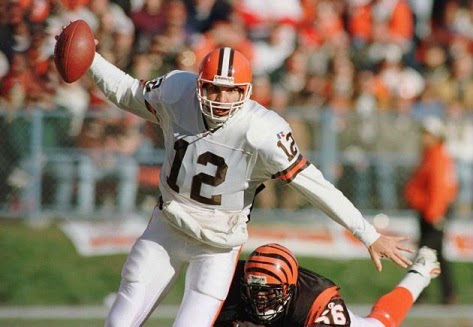
Cleveland was beginning its third year under Head Coach Bill Belichick and had been active in signing veteran free agents such as QB Vinny Testaverde, WR Mark Carrier, and G Houston Hoover on offense and DT Jerry Ball and CB Najee Mustafaa on defense. They had also drafted an offensive lineman in the first round, Michigan center Steve Everitt. Still, the starting quarterback was Bernie Kosar (pictured above), in his eighth year with the club, and there were talented veterans on the tough defense that included DT Michael Dean Perry and LB Clay Matthews.

The Bengals were a young team with 28 first- or second-year players on the roster to start the season. They had a young head coach as well in Dave Shula, son of the legendary Don Shula and back for a second season at age 34. QB David Klingler, the team’s 1992 first-round draft choice who started some late-season games, was now taking over for nine-year veteran Boomer Esiason, who had been dealt to the Jets during the offseason.

It was a sunny and mild day with 75,508 fans in attendance at Cleveland Municipal Stadium. The teams exchanged punts to start the game before the Bengals put together an 80-yard drive in six plays. David Klingler completed two passes to WR Jeff Query for gains of 25 and 51 yards. The second was a screen pass in a third-and-nine situation and set up a four-yard touchdown run by RB Ostell Miles. Doug Pelfrey added the extra point.

A short series by the Browns resulted in a punt and Cincinnati, benefiting from a 36-yard return by WR Patrick Robinson, again advanced to a score. Klingler completed a third-and-four pass to RB Derrick Fenner for 23 yards to the Cleveland 18 and, after Fenner ran for four yards, two more passes were good to Miles for nine yards and to WR Carl Pickens for a five-yard TD. Pelfrey again converted and the visitors were staked to a 14-0 lead with three minutes remaining in the opening period.

The Browns responded by driving 80 yards in 10 plays that extended into the second quarter. After a penalty on the Bengals gave Cleveland a first down at its own 31, RB Leroy Hoard ran for 12 yards and Bernie Kosar threw to Mark Carrier for 24 yards to reach the Cincinnati 33. Three consecutive completions that included a third-and-six pass to RB Eric Metcalf for 14 yards advanced the Browns to the 15 and, two plays later, Kosar connected with WR Michael Dyson (aka Jackson) for a 13-yard touchdown. Matt Stover’s point after narrowed the score to 14-7.

The teams again traded punts until the Browns put together another scoring possession, going 59 yards in 10 plays. Kosar started the series off with a throw to Carrier for 29 yards and had four more completions, setting up RB Tommy Vardell’s one-yard touchdown run with 31 seconds remaining in the first half. Stover again added the PAT and the teams went into halftime tied at 14-14.


Cleveland had the first possession in the third quarter and put together an 11-play, 64-yard drive. Vardell (pictured at left) ran effectively, picking up 35 yards on six carries, and while he was held for no gain on a third-and-one play at the Cincinnati 11, Stover put the Browns ahead by three with a 28-yard field goal.

It got worse for the Bengals on the next series as a Klingler pass was intercepted by CB Selwyn Jones, giving the ball back to the Browns at the Cincinnati 48. Kosar immediately threw to Carrier for 26 yards but the home team advanced no further and Stover booted another field goal, this time from 34 yards.

Following another exchange of punts, the Browns added to their lead early in the fourth quarter when Klingler, who was being sacked for the third straight play, fumbled and SS Stevon Moore recovered and ran 22 yards for a touchdown. Stover’s extra point put Cleveland ahead by a commanding 13 points.

Once more the teams traded punts before the Bengals, with 10:25 left to play, took over from their 17 yard line and began to move down the field. Klingler hit on five straight passes, including one to WR Tim McGee that covered 33 yards to the Cleveland 16. A pass interference penalty gave the visitors a first down at the one, but the defense held as three carries by Fenner netted a one-yard loss and on fourth down Klingler fumbled the snap. It was, in essence, the last gasp for Cincinnati.

Taking over on downs, the Browns kept the ball on the ground and were finally forced to punt from their 19 with the clock now down to 1:15. There were no last-minute heroics in store and when Klingler threw a pass that Selwyn Jones intercepted, it nailed down the 27-14 win.       

Cleveland led in total yards (263 to 227), first downs (18 to 12), and time of possession (32:38 to 27:22). The Browns recorded six sacks, to two by Cincinnati, and the Bengals turned the ball over three times, while Cleveland had none. The visitors further were hurt by nine penalties, to five flags thrown on the Browns.

Bernie Kosar completed 18 of 30 passes for 182 yards and a touchdown while giving up no interceptions. Tommy Vardell ran for 60 yards on 16 carries that included a TD while Eric Metcalf, who gained 14 yards on four rushing attempts, had 9 catches for 60 yards. Mark Carrier topped the club with 79 yards on his three pass receptions.


For the Bengals, David Klingler (pictured above) was successful on 20 of 28 throws for 214 yards and a TD, but gave up two interceptions and suffered from being under constant pressure in addition to the sacks. Derrick Fenner rushed for 41 yards on 13 attempts and also pulled in 9 passes for 64 yards. Jeff Query, thanks to the long reception in the first quarter, gained 80 yards on three catches.

The Browns got off to a 3-0 start and then, after a 2-3 stretch, Bernie Kosar was released in a stunning move and ultimately replaced by Vinny Testaverde. Cleveland went 2-6 the rest of the way to end up with another 7-9 record and third place finish in the AFC Central. Cincinnati was 0-10 before finally winning three of its last six contests to place last in the division at 3-13. David Klingler continued to struggle, not helped by the deficient offensive line, and ultimately failed as a starting quarterback. While the Browns would turn things around in ’94 with Testaverde behind center, Cincinnati remained in a prolonged funk, with both Coach Shula and QB Klingler falling by the wayside.

March 22, 2015

Highlighted Year: Marcus Allen, 1993

Running Back, Kansas City Chiefs


Age: 33
12th season in pro football, 1st with Chiefs
College: Southern California
Height: 6’2”   Weight: 210

Prelude:
After winning the 1981 Heisman Trophy at USC, Allen was chosen by the Raiders in the first round of the ’82 draft. In the strike-shortened 1982 season, he led the NFL with 1098 yards from scrimmage, 14 TDs, and 84 points. For his efforts, he was a consensus Rookie of the Year and first-team All-NFL selection and was chosen to the Pro Bowl. He gained over a thousand yards rushing in each of the next three seasons, with a high of 1759 yards in ’85, which led the league along with his 2314 yards from scrimmage. He also topped the league in touchdowns with 18 in 1984 and was the MVP of the Super Bowl following the ’83 season, after rushing for 191 yards. Allen was a proficient receiver out of the backfield, catching a total of 237 passes in his first four seasons. He was a consensus first-team All-Pro in 1982 and ’85, when he also received MVP recognition, and was selected to the Pro Bowl five times. However, after 1985, Allen never again ran for a thousand yards or caught more than 51 passes in a season. Bothered by injuries (and involved in disputes with owner Al Davis), he shared time with other running backs during the remainder of his career with the Raiders, most notably Bo Jackson. Having rushed for 8545 yards on 2090 carries (4.1 avg.) and caught 446 passes for another 4258 yards (9.5 avg.) and scoring a total of 98 touchdowns, Allen left the Raiders for the Chiefs in 1993 and took over the starting running back job from Harvey Williams during the season.

1993 Season Summary
Appeared in all 16 games
[Bracketed numbers indicate league rank in Top 20]

Rushing
Attempts – 206 [15]
Most attempts, game – 22 (for 74 yds.) vs. Buffalo 11/28
Yards – 764 [15]
Most yards, game – 91 yards (on 17 carries) vs. Denver 9/20
Average gain – 3.7
TDs – 12 [1]

Pass Receiving
Receptions – 34
Most receptions, game – 5 (for 36 yds.) at Miami 10/31, (for 20 yds.) vs. San Diego 12/19
Yards – 238
Most yards, game – 36 (on 5 catches) at Miami 10/31
Average gain – 7.0
TDs – 3

Scoring
TDs – 15 [2, tied with Andre Rison, 1st in AFC]
Points – 90

Postseason: 3 G
Rushing attempts – 53
Most rushing attempts, game – 21 vs. Pittsburgh, AFC Wild Card playoff
Rushing yards – 191
Most rushing yards, game – 74 at Houston, AFC Divisional playoff
Average gain rushing – 3.6
Rushing TDs – 3

Pass receptions – 7
Most pass receptions, game – 4 vs. Pittsburgh, AFC Wild Card playoff
Pass receiving yards – 77
Most pass receiving yards, game – 36 at Buffalo, AFC Championship
Average yards per reception – 11.0
Pass Receiving TDs – 0

Awards & Honors:
NFL Comeback Player of the Year: AP
1st team All-AFC: UPI, Pro Football Weekly
Pro Bowl

Chiefs went 11-5 to finish first in the AFC West. Won AFC Wild Card playoff over Pittsburgh Steelers (27-24) and AFC Divisional playoff over Houston Oilers (28-20). Lost AFC Championship to Buffalo Bills (30-13).

Aftermath:
Having reinvigorated his career, Allen played another four seasons with the Chiefs, still scoring 11 TDs as a backup in his final year at age 37. He retired in 1997 with 123 career touchdowns, as well as 12,243 rushing yards and 587 pass receptions (the record for a running back at the time) for another 5412 yards. Of those totals, 3698 rushing yards and 1153 receiving yards came in Kansas City. Allen was inducted into the Pro Football Hall of Fame, Class of 2003.

--

Highlighted Years features players who were consensus first-team All-League* selections or league* or conference** leaders in the following statistical categories:

Rushing: Yards, TDs (min. 10)
Passing: Yards, Completion Pct., Yards per Attempt, TDs, Rating
Receiving: Catches, Yards, TDs (min. 10)
Scoring: TDs, Points, Field Goals (min. 5)
All-Purpose: Total Yards
Defense: Interceptions, Sacks
Kickoff Returns: Average
Punt Returns: Average
Punting: Average

*Leagues include NFL (1920 to date), AFL (1926), AFL (1936-37), AAFC (1946-49), AFL (1960-69), WFL (1974-75), USFL (1983-85)

**NFC/AFC since 1970

January 8, 2015

1994: Packers Overcome Lions in NFC Wild Card Playoff Game


The NFC Wild Card playoff game on January 8, 1994 featured two NFC Central rivals that had faced each other the week before to finish out the 1993 regular season. In that instance, the Detroit Lions defeated the Green Bay Packers by a 30-20 score, wrapping up the division title with a 10-6 record. The Packers ended up in third at 9-7 to qualify for a Wild Card slot (Minnesota was also 9-7 and got second place thanks to a season sweep of Green Bay).

Detroit was coached by Wayne Fontes and rebounding from a 5-11 record in ’92 after going all the way to the NFC Championship game the year before. RB Barry Sanders, who posted his fifth Pro Bowl season in as many years, was back in action after being lost with a sprained left knee on Thanksgiving that cost him the last five games of the regular season and a shot at the league rushing title. WR Herman Moore was a rising star and WR Brett Perriman was solid on the other side, but quarterback had been a problem area. Following the firing of offensive coordinator Dan Henning after 12 games, Erik Kramer was installed as the starter and performed well. There were injury concerns on defense, which was missing CB Ray Crockett while LB Pat Swilling was playing with a pulled hamstring.

The Packers, in their second season under Head Coach Mike Holmgren, were in the playoffs for the first time since 1982. 24-year-old QB Brett Favre (pictured above), who had taken over the starting job during the previous year, displayed tremendous potential and was named to the Pro Bowl, but was also inconsistent. He gave up four interceptions in the season-ending loss to the Lions, giving him a league-leading 24 in all, against 19 touchdowns. WR Sterling Sharpe was a consensus first-team All-Pro who caught a NFL-high 112 passes for 1274 yards and 11 TDs, but none of the other receivers were exceptional, nor were the running backs. The defensive line was anchored by DE Reggie White, while Bryce Paup recorded 11 sacks from the outside linebacker position and SS LeRoy Butler was an All-NFL selection.  

There were 68,479 fans in attendance for the late Saturday afternoon contest at the Pontiac Silverdome. The teams exchanged punts to start the game before the Lions drove to the Green Bay 17 thanks to a pass from Erik Kramer to Brett Perriman that covered 18 yards in a third-and-12 situation and a 25-yard run by Barry Sanders. However, Kramer’s pass intended for Herman Moore was intercepted by CB Terrell Buckley.

The Packers had to punt following the ensuing series and the Lions again drove into Green Bay territory, advancing 50 yards in nine plays and not coming up empty. Kramer completed four passes, three of them to Perriman, and a pass interference penalty added nine yards. But Detroit was backed up by a false start penalty, a sack, and a run by Sanders that lost two yards, and while a throw to TE Rodney Holman was completed, it could not overcome a third-and-20 situation. Jason Hanson kicked a 47-yard field goal on the last play of the opening period.

The Packers started off the second quarter by putting together a 13-play, 80-yard possession. Brett Favre was successful on four passes and had a ten-yard run along the way. Two of the completions were to Sterling Sharpe, the last of which was good for a 12-yard touchdown. Chris Jacke added the extra point to put the visitors in front by 7-3.


The next Detroit series got off to a less-than-promising start when WR Mel Gray, normally an outstanding kick returner, fumbled on the return. The ball bounced back to hit his face mask and went out of bounds at the six yard line. Kramer hit on two passes, to Holman for 16 yards and Perriman for 12, and Sanders took off around end for a gain of 44 yards to the Green Bay 20. A false start moved the Lions back and, following an incomplete pass, Sanders ran for seven yards. Facing third-and-eight, Perriman caught a pass from Kramer for 13 yards to reach the five. Two carries by Sanders got the ball to the one, and from there Kramer threw to Perriman once more for a TD. Hanson’s point after made it a 10-7 tally with just over two minutes remaining in the first half, and that was the score at the intermission.

The teams started the third quarter by again trading punts. The Packers were pinned back at their five and Favre threw a pass that was intercepted by CB Melvin Jenkins and returned 15 yards for a TD. Hanson’s conversion put the Lions ahead by ten points at 17-7.

Green Bay responded by driving 72 yards in seven plays. Favre completed four passes, including one to TE Ed West for 23 yards and the last to Sharpe for a 28-yard touchdown. Jacke’s extra point reduced the home team’s lead to 17-14.

The Lions came back with Kramer throwing to Perriman for 19 yards, an unnecessary roughness penalty that picked up 15 yards on what had been an incompletion, and then another pass to Perriman for 31 yards to the Green Bay eight. Following a three-yard carry by Sanders, Kramer went to the air again, but this time FS George Teague intercepted in the end zone and returned it 101 yards for a TD. Jacke tacked on the PAT, and in stunning fashion the Packers were in the lead by 21-17.

As the game headed into the fourth quarter, the Lions put together a 15-play, 89-yard series. Kramer completed four passes and Sanders had a 13-yard run that set up a five-yard touchdown carry by RB Derrick Moore. Hanson added the extra point and Detroit was back in front at 24-21.

The Packers had a short possession and punted and the Lions drove to their 44 before they had to punt in turn. There was 2:26 left on the clock as the Green Bay offense regained possession at its 29. Favre threw a screen pass to RB Edgar Bennett for 12 yards and to West for nine. A run by Bennett picked up four more yards and Favre tossed a short pass to Sharpe for another six. On the next play, Favre was forced to scramble and found Sharpe, alone in the end zone thanks to a blown coverage, for a 40-yard touchdown (pictured below). Jacke’s extra point put Green Bay back in front by four points with 55 seconds to play.


The Lions, following a kickoff return of just eight yards by Gray, weren’t able to move past their own 20 in the remaining time and the Packers won by a final score of 28-24.

Detroit had wide leads in total yards (410 to 293) and first downs (25 to 16), and was especially dominant on the ground (175 to 89). However, the Lions turned the ball over twice, both in Green Bay territory, to one by the Packers, who also recorded the only four sacks of the game. Special teams were a factor as Corey Harris averaged 29.7 yards on three kickoff returns while Mel Gray was held to 11.0 yards on four returns.

Brett Favre completed 15 of 26 passes for 204 yards and three touchdowns while giving up one interception. Sterling Sharpe had 5 catches for 101 yards and all three of the TDs. Darrell Thompson led the Packers with 41 yards on 12 carries and added 32 yards on three pass receptions and Edgar Bennett rushed for 30 yards on 9 attempts while catching two passes for 21 yards. On defense, two of the sacks were accounted for by Reggie White.


For the Lions, Barry Sanders (pictured above) showed no ill effects from his layoff with 169 yards on 27 carries. Brett Perriman caught 10 passes for 150 yards and a touchdown. Erik Kramer was successful on 22 of 31 throws for 248 yards and a TD, but gave up two interceptions.

Following the dramatic win against Detroit, the Packers lost to the Cowboys the next week by a 27-17 score. But after the long postseason dry spell, 1993 marked the first of six straight playoff appearances, two of which resulted in Super Bowl appearances, won of them a victory. The Lions reached the playoffs after each of the next two seasons, losing in the Wild Card round each time, including to the Packers again the next year.

October 3, 2014

Rookie of the Year: Rick Mirer, 1993

Quarterback, Seattle Seahawks


Age:  23
College: Notre Dame
Height: 6’2”   Weight: 216

Prelude:
As a starting quarterback in college, Mirer went 29-7-1 and was co-MVP of the 1992 Sugar Bowl. He set several career records at Notre Dame, including passing yards (5997) and touchdown passes (41) and was chosen by the Seahawks with the second overall pick in the first round of the 1993 NFL draft.

1993 Season Summary
Appeared and started in all 16 games
[Bracketed numbers indicate league rank in Top 20]

Passing
Attempts – 486 [4, tied with Neil O’Donnell]
Most attempts, game – 43 vs. New England 10/24
Completions – 274 [7]
Most completions, game – 25 vs. San Diego 10/3
Yards – 2833 [14]
Most yards, game – 287 vs. Kansas City 12/5
Completion percentage – 56.4
Yards per attempt – 5.8
TD passes – 12 [18, tied with Scott Mitchell, Wade Wilson & Stan Humphries]
Most TD passes, game – 2 at Kansas City 1/2
Interceptions – 17 [5, tied with Bobby Hebert & Steve Beuerlein]
Most interceptions, game – 3 at Detroit 10/17
Passer rating – 67.0
200-yard passing games – 4

Rushing
Attempts – 68
Most attempts, game - 9 (for 17 yds.) at Cincinnati, (for 52 yds.) at LA Raiders 12/12
Yards – 343
Most yards, game – 52 yards (on 9 carries) at LA Raiders 12/12
Yards per attempt – 5.0
TDs – 3

Scoring
TDs – 3
Points – 18

Awards & Honors:
AFC Rookie of the Year: UPI

Seahawks went 6-10 to finish fifth in the AFC West while leading the conference in rushing yards (2015).

Aftermath:
Mirer’s promising first season remained his best. He struggled in 1994 until knocked out of the last three games with a broken thumb, dealing with poor mechanics and a weak supporting cast. It got worse in ’95 when he tossed 20 interceptions and, after another mediocre year in 1996, he was traded to Chicago. Athletic but with a poor throwing arm, Mirer lasted a year with the Bears, was cut, and picked up as a third-string backup for the Packers in ’98. He saw no action that year and continued as a journeyman with the Jets, 49ers, and Raiders. Over the course of eight active seasons and 80 games, Mirer threw for 11,969 yards and 50 TDs with 60 interceptions while completing 53.3 percent of his passes and averaging only 5.9 yards per attempt.

--

Rookie of the Year Profiles feature players who were named Rookie of the Year in the NFL (including NFC/AFC), AFL (1960-69), or USFL (1983-85) by a recognized organization (Associated Press – Offense or Defense, Newspaper Enterprise Association, United Press International, The Sporting News, or the league itself – Pepsi NFL Rookie of the Year).

March 31, 2014

1993: Vinny Testaverde Signs with Browns


On March 31, 1993 free agent QB Vinny Testaverde, previously with the Tampa Bay Buccaneers, signed a one-year contract with the Cleveland Browns. He was to back up Bernie Kosar, a quarterback he had understudied at the University of Miami nearly a decade before. At 29, Testaverde and Kosar were the same age (in fact, their birthdays were just 12 days apart – the studious Kosar graduated from college a year early and Testaverde entered late).

“Cleveland wanted me, Tampa would have settled for me,” said Testaverde in discussing his decision. The Bucs had reportedly offered a deal to Pittsburgh QB Neil O’Donnell prior to Testaverde choosing to go with Cleveland (O’Donnell remained with the Steelers and Tampa Bay ended up going with Craig Erickson, a rookie backup in ’92 who was also a product of Miami).

“Being back on the same team, playing the role I did in college, I feel comfortable with it,” Testaverde added. “We have a good relationship, Bernie and I do, and I think that will make it more fun than it has been for me in the past few years.”

Cleveland Head Coach Bill Belichick welcomed the depth that his new quarterback brought to the position. The Browns ran into trouble in ’92 when Kosar and backup Todd Philcox were both injured. Former Bears QB Mike Tomczak had been signed to fill in, but the team lost six of its last nine games to finish with a 7-9 record.

Testaverde had won the 1986 Heisman Trophy and Tampa Bay made him the first overall pick in the ’87 NFL draft. With his outstanding physical tools, at 6’5” and 235 pounds and including a strong arm, expectations were high for him, but his six seasons were filled with adversity. He took over as the starting quarterback late in the strike-interrupted 1987 season and proceeded to lead the league in interceptions thrown over the course of the next two years, including 35 in 1988, still the second-highest total in NFL/AFL history.

While he could be a precise passer and was fairly mobile, Testaverde also tended to deal poorly with adversity and could make bad plays as a result. He left the Buccaneers as the team’s all-time leader with 14,820 passing yards. However, Tampa Bay went 24-48 with him as the starting quarterback. While mediocre coaching and lack of a strong supporting cast certainly played a role, Testaverde drew criticism regarding his work ethic and toughness under pressure. In many ways, he was the exact opposite of Kosar, who overachieved with less impressive skills and had great intelligence and leadership ability.

As anticipated, Kosar started the ‘93 season but struggled and Testaverde performed ably in relief outings. The Browns had a 5-3 record when Coach Belichick, in a stunning decision, released Kosar – all the more surprising because Testaverde was injured and Philcox had to step into the lineup for four games (three of them losses on the way to another 7-9 record).

When Testaverde returned, he continued to play well and had his best pro season to date, throwing more touchdowns (14) than interceptions (9) for the first time and compiling an 85.7 passer rating. His 91.3 completion percentage on a 21-of-23 performance against the Rams was a NFL record at the time. He was rewarded with a contract extension and the starting job for ’94.

In 1994, the gamble appeared to pay off when the Browns went 11-5 and reached the playoffs. Still, operating behind an offensive line that allowed only 14 sacks, Testaverde reverted to form with a negative TD pass-to-interception ratio of 16 to 18 and was especially unimpressive in fourth quarter pressure situations. But he was a winning quarterback in his first postseason game and drew praise for development as a leader.

Hopes for further improvement in 1995 were dashed when the team fell to 5-11 after getting off to a 3-1 start. The announced move of the franchise to Baltimore for ’96 was a significant distraction, but Testaverde continued to have difficulty with consistency. While he gave up only 10 interceptions, tossing 17 touchdown passes, he was also benched for three games in favor of backup Eric Zeier.

The team, now called the Baltimore Ravens, had a new offensive-minded head coach in Ted Marchibroda for 1996 and Testaverde put up big numbers, including 4177 yards and 33 TD passes, and was named to the Pro Bowl for the first time. But the record was only 4-12 and, after a lesser performance in ’97, Testaverde was let go.

In five seasons with the Browns and Ravens, Testaverde threw for 14,403 yards and 98 touchdowns while giving up 71 interceptions. It was improvement, to be sure, but the inconsistency remained and only once during that period did the team finish with a winning record.

Testaverde went on to have an outstanding year with the New York Jets in 1998, followed by a season in which he went down for the year in the opening week and then a 2000 campaign where he led the NFL in interceptions for the fourth time. His career would ultimately come to an end in 2007 at age 44, and while there were many accomplishments, there was also the up-and-down pattern of performance that caused Testaverde’s failure to achieve the heights that were anticipated when he came into the league in 1987.

January 10, 2014

MVP Profile: Jerry Rice, 1993

Wide Receiver, San Francisco 49ers


Age: 31 (Oct. 13)
9th season in pro football & with 49ers
College: Mississippi Valley State
Height: 6’2”   Weight: 200

Prelude:
Drafted by the 49ers in the first round in 1985, Rice moved into the starting lineup as a rookie and showed flashes of future greatness as he caught 49 passes for 927 yards and diverted coverage from veteran WR Dwight Clark. In ’86, Rice broke out with 86 receptions and led the NFL in receiving yards (1570) and TD catches (15). He was a consensus first-team All-Pro selection and was chosen for the Pro Bowl. It was the first of seven straight seasons prior to ’93 in which he received first-team All-Pro honors, and he was picked for the Pro Bowl every year during that stretch as well. In the strike-interrupted 1987 season Rice had a record 22 touchdown receptions in just 12 games and received MVP recognition. In 1989, he led the NFL in pass receiving yards (1483) and TD catches (17) and in ’90 led in pass receptions (100) as well as receiving yards (1502) and TD catches (14). He had more than 80 catches, a thousand yards, and was in double figures in TD receptions in 1991 and ’92.

1993 Season Summary
Appeared in all 16 games
[Bracketed numbers indicate league rank in Top 20]

Pass Receiving
Receptions – 98 [2] 
Most receptions, game – 10 (for 83 yds.) vs. Houston 12/25
Yards – 1503 [1]
Most yards, game - 172 (on 8 catches) at Tampa Bay 11/14
Average gain – 15.3 [15, tied with Herman Moore]
TDs – 15 [1, tied with Andre Rison]
100-yard receiving games – 5

Rushing
Attempts – 3
Yards – 69
Average gain – 23.0
TDs – 1

Scoring
TDs – 16 [1]
Points – 96 [20]

Postseason: 2 G
Pass receptions – 9
Most pass receptions, game – 6 at Dallas, NFC Championship
Pass receiving yards – 126
Most pass receiving yards, game – 83 at Dallas, NFC Championship
Average yards per reception – 14.0
Pass Receiving TDs – 0

Rushing attempts – 1
Rushing yards - -9

Awards & Honors:
NFL Offensive Player of the Year: AP
1st team All-NFL: AP, PFWA, Sporting News
1st team All-NFC: UPI, Pro Football Weekly
Pro Bowl

49ers went 10-6 to finish first in the NFC West while leading the NFL in total yards (6435), scoring (473 points), and touchdowns (61) and the NFC in passing yards (4353). Won NFC Divisional playoff over New York Giants (44-3). Lost NFC Championship to Dallas Cowboys (27-17).

Aftermath:
Rice continued on to play 20 seasons in the NFL (he missed most of 1997 due to injury) and re-wrote the record book by the time he was done. The 1986 and ’87 seasons were the first of 11 straight thousand-yard receiving seasons and 14 overall. He led the league in that category five more times, including a record 1848 in 1995. Rice also had four 100-catch seasons and was the NFL leader twice. A prolific scorer, he had a total of nine years in which he reached double figures in receiving TDs and paced the league six times. After 16 years with San Francisco, Rice moved on to the Raiders for three full seasons plus part of his last year, in 2004, in which he finished up with Seattle. Overall, he retired as career leader in pass receptions (1549), receiving yards (22,895), receiving touchdowns (197), and total TDs (208). He gained the most total yards (23,546) of any player in NFL history. The 49ers retired Rice’s #80 and he was inducted into the Pro Football Hall of Fame, Class of 2010.

--


MVP Profiles feature players who were named MVP or Player of the Year in the NFL, AAFC (1946-49), AFL (1960-69), WFL (1974), or USFL (1983-85) by a recognized organization (Associated Press, Pro Football Writers Association, Newspaper Enterprise Association, United Press International, The Sporting News, Maxwell Club – Bert Bell Award, or the league itself). 

January 2, 2014

1994: Raiders Rally to Beat Broncos in OT and Secure Playoff Spot


The Los Angeles Raiders had a 9-6 record and needed a win to make the postseason as they hosted the Denver Broncos in the season finale on January 2, 1994. Coached by Art Shell, the Raiders were lightly regarded coming into the season and, indeed, were an inconsistent team, capable of beating strong clubs and falling to far weaker ones. QB Jeff Hostetler, in his first year with the team, was a fine addition to the offense and he had a good receiving corps led by WR Tim Brown (pictured above). However, the running game was mediocre and while the defense had solid performers in DE Anthony Smith, DT Chester McGlockton, and CB Terry McDaniel, the unit was prone to giving up points.

Denver, in its first year under Head Coach Wade Phillips, also had trouble running the football but had outstanding 33-year-old QB John Elway and a rising talent in TE Shannon Sharpe. The defense featured a tremendous hybrid pass rushing DE/LB in Simon Fletcher, but was vulnerable against the pass. The Broncos were also 9-6 and had lost to the Raiders in Denver.

It was a hazy but sunny day at the LA Memorial Coliseum with 66,904 fans in attendance. Following a three-and-out possession by the Raiders to start the game, Denver drove 55 yards in 12 plays. John Elway threw to WR Arthur Marshall for 23 yards in a third-and-13 situation and Jason Elam put the Broncos on the board with a 52-yard field goal.

On the Raiders’ next series, RB Randy Jordan fumbled when hit by LB Mike Croel, who recovered at the LA 31. Three plays later, Elway passed to WR Cedric Tillman for a 27-yard touchdown and, with Elam adding the extra point, a 10-0 Denver lead.

Another short Los Angeles possession ended with a punt and the Broncos were driving as the first quarter ended with Elway running for 18 yards on a third-and-10 play. The 11-play series ended with Elam kicking another field goal, this time from 24 yards.


The Raiders put together a scoring series of 82 yards in eight plays. Jeff Hostetler (pictured above) completed four passes, the last to Tim Brown for a four-yard TD. RB Tyrone Montgomery ran the ball three times for 24 yards along the way. Jeff Jaeger added the extra point that cut Denver’s lead to 13-7.

However, the Broncos responded by going 83 yards in seven plays to score once again. Elway threw to Shannon Sharpe for a 54-yard touchdown and Elam added the PAT to again put the Raiders behind by 13 points.

Hostetler completed back-to-back passes to fleet rookie WR James Jett for 22 yards and to Brown for 24 yards to the Denver 31 as Los Angeles advanced 53 yards in eight plays. The series finally stalled at the 25 and Jaeger kicked a 43-yard field goal.

There was a minute remaining in the first half but the back-and-forth nature of the game continued as RB Robert Delpino returned the ensuing kickoff 49 yards to give the Broncos good field position at the LA 43, and they made the most of it. RB Glyn Milburn ran for 13 yards, Elway threw to Sharpe for another 28 yards, and three plays later he connected with Sharpe again from a yard out for a touchdown. Elam added the extra point. The Raiders, in the last 24 seconds, benefited from three Hostetler pass completions that set up a 50-yard Jaeger field goal. Denver led by 27-13 at halftime.

The Broncos took the second half kickoff and put together a nine-play, 71-yard drive to put more points on the board. Elway threw to Sharpe for 21 yards and to WR Kitrick Taylor for another 28. The series stalled at the LA 17 and Elam booted a 27-yard field goal to give the visitors an imposing 17-point lead.

The Raiders fought back as Hostetler completed three passes to Brown that highlighted an 82-yard drive. The first was good for 26 yards to the Denver 45, the second gained 15 yards on a second-and-11 play, and the third covered 24 yards and scored a touchdown. Jaeger’s extra point made it a ten-point game at 30-20.

The Broncos reached the LA 44 before having to punt on their next series. The Raiders opened the fourth quarter with a 52-yard Jeff Gossett punt that pinned the Broncos back at their 15. Denver punted in turn and, with LA getting the better of the field position battle, the Raiders started off at their 49 and advanced 31 yards in seven plays, the biggest of which was a Hostetler to Brown completion that picked up 25 yards. Jaeger kicked a 39-yard field goal and Denver’s lead was down to seven points.

The Broncos had to punt following their next possession and Tom Rouen’s kick was blocked, but the Raiders were unable to move the ball on offense and had to punt it back. Another short series ending with a punt gave the ball to the Raiders at their 30 with just under three minutes left in regulation.

With Montgomery both running and catching the ball, the Raiders reached the Denver 40. Hostetler completed two passes of 13 yards apiece to Brown to reach the 14, and two more short throws picked up another 10 yards. Two more passes fell incomplete, but with eight seconds left Hostetler connected with WR Alexander Wright, who had gotten open when defending CB Charles Dimry fell, for a four-yard touchdown on the 13th play of the series. Jaeger successfully added the all-important extra point, and the fourth quarter ended with the teams tied at 30-30.

The Broncos had the first possession in overtime, and it appeared that they would prevail. Elway threw to Tillman twice, for 20 and 30 yards, and having reached the LA 22, Elam came in to attempt a 40-yard field goal. However, the rookie’s kick sailed wide to the left to give the Raiders a reprieve.

A short carry by Montgomery was followed by Hostetler taking off for a 19-yard gain and, after RB Napoleon McCallum ran for four yards, Hostetler completed a pass to TE Ethan Horton for 20 yards to the Denver 32. Two more runs netted three yards and, after a Hostetler pass was incomplete, Jaeger came in and kicked a 47-yard field goal to give the Raiders a 33-30 win at 7:10 into the extra period.

Denver had more total yards (471 to 398) while Los Angeles had the edge in first downs (24 to 22). The Raiders gave up the only turnover of the contest and the Broncos recorded three sacks, to none by LA.

Jeff Hostetler completed 25 of 41 passes for 310 yards and three touchdowns with none intercepted, and he also ran for 26 yards on two carries. Tim Brown had a big day with 11 catches for 173 yards and two TDs. Tyrone Montgomery (pictured below) paced the ground game with 44 yards on 13 attempts.


For the Broncos, John Elway was successful on 25 of 36 throws for 361 yards, also with three TDs and no interceptions. Shannon Sharpe caught 6 passes for 115 yards and two touchdowns and Cedric Tillman contributed 5 receptions for 91 yards and a score. Robert Delpino ran for 66 yards on 20 carries.

“There have been a lot of great comeback victories in Raider history, and I’ve been involved in a lot of them,” said Coach Art Shell. “But this one stacks up with the best.”

With the win, the Raiders finished second in the AFC West with a 10-6 record, grabbing the first Wild Card spot in the postseason. Denver, at 9-7, ended up third in the division and, thanks to advantageous tiebreakers, also qualified as a Wild Card team. Thus, the two teams met again at the same venue the following week in the Wild Card playoff round and the Raiders again won, this time by a more convincing tally of 42-24. LA lost to Buffalo at the Divisional level.

Tim Brown caught 80 passes for 1180 yards (his first of nine straight thousand-yard receiving seasons) and seven touchdowns. He was selected to the Pro Bowl.


John Elway led the NFL in pass attempts (551), completions (348), and yards (4030) and he topped the AFC in passing (92.8 rating), TD passes (25), and completion percentage (63.2). He also received Pro Bowl recognition. Shannon Sharpe (pictured at right) caught 81 passes for 995 yards and nine touchdowns, not only gaining selection to the Pro Bowl but receiving consensus first-team All-NFL honors for the first time as well.

November 14, 2013

1993: Recently-Obtained Bernie Kosar Leads Cowboys Over Cards


The Dallas Cowboys, defending NFL Champions, were 6-2 and had won six straight games after an 0-2 start as they hosted the Phoenix Cardinals on November 14, 1993. However, Head Coach Jimmy Johnson’s team would be without star QB Troy Aikman due to a hamstring injury. They still had the other key components to their offense in RB Emmitt Smith and WR Michael Irvin. They had also just picked up ninth-year veteran QB Bernie Kosar (pictured at right), who had only been with the Cowboys for four days after his abrupt release by the Browns, where Head Coach Bill Belichick said he had “diminished skills”.

The Cardinals were coached by Joe Bugel and limping along at 3-6, although they were coming off a win against the Eagles. QB Steve Beuerlein had been benched in favor of Chris Chandler and RB Garrison Hearst, the highly-touted first round draft choice, held out and then went down with a knee injury six games into the season. Still, Phoenix had a good receiving threat out of the backfield in FB Larry Centers, a reliable possession receiver in WR Ricky Proehl, and the defense could be stingy at giving up points.

There was a crowd of 64,224 in attendance for the late afternoon game at Texas Stadium. The Cardinals went three-and-out on their opening possession. Following the punt, Dallas drove 35 yards in seven plays with rookie Jason Garrett at quarterback. Five of them were runs by RB Emmitt Smith and Garrett completed a pass to WR Michael Irvin for 16 yards. Eddie Murray kicked a 44-yard field goal to give the Cowboys the early 3-0 lead.

The teams traded punts and on the third Dallas series, Bernie Kosar entered the game at quarterback. He immediately completed a pass to Irvin for 14 yards and, after Smith was tossed for a five-yard loss, threw back-to-back completions to FB Daryl “Moose” Johnston for six yards and to Irvin for 18 to reach the Phoenix 32. Smith then ran the ball five straight times, the last on the first play of the second quarter for a four-yard TD. Murray’s extra point made it a 10-0 game.

The Cardinals, who had done nothing on offense during the first quarter, generated three first downs as they advanced to the Dallas 45 on their next series. QB Chris Chandler completed three passes, although one that was called back due to offsetting penalties negated a big gain.

The Cards ended up having to punt and once again Kosar led the Cowboys on a scoring drive. The big play was what started out as a five-yard completion to Smith out of the backfield that the great runner turned into a gain of 86 yards to the Phoenix two, breaking three tackles along the way. Smith couldn’t penetrate the end zone on two running plays, but Kosar threw to TE Jay Novacek for a one-yard TD and, with the extra point, the home team held a 17-0 lead.

After a three-and-out series by the Cardinals, Dallas again advanced into Phoenix territory, but a fumble at the 28 negated an opportunity to add more points. Jason Garrett returned at quarterback for the Cowboys on their next series and the half ended with no further points scored.

The Cowboys punted following the first possession of the third quarter, with Kosar again behind center. The Cards drove 47 yards in 11 plays, Chandler completed four passes, the longest to Ricky Proehl for 16 yards in a third-and-six situation, but after getting a first-and-goal at the Dallas five, they ended up having to settle for a 19-yard Greg Davis field goal.

On the first play following the kickoff, Kosar fumbled and DE Reuben Davis recovered for Phoenix at the Dallas 19. The Cardinals capitalized three plays later when Chandler threw to Larry Centers for a 17-yard touchdown. Davis added the extra point and suddenly the visitors were only a touchdown behind the Cowboys.

Dallas punted following its next series, but now it was Phoenix’s turn to give up a costly fumble. Chandler dropped the snap on the fourth play and DE Charles Haley recovered to give the Cowboys the ball at the Phoenix 39. Two passes by Kosar picked up 21 yards and, early in the fourth quarter, Murray kicked a 43-yard field goal to extend the Dallas margin to ten points.

After a punt by the Cards pinned the Cowboys down at their one yard line, Kosar was penalized for intentional grounding while passing out of the end zone, resulting in a safety. Phoenix then took the free kick and went 30 yards in eight plays. Davis kicked a 47-yard field goal to narrow the Dallas lead to five points.

The Cowboys responded with a long non-scoring drive that knocked time off the clock. It was all Smith, either running or catching short passes from Kosar, as Dallas converted two third downs. By the time the Cardinals got the ball back at their own 13 following a punt, there was just 2:37 left in the game. Chandler passed Phoenix into Dallas territory, but on a fourth-down play at the Dallas 41, FS Kenneth Gant came up with an interception and that was it. Dallas won by a final score of 20-15.

The Cowboys had the edge in total yards (311 to 265) while each team generated 15 first downs. There were no sacks by either club. The Cardinals turned the ball over three times, to two suffered by Dallas.

Bernie Kosar completed 13 of 21 passes for 199 yards and a touchdown with none intercepted. Emmitt Smith (pictured below), who was battling the flu, rushed for 80 yards and a TD on 24 carries and gained another 102 yards on four pass receptions. Michael Irvin also caught four passes, for 63 yards.


For the Cards, Chris Chandler was successful on 27 of 46 throws for 214 yards and a TD with one intercepted. Larry Centers, who rushed for three yards on two carries, caught 7 passes for 59 yards and a touchdown while Ricky Proehl gained a team-leading 66 yards on six receptions. Johnny Bailey led the modest ground attack with 8 carries for 31 yards and contributed 6 catches for 34 yards.

“For Bernie to pull this off with limited practice time was commendable,” said Coach Jimmy Johnson. “He was hitting Michael Irvin on crossover routes and executing the offense. He had everything spinning in his head but did a tremendous job.”

“I didn’t want to let the coaches and the players on this great team down,” said Kosar. “I’m just so happy we won. It was a tough week getting ready. I told some Cleveland friends it’s amazing what a difference a week can make.”

The Cowboys lost their next two games before winning the remainder and finishing atop the NFC East with a 12-4 record. They again advanced to the Super Bowl and won for the second straight year. The Cardinals finished strong with four wins in their last five games to end up fourth in the division at 7-9.

Bernie Kosar started one more game before Troy Aikman returned to take over the reins. He completed 36 of 63 passes for 410 yards and three touchdowns with none intercepted. He moved on to the Dolphins for 1994 where he backed up QB Dan Marino for three years to finish out his career.

Emmitt Smith went on to win his third consecutive NFL rushing title, gaining 1486 yards on 283 carries (5.3 avg.) and scoring nine touchdowns. He also caught 57 passes for 414 yards and another score. The 86-yard reception against the Cardinals was the longest of his Hall of Fame career.