Showing posts with label Doug Flutie. Show all posts

October 11, 2016

1998: Flutie & Bills Dominate Second Half to Defeat Colts


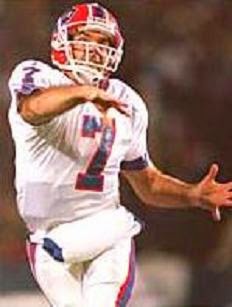
The Buffalo Bills were off to a slow 1-3 start as they faced the Indianapolis Colts on October 11, 1998. The Bills were in transition as key players in conference-topping seasons such as QB Jim Kelly, RB Thurman Thomas, and WR Andre Reed were either gone or in the twilight of great careers. Marv Levy had retired as head coach and was replaced by Wade Phillips, and the team invested heavily in QB Rob Johnson, who was obtained from Jacksonville and viewed as a young passer with great potential. The Bills also picked up 35-year-old QB Doug Flutie (pictured at right), the diminutive former Heisman Trophy winner who came from the CFL following eight outstanding seasons after faltering in the NFL. Johnson had the starting job and initially struggled, but performed well in an upset of the 49ers the previous week.

The Colts were at 1-4 and also won for the first time the week before. Head Coach Jim Mora’s team had a young quarterback of its own in Peyton Manning, the first overall pick in the NFL draft. He had been put directly into the starting lineup and, as to be expected, was struggling in the early going. RB Marshall Faulk was highly productive as a runner and receiver out of the backfield, but Indianapolis was a young team and very much a work in progress.

There were 52,938 fans in attendance at the RCA Dome in Indianapolis. Following a short series by the Bills that ended with a punt, and with Rob Johnson having to exit due to bruised ribs suffered when he was sacked on third down, the Colts started with good field position at their 48. Marshall Faulk took off around left end for a 40-yard gain to the Buffalo 12, and after three more Faulk carries picked up seven yards, Mike Vanderjagt kicked a 22-yard field goal to give the home team an early 3-0 lead.

Doug Flutie was at quarterback for the Bills in place of Johnson on the next series and he completed four passes, the longest to WR Eric Moulds for 16 yards. The drive stalled at the Indianapolis 35 and the visitors came up empty when Steve Christie missed on a 53-yard field goal attempt.

The Colts went 42 yards in seven plays on their next possession. Peyton Manning completed a pass to TE Ken Dilger for 21 yards on first down to move the ball back into Buffalo territory and a pass interference penalty on a third down play advanced the ball to the Buffalo 18. Once again the Colts couldn’t reach the end zone but Vanderjagt added another field goal, from 33 yards, to put them ahead by 6-0.

Following a punt by the Bills early in the second quarter, the Colts put together a nine-play, 54-yard drive that was helped along by a roughing-the-passer penalty on DE Bruce Smith. Manning converted a third-and-nine situation with a completion to WR Marvin Harrison and Vanderjagt kicked a 43-yard field goal, his third, to put Indianapolis up by 9-0.

Taking possession with 8:17 remaining in the first half, the Bills advanced 71 yards in nine plays. Five of them were pass completions by Flutie, with three to WR Andre Reed. The third was for 24 yards to reach the Indianapolis six and, two plays later, a scrambling Flutie connected with TE Jay Riemersma for a seven-yard TD. Christie added the extra point to make it a two-point contest. The Colts responded with a scoring drive that included Manning passes to Faulk that covered 26, 11, and five yards and once again ended with a field goal by Vanderjagt, this time covering 41 yards. Indianapolis took a 12-7 lead into halftime, but after dominating play in the first half, the Colts led by only five points.

In their second possession of the third quarter, the Bills moved 59 yards in 11 plays. Flutie converted three third downs along the way, with a 20-yard completion to FB Sam Gash while facing third-and-three, a four-yard toss to WR Kevin Williams when again in a third-and-three situation, and the last was again to Williams on third-and-goal for a six-yard TD. Christie added the point after and Buffalo was in front for the first time by 14-12.

A three-and-out possession by the Colts gave the Bills the ball at their 43 and resulted in a seven-play, 57-yard drive that stretched into the fourth quarter. The big plays along the way were passes to Reed for 20 and 15 yards, and Flutie had a 12-yard run as well. RB Antowain Smith gained the last four yards for a touchdown and Christie converted.

It quickly got worse for the Colts when, on their second play of the ensuing series, Manning was intercepted by NT Ted Washington, who batted the ball into the air at the line and gathered it in to give Buffalo the ball at the Indianapolis 25. Four plays later, it was Smith scoring another touchdown from a yard out and, with Christie’s kick, the Bills had a commanding 28-12 lead with eleven minutes to play.

The Colts were unable to get out of their end of the field on the next series, resulting in a punt, and with Smith running the ball five straight times, the big one for a gain of 30 yards, Buffalo was able to add a 39-yard Christie field goal.

In a deep 31-12 hole, the Colts fought back as Manning filled the air with passes. A 14-play drive covered 83 yards and resulted in a touchdown pass to WR Torrance Small from three yards out. The try for a two-point conversion failed and Indianapolis remained behind by 31-18. The home team got their next shot with 55 seconds left on the clock and Manning tossed to Harrison for a 25-yard TD. Again the try for a two-point conversion failed, but the outcome was already decided. Buffalo won by a final score of 31-24.
  
The Bills led in total yards (381 to 341), first downs (24 to 21), and time of possession (36:41 to 23:19). However, during Buffalo’s 24-point surge in the second half, the visitors outgained Indianapolis by 150 yards to 28. The Colts also turned the ball over twice, to none by the Bills. Buffalo led in penalties with 9 at a cost of 77 yards to four for 18 yards on the Colts.

Doug Flutie was highly efficient, especially in the second half, as he completed 23 of 28 passes for 213 yards and two touchdowns with none intercepted. Antowain Smith rushed for 130 yards on 31 carries that included two TDs. Thurman Thomas gained 23 yards on six rushing attempts and 5 catches for 32 yards while Sam Gash contributed 45 yards on his 5 receptions. Andre Reed also pulled in 5 passes and led the Bills with 76 yards.

For the Colts, Peyton Manning was successful on 20 of 41 throws for 235 yards and two TDs while being intercepted twice. Marshall Faulk gained 93 rushing yards on 18 carries and also led the club with 6 pass receptions for 80 yards. Mike Vanderjagt was a perfect four-for-four on field goal attempts.

“We had opportunities to score touchdowns and weren’t able to do that, and that hurt us,” summed up Coach Jim Mora in defeat. “We were playing well and had good field position and couldn’t get it in the end zone. In the second half, they took over offensively and defensively, and we couldn’t get anything going.”

The win for Buffalo marked the second of five straight on the way to a 10-6 record and third place finish in the AFC East. That was enough to secure a Wild Card playoff spot, but the Bills lost to the club that came in second, Miami, in the first round. The Colts were at 1-8 before they won again and ended up at 3-13 for the second consecutive year. However, the groundwork was laid for significant improvement.

Doug Flutie ended up having a Pro Bowl year as he passed for 2711 yards and 20 touchdowns, and provided a spark to the offense, although the competition with Rob Johnson proved to be rancorous. Antowain Smith also continued to perform well, rushing for 1124 yards on 300 carries (3.7 avg.) with eight TDs.

Peyton Manning played every down at quarterback for the Colts and while he led the NFL by tossing 28 interceptions, he also threw 26 TD passes and accumulated 3739 passing yards, foreshadowing much bigger seasons to come.

May 19, 2016

1985: Johnson’s 3 TDs Lead Gold to Win Against Generals


Two 8-4 teams that were in the running for playoff spots in the United States Football League’s third season met in Denver on May 19, 1985. The hosts, the Denver Gold, were in contention with Oakland and Houston in the Western Conference while the visiting New Jersey Generals were trying to keep pace with the Birmingham Stallions, Tampa Bay Bandits, and Memphis Showboats in the Eastern Conference.

The Gold were coached by Darrell “Mouse” Davis and utilized his run-and-shoot offense. After starting slowly, Bob Gagliano replaced nine-year veteran Vince Evans at quarterback and the club had won four of five games. WR Leonard Harris was the favored target on pass plays and RB Bill Johnson (pictured above) was productive carrying the ball.

As had been the case since the Generals came into being, RB Herschel Walker was the key to the offense, and he had a string of six straight hundred-yard rushing games on the line coming into Denver. Prize rookie QB Doug Flutie was suffering growing pains but brought mobility and a strong arm to the offense.

There were 29,139 fans in attendance at Mile High Stadium. The Generals struck quickly on their first play from scrimmage as Herschel Walker looped out of the backfield and sped past the coverage to pull in a pass by Doug Flutie for a 68-yard touchdown. Roger Ruzek added the extra point for the early 7-0 lead.

Following an exchange of punts, the Gold put together a quick three-play, 63-yard drive that featured a carry by Bill Johnson and a personal foul on the Generals that set up a 30-yard scoring pass from Bob Gagliano to Leonard Harris. Jim Asmus tied the game with the point after.

Neither team threatened again until late in the opening period when the Gold, deep in their own territory, turned the ball over when Johnson fumbled while fighting for extra yardage on a running play and New Jersey recovered at the 12. A sack of Flutie moved the Generals back but they regained the lead by three points on a Ruzek field goal from 35 yards.

The score remained unchanged during the second quarter as the defenses dominated and a rain shower passed through. With 1:23 remaining in the first half, DE Calvin Turner of the Gold recovered a fumble by FB Maurice Carthon at the New Jersey 15 and, shortly thereafter, Johnson took a pitchout and ran three unmolested yards for a TD. Asmus converted and Denver took a 14-10 lead into halftime.

The Generals started the third quarter by advancing methodically on a 12-play, 80-yard drive that featured ten carries for 31 yards by Walker and a fine pass from Flutie to WR Walter Broughton. Walker crashed over for a touchdown from five yards out, Ruzek added the extra point, and the visitors were back in front by 17-14.

The Gold responded by going to the air and Gagliano connected with WR Vincent White for a 48-yard gain to the New Jersey 15. A pass to Johnson out of the backfield picked up 12 yards and Johnson powered over for a three-yard TD. Asmus kicked the point after and Denver was in the lead by 21-17.

The Generals were driving as the game headed into the fourth quarter and Walker started the final period off by hurdling for a yard to convert a fourth down at the Denver 16. Flutie bootlegged to the six and, with Walker pounding into the line play after play, the visitors again faced a fourth-and-goal situation at the one that resulted in a Walker touchdown dive. Ruzek’s kick had New Jersey ahead in the back-and-forth contest by 24-21.

Denver again responded with a 69-yard scoring drive in which Gagliano completed passes to four different receivers and concluded with Johnson blasting into the end zone for the final yard and a TD. Asmus converted to put the Gold up by four points with 6:02 remaining to play.

The offenses had taken command in the second half with every possession ending in a touchdown and it appeared that the Generals might continue the trend on the next series but, after reaching the Denver 43, Flutie was sacked for a five-yard loss on second down by LB Craig Walls and, while a throw to Walker gained seven yards, a fourth-and-four pass was tipped and fell incomplete. A clutch completion to Johnson that converted a third down allowed Denver to run the clock down to 22 seconds remaining before the Generals were able to regain possession and the Gold won by a final score of 28-24.

Denver had the edge in total yards (310 to 301) and first downs (17 to 15) although the Generals led in time of possession (32:42 to 27:18). New Jersey also accounted for four sacks, to two by the Gold, but the Generals turned the ball over twice, one of which led to a Denver touchdown, to one by the home team.

Bob Gagliano completed 17 of 31 passes for 242 yards (167 of which came in the second half) and a touchdown while giving up no interceptions. Bill Johnson rushed for 98 yards on 23 carries that included three TDs and caught four passes for another 46 yards. Leonard Harris also had a team-leading four pass receptions, for 62 yards and a score.

For the Generals, Herschel Walker was productive despite Denver’s efforts to stack the line of scrimmage, gaining 142 yards on 36 rushing attempts with two touchdowns and pulling in three passes for 106 yards that included the one long TD. Doug Flutie was successful on just 5 of 15 throws for 141 yards and a touchdown while being intercepted once.

Denver went on to place second in the Western Conference with an 11-7 record and qualified for the postseason where the club took a thrashing in the Quarterfinal playoff round at the hands of the Memphis Showboats. As for the Generals, the loss dropped them to 8-5 and they also finished at 11-7 and second in the Eastern Conference. They lost a close Quarterfinal round game to the Baltimore Stars.

Bill Johnson rushed for a total of 1261 yards on 212 carries (5.9 avg.) with 15 touchdowns. His yardage ranked third in the league and he received All-USFL recognition from College & Pro Football Newsweekly. At the top of the rushing rankings was Herschel Walker, who gained a gargantuan 2411 yards on 438 attempts (5.5 avg.) and also led the circuit in scoring with 22 touchdowns for 132 points. He received consensus Player of the Year as well as All-USFL honors.

December 19, 2015

1998: Jets Defeat Bills to Clinch AFC East


The New York Jets had a 10-4 record and were looking to wrap up the AFC East title as they faced the Buffalo Bills on December 19, 1998. In their second season under Head Coach Bill Parcells, the Jets were a far cry from the 1-15 club of two years earlier. Newcomers to the offense, most notably QB Vinny Testaverde (pictured at right) and RB Curtis Martin, were having a major impact, as were wide receivers Keyshawn Johnson, a flashy third-year player, and Wayne Chrebet, a classic overachiever in his fourth season. The defense was strongest at linebacker, where Mo Lewis was joined by Bryan Cox, let go by the Bears but revitalized with the Jets.

Buffalo was coached by Wade Phillips and came into the contest at 9-5. Diminutive 36-year-old QB Doug Flutie had turned the club around in his return to the NFL from the CFL, taking over for QB Rob Johnson after a slow start. Retooling from the squad that had started the decade with four straight AFC Championships, the offense now also featured RB Antowain Smith and WR Eric Moulds while RB Thurman Thomas and WR Andre Reed had reduced roles. The tough defense was still anchored by DE Bruce Smith, who was beginning to slow down at age 36, as well as NT Ted Washington.

There were 79,056 fans in attendance at Rich Stadium on a windy Saturday. The Bills had the first possession and advanced into New York territory thanks to a pass from Doug Flutie to Eric Moulds that picked up 28 yards. Another throw to WR Quinn Early gained eight more yards to the 23, but on the next play the usually sure-handed Antowain Smith fumbled and LB Pepper Johnson recovered for the Jets.

New York drove 79 yards in eight plays. Vinny Testaverde threw to Keyshawn Johnson (pictured below) for 16 yards on first down and, after the series appeared to be stymied at the Jets’ 37, Testaverde ran for 14 yards on a third-and-10 play. Two plays later, RB Dave Meggett, who had only recently joined the team, gained 18 yards on a carry up the middle, Johnson picked up another 25 yards on an end-around, and it was Testaverde to Wayne Chrebet for a seven-yard touchdown. John Hall added the extra point and the visitors had the early 7-0 lead.


On the next possession, the Bills converted a third-and-nine situation with a Flutie pass to Moulds for 27 yards, but a 15-yard taunting penalty on the receiver at the end of the play erased most of the gain and Buffalo was ultimately forced to punt. Chris Mohr’s kick traveled 47 yards and pinned the Jets back at their one yard line, and a short series resulted in a punt in return. A 30-yard kick by John Kidd went just 30 yards and gave the Bills good starting field position at the New York 40. But after a short Flutie pass to Smith gained five yards, two more throws were incomplete and, facing fourth-and-five, another pass intended for Moulds also was unsuccessful.

The teams continued to exchange punts as the game entered the second quarter. Finally, Buffalo put together an 11-play drive that covered 79 yards. Flutie completed passes to FB Sam Gash for nine yards and WR Kevin Williams for 22 yards in a third-and-six situation. Smith ran effectively and Flutie himself had a nine-yard run. Flutie connected with Thurman Thomas for a 25-yard TD to complete the series and Steve Christie added the point after to tie the score.

Following a punt by the Jets, the Bills drove from their one to the New York 10 as Flutie completed three passes, the longest to Moulds (pictured below) for 35 yards, but they ultimately came up empty when Christie was wide to the left on a 28-yard field goal attempt in the final seconds of the half. The score remained unchanged at 7-7 although Buffalo had already accumulated 266 yards.


The Jets started off the third quarter by advancing into Buffalo territory. Testaverde completed consecutive passes to Keyshawn Johnson for 16 and six yards and Curtis Martin had a nine-yard run. Hall kicked a 48-yard field goal to put the visitors back in the lead by 10-7.

Buffalo responded with a long scoring drive. Smith carried most of the load, picking up 35 yards on eight attempts and Flutie converted two third downs, one on a pass to Williams for seven yards and another on a three-yard run. The advance finally faltered at the New York 26 and Christie tied the score once more with a 44-yard field goal into the wind. But two plays after the ensuing kickoff, Testaverde threw to WR Dedric Ward, who beat CB Donovan Greer, an injury replacement, for a 71-yard touchdown. Hall’s kick gave the visitors a seven-point lead.

The Bills had to punt following the next series and the Jets moved into Buffalo territory, helped by a defensive holding penalty in a third-and-nine situation. But they were again forced to try for a field goal and Hall’s attempt from 46 yards was no good.

Following another exchange of punts, the Bills had good starting field position at the New York 49. Keeping the ball on the ground, they reached the 21, but a Flutie pass was bobbled by Williams and barely picked off by diving CB Victor Green (television replays were inconclusive as to whether he maintained possession) with just under four minutes remaining in regulation.

The Jets went three-and-out, with Kidd’s punt sailing 57 yards. Starting from their 20, the Bills had one last chance and Flutie immediately threw to Moulds for 17 yards. But following a short run by Thomas, the next three passes fell incomplete to turn the ball over to New York on downs. There was still 1:32 left on the clock, but a Testaverde throw to Johnson for seven yards on a third-and-six play nailed down the 17-10 win for the Jets.

Buffalo had the edge in total yards (366 to 269), although the Bills gained only 100 yards in the second half. They also had more first downs (21 to 14) and ran far more plays (74 to 51). However, the home team also turned the ball over twice, to none suffered by the Jets.

Vinny Testaverde completed 14 of 23 passes for 184 yards and a touchdown while giving up no interceptions. Keyshawn Johnson had 7 catches for 66 yards while Dedric Ward gained a team-leading 71 yards on his one long scoring reception. Curtis Martin was held to 38 rushing yards on 20 attempts.

For the Bills, Doug Flutie had a rough outing, completing just 14 of 38 throws for 220 yards and a TD as well as an interception. While he was only sacked once, he faced heavy pressure and was knocked down often. Antowain Smith (pictured below) gained 82 yards while running the ball 20 times. Eric Moulds topped the receivers with four catches for 107 yards.


The Jets won the season finale to finish at 12-4 with their first division title since they were an AFL team in 1969. They reached the AFC Championship game before losing to Denver. Buffalo ended up in third place in the AFC East with a 10-6 record and qualified for the playoffs as a Wild Card. The Bills lost to Miami, the club that finished second in the division, in the first round.

Vinny Testaverde ended up with an AFC-leading 101.6 passer rating, throwing for 3256 yards and 29 TDs with just seven interceptions. He was selected to the Pro Bowl along with Keyshawn Johnson, who caught 83 passes for 1131 yards and 10 touchdowns, and Curtis Martin, who had many more productive games on his way to 1287 rushing yards.

Doug Flutie also was chosen for the Pro Bowl as he started ten games, seven of them wins, and threw for 2711 yards and 20 touchdowns against 11 interceptions. Eric Moulds led the AFC with 1368 pass receiving yards on his 67 catches with 9 TDs and was another Pro Bowl selection. Antowain Smith, in his second season, rushed for 1124 yards while averaging 3.7 yards per attempt and scored eight TDs. 

November 29, 2014

1998: Last-Play TD Gives Patriots Win Over Bills


The New England Patriots were 6-5 and fighting to stay in the playoff hunt as they hosted the division-rival Buffalo Bills on November 29, 1998. To add to New England’s concerns, QB Drew Bledsoe (pictured above) was playing with a splint on his throwing hand due to a broken finger suffered the previous week, when he had still managed to toss a late scoring pass to pull out a win. Prior to that, Head Coach Pete Carroll’s team had lost four of five games, but the offense was helped by the return from injury of WR Terry Glenn.

Buffalo, coached by Wade Phillips, was 7-4 and had beaten the Patriots at home two weeks earlier. Diminutive QB Doug Flutie, former Boston College star and CFL legend, replaced Rob Johnson, the young quarterback the team had swung a deal with Jacksonville to obtain, with good results. WR Eric Moulds was a big-play talent across from 34-year-old WR Andre Reed and, with RB Thurman Thomas entering the twilight of his great career, RB Antowain Smith emerged as a productive starter. DE Bruce Smith was still a key player on the defensive line, along with NT Ted Washington.

There were 58,304 fans in attendance at Foxboro Stadium. Buffalo had the first possession and Doug Flutie completed his first three passes, but the drive stalled at the New England 45 and the Bills punted. They got the ball back in short order when CB Thomas Smith intercepted a pass by Drew Bledsoe at the Buffalo 12. Flutie completed a throw to Eric Moulds for 33 yards and the long series finally ended at the New England 17 where the Bills came up empty when Steve Christie missed a 35-yard field goal attempt.

The teams exchanged punts as the game headed into the second quarter. The Patriots then put together a 66-yard drive in eight plays. Bledsoe threw to Terry Glenn for 15 and 33 yards and TE Ben Coates for 12 to reach the Buffalo nine. A pass interference penalty moved the ball to the one, and after two carries by RB Robert Edwards netted a loss of a yard, Bledsoe passed to him for a two-yard touchdown. Adam Vinatieri added the extra point for the 7-0 lead.

Once again the Bills had to punt following their next possession, and once again the Patriots drove to a score. This time it took them seven plays to advance 53 yards, having gotten a 30-yard punt return from CB Chris Canty to give them good starting field position. Bledsoe completed five passes, with gains of 12 yards to Glenn, 13 to Coates, and finally a 12-yard TD throw to RB Derrick Cullors. Vinatieri kicked the point after to expand the New England lead to 14-0.

 Down by two touchdowns, the Bills got a break on the next series when the Patriots were flagged for pass interference on a third-and-10 play that picked up 26 yards. Antowain Smith followed up with three runs that totaled 22 yards to the New England 38. A Flutie pass and another run by Smith picked up another ten yards, but that was it and Christie came on to kick a 34-yard field goal.

With 1:16 remaining in the first half, the Patriots responded with Bledsoe completing three straight short passes. However, a third-down sack forced a punt and the Bills, starting from their 37 with the clock now down to 18 seconds, got a 55-yard gain on a pass from Flutie to WR Kevin Williams. Christie kicked a 26-yard field goal on the last play before halftime and the score stood at 14-6 at the game’s midpoint.


Following a punt by the Patriots to finish off the first series of the third quarter, Buffalo struck quickly when Flutie (pictured at left) connected with Moulds for an 84-yard touchdown. The pass for a two-point conversion failed, but the visitors were now only two points behind.

Short Bledsoe passes and the running of Edwards moved the Patriots down the field on the next possession, and Vinatieri booted a 44-yard field goal to expand New England’s lead to 17-12. But the Bills came back with another score of their own on a series in which Flutie completed passes to Andre Reed for 23 yards and Moulds for 17. With a second-and-goal at the four, they were unable to reach the end zone, but Christie kicked a 22-yard field goal to again narrow the margin to two points at 17-15.

As the contest entered the fourth quarter, the Patriots again had to punt and Buffalo put together a long, penalty-filled drive of 67 yards. A defensive holding penalty converted a third-and-16 situation and an illegal-use-of-hands call turned a third-and-four play into a first down. Flutie completed four passes, one to Williams to convert yet another third and long that picked up 22 yards, although an apparent 23-yard completion to Reed was called back for holding. Finally, Flutie threw to Reed for a touchdown from four yards out and, while the two-point conversion attempt again failed, the Bills were in front by 21-17.

The Patriots came up empty on their next series when Vinatieri missed a 47-yard field goal attempt. After Buffalo’s next possession resulted in a punt just after the two-minute warning, New England started off at its 18 and had no remaining timeouts. Bledsoe completed four of five passes, two of them to Coates, as the Patriots advanced to the Buffalo 37. However, the drive stalled there until, on fourth-and-nine, a pass lofted toward Glenn in the end zone was incomplete but Buffalo was called for pass interference. The ball was moved to the one, much to the fury of the Bills. With no time left on the clock, Bledsoe connected with Coates for a touchdown and, with the angry Bills having already departed for the locker room, Vinatieri ran for an unopposed two-point conversion rather than kicking. The Patriots came away with a dramatic 25-21 win.

Buffalo had a sizable lead in total yards (428 to 259) and time of possession (34:01 to 24:59), although New England had the edge in first downs (24 to 23). The Bills also recorded four sacks, to one by the Patriots, and New England suffered the only turnover. But Buffalo was penalized 12 times, at a cost of 107 yards, which in the end proved fatal, while the Patriots drew 9 flags for 80 yards.


Drew Bledsoe completed 28 of 43 passes for 246 yards and three touchdowns while giving up one interception. Ben Coates (pictured at right) had 10 catches for 70 yards and the game-winning TD and Terry Glenn gained 104 yards on 8 receptions. Robert Edwards led New England in rushing with 40 yards on 13 carries.

For the Bills, Doug Flutie was successful on 21 of 39 throws for 339 yards and two TDs and no interceptions. He also ran for 30 yards on five carries. Eric Moulds caught 8 passes for 177 yards and the long touchdown. Kevin Williams contributed 74 yards on his four receptions and Andre Reed accounted for 53 yards and a TD on his four. Antowain Smith rushed for 58 yards on 21 attempts.

“We were robbed,” said SS Henry Jones, who was called for the crucial pass interference penalty at the end. “Terry Glenn jumped for the ball, but no one even grabbed him.”

“Well, [the officials] gave them the game, they might as well give them the extra point,” added Coach Phillips, also making reference to the unopposed two-point conversion at the end.

“He [Jones] wasn’t playing the ball, but he did make contact with the receiver,” countered referee Walt Coleman. “That’s pass interference.”

The win tied the Patriots with the Bills as they remained in the playoff mix, but they split their last two contests, including a loss to the division-winning Jets in the finale, to finish fourth in the AFC East at 9-7. It was still enough to make it in to the postseason with the last Wild Card spot and they lost to Jacksonville in the first round. Buffalo was third with a 10-6 record and lost to Miami, the second-place team, in the Wild Card playoff.

Drew Bledsoe, who missed the last two games and the playoff loss due to injury, ended up passing for 3633 yards and 20 touchdowns. Ben Coates led the team with 67 pass receptions, for 668 yards (10.0 avg.) and six TDs. He was named to the Pro Bowl for the fifth straight year.

Doug Flutie and Eric Moulds were also selected to the Pro Bowl. The 36-year-old Flutie threw for 2711 yards and 20 touchdowns and ran for another 248 yards while the team went 7-3 with him as the starting quarterback. Moulds (pictured below) averaged 20.4 yards on his 67 catches for an AFC-leading 1368 yards with nine TDs.


March 1, 2014

1985: Flutie Throws 4 TD Passes as Generals Defeat Renegades


The New Jersey Generals of the United States Football League were 0-1 as they faced the Orlando Renegades, also 0-1, on March 1, 1985. The center of attention for New Jersey was rookie QB Doug Flutie, the diminutive Heisman Trophy winner out of Boston College who had struggled in his debut against the Birmingham Stallions.

Flutie signed a five-year, $7 million deal to join the Generals, and was put even more on the spot when veteran QB Brian Sipe was traded away to Jacksonville, thus propelling the rookie immediately into the starting lineup. Head Coach Walt Michaels’ team had been heavily dependent on another ex-Heisman winner, RB Herschel Walker, in its first two years and had benefited from an influx of veteran talent that owner Donald Trump signed to bolster the roster. Flutie was hoping to rebound from a rough performance against the Stallions in which he misfired on his first nine passes, two of which were intercepted.

The Renegades were the transplanted Washington Federals of 1983 and ’84 under new ownership and a new head coach in Lee Corso. The Federals had been a losing team, but RB Curtis Bledsoe and WR Joey Walters were quality players. Quarterback was a question mark with mediocre veteran Jerry Golsteyn starting, who was sacked eight times in a Week 1 loss to Tampa Bay.

There were 32,748 fans in attendance for the nationally televised Friday night game at the Florida Citrus Bowl. They had little to cheer about, as the Generals dominated the first half. Orlando had difficulty generating offense with Jerry Golsteyn. Meanwhile, Doug Flutie’s mobility and the rushing of Herschel Walker and FB Maurice Carthon allowed the visitors to score three touchdowns in the first thirty minutes of play.  

Flutie threw to WR Clarence Collins for a nine-yard touchdown in the first quarter and connected with Collins, again from nine yards, for another TD midway into the second quarter. Just before the half, Flutie tossed his third touchdown pass, this time covering 25 yards to TE Sam Bowers. Roger Ruzek added the extra point after each and the score was 21-0 at halftime.

In addition to his scoring passes, Flutie scrambled for 48 yards in the first half and continually kept the Orlando defense off balance.  Walker and Carthon combined for 139 yards on 29 carries. Meanwhile, Jerry Golsteyn was successful on only four of 15 first half passes.

Early in the third quarter, Orlando’s offense finally came alive and put together an impressive 10-play, 64-yard drive that stalled at the New Jersey 12. Jeff Brockhaus kicked a 22-yard field goal to get the Renegades on the board. However, Flutie tossed his fourth touchdown pass, once again to Collins on a 47-yard play that put the home team 25 points behind.

Orlando finally scored again midway through the fourth quarter. Golsteyn threw to TE Bob Niziolek for a two-yard touchdown. It followed a Golsteyn completion to TE Don Echols that gained 18 yards to the three, where Echols fumbled into the end zone but, although Orlando recovered, the officials ruled the ball dead at the three. It was of no consequence to the outcome as New Jersey came away with a convincing 28-10 win.

The Generals dominated in total yards (449 to 214), with 258 of that total coming on the ground, and had twice as many first downs (26 to 13) as Orlando. The Renegades also turned the ball over twice, to no turnovers suffered by New Jersey.

Doug Flutie didn’t have a high-percentage passing day as he was successful on 11 of 24 throws, but they were good for 191 yards and four touchdowns while none were intercepted. Flutie also ran the ball 6 times for 57 yards. Herschel Walker, as was typically the case, led the ground attack with 110 yards on 25 carries and Maurice Carthon contributed another 91 yards on 20 attempts. Clarence Collins (pictured below) was the receiving star with four catches for 82 yards and three TDs.


For the Renegades, Jerry Golsteyn was successful on 12 of 27 passes for 138 yards and a TD while giving up one interception. Curtis Bledsoe ran for 68 yards on 15 attempts and also caught four passes for 29 more yards. WR Ricky Simmons gained a team-leading 37 yards on his two receptions and Bob Niziolek was right behind with 36 yards on three catches that included the club’s only TD.

“It was a load off my back,” said a relieved Doug Flutie after a strong performance in a win for the Generals.

“I think what did us in was the speed and quickness of Flutie…He just did us in,” said Orlando’s Coach Corso. “He did some great things individually. I was very impressed with Flutie. I thought he played very well.”

The Generals went on to post an 11-7 record in finishing second in the Eastern Conference. They lost their Quarterfinal playoff game to the Baltimore Stars. Orlando continued to struggle and ended up at the bottom of the conference at 5-13.

Doug Flutie passed for 2109 yards with 13 touchdowns and 14 interceptions, and, as he did against the Renegades, utilized his running ability to good effect in gaining 465 yards on 65 carries. A broken collar bone sidelined him late in the season. Clarence Collins caught just one more scoring pass over the course of the season, ending up with 27 catches for 566 yards (21.0 avg.). 

December 9, 2012

2001: Dawkins Stars on Defense as Eagles Overcome Chargers


The Philadelphia Eagles had a 7-4 record and were leading the NFC East as they hosted the San Diego Chargers on December 9, 2001. Under third-year Head Coach Andy Reid the team ran a pass-heavy West Coast offense directed by QB Donovan McNabb. Defensive coordinator Jim Johnson’s aggressive, blitz-heavy unit tended to give up rushing yards but had an outstanding defensive backfield anchored by FS Brian Dawkins (pictured at right).

The Chargers, under Head Coach Mike Riley, had gotten off to a surprising 5-2 start but then lost five straight and were 5-7 coming into the game at Philadelphia. 39-year-old QB Doug Flutie was beginning to fade down the stretch, but rookie RB LaDainian Tomlinson was proving worthy of his first-round draft selection. The defense was tough against the run but had difficulty holding onto leads.

On their first possession of the game, which was set up by a 32-yard punt return by RB Brian Mitchell, the Eagles drove 63 yards in six plays. Highlights were Donovan McNabb passes to RB Duce Staley for 28 yards and 31 yards to WR James Thrash that set up a one-yard toss to TE Chad Lewis for a touchdown.

The Chargers made a big play on their next series when Doug Flutie threw a pass that WR Jeff Graham caught by reaching around CB Troy Vincent, who had his back to the throw, and tipping the ball to himself - he then took it all the way to the end zone for a 61-yard TD. With the addition of the extra point, the score was tied at 7-7.

Following a punt by the Eagles on their next possession, it seemed as though San Diego might be on the way to another score. Flutie connected with WR Tim Dwight for a 29-yard gain into Philadelphia territory and a nine-yard completion to LaDainian Tomlinson had the Chargers at the 38 yard line. But on the next play, Tomlinson was unable to maintain control of a pitchout behind the line of scrimmage and Brian Dawkins proceeded to scoop up the ball at the San Diego 49 and return it for a touchdown. Rather than potentially giving up more points, the Eagles were ahead by 14-7.

Once again the tenacious Chargers advanced into Philadelphia territory, but this time CB Bobby Taylor picked off Flutie’s pass at the 24. The Eagles didn’t capitalize this time, but San Diego still had come up empty.

In the second quarter, the Chargers put together another promising drive. In eleven plays, they moved from their 24 to the Philadelphia 16 with Tomlinson running for 16 yards in four carries and Flutie completing a 17-yard pass to WR Curtis Conway in a third-and-14 situation.  But again they failed to put points on the board when Steve Christie’s 34-yard field goal attempt was unsuccessful when it hit the upright.
 
After the teams traded punts, it was time for the Eagles to put together a scoring series. With the ball at their 19 yard line to start, McNabb tossed a screen pass to Staley on first down for a 37-yard gain. Facing fourth-and-one at the San Diego 35, McNabb completed a throw to Thrash for 24 yards to the 11 and three plays later Staley caught an eight-yard touchdown toss. 


The first half scoring wasn’t over, however. The Chargers, now down by 14 points, responded by going 71 yards in seven plays, six of them Flutie passes and one of them an 11-yard carry by the diminutive quarterback. The big completion along the way was for 29 yards to Conway and the series ended with Flutie tossing a 10-yard TD pass to Graham. The score was 21-14 in favor of the home team at the half despite Flutie’s 229 passing yards.

The Eagles defense dominated the anticlimactic second half as the Chargers, who had moved the ball effectively but had difficulty scoring in the first half, were unable to penetrate Philadelphia territory again until late in the fourth quarter. Philadelphia started off the third quarter with a long drive that stalled at the San Diego 36 and resulted in Sean Landeta’s punt pinning the Chargers down at their five, and from there the battle for field position worked against the visitors (Landeta punted 10 times during the contest).

In the fourth quarter, Dawkins made another big defensive play for the Eagles when his tackle of Flutie forced a fumble that was recovered by DT Hollis Thomas at the San Diego 26. It set up a David Akers field goal from 37 yards that proved to be the last score of the game.

San Diego’s last-gasp effort began with 5:29 left on the clock. Starting at his four yard line, Flutie hit TE Freddie Jones on passes that covered 34 and 20 yards and then followed up with a throw to Dwight for 13 yards to the Philadelphia 29. However, after reaching the 19 the Chargers were forced to try for a field goal and once again Christie missed, this time from 37 yards. That ended any comeback hopes and the Eagles won by a final score of 24-14.

The Chargers actually outgained the Eagles (393 yards to 273) and had more first downs (18 to 14). However, San Diego also turned the ball over four times, to two by Philadelphia, and was penalized seven times, at a cost of 67 yards, to four flags thrown on the home team.

Donovan McNabb completed 22 of 44 passes for 221 yards with two touchdowns and an interception and, tellingly, was also the club’s leading rusher with 39 yards on 7 carries. Duce Staley had difficulty against San Diego’s tough run defense and gained just 21 yards on 15 attempts, but was more effective as a pass receiver with 5 catches for 88 yards and a TD. James Thrash and WR Todd Pinkston also had 5 receptions, for 74 and 17 yards, respectively. Brian Dawkins had a noteworthy defensive performance as he recorded eight tackles, forced a key fumble, and returned another fumble for a touchdown.

For the Chargers, Doug Flutie (pictured below) went to the air 44 times and completed 20 of those passes for 307 yards and two TDs with two picked off. He also ran 8 times for 45 yards. LaDainian Tomlinson gained just 51 yards on 19 carries and had the fumble that led directly to an Eagles score. Jeff Graham led the receivers with 5 catches for 110 yards and two touchdowns.


“A lot of times when you play good teams they cause you to make mistakes,” said Mike Riley. “Their defense is darn good, the best we’ve seen.”

“We fought our tails off, but they have a good defense,” echoed Doug Flutie.

The Eagles went on to win the NFC East with an 11-5 record, advancing to the conference title game before succumbing to the Rams. San Diego failed to win another contest and ended up at the bottom of the AFC West at 5-11.

Brian Dawkins, in his sixth year out of Clemson, gained first-team All-NFL recognition for the first of an eventual four times and was selected to the Pro Bowl for the second of eight career occurrences. He intercepted two passes, recovered two fumbles, and was credited with 58 tackles.

Duce Staley’s rushing and receiving totals against the Chargers proved to be typical of his performances throughout the season. He ended up rushing for 604 yards on 166 carries (3.6 avg.) and two touchdowns and gained another 626 yards with 63 pass receptions (co-leading the club along with James Thrash) for a 9.9 average gain and two more TDs.

In his last full season as a starting quarterback, Doug Flutie passed for 3464 yards and 15 touchdowns along with a NFL-career high 18 interceptions. Still nimble late in his career, he also rushed for 192 yards. The ex-Boston College star continued as a reserve for four more years, three of them backing up Drew Brees, a rookie in ’01, before finishing out his career behind Tom Brady in New England.

January 20, 2012

1998: Doug Flutie Returns to NFL with Buffalo


The Buffalo Bills had the NFL’s 25th-ranked offense in 1997 with Todd Collins and Alex Van Pelt at quarterback. On January 20, 1998 they took a step toward addressing that problem by signing 35-year-old QB Doug Flutie to a two-year contract loaded with incentives.

The diminutive (5’9”, 180) scrambler with the big throwing arm had been an exciting player at Boston College and won the Heisman Trophy in 1984. His game-winning 50-yard “Hail Mary” touchdown pass on the final play of the game to beat the University of Miami (and QB Bernie Kosar) became an instant classic. But there were doubts that he could succeed in pro football with his short stature.

The Los Angeles Rams picked him in the 11th round of the ’85 NFL draft, but he signed with the USFL’s New Jersey Generals instead, who obligingly dealt away veteran QB Brian Sipe to open up the starting job for him. He struggled initially and also sustained a broken collar bone, but had a respectable year in which he threw for 2109 yards with 13 TDs and 14 interceptions and rushed for 465 yards.

Following the demise of the USFL, the Bears traded for his rights and he mostly sat on the bench (and drew the ire of veteran starter Jim McMahon). He got to start the season finale, a win, and a playoff game that was a loss. At the time of the players’ strike in 1987, Chicago dealt Flutie to New England. He started the last of the replacement player games for the Patriots and saw occasional action in 1988 and ’89, but failed to impress and was let go with Head Coach Raymond Berry suggesting that he try coaching.

Flutie didn’t try coaching – he went to the Canadian Football League instead and had a tremendous career. Over eight years, he was named the CFL’s outstanding player six times and led his teams to three Grey Cup titles. He played for British Columbia, Calgary, and Toronto and threw for over 41,355 yards, including a record 6619 in 1991 alone, and 270 touchdowns.

In ’97, Flutie passed for 5505 yards and 47 TDs in leading Toronto to its second consecutive Grey Cup title. While he was within sight of the CFL career records in passing yards and touchdowns held by Ron Lancaster, Flutie preferred to return to the NFL. He had been earning 1.1 million Canadian dollars per year ($700,000 American at the time).

“I always said that if there was a reason to go back it would be to play two more years and shoot for the record,” said Flutie. “But as far as I'm concerned that's probably behind me now. This (NFL) is my future.”

The Bills didn’t just add Flutie at quarterback, however. They also obtained QB Rob Johnson, a third-year pro who had been backing up Mark Brunell in Jacksonville and was considered to be a promising talent. The conflict with the younger quarterback added an element of drama to Flutie’s tenure in Buffalo and proved highly divisive to the team.

The Bills lost their first three games in ‘98, and Johnson was the starting quarterback. He led the team to a win over the 49ers but suffered a rib injury and Flutie took over. The result was four straight wins and six in ten games. The turnaround owed much to the veteran’s leadership skills and, even after Johnson was available again, first-year Head Coach Wade Phillips kept Flutie in the lineup. Buffalo’s record improved from 6-10 to 10-6 and the team returned to the playoffs, losing in the first round to division-rival Miami. While the numbers might have paled next to his CFL performances, Flutie still completed 57.1 percent of his passes for 2711 yards with 20 touchdowns and 11 interceptions and earned selection to the Pro Bowl. All in all, it was an impressive return to the NFL.

The Bills chose to keep both Flutie and Johnson, and restructured Flutie’s contract accordingly. It was a rockier road in 1999. While Flutie passed for 3171 yards and 19 TDs, against 16 interceptions, his yards per attempt dropped from 7.7 to 6.6 and the team did not score as readily. His arm was no longer as strong, defenses were catching up to his style of play, and in a controversial move, Coach Phillips chose to start Johnson in the Wild Card playoff game at Tennessee that the Titans won with a stunning kickoff return referred to as “the Music City Miracle”.

The bitter quarterback conflict continued for one more year. Johnson again moved ahead of Flutie on the depth chart, but was injured once more and the team’s performance improved with Flutie behind center. Johnson was far less mobile and prone to taking sacks, in contrast to the nimble veteran who also displayed superior leadership skills. Overall, the team’s record was a drop to 8-8 (4-1 in Flutie’s starts, 4-7 with Johnson) and Flutie ended the battle by moving on to the San Diego Chargers as a free agent. He had his highest passing-yardage season in the NFL with the Chargers in 2001 (3464) but eventually gave way to Drew Brees, finishing his career back with the Patriots as backup to Tom Brady in 2005. At age 43, he said good-bye to pro football by drop-kicking an extra point in the season finale.

Doug Flutie brought a unique style of play and a great deal of excitement to pro football. Despite his small stature and many detractors, his return to the NFL after a brilliant run in the CFL proved successful. He led the Bills to back-to-back winning seasons and was selected to a Pro Bowl. In all, he lasted 21 years as a pro quarterback, playing in three different leagues, an impressive feat in itself.

May 5, 2011

1985: Bulls Score Two TDs in 4th Quarter to Beat Generals


The second-year Jacksonville Bulls were 5-5, and had won their last three United States Football League contests, as they hosted the New Jersey Generals on May 5, 1985. Coached by Lindy Infante, they had benefited from the play of QB Ed Luther, formerly of the NFL Chargers, who had joined the team early in the season and took over for the injured Brian Sipe. They also had second-year RB Mike Rozier (pictured at right), a former Heisman Trophy winner out of Nebraska who played for the Pittsburgh Maulers in ’84, a franchise that folded after one season. The defense had improved since the previous year, benefiting from the presence of rookie DE Keith Millard to go along with second-year LB Vaughan Johnson.

The Generals, coming into the contest at 7-3 and tied for the lead in the USFL’s Eastern Conference, were coached by Walt Michaels and had two ex-Heisman Trophy winners of their own – star RB Herschel Walker and rookie QB Doug Flutie – to go along with an array of veteran talent.

Typically drawing well, there were 60,100 in attendance at the Gator Bowl. The fans saw the Generals control the game early, scoring the first two times they had the ball. Four minutes into the contest, Roger Ruzek kicked a 49-yard field goal. Just three minutes later, following a bad punt by the Bulls, Flutie threw to TE Sam Bowers for a 30-yard touchdown. The possession lasted two plays and New Jersey was ahead by 10-0.

Jacksonville got back into the game by putting together a 72-yard drive over nine plays that ended when Rozier ran 23 yards up the middle with less than two minutes remaining in the first quarter. New Jersey held a three-point lead after one period.

The teams traded field goals in the second quarter. Jacksonville’s Brian Franco (pictured below) kicked two, of 23 and 38 yards, and Ruzek booted a 46-yarder with 2:09 left in the first half, knotting the score at 13-13 at halftime.


The Bulls got a break in the third quarter on a fake field goal attempt by the Generals that went awry. Holder Rick Partridge attempted a pass that was intercepted by DB Joe Johnson and returned 16 yards to the New Jersey 49. Franco capped the possession with a 36-yard field goal and the Bulls were ahead by 16-13.

New Jersey opened the fourth quarter in the midst of an 11-play, 77-yard drive with Walker taking off on runs of 18 and 13 yards along the way. FB Maurice Carthon rushed for a 10-yard touchdown, and the Generals were back in front by 20-16 with 10:45 to go.

New Jersey’s lead didn’t last long, however. On the ensuing kickoff, Jacksonville TE Norris Brown, who had been waived by the Generals in the preseason, gathered in the ball at his 18 yard line and ran down the right sideline 82 yards for a touchdown. It was not only the biggest play of the game, giving the Bulls a 23-20 lead, but was the only kickoff return for a TD in franchise history.

Any hopes that the Generals had of coming back were crushed by a 72-yard Jacksonville possession that ran more than six minutes off the clock and ended with Rozier scoring a second touchdown, going around end from a yard out to cushion the lead with 2:17 remaining in the contest and providing the final score of 30-20.

The Bulls had more first downs (21 to 19), and while New Jersey far outrushed Jacksonville (209 yards to 98), the Bulls had more passing yards (195 to 119).

Ed Luther completed 20 of 31 passes for 200 yards with none intercepted. Mike Rozier ran for 87 yards on 22 carries, two of them for scores, and caught three passes for 41 more. WR Perry Kemp and TE Mark Keel each caught four passes, with Kemp gaining 45 yards to Keel’s 33.

For New Jersey, Herschel Walker had a typically strong showing, running for 169 yards on 29 attempts, his fifth consecutive hundred-yard performance. Doug Flutie completed 9 of 17 passes for 148 yards and a TD with one intercepted. Sam Bowers caught two passes for 43 yards and a touchdown. WR Walter Broughton was right behind with 42 yards on his two receptions.

“Norris Brown's run could not have come at a better time,” said Bulls coach Lindy Infante afterward. “It was a great spark.”

“New Jersey waived me so I wanted to do whatever I could to help the Bulls,” said Brown. “I just popped the opening and all I had was field in front of me. I couldn't believe there was all that ground out there with nobody in front of me. I was so wide open, I thought I was going to pull a muscle or something.”

Ultimately, the Generals remained ahead of the Bulls in the final standings. New Jersey finished at 11-7, in second place in the Eastern Conference. They lost to the Baltimore Stars in the Quarterfinal round of the playoffs. Jacksonville had a 9-9 record, placing them sixth in the same conference.

Herschel Walker went on to lead the USFL with a phenomenal 2411 rushing yards. Mike Rozier placed second with 1361. Ed Luther ended up ninth among the league’s passers, throwing for 2792 yards and completing an even 60 percent of his passes, while tossing 15 touchdowns against 21 interceptions. Brian Franco was named All-USFL placekicker by the league, succeeding on 24 of 29 field goal attempts and scoring 117 points.

February 24, 2011

1985: Doug Flutie Has Rough Debut as Generals Fall to Stallions


Entering its third season, the United States Football League once again began play with the reigning Heisman Trophy winner on one of its rosters. In 1983, it had been RB Herschel Walker, and in ’84, RB Mike Rozier. Now in 1985, Doug Flutie (pictured at right), the diminutive (5’9”) but strong-armed and mobile Heisman-winning quarterback from Boston College, was under contract in the USFL.

Flutie signed a five-year deal with owner Donald Trump’s New Jersey Generals for $7 million. The Generals took the further step of dealing their 1984 starting quarterback, veteran Brian Sipe, to the Jacksonville Bulls. Ready or not, Flutie was expected to step in and start right away.

Flutie had been with the team for just two weeks after signing his contract, and appeared in one preseason game where his performance was underwhelming. His regular season debut came on February 24, 1985 at Birmingham’s Legion Field against the Stallions, a good team that was coming off of a 14-4 record and Southern Division title in ’84.

New Jersey had also gone 14-4 in 1984, good enough for a wild card slot, but the Generals lost to the eventual league champs, the Philadelphia Stars, in the first round of the playoffs. It was a big improvement over the 6-12 record of the inaugural season in ’83, and reflected many changes. Walt Michaels, formerly of the Jets, had taken over as head coach, and veterans such as Sipe, G Dave Lapham, CB Kerry Justin, FS Gary Barbaro, SS Greggory Johnson, and linebackers Jim LeClair and Bobby Leopold were grabbed away from the NFL. Walker, the USFL’s leading rusher in 1983, was joined as a thousand-yard ground-gainer by FB Maurice Carthon, better known for his outstanding blocking.

There were 34,785 in attendance at Legion Field, along with a national television audience as ABC heavily hyped the game. What they saw was a dominant first half performance by the home team and a rookie quarterback whose lack of preparation was clearly evident.

Flutie missed on his first nine passes, most of which were poorly thrown, and two of them intercepted. He didn’t complete his first pass of the game, for six yards to WR Clarence Collins, until late in the third quarter.

Meanwhile, ninth-year veteran QB Cliff Stoudt, the league’s second-rated passer in ’84, operated Birmingham’s conservative offense smoothly and effectively. The ex-Steeler threw for three touchdowns and led long drives for two more.

Birmingham scored the game’s first touchdown at the end of a 10-play, 73-yard first quarter drive that was highlighted by Stoudt’s 28-yard run in a third down situation that advanced the ball to the New Jersey five yard line. The possession was capped by a two-yard touchdown pass from Stoudt to TE Darryl Mason.

Three plays after Birmingham’s TD, and just seconds into the second quarter, the Generals responded when Carthon ran off tackle and broke away for a 55-yard touchdown to tie the score at 7-7.

It appeared that the Stallions had retaken the lead later in the period when, in a fourth-and-four situation, Stoudt completed an apparent 36-yard touchdown pass to RB Joe Cribbs. However, a holding call on Mason nullified the score, and Birmingham came up empty.

The Stallions did retake the lead before the first half ended. Cribbs ran for a two-yard touchdown with 19 seconds left, capping a seven-play drive that ran 7:29 off the clock. Birmingham had dominated the first half, holding onto the ball for 22 of the 30 minutes, but the score was just 14-7 at halftime.

The Stallions took control of the game in the third quarter, scoring 17 points while New Jersey’s offense floundered. In their first possession, they drove 69 yards in 11 plays that led to a two-yard scoring run by RB Leon Perry.

Four minutes later, and after FS Chuck Clanton intercepted a Flutie pass and returned it to the New Jersey 19, Birmingham scored again when Stoudt connected with RB Earl Gant on a swing pass that resulted in a six-yard TD. Late in the period, Danny Miller kicked a 33-yard field goal that made the score 31-7.

At this point, Flutie completed his first pass to the derisive cheers of the Birmingham fans. However, making that first completion seemed to settle the rookie quarterback, and he began to flash the form that had made him a star in college.

Flutie tossed a well-thrown bomb to Walker that covered 51 yards and set up Walker’s one-yard touchdown run, cutting the Birmingham lead to 31-14. Following Kerry Justin’s interception of a Stoudt pass, Flutie led a drive that culminated in his first pro TD pass, rolling out and throwing four yards to WR Danny Knight.

Down now by just 10 points, it seemed as though the Generals might pull off a big comeback when they got the ball again with seven minutes left to play. However, CB Dennis Woodberry intercepted a Flutie pass and returned it 22 yards to the New Jersey 44. Two plays later, Stoudt threw to WR Jim Smith for a 44-yard touchdown that effectively put the game out of reach at 38-21.

Flutie’s second TD pass was similar to the first, coming on a rollout and covering five yards to WR Marcus Hackett (his only catch of the season), but with 3:13 remaining it was too little, too late. Birmingham came away with a 38-28 opening-day win.

The Stallions had a huge edge in time of possession (41:37 to 18:33). They also led in total yards (372 to 288) and first downs (25 to 12). The Generals turned the ball over five times, to three by Birmingham.


Cliff Stoudt completed 21 of 33 passes for 220 yards and three touchdowns against two interceptions, and rushed 9 times for 65 yards to lead the club. Joe Cribbs was the most productive of the running backs, gaining 46 yards on 16 attempts and scoring a TD. Jim Smith caught 6 passes for 98 yards, including the long touchdown.

Doug Flutie ended up completing 12 of 27 passes for 189 yards with two TDs and three interceptions; he gained 17 yards on two carries as well. Herschel Walker was held to only 5 yards on 6 carries, but caught 3 passes for 71 yards. Maurice Carthon, thanks to the long touchdown carry, ran for 74 yards on 8 attempts. Danny Knight also caught 3 passes, for 38 yards.

“I think I'm ready,” said Flutie. “I didn't prove it today, but I believe I will next week.”

The Generals won their next two games, on the way to an 11-7 record and second place finish in the Eastern Conference (they once again lost to their nemesis, the Stars, in the first round of the playoffs). Flutie played respectably, passing for 2109 yards and 13 touchdowns against 14 interceptions. However, it was Herschel Walker who keyed the offense – despite his low total against Birmingham, he ran for 2411 yards and 21 touchdowns and led the club in receiving with 37 catches for 467 yards and another TD.

As for the Stallions, they ended up placing first in the Eastern Conference at 13-5 and won their first round playoff game, but lost to the Stars in the Semifinal round.