Showing posts with label Roger Craig. Show all posts

August 18, 2017

Highlighted Year: Roger Craig, 1985

Fullback, San Francisco 49ers


Age: 25
3rd season in pro football & with 49ers
College: Nebraska
Height: 6’0”    Weight: 222

Prelude:
Chosen by the 49ers in the second round of the 1983 NFL draft to address the unsettled situation at running back, and better known in college for his blocking ability, Craig teamed at fullback with veteran acquisition RB Wendell Tyler and gained 1152 yards from scrimmage (725 rushing, 427 receiving).

1985 Season Summary
Appeared in all 16 games
[Bracketed numbers indicate league rank in Top 20]

Rushing
Attempts – 214 [19]
Most attempts, game – 22 (for 117 yds.) at Denver 11/11
Yards – 1050 [13]
Most yards, game – 117 yards (on 22 carries) at Denver 11/11
Average gain – 4.9 [6]
TDs – 9 [8, tied with Walter Payton & Larry Kinnebrew]
100-yard rushing games – 2

Pass Receiving
Receptions – 92 [1] 
Most receptions, game – 12 (for 167 yds.) at Atlanta 10/6
Yards – 1016 [11]
Most yards, game – 167 (on 12 catches) at Atlanta 10/6
Average gain – 11.0
TDs – 6 [20, tied with eight others]
100-yard receiving games – 2

Total Yards – 2066 [3, 1st in NFC]

Scoring
TDs – 15 [2, tied with Louis Lipps]
Points – 90

Postseason: 1 G (NFC Wild Card playoff at NY Giants)
Rushing attempts – 9
Rushing yards – 23
Average gain rushing – 2.6
Rushing TDs – 0

Pass receptions – 2
Pass receiving yards – 18
Average yards per reception – 9.0
Pass Receiving TDs – 0

Awards & Honors:
2nd team All-NFL: AP, NEA
2nd team All-NFC: UPI
Pro Bowl

49ers went 10-6 to finish second in the NFC West and qualify for the postseason as a wild card entry, while leading the conference in total yards (5920) and touchdowns (53). Lost NFC Wild Card playoff to New York Giants (17-3).


Aftermath:
Craig split time with HB Joe Cribbs in 1986 but had a second Pro Bowl year in ‘87 as he gained 1307 total yards in the strike-abbreviated season (815 rushing, 492 receiving). Craig received NFL Offensive Player of the Year honors in 1988 while rushing for 1502 yards and catching 76 passes for 534 yards as the 49ers advanced to a Super Bowl victory. He had a fourth Pro Bowl year in 1989, gaining 1054 yards on the ground and 473 through catching passes as the 49ers won another championship, but, after absorbing seven years of punishment as a versatile all-purpose back, his productivity began to drop off thereafter. After one last year with the 49ers in ’90, he moved on to the Raiders and then two final years in Minnesota, never gaining more than 590 yards rushing in any of his last four seasons or catching more than 25 passes. He retired with totals of 8189 rushing yards and 4911 receiving yards on 566 receptions, a total of 13,100 yards from scrimmage.

--

Highlighted Years features players who were consensus first-team All-League* selections or league* or conference** leaders in the following statistical categories:

Rushing: Yards, TDs (min. 10)
Passing: Yards, Completion Pct., Yards per Attempt, TDs, Rating
Receiving: Catches, Yards, TDs (min. 10)
Scoring: TDs, Points, Field Goals (min. 5)
All-Purpose: Total Yards
Defense: Interceptions, Sacks
Kickoff Returns: Average
Punt Returns: Average

November 14, 2012

1993: Salisbury’s Passing, Irwin’s Blocked Kicks Propel Vikings Over Broncos


The Minnesota Vikings were 4-4 and coming off of two straight losses as they faced the Denver Broncos on November 14, 1993. Head Coach Dennis Green’s team had difficulty scoring and offensive coordinator Jack Burns was already a casualty. Brittle veteran QB Jim McMahon was injured and Sean Salisbury (pictured above) had taken over. A star for two years in the CFL, leading Winnipeg to a Grey Cup title, Salisbury had been strictly a backup in the NFL. The loss of RB Terry Allen for the year with a knee injury further hampered the offense.

Denver was 5-3 and had just won two consecutive games. Under a new head coach in Wade Phillips, following twelve seasons with Dan Reeves at the helm, the key to the offense was still veteran QB John Elway, and he was thriving in offensive coordinator Jim Fassel’s West Coast offense.

A morning snowstorm had dropped six inches of snow on Denver. While the field at Mile High Stadium was clear, footing was slippery and the temperature was around 30 degrees at kickoff.

Minnesota had the first possession and punted, but Elway fumbled away his first snap, thus giving the Vikings an early break as they took possession at the Denver 34. Three plays later, Sean Salisbury threw to WR Anthony Carter but Carter, having broken a tackle, tripped and fell at the one yard line after gaining 27 yards. It proved to be significant on the next play when Salisbury fumbled while being sacked and LB Karl Mecklenburg recovered for the Broncos.

Denver went three-and-out, but three plays after punting CB Frank Robinson intercepted a Salisbury pass and returned it 13 yards to give the Broncos possession at the Minnesota 31. Elway completed four passes as the home team scored in six plays that included a four-yard throw to WR Derek Russell for a touchdown. However, tackle Tim Irwin blocked the extra point attempt and the score remained 6-0.

The Vikings responded by going 71 yards in seven plays. Following a nine-yard carry by eleventh-year RB Roger Craig to start off the series, Salisbury threw to Anthony Carter for 30 yards to get into Broncos territory. Two plays later he hit Carter again for 39 yards but the drive stalled at the Denver seven yard line and Minnesota settled for a 25-yard field goal by Fuad Reveiz. The Broncos led by a 6-3 score.

Russell returned the ensuing kickoff 49 yards to give Denver good starting field position at the Minnesota 49. In a series that extended into the second quarter, the Broncos scored in seven plays as RB Robert Delpino ran for a three-yard TD. This time the extra point was successful and Denver’s lead was extended to ten points.

Minnesota’s next possession ended with a fumble by RB Barry Word, forced by Mecklenburg, and once again the Broncos had the ball in good field position at the Vikings’ 37. Again they capitalized, driving methodically down the field in six plays that ended with Elway tossing a 13-yard scoring pass to WR Vance Johnson.

Now down by 17 points midway through the second quarter, the Vikings came back on a series that was highlighted by Salisbury throwing to TE Steve Jordan for a 53-yard gain to the Denver 11. Two plays later Salisbury completed a nine-yard touchdown pass to WR Cris Carter.

Following a Denver punt, the Vikings took possession at their 45 yard line with 1:39 left in the half. It took four plays to cover 55 yards as Salisbury threw to Cris Carter for 23 yards, Anthony Carter for 15, and Craig for a 17-yard touchdown. Going into halftime, Minnesota had narrowed Denver’s lead to 20-17.

After a punt by the Broncos, Minnesota tied the game in its first series of the third quarter. However, it had seemed as though the Vikings would do more than that when Salisbury threw to Cris Carter for 26 yards and, following a pass interference penalty, they had first-and-goal on the Denver three. But two runs by Craig failed to reach the end zone and Salisbury tossed an incomplete pass. Minnesota ended up with a 19-yard Reveiz field goal.

Elway came out throwing on Denver’s next series, but an apparent long completion to TE Shannon Sharpe was nullified by an illegal formation penalty and the Broncos ultimately had to punt. The Vikings had to kick it back and once more Elway passed the Broncos down the field, hitting Johnson for 17 yards and Russell for 30. However, after getting to the Minnesota nine, a 26-yard field goal try by Jason Elam was blocked by Irwin.

As the game entered the fourth quarter, neither team was able to mount another threat until the Vikings took possession at the Denver 40 following a punt. They were able to drive into scoring position and Reveiz kicked a 35-yard field goal. But Denver responded in kind, going 45 yards in six plays that ended with Elam booting a field goal from 53 yards.

The trading of three-pointers continued when the Vikings advanced to the Denver 25 on a series highlighted by a Salisbury pass to Cris Carter for 55 yards. Reveiz added a 43-yard field goal to put Minnesota back in front.

With a little under three minutes left on the clock, Elway and the Broncos mounted another promising drive that was helped along by two defensive penalties. But RB Glyn Milburn’s fumble after catching a pass from Elway at the Minnesota 21 with 54 seconds left stopped the potential comeback in its tracks and sealed the 26-23 win for the Vikings.

Minnesota led in total yards (427 to 342), with all but 70 of that total coming through the air. However, the Broncos had more first downs (25 to 18) and recorded four sacks to one of Elway by the Vikings. Denver also turned the ball over four times, to three suffered by Minnesota. There were 23 penalties in all, with 13 of those called on the Vikings.

Sean Salisbury had an outstanding performance, completing 19 of 37 passes for 366 yards with two touchdowns and an interception. Cris Carter caught 6 of those throws for 134 yards and a TD while Anthony Carter contributed 111 yards on four receptions. Steve Jordan pulled in 6 passes for 85 yards. Roger Craig was the leading rusher with 41 yards on 14 carries. Tim Irwin (pictured below) blocked a short field goal and extra point, giving him eight blocked kicks thus far in his career.


For the Broncos, John Elway was successful on 30 of 40 throws for 290 yards with two TDs and one interception. Shannon Sharpe caught 7 passes for 104 yards. Rod Bernstine gained 37 yards on 8 rushes and added 6 catches for another 37 yards. Glyn Milburn gained 30 yards on four attempts, caught 5 passes for 27 yards, and had another 116 yards returning kicks, but also had the critical fumble at the end.

Salisbury is throwing the ball well, hitting the open receiver and using good judgment,” summed up Dennis Green. “Our defense did a good job, holding them to three points in the second half.”

The Vikings lost their next two games but won four of their last five to finish second in the NFC Central with a 9-7 record and qualify for the playoffs as a Wild Card. They lost to the Giants in the first round. Denver also made it to the postseason with an identical 9-7 tally. The Broncos were a Wild Card entry as well, placing third in the AFC West, and lost to the division-rival Raiders in the initial round.

Sean Salisbury started a total of four games for the Vikings in 1993. Overall, he completed 115 of 195 passes (59 %) for 1413 yards with 9 touchdowns and 6 interceptions. The 366-yard passing performance against Denver was his NFL career high and the second of back-to-back 300-yard games.

The ‘93 season proved to be the finale for Tim Irwin’s 13 years with the Vikings. He ended up with a total of 10 blocked kicks. 

November 11, 2011

1985: Elway & Broncos Beat 49ers in Game of Kicking Miscues


The San Francisco 49ers had been the champions of the 1984 NFL season, but were off to a slow start in ’85. They were 3-4 following back-to-back losses to the Bears and Lions, but then defeated the Rams and Eagles to enter the November 11 contest against the Denver Broncos with a 5-4 record. Head Coach Bill Walsh’s team had problems on defense, but still had QB Joe Montana and a fine group of receivers that was augmented by rookie WR Jerry Rice, plus versatile third-year FB Roger Craig.

Denver, under Head Coach Dan Reeves, was 6-3 and coming off a division-winning season in ’84. QB John Elway (pictured above), in his third year out of Stanford, was a rising talent and the key to an offense that lacked a dominating running game. The defense contained another emerging star in LB Karl Mecklenburg, as well as DE Rulon Jones and SS Dennis Smith.

It was a cold, foggy Monday night at Mile High Stadium. Early in the game, the Broncos achieved good field position when San Francisco’s Max Runager shanked a punt that traveled only a yard. They didn’t take advantage right away, going three-and-out on their first possession, but they were also winning the battle for field position as the teams punted back and forth.

Getting the ball at the 49ers’ 37 following another Runager punt, Denver took eight plays to score as Elway threw to RB Gene Lang for a three-yard touchdown. The clubs again traded punts, but LB Ron Ferrari partially blocked a kick by Denver’s Chris Norman, giving the 49ers the ball at the Denver 40.

Montana immediately passed to TE John Frank for 14 yards and carries by running backs Derrick Harmon and Roger Craig gained 18 more. On the first play of the second quarter, Ray Wersching kicked a 26-yard field goal that made the score 7-3.

After trading punts once again, Elway threw to TE James Wright for nine yards and then followed up on a flea-flicker with a pass to rookie WR Vance Johnson that gained 50 yards to the San Francisco eight yard line. Three plays later, Elway found WR Steve Watson in the end zone for a touchdown and 11-point lead.

On their next possession, the Broncos went three-and-out and suffered another miscue on a punt as Norman was unable to get the kick away after fielding a high snap and was tackled for an 11-yard loss that gave the Niners first-and-goal on the Denver four yard line. Harmon gained two yards up the middle, but Montana threw two incomplete passes and, electing to go for it on fourth-and-two, Craig was stopped short on a one-yard run.

Taking over at their one, the Broncos drove to their 27 before having to punt just after the two minute warning. The 49ers regained possession at their 39 and Montana threw to Rice for a 33-yard gain to the Denver 28. Craig ran the ball four times for 26 yards, including eight yards in a fourth-and-one situation at the 19 and nine yards to the one on third-and-ten.

With 17 seconds left in the half, the 49ers lined up to attempt the short field goal. But just before the snap, a snowball sailed out of the stands and landed in front of holder Matt Cavanaugh, the backup quarterback. The distracted Cavanaugh bobbled the snap and had to abort the three-point try. His pass into the end zone falling incomplete, Denver remained in front by a score of 14-3 at the intermission.

The 49ers rallied in the second half. In their first play of the third quarter, following a Denver punt, Montana threw to WR Mike Wilson for a 44-yard gain. Craig ran the ball twice, and then Wilson caught another pass, this one for 13 yards and a touchdown. With the extra point, it was now a four-point game.

Following the kickoff, Elway went to the air and was intercepted by CB Ronnie Lott, and with an 18-yard return the 49ers had possession at the Denver 40. Craig gained 24 yards on four carries and Harmon ran twice for 11 yards as San Francisco stuck to the ground to advance to the six yard line. From there, Wersching kicked a 22-yard field goal and Denver’s margin was down to one point at 14-13.

The Niners attempted an onside kick that failed to go the required distance and, the element of surprise gone, kicked away. Starting at their 34, the Broncos got a first down thanks to two Elway passes and, faced with a third-and-ten situation, the quarterback took off on a 12-yard run to keep the drive going. A 16-yard completion to TE Clarence Kay and an 18-yard run by Lang gave Denver a first-and-goal at the San Francisco 9. RB Gerald Willhite ran for six yards, but then was held to no gain on his next attempt. A third consecutive carry was good for two yards to the Niners’ one. The Broncos elected to go for it on fourth-and-one, but RB Sammy Winder was stopped for no gain and they came up empty as the 49ers produced a goal line stand of their own and took over on downs.

With the third quarter running down, the Niners gained nothing in three plays and punted, giving Denver good field position at the San Francisco 45. On the last play of the period, Elway connected with Johnson for 14 yards. However, the Broncos were unable to advance beyond the 49ers’ 31 and a 48-yard field goal attempt by Karlis was wide to the left.

The teams traded punts twice each. From his own 37, Montana threw to Craig for 13 yards and Rice for 16 to the Denver 34. Four plays later, Wersching’s 45-yard field goal put the 49ers ahead for the first time at 16-14 with 3:46 to go.

Denver countered with a 63-yard drive that included a 42-yard pass interference call on FS Dwight Hicks. On third-and-ten at the San Francisco 31, Elway scrambled away from a blitzing Lott and, sprinting to his right, fired a 22-yard pass completion to Watson. It set up a 24-yard Karlis field goal by for the winning points with 1:27 to play. The Broncos won by a score of 17-16.

The statistics reflected the closeness of the score. The 49ers barely outgained Denver by 341 yards to 336, while the Broncos had the edge in first downs, 18 to 16. There was just one turnover (by Denver) and five penalties were called (three for 57 yards on the 49ers, two for 14 yards on Denver).


Neither quarterback completed half of his passes. John Elway was successful on 20 of 42 throws for 215 yards with two touchdowns and one intercepted. Vance Johnson (pictured at right) had 6 catches for 92 yards while Steve Watson contributed 5 receptions for 61 yards and a TD. Sammy Winder led the ground game with 51 yards on 18 carries.

For San Francisco, Joe Montana went to the air 40 times and completed 17 for 222 yards and a touchdown. Roger Craig ran for 117 yards on 22 attempts and added 21 more yards on three catches. Jerry Rice caught 4 passes for 67 yards.

Failures and oddities pertaining to the kicking game for both teams played a role in the outcome. Regarding the critical botched field goal attempt at the end of the first half, Matt Cavanaugh said, “I saw the snowball. It broke my concentration. I'm not sure if I got the ball back up in time to kick it, but there must not have been time because Ray decided not to kick it.”

Referee Jim Tunney saw the offending snowball but could do nothing about it other than confer with security. “Cooperation was excellent by security,” said Tunney. “There were virtually no snowballs thrown during the second half…We had no recourse in terms of a foul or to call it on the home team or the fans. There's nothing in the rule book that allows us to do that…There is no way you can construe unsportsmanlike conduct on a snowball incident like that.”

Denver won four of its last six games to finish at 11-5 and second in the AFC West. Tiebreakers kept the Broncos from qualifying for a wild card spot, however (the Jets and Patriots had the same record). The 49ers did make the playoffs as they rallied to win five of their last six to place second in the NFC West at 10-6. They lost to the Giants in the Wild Card round.

John Elway threw the most passes in the NFL during the season (605) and placed second in completions (327), yards (3891) and, on the downside, interceptions (23). He tossed 22 touchdown passes and the win over the 49ers was one of six game-winning drives that he engineered.

Joe Montana led the league in completion percentage (61.3) and ranked third in passing (91.3 rating). He threw for 3653 yards with 27 TDs and 13 interceptions and was chosen for the Pro Bowl for the fourth time. Roger Craig also earned Pro Bowl recognition as he became the first player in NFL history to gain a thousand yards both rushing and pass receiving in the same season. He ran for 1050 yards on 214 carries and added 1016 yards on a league-leading 92 catches. Craig totaled 2066 yards and scored 15 touchdowns.

July 14, 2011

MVP Profile: Roger Craig, 1988

Running Back, San Francisco 49ers


Age: 28
6th season in pro football & with 49ers
College: Nebraska
Height: 6’0” Weight: 224

Prelude:
Chosen by the 49ers in the second round of the 1983 NFL draft to address the unsettled situation at running back, and better known in college for his blocking ability, Craig teamed at fullback with veteran acquisition RB Wendell Tyler and gained 1152 yards from scrimmage (725 rushing, 427 receiving). After a second such year in ’84, he had his first Pro Bowl season in 1985, becoming the first back to gain a thousand yards both rushing (1050) and receiving (1016 on a NFL-leading 92 catches). Craig split time with HB Joe Cribbs in ’86 but had a second Pro Bowl year in 1987 as he gained 1307 total yards in the strike-abbreviated season (815 rushing, 492 receiving).

1988 Season Summary
Appeared in all 16 games
[Bracketed numbers indicate league rank in Top 20]

Rushing
Attempts – 310 [3]
Most attempts, game - 26 (for 143 yds.) vs. Denver 10/9, (for 162 yds.) at Phoenix 11/6
Yards – 1502 [3]
Most yards, game – 190 yards (on 22 carries) at LA Rams 10/16
Average gain – 4.8 [6]
TDs – 9 [9, tied with Lorenzo Hampton]
100-yard rushing games - 7

Pass Receiving
Receptions – 76 [7]
Most receptions, game – 10 (for 61 yds.) vs. Atlanta 9/18
Yards – 534
Most yards, game - 73 (on 7 catches) at Atlanta 12/4
Average gain – 7.0
TDs – 1

Kickoff Returns
Returns – 2
Yards – 32
Average per return – 16.0
TDs – 0
Longest return – 17 yards

Total Yards – 2068 [2, 1st in NFC]

Scoring
TDs – 10 [12, tied with five others]
Points – 60

Postseason: 3 G
Rushing attempts – 56
Most rushing attempts, game - 21 vs. Minnesota, NFC Divisional playoff
Rushing yards – 274
Most rushing yards, game - 135 vs. Minnesota, NFC Divisional playoff
Average gain rushing – 4.9
Rushing TDs – 2
100-yard rushing games - 1

Pass receptions – 13
Most pass receptions, game - 8 vs. Cincinnati, Super Bowl
Pass receiving yards - 160
Most pass receiving yards, game - 101 vs. Cincinnati, Super Bowl
Average yards per reception – 12.3
Pass Receiving TDs – 0

Awards & Honors:
NFL MVP: NEA
NFL Offensive Player of the Year: AP
1st team All-NFL: AP, PFWA, NEA, Pro Football Weekly, Sporting News
1st team All-NFC: UPI, Pro Football Weekly
Pro Bowl

49ers went 10-6 to finish first in the NFC West while leading the league in total offense (5987 yards), rushing yards (2237), scoring (459 points), and TDs (59); they led the NFC in passing yards (3750). Won NFC Divisional playoff over Minnesota Vikings (34-9), NFC Championship over Chicago Bears (28-3), and Super Bowl over Cincinnati Bengals (20-16).

Aftermath:
Craig had a fourth Pro Bowl year in 1989, gaining 1054 yards on the ground and 473 through catching passes as the 49ers won another championship, but, after absorbing seven years of punishment as a versatile all-purpose back, his productivity began to drop off thereafter. After one last year with the 49ers in ’90, he moved on to the Raiders and then two final years in Minnesota, never gaining more than 590 yards rushing in any of his last four seasons or catching more than 25 passes. He retired with totals of 8189 rushing yards and 4911 receiving yards on 566 receptions, a total of 13,100 yards from scrimmage.

--

MVP Profiles feature players who were named MVP or Player of the Year in the NFL, AAFC (1946-49), AFL (1960-69), WFL (1974), or USFL (1983-85) by a recognized organization (Associated Press, Pro Football Writers Association, Newspaper Enterprise Association, United Press International, The Sporting News, Maxwell Club – Bert Bell Award, or the league itself).

[Updated 2/15/14]
[Updated 11/28/14]

January 20, 2011

1985: Montana & 49ers Beat Marino & Dolphins in Super Bowl XIX


The playoffs have often yielded surprises when it comes to Super Bowl participants, but such was not the case in Super Bowl XIX on January 20, 1985. Both the San Francisco 49ers and Miami Dolphins were widely perceived to be the best that their respective conferences had to offer.

The 49ers had roared to the top of the NFC West with a 15-1 record in 1984 and easily dispatched the Giants and Bears in the postseason. Under the innovative guidance of Head Coach Bill Walsh, the club was best known for its offense but was solid on defense as well. QB Joe Montana (pictured above) skillfully directed the attack, RB Wendell Tyler ran for 1262 yards, and there were three Pro Bowlers on the offensive line in C Fred Quillan, G Randy Cross, and OT Keith Fahnhorst. The defense had to make due without star pass rushing DE Fred Dean for much of the season due to a contract dispute, but still had solid performers in DE Dwaine Board and OLB Keena Turner. All four members of the backfield were selected for the Pro Bowl (cornerbacks Ronnie Lott and Eric Wright, FS Dwight Hicks, and SS Carlton Williamson).

Miami, under Head Coach Don Shula, went 14-2 in winning the AFC East and defeated the Seahawks and Steelers in the playoffs on the way to the Super Bowl. The passing game was nothing short of spectacular as second-year QB Dan Marino re-wrote the record book in setting new season records for passing yards (5084) and touchdown passes (48, exceeding the previous mark by 12). WR Mark Clayton set a new standard for TD catches in a season (18) and he and WR Mark Duper each caught over 70 passes and exceeded 1300 yards. The defense included the “Killer Bees”, ends Doug Betters and Kim Bokamper, NT Bob Baumhower, and LB Bob Brudzinski, plus Pro Bowl ILB A.J. Duhe.

There were 84,059 fans in attendance at Stanford Stadium along with the usual mammoth television audience. Following a punt by the 49ers, the Dolphins drove 45 yards on six plays, featuring a 25-yard pass from Marino to RB Tony Nathan, and scored the first points of the game on a 37-yard field goal by Uwe van Schamann. San Francisco wasted no time in responding, however, as short passes by Montana and runs by Tyler got the Niners to the Miami 48 yard line. Facing a third-and-seven situation, Montana took off on a 15-yard run for a first down, and on the next play he threw to RB Carl Monroe for a 33-yard touchdown.

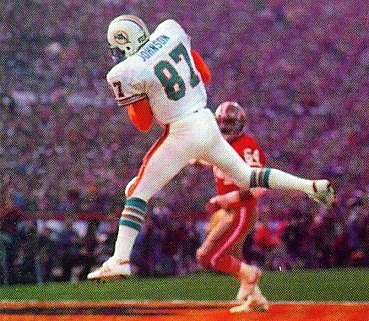
Miami went into a no-huddle offense the next time it had the ball and Marino completed five straight passes, including the last for a two-yard TD to TE Dan Johnson (pictured below). The Dolphins held a 10-7 lead after one quarter.


The 49ers punted following their next possession, but a defensive adjustment caused Miami to go three-and-out the next three times it was on offense. Coach Walsh had gone to an “elephant” defense, a 4-2-5 alignment with safety Tom Holmoe as a nickel back and another safety, Jeff Fuller, lined up at linebacker along with Turner, and it proved to be effective. Marino, who had completed nine of his first ten passes, didn’t complete another until near the end of the half.

Meanwhile, San Francisco took control of the game. Following a poor 37-yard punt by Reggie Roby from his own end zone, the 49ers had good field position at the Miami 47. Montana again showed off his mobility by running for a 19-yard gain on the first play, and then passed to WR Dwight Clark for another 16 yards. Two plays later, he tossed an eight-yard scoring pass to RB Roger Craig and the 49ers retook the lead at 14-10.

With the 49ers getting the ball in good field position at their own 45 to start their next possession, Tyler and Craig ran the ball for a total of 15 yards and then Montana threw back-to-back completions to TE Russ Francis for another 29. Following a five-yard carry by Craig, Montana ran six yards for a touchdown on a quarterback keeper and the lead was strechted to 21-10.

San Francisco scored once more in the second quarter, on a nine-yard drive that covered 52 yards and culminated in a two-yard run by Craig for a touchdown. Coming down to the last two minutes of the half, Marino began completing passes again, going 7 for 11 as the Dolphins drove to the 49ers’ 13 yard line and van Schamann kicked a 31-yard field goal with 12 seconds remaining.

It wasn’t over, however, as G Guy McIntyre fumbled the squibbed Miami kickoff and WR Jim Jensen recovered for the Dolphins at the San Francisco 12. Another van Schamann field goal, this time from 30 yards, made the score 28-16 at halftime.

Miami received the second half kickoff but wasn’t able to maintain the momentum generated at the end of the second quarter. Nathan was thrown for a one-yard loss, Marino threw an incompletion, and then the quarterback was sacked for a nine-yard loss by Board. Following Roby’s punt, the 49ers took nine plays to drive 43 yards and Ray Wersching kicked a 27-yard field goal.


Once again the Dolphins had difficulty moving the ball as Marino (pictured at left) faced tremendous pressure from the San Francisco defense. The Niners’ offense continued to move effectively – on their next possession following the field goal, Montana hit on five passes, including 40 yards to Tyler and 14 to Francis, and completed a 16-yard TD pass to Craig for the second-year running back’s third score of the day.

Miami, desperate to get back in the game, moved to the San Francisco 27 on its next possession, but Marino threw a long pass intended for Clayton that Wright intercepted at the one yard line. The third quarter ended with the 49ers ahead by 22 points.

The Dolphins had to punt at the end of their next possession but got a break when CB Dana McLemore fumbled the kick and WR Vince Heflin recovered for Miami at the San Francisco 21. But on the first play, Marino threw into the end zone and was intercepted by Carlton Williamson. For all intents and purposes, the game was over.

Each team got the ball once more, but there was no more scoring and the 49ers came away the winner, 38-16.

San Francisco ran up 537 yards to Miami’s 314 and also had a significant edge in first downs (31 to 19). The 49ers ran a well-balanced attack, gaining 211 yards on the ground and 331 through the air. Meanwhile, the Dolphins, with a suspect running game to begin with, were held to just 25 yards rushing. Marino was sacked four times, especially notable since the quarterback had suffered only 13 sacks during the entire regular season.


Joe Montana, the game’s MVP, completed 24 of 35 passes for 331 yards with three touchdowns and no interceptions, and also ran five times for 59 yards and a TD. Wendell Tyler led the rushers with 65 yards on 13 carries, catching four passes for 70 yards as well, while Roger Craig (pictured at right) gained 58 yards on 15 attempts and in addition had 7 pass receptions for another 77 yards, both team-leading figures to go with his three TDs. Dwight Clark also gained 77 yards on his 6 catches.

For Miami, Dan Marino threw 50 passes and completed 29 of them for 318 yards with a TD and two interceptions. Tony Nathan caught 10 passes, for 83 yards, to lead the club both in receptions and rushing - albeit with just 18 yards on five attempts. Mark Clayton gained 92 yards on 6 catches, and TE Joe Rose contributed 6 receptions for 73 yards. Mark Duper was held to just one catch for 11 yards.

“Montana is the guy who made it go for them,” said Don Shula afterward. “He beat everything we put against him. Whenever they needed him to, he wiggled loose and kept them going.”

Montana spoke in terms of the whole team’s effort. “All week, all we heard was ‘Miami, Miami, Miami’,” he said. “That motivated us. We felt we had more tools than Miami – passing, running, a great defense – and we wanted to prove it.”

Bill Walsh summed up by saying, “This is the best game we have played since I joined the 49ers. It was a great performance by a truly great team. This is one of the best teams of all time.”

For Walsh, Montana, and the 49ers, it was the second championship in four years, and they would win twice more before the conclusion of the decade (although Walsh had stepped aside as coach by the last one).

Dan Marino went on to play 17 seasons in the NFL, all with the Dolphins. Altogether, he passed for 61,361 yards and 420 touchdowns over the course of his Hall of Fame career. But he never again played in the Super Bowl.