Showing posts with label Pass Receiving Leaders. Show all posts

August 18, 2017

Highlighted Year: Roger Craig, 1985

Fullback, San Francisco 49ers


Age: 25
3rd season in pro football & with 49ers
College: Nebraska
Height: 6’0”    Weight: 222

Prelude:
Chosen by the 49ers in the second round of the 1983 NFL draft to address the unsettled situation at running back, and better known in college for his blocking ability, Craig teamed at fullback with veteran acquisition RB Wendell Tyler and gained 1152 yards from scrimmage (725 rushing, 427 receiving).

1985 Season Summary
Appeared in all 16 games
[Bracketed numbers indicate league rank in Top 20]

Rushing
Attempts – 214 [19]
Most attempts, game – 22 (for 117 yds.) at Denver 11/11
Yards – 1050 [13]
Most yards, game – 117 yards (on 22 carries) at Denver 11/11
Average gain – 4.9 [6]
TDs – 9 [8, tied with Walter Payton & Larry Kinnebrew]
100-yard rushing games – 2

Pass Receiving
Receptions – 92 [1] 
Most receptions, game – 12 (for 167 yds.) at Atlanta 10/6
Yards – 1016 [11]
Most yards, game – 167 (on 12 catches) at Atlanta 10/6
Average gain – 11.0
TDs – 6 [20, tied with eight others]
100-yard receiving games – 2

Total Yards – 2066 [3, 1st in NFC]

Scoring
TDs – 15 [2, tied with Louis Lipps]
Points – 90

Postseason: 1 G (NFC Wild Card playoff at NY Giants)
Rushing attempts – 9
Rushing yards – 23
Average gain rushing – 2.6
Rushing TDs – 0

Pass receptions – 2
Pass receiving yards – 18
Average yards per reception – 9.0
Pass Receiving TDs – 0

Awards & Honors:
2nd team All-NFL: AP, NEA
2nd team All-NFC: UPI
Pro Bowl

49ers went 10-6 to finish second in the NFC West and qualify for the postseason as a wild card entry, while leading the conference in total yards (5920) and touchdowns (53). Lost NFC Wild Card playoff to New York Giants (17-3).


Aftermath:
Craig split time with HB Joe Cribbs in 1986 but had a second Pro Bowl year in ‘87 as he gained 1307 total yards in the strike-abbreviated season (815 rushing, 492 receiving). Craig received NFL Offensive Player of the Year honors in 1988 while rushing for 1502 yards and catching 76 passes for 534 yards as the 49ers advanced to a Super Bowl victory. He had a fourth Pro Bowl year in 1989, gaining 1054 yards on the ground and 473 through catching passes as the 49ers won another championship, but, after absorbing seven years of punishment as a versatile all-purpose back, his productivity began to drop off thereafter. After one last year with the 49ers in ’90, he moved on to the Raiders and then two final years in Minnesota, never gaining more than 590 yards rushing in any of his last four seasons or catching more than 25 passes. He retired with totals of 8189 rushing yards and 4911 receiving yards on 566 receptions, a total of 13,100 yards from scrimmage.

--

Highlighted Years features players who were consensus first-team All-League* selections or league* or conference** leaders in the following statistical categories:

Rushing: Yards, TDs (min. 10)
Passing: Yards, Completion Pct., Yards per Attempt, TDs, Rating
Receiving: Catches, Yards, TDs (min. 10)
Scoring: TDs, Points, Field Goals (min. 5)
All-Purpose: Total Yards
Defense: Interceptions, Sacks
Kickoff Returns: Average
Punt Returns: Average

November 13, 2016

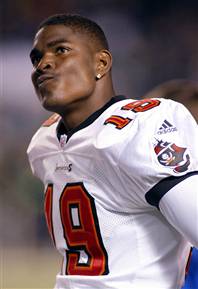
Highlighted Year: Keyshawn Johnson, 2001

Wide Receiver, Tampa Bay Buccaneers


Age: 29
6th season in pro football, 2nd with Buccaneers
College: Southern California
Height: 6’4”   Weight: 212

Prelude:
In two seasons at USC after transferring from West Los Angeles College, Johnson caught 168 passes for 2796 yards (16.6 avg.) and 16 touchdowns, including 102 for 1434 yards and 7 TDs in 1995. He received consensus first-team All-America recognition and was chosen by the New York Jets as the top overall selection in the 1996 NFL draft. Johnson showed off his potential, with 63 receptions for 844 yards and 8 TDs as a rookie, but also a distracting brashness. Big and physical, if not particularly fast, he followed up with another solid season in ’97 and, with the club improving dramatically overall, had consecutive Pro Bowl seasons in 1998 and ’99 as he caught over 80 passes and gained a thousand yards in each, scoring a combined 18 touchdowns. Johnson was traded to Tampa Bay in 2000 and had a lesser year, catching 71 passes for 874 yards and 8 TDs.

2001 Season Summary
Appeared in 15 of 16 games
[Bracketed numbers indicate league rank in Top 20]

Pass Receiving
Receptions – 106 [4, 1st in NFC]  
Most receptions, game – 12 (for 89 yds.) vs. Chicago 11/18
Yards – 1266 [7]
Most yards, game – 159 (on 10 catches) vs. Pittsburgh 10/21
Average gain – 11.9
TDs – 1
100-yard receiving games – 4

Scoring
TDs – 1
Points – 6

Postseason: 1 G (NFC Wild Card playoff at Philadelphia)
Pass receptions – 3
Pass receiving yards – 75
Average yards per reception – 25.0
Pass Receiving TDs – 0

Awards & Honors:
Pro Bowl

Buccaneers went 9-7 to finish third in the NFC Central and qualified for a Wild Card playoff spot. Lost NFC Wild Card playoff to Philadelphia Eagles (31-9).

Aftermath:
Johnson followed up with 76 catches for 1088 yards (14.3 avg.) and five touchdowns in 2002 as the Buccaneers won the NFL title, but as his relationship with the coaching staff deteriorated, he was deactivated for the last seven games of the ’03 season. Dealt to the Dallas Cowboys in 2004, Johnson continued to be a productive possession receiver for two seasons and finished up by catching 70 passes for 815 yards with Carolina in 2006. For his career, Johnson had 814 pass receptions for 10,571 yards (13.0 avg.) and 64 TDs. Of those totals, 298 for 3828 yards and 17 TDs were with Tampa Bay. He was selected to three Pro Bowls.

--

Highlighted Years features players who were consensus first-team All-League* selections or league* or conference** leaders in the following statistical categories:

Rushing: Yards, TDs (min. 10)
Passing: Yards, Completion Pct., Yards per Attempt, TDs, Rating
Receiving: Catches, Yards, TDs (min. 10)
Scoring: TDs, Points, Field Goals (min. 5)
All-Purpose: Total Yards
Defense: Interceptions, Sacks
Kickoff Returns: Average
Punt Returns: Average
Punting: Average

*Leagues include NFL (1920 to date), AFL (1926), AFL (1936-37), AAFC (1946-49), AFL (1960-69), WFL (1974-75), USFL (1983-85)

**NFC/AFC since 1970

November 7, 2016

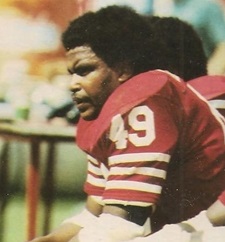
Highlighted Year: Earl Cooper, 1980

Fullback, San Francisco 49ers


Age: 23 (Sept. 17)
1st season in pro football
College: Rice
Height: 6’2”   Weight: 227

Prelude:
Cooper was an effective all-around back in college, rushing for 1583 yards on 407 carries and catching 101 passes for 802 yards. Altogether he totaled 2385 yards from scrimmage and 21 touchdowns. Attracted by his size and ability to catch the ball, he was chosen by the 49ers in the first round of the 1980 NFL draft (13th overall) and proved to be a productive receiver out of the backfield in Head Coach Bill Walsh’s West Coast offense.

1980 Season Summary
Appeared and started in all 16 games
[Bracketed numbers indicate league rank in Top 20]

Rushing
Attempts – 171
Most attempts, game – 21 (for 86 yds.) vs. NY Giants 11/23
Yards – 720
Most yards, game – 90 yards (on 15 carries) vs. Buffalo 12/21
Average gain – 4.2 [16]
TDs – 5

Pass Receiving
Receptions – 83 [2, 1st in NFC]
Most receptions, game – 10 (for 71 yds.) at New Orleans 9/7
Yards – 567
Most yards, game – 84 (on 3 catches) vs. NY Giants 11/23
Average gain – 6.8
TDs – 4

Scoring
TDs – 9 [12, tied with eight others]
Points – 54

49ers went 6-10 to finish third in the NFC West.

Aftermath:
Cooper rushed for 330 yards on 98 carries and caught 51 passes for 477 yards during the 1981 season that ended with a win in the Super Bowl, where he also contributed a touchdown catch. However, he proved to not be an effective inside runner and lost his starting job during the strike-shortened 1982 season. Cooper was shifted to backup tight end in ’83 due to his pass receiving skills and had his best year at that position in 1984, with 41 catches for 459 yards and four TDs, but lasted just one more season in San Francisco and finished his career in 1986 with the Raiders. Overall, Cooper rushed for 1152 yards on 298 carries (3.9 avg.) and caught 213 passes for 1908 yards (9.0 avg.), scoring a total of 18 touchdowns.

--

Highlighted Years features players who were consensus first-team All-League* selections or league* or conference** leaders in the following statistical categories:

Rushing: Yards, TDs (min. 10)
Passing: Yards, Completion Percentage, Yards per Attempt, TDs, Rating
Receiving: Catches, Yards, TDs (min. 10)
Scoring: TDs, Points, Field Goals (min. 5)
All-Purpose: Total Yards
Defense: Interceptions, Sacks
Kickoff Returns: Average
Punt Returns: Average
Punting: Average

*Leagues include NFL (1920 to date), AFL (1926), AFL (1936-37), AAFC (1946-49), AFL (1960-69), WFL (1974-75), USFL (1983-85)

**NFC/AFC since 1970

August 24, 2016

Highlighted Year: Charlie Brown, 1983

Wide Receiver, Washington Redskins


Age: 25 (Oct. 29)
3rd season in pro football (2nd active) & with Redskins
College: South Carolina State
Height: 5’10” Weight: 179

Prelude:
An outstanding receiver on a run-oriented college team, Brown was chosen by the Redskins in the eighth round of the 1981 NFL draft but spent his first year on injured reserve due to a knee injury suffered in the third preseason game. He made an impact in the 1982 season opening game by scoring on a 78-yard touchdown catch, the first of eight TDs in the strike-shortened campaign that saw him pull in 32 receptions for 690 yards (21.6 avg.). Brown caught another 17 passes for 242 yards and two TDs in the postseason as the Redskins won the NFL Championship and he received second-team All-NFL recognition from the NEA and was selected to the Pro Bowl. He became part of a group of capable receivers known as “the Fun Bunch” that were a component of the NFL’s most potent offense.

1983 Season Summary
Appeared in 15 of 16 games
[Bracketed numbers indicate league rank in Top 20]

Pass Receiving
Receptions – 78 [6, tied with Earnest Gray & Roy Green, 1st in NFC]           
Most receptions, game – 11 (for 180 yds.) vs. LA Raiders 10/2
Yards – 1225 [6]
Most yards, game – 180 (on 11 catches) vs. LA Raiders 10/2
Average gain – 15.7
TDs – 8 [7, tied with five others]
100-yard receiving games – 4

Rushing
Attempts – 4
Yards – 53
Average gain – 13.3
TDs – 0

Scoring
TDs – 8
Points – 48

Postseason: 3 G
Pass receptions – 14
Most pass receptions, game – 6 vs. LA Rams, NFC Divisional playoff
Pass receiving yards – 401
Most pass receiving yards, game – 171 vs. LA Rams, NFC Divisional playoff
Average yards per reception – 28.6
Pass Receiving TDs – 1
100-yard receiving games – 2

Awards & Honors:
2nd team All-NFC: UPI
Pro Bowl

Redskins went 14-2 and finished first in the NFC East while leading the NFL in scoring (541 points) and touchdowns (63). Won NFC Divisional playoff over Los Angeles Rams (51-7) and NFC Championship over San Francisco 49ers (24-21). Lost Super Bowl to Los Angeles Raiders (38-9).

Aftermath:
Brown suffered through an injury-plagued season in 1984, catching just 18 passes for 200 yards (11.1 avg.), and was traded to the Atlanta Falcons. Following a mediocre 24-catch season in ’85, Brown rebounded in 1986 with 63 pass receptions for 918 yards (14.6 avg.) and four touchdowns. It was his last hurrah as he caught just five more passes in 1986 and his NFL career came to an end with his release by the Colts in 1988. Brown played arena football in 1990 with the a Washington Commandos and caught 11 passes for 129 yards and two TDs. Overall in the NFL, Brown had 220 receptions for 3548 yards (16.1 avg.) and 25 touchdowns, with 128 of those catches for 2115 yards and 19 TDs coming with Washington. He added another 31 catches for 643 yards (20.7 avg.) and three TDs in eight postseason games. Brown received second-team All-NFL honors once, second-team All-NFC recognition twice, and was chosen to two Pro Bowls.

--

Highlighted Years features players who were consensus first-team All-League* selections or league* or conference** leaders in the following statistical categories:

Rushing: Yards, TDs (min. 10)
Passing: Yards, Completion Pct., Yards per Attempt, TDs, Rating
Receiving: Catches, Yards, TDs (min. 10)
Scoring: TDs, Points, Field Goals (min. 5)
All-Purpose: Total Yards
Defense: Interceptions, Sacks
Kickoff Returns: Average
Punt Returns: Average
Punting: Average

*Leagues include NFL (1920 to date), AFL (1926), AFL (1936-37), AAFC (1946-49), AFL (1960-69), WFL (1974-75), USFL (1983-85)

**NFC/AFC since 1970

August 2, 2016

Highlighted Year: Joe Carter, 1934

End, Philadelphia Eagles


Age: 24
2nd season in pro football & with Eagles
College: Southern Methodist
Height: 6’1”   Weight: 203

Prelude:
Carter, who played baseball and basketball as well as football in college, joined the first-year Eagles in 1933 and moved into the starting lineup at right end, catching five passes, good for 109 yards (21.8 avg.) and two touchdowns.

1934 Season Summary
Appeared in all 11 games
[Bracketed numbers indicate league rank in Top 20]

Pass Receiving
Receptions – 16 [1, tied with Red Badgro]         
Yards – 238 [2]
Average gain – 14.9 [5]
TDs – 4 [2]

Scoring
TDs – 4 [11, tied with Harry Newman & Roger Grove]
Points – 24 [18]

Eagles went 4-7 to finish third in the NFL Eastern Division (tied with the Brooklyn Dodgers).

Aftermath:
Carter spent another six seasons with the Eagles. He received second-team All-NFL recognition from Collyers Eye and the Chicago Daily News in 1936 and reached the apex of his career in 1938, when he caught 27 passes for 386 yards (14.3 avg.) and 7 TDs and was named to the Pro All-Star Game (predecessor to the Pro Bowl) as well as garnering second-team All-NFL honors from the Pro Football Writers and New York Daily News. Carter had another All-Star season in 1939, with 24 receptions for 292 yards (12.2 avg.) and two touchdowns. He later saw action with Green Bay in 1942, spent ’43 in the military, and then was with Brooklyn in 1944 and the Chicago Cardinals in 1945, his final season. Overall, Carter caught 132 passes for 1989 yards (15.1 avg.) and 22 touchdowns. Of those totals, 114 receptions for 1810 yards and 21 TDs came with the Eagles. Carter twice received second-team All-NFL recognition and was chosen to two Pro/NFL All-Star Games. 

--

Highlighted Years features players who were consensus first-team All-League* selections or league* or conference** leaders in the following statistical categories:

Rushing: Yards, TDs (min. 10)
Passing: Yards, Completion Pct., Yards per Attempt, TDs, Rating
Receiving: Catches, Yards, TDs (min. 10)
Scoring: TDs, Points, Field Goals (min. 5)
All-Purpose: Total Yards
Defense: Interceptions, Sacks
Kickoff Returns: Average
Punt Returns: Average
Punting: Average

*Leagues include NFL (1920 to date), AFL (1926), AFL (1936-37), AAFC (1946-49), AFL (1960-69), WFL (1974-75), USFL (1983-85)

**NFC/AFC since 1970

June 12, 2016

Highlighted Year: Muhsin Muhammad, 1999

Wide Receiver, Carolina Panthers


Age: 26
4th season in pro football & with Panthers
College: Michigan State
Height: 6’2”   Weight: 220

Prelude:
Muhammad caught 50 passes for 867 yards (17.3 avg.) and three touchdowns in 1995, his last college season, and was chosen by the Panthers in the second round of the ’96 NFL draft. While hampered by a hamstring injury as a rookie, he showed promise, catching 25 passes for 407 yards (16.3 avg.) and impressing with his size as well as speed. Following another injury-plagued season in 1997, Muhammad started every game in ’98 and broke out with 68 receptions for 941 yards (13.8 avg.) and six TDs.

1999 Season Summary
Appeared in 15 of 16 games
[Bracketed numbers indicate league rank in Top 20]

Pass Receiving
Receptions – 96 [3, 1st in NFC]    
Most receptions, game – 11 (for 126 yds.) vs. San Francisco 12/18
Yards – 1253 [7]
Most yards, game – 151 (on 8 catches) at Washington 10/3
Average gain – 13.1
TDs – 8 [12, tied with Az-Zahir Hakim, Kevin Johnson & Keyshawn Johnson]
100-yard receiving games – 5

Scoring
TDs – 8
Points – 48

Awards & Honors:
Pro Bowl

Panthers went 8-8 to finish second in the NFC West while ranking second in the NFL in passing yards (4161) and third in touchdowns (50).

Aftermath:
Muhammad led the NFL with 102 catches in 2000, gaining 1183 yards (11.6 avg.) and scoring six touchdowns. Injuries and off-field problems caused his production to drop off significantly in 2001, but there was improvement in 2002 and ’03, and he had an 85-yard scoring reception in the Super Bowl loss to New England following the latter season. Muhammad had a big year in 2004, leading the NFL with 1405 yards and 16 TDs on his 93 pass receptions and receiving consensus first-team All-NFL honors as well as selection to the Pro Bowl. However, he was released by the Panthers in the offseason due to contract issues and moved on to the Chicago Bears in 2005, where with his diminished speed combining with inconsistency at quarterback, his numbers dropped off. He spent three years with the Bears before returning to Carolina for his last two seasons in 2008 and ’09. Overall, Muhammad caught 860 passes for 11,438 yards (13.3 avg.) and 62 touchdowns. Of those totals, 696 receptions for 9255 yards and 50 TDs came with the Panthers. Muhammad was a first-team All-NFL selection once and was named to two Pro Bowls.

--

Highlighted Years features players who were consensus first-team All-League* selections or league* or conference** leaders in the following statistical categories:

Rushing: Yards, TDs (min. 10)
Passing: Yards, Completion Percentage, Yards per Attempt, TDs, Rating
Receiving: Catches, Yards, TDs (min. 10)
Scoring: TDs, Points, Field Goals (min. 5)
All-Purpose: Total Yards
Defense: Interceptions, Sacks
Kickoff Returns: Average
Punt Returns: Average
Punting: Average

*Leagues include NFL (1920 to date), AFL (1926), AFL (1936-37), AAFC (1946-49), AFL (1960-69), WFL (1974-75), USFL (1983-85)

**NFC/AFC since 1970

May 30, 2016

Highlighted Year: Bobby Joe Conrad, 1963

Flanker, St. Louis Cardinals


Age: 28 (Nov. 17)
6th season in pro football & with Cardinals
College: Texas A & M
Height: 6’0”   Weight: 195

Prelude:
The versatile Conrad played at quarterback, halfback, and fullback in addition to end in college and was part of the 1956 Texas A & M team that won the Southwest Conference title. He also starred in the 1958 College All-Star Game upset of the Detroit Lions, kicking four field goals and intercepting a pass. Conrad was chosen by the New York Giants in the fifth round of the ’58 NFL draft but was traded to the Cards prior to the season and was used in the defensive backfield as a rookie, intercepting four passes, as well as for returning punts and placekicking. He was shifted to offense in 1959 and backed up at halfback for two seasons, rushing for a career-high 328 yards in ’59, before being moved to flanker in 1961, where he broke out with 30 catches for 499 yards (16.6 avg.) and two touchdowns. Conrad had a bigger year in 1962, hauling in 62 pass receptions for 954 yards (15.4) avg. and four TDs as part of a productive tandem with split end Sonny Randle.

1963 Season Summary
Appeared in all 14 games
[Bracketed numbers indicate league rank in Top 20]

Pass Receiving
Receptions – 73 [1] 
Most receptions, game – 8 (for 112 yds.) vs. Green Bay 10/20
Yards – 967 [6]
Most yards, game – 122 (on 6 catches) vs. Philadelphia 12/8
Average gain – 13.2
TDs – 10 [4, tied with Gail Cogdill & Frank Clarke]
100-yard receiving games – 2

Rushing
Attempts – 1
Yards – 0
TDs – 0

Punt Returns
Returns – 1
Yards – 1
Average per return – 1.0
TDs – 0

Scoring
TDs – 10 [6, tied with four others]
Points – 60 [15, tied with four others]

Awards & Honors:
1st team All-NFL: AP, UPI, NY Daily News
2nd team All-NFL: NEA

Cardinals went 9-5 to finish third in the NFL Eastern Conference.

Aftermath:
Conrad followed up with 61 catches for 780 yards (12.8 avg.) and six touchdowns in 1964 and achieved Pro Bowl recognition. Consistent if not especially fast or flashy, he remained a capable possession receiver for the Cards through 1968, a total of 11 seasons, before finishing up with the Dallas Cowboys in 1969. Overall, he caught 422 passes for 5902 yards (14.0 avg.) and 38 TDs, with 418 of those catches for 5828 yards and all of the TDs coming with the Cardinals. Conrad also returned 33 kickoffs for a 24.6-yard average and 51 punts for an average of 9.1 yards and two TDs. As a placekicker he booted 14 field goals out of 33 attempts and made good on 95 of 99 extra points which, combined with his 42 touchdowns, accounted for a total of 389 points. Conrad received first-team All-NFL recognition once, second-team honors after one other season, and was selected to one Pro Bowl.

--

Highlighted Years features players who were consensus first-team All-League* selections or league* or conference** leaders in the following statistical categories:

Rushing: Yards, TDs (min. 10)
Passing: Yards, Completion Pct., Yards per Attempt, TDs, Rating
Receiving: Catches, Yards, TDs (min. 10)
Scoring: TDs, Points, Field Goals (min. 5)
All-Purpose: Total Yards
Defense: Interceptions, Sacks
Kickoff Returns: Average
Punt Returns: Average
Punting: Average

*Leagues include NFL (1920 to date), AFL (1926), AFL (1936-37), AAFC (1946-49), AFL (1960-69), WFL (1974-75), USFL (1983-85)

**NFC/AFC since 1970

May 5, 2016

Highlighted Year: Dwight Clark, 1981

Wide Receiver, San Francisco 49ers


Age: 24
3rd season in pro football & with 49ers
College: Clemson
Height: 6’3”   Weight: 205

Prelude:
Playing across from star WR Jerry Butler in college, Clark caught 33 passes for 571 yards (17.3 avg.) and three touchdowns and was chosen by the 49ers in the 10th round of the 1979 NFL draft. He started three games as a rookie and had 18 catches for 232 yards, but broke out in 1980 with 82 receptions for 991 yards and eight touchdowns. An overachieving possession receiver, he proved to be a comfortable fit in San Francisco’s West Coast passing offense.

1981 Season Summary
Appeared in all 16 games
[Bracketed numbers indicate league rank in Top 20]

Pass Receiving
Receptions – 85 [2, 1st in NFC]    
Most receptions, game – 9 (for 77 yds.) at Atlanta 9/20
Yards – 1105 [9]
Most yards, game – 135 (on 4 catches) vs. Dallas 10/11
Average gain – 13.0
TDs – 4
100-yard receiving games – 3

Rushing
Attempts – 3
Yards – 32
Average gain – 10.7
TDs – 0

Passing
Attempts – 1
Completions – 0
Yards – 0
Interceptions – 0

Scoring
TDs – 4
Points – 24

Postseason: 3 G
Pass receptions – 17
Most pass receptions, game – 8 vs. Dallas, NFC Championship
Pass receiving yards – 269
Most pass receiving yards, game – 120 vs. Dallas, NFC Championship
Average yards per reception – 15.8
Pass Receiving TDs – 2

Rushing attempts – 2
Rushing yards – 4
Yards per attempt – 2.0
Rushing TDs – 0

Awards & Honors:
2nd team All-NFC: UPI
Pro Bowl

49ers went 13-3 to finish first in the NFC West. Won NFC Divisional playoff over New York Giants (38-24), NFC Championship over Dallas Cowboys (28-27) & Super Bowl over Cincinnati Bengals (26-21).

Aftermath:
While the 49ers dipped from their championship form in 1982, Clark led the NFL with 60 catches, for 913 yards (15.2 avg.) and five touchdowns, in the strike-shortened season and was a consensus first-team All-NFL as well as Pro Bowl selection. He had 70 receptions for 840 yards and 8 TDs in ’83, but also had knee surgery. Clark remained a dependable clutch receiver until 1987, when further knee problems ended his career after nine seasons, all with the 49ers. Overall, he caught 506 passes for 6750 yards (13.3 avg.) and 48 touchdowns. He added another 48 receptions for 726 yards (15.1 avg.) and three TDs in the postseason, which included his dramatic NFC Championship game-winning catch in 1981. Clark was a consensus first-team All-NFL choice once and was chosen to two Pro Bowls. The 49ers retired his #87.

--

Highlighted Years features players who were consensus first-team All-League* selections or league* or conference** leaders in the following statistical categories:

Rushing: Yards, TDs (min. 10)
Passing: Yards, Completion Pct., Yards per Attempt, TDs, Rating
Receiving: Catches, Yards, TDs (min. 10)
Scoring: TDs, Points, Field Goals (min. 5)
All-Purpose: Total Yards
Defense: Interceptions, Sacks
Kickoff Returns: Average
Punt Returns: Average
Punting: Average

*Leagues include NFL (1920 to date), AFL (1926), AFL (1936-37), AAFC (1946-49), AFL (1960-69), WFL (1974-75), USFL (1983-85)

**NFC/AFC since 1970

April 24, 2016

Highlighted Year: Harold Carmichael, 1973

Wide Receiver, Philadelphia Eagles


Age: 24 (Sept. 22)
3rd season in pro football & with Eagles
College: Southern
Height: 6’8”   Weight: 225

Prelude:
A quarterback in high school, Carmichael shifted to wide receiver in college. With concerns about his tall but lean frame being able to hold up in pro football, he was chosen by the Eagles in the seventh round of the 1971 NFL draft and spent the first two years of his career being tried at tight end as well as wide receiver and missing time due to injuries. He caught a total of 40 passes in 1971 and ’72 for 564 yards and two touchdowns. With WR Harold Jackson traded to the Rams for QB Roman Gabriel, and new Head Coach Mike McCormack committing to Carmichael at the open wide receiver slot, he broke out in ’73. In combination with 6’3” WR Don Zimmerman and 6’4” TE Charle Young, he became the tallest member of the “Fire High Gang”.

1973 Season Summary
Appeared in all 14 games
[Bracketed numbers indicate league rank in Top 20]

Pass Receiving
Receptions – 67 [1] 
Most receptions, game – 12 (for 187 yds.) at St. Louis 10/14
Yards – 1116 [1]
Most yards, game – 187 (on 12 catches) at St. Louis 10/14
Average gain – 16.7 [14]
TDs – 9 [4, tied with Isaac Curtis]
100-yard receiving games – 5

Rushing
Attempts – 3
Yards – 42
Average gain – 14.0
TDs – 0

Scoring
TDs – 9 [10, tied with four others]
Points – 54

Awards & Honors:
1st team All-NFL: PFWA, Pro Football Weekly
2nd team All-NFL: AP, NEA
1st team All-NFC: AP, Pro Football Weekly
Pro Bowl

Eagles went 5-8-1 to finish third in the NFC East while leading the NFL in passing yards (2998).

Aftermath:
Carmichael’s pass reception and yardage totals in 1973 remained his career highs, but he continued to be a key element in Philadelphia’s offense for another ten seasons. Lacking speed, Carmichael used his height and dependable hands to good advantage, and was difficult to bring down in the open field. He caught 56 passes for 649 yards and eight touchdowns in ’74, garnering second-team All-NFC recognition from UPI. After three seasons of less than 50 catches with a club that struggled on offense, Carmichael had 55 receptions for 1072 yards (averaging a career-best 19.5 yards) and 8 TDs in 1978, the first of two consecutive years in which he received first-team All-NFC honors and three straight in which he was chosen to the Pro Bowl. He had a career-high 11 scoring receptions in ’79, the same year in which he broke the record for consecutive games with pass receptions, a streak that eventually reached 127 and served as a testament to his durability as well as reliability. Carmichael departed the Eagles after the 1983 season holding club records with 589 catches, 8978 receiving yards, and 79 touchdowns. He appeared in two games with Dallas in 1984, his last season, and caught one pass for seven yards to top out his career total at 590, which ranked fifth in NFL history at the time. Carmichael received first-team All-NFL recognition once, first- or second-team All-NFC honors after five other seasons, and was chosen to four Pro Bowls.  

--

Highlighted Years features players who were consensus first-team All-League* selections or league* or conference** leaders in the following statistical categories:

Rushing: Yards, TDs (min. 10)
Passing: Yards, Completion Percentage, Yards per Attempt, TDs, Rating
Receiving: Catches, Yards, TDs (min. 10)
Scoring: TDs, Points, Field Goals (min. 5)
All-Purpose: Total Yards
Defense: Interceptions, Sacks
Kickoff Returns: Average
Punt Returns: Average
Punting: Average

*Leagues include NFL (1920 to date), AFL (1926), AFL (1936-37), AAFC (1946-49), AFL (1960-69), WFL (1974-75), USFL (1983-85)

**NFC/AFC since 1970

April 7, 2016

Highlighted Year: Cris Carter, 1994

Wide Receiver, Minnesota Vikings


Age: 29 (Nov. 25)
8th season in pro football, 5th with Vikings
College: Ohio State
Height: 6’3”   Weight: 197

Prelude:
Carter caught 168 passes for 2725 yards (16.2 avg.) and 27 touchdowns in college, including 69 receptions for 1127 yards and 11 TDs in 1986, when he was a consensus first-team All-American. Declared ineligible for the 1987 season due to having signed a contract with an agent, he was chosen by the Philadelphia Eagles in the fourth round of the ’87 NFL supplemental draft. He saw little action as a rookie but caught 39 passes for 761 yards (19.5 avg.) and six TDs in 1988 and scored 11 touchdowns among his 45 receptions for 605 yards in ’89. However, he had off-field substance abuse issues, clashed with Head Coach Buddy Ryan, and was waived in 1990. Picked up by the Vikings, Carter backed up wide receivers Anthony Carter (no relation) and Hassan Jones that year but had a 72-catch, 962-yard season in 1991. While missing four games due to a broken collar bone in ’92, Carter still led the club with 53 catches and in 1993 he caught 86 passes for 1071 yards and 9 TDs, earning his first Pro Bowl selection. Lacking speed, Carter provided height, excellent jumping ability, and reliable hands.

1994 Season Summary
Appeared in all 16 games
[Bracketed numbers indicate league rank in Top 20]

Pass Receiving
Receptions – 122 [1]          
Most receptions, game – 14 (for 167 yds.) at Arizona 10/2
Yards – 1256 [7]
Most yards, game – 167 (on 14 catches) at Arizona 10/2
Average gain – 10.3
TDs – 7 [11, tied with four others]
100-yard receiving games – 5

Scoring
TDs – 7
2-pt conversions – 2 [4, tied with six others]
Points – 46

Postseason: 1 G (NFC Wild Card playoff vs. Chicago)
Pass receptions – 8
Pass receiving yards – 61
Average yards per reception – 7.6
Pass Receiving TDs – 1

Awards & Honors:
1st team All-NFL: AP, PFWA, Sporting News
1st team All-NFC: UPI, Pro Football Weekly
Pro Bowl

Vikings went 10-6 to finish first in the NFC Central while leading the conference in passing yards (4324). Lost NFC Wild Card playoff to Chicago Bears (35-18).

Aftermath:
Carter’s record-breaking 1994 season was the second of eight in which he both exceeded a thousand pass receiving yards and was selected to the Pro Bowl. He matched his total of 122 catches in ’95, when he achieved career highs with 1371 yards and a league-leading 17 touchdowns – his first of five consecutive seasons reaching double figures in receiving TDs. Carter had 90 or more catches three more times and departed the Vikings after the 2001 season, having caught 1004 passes for 12,383 yards (12.3 avg.) and 110 TDs with Minnesota, all franchise highs. He finished up with the Miami Dolphins in 2002. Overall, Carter had 1101 pass receptions for 13,899 yards (12.6 avg.) and 130 TDs; the receptions and receiving TDs ranked second in NFL history at the time, and the yards placed fourth. He received first-team All-NFL honors twice, second-team All-NFL or All-NFC recognition after two other seasons, and was chosen to eight Pro Bowls. His #80 was retired by the Vikings and he was inducted into the Pro Football Hall of Fame, Class of 2013.

--

Highlighted Years features players who were consensus first-team All-League* selections or league* or conference** leaders in the following statistical categories:

Rushing: Yards, TDs (min. 10)
Passing: Yards, Completion Pct., Yards per Attempt, TDs, Rating
Receiving: Catches, Yards, TDs (min. 10)
Scoring: TDs, Points, Field Goals (min. 5)
All-Purpose: Total Yards
Defense: Interceptions, Sacks
Kickoff Returns: Average
Punt Returns: Average
Punting: Average

*Leagues include NFL (1920 to date), AFL (1926), AFL (1936-37), AAFC (1946-49), AFL (1960-69), WFL (1974-75), USFL (1983-85)

**NFC/AFC since 1970