Showing posts with label Harold Carmichael. Show all posts

November 12, 2016

1979: Eagles Defeat Cowboys in Monday Night Showdown


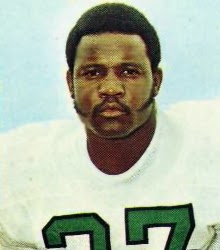
The Philadelphia Eagles faced an uphill battle as they took on the Dallas Cowboys in a Monday night game on November 12, 1979. Head Coach Dick Vermeil’s team had gotten off to a 6-1 start but, following three straight losses, was at 6-4 and in danger of falling out of contention in the NFC East. QB Ron Jaworski provided gritty leadership, HB Wilbert Montgomery was highly productive both running and receiving, and WR Harold Carmichael (pictured at right) had set a new NFL record by catching a pass in his 106th consecutive game the previous week. The defense lost its leader, MLB Bill Bergey, to a knee injury in the third week but was proving to be formidable and the kicking game, which had been a sore spot the previous year, was also much improved with the arrival of the barefoot-kicking rookie Tony Franklin.

The Cowboys were the defending NFC Champions and atop the division with an 8-2 record. In their twentieth season under Head Coach Tom Landry, they remained strong on offense with QB Roger Staubach throwing the ball and HB Tony Dorsett carrying, while the defense had weathered some key losses to retirement and injury to keep the club on track. Moreover, they had not lost to the Eagles at home since 1965 and were nine-point favorites.

There were 62,417 fans in attendance at Texas Stadium as well as a national television audience. The Cowboys had the first possession and, after Tony Dorsett ran for 24 yards on a sweep and FB Scott Laidlaw gained another eight, they came through with a big play when Roger Staubach went long to WR Tony Hill for a 48-yard touchdown. Rafael Septien added the extra point for the early 7-0 advantage.

Following a short series by the Eagles that resulted in a punt, Dallas was again on the move thanks to the running of Dorsett as well as Staubach but, after catching a second down pass, Dorsett was stripped of the ball by LB Jerry Robinson at the Philadelphia 41. It looked as though the reprieve would be a short one, but helped by a defensive holding call that nullified a third down sack, the Eagles maintained possession and Ron Jaworski passed to Harold Carmichael for 16 yards. A few plays later the drive stalled and, facing fourth-and-six, Tony Franklin was short on a 53-yard field goal attempt, but once again a Dallas penalty intervened and moved the visitors up five yards. Now facing fourth-and-one, the offense returned to the field and took the Cowboys by surprise as Jaworski passed to Carmichael for a 32-yard TD. Franklin added the game-tying point after.

Midway through the second quarter, the Eagles were back in scoring position after DB John Sciarra returned a Dallas punt 32 yards. Jaworski threw to Wilbert Montgomery for 15 yards but the series ultimately came up empty when Franklin was wide to the left on a 45-yard field goal try. With Staubach out due to a thigh injury, QB Danny White entered the game and the Cowboys were forced to punt following a short possession.

The Eagles lost their quarterback as well when Jaworski also had to leave the game due to a wrist injury suffered when he was hit by DE Harvey Martin and they turned to their backup, John Walton. The series ended with a punt but WR Steve Wilson of the Cowboys muffed the kick and LB Frank LeMaster recovered at the Dallas 29 with a minute remaining in the first half. The visitors immediately capitalized when Walton threw to WR Charlie Smith for a 29-yard touchdown and, with Franklin’s conversion, Philadelphia was ahead by 14-7.

However, the Eagles weren’t done as SS Randy Logan intercepted a White pass on the ensuing series at the Dallas 42 that set up a club-record 59-yard field goal by Franklin, giving the Eagles not only a 17-7 halftime lead but a psychological lift.

Both starting quarterbacks were back in the game in the third quarter. In a drive that featured the running of Montgomery and FB Leroy Harris, the Eagles advanced into Dallas territory and scored on a Jaworski pass to Carmichael in the right corner of the end zone for a 13-yard touchdown. Franklin added the extra point to make it a 24-7 contest.

The Cowboys, now in a deeper hole, responded with a five-play possession that started with Staubach passing to Hill for 36 yards to the Philadelphia 31, but they came up empty when Septien’s field goal attempt from 47 yards was short. Later in the period, the Eagles failed to extend their lead when Franklin missed from 52 yards.


With six minutes left to play, Dallas finally got on the board again in electrifying fashion when Staubach threw long again to Hill (pictured at left) for a 75-yard touchdown. Getting the ball back with 2:48 remaining on the clock, the Cowboys advanced 72 yards in nine plays that concluded with another Staubach scoring pass, this time to TE Billy Joe DuPree from five yards out. Septien successfully converted after each TD and the margin was thus narrowed further to 24-21 with 1:19 to play. But any hopes of a stunning comeback were dashed when, on the following series and facing a crucial third down, the Eagles sealed the win as Montgomery broke away for a 37-yard TD. Franklin’s point after capped the 31-21 victory.

The Cowboys had the edge in total yards (408 to 328) while the teams were even with 17 first downs apiece. However, Dallas turned the ball over five times, to none by the Eagles, and Philadelphia recorded five sacks, to three by the home team.

Ron Jaworski completed just 12 of 29 passes for 145 yards, but two were for touchdowns and there were no interceptions. John Walton was two-of-six for 41 yards and a TD in his relief appearance. Wilbert Montgomery rushed for 127 yards on 25 carries that included a touchdown. Harold Carmichael had four catches for 69 yards and two TDs and Charlie Smith contributed four receptions for 54 yards and a score. John Sciarra had an outstanding night averaging 13.8 yards on six punt returns. Tony Franklin made good on only one of his four field goal attempts, but it was a big one.

For the Cowboys, Roger Staubach was successful on 17 of 28 throws for 308 yards and three TDs with none intercepted. Tony Hill (pictured at left) had a big night in defeat, catching 7 passes for 213 yards and two touchdowns. Tony Dorsett gained 53 yards on 13 rushing attempts and had 7 catches for 64 more yards.

The Eagles climbed to a game behind Dallas with the win. It was the first of four straight and five in the last six games, but Philadelphia lost the rematch with the Cowboys and, while both clubs finished at 11-5, it was Dallas winning the division and the Eagles placing second, although reaching the postseason as a Wild Card. They defeated the Bears in the first round but lost to Tampa Bay at the Divisional level. Dallas also fell in the Divisional round, losing to the Rams.

Both Harold Carmichael and Wilbert Montgomery had Pro Bowl seasons, with Carmichael catching 52 passes for 872 yards (16.8 avg.) and 11 touchdowns and Montgomery gaining 2006 yards from scrimmage (1512 on 338 rushing attempts, 494 on 41 pass receptions) and compiling 14 TDs.


Tony Franklin (pictured at right) ended up kicking 23 field goals out of 31 attempts, with three of them coming from over 50 yards. Prone to inconsistency, his 74.2 percentage was the best of his five years in Philadelphia, although he would go on to better years in New England. The 59-yard field goal against the Cowboys remained his career high by far.

Tony Hill ended up with 60 catches for 1062 yards (17.7 avg.) and 10 touchdowns, and received Pro Bowl honors for the second year. His 213-yard pass receiving total against the Eagles remained his career best.

April 24, 2016

Highlighted Year: Harold Carmichael, 1973

Wide Receiver, Philadelphia Eagles


Age: 24 (Sept. 22)
3rd season in pro football & with Eagles
College: Southern
Height: 6’8”   Weight: 225

Prelude:
A quarterback in high school, Carmichael shifted to wide receiver in college. With concerns about his tall but lean frame being able to hold up in pro football, he was chosen by the Eagles in the seventh round of the 1971 NFL draft and spent the first two years of his career being tried at tight end as well as wide receiver and missing time due to injuries. He caught a total of 40 passes in 1971 and ’72 for 564 yards and two touchdowns. With WR Harold Jackson traded to the Rams for QB Roman Gabriel, and new Head Coach Mike McCormack committing to Carmichael at the open wide receiver slot, he broke out in ’73. In combination with 6’3” WR Don Zimmerman and 6’4” TE Charle Young, he became the tallest member of the “Fire High Gang”.

1973 Season Summary
Appeared in all 14 games
[Bracketed numbers indicate league rank in Top 20]

Pass Receiving
Receptions – 67 [1] 
Most receptions, game – 12 (for 187 yds.) at St. Louis 10/14
Yards – 1116 [1]
Most yards, game – 187 (on 12 catches) at St. Louis 10/14
Average gain – 16.7 [14]
TDs – 9 [4, tied with Isaac Curtis]
100-yard receiving games – 5

Rushing
Attempts – 3
Yards – 42
Average gain – 14.0
TDs – 0

Scoring
TDs – 9 [10, tied with four others]
Points – 54

Awards & Honors:
1st team All-NFL: PFWA, Pro Football Weekly
2nd team All-NFL: AP, NEA
1st team All-NFC: AP, Pro Football Weekly
Pro Bowl

Eagles went 5-8-1 to finish third in the NFC East while leading the NFL in passing yards (2998).

Aftermath:
Carmichael’s pass reception and yardage totals in 1973 remained his career highs, but he continued to be a key element in Philadelphia’s offense for another ten seasons. Lacking speed, Carmichael used his height and dependable hands to good advantage, and was difficult to bring down in the open field. He caught 56 passes for 649 yards and eight touchdowns in ’74, garnering second-team All-NFC recognition from UPI. After three seasons of less than 50 catches with a club that struggled on offense, Carmichael had 55 receptions for 1072 yards (averaging a career-best 19.5 yards) and 8 TDs in 1978, the first of two consecutive years in which he received first-team All-NFC honors and three straight in which he was chosen to the Pro Bowl. He had a career-high 11 scoring receptions in ’79, the same year in which he broke the record for consecutive games with pass receptions, a streak that eventually reached 127 and served as a testament to his durability as well as reliability. Carmichael departed the Eagles after the 1983 season holding club records with 589 catches, 8978 receiving yards, and 79 touchdowns. He appeared in two games with Dallas in 1984, his last season, and caught one pass for seven yards to top out his career total at 590, which ranked fifth in NFL history at the time. Carmichael received first-team All-NFL recognition once, first- or second-team All-NFC honors after five other seasons, and was chosen to four Pro Bowls.  

--

Highlighted Years features players who were consensus first-team All-League* selections or league* or conference** leaders in the following statistical categories:

Rushing: Yards, TDs (min. 10)
Passing: Yards, Completion Percentage, Yards per Attempt, TDs, Rating
Receiving: Catches, Yards, TDs (min. 10)
Scoring: TDs, Points, Field Goals (min. 5)
All-Purpose: Total Yards
Defense: Interceptions, Sacks
Kickoff Returns: Average
Punt Returns: Average
Punting: Average

*Leagues include NFL (1920 to date), AFL (1926), AFL (1936-37), AAFC (1946-49), AFL (1960-69), WFL (1974-75), USFL (1983-85)

**NFC/AFC since 1970

October 21, 2014

1973: Vikings Sink Feisty Eagles as Gilliam Stars


The Minnesota Vikings were undefeated at 5-0 as they hosted the Philadelphia Eagles on October 21, 1973. Head Coach Bud Grant’s team had not allowed more than 16 points in any game thus far, but while best known for strong defense, the Vikings were a formidable team on offense as well. 33-year-old QB Fran Tarkenton was an outstanding and mobile passer, rookie FB Chuck Foreman was potent as both a runner and receiver out of the backfield, and WR John Gilliam (pictured at right) provided speed on the outside. The line was solid.

Philadelphia, under first-year Head Coach Mike McCormack, was 1-4-1 and a seventeen-point underdog. Coming off of a dreadful last-place finish the year before, the Eagles were rebuilding with an offense led by QB Roman Gabriel, a 12th-year veteran who had been obtained at heavy price from the Rams during the offseason. 6’8” WR Harold Carmichael was having a breakout season and rookie TE Charle Young further bolstered the passing game. The problem was with a thin defense in need of fortification on the line and at linebacker.

It was a clear day at Metropolitan Stadium with 47,478 fans in attendance. The Eagles got the first break when Chuck Foreman fumbled at the end of a 16-yard run and DE Will Wynn recovered at the Minnesota 41. However, they weren’t able to gain much ground and Tom Dempsey’s field goal attempt from 44 yards was wide to the right.

The Vikings responded with an 80-yard drive in six plays. Fran Tarkenton ran twice for 19 yards and John Gilliam ran for 44 yards and a touchdown on a well-executed double-reverse. Fred Cox added the extra point for the early 7-0 lead.

The teams traded punts, each stopping just short of midfield. A Philadelphia series was then blunted when Harold Carmichael’s gain on a pass into the flat was nullified by a hurdling penalty as the rangy wide receiver leaped over CB Nate Wright. Following a punt, Minnesota moved methodically into Eagles territory on a series that extended into the second quarter. Tarkenton completed four short passes, with a 10-yard completion to WR Carroll Dale gaining the necessary yardage to convert a third down, and also scrambled for a 12-yard gain in a second-and-nine situation. But after reaching the Philadelphia 24, Cox’s field goal try from 31 yards was blocked by CB Joe Lavender.

Another short series led to a punt by the Eagles, and the Vikings didn’t come up empty this time, advancing 65 yards in seven plays. In a third-and-seven situation, Tarkenton threw twice to Gilliam for 14 and 42 yards to the Philadelphia six. Three plays later, HB Oscar Reed leaped into the end zone from a yard out and, with Cox’s conversion, Minnesota was up by 14-0.

Regaining possession with four minutes remaining in the first half, the Eagles put together a 10-play, 80-yard drive. HB Po James (pictured below) started off with a 17-yard carry up the middle and Gabriel completed five passes along the way. In a fourth-and-one situation at the Philadelphia 46, HB Tom Sullivan ran for four yards. A holding penalty nullified an apparent long scoring toss to Carmichael, but following a nine-yard gain by James on a draw play, Gabriel threw to Charle Young for 20 yards, to James for 12, and to Carmichael for 11. James ran the last 12 yards for a TD and, and with Dempsey adding the PAT, the home team’s lead was halved to 14-7. There was still 1:03 left in the period as the Vikings regained possession, but Cox was short on a field goal attempt from 53 yards and time ran out on the Eagles at their 31.


Philadelphia had first possession in the third quarter but had to punt, and the short kick by Tom McNeill gave the Vikings the ball at their own 43. They went 57 yards in eight plays, the last a Tarkenton pass to a wide-open Gilliam for a 24-yard touchdown. Cox kicked the extra point to make it a 21-7 game.

The Eagles responded with a 14-play, 76-yard scoring drive of their own. Gabriel, with his first of six completions during the series, threw to Young for a 24-yard gain.  Four of his passes, in fact, were to the rookie tight end, the last for 12 yards to the Minnesota three, and two plays later FB Lee Bouggess ran for a two-yard TD. Dempsey’s conversion again made it a seven-point margin.


In a series that moved into the fourth quarter, the Vikings came back with a 69-yard drive that took 13 plays. Tarkenton (pictured at left) had completions to TE Stu Voigt for 15 and 13 yards and Foreman outraced Lavender and FS Bill Bradley to the goal line for a five-yard touchdown. Cox again made it a 14-point game with the extra point.

The teams exchanged punts before the Eagles put together a nine-play, 78-yard series. Gabriel threw to WR Don Zimmerman for 14 yards and to Carmichael for 19 in a third-and-10 situation and James had runs of 22 and seven yards. From the Minnesota 17, Young took a handoff on an end-around play and plowed over three defenders on the way to a TD. Dempsey initially failed to convert, but an offside penalty on the Vikings gave him a second chance that he made good on.

The determined Eagles had again closed to seven points and there were four minutes remaining to play, but they never got the ball again as Minnesota was able to run out the clock, helped by Tarkenton’s 16-yard scramble that converted a third-and-nine situation. The final score was 28-21.

The Vikings led in total yards (409 to 315) and first downs (25 to 19), with Minnesota’s total showing offensive balance – 217 on the ground and 192 net yards through the air. The Vikings suffered the game’s only turnover and managed to record two sacks, to one by Philadelphia.

John Gilliam caught 6 passes for 116 yards and a touchdown and added another TD on his 44-yard run. Fran Tarkenton completed 16 of 21 passes for 202 yards and a touchdown with no interceptions and also ran for 49 yards on 9 carries. Chuck Foreman topped the Vikings with 68 rushing yards on 21 attempts that included a TD.


For the Eagles, Roman Gabriel was successful on 23 of 32 throws for 201 yards and no TDs but also no interceptions. Po James ran for 78 yards on 11 carries that included a score and also had 6 catches for 25 yards. Charle Young (pictured at right) caught 6 passes also, for 86 yards, and had the 17-yard touchdown carry and Harold Carmichael contributed 6 receptions for 52 yards.

The Vikings reached 9-0 before finally dropping a game and ended up on top of the NFC Central with a 12-2 record. They won the NFC Championship but were handily beaten by Miami in the Super Bowl. Philadelphia won its next two games and continued to provide exciting offense and mediocre defense on the way to a 5-8-1 tally and third place finish in the NFC East.

John Gilliam went on to a Pro Bowl season as he caught 42 passes for 907 yards (21.6 avg.) and scored eight touchdowns. Fran Tarkenton remained efficient throwing the ball, completing 61.7 percent of his passes and compiling a career-high 93.2 rating while giving up only seven interceptions.

Roman Gabriel led the league in pass attempts (460), completions (270), yards (3219), and TD passes (23, tied with Roger Staubach of the Cowboys) and was selected to the Pro Bowl. Harold Carmichael topped the NFL in both pass receptions (67) and yards (1116) and Charle Young received Rookie of the Year recognition for his 55 catches and 854 yards. Both receivers were Pro Bowl choices and received All-NFL recognition, with Young a consensus first-team honoree.

December 29, 2013

1979: Bucs Beat Eagles for First Postseason Win


The Tampa Bay Buccaneers had been a source of derision when they debuted at 0-14 in 1976, but three years later the laughter subsided as the Bucs rode a 6-0 start to an overall record of 10-6, placing them atop the NFC Central. On December 29, 1979 they faced the Philadelphia Eagles in the first postseason game in franchise history.

Coached by John McKay, the Buccaneers featured the league’s best defense, both overall and against the pass. Utilizing a 3-4 alignment, the solid unit was anchored by formidable DE Lee Roy Selmon. The ball-control offense operated behind a good line, which was a big help to second-year QB Doug Williams as well as FB Ricky Bell (pictured above), who rushed for 1263 yards. Still, there was a perception that Tampa Bay had taken advantage of a relatively easy schedule and not much was expected in the postseason.

The Eagles were in the playoffs for the second straight year under Head Coach Dick Vermeil, having placed second in the NFC East with an 11-5 tally and securing a Wild Card spot. Ever-improving QB Ron Jaworski directed the attack that featured HB Wilbert Montgomery and WR Harold Carmichael. The defense had lost star ILB Bill Bergey to a knee injury but benefited from the arrival of rookie OLB Jerry Robinson. Philadelphia had rallied past the Bears in the first playoff round to earn the trip to Tampa for a NFC Divisional playoff game.

It was a sunny and pleasant day at Tampa Stadium with a sellout crowd of 72,126 in attendance. The Buccaneers set the tone with their first possession, driving 80 yards in 18 plays. Doug Williams completed passes to TE Jim Giles for 18 and 16 yards and Ricky Bell ran the ball effectively. It was Bell sweeping around end from four yards out for a touchdown that finished the series and, with Neil O’Donoghue’s extra point, the home team was ahead by 7-0.

The teams traded punts before the Eagles mounted a threat during a possession that extended into the second quarter. While facing a heavy pass rush, Ron Jaworski still managed to complete a throw to TE Keith Krepfle for 12 yards on a third-and-11 play, but when the series stalled and the Eagles lined up for a field goal attempt while facing fourth-and-four at the Tampa Bay 30, holder John Sciarra took off on a fake for a seven-yard gain, only to have it called back due to a delay-of-game penalty. With the ball set back five yards, Tony Franklin tried to kick a field goal for real from 52 yards and it fell short.

The Bucs followed up with a 10-play, 43-yard drive. On second-and-12, Williams threw to WR Larry Mucker for 34 yards to the Philadelphia 33. After Bell and HB Jerry Eckwood carried the ball for a total of nine yards, Bell converted a fourth-and-one with a five-yard run. Two plays later, Williams connected with WR Isaac Hagins for 26 yards. A holding penalty backed Tampa Bay up and a pass to Giles in the end zone was controversially ruled incomplete due to the receiver not having control of the ball before stepping out of bounds. O’Donoghue kicked a 40-yard field goal and the Buccaneers still increased their lead to 10-0.

The Bucs got a break when Wilbert Montgomery fumbled at his own five yard line and MG Randy Crowder recovered. It took four plays, but Bell blasted into the end zone from a yard out on fourth-and-goal and, with O’Donoghue’s kick, the score was 17-0. Philadelphia appeared in danger of being routed.

Following a short series and punt, the Eagles got a big defensive play when Jerry Robinson intercepted a Williams pass and returned it 37 yards to the Tampa Bay 11 with 1:37 left in the half. Two plays later, Jaworski threw to WR Charlie Smith for an 11-yard TD and, with Franklin adding the PAT, the score was 17-7 at halftime.

Philadelphia further narrowed the Bucs’ lead with the first possession of the third quarter. A long completion to Harold Carmichael was nullified by a clipping penalty, but with Montgomery running for 20 yards on three carries, the Eagles reached the Tampa Bay 25 and Franklin booted a 42-yard field goal that made it a seven-point game.

After an exchange of punts, the Eagles again advanced into Tampa Bay territory thanks to a Jaworski-to-Montgomery pass completion that gained 30 yards. But after reaching the 38, Lee Roy Selmon sacked Jaworski on back-to-back plays for a total loss of 20 yards and Philadelphia had to punt.


Heading into the fourth quarter, both teams went three-and-out and punted before the Bucs put together a critical scoring drive of 57 yards in nine plays. Bell had a 26-yard run on a third-and-two play and Williams converted a third-and-four situation by rolling out and keeping the ball himself for an eight-yard gain to the Philadelphia nine. From there, Williams rifled a throw to Giles (pictured above) for a touchdown and, adding on the extra point, the Buccaneers had a formidable a 14-point lead.

With seven minutes left to play, Jaworski filled the air with passes on the next series. A pass interference penalty picked up 20 yards and a fourth-and-five throw to Krepfle was good for six yards. The Eagles converted another fourth down when Jaworski connected with Smith for 13 yards and then a pass to Carmichael resulted in a 37-yard touchdown. Franklin’s conversion made it a seven-point game once more.

The Eagles attempted an onside kick that went out of bounds, but the rookie placekicker Franklin chose to try again and the second kick was recovered by the Buccaneers and gave them possession at their own 48 – much to the fury of Coach Vermeil, who had instructed Franklin to kick deep. The Bucs punted, but the Eagles had to start deep in their territory for one last opportunity with the clock down to 2:11. Jaworski threw to Carmichael for 16 yards and, on fourth-and-15, to Smith for 25 yards to the Tampa Bay 45. But that was as far as the visitors could get. Heavily pressured by the inspired defense on each play, Jaworski threw four straight incomplete passes and the Buccaneers were winners by a final score of 24-17.

Tampa Bay had the edge in total yards (318 to 227) and first downs (17 to 15). The Bucs ground out 186 yards of their total on 55 running plays, while the Eagles managed just 48 yards on 18 attempts. Each team turned the ball over once. The Tampa Bay defense was fired up and displayed uncharacteristic emotion throughout the game.


Ricky Bell rushed for 142 yards and two touchdowns, setting a NFL playoff record with 38 carries (broken by Lamar Smith of the Dolphins in 2000). Doug Williams went to the air just 15 times and, while he had only 7 completions, they were good for 132 yards and a TD, with one interception. He also ran the ball 6 times for 19 yards. Jim Giles was Tampa Bay’s top receiver with three catches for 43 yards and a touchdown. Lee Roy Selmon (pictured above, closing in on Ron Jaworski) had the two key sacks on defense and, along with DE Wally Chambers, was consistently disruptive.

For the Eagles, Ron Jaworski was successful on a mere 15 of 39 throws for 199 yards and two touchdowns with none intercepted. Wilbert Montgomery had 35 yards on 13 carries and gained another 35 yards on his team-leading four pass receptions. Harold Carmichael contributed 92 yards on his three catches that included a TD.

The Bucs hosted the NFC Championship game against the Rams, where the run ended in a 9-0 defeat. They dropped to 5-10-1 in 1980, but returned to the postseason in ’81. Philadelphia recovered to go 12-4 in 1980 and reach the Super Bowl, falling to the Raiders.

February 8, 2010

1976: Dick Vermeil Hired as Head Coach by Philadelphia Eagles


Since winning the NFL Championship in 1960 under Head Coach Buck Shaw, who promptly retired, the Philadelphia Eagles had gone through a long period of successive coaching failures. Through the 1975 season the Eagles had five coaches, who combined for a won-lost record of 74-127-9 with just two winning years along the way. The last of those, Mike McCormack, went 16-25-1 from 1973 to ’75 and was let go.

Owner Leonard Tose had hired three of those coaches since taking over the team in 1969, and interviewed several candidates for the latest vacancy, including those with pro head coaching experience such as Hank Stram and Allie Sherman, as well as Norm Van Brocklin, the quarterback of the 1960 championship team who had gone on to coach the Vikings and Falcons. On February 8, 1976 he signed 39-year-old Dick Vermeil, who had drawn national attention after coaching UCLA to an upset of top-ranked Ohio State in the Rose Bowl.

Vermeil had been an assistant coach at the pro level, having served as the first designated special teams coach in NFL history under George Allen with the Los Angeles Rams. He had led UCLA to an overall record of 15-5-3 over two seasons. Initially reluctant to accept the job, he was taking on the task of trying to turn around an organization that had been mired in losing and had mortgaged its future, primarily in deals for QB Roman Gabriel before the 1973 season and LB Bill Bergey in ’74. They did not have a draft choice until the fourth round in ’76 and the fifth round in ’77, and would not choose again in either the first or second round until 1979.

Vermeil was signed to a five-year contract and took the first season to evaluate the talent on hand. Gabriel was still with the team, but clearly on the downside of his career at age 36 and primarily utilized as a backup to the mediocre Mike Boryla. There was quality at tight end, where Charle Young was considered one of the league’s best (and was prone to being outspoken about that fact) and wide receiver, with 6’8” Harold Carmichael providing a big, if sometimes inconsistent, target.

Rookie FB Mike Hogan played well prior to an injury that ended his season after eight games, while veteran HB Tom Sullivan suffered through an injury-plagued campaign. The offensive line needed work, but had some promising players in tackles Jerry Sisemore and Stan Walters.

With a lack of quality defensive linemen and a better group of linebackers led by the All-Pro Bergey, Vermeil chose to use a 3-4 alignment. Strong safety Randy Logan was a rising star in the defensive backfield.

The biggest change Vermeil brought to the club from the beginning was intensity and a solid work ethic. He personified it by working long hours and often spending the night on a cot in his office at Veterans Stadium. It took time for the results to show, but when they did, the change was dramatic.

“I always had a sense that we were moving in the right direction,” Bergey said later. “Even in the early years when the wins were few and far between, we could see the intensity of the play picking up. Dick’s personality rubbed off on us.”

The wins were most definitely few and far between initially. The club duplicated the 1975 record of 4-10 in ’76, and was 5-9 in 1977. Young, who had become involved in a contract dispute, was traded to the Rams after the first year for QB Ron Jaworski (pictured with Vermeil below); “The Polish Rifle” took over the starting job and improved along with the team. Carmichael showed a greater maturity and became an even better receiver and team leader. At the end of the 1977 season, rookie Wilbert Montgomery emerged as a quality running back. Moreover, six of the nine losses were by six points or less, pointing to the increasing competitiveness of the team.

The hard work was rewarded in 1978, as the Eagles went 9-7 and earned a wild card playoff spot while Montgomery set a new team single-season rushing record with 1220 yards. The record improved to 11-5 and another wild card berth in ’79, and in 1980 Philadelphia won the NFC Championship with a 12-4 tally, although they faltered badly in the Super Bowl. Some fans and commentators blamed Vermeil for allowing the team to become too tight going into the Super Bowl, and the loss seemed to be a negative turning point for both the coach and team.

While the club got off to a 6-0 start in 1981, it faltered in the second half and just made it into the postseason as a wild card entry with a 10-6 tally; they lost to the Giants in the first round. It was the first time that the team had failed to improve on the previous year’s showing since Vermeil had arrived.

The Eagles went 3-6 in the strike-shortened 1982 season, and Vermeil resigned, citing burnout. The emotional Vermeil’s intensity had ultimately proved to be his undoing in Philadelphia. He left with an overall record of 57-51.

Vermeil moved to the broadcast booth and did not return to coaching until he signed on with the Rams fifteen years later in 1997 (after flirting with the idea of coming back to the Eagles in 1995). But from 1976 through ’80, he turned a perennially losing team into a contender and was twice selected as NFC Coach of the Year by the Pro Football Writers of America for his efforts.