Showing posts with label Charle Young. Show all posts

October 21, 2014

1973: Vikings Sink Feisty Eagles as Gilliam Stars


The Minnesota Vikings were undefeated at 5-0 as they hosted the Philadelphia Eagles on October 21, 1973. Head Coach Bud Grant’s team had not allowed more than 16 points in any game thus far, but while best known for strong defense, the Vikings were a formidable team on offense as well. 33-year-old QB Fran Tarkenton was an outstanding and mobile passer, rookie FB Chuck Foreman was potent as both a runner and receiver out of the backfield, and WR John Gilliam (pictured at right) provided speed on the outside. The line was solid.

Philadelphia, under first-year Head Coach Mike McCormack, was 1-4-1 and a seventeen-point underdog. Coming off of a dreadful last-place finish the year before, the Eagles were rebuilding with an offense led by QB Roman Gabriel, a 12th-year veteran who had been obtained at heavy price from the Rams during the offseason. 6’8” WR Harold Carmichael was having a breakout season and rookie TE Charle Young further bolstered the passing game. The problem was with a thin defense in need of fortification on the line and at linebacker.

It was a clear day at Metropolitan Stadium with 47,478 fans in attendance. The Eagles got the first break when Chuck Foreman fumbled at the end of a 16-yard run and DE Will Wynn recovered at the Minnesota 41. However, they weren’t able to gain much ground and Tom Dempsey’s field goal attempt from 44 yards was wide to the right.

The Vikings responded with an 80-yard drive in six plays. Fran Tarkenton ran twice for 19 yards and John Gilliam ran for 44 yards and a touchdown on a well-executed double-reverse. Fred Cox added the extra point for the early 7-0 lead.

The teams traded punts, each stopping just short of midfield. A Philadelphia series was then blunted when Harold Carmichael’s gain on a pass into the flat was nullified by a hurdling penalty as the rangy wide receiver leaped over CB Nate Wright. Following a punt, Minnesota moved methodically into Eagles territory on a series that extended into the second quarter. Tarkenton completed four short passes, with a 10-yard completion to WR Carroll Dale gaining the necessary yardage to convert a third down, and also scrambled for a 12-yard gain in a second-and-nine situation. But after reaching the Philadelphia 24, Cox’s field goal try from 31 yards was blocked by CB Joe Lavender.

Another short series led to a punt by the Eagles, and the Vikings didn’t come up empty this time, advancing 65 yards in seven plays. In a third-and-seven situation, Tarkenton threw twice to Gilliam for 14 and 42 yards to the Philadelphia six. Three plays later, HB Oscar Reed leaped into the end zone from a yard out and, with Cox’s conversion, Minnesota was up by 14-0.

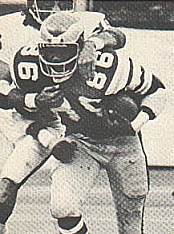
Regaining possession with four minutes remaining in the first half, the Eagles put together a 10-play, 80-yard drive. HB Po James (pictured below) started off with a 17-yard carry up the middle and Gabriel completed five passes along the way. In a fourth-and-one situation at the Philadelphia 46, HB Tom Sullivan ran for four yards. A holding penalty nullified an apparent long scoring toss to Carmichael, but following a nine-yard gain by James on a draw play, Gabriel threw to Charle Young for 20 yards, to James for 12, and to Carmichael for 11. James ran the last 12 yards for a TD and, and with Dempsey adding the PAT, the home team’s lead was halved to 14-7. There was still 1:03 left in the period as the Vikings regained possession, but Cox was short on a field goal attempt from 53 yards and time ran out on the Eagles at their 31.


Philadelphia had first possession in the third quarter but had to punt, and the short kick by Tom McNeill gave the Vikings the ball at their own 43. They went 57 yards in eight plays, the last a Tarkenton pass to a wide-open Gilliam for a 24-yard touchdown. Cox kicked the extra point to make it a 21-7 game.

The Eagles responded with a 14-play, 76-yard scoring drive of their own. Gabriel, with his first of six completions during the series, threw to Young for a 24-yard gain.  Four of his passes, in fact, were to the rookie tight end, the last for 12 yards to the Minnesota three, and two plays later FB Lee Bouggess ran for a two-yard TD. Dempsey’s conversion again made it a seven-point margin.


In a series that moved into the fourth quarter, the Vikings came back with a 69-yard drive that took 13 plays. Tarkenton (pictured at left) had completions to TE Stu Voigt for 15 and 13 yards and Foreman outraced Lavender and FS Bill Bradley to the goal line for a five-yard touchdown. Cox again made it a 14-point game with the extra point.

The teams exchanged punts before the Eagles put together a nine-play, 78-yard series. Gabriel threw to WR Don Zimmerman for 14 yards and to Carmichael for 19 in a third-and-10 situation and James had runs of 22 and seven yards. From the Minnesota 17, Young took a handoff on an end-around play and plowed over three defenders on the way to a TD. Dempsey initially failed to convert, but an offside penalty on the Vikings gave him a second chance that he made good on.

The determined Eagles had again closed to seven points and there were four minutes remaining to play, but they never got the ball again as Minnesota was able to run out the clock, helped by Tarkenton’s 16-yard scramble that converted a third-and-nine situation. The final score was 28-21.

The Vikings led in total yards (409 to 315) and first downs (25 to 19), with Minnesota’s total showing offensive balance – 217 on the ground and 192 net yards through the air. The Vikings suffered the game’s only turnover and managed to record two sacks, to one by Philadelphia.

John Gilliam caught 6 passes for 116 yards and a touchdown and added another TD on his 44-yard run. Fran Tarkenton completed 16 of 21 passes for 202 yards and a touchdown with no interceptions and also ran for 49 yards on 9 carries. Chuck Foreman topped the Vikings with 68 rushing yards on 21 attempts that included a TD.


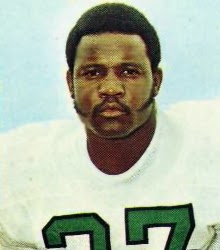
For the Eagles, Roman Gabriel was successful on 23 of 32 throws for 201 yards and no TDs but also no interceptions. Po James ran for 78 yards on 11 carries that included a score and also had 6 catches for 25 yards. Charle Young (pictured at right) caught 6 passes also, for 86 yards, and had the 17-yard touchdown carry and Harold Carmichael contributed 6 receptions for 52 yards.

The Vikings reached 9-0 before finally dropping a game and ended up on top of the NFC Central with a 12-2 record. They won the NFC Championship but were handily beaten by Miami in the Super Bowl. Philadelphia won its next two games and continued to provide exciting offense and mediocre defense on the way to a 5-8-1 tally and third place finish in the NFC East.

John Gilliam went on to a Pro Bowl season as he caught 42 passes for 907 yards (21.6 avg.) and scored eight touchdowns. Fran Tarkenton remained efficient throwing the ball, completing 61.7 percent of his passes and compiling a career-high 93.2 rating while giving up only seven interceptions.

Roman Gabriel led the league in pass attempts (460), completions (270), yards (3219), and TD passes (23, tied with Roger Staubach of the Cowboys) and was selected to the Pro Bowl. Harold Carmichael topped the NFL in both pass receptions (67) and yards (1116) and Charle Young received Rookie of the Year recognition for his 55 catches and 854 yards. Both receivers were Pro Bowl choices and received All-NFL recognition, with Young a consensus first-team honoree.

January 28, 2013

Rookie of the Year: Charle Young, 1973

Tight End, Philadelphia Eagles


Age: 22
College: Southern California
Height: 6’4”   Weight: 230

Prelude:
An All-American in college, Young was the second of two first-round draft picks (sixth overall) by the Eagles in 1973. The outspoken rookie moved directly into the starting lineup and backed up his words with production as part of the “Fire High Gang” along with tall wide receivers Harold Carmichael (6’8”) and Don Zimmerman (6’4”).

1973 Season Summary
Appeared in all 14 games
[Bracketed numbers indicate league rank in Top 20]

Pass Receiving
Receptions – 55 [4, tied with Ed Podolak]     
Most receptions, game – 8 (for 108 yds.) vs. New England 11/4
Yards – 854 [4]
Most yards, game – 113 (on 4 catches) at Dallas 11/18
Average gain – 15.5 (19)
TDs – 6 [12, tied with Jerome Barkum, Otto Stowe & Larry Brown]
100-yard receiving games - 4

Rushing
Attempts – 4
Yards – 24
Average gain – 6.0
TDs – 1

Kickoff Returns
Returns – 1
Yards – 14
TDs – 0

Scoring
TDs – 7 [18, tied with seven others]
Points – 42

Awards & Honors:
NFC Rookie of the Year: UPI
1st team All-NFL: AP, PFWA, Pro Football Weekly
2nd team All-NFL: NEA
1st team All-NFC: AP, Pro Football Weekly
2nd team All-NFC: UPI
Pro Bowl

Eagles went 5-8-1 to finish third in the NFC East while leading the NFL in passing offense (2998 yds.).

Aftermath:
Young followed up his outstanding rookie season by gathering in a NFC-leading 63 catches for 696 yards (11.0 avg.) and three touchdowns in 1974. He was again selected to the Pro Bowl in 1974 and ’75, although his production dropped with the offensively-challenged Eagles in 1975 and ’76. His first name also went through several different changes, from Charles to Charlie, Charli, and finally Charle. A contract dispute forced the trade of his rights to the Los Angeles Rams in 1977 for QB Ron Jaworski, and he dropped into obscurity behind Terry Nelson. In three seasons in LA, he caught just 36 passes. Moving on to San Francisco, Young was a better fit and, in the 1981 Super Bowl-winning season, had 37 pass receptions for 400 yards and five TDs. Following three years with the 49ers, he finished up with three seasons with the Seattle Seahawks. For his 13-season career, Young caught 418 passes for 5106 yards (12.2 avg.) and 27 touchdowns and was selected to the Pro Bowl three times.

--

Rookie of the Year Profiles feature players who were named Rookie of the Year in the NFL, AFL (1960-69), or USFL (1983-85) by a recognized organization (Associated Press – Offense or Defense, Newspaper Enterprise Association, United Press International, The Sporting News, or the league itself – Pepsi NFL Rookie of the Year). 

[Updated 2/6/14]

March 9, 2011

1977: Eagles Trade Charle Young to Rams for Ron Jaworski


On March 9, 1977 the Philadelphia Eagles and Los Angeles Rams traded the negotiating rights to disgruntled players who had played out their options and were looking to change teams. Charle Young, well-established as a top pass receiving tight end in Philadelphia, was swapped for Ron Jaworski, caught in the glut at quarterback in LA.

Jaworski (pictured at right), just short of his 26th birthday, had been chosen by the Rams in the second round of the 1973 draft out of Youngstown State. He found himself competing for playing time with, first, John Hadl, and then James Harris and Pat Haden during his four years in Los Angeles. “The Polish Rifle” started a handful of games, including a NFC Divisional playoff game win over the Cardinals. Jaworski was injured in ’76, and dropped to the number three spot behind Haden and Harris as a result (Harris was also dealt away during the same offseason, while an over-the-hill Joe Namath was brought in).

The 6’2”, 195-pound quarterback refused a five-year, $700,000 offer to stay with the Rams, hoping for a better opportunity elsewhere. While he had entertained offers from other clubs (technically, he was a free agent), Eagles Head Coach Dick Vermeil assured Jaworski of an opportunity to start. Vermeil, having completed one season in Philadelphia, was not satisfied with holdover quarterbacks Mike Boryla, who suffered from inconsistency, and Roman Gabriel, once an outstanding player but now clearly on the downside of his career. He was familiar with Jaworski from when he was offensive backfield coach with the Rams in 1973.

“We are very excited about obtaining the rights to Ron Jaworski while at the same time
we are disappointed about having to give up the rights to Charle Young,” Vermeil said following the completion of the trade.

Charle Young had been an All-American at Southern California and was one of Philadelphia’s two first round draft picks in 1973 (the other was OT Jerry Sisemore). He had an immediate impact, catching 55 passes for 854 yards and receiving NFC Rookie of the Year honors from UPI as well as consensus first-team All-Pro recognition. It was the first of three straight Pro Bowl seasons as Young followed up with an NFC-leading 63 receptions for 696 yards in ’74 and 49 for 659 yards in 1975. However, the team went a combined 16-25-1, and Head Coach Mike McCormack was replaced by Vermeil. Young caught just 30 passes for 374 yards in 1976.

The 6’4”, 240-pound Young was as outspoken as he was talented – from the day he was drafted, he made clear that he considered himself to be an elite player. He also tinkered with his first name throughout his stay in Philadelphia, which evolved from Charles to Charlie, Charli, and Charle.

The contract negotiations with the Eagles were going badly, and it was apparent that the brash tight end was looking to move elsewhere. “I want to play for a warm weather franchise,” Young said. “I'd like to play on natural turf and I'd like to be with a contender.”

“Charles Young would give us an added dimension as both a wide receiver and tight end,” said Chuck Knox, head coach of the Rams, following the trade. “I coached him in the Pro Bowl and I'm delighted we've acquired the rights to a player of this quality.”

In going back to Los Angeles, his college town, Young was clearly getting his wishes granted. However, the result was not what he anticipated. The Rams were a run-oriented team, and Terry Nelson emerged to move ahead of Young on the depth chart. The former All-Pro caught just five passes in 1977, and a total of 36 in three seasons in LA.

Jaworski, meanwhile, developed along with the Eagles under Vermeil’s guidance. He passed for 2183 yards in 1977, completing 48 percent of his passes with 18 touchdowns and 21 interceptions for a club that went 5-9. In 1978, Jaws completed 51.8 percent of his throws for 2487 yards and broke even with 16 TDs and interceptions apiece. The Eagles were 9-7 and claimed a wild card spot for their first foray into the postseason since 1960. In ’79, Jaworski’s yardage total was 2669 and he had more touchdowns (18) than passes picked off (12) as Philadelphia improved to 11-5 and another wild card playoff berth. 1980 saw the Eagles win the NFC East with a 12-4 record and advance to the Super Bowl (a loss to the Raiders). Jaworski led the NFC in passing (91.0 rating) and threw for 3529 yards with 27 touchdowns and 12 interceptions. He was selected to the Pro Bowl and received the Bert Bell Trophy from the Maxwell Club as NFL MVP.


Things did get better for Young – and worse for Jaworski. Young moved on to the San Francisco 49ers in 1980 and again became a starting tight end. He caught 37 passes for 400 yards and five TDs during the 1981 season that culminated in a championship. He played the last three years of his career for the Seahawks (1983-85) and ended up with a career total of 418 catches for 5106 yards and 27 touchdowns. While he never achieved All-Pro or Pro Bowl recognition after leaving Philadelphia, he was a serviceable player who contributed to a Super Bowl championship.

The Eagles went out in the first round of the playoffs in 1981 and dropped to 3-6 during the strike-shortened ’82 season, after which Vermeil resigned. The team slid back into mediocrity, with organizational problems aiding the descent.

Jaworski stayed with Philadelphia through the 1986 season, when he finally was forced to give way to Randall Cunningham. Tough and durable, he started every game of his first seven years in Philadelphia until sidelined by a broken leg suffered 13 games into the ’84 season. By the time “The Polish Rifle” left, to finish his career with a year apiece in Miami and Kansas City, he had set team career passing records that would not be broken until Donovan McNabb’s tenure at quarterback, including attempts (3918), completions (2088), yards (26,963), and touchdowns (175).