Showing posts with label Mike McCormack. Show all posts

October 21, 2014

1973: Vikings Sink Feisty Eagles as Gilliam Stars


The Minnesota Vikings were undefeated at 5-0 as they hosted the Philadelphia Eagles on October 21, 1973. Head Coach Bud Grant’s team had not allowed more than 16 points in any game thus far, but while best known for strong defense, the Vikings were a formidable team on offense as well. 33-year-old QB Fran Tarkenton was an outstanding and mobile passer, rookie FB Chuck Foreman was potent as both a runner and receiver out of the backfield, and WR John Gilliam (pictured at right) provided speed on the outside. The line was solid.

Philadelphia, under first-year Head Coach Mike McCormack, was 1-4-1 and a seventeen-point underdog. Coming off of a dreadful last-place finish the year before, the Eagles were rebuilding with an offense led by QB Roman Gabriel, a 12th-year veteran who had been obtained at heavy price from the Rams during the offseason. 6’8” WR Harold Carmichael was having a breakout season and rookie TE Charle Young further bolstered the passing game. The problem was with a thin defense in need of fortification on the line and at linebacker.

It was a clear day at Metropolitan Stadium with 47,478 fans in attendance. The Eagles got the first break when Chuck Foreman fumbled at the end of a 16-yard run and DE Will Wynn recovered at the Minnesota 41. However, they weren’t able to gain much ground and Tom Dempsey’s field goal attempt from 44 yards was wide to the right.

The Vikings responded with an 80-yard drive in six plays. Fran Tarkenton ran twice for 19 yards and John Gilliam ran for 44 yards and a touchdown on a well-executed double-reverse. Fred Cox added the extra point for the early 7-0 lead.

The teams traded punts, each stopping just short of midfield. A Philadelphia series was then blunted when Harold Carmichael’s gain on a pass into the flat was nullified by a hurdling penalty as the rangy wide receiver leaped over CB Nate Wright. Following a punt, Minnesota moved methodically into Eagles territory on a series that extended into the second quarter. Tarkenton completed four short passes, with a 10-yard completion to WR Carroll Dale gaining the necessary yardage to convert a third down, and also scrambled for a 12-yard gain in a second-and-nine situation. But after reaching the Philadelphia 24, Cox’s field goal try from 31 yards was blocked by CB Joe Lavender.

Another short series led to a punt by the Eagles, and the Vikings didn’t come up empty this time, advancing 65 yards in seven plays. In a third-and-seven situation, Tarkenton threw twice to Gilliam for 14 and 42 yards to the Philadelphia six. Three plays later, HB Oscar Reed leaped into the end zone from a yard out and, with Cox’s conversion, Minnesota was up by 14-0.

Regaining possession with four minutes remaining in the first half, the Eagles put together a 10-play, 80-yard drive. HB Po James (pictured below) started off with a 17-yard carry up the middle and Gabriel completed five passes along the way. In a fourth-and-one situation at the Philadelphia 46, HB Tom Sullivan ran for four yards. A holding penalty nullified an apparent long scoring toss to Carmichael, but following a nine-yard gain by James on a draw play, Gabriel threw to Charle Young for 20 yards, to James for 12, and to Carmichael for 11. James ran the last 12 yards for a TD and, and with Dempsey adding the PAT, the home team’s lead was halved to 14-7. There was still 1:03 left in the period as the Vikings regained possession, but Cox was short on a field goal attempt from 53 yards and time ran out on the Eagles at their 31.


Philadelphia had first possession in the third quarter but had to punt, and the short kick by Tom McNeill gave the Vikings the ball at their own 43. They went 57 yards in eight plays, the last a Tarkenton pass to a wide-open Gilliam for a 24-yard touchdown. Cox kicked the extra point to make it a 21-7 game.

The Eagles responded with a 14-play, 76-yard scoring drive of their own. Gabriel, with his first of six completions during the series, threw to Young for a 24-yard gain.  Four of his passes, in fact, were to the rookie tight end, the last for 12 yards to the Minnesota three, and two plays later FB Lee Bouggess ran for a two-yard TD. Dempsey’s conversion again made it a seven-point margin.


In a series that moved into the fourth quarter, the Vikings came back with a 69-yard drive that took 13 plays. Tarkenton (pictured at left) had completions to TE Stu Voigt for 15 and 13 yards and Foreman outraced Lavender and FS Bill Bradley to the goal line for a five-yard touchdown. Cox again made it a 14-point game with the extra point.

The teams exchanged punts before the Eagles put together a nine-play, 78-yard series. Gabriel threw to WR Don Zimmerman for 14 yards and to Carmichael for 19 in a third-and-10 situation and James had runs of 22 and seven yards. From the Minnesota 17, Young took a handoff on an end-around play and plowed over three defenders on the way to a TD. Dempsey initially failed to convert, but an offside penalty on the Vikings gave him a second chance that he made good on.

The determined Eagles had again closed to seven points and there were four minutes remaining to play, but they never got the ball again as Minnesota was able to run out the clock, helped by Tarkenton’s 16-yard scramble that converted a third-and-nine situation. The final score was 28-21.

The Vikings led in total yards (409 to 315) and first downs (25 to 19), with Minnesota’s total showing offensive balance – 217 on the ground and 192 net yards through the air. The Vikings suffered the game’s only turnover and managed to record two sacks, to one by Philadelphia.

John Gilliam caught 6 passes for 116 yards and a touchdown and added another TD on his 44-yard run. Fran Tarkenton completed 16 of 21 passes for 202 yards and a touchdown with no interceptions and also ran for 49 yards on 9 carries. Chuck Foreman topped the Vikings with 68 rushing yards on 21 attempts that included a TD.


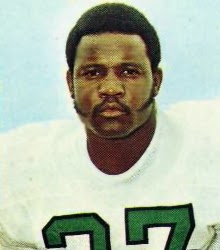
For the Eagles, Roman Gabriel was successful on 23 of 32 throws for 201 yards and no TDs but also no interceptions. Po James ran for 78 yards on 11 carries that included a score and also had 6 catches for 25 yards. Charle Young (pictured at right) caught 6 passes also, for 86 yards, and had the 17-yard touchdown carry and Harold Carmichael contributed 6 receptions for 52 yards.

The Vikings reached 9-0 before finally dropping a game and ended up on top of the NFC Central with a 12-2 record. They won the NFC Championship but were handily beaten by Miami in the Super Bowl. Philadelphia won its next two games and continued to provide exciting offense and mediocre defense on the way to a 5-8-1 tally and third place finish in the NFC East.

John Gilliam went on to a Pro Bowl season as he caught 42 passes for 907 yards (21.6 avg.) and scored eight touchdowns. Fran Tarkenton remained efficient throwing the ball, completing 61.7 percent of his passes and compiling a career-high 93.2 rating while giving up only seven interceptions.

Roman Gabriel led the league in pass attempts (460), completions (270), yards (3219), and TD passes (23, tied with Roger Staubach of the Cowboys) and was selected to the Pro Bowl. Harold Carmichael topped the NFL in both pass receptions (67) and yards (1116) and Charle Young received Rookie of the Year recognition for his 55 catches and 854 yards. Both receivers were Pro Bowl choices and received All-NFL recognition, with Young a consensus first-team honoree.

March 26, 2012

1953: Browns and Colts Conclude 15-Player Trade


On March 26, 1953 the Baltimore Colts and Cleveland Browns completed one of the largest trades in NFL history. It involved 15 players, most of whom were reserves or newly-drafted rookies. Cleveland was one of the league’s best teams, having appeared in its seventh straight league title game in 1952 including a string of four consecutive All-America Football Conference championships and a NFL title in 1950. The Colts were returning to the NFL after the original team of that name (also previously in the AAFC) folded following the ’50 season - they were replacing the failed Dallas Texans franchise of 1952, which in turn had taken the place of the New York Bulldogs/Yanks of 1949-51, and thus there were players passed along from both of those clubs involved in the transaction.

Of the 15 players involved, 10 were sent by the Browns to Baltimore and included:

QB Harry Agganis, first-round draft choice in 1952 out of Boston University who had not played for the Browns while pursuing a baseball career; S Bert Rechichar (pictured above), Cleveland’s other first-round pick in ’52 out of Tennessee who intercepted six passes as a rookie; HB Don Shula (pictured below), ninth-round pick in 1951 from John Carroll, who intercepted four passes in his first year and went into the military; HB Carl Taseff, 22nd-round draft choice in ’51, also out of John Carroll and just out of the military - he ran the ball 13 times for 49 yards as a rookie on offense; G Ed Sharkey, a veteran of three AAFC seasons and two in the NFL, the most recent with the Browns; G Elmer Wilhoite, 12th-round draft choice out of USC in 1953; E Art Spinney, from Boston College who played for the original Colts in 1950 and spent two years in the military; E Gern Nagler, 14th-round draft choice from Santa Clara in ’53; T Stu Sheets, co-captain at Penn State and 17th-round pick in 1952; and T Dick Batten, 18th-round choice out of College of the Pacific for 1953.


The Colts, building upon the carcass of the Texans franchise and desperate for new talent, gave up five players:

C Tom Catlin, All-American from Oklahoma drafted in the fourth-round for 1953; DT Don Colo, a three-year pro who had been with the original Colts in 1950 and moved on to the Yanks and Texans; OT Mike McCormack, third-round draft choice in 1951 by the Yanks who had played one season for them; HB John Petitbon, formerly of Notre Dame and taken by the Yanks/Texans in the seventh round for 1952, intercepting five passes in his first year; and G Herschel Forester, an eighth-round draft choice out of SMU in 1952 who was in the military.

Head Coach Paul Brown of Cleveland was especially annoyed with players who had indicated that they would play pro football only if they first failed to make it as baseball players. He said of Agganis, a star quarterback at Boston University, that, “we are not waiting to see whether or not (he) makes a baseball team. We prefer to make our plans now and can afford to do so since we do not have a quarterback problem.”

Agganis, known as “The Golden Greek”, chose to sign with baseball’s Boston Red Sox for a reported $35,000 and was forbidden to play football. Colts Coach Keith Molesworth, needing a quarterback, hoped he could be persuaded to change his mind and Agganis was a key player in the deal for Baltimore. “The Golden Greek” stuck with baseball, however, and showed the potential to become a star at the major league level. Tragically, Agganis died of a pulmonary embolism at age 26 in 1955.

Molesworth (and his successor, Weeb Ewbank) had better outcomes with some of the other players. Rechichar, Shula, and Taseff all moved into the starting lineup in the defensive backfield while Spinney started at defensive end before being shifted to guard on offense. Of that group, Rechichar had the biggest immediate impact, garnering second-team All-Pro honors in ’53 and eventually being selected to three Pro Bowls. While he was at it, he booted a league-record 56-yard field goal in the 1953 opening-game win over the Bears.

Rechichar was with the Colts, but past his prime, when they won back-to-back NFL titles in 1958 and ’59. Taseff and Spinney were still in the starting lineup, however. Shula was gone by then, but would gain far greater fame as a head coach (starting with Baltimore).

Of the others, Sharkey played one year for the Colts as a reserve before moving on to Philadelphia in 1954. None of the remaining players involved saw action with the team, although Nagler was with the Chicago Cardinals for five seasons and Pittsburgh for one before ending up back in Cleveland as a tight end.

For Cleveland’s part, Paul Brown was concentrating on strengthening his team at tackle and linebacker. While McCormack and Forester were in military service and would not be available until after 1953, Brown saw them as an investment in the future. Colo was expected to contribute right away, especially with DT Bob Gain leaving for the military, and he did, moving into the starting lineup in ’53 and staying there until 1958 while achieving selection to the Pro Bowl three times during that period.


McCormack (pictured at right) joined the club in ’54, started as a middle guard on defense that year, and then moved to right offensive tackle, where he remained a fixture for eight seasons. He garnered first- or second-team All-Pro honors in every one of those years and went to six Pro Bowls. The lineman that Paul Brown acquired as a future consideration was inducted into the Pro Football Hall of Fame in 1984. Forester, while far less accomplished, put in four seasons with the Browns.

Catlin played at linebacker in Cleveland and also stayed for four years before moving on to the Eagles. Of the five players the Browns received, Petitbon contributed the least, playing one year at safety in 1955 after spending time in the service.

Overall, the huge trade garnered benefits for both teams. Cleveland, filling in some holes on an already-sound club, topped the Eastern Conference in ’53 and added NFL titles in 1954 and ’55 (and regularly contended well beyond). The Colts, looking to build for the future, didn’t become a winner right away (they were 3-9 in 1953), but methodically developed into a championship team by the last two years of the decade.

September 23, 2011

1974: Defense & Dempsey Key Eagles Upset of Cowboys


The Monday Night Football game on September 23, 1974 featured two NFC East rivals, the Dallas Cowboys against the Philadelphia Eagles. The Cowboys, under Head Coach Tom Landry, had been the far more successful of the two clubs, having been to the postseason in each of the preceding eight seasons. They were coming off of a 10-4 record in ’73 and had won their season-opening game over the Falcons handily by a score of 24-0. Moreover, they had won 12 of the last 13 matchups with the Eagles dating back to 1967.

Philadelphia, meanwhile, was once again in rebuilding mode under second-year Head Coach Mike McCormack. The Eagles had been over .500 just twice since last winning a league championship in 1960 and were on their fifth head coach since that time. McCormack replaced Ed Khayat after a dreadful 2-11-1 season in 1972 in which the team produced a total of just 145 points and 12 touchdowns. A major deal was swung to bring veteran QB Roman Gabriel from the Rams, and the offense improved significantly in ’73, although the overall record was still only 5-8-1. For 1974, another major trade was made to upgrade the defense as Philadelphia obtained star MLB Bill Bergey from Cincinnati. In the Week 1 game at St. Louis against the Cardinals, the Eagles gave up just seven points – but scored only three.

There were 64,088 fans at Philadelphia’s Veterans Stadium, and for most of the game they saw both offenses struggle. The Eagles couldn’t move the ball, but star QB Roger Staubach of the Cowboys missed on his first six pass attempts.

However, in the second quarter, Dallas put together a 90-yard drive with three Staubach completions along the way and RB Doug Dennison scored from three yards out. That was it for the first half scoring as the Cowboys led by 7-0 at halftime.

In the third quarter, Dallas was driving deep into Eagles territory again after a Gabriel pass was intercepted by CB Charlie Waters. Once more at the three yard line Dennison took the handoff, but this time he fumbled when hit by Bergey just short of the goal line. CB Joe “Big Bird” Lavender picked the loose ball up on the bounce and ran 96 yards up the sideline for a touchdown. Instead of the Cowboys being ahead by two touchdowns, in stunning fashion the score was tied at 7-7.


Such was the situation as the game entered the fourth quarter. A poor 26-yard punt by the Cowboys gave Philadelphia good field position, and with just under 12 minutes to play, Tom Dempsey gave the Eagles the lead with a 34-yard field goal.

On the ensuing kickoff, Dallas RB Dennis Morgan returned the kick 36 yards and might have broken free but was tackled by the 265-pound Dempsey, who had played defensive end in junior college. As it was, with 8:34 left, Mac Percival kicked a 26-yard field goal to again tie the score at 10-10.

Coach McCormack considered replacing the ineffective Roman Gabriel with backup John Reaves, as the 34-year-old veteran had completed only four passes and the offense had just one first down. Leaving the ex-Ram in, Gabriel proceeded to throw to RB Po James for a 34-yard gain and WR Harold Carmichael for 13. He gained six yards on a quarterback draw, giving Philadelphia three first downs in the series. However, with the clock down to 3:13, RB Tom Sullivan fumbled and Dallas LB Dave Edwards recovered at his own 11.

Three plays later, the Eagles got the ball back when SS Randy Logan intercepted a Staubach pass intended for WR Drew Pearson at the sideline with 1:49 left. Typical of how most of the game had gone for the Eagles offense, they ran the ball twice for negligible yardage and Gabriel threw an incompletion, necessitating a 45-yard field goal attempt.

Dempsey was again successful and his kick put Philadelphia in front with 25 seconds to play. However, the Cowboys still had a shot and drove from their 18 to the Philadelphia 31 thanks to two Staubach passes to Pearson. But with two seconds left on the clock, Percival missed a 48-yard field goal attempt into the wind that fell short and to the left. The Eagles came away with a hard-fought 13-10 upset win.

Dallas dominated statistically, outgaining Philadelphia (385 yards to 165) and accumulating far more first downs (20 to 5). The Cowboys both outran the Eagles (168 yards to 98) and outpassed them (217 yards to 67) while both teams turned the ball over three times.

Roman Gabriel completed only 6 of 14 passes for 92 yards with one intercepted. Tom Sullivan was the leading rusher with 57 yards on 16 carries and Harold Carmichael the top receiver with two catches for 45 yards. Tom Dempsey, with the two clutch field goals, and Bill Bergey, who was credited with 18 tackles, were the stars of the game, along with Joe Lavender and his team-record fumble return (a record that lasted until 2006).

For the Cowboys, Roger Staubach was successful on 19 of 33 passes for 217 yards, but none were good for scores while two were intercepted. Drew Pearson was the primary offensive weapon as he caught 10 passes for 161 yards. RB Robert Newhouse rushed for 97 yards on 22 attempts.

“The defense and Tom Dempsey won the game,” said Coach McCormack afterward. Each member of the defense and Dempsey received game balls.

The big concern for the Eagles was that, for the second straight week, the offense had not gotten the ball into the end zone. Still, they got off to a 4-1 start before losing six straight games (starting with a 31-24 defeat at the hands of the Cowboys in Dallas). They won their last three (with rookie Mike Boryla starting at quarterback for the benched Gabriel) to salvage a 7-7 record that put them in fourth place in the NFC East.

Dallas went on to have an off-year, losing their next three games before recovering to win 7 of the last 9. The Cowboys finished third in the division with an 8-6 tally and missed the postseason for the first time since 1965.

With his job reportedly on the line coming into the Monday night game against Dallas, Tom Dempsey’s two field goals earned him a reprieve and he finished out the season (the first since 1932 in which the goal posts were at the back of the end zone rather than the goal line) with 10 field goals in 16 attempts. The hefty placekicker born without toes on his right foot, and who had booted a record 63-yard field goal for the Saints in 1970 before coming over to the Eagles in ’71, had been the team’s player representative during the ’74 preseason strike and acrimony had risen between him and owner Leonard Tose. He was traded to the Rams after the season.

Bill Bergey’s dominating performance against the Cowboys was the first of many and he had an outstanding year, garnering consensus first-team All-Pro honors for the first of two consecutive seasons. He was also selected to the Pro Bowl, an honor he would achieve four times while with the Eagles. The leader of the defense (as well as its best player) inspired chants of “Ber-gey, Ber-gey” from the Philadelphia fans that would become a regular feature of games at the Vet during his heyday. (Bergey pictured below)