Showing posts with label John Gilliam. Show all posts

December 22, 2015

1973: Vikings Defeat Redskins in NFC Divisional Playoff Game


The NFC Divisional Playoff game on December 22, 1973 featured the Minnesota Vikings, first place finishers in the NFC Central at 12-2, hosting the Washington Redskins, who placed second in the NFC East with a 10-4 record and qualified for the postseason as a Wild Card entry.

The Vikings were in their seventh season under Head Coach Bud Grant and back in the postseason after a one-year hiatus in 1972. Prior to that they had won four straight division titles, but lost their last two Divisional round games. QB Fran Tarkenton (pictured above), an original Viking, returned to the club in ’72 and was making his first postseason appearance in his 13th year as a pro. Tarkenton was talented and known for his scrambling style, but still had something to prove to critics who questioned his ability to come up a winner in big games. WR John Gilliam was a fine receiver and the addition of rookie FB Chuck Foreman helped both the running and passing attack. The tough defense remained the key to the team’s success, in particular the line with ends Carl Eller and Jim Marshall and tackles Alan Page and Gary Larsen.

The Redskins, coached by George Allen, were the defending NFC Champions and still a very strong, veteran-laden club. Gritty QB Bill Kilmer directed an offense that included the running of HB Larry Brown and a strong receiving corps with wide receivers Charley Taylor and Roy Jefferson and TE Jerry Smith. The defense was strong and adept at pressuring opposing quarterbacks. While Washington was also known for the quality of its special teams play, PK Curt Knight caused concern with his erratic tendencies. In addition, Kilmer had been hospitalized during the previous week due to a stomach disorder.

There were 45,475 fans in attendance at Metropolitan Stadium on a day with temperatures in the twenties and a seven mph wind. The field had been cleared of snow and dyed green to hide the wear. Minnesota came out throwing, but a Fran Tarkenton bomb to an open John Gilliam just grazed the receiver’s finger tips, which was the closest the Vikings came to pulling off a big play in the early going. The Redskins missed a scoring opportunity in the first quarter when they drove from their 14 into Minnesota territory but Curt Knight failed on a 17-yard field goal attempt.

Later in the period, Knight again missed a field goal attempt, coming up short from 49 yards. The Vikings were stymied on offense and didn’t register a first down until two minutes into the second quarter, but they finally came up with a big play when Tarkenton completed a pass to HB Oscar Reed for a gain of 50 yards and that set up a 19-yard field goal by Fred Cox.


With 3:30 remaining in the first half, the Redskins got a break when CB Bobby Bryant fumbled a punt and HB Bob Brunet recovered for Washington at the Minnesota 21. Three plays later, which included a pass from Bill Kilmer to Charley Taylor for 17 yards, Larry Brown (pictured at left) ran for a three-yard touchdown. Knight added the extra point for a 7-3 lead.

The Vikings advanced into field goal position as Tarkenton completed passes to WR Carroll Dale and Chuck Foreman, but an interception inside the ten yard line snuffed out the threat and the score remained unchanged at the half.

During halftime, Minnesota DE Carl Eller delivered an emotional speech to his teammates, who had played without apparent emotion during the first half, saying that they had come “too damn far” and were “embarrassing ourselves”. To accent the point, he proceeded to break apart the team’s blackboard. The tirade made an impression and the Vikings showed more fire in the second half.

Early in the third quarter, Reed, taking advantage of the defense’s keying on Chuck Foreman, broke six tackles on a 46-yard carry that set up a two-yard TD run by FB Bill Brown. Cox added the point after and the home team was ahead by 10-7.

Meanwhile, the Redskins were now without CB Pat Fischer, who suffered cracked ribs in the second quarter and was unable to continue. He was replaced by DB Speedy Duncan, also experienced but typically a kick returner who was more comfortable at safety.

Washington managed to tie the score before the period was over with Curt Knight’s 52-yard field goal that matched the then-league playoff record. Knight kicked another field goal, from 42 yards, on the first play of the fourth quarter, and the visitors held a 13-10 edge.

The Vikings proceeded to advance 71 yards in eight plays concluding with a Tarkenton pass to Gilliam, who beat Duncan for a 28-yard touchdown. Cox converted and Minnesota was back in the lead by 17-13. On Washington’s next offensive play, CB Nate Wright intercepted a Kilmer pass and returned it 26 yards to the Redskins’ eight. Two plays later, it was Tarkenton to Gilliam again for a TD, this time from six yards out and after the nimble quarterback scrambled out of trouble, running to his left and then right before finding the receiver open in the right corner of the end zone. Cox added the point after and, in the space of 1:05, the Vikings had scored twice to take a 24-13 lead.

The Redskins managed to get on the board again following DB Ken Stone’s block of a Mike Eischeid punt. Kilmer passed to WR Roy Jefferson for a 28-yard touchdown with 5:28 left to play and Knight converted to close the margin to four points.

The Vikings were able to use up four minutes on a series that concluded with Cox kicking a 30-yard field goal. Washington fought back in the remaining time as Kilmer completed three passes, but the drive came to an end at the Minnesota 42 on a fourth down incompletion. Minnesota won by a final score of 27-20.

The statistics were fairly even. The Vikings led in total yards (359 to 314) while Washington had the edge in first downs (18 to 17). Each team turned the ball over twice. The game was almost penalty-free, with Minnesota drawing the only two flags at a minimal cost of nine yards.

Fran Tarkenton completed 16 of 28 passes for 222 yards with two touchdowns and one interception, and was at his best as the Vikings took command in the second half, when he hit on eight of ten throws and both TDs. John Gilliam had just two catches for 36 yards, but they accounted for both touchdowns. Oscar Reed (pictured below) rushed for 95 yards on 17 carries and caught 5 passes for 76 more yards. Chuck Foreman contributed 40 yards on 11 attempts and had three pass receptions for 23 yards.


For the Redskins, Bill Kilmer was successful on 13 of 24 throws for 159 yards and a TD along with an interception. Larry Brown, who was playing with injured ribs, gained 115 yards on 29 rushing attempts and scored a touchdown. Roy Jefferson caught 6 passes for 84 yards and a TD and Charley Taylor contributed four receptions for 56 yards.

“Sometimes they’re not concentrating on me,” explained Oscar Reed, who received a game ball for his performance. “Since early in the season they’ve been keying on Chuck Foreman. I’m not the world’s greatest pass catcher or runner, but given a little room, I’ll use what I’ve got.”

The Vikings went on to defeat Dallas for the NFC Championship before losing to Miami in the Super Bowl. Washington came back in 1974 to again go 10-4 and reach the playoffs as a Wild Card. The Redskins lost in the Divisional round, this time to the Rams.

April 26, 2015

1972: Vikings Obtain Gilliam & Draft Picks from Cards for Cuozzo


On April 26, 1972 the Minnesota Vikings traded discontented QB Gary Cuozzo to the St. Louis Cardinals for WR John Gilliam and two draft choices, which were second and fourth picks for 1973.

The 31-year-old Cuozzo had played out his option and was due to become a free agent on May 1 and had demanded a trade. After being the primary starter in 1970, he had split time with Norm Snead, who was obtained from Philadelphia with the hope that he might supplant Cuozzo, and Bob Lee in ’71. While Snead was traded to the Giants three months earlier, it was as part of the deal that brought QB Fran Tarkenton back to Minnesota – a clear indication that Cuozzo was not part of the team’s plans.

Undrafted out of Virginia in 1963, Cuozzo had originally been a backup to Johnny Unitas for four seasons with the Colts. While he didn’t see much action, he had a five-touchdown passing performance against the Vikings in 1965 that drew a great deal of favorable attention and the New Orleans Saints traded a first-round draft pick for him in ’67. Cuozzo was unable to hold onto the starting job with the first-year team and was dealt to Minnesota the following year, this time for two first-round picks. He couldn’t unseat starting QB Joe Kapp, finally taking over when the fiery Kapp left the club after the 1969 season. Smart (he was Phi Beta Kappa in college) and an accurate passer, he lacked arm strength and was not nearly the leader that his predecessor in Minnesota was.  Overall with the Vikings, Cuozzo completed 49.6 percent of his passes for 3552 yards and 18 touchdowns, giving up 23 interceptions. And while the club was 16-5 during his regular season starts, it had not been able to win in the postseason.

Head Coach Bob Hollway of the Cardinals indicated that Cuozzo would be the starting quarterback, ahead of Jim Hart and Pete Beathard, who both had trouble with consistency. St. Louis was coming off of a 4-9-1 record in 1971, which marked a big drop from the previous year, and quarterback was an area of concern.

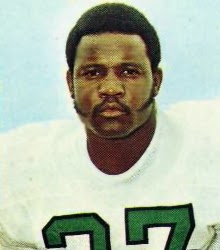
John Gilliam (pictured at top) was 26 and was a teammate of Cuozzo’s with the Saints in 1967, who had drafted him in the second round. He scored the first regular season touchdown in franchise history on the opening kickoff of the ’67 season, but the remainder of his tenure with the club was unremarkable and he was obtained by the Cards in 1969. With his great speed in a better offense, he broke out in St. Louis, catching 52 passes for 997 yards (19.2 avg.) and nine TDs in his first year with the club. Gilliam followed up with 45 receptions for 952 yards (21.1 avg.) and five touchdowns in ’70 and was coming off of a 1971 season with 42 catches for 837 yards (19.9 avg.). He led the team in receiving yards in each of his three seasons and in receptions in the last two. With WR Bob Grim having been traded to the Giants along with Snead, a spot was open in the Minnesota lineup for Gilliam.


Cuozzo (pictured above) proved to not be the answer in St. Louis. He started six games, only one of which resulted in a win for the Cards, while splitting time with Hart and unheralded Tim Van Galder (Pete Beathard was traded to the Rams during the preseason). He completed just 43.7 percent of his passes for 897 yards and five touchdowns while giving up 11 interceptions. It marked the end of the line for his pro career as he retired to practice dentistry.

Gilliam had much more success in Minnesota. He caught 47 passes for 1035 yards (22.0 avg.) and seven touchdowns and earned the first of four straight Pro Bowl selections, matching his number of seasons with the Vikings (he jumped to the Chicago Winds of the WFL in 1975, but when the team folded at the end of August after five games he returned to Minnesota in time for the regular season). He had a total of 165 catches for 3297 yards (20.0 avg.) and 27 TDs for the Vikings and added another 14 receptions for 261 yards (18.6 avg.) and five scores in the postseason. Gilliam moved on to the Atlanta Falcons in ’76, where his production dropped off significantly in his next-to-last year.

The 1973 second round draft choice that Minnesota also obtained was used to take Jackie Wallace, a defensive back from Arizona, while the fourth round pick was passed on to Kansas City (who used it to take Emporia State DE John Lohmeyer). Wallace started at cornerback in place of the injured Bobby Bryant and also returned kicks before moving on to the Colts, who shifted him to safety for two years, and eventually the Rams, where he led the league with 52 punt returns for 618 yards in 1978.

October 21, 2014

1973: Vikings Sink Feisty Eagles as Gilliam Stars


The Minnesota Vikings were undefeated at 5-0 as they hosted the Philadelphia Eagles on October 21, 1973. Head Coach Bud Grant’s team had not allowed more than 16 points in any game thus far, but while best known for strong defense, the Vikings were a formidable team on offense as well. 33-year-old QB Fran Tarkenton was an outstanding and mobile passer, rookie FB Chuck Foreman was potent as both a runner and receiver out of the backfield, and WR John Gilliam (pictured at right) provided speed on the outside. The line was solid.

Philadelphia, under first-year Head Coach Mike McCormack, was 1-4-1 and a seventeen-point underdog. Coming off of a dreadful last-place finish the year before, the Eagles were rebuilding with an offense led by QB Roman Gabriel, a 12th-year veteran who had been obtained at heavy price from the Rams during the offseason. 6’8” WR Harold Carmichael was having a breakout season and rookie TE Charle Young further bolstered the passing game. The problem was with a thin defense in need of fortification on the line and at linebacker.

It was a clear day at Metropolitan Stadium with 47,478 fans in attendance. The Eagles got the first break when Chuck Foreman fumbled at the end of a 16-yard run and DE Will Wynn recovered at the Minnesota 41. However, they weren’t able to gain much ground and Tom Dempsey’s field goal attempt from 44 yards was wide to the right.

The Vikings responded with an 80-yard drive in six plays. Fran Tarkenton ran twice for 19 yards and John Gilliam ran for 44 yards and a touchdown on a well-executed double-reverse. Fred Cox added the extra point for the early 7-0 lead.

The teams traded punts, each stopping just short of midfield. A Philadelphia series was then blunted when Harold Carmichael’s gain on a pass into the flat was nullified by a hurdling penalty as the rangy wide receiver leaped over CB Nate Wright. Following a punt, Minnesota moved methodically into Eagles territory on a series that extended into the second quarter. Tarkenton completed four short passes, with a 10-yard completion to WR Carroll Dale gaining the necessary yardage to convert a third down, and also scrambled for a 12-yard gain in a second-and-nine situation. But after reaching the Philadelphia 24, Cox’s field goal try from 31 yards was blocked by CB Joe Lavender.

Another short series led to a punt by the Eagles, and the Vikings didn’t come up empty this time, advancing 65 yards in seven plays. In a third-and-seven situation, Tarkenton threw twice to Gilliam for 14 and 42 yards to the Philadelphia six. Three plays later, HB Oscar Reed leaped into the end zone from a yard out and, with Cox’s conversion, Minnesota was up by 14-0.

Regaining possession with four minutes remaining in the first half, the Eagles put together a 10-play, 80-yard drive. HB Po James (pictured below) started off with a 17-yard carry up the middle and Gabriel completed five passes along the way. In a fourth-and-one situation at the Philadelphia 46, HB Tom Sullivan ran for four yards. A holding penalty nullified an apparent long scoring toss to Carmichael, but following a nine-yard gain by James on a draw play, Gabriel threw to Charle Young for 20 yards, to James for 12, and to Carmichael for 11. James ran the last 12 yards for a TD and, and with Dempsey adding the PAT, the home team’s lead was halved to 14-7. There was still 1:03 left in the period as the Vikings regained possession, but Cox was short on a field goal attempt from 53 yards and time ran out on the Eagles at their 31.


Philadelphia had first possession in the third quarter but had to punt, and the short kick by Tom McNeill gave the Vikings the ball at their own 43. They went 57 yards in eight plays, the last a Tarkenton pass to a wide-open Gilliam for a 24-yard touchdown. Cox kicked the extra point to make it a 21-7 game.

The Eagles responded with a 14-play, 76-yard scoring drive of their own. Gabriel, with his first of six completions during the series, threw to Young for a 24-yard gain.  Four of his passes, in fact, were to the rookie tight end, the last for 12 yards to the Minnesota three, and two plays later FB Lee Bouggess ran for a two-yard TD. Dempsey’s conversion again made it a seven-point margin.


In a series that moved into the fourth quarter, the Vikings came back with a 69-yard drive that took 13 plays. Tarkenton (pictured at left) had completions to TE Stu Voigt for 15 and 13 yards and Foreman outraced Lavender and FS Bill Bradley to the goal line for a five-yard touchdown. Cox again made it a 14-point game with the extra point.

The teams exchanged punts before the Eagles put together a nine-play, 78-yard series. Gabriel threw to WR Don Zimmerman for 14 yards and to Carmichael for 19 in a third-and-10 situation and James had runs of 22 and seven yards. From the Minnesota 17, Young took a handoff on an end-around play and plowed over three defenders on the way to a TD. Dempsey initially failed to convert, but an offside penalty on the Vikings gave him a second chance that he made good on.

The determined Eagles had again closed to seven points and there were four minutes remaining to play, but they never got the ball again as Minnesota was able to run out the clock, helped by Tarkenton’s 16-yard scramble that converted a third-and-nine situation. The final score was 28-21.

The Vikings led in total yards (409 to 315) and first downs (25 to 19), with Minnesota’s total showing offensive balance – 217 on the ground and 192 net yards through the air. The Vikings suffered the game’s only turnover and managed to record two sacks, to one by Philadelphia.

John Gilliam caught 6 passes for 116 yards and a touchdown and added another TD on his 44-yard run. Fran Tarkenton completed 16 of 21 passes for 202 yards and a touchdown with no interceptions and also ran for 49 yards on 9 carries. Chuck Foreman topped the Vikings with 68 rushing yards on 21 attempts that included a TD.


For the Eagles, Roman Gabriel was successful on 23 of 32 throws for 201 yards and no TDs but also no interceptions. Po James ran for 78 yards on 11 carries that included a score and also had 6 catches for 25 yards. Charle Young (pictured at right) caught 6 passes also, for 86 yards, and had the 17-yard touchdown carry and Harold Carmichael contributed 6 receptions for 52 yards.

The Vikings reached 9-0 before finally dropping a game and ended up on top of the NFC Central with a 12-2 record. They won the NFC Championship but were handily beaten by Miami in the Super Bowl. Philadelphia won its next two games and continued to provide exciting offense and mediocre defense on the way to a 5-8-1 tally and third place finish in the NFC East.

John Gilliam went on to a Pro Bowl season as he caught 42 passes for 907 yards (21.6 avg.) and scored eight touchdowns. Fran Tarkenton remained efficient throwing the ball, completing 61.7 percent of his passes and compiling a career-high 93.2 rating while giving up only seven interceptions.

Roman Gabriel led the league in pass attempts (460), completions (270), yards (3219), and TD passes (23, tied with Roger Staubach of the Cowboys) and was selected to the Pro Bowl. Harold Carmichael topped the NFL in both pass receptions (67) and yards (1116) and Charle Young received Rookie of the Year recognition for his 55 catches and 854 yards. Both receivers were Pro Bowl choices and received All-NFL recognition, with Young a consensus first-team honoree.