Showing posts with label Bill Walsh. Show all posts

August 16, 2016

1976: Cards Beat Chargers in Preseason Game in Tokyo


It was a National Football League first on August 16, 1976 when the San Diego Chargers and St. Louis Cardinals met for a preseason game in Tokyo, Japan. While NFL contests had been played in Canada, never before had one occurred outside of North America.

The game was referred to as the Mainichi Star Bowl since it was jointly sponsored by the Mainichi Newspaper Company and the Sports Nippon Newspaper Company as part of the United States Bicentennial celebration.

There were 38,000 fans in attendance in a misty rain at the Korakuen Stadium, normally used for baseball. The crowd was mostly Japanese with some Americans for the Monday night contest and the atmosphere was festive. Fans were enthusiastic and occasionally engaged in chants during the contest, such as “Chargers, Chargers, Banzai! Banzai!” and “Cardinals, attack the ball!”

Many citizens of the city of Suwa in central Japan, which had engaged in several cultural exchanges with St. Louis, were at the game, led by Mayor Setsuji Iwamoto. Four firemen played Japanese army assault marches on their bugles while another citizen of the city banged on a drum.

“They are such nice people, and they respond very quickly to our action,” said Lori West, a University of Missouri student and cheerleader for the Cardinals.

As for the participants on the field, it was the third preseason game for each club. The Cardinals, coached by Don Coryell for the fourth year, were coming off of consecutive NFC East titles and had been 11-3 in 1975. San Diego was a less successful club under the direction of Head Coach Tommy Prothro and posted a 2-12 record the previous year, its sixth straight losing season. In a rebuilding mode, the Chargers hired Bill Walsh away from Cincinnati to be offensive coordinator and especially to provide guidance for young QB Dan Fouts.

Neither team generated much of a ground attack in the early going. In the first quarter, Jim Bakken kicked a 30-yard field goal for the Cards and, in the second quarter, St. Louis again moved into scoring position thanks to a nine-yard carry by HB Jerry Latin and a run by HB Wayne Morris that picked up five for a first down at the San Diego 15. From there, QB Bill Donckers threw a touchdown pass to WR Pat Tilley and Bakken converted to put the Cards up by 10-0. San Diego finally got on the board with four seconds left in the first half as Sergio Albert booted a 30-yard field goal.

In the third quarter, a bad punt by a heavily-rushed Terry Joyce of the Cards, kicking from his own end zone, gave the Chargers possession at the St. Louis 28. Dan Fouts tossed a four-yard completion to WR Charlie Joiner before throwing a 23-yard TD pass to WR Dwight McDonald and Albert added the extra point that tied the contest at 10-10.

The Cardinals came right back as Jim Hart went long to WR Ike Harris in a play that covered 52 yards for a touchdown. Bakken closed out the scoring with a 10-yard field goal in the fourth quarter and St. Louis won by a final tally of 20-10.

The game was pass-heavy, with the Cards running 41 times for 105 yards and San Diego gaining just 34 yards on 19 attempts. St. Louis had 20 first downs to 12 for the Chargers.

Bill Donckers and Jim Hart both threw 14 passes apiece for the Cardinals, with Donckers, the backup, completing 10 for 94 yards and a touchdown and Hart 9 for 111 yards and a TD. Neither was intercepted. Wayne Morris gained 49 yards on 14 carries and Pat Tilley caught 4 passes for 54 yards.

For the Chargers, Dan Fouts completed just 4 of 10 passes for 70 yards while backup Jesse Freitas was successful on 9 of 20 for 85 yards and was intercepted once. FB Jim Harrison had 28 yards on 6 carries to pace the club in rushing. Dwight McDonald caught two passes for 44 yards and a TD.

In the regular season, St. Louis put together a 10-4 record but just missed the playoffs this time, ending up third in the NFC East. The Chargers improved to 6-8 and third in the AFC West.

As a side note, Bill Walsh stayed for a year with the Chargers before departing for Stanford, and Dan Fouts, who showed much improvement under Walsh’s guidance, would go on to Hall of Fame success after Don Coryell left the Cards and came to San Diego to replace Tommy Prothro.

As for the NFL playing outside of North America, the next overseas preseason game occurred in London, UK in 1983, and London would become a regular host to preseason and, eventually, regular season contests. The NFL would also return to Tokyo, but not until 1989, and for preseason games only.

September 14, 2014

1980: Hofer Stars as 49ers Defeat Cards in Overtime


The San Francisco 49ers, fresh off an opening week victory to start the 1980 NFL season, hosted the St. Louis Cardinals on September 14 in Week 2. The 49ers were coming off consecutive 2-14 records in 1978 and ’79 and were in their second season under Head Coach Bill Walsh. QB Steve DeBerg had set league records for pass attempts and completions in Walsh’s innovative system and had a fine, if injury-prone, HB Paul Hofer (pictured above) to hand off and pass to as well as rookie FB Earl Cooper. DeBerg’s passing statistics were heavily skewed by his tendency to dump off short passes to his backs rather than throw downfield and, in the Week 1 win over the Saints, 17 of DeBerg’s 21 completions were to Hofer and Cooper.

The Cardinals had been 5-11 in 1979 and surrendered 41 points in losing to the Giants in their opener. Jim Hanifan was the new head coach but 36-year-old QB Jim Hart had been a familiar face in St. Louis since first taking over the starting job in 1967. RB Ottis Anderson was outstanding as a rookie in ’79, rushing for 1605 yards, and WR Pat Tilley a quality possession receiver. The defense was a work in progress and had most notably added rookie DE Curtis Greer, the team’s first draft choice.

There were 49,999 fans in attendance at Candlestick Park. Starting off at their 45 after a 37-yard return of the opening kickoff by DB Roy Green, the Cardinals drove to the San Francisco 17. Jim Hart completed three passes, including one to WR Mark Bell for 15 yards in a third-and-14 situation, but they came up empty when Steve Little’s 35-yard field goal attempt was wide to the right.

St. Louis got the ball back a few plays later when CB Tim Collier intercepted a bomb by Steve DeBerg at the goal line. Hart completed consecutive passes to TE Doug Marsh that totaled 42 yards, but after again advancing into San Francisco territory, the Cards were forced to punt.

Neither team could reach scoring territory until the 49ers put together a six-play, 56-yard series in the second quarter. DeBerg, who was suffering from laryngitis and using an electronic voice amplifier so his teammates could hear him, completed two passes to Earl Cooper, the longest covering 19 yards, and the drive was capped by a throw to Paul Hofer for a 19-yard touchdown. Ray Wersching added the extra point to make the score 7-0.

On the Cards’ next play from scrimmage, Marsh fumbled after catching a pass and LB Bobby Leopold recovered for the 49ers, who returned it to the St. Louis 22. But the home team was unable to capitalize, having to settle for a Wersching field goal try from 34 yards that was partially blocked and missed the mark. The teams traded punts thereafter for the remainder of the half.

St. Louis got a break on the second half kickoff when WR Terry Anderson fumbled and FS Ken Stone recovered for the Cards at the San Francisco 22. Seven plays later, Hart threw to FB Theotis Brown for a 13-yard touchdown and, adding on Little’s extra point, the score was tied at 7-7.

The 49ers punted following a short series and the Cards drove to another score, this time taking 13 plays to cover 67 yards. Hart passed to Anderson for 17 yards on a third-and-five play, one of six completions along the way, with the last to Marsh for a five-yard touchdown. Little added the PAT and the visitors were ahead by 14-7.

San Francisco was on the move as the period came to a close. DeBerg tossed a pass to Hofer for a 23-yard gain and HB Lenvil Elliott ran around end for 19 yards to the St. Louis 22. On the second play of the fourth quarter, DeBerg connected with Cooper for a nine-yard TD and Wersching’s extra point again tied the score.

Now it was the Cards suffering a turnover on a kickoff, as HB Randy Love coughed up the ball when hit by LB Dan Bunz and DB Charles Cornelius recovered at the St. Louis 26. But the opportunity was missed when DeBerg threw for the goal line four plays later and was picked off by CB Roger Wehrli, who returned it 25 yards. The visitors made the most of the reprieve, advancing 75 yards in eight plays as Hart completed passes to WR Mel Gray for 29 yards and to Pat Tilley for 18. HB Willard Harrell ran for a five-yard touchdown that, adding Little’s conversion, put the Cards back in front at 21-14.

The 49ers fought back, with Cofer catching two straight passes from DeBerg, the second for 27 yards to the San Francisco 48. However, penalties set them back and then DeBerg again tossed an interception, this time by SS Ken Greene, who ran it back 26 yards to give St. Louis excellent field position at the San Francisco 25.

Faced with the prospect of falling behind even farther, the 49ers toughened on defense. Harrell was thrown for a two-yard loss and then lost another seven yards after catching a pass and being hit by LB Willie Harper. The teams exchanged punts until San Francisco, getting the ball back with 1:51 remaining in regulation, put together an 80-yard drive in eight plays. DeBerg completed five passes, the longest to WR Dwight Clark for 16 yards in a do-or-die, fourth-and-eight situation, and Hofer ran for a 26-yard touchdown. Wersching added the all-important extra point, and the game went into overtime tied at 21-21.

The Cardinals had the first possession in the extra period but went three-and-out and punted. Starting at their 32, the 49ers gained 15 yards on a DeBerg completion to Hofer and, following a short gain by Cooper, DeBerg threw to TE Eason Ransom for nine yards to advance into St. Louis territory at the 43. Hofer took off for an 18-yard run to get into scoring range and, four plays later and at 2:25 into overtime, Wersching kicked a 33-yard field goal to win the game for the 49ers by a score of 24-21.

San Francisco had the edge in total yards (392 to 342) although the Cardinals generated more first downs (21 to 19). St. Louis was held to 86 yards on 36 running plays, while gaining 256 net passing yards, while the 49ers had 132 yards on the ground and 260 through the air. Both teams turned the ball over four times apiece.

Paul Hofer had an outstanding all-purpose day, rushing for 89 yards and a touchdown on 14 carries and catching 9 passes for 135 yards and another TD, a total of 224 yards from scrimmage. Steve DeBerg completed 25 of 42 throws for 266 yards and two touchdowns, but also gave up three interceptions, and as usual only five completions were to wide receivers. Earl Cooper also had 9 pass receptions, for 51 yards and a score, while running for 13 yards in 8 attempts.


For the Cardinals, Jim Hart completed 28 of 38 passes for 265 yards and two TDs while being picked off once. Doug Marsh (pictured at right) topped the receivers with 7 catches for 90 yards and a touchdown. Ottis Anderson, who was knocked out of the game in the fourth quarter, was held to 59 yards on 20 carries.

With two wins in the first two games, the 49ers equaled their total of the previous season, and they reached 3-0 before losing eight straight games. They rallied to finish at 6-10 for third place in the NFC West, and by that point Steve DeBerg had been supplanted by second-year QB Joe Montana. The stage was nearly set for Bill Walsh’s rebuilding project to yield a NFL title in 1981. The Cardinals reached 0-3 before winning their next two games, but, with the defense beset by injuries, they ended up at 5-11 and fourth in the NFC East.

“Paul Hofer to me is one of the great players in the league today,” said Coach Bill Walsh following Hofer’s outstanding effort against the Cardinals. “I don’t understand why people don’t recognize him as such.”

Hofer continued to be productive until a knee injury ended his season in the sixth week. He rushed for 293 yards, averaging 4.9 yards per carry, and had 41 catches for 467 yards (11.3 avg.) and totaled three touchdowns. Hofer returned for 1981, but would be placed on injured reserve long before the postseason run in what was the final year of his promising but injury-filled career. Earl Cooper led the 49ers in both rushing and pass receiving as a rookie, gaining 720 yards on the ground and catching 83 passes for 567 yards (6.8 avg.).

November 28, 2012

1982: Saints Overcome Late Rally to Beat 49ers


Under second-year Head Coach Bum Phillips, the perennially-losing New Orleans Saints were showing signs of improvement. They started off the 1982 NFL season at 1-1 before the whole league went on hiatus for eight weeks due to a players’ strike. Upon returning, the Saints defeated the Chiefs and headed to San Francisco for a matchup with the 49ers on November 28.

36-year-old QB Ken Stabler (pictured at right) had been picked up just before the season began after having been unceremoniously released by the Oilers. Taking the spot of injured QB Dave Wilson, “The Snake” had beaten out 11th-year veteran QB Archie Manning for the starting job. RB George Rogers was also a key player in the conservative offense that Phillips preferred to utilize. The defense had promising young talent, most notably DE Bruce Clark and LB Rickey Jackson.

The 49ers, under Head Coach Bill Walsh, were coming off a championship season in 1981 but had lost their first two pre-strike games in ’82 and, having also won their first post-strike contest, were at 1-2 as they hosted the Saints. While QB Joe Montana, who had emerged as a star in the title year, was still playing at a high level, the running game was insufficient and injuries on defense were a problem.

There were 51,611 fans at Candlestick Park on a rainy day in San Francisco. Things didn’t start out in promising fashion for the visitors. On their initial possession, a Stabler pass was deflected and intercepted by LB Willie Harper. While the 49ers weren’t able to capitalize on the turnover, they advanced to the New Orleans 34 and Jim Miller’s punt pinned the Saints down at their own one yard line.

However, Ken Stabler completed all five of his passes as the Saints drove 99 yards in the rain for the early lead. “The Snake” started with a 16-yard pass to TE Hoby Brenner from the one yard line, included another pass to Brenner for 25 yards, and finished off the series with a 10-yard scoring throw to FB Wayne Wilson.

San Francisco came back in the second quarter with a 57-yard drive in eight plays that ended with Ray Wersching kicking a 40-yard field goal. But later in the period, Rickey Jackson (pictured below) recovered a fumble at midfield and New Orleans capitalized as George Rogers ran for a 38-yard gain and RB Jimmy Rogers capped the five-play possession with a two-yard run for a touchdown. While Toni Fritsch’s extra point attempt hit the upright and was unsuccessful, the Saints were ahead by 13-3. Just before the end of the first half, Wersching booted a 45-yard field goal to narrow the margin to 13-6.


In the third quarter, New Orleans had first possession and methodically went 54 yards in 11 plays ending with Fritsch kicking a 27-yard field goal. Shortly thereafter, Jackson made another big play on defense as he intercepted a Montana pass and returned it 32 yards to the San Francisco six to set up a second scoring run by George Rogers, this time of just a yard. The extra point was good and the Saints held a seemingly-comfortable 23-6 lead.

The New Orleans defense stymied the 49ers until late in the fourth quarter and San Francisco also fumbled the ball away twice, once at the New Orleans 24. But with just over five minutes remaining to play, Montana and the 49ers caught fire. They drove 79 yards in nine plays that featured pass completions of 24 and 12 yards to WR Dwight Clark and 14 yards to WR Freddie Solomon. Following Montana’s completion to FB Earl Cooper for 13 yards to the New Orleans 17 in a second-and-15 situation, HB Jeff Moore ran for five yards and a first down and Montana fired a 12-yard touchdown pass to Moore

After a short series and punt by the Saints, the Niners got the ball back at their 41. A Montana pass to Solomon, who lateraled to Moore, got the ball to the New Orleans 29. It took a total of six plays to get into the end zone with Montana hitting TE Russ Francis from 17 yards out. But the score came with just five seconds remaining and San Francisco’s slim comeback hopes ended on the ensuing onside kick that WR Jeff Groth recovered for the Saints. New Orleans came away with a 23-20 win.

The 49ers gained more yards (376 to 324) and had more first downs (21 to 17) than the Saints, but also turned the ball over three times while New Orleans did so just once. San Francisco’s problems running the ball were also a hindrance, with 55 yards on 16 carries.

Ken Stabler completed 11 of 20 passes for 154 yards with a touchdown and an interception. George Rogers (pictured below) rushed for 97 yards and a TD on 17 carries, the biggest chunk of the 170 yards on the ground for New Orleans. Wayne Wilson, who ran for 25 yards in 8 attempts, had 53 receiving yards on his three catches to lead the club, and scored a touchdown. Hoby Brenner also had three receptions, for 49 yards.


For the Niners, Joe Montana was successful on 27 of 42 throws for 334 yards and two scores while tossing one interception. Dwight Clark pulled in 6 passes for 90 yards and Earl Cooper also had 6 catches for 68 yards to go along with his 15 yards on five runs. Likewise Jeff Moore, the team’s leading rusher with 23 yards on 8 attempts, gained more yards through the air as he caught four passes for 65 yards and a TD.

“That was one of the finest football games I’ve seen in the last few years,” said Bum Phillips. “The 49ers didn’t give up, showed why they are champs.”

“A lot of people had written me off, but I don’t ever remember leaving,” said Ken Stabler.

It was the high point of the abbreviated season for the Saints, who at 3-1 were off to the best start in franchise history and thinking playoffs. They lost their next four games and ended up with a 4-5 record, placing ninth and just out of the running for a postseason slot in the revised post-strike structure (no divisions with the top eight teams in each conference qualifying for spots in the playoff tournament. The Detroit Lions, also 4-5, came in eighth due to a better conference record than New Orleans). San Francisco had an even more disappointing year in going 3-6 to finish eleventh in the NFC.

Ken Stabler didn't have a big statistical season but helped the Saints with his leadership and savvy. He completed 61.9 percent of his passes for 1343 yards with six touchdowns and 10 interceptions. Injuries wore him down, as was also the case with George Rogers, who was nagged by a hamstring injury but rushed for 535 yards in six games and earned a second straight trip to the Pro Bowl.


January 22, 2012

1989: Late Drive Gives 49ers Win Over Bengals in Super Bowl XXIII


Super Bowl XXIII on January 22, 1989 featured a rematch of two teams who had met in the Super Bowl following the 1981 season. The winning team in that earlier Super Bowl was the San Francisco 49ers, and under Head Coach Bill Walsh they had won a second championship in 1984. However, they had fallen short in the next three years, and it had been especially disappointing in 1987 when they put together the best record in the league but were upset in the Divisional round by the Vikings. There were questions about QB Joe Montana (pictured above), so outstanding in that first Super Bowl-winning year and beyond, but coming off back surgery in ’86 and challenged by younger backup Steve Young in 1988. RB Roger Craig had a great year (2036 yards from scrimmage), but star WR Jerry Rice was hindered by an ankle injury. The Niners were sputtering at 6-5 after eleven games of the ’88 season, but then won four of their last five to top the NFC West with a 10-6 record. Montana was at his best in the playoff run as San Francisco gained revenge on the Vikings at home and then dominated the Bears in the NFC Championship game at Chicago.

The AFC Champions, as in ’81, were the Cincinnati Bengals, now coached by Sam Wyche. They had made a dramatic jump from 4-11 in 1987 to 12-4 in ’88. QB Boomer Esiason was the consensus league MVP and RB Ickey Woods rushed for 1066 yards and 15 touchdowns (followed by the “Ickey Shuffle”) behind an outstanding offensive line; backfield mate James Brooks contributed another 931 yards. WR Eddie Brown (53 catches, 1273 yards) and TE Rodney Holman (39 receptions, 527 yards) headed a good group of receivers. The defense was not as impressive but contained stars in All-Pro NT Tim Krumrie (who would be lost to a broken leg early in the Super Bowl) and two Pro Bowlers in the secondary, CB Eric Thomas and SS David Fulcher. The Bengals defeated Seattle in the Divisional playoff round and Buffalo for the AFC title, although there were concerns that Esiason was being slowed by injuries.

There were 75,129 fans on hand at Joe Robbie Stadium in Miami, along with the usual mammoth television audience, and they were anticipating a shootout between the two potent offenses. Instead, the first half was low-scoring. Both teams punted on their first possession before the 49ers, backed up to their own three yard line to start, put together a long 12-play scoring drive that covered 73 yards. Montana completed three passes along the way but, after reaching the Cincinnati 24, had three straight incompletions that included a drop by Craig. Mike Cofer kicked a 41-yard field goal to make it 3-0.

That was the score heading into the second quarter as San Francisco mounted another drive following a punt by the Bengals. Montana completed a pass to Rice that gained 30 yards to the Cincinnati 11. On third-and-eight, FB Tom Rathman ran for seven yards up the middle and was stopped at the two. However, following a bad snap, Cofer shanked the 19-yard field goal attempt.

The Bengals went three-and-out, and while Lee Johnson’s punt sailed 63 yards, WR John Taylor’s return was for 45 yards to the Cincinnati 46. The Niners moved backward from there, however, as a lateral to RB Harry Sydney lost 10 yards and Montana was sacked for a loss of two more. Craig broke off a 13-yard run on third-and-22, but fumbled and DE Jim Skow recovered for the Bengals at his own 41. Cincinnati moved into San Francisco territory, but DE Daniel Stubbs sacked Esiason for an eight-yard loss to the 50 on a third-and-ten play. Johnson’s punt pinned the 49ers back at their 11 and, in the battle for field position, Cincinnati came out ahead when Barry Helton’s 37-yard punt was returned to the San Francisco 44.

Esiason completed an 18-yard pass to WR Tim McGee and runs by Brooks and Woods got the ball to the 16. Jim Breech booted a 34-yard field goal and the score was tied at 3-3 going into halftime.

The Bengals started off the second half with a long scoring drive that covered 63 yards in 12 plays. Along the way, Esiason threw to WR Cris Collinsworth for 23 yards and Brooks for 20. An 11-yard completion to Collinsworth on a third-and-eight play moved Cincinnati to the San Francisco 22, but the drive stalled there and Breech kicked a 43-yard field goal that put the Bengals in front at 6-3.

On the first play following a punt by the Niners, Esiason was intercepted by rookie LB Bill Romanowski, giving San Francisco the ball at the Cincinnati 23. Cofer was successful on a 32-yard field goal that evened the tally at 6-6, but it didn’t stay that way for long. RB Stanford Jennings returned the ensuing kickoff 93 yards for a touchdown and, with the successful extra point, the Bengals were back in front at 13-6.

Down by seven points, San Francisco’s offense came alive as Montana finished out the third quarter with a 31-yard completion to Rice and started off the final period by going deep to Craig out of the backfield for 40 more to the Cincinnati 14. After a throw intended for Taylor was almost picked off, Montana completed a touchdown pass to Rice, who just managed to get the ball into the end zone and, with Cofer’s PAT, the score was even at 13-13.

Following a Cincinnati punt, Montana again passed for a long gain, hitting Rice for 44 yards to the Bengals’ 38. After Craig’s seven-yard run, the drive stalled and the 49ers came up empty when Cofer was wide to the right on a 49-yard field goal attempt.

Starting from their own 32, the Bengals moved methodically down the field. Esiason connected with WR Ira Hillary for 17 yards on a third-and-13 play, Woods had back-to-back carries that gained 17 more yards, and a pass to Brooks gained 12. Breech kicked a 40-yard field goal and the Bengals were up by 16-13 with 3:20 remaining in the fourth quarter.

An illegal block on the kickoff return started the 49ers off at their own eight yard line. Montana completed three straight passes to start off the series, gaining 22 yards. Craig ran twice and, on third-and-two, Montana found Rice for 17 yards. It was Montana to Craig for 13 yards down the middle, but after an incompletion the Niners were backed up due to an illegal player downfield on another pass play. Montana followed up by throwing to Rice, running a crossing pattern, for a 27-yard gain to the Cincinnati 18. San Francisco was now within field goal range, but Montana went to the air twice more. The first was to Craig for eight yards and, following a timeout, the second was to Taylor in the end zone for a ten-yard touchdown (Taylor’s only catch of the day, pictured below). The 49ers had gone 92 yards in 11 plays and, with the successful extra point, were up by four points with 34 seconds remaining on the clock.


After a short pass on Cincinnati’s first play, three passes fell incomplete, the last broken up by CB Eric Wright at the San Francisco 25, and the 49ers were champions by a score of 20-16.

The 49ers outgained Cincinnati by 452 yards to 229 and had 23 first downs to the Bengals’ 13. The highest-scoring team in the NFL scored no offensive touchdowns and was held to just 123 net passing yards as Esiason was sacked five times (to three of Montana). The 49ers turned the ball over twice, while Cincinnati had one.

Joe Montana completed 23 of 36 passes for 357 yards with two touchdowns and none intercepted, and was at his best in the closing drive. Jerry Rice (pictured below) was the game’s MVP, however, as he had 11 catches for 215 yards (a Super Bowl record) and one TD. Roger Craig rushed for 71 yards on 17 carries and pulled in 8 passes for 101 yards. LB/DE Charles Haley accounted for two of the team’s five sacks.


For the Bengals, Boomer Esiason was successful on just 11 of his 25 throws for 144 yards and was picked off once. WR Eddie Brown was the club’s top receiver with 4 catches for 44 yards. Ickey Woods ran the ball 20 times for 79 yards.

The win in Super Bowl XXIII marked the end of Bill Walsh’s successful tenure as head coach of the 49ers. He chose to move exclusively to the front office and defensive coordinator George Seifert took over as coach for 1989. The result was the same – another NFC title and a win in the Super Bowl over Denver (and by a much larger margin).

Sam Wyche, whose job was in trouble after the losing year in ’87, was rewarded with a new contract for 1989. Much was expected of the Bengals, but they dropped to 8-8 and missed the postseason altogether.

January 9, 2012

1988: Anthony Carter Stars as Vikings Upset 49ers in NFC Divisional Playoff Round


In what had been an odd NFL season (one game lost and three played with replacement players) due to a players’ strike in 1987, the San Francisco 49ers emerged with the best overall record at 13-2. They were 10.5-point favorites as they hosted the Minnesota Vikings in a NFC Divisional Playoff game on January 9, 1988. While the Vikings had easily dismantled the Saints in the Wild Card playoff the previous week by a 44-10 score, they had finished second in the NFC Central with a decidedly ordinary 8-7 tally.

QB Joe Montana had recovered from a severe back injury that required surgery in ’86 and led the league in passing (102.1 rating), although he was having to look over his shoulder at backup Steve Young, who played well when called upon in relief. WR Jerry Rice had a sensational season, pulling in a then-record 22 scoring catches while appearing in only 12 games. The Niners were strong on both sides of the ball and seemed a likely bet to win a third title in the coaching tenure of the innovative Bill Walsh, which had commenced in 1979.

Minnesota was coached for the second year by Jerry Burns and while the Vikings lost all three contests that involved replacement players, they also were beaten in three of their last four regular season games. QB Tommy Kramer was afflicted with a pinched nerve in his shoulder, but backup Wade Wilson performed ably in his absence. Ex-USFL star WR Anthony Carter (pictured above) averaged a NFL-leading 24.3 yards-per-catch on his 38 receptions for 922 yards and earned selection to the Pro Bowl. The defense was tough and contained Pro Bowlers in DE Chris Doleman (11 sacks in a breakout year), MLB Scott Studwell, and SS Joey Browner.

There were 62,547 in attendance at Candlestick Park on a foggy Saturday. The field was already wet and rain fell during the last three quarters of play. Because of conditions, and with Kramer still not at full strength, Minnesota’s Coach Burns decided to start Wade Wilson at quarterback.

The Vikings had the first possession and drove 77 yards in 15 plays, converting two third downs along the way. Wilson completed passes for first downs on each of the first two plays from scrimmage, and also ran 11 yards out of the shotgun formation to convert a third-and-seven situation. Chuck Nelson kicked a 21-yard field goal and the Vikings had an early 3-0 lead.

If the Minnesota offense set a tone with its methodical drive down the field, the defense set one on San Francisco’s first play from scrimmage when Montana passed to RB Roger Craig and LB Jesse Solomon dropped him for a two-yard loss. The teams traded punts and the 49ers put together a 10-play, 74-yard series that included Montana completions of 18 yards to Craig and 33 yards to WR John Taylor. Ray Wersching booted a 43-yard field goal and the first quarter ended with the score tied at 3-3.

The Vikings broke the tie in the second quarter thanks to a 70-yard drive. Carter caught two passes that gained 12 and 11 yards and Wilson again took off and ran for 12 yards and a first down on the play before throwing a seven-yard TD pass to TE Carl Hilton.

Following a San Francisco punt, Minnesota got a big play when a third-and-10 pass from Wilson to Carter covered 63 yards. That set up a 23-yard field goal by Nelson that made it 13-3. On the next series, safety Reggie Rutland of the Vikings, used as a nickel back, intercepted a poorly-thrown pass by Montana that was intended for WR Dwight Clark and returned it 45 yards for a touchdown.


Neither offense was able to move during the remainder of the half. Wersching missed a 26-yard field goal attempt in the final seconds and the teams went into halftime with Minnesota ahead by a score of 20-3 thanks to the 17-point second quarter.

The 49ers got a break early in the third quarter when SS Jeff Fuller intercepted a Wilson pass and returned it 48 yards for a touchdown. Minnesota came right back on the next possession, however, with a 68-yard drive. Carter ran 30 yards on an end-around play and five plays later, Wilson threw over CB Don Griffin to WR Hassan Jones for a five-yard TD.

Following an exchange of punts and with 6:29 to go in the third quarter, Walsh pulled Montana in favor of Steve Young. It did help spur the sputtering offense as Young immediately threw to Craig for a 31-yard gain and the five-play drive ended with the highly-mobile quarterback running around left end for a five-yard touchdown to make it a ten-point game. But the Vikings fired right back as Wilson threw to Carter for a 40-yard gain to the San Francisco 25. Nelson booted his third field goal, of 40 yards, and when Wersching missed again for the 49ers from 48 yards on the final play of the third quarter, Minnesota went into the final period with a 30-17 lead.

The Vikings went 40 yards in eight plays, highlighted by Wilson tossing a screen pass to RB Allen Rice that gained 19 yards plus another 15 thanks to a roughing-the-passer penalty on Fuller. While DE Charles Haley sacked Wilson for a 13-yard loss two plays later, Nelson kicked another field goal, from 46 yards, to extend Minnesota’s lead to 33-17.

Young came out throwing on the next series and was intercepted by CB Carl Lee. Following a punt by the Vikings, the Niners scored again thanks to an eight-play, 68-yard drive that ended with Young passing to TE John Frank for a 16-yard touchdown. But with 3:42 remaining, the result was no longer in question. Nelson capped the scoring with a 23-yard field goal and the Vikings came away with a stunning 36-24 win.

Minnesota outgained the 49ers (397 yards to 358), both on the ground (117 to 115) and through the air (298 to 267), and had more first downs (22 to 17). San Francisco turned the ball over twice, to just one suffered by the Vikings, and was flagged eight times while Minnesota was penalized twice.

Anthony Carter was the star of the game for the Vikings as he caught 10 passes for 227 yards (a playoff record at the time) and also had 30 more yards on the ground on his one run. Wade Wilson (pictured below) completed 20 of 34 passes for 298 yards with two touchdowns and an interception. HB Darrin Nelson led the club in rushing with 42 yards on 11 carries while the mobile Wilson ran the ball 6 times for 30 yards. Chuck Nelson set a NFL playoff game record with his five field goals, with no misses, which was especially noteworthy since he had been successful on just 13 of 24 attempts during the regular season.


Joe Montana had an uncharacteristically dismal performance for the 49ers as he was successful on just 12 of his 26 throws for 109 yards with one intercepted – he was also sacked four times (twice by Chris Doleman). Steve Young was 12 of 17 passing for 158 yards with a TD and one picked off and also led the team in rushing with 72 yards on 6 carries that included a touchdown. Roger Craig gained just 17 yards on 7 runs but led the Niners with 9 pass receptions for 78 yards. The Vikings secondary did a good job of shutting down Jerry Rice, who caught only 3 passes for 28 yards. Montana repeatedly looked for him but found him to be consistently double- and even triple-covered.

“I went with Wade because I thought the field would be heavy, and Tommy wasn’t 100 percent yet,” Jerry Burns explained afterward as to his decision to go with Wilson over Kramer. “Wade's ability to scramble and run got us out of some tough spots.”

“I've never seen Carter play any greater,” added Burns. “He’s a big-play guy in a big game.”

Minnesota’s postseason run came to an end the next week with a 17-10 loss to the Washington Redskins in the NFC Championship game. Anthony Carter had another fine performance with 7 catches for 85 yards, but the Vikings were forced to punt 10 times.

Joe Montana erased any questions regarding his ability to still win big games in 1988 as the 49ers again won their division (with a lesser record) and successfully advanced to the Super Bowl, winning a dramatic contest against the Bengals. Along the way, they again met up with the Vikings, who again qualified as a wild card, in the Divisional round and avenged their 1987 defeat by a convincing 34-9 score.

November 11, 2011

1985: Elway & Broncos Beat 49ers in Game of Kicking Miscues


The San Francisco 49ers had been the champions of the 1984 NFL season, but were off to a slow start in ’85. They were 3-4 following back-to-back losses to the Bears and Lions, but then defeated the Rams and Eagles to enter the November 11 contest against the Denver Broncos with a 5-4 record. Head Coach Bill Walsh’s team had problems on defense, but still had QB Joe Montana and a fine group of receivers that was augmented by rookie WR Jerry Rice, plus versatile third-year FB Roger Craig.

Denver, under Head Coach Dan Reeves, was 6-3 and coming off a division-winning season in ’84. QB John Elway (pictured above), in his third year out of Stanford, was a rising talent and the key to an offense that lacked a dominating running game. The defense contained another emerging star in LB Karl Mecklenburg, as well as DE Rulon Jones and SS Dennis Smith.

It was a cold, foggy Monday night at Mile High Stadium. Early in the game, the Broncos achieved good field position when San Francisco’s Max Runager shanked a punt that traveled only a yard. They didn’t take advantage right away, going three-and-out on their first possession, but they were also winning the battle for field position as the teams punted back and forth.

Getting the ball at the 49ers’ 37 following another Runager punt, Denver took eight plays to score as Elway threw to RB Gene Lang for a three-yard touchdown. The clubs again traded punts, but LB Ron Ferrari partially blocked a kick by Denver’s Chris Norman, giving the 49ers the ball at the Denver 40.

Montana immediately passed to TE John Frank for 14 yards and carries by running backs Derrick Harmon and Roger Craig gained 18 more. On the first play of the second quarter, Ray Wersching kicked a 26-yard field goal that made the score 7-3.

After trading punts once again, Elway threw to TE James Wright for nine yards and then followed up on a flea-flicker with a pass to rookie WR Vance Johnson that gained 50 yards to the San Francisco eight yard line. Three plays later, Elway found WR Steve Watson in the end zone for a touchdown and 11-point lead.

On their next possession, the Broncos went three-and-out and suffered another miscue on a punt as Norman was unable to get the kick away after fielding a high snap and was tackled for an 11-yard loss that gave the Niners first-and-goal on the Denver four yard line. Harmon gained two yards up the middle, but Montana threw two incomplete passes and, electing to go for it on fourth-and-two, Craig was stopped short on a one-yard run.

Taking over at their one, the Broncos drove to their 27 before having to punt just after the two minute warning. The 49ers regained possession at their 39 and Montana threw to Rice for a 33-yard gain to the Denver 28. Craig ran the ball four times for 26 yards, including eight yards in a fourth-and-one situation at the 19 and nine yards to the one on third-and-ten.

With 17 seconds left in the half, the 49ers lined up to attempt the short field goal. But just before the snap, a snowball sailed out of the stands and landed in front of holder Matt Cavanaugh, the backup quarterback. The distracted Cavanaugh bobbled the snap and had to abort the three-point try. His pass into the end zone falling incomplete, Denver remained in front by a score of 14-3 at the intermission.

The 49ers rallied in the second half. In their first play of the third quarter, following a Denver punt, Montana threw to WR Mike Wilson for a 44-yard gain. Craig ran the ball twice, and then Wilson caught another pass, this one for 13 yards and a touchdown. With the extra point, it was now a four-point game.

Following the kickoff, Elway went to the air and was intercepted by CB Ronnie Lott, and with an 18-yard return the 49ers had possession at the Denver 40. Craig gained 24 yards on four carries and Harmon ran twice for 11 yards as San Francisco stuck to the ground to advance to the six yard line. From there, Wersching kicked a 22-yard field goal and Denver’s margin was down to one point at 14-13.

The Niners attempted an onside kick that failed to go the required distance and, the element of surprise gone, kicked away. Starting at their 34, the Broncos got a first down thanks to two Elway passes and, faced with a third-and-ten situation, the quarterback took off on a 12-yard run to keep the drive going. A 16-yard completion to TE Clarence Kay and an 18-yard run by Lang gave Denver a first-and-goal at the San Francisco 9. RB Gerald Willhite ran for six yards, but then was held to no gain on his next attempt. A third consecutive carry was good for two yards to the Niners’ one. The Broncos elected to go for it on fourth-and-one, but RB Sammy Winder was stopped for no gain and they came up empty as the 49ers produced a goal line stand of their own and took over on downs.

With the third quarter running down, the Niners gained nothing in three plays and punted, giving Denver good field position at the San Francisco 45. On the last play of the period, Elway connected with Johnson for 14 yards. However, the Broncos were unable to advance beyond the 49ers’ 31 and a 48-yard field goal attempt by Karlis was wide to the left.

The teams traded punts twice each. From his own 37, Montana threw to Craig for 13 yards and Rice for 16 to the Denver 34. Four plays later, Wersching’s 45-yard field goal put the 49ers ahead for the first time at 16-14 with 3:46 to go.

Denver countered with a 63-yard drive that included a 42-yard pass interference call on FS Dwight Hicks. On third-and-ten at the San Francisco 31, Elway scrambled away from a blitzing Lott and, sprinting to his right, fired a 22-yard pass completion to Watson. It set up a 24-yard Karlis field goal by for the winning points with 1:27 to play. The Broncos won by a score of 17-16.

The statistics reflected the closeness of the score. The 49ers barely outgained Denver by 341 yards to 336, while the Broncos had the edge in first downs, 18 to 16. There was just one turnover (by Denver) and five penalties were called (three for 57 yards on the 49ers, two for 14 yards on Denver).


Neither quarterback completed half of his passes. John Elway was successful on 20 of 42 throws for 215 yards with two touchdowns and one intercepted. Vance Johnson (pictured at right) had 6 catches for 92 yards while Steve Watson contributed 5 receptions for 61 yards and a TD. Sammy Winder led the ground game with 51 yards on 18 carries.

For San Francisco, Joe Montana went to the air 40 times and completed 17 for 222 yards and a touchdown. Roger Craig ran for 117 yards on 22 attempts and added 21 more yards on three catches. Jerry Rice caught 4 passes for 67 yards.

Failures and oddities pertaining to the kicking game for both teams played a role in the outcome. Regarding the critical botched field goal attempt at the end of the first half, Matt Cavanaugh said, “I saw the snowball. It broke my concentration. I'm not sure if I got the ball back up in time to kick it, but there must not have been time because Ray decided not to kick it.”

Referee Jim Tunney saw the offending snowball but could do nothing about it other than confer with security. “Cooperation was excellent by security,” said Tunney. “There were virtually no snowballs thrown during the second half…We had no recourse in terms of a foul or to call it on the home team or the fans. There's nothing in the rule book that allows us to do that…There is no way you can construe unsportsmanlike conduct on a snowball incident like that.”

Denver won four of its last six games to finish at 11-5 and second in the AFC West. Tiebreakers kept the Broncos from qualifying for a wild card spot, however (the Jets and Patriots had the same record). The 49ers did make the playoffs as they rallied to win five of their last six to place second in the NFC West at 10-6. They lost to the Giants in the Wild Card round.

John Elway threw the most passes in the NFL during the season (605) and placed second in completions (327), yards (3891) and, on the downside, interceptions (23). He tossed 22 touchdown passes and the win over the 49ers was one of six game-winning drives that he engineered.

Joe Montana led the league in completion percentage (61.3) and ranked third in passing (91.3 rating). He threw for 3653 yards with 27 TDs and 13 interceptions and was chosen for the Pro Bowl for the fourth time. Roger Craig also earned Pro Bowl recognition as he became the first player in NFL history to gain a thousand yards both rushing and pass receiving in the same season. He ran for 1050 yards on 214 carries and added 1016 yards on a league-leading 92 catches. Craig totaled 2066 yards and scored 15 touchdowns.

October 21, 2011

1979: 49ers Beat Falcons for First Win Under Bill Walsh


In his first season as head coach/general manager of the San Francisco 49ers, Bill Walsh had suffered through seven losses without winning a game as they prepared to face the Atlanta Falcons on October 21, 1979 at Candlestick Park. To be sure, not much had been expected, for he had inherited a club that was a mess. From a team that had played for the NFC Championship in 1970 and ’71, the 49ers had dropped to a league- and franchise-worst 2-14 record in 1978. New owner Edward DeBartolo Jr. had hired Joe Thomas as general manager in ’77, and after two seasons of wheeling-and-dealing, and going through three head coaches (one interim), Thomas had been sent packing. In that period, QB Jim Plunkett had been let go (to resurface with the Raiders), as well as popular veteran WR Gene Washington, and productive players such as RB Delvin Williams, DE Tommy Hart, and G Woody Peoples were traded away for little return. Meanwhile, over-the-hill RB O.J. Simpson came to the 49ers from Buffalo at a big price – well beyond what he was now capable of producing as his career slid downward.

The 47-year-old Walsh had most recently been head coach at Stanford University and was known for having an innovative approach to the passing game. As an assistant with Oakland in the mid-60s and then, more prominently, under Paul Brown with the Cincinnati Bengals, he had begun to develop what came to be known as the West Coast offense, which featured a short-to-medium passing game, characterized by low-risk throws spread around to several receivers. He developed QB Ken Anderson into a precision passer and, as an assistant with the Chargers for a year before accepting the position at Stanford, played a significant role in the growth of QB Dan Fouts.


San Francisco had drafted QB Joe Montana out of Notre Dame in the third round of the 1979 NFL draft, but for the first year it would be Steve DeBerg (pictured at right) behind center, a second-year pro who threw 22 interceptions in ’78. The team was in early rebuilding mode – and played like it.

The 49ers were the last still-winless team in the NFL as they hosted the Falcons (3-4). They started things off in exciting fashion in the first quarter as WR Freddie Solomon scored a 56-yard touchdown on a reverse, thanks to a block by G John Ayres.

In the second quarter, and following a fumble recovery by LB Robert Pennywell, Tim Mazzetti kicked a 23-yard field goal to put the Falcons on the board. Atlanta took advantage of another San Francisco turnover, this time an interception by CB Rolland Lawrence, and WR Alfred Jenkins scored on a seven-yard pass from QB Steve Bartkowski. The extra point attempt was missed, but the Falcons took a 9-7 lead into halftime.

The 49ers got back in front late in the third quarter. HB Paul Hofer scored on a two-yard run with 2:36 remaining in the period and San Francisco held a 14-9 lead. But a lapse on special teams worked to Atlanta’s benefit. Lawrence ran 41 yards with a punt blocked by DB Frank Reed to score for the Falcons in the fourth quarter, putting them back in front. Mazzetti had his second extra point attempt of the game blocked, leaving the tally at 15-14.

Following the Atlanta touchdown, the 49ers drove 70 yards for the winning score in the fourth quarter. DeBerg completed all six of his passes along the way and Hofer capped the drive with his second TD, this time from three yards out, with 5:30 to go. The extra point was no good (it was not a great day for the kicking game on either side), but the Niners nevertheless held a five-point lead.

The Falcons still had a chance, but CB Gerard Williams batted down a Bartkowski pass at the San Francisco 25 that would have given the Falcons a first down and followed that up with an interception to seal the 20-15 win.

The 49ers led in total yards with 397, to Atlanta’s 214, and also had the lead in first downs, 22 to 13. Both teams turned the ball over twice, and there were just three penalties called (two on San Francisco, one on the Falcons).

Paul Hofer (pictured below) was a hero of the game for the Niners. Even though he ran for just 33 yards on 10 carries, two were touchdowns, and he caught 7 passes for 84 yards, several coming in key situations. Steve DeBerg completed 24 of 37 throws for 245 yards with no TDs and one intercepted. Freddie Solomon, with the long scoring run on the reverse, led the club in rushing with 68 yards on two attempts. FB Wilbur Jackson gained 29 yards on 13 carries and O.J. Simpson added 10 rushes for 21 yards.


Steve Bartkowski was successful on just 13 of 27 passes for the Falcons, for 126 yards and a touchdown as well as an interception. RB Lynn Cain gained 58 yards on 11 attempts. FB William Andrews was the top receiver with 6 catches for 41 yards while rushing for 36 yards on 12 carries. WR Wallace Francis gained 71 yards on his 5 receptions.

“We’ve been working too hard and losing too many close ones to let this one get away,” said Steve DeBerg afterward.

“I'm trying to be casual about this,” a smiling Walsh said when it was all over, “but it was great to win. I knew sooner or later this would happen. I hope it’s the start of a solid finish. No question, this was our best performance of the year.”

San Francisco returned to its losing ways with a one-point loss the next week to the Bears. In fact, the Niners lost six straight before winning another game and finishing again at 2-14 and at the bottom of the NFC West. The Falcons went 6-10 to place third in the division.

While it was another poor finish for the 49ers, things would improve in 1980, at which point Montana supplanted DeBerg, and in ’81 the pieces were in place for a championship. Walsh would direct the team to three Super Bowl victories before stepping aside, and his West Coast offense would quickly become popular throughout the NFL.

As a footnote, Steve DeBerg prospered in ’79 as he set league records with 578 pass attempts and 347 completions. He ranked third with a 60.0 completion percentage and threw for 3652 yards with 17 touchdowns. While he still tossed 21 interceptions, it was one less than he threw in ’78 on 276 fewer pass attempts. His future would not be in San Francisco, but he went on to play 17 years in the NFL with six different teams.

January 20, 2011

1985: Montana & 49ers Beat Marino & Dolphins in Super Bowl XIX


The playoffs have often yielded surprises when it comes to Super Bowl participants, but such was not the case in Super Bowl XIX on January 20, 1985. Both the San Francisco 49ers and Miami Dolphins were widely perceived to be the best that their respective conferences had to offer.

The 49ers had roared to the top of the NFC West with a 15-1 record in 1984 and easily dispatched the Giants and Bears in the postseason. Under the innovative guidance of Head Coach Bill Walsh, the club was best known for its offense but was solid on defense as well. QB Joe Montana (pictured above) skillfully directed the attack, RB Wendell Tyler ran for 1262 yards, and there were three Pro Bowlers on the offensive line in C Fred Quillan, G Randy Cross, and OT Keith Fahnhorst. The defense had to make due without star pass rushing DE Fred Dean for much of the season due to a contract dispute, but still had solid performers in DE Dwaine Board and OLB Keena Turner. All four members of the backfield were selected for the Pro Bowl (cornerbacks Ronnie Lott and Eric Wright, FS Dwight Hicks, and SS Carlton Williamson).

Miami, under Head Coach Don Shula, went 14-2 in winning the AFC East and defeated the Seahawks and Steelers in the playoffs on the way to the Super Bowl. The passing game was nothing short of spectacular as second-year QB Dan Marino re-wrote the record book in setting new season records for passing yards (5084) and touchdown passes (48, exceeding the previous mark by 12). WR Mark Clayton set a new standard for TD catches in a season (18) and he and WR Mark Duper each caught over 70 passes and exceeded 1300 yards. The defense included the “Killer Bees”, ends Doug Betters and Kim Bokamper, NT Bob Baumhower, and LB Bob Brudzinski, plus Pro Bowl ILB A.J. Duhe.

There were 84,059 fans in attendance at Stanford Stadium along with the usual mammoth television audience. Following a punt by the 49ers, the Dolphins drove 45 yards on six plays, featuring a 25-yard pass from Marino to RB Tony Nathan, and scored the first points of the game on a 37-yard field goal by Uwe van Schamann. San Francisco wasted no time in responding, however, as short passes by Montana and runs by Tyler got the Niners to the Miami 48 yard line. Facing a third-and-seven situation, Montana took off on a 15-yard run for a first down, and on the next play he threw to RB Carl Monroe for a 33-yard touchdown.

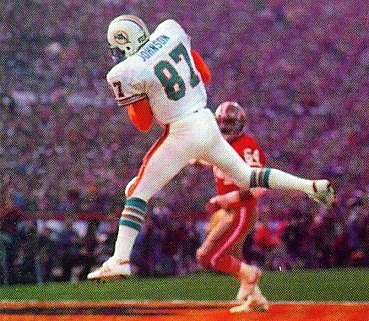
Miami went into a no-huddle offense the next time it had the ball and Marino completed five straight passes, including the last for a two-yard TD to TE Dan Johnson (pictured below). The Dolphins held a 10-7 lead after one quarter.


The 49ers punted following their next possession, but a defensive adjustment caused Miami to go three-and-out the next three times it was on offense. Coach Walsh had gone to an “elephant” defense, a 4-2-5 alignment with safety Tom Holmoe as a nickel back and another safety, Jeff Fuller, lined up at linebacker along with Turner, and it proved to be effective. Marino, who had completed nine of his first ten passes, didn’t complete another until near the end of the half.

Meanwhile, San Francisco took control of the game. Following a poor 37-yard punt by Reggie Roby from his own end zone, the 49ers had good field position at the Miami 47. Montana again showed off his mobility by running for a 19-yard gain on the first play, and then passed to WR Dwight Clark for another 16 yards. Two plays later, he tossed an eight-yard scoring pass to RB Roger Craig and the 49ers retook the lead at 14-10.

With the 49ers getting the ball in good field position at their own 45 to start their next possession, Tyler and Craig ran the ball for a total of 15 yards and then Montana threw back-to-back completions to TE Russ Francis for another 29. Following a five-yard carry by Craig, Montana ran six yards for a touchdown on a quarterback keeper and the lead was strechted to 21-10.

San Francisco scored once more in the second quarter, on a nine-yard drive that covered 52 yards and culminated in a two-yard run by Craig for a touchdown. Coming down to the last two minutes of the half, Marino began completing passes again, going 7 for 11 as the Dolphins drove to the 49ers’ 13 yard line and van Schamann kicked a 31-yard field goal with 12 seconds remaining.

It wasn’t over, however, as G Guy McIntyre fumbled the squibbed Miami kickoff and WR Jim Jensen recovered for the Dolphins at the San Francisco 12. Another van Schamann field goal, this time from 30 yards, made the score 28-16 at halftime.

Miami received the second half kickoff but wasn’t able to maintain the momentum generated at the end of the second quarter. Nathan was thrown for a one-yard loss, Marino threw an incompletion, and then the quarterback was sacked for a nine-yard loss by Board. Following Roby’s punt, the 49ers took nine plays to drive 43 yards and Ray Wersching kicked a 27-yard field goal.


Once again the Dolphins had difficulty moving the ball as Marino (pictured at left) faced tremendous pressure from the San Francisco defense. The Niners’ offense continued to move effectively – on their next possession following the field goal, Montana hit on five passes, including 40 yards to Tyler and 14 to Francis, and completed a 16-yard TD pass to Craig for the second-year running back’s third score of the day.

Miami, desperate to get back in the game, moved to the San Francisco 27 on its next possession, but Marino threw a long pass intended for Clayton that Wright intercepted at the one yard line. The third quarter ended with the 49ers ahead by 22 points.

The Dolphins had to punt at the end of their next possession but got a break when CB Dana McLemore fumbled the kick and WR Vince Heflin recovered for Miami at the San Francisco 21. But on the first play, Marino threw into the end zone and was intercepted by Carlton Williamson. For all intents and purposes, the game was over.

Each team got the ball once more, but there was no more scoring and the 49ers came away the winner, 38-16.

San Francisco ran up 537 yards to Miami’s 314 and also had a significant edge in first downs (31 to 19). The 49ers ran a well-balanced attack, gaining 211 yards on the ground and 331 through the air. Meanwhile, the Dolphins, with a suspect running game to begin with, were held to just 25 yards rushing. Marino was sacked four times, especially notable since the quarterback had suffered only 13 sacks during the entire regular season.


Joe Montana, the game’s MVP, completed 24 of 35 passes for 331 yards with three touchdowns and no interceptions, and also ran five times for 59 yards and a TD. Wendell Tyler led the rushers with 65 yards on 13 carries, catching four passes for 70 yards as well, while Roger Craig (pictured at right) gained 58 yards on 15 attempts and in addition had 7 pass receptions for another 77 yards, both team-leading figures to go with his three TDs. Dwight Clark also gained 77 yards on his 6 catches.

For Miami, Dan Marino threw 50 passes and completed 29 of them for 318 yards with a TD and two interceptions. Tony Nathan caught 10 passes, for 83 yards, to lead the club both in receptions and rushing - albeit with just 18 yards on five attempts. Mark Clayton gained 92 yards on 6 catches, and TE Joe Rose contributed 6 receptions for 73 yards. Mark Duper was held to just one catch for 11 yards.

“Montana is the guy who made it go for them,” said Don Shula afterward. “He beat everything we put against him. Whenever they needed him to, he wiggled loose and kept them going.”

Montana spoke in terms of the whole team’s effort. “All week, all we heard was ‘Miami, Miami, Miami’,” he said. “That motivated us. We felt we had more tools than Miami – passing, running, a great defense – and we wanted to prove it.”

Bill Walsh summed up by saying, “This is the best game we have played since I joined the 49ers. It was a great performance by a truly great team. This is one of the best teams of all time.”

For Walsh, Montana, and the 49ers, it was the second championship in four years, and they would win twice more before the conclusion of the decade (although Walsh had stepped aside as coach by the last one).

Dan Marino went on to play 17 seasons in the NFL, all with the Dolphins. Altogether, he passed for 61,361 yards and 420 touchdowns over the course of his Hall of Fame career. But he never again played in the Super Bowl.

January 10, 2011

1982: 49ers Defeat Cowboys for NFC Title on Montana to Clark TD


The NFC Championship game at San Francisco’s Candlestick Park on January 10, 1982 brought together two franchises with different histories – and heading in divergent directions. The visiting Dallas Cowboys were no stranger to the upper echelons of the postseason - since the restructuring due to the AFL/NFL merger in 1970, they had appeared in eight NFC title games, winning five of them, and had prevailed in two of the ensuing Super Bowls. The host 49ers had never won a championship, dating all the way back to the team’s origins in the All-America Football Conference (AAFC) of 1946-49. San Francisco had five postseason appearances in the preceding 35 years, losing the AAFC title to the Browns in 1949 and NFC title games to the Cowboys following the 1970 and ’71 seasons.

The Cowboys, under venerable Head Coach Tom Landry, won the NFC East with a 12-4 record. While they lost to the 49ers along the way, they had won four of their last five regular season games and decimated the Buccaneers in the Divisional playoff round. QB Danny White had a solid season, ranking second in the league in passing, and RB Tony Dorsett ran for 1646 yards. Two rookies in the defensive backfield paid dividends as CB Everson Walls led the NFL with 11 interceptions and FS Michael Downs contributed seven pickoffs. Dallas was a strong, consistently solid club, and was expected to contend.


San Francisco had not been expected to jump so high after four straight losing seasons. However, in the third year under innovative Head Coach Bill Walsh, the 49ers broke out in a big way, going 13-3 to win the NFC West. The emergence of third-year QB Joe Montana (pictured at right) had been the key as he led the NFL in passing and ran the complex West Coast offense with a cool precision. The running game was ordinary, but WR Dwight Clark was a dependable, if not speedy, target and the offensive line, led by G Randy Cross, stepped up. Two veterans, LB Jack “Hacksaw” Reynolds and DE Fred Dean, contributed significantly to the defense, as did the backfield that contained three rookie starters – most notably CB Ronnie Lott, who achieved All-Pro recognition in his first year. The Niners had easily beaten the Giants in the Divisional round to advance to the conference title game.

The 49ers drove to the first score of the day, an eight-yard touchdown pass from Montana to WR Freddie Solomon in the first quarter. Dallas came back with a 44-yard field goal by Rafael Septien and then, following a fumble by San Francisco RB Bill Ring, the Cowboys struck again as White connected with WR Tony Hill for a 26-yard TD. The score was 10-7 in favor of Dallas after one quarter.

The Niners regained the lead in the second quarter when Montana, throwing while falling down, hit Clark for a 20-yard touchdown. But as the game settled into a back-and-forth affair, the Cowboys again came back on an 80-yard drive, including a pass interference call on Lott that gained 34 yards, and was capped by a five-yard scoring run by Dorsett. Dallas took a 17-14 lead into halftime.

The teams exchanged turnovers in the third quarter. Following San Francisco LB Bobby Leopold’s interception of a tipped pass, the 49ers went back ahead when RB Johnny Davis ran for a two-yard TD.

Early in the fourth quarter, Septien cut the San Francisco margin to 21-20 with a 22-yard field goal. Another fumble by the Niners, this time RB Walt Easley, gave Dallas the ball at midfield. Four plays later, a 21-yard scoring pass from White to TE Doug Cosbie made the score 27-21 and put the Cowboys in a commanding position with time running down.

Walls intercepted a Montana pass on the next possession, but the Cowboys were unable to move the ball and punted. With 4:54 left on the clock, San Francisco took over at its 11 yard line. Using short passes and runs by RB Lenvil Elliott, the 49ers moved methodically down the field. Coming out of the two-minute warning, they ran Solomon on a reverse, and he picked up 14 yards to the Dallas 35. Despite a heavy Dallas pass rush, Montana completed passes of 10 yards to Clark and 12 to Solomon. Elliott took off around end for a seven-yard gain.

San Francisco faced a third-and-three situation at the Dallas six with time down to 58 seconds. Montana took the snap and rolled to his right. With DE Larry Bethea about to hit him and his primary receiver (Solomon) covered, he fired an off-balance pass that was high and to the outside of Clark, coming across the back of the end zone. The 6’4” receiver leaped and grabbed the ball for a touchdown (pictured at top). With the successful extra point by Ray Wersching, the 49ers clung to a one-point lead.

The Cowboys got the ball back with 51 seconds still to go, and it seemed as though they might yet pull off a comeback of their own. White fired a pass to WR Drew Pearson that covered 31 yards to the San Francisco 44, where he was pulled down by CB Eric Wright. However, on the next play DT Lawrence Pillers caused White to fumble, and DE Jim Stuckey recovered for the Niners. San Francisco was on the way to its first Super Bowl appearance by a score of 28-27.

The 49ers outgained Dallas (393 yards to 250) and had more first downs (26 to 16). However, they also turned the ball over six times, to three by the Cowboys, which nearly proved fatal.

Joe Montana completed 22 of 35 passes for 286 yards with three touchdowns and three interceptions (two by Everson Walls). Dwight Clark caught 8 passes for 120 yards and the two big TDs while Freddie Solomon contributed 6 receptions for 75 yards and a score. Lenvil Elliott led the Niners with 48 yards on 10 carries.

For the Cowboys, Danny White (pictured below) was successful on 16 of 24 passes for 173 yards with two touchdowns and an interception. Tony Dorsett, who had to sit out three series in the first half due to an eye injury, gained 91 yards on 22 rushing attempts. RB James Jones, RB Ron Springs, and TE Billy Joe DuPree each caught three passes, while Tony Hill’s 43 yards on two receptions, including a TD, led the club.


“I was split out right,” Clark said in recounting the decisive touchdown pass. “Both Freddie (Solomon) and I go down into the end zone and slide back on the end line. The two defensive backs who were on me were watching Joe and when he scrambled out I just slid down the end line and got a step on them. When the ball went up it was just a matter of me going up and getting it. Joe put it in a place where it was either going to be caught by me or be incomplete. There was no chance of an interception.”

“The 49ers aren't a better team than us, but the game ended at the right time for them,” summed up Tom Landry.

“It's kind of like driving a car off the end of a cliff,” said Dallas safety Charlie
Waters, following what was the final game of his eleven-year career. “All I will remember is that they drove 89 yards on us.”

San Francisco went on to defeat the Cincinnati Bengals, another upstart team, in the Super Bowl. It would be the first of four during the decade of the ‘80s, all with Montana at quarterback and three with Walsh as head coach. While Dallas would return to the postseason in three of the next four years, they would not make it back to a Super Bowl until the game following the 1992 season.

November 21, 2010

1982: Joe Montana Passes Mistake-Prone 49ers Past Cardinals


It had been over two months since NFL teams had last taken the field as the St. Louis Cardinals hosted the San Francisco 49ers at Busch Stadium on November 21, 1982. The players had gone on strike – the first to occur during the season – following the second week of action. The work-stoppage was over, 57 days later, and now Week 3 was occurring late in November.

Head Coach Bill Walsh’s 49ers were coming off a championship season in 1981, but had lost their first two games in ’82 prior to the strike. The Cardinals were 1-1 under Head Coach Jim Hanifan and coming off of a 7-9 year in ’81. The teams had just four days of practice prior to the contest.

There were 38,064 fans in attendance – and, as was the case in many NFL venues on this day, many no-shows (13,328). The 49ers took the early lead as Ray Wersching booted a 36-yard field goal in the first quarter and RB Jeff Moore scored on a one-yard touchdown run in the second quarter for a 10-0 lead.

With 30 seconds remaining in the first half, the Cardinals got on the board as WR Roy Green made a diving catch of a 17-yard pass from QB Neil Lomax for a touchdown. The 49ers got the ball back but fumbled, and LB Charlie Baker recovered for St. Louis. But an opportunity to tie the score at the half was lost when Neil O’Donoghue missed a 44-yard field goal attempt on the last play (he also missed from 47 yards in the first quarter). San Francisco remained in the lead at 10-7.

The Cardinals took advantage of two turnovers in the third quarter to go in front. First, DE Curtis Greer recovered a fumble that set up O’Donoghue’s tying field goal from 30 yards out. Then CB Jeff Griffin intercepted a Joe Montana pass and O’Donoghue kicked a 32-yard field goal to make the score 13-10 in favor of St. Louis. Unfortunately for the Cardinals, the failure to get a touchdown on one or both possessions allowed the 49ers ample room to recover.

The turning point in the game came when San Francisco got the ball back, still in the third quarter. Facing a third-and-18 situation in his own territory, Montana connected with WR Renaldo Nehemiah on a 55-yard pass play. Two plays later, Montana threw a six-yard TD pass to TE Russ Francis that put the Niners back in the lead at 17-13.

The Cardinals had a chance to make a big play of their own, but Lomax overthrew Green on what could have been a 45-yard TD pass. Now in the fourth quarter, the 49ers regained possession and went 91 yards in 10 plays with Montana hitting WR Dwight Clark for a 33-yard touchdown.

San Francisco had another big play that set up a third passing touchdown. Montana passed to rookie RB Vince Williams, who proceeded to gain 55 yards to set up a 17-yard TD pass to RB Earl Cooper. In a stretch of 13 minutes, the Niners had scored three touchdowns to take control, at 31-13, of what had been a close game.

38-year-old veteran QB Jim Hart replaced the second-year Lomax with nine minutes remaining and led the Cardinals to a score on a three-yard carry by RB Ottis Anderson. But it was too-little, too-late as the 49ers won by a final score of 31-20.

San Francisco outgained the Cardinals by 448 yards to 254 and had 22 first downs to 15 for St. Louis. The 49ers were damaged by their three turnovers, as opposed to none by the Cardinals, but the failure of the home team to better capitalize on their opportunities set the stage for the Niners to take control.

Joe Montana completed 26 of 39 passes for a then-team record 408 yards with three touchdowns against one interception. The fourth-year veteran out of Notre Dame spread the ball around well as eight different receivers caught at least two passes apiece. In the second half alone, he completed 15 of 20 for 238 yards and all of the TDs.


Dwight Clark (pictured at left) led the club with 6 catches for 103 yards and a touchdown while Renaldo Nehemiah gained 93 yards on three receptions and Jeff Moore contributed four catches for 87 yards to go along with his 9 rushing attempts for 19 yards. Indeed, the 49ers gained just 77 yards on 26 running plays, and Earl Cooper led the way with 30 yards on 7 carries.

For the Cardinals, Neil Lomax was successful on just 9 of 23 passes for 82 yards and a TD. Jim Hart was more proficient, completing 8 of 11 throws for 72 yards. Ottis Anderson led the club with 65 yards on 15 rushes, including a TD, and also caught 6 passes for 51 yards. WR Pat Tilley slightly led in pass receiving yards with 53 on four receptions.

“It's a good way to come back,” Montana said afterward. “My timing wasn't there early and I made a lot of mistakes. But I thought we played well. I wasn't surprised; we looked like we were in good shape in practice.”

There was concern that the players might go back on strike if they voted to reject the preliminary settlement that had allowed play to resume. The Cardinals’ player representative, guard Terry Stieve, said, “Here in St. Louis, we'll ratify it and I have a gut feeling it will be ratified by the players throughout the league. The fans are the forgotten group in this thing, so it's time both sides realize the importance of the fans. I don't blame them for feeling cheated in this deal.”

The games did continue through what became a nine-game regular season. Division play was done away with and the top eight teams in each conference qualified for a playoff tournament. The 49ers didn’t make it that far - plagued by injuries and (according to Coach Walsh) diminished intensity, they ended up with a 3-6 record and a woeful eleventh place in the 14-team NFC. St. Louis made out better, going 5-4 and making it to the postseason as the sixth seeded team in the conference. They were handily beaten by Green Bay in the first round.

Joe Montana topped NFL quarterbacks with 346 attempts and 17 touchdown passes (tied with Pittsburgh’s Terry Bradshaw and Dan Fouts of the Chargers) and ranked second in completions (213) and yards (2613). While he was at it, he set a record by stringing together five straight 300-yard passing performances (since exceeded).

Dwight Clark led the league with 60 pass receptions and was second with 913 receiving yards. He was a consensus first-team All-Pro and was named to the Pro Bowl.

The losing record by the 49ers would be their last until 1999 – a string of 16 consecutive seasons in which they would never finish with fewer than 10 wins. The club won four NFL championships during that run.

September 2, 2010

1979: Kramer to Rashad Leads Vikings Over 49ers


The Minnesota Vikings, under Head Coach Bud Grant, had been the dominant team in the NFC Central division throughout the decade of the ‘70s (indeed, since 1968), but there were question marks surrounding the club leading into the 1979 season. The Vikings had won the division title for the tenth time in eleven years in ’78, but with only an 8-7-1 record; they had been easily dispatched by the Rams in the opening round of the playoffs. Furthermore, star QB Fran Tarkenton had retired in the offseason and third-year QB Tommy Kramer (pictured above) was taking his place in the starting lineup.

The 6’2”, 200-pound Kramer had been drafted out of Rice in the first round by the Vikings in 1977 with the expectation that he would be Tarkenton’s heir. There was little question regarding his arm or confidence, but Kramer had seen little action in his first two years, throwing a total of 73 passes for 475 yards with five touchdowns and five interceptions apiece. However, he had experienced wide receivers in Ahmad Rashad and Sammy White, as well as RB Rickey Young, an outstanding receiver out of the backfield who had led the NFL with 88 catches in ’78.

The Vikings hosted their season-opening game on September 2, 1979 against the San Francisco 49ers at Metropolitan Stadium. While Minnesota was in transition, the 49ers were in full rebuilding mode after coming off of a miserable 2-14 season. They were under the guidance of a new head coach/GM, Bill Walsh.

Neither team generated much excitement in the first half. Ray Wersching kicked field goals of 37 and 22 yards in the second quarter and the 49ers clung to a 6-0 halftime lead. Wersching booted another field goal, of 44 yards, in the third quarter before Kramer connected with Rashad for a 52-yard touchdown. The young quarterback threw another TD pass to Rashad, covering 32 yards, before the period was over to give Minnesota a 14-9 lead.

A third Kramer to Rashad touchdown pass play, for eight yards, gave the Vikings a 21-9 fourth quarter lead, but it did not prove to be a comfortable one. 49ers QB Steve DeBerg threw a 44-yard TD pass to WR Freddie Solomon, and when RB Lenvil Elliott ran for a four-yard touchdown, San Francisco was back in front by a 22-21 score (the extra point attempt failed following the second TD).

With 17 seconds remaining on the clock, it was Kramer to Rashad once more for the winning 25-yard touchdown, although the 49ers claimed the wide receiver didn’t have possession when he crossed the goal line. An apparent forward fumble had been recovered in the end zone by fellow Vikings WR Sammy White, and under a new rule should not have been a touchdown but rather Minnesota’s ball on the one yard line. It was a moot point – and there was no instant replay provision at that time – as the officials ruled that Rashad had crossed the goal line before fumbling. The Vikings won, 28-22.

“I’m sick about the loss,” said Bill Walsh, whose head coaching debut had been marred by the late score.

The game had indeed been closely fought. Both clubs had 22 first downs and turned the ball over twice, while Minnesota led in passing yards (287 to 254) and total yards (397 to 352). Both squads ran the ball 27 times, with the Vikings outgaining the Niners, 110 to 98 yards.


Kramer had a solid outing, completing 21 of 34 passes for 297 yards with four touchdowns and no interceptions. Ahmad Rashad was of course the pass receiving star, with 7 catches for 152 yards and the four touchdowns. Fading veteran RB Chuck Foreman ran the ball the most times, with 11 carries for 33 yards, while Rickey Young was the team’s leading ground gainer with 43 yards on six attempts.

Steve DeBerg, at the beginning of what would be a record-setting passing season, threw the ball 42 times and had 29 completions for 262 yards with a TD and two interceptions. Freddie Solomon, thanks to the long touchdown reception, led the 49ers in receiving yards with 107 on four catches, while FB Mike Hogan caught the most passes (7, for 39 yards). Lenvil Elliott topped the runners with 41 yards on 10 carries and the one touchdown.

It was not the beginning of a rejuvenating year for the Vikings – they fell below .500 for the first time since 1967 with a 7-9 record that placed them third in the NFC Central. It was a harder year for the 49ers, who again went 2-14 and placed last in the NFC West; however, the groundwork was being laid for better years ahead under Walsh.

Tommy Kramer placed second in the NFL in passes attempted (566) and third in completions (315), categories in which Steve DeBerg set new league records (578 attempts, 347 completions). Kramer’s 3397 yards and 23 touchdown passes were solid numbers, but he also tossed 24 interceptions (tied for first in the NFC with Tampa Bay’s Doug Williams). Ahmad Rashad led the conference in both pass receptions (80) and yards (1156) while scoring a total of 9 touchdowns.