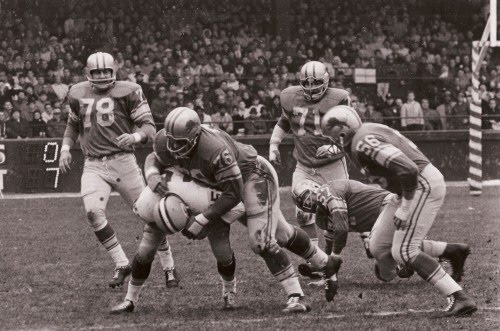
Showing posts with label Jim Taylor. Show all posts

September 15, 2016

1963: Bears Shut Down Packers to Win Season-Opening Game


The Chicago Bears faced a formidable task as they took on their arch-rivals, the Green Bay Packers, in a season-opening game on September 15, 1963. The Packers were coming off of two consecutive NFL Championships, going a combined 24-4 during the regular season in so doing, and had beaten Chicago in five straight contests. The defending champs were two-touchdown favorites to keep the streak going at home.

Head Coach Vince Lombardi was commencing his fifth year with Green Bay and the club was as formidable on both sides of the ball as their record would imply. QB Bart Starr was highly efficient and FB Jim Taylor had unseated Cleveland’s Jim Brown as the rushing leader in ’62 while also scoring a record 19 touchdowns. The receivers were good and the line excellent. If there was a major concern, it was over the loss of HB/PK Paul Hornung for the year due to a gambling suspension. Likewise on defense, the Packers had five returning players who had received at least some first-team All-NFL recognition and Lombardi felt secure enough to trade two aging veterans, DE Bill Quinlan and CB Johnny Symank, during the offseason.

The Bears, under the direction of 68-year-old owner and Head Coach George Halas, were coming off of a 9-5 record and looked to be a potential challenger in the Western Conference. QB Bill Wade (pictured above) was an able passer, there were good receivers in flanker Johnny Morris and TE Mike Ditka, and a fair stable of running backs. However, the defense, under the guidance of assistant coach George Allen, was especially impressive and contained stalwarts in DE Doug Atkins, MLB Bill George, and safeties Roosevelt Taylor and Richie Petitbon. 

There were 42,327 fans in attendance at Green Bay’s City Stadium. The Packers had to punt following the game’s first series and the Bears nearly provided some excitement when Johnny Morris returned the kick 44 yards to the Green Bay 38, but it was all for naught when Chicago was flagged for clipping. Now starting from their 13, the visitors made one first down before having to punt in return.

Jim Taylor ran for eight yards but LB Larry Morris managed to force a fumble and SS Richie Petitbon recovered at the Green Bay 33. Carries by HB Ronnie Bull and FB Rick Casares picked up 11 yards before the defense was able to halt the advance. Bob Jencks came on to kick a 32-yard field goal and Chicago had a 3-0 lead.

CB Herb Adderley nearly broke the ensuing kickoff return but was tripped up by FB Joe Marconi. Taylor and HB Tom Moore ran for a total of 17 yards and Bart Starr completed passes to TE Ron Kramer and Moore to get to the Chicago 34. The drive halted there and Jerry Kramer tied the score with a 41-yard field goal.

The teams exchanged punts as the game entered the second quarter. The Bears then mounted a drive that covered 66 yards in 14 plays that included Wade running for 10 yards and passing to Bull for 22 to the Green Bay four. However, on second down Wade fumbled when hit hard by DT Dave Hanner and DT Henry Jordan recovered to end the threat. Each team came up with an interception before the first half ended as CB Jesse Whittenton picked off a Wade pass and Petitbon grabbed one for the Bears, and the score remained tied at the intermission.

Following a short series by the Bears to start the third quarter, Green Bay commenced a drive in which Taylor gained 15 yards on two carries and Starr threw to Moore for 18 to the Chicago 47. But following two short running plays, Starr’s pass intended for flanker Boyd Dowler bounced off the receiver’s hands and was intercepted by FS Roosevelt Taylor.


The Bears proceeded to put together a 68-yard drive in 10 plays. Wade completed passes to Bull for 21 yards and Marconi for 16 to the Green Bay 18 and, two plays later, he connected with split end Bo Farrington to the two. From there, Marconi (pictured at left) ran off-tackle for a touchdown and Jencks converted to put Chicago ahead by seven with less than four minutes remaining in the period.

Following an exchange of punts, the Packers began to move the ball again early in the fourth quarter. Starr made throws to Ron Kramer for 11 yards and split end Max McGee for 10 to reach the Chicago 36, but the drive halted there and, facing fourth-and-one, they punted.

The Bears were able to hold onto the ball with the help of a roughing-the-kicker penalty and the clock was down to 6:59 when Green Bay finally regained possession. CB Dave Whitsell intercepted a Starr throw and Chicago advanced into scoring position, but a Jencks field goal try was wide with 1:56 remaining to play. However, any lingering hopes for the Packers ended when Bill George picked off a short pass by Starr and Chicago pulled off the upset by a final score of 10-3.

Chicago’s domination was total as the Bears led in total yards (231 to 150) and first downs (15 to 9) and ran 59 plays to Green Bay’s 43. The point total was the lowest for the Packers since 1959, Lombardi’s first season, and they turned the ball over five times, to two by Chicago.

Bill Wade kept the passes short and completed an efficient 18 of 24 for 129 yards while giving up one interception. He also ran the ball 8 times for 26 yards, placing just behind Rick Casares, who gained 27 yards on five carries, as Chicago’s leading rusher. In addition to gaining 23 yards on 12 rushing attempts, Ronnie Bull (pictured below) led the team by pulling in 6 catches for 48 yards.


For the Packers, Bart Starr had an uncharacteristically rough outing as he succeeded on 11 of 22 throws for 83 yards and was intercepted four times. Jim Taylor was held to 53 yards on 12 carries and Tom Moore, who ran 9 times for 24 yards, gained 32 yards on a team-leading four pass receptions. Ron Kramer picked up 35 yards on his three catches. Jerry Norton, the team’s new punter obtained from the Cowboys, boomed five punts for a 48.6-yard average.

“We had nothing going,” summed up Vince Lombardi in defeat. “We couldn’t even get our hands on the ball. We were lucky to get away 10-3.”

The first week battle set up a tight race between the Bears and Packers that lasted the entire season. Chicago swept the series between the clubs and that was the difference as the Bears finished first in the Western Conference at 11-1-2 and Green Bay in second with an 11-2-1 record. The Bears came away with the NFL Championship, their first since 1946, by defeating the New York Giants.  

Chicago’s defense remained stifling and led the league in ten categories, including fewest points allowed (144) and fewest total yards (3176) which included both the lowest rushing (1442) and passing (1734) yards allowed. Fittingly, five members of the defensive unit were consensus first-team All-NFL selections, including Doug Atkins, Bill George, OLB Joe Fortunato, Roosevelt Taylor, and Richie Petitbon.

October 9, 2013

1966: Mira Leads 49ers to Upset of Packers


The San Francisco 49ers had gotten off to a slow start in the 1966 NFL season. They were 0-2-1 as they prepared to host the powerful Green Bay Packers on October 9. Following their first winning season in four years (7-6-1 in ’65), Head Coach Jack Christiansen’s team had plenty of talent on offense but also had a suspect defense and was coming off of two big losses to the Colts and Rams. Tenth-year QB John Brodie received a big contract extension in the offseason but endured two rough performances in those defeats. George Mira (pictured above), a third-year backup out of Miami, was getting his first start of the season at quarterback in place of Brodie, with the hope that his darting, scrambling style would prove effective against the vaunted Packers defense.

The prospect of facing Head Coach Vince Lombardi’s Packers did not promise any relief for the 49ers. Green Bay was the defending NFL Champion and off to a 4-0 start. QB Bart Starr didn’t typically throw often, but he was efficient when he did and had tossed six touchdown passes as opposed to just one interception thus far. The veteran backfield duo of FB Jim Taylor and HB Paul Hornung was wearing down, but the receiving corps was effective and the defense solid from front to back. If there was one discordant note for the Packers coming into San Francisco, it was that they had been having recent difficulty in games at Kezar Stadium, having not won there since 1963 (in 1965 they tied the 49ers in the last game, which forced a playoff for the Western Conference title with the Colts).

There were 39,290 fans in attendance at Kezar Stadium on a sunny afternoon. In the first quarter, the Packers drove to the San Francisco 32 yard line as Taylor and Hornung ran to good effect, but Don Chandler missed a 39-yard field goal attempt.

Following a San Francisco punt, Green Bay moved even deeper into 49ers territory on a series highlighted by Bart Starr throwing to split end Max McGee for a 39-yard gain, but, after getting to the eleven, had to settle for a Chandler field goal try that was successful from 18 yards.

Two possessions later, Mira’s first scoring pass came on a play when his mobility was put to good use. He first ran to his right and then reversed field to avoid the rush and threw on the run to HB John David Crow at the Green Bay one who then dove into the end zone for a 27-yard touchdown.

After the teams traded punts, Mira was shaken up in the second quarter and had to leave the game briefly. When John Brodie came onto the field as his replacement, he was greeted with a shower of boos from the home crowd. He did complete a six-yard pass to FB Ken Willard, but a 41-yard field goal attempt by Tommy Davis was unsuccessful with 29 seconds left in the half. Still, the Niners carried a 7-3 lead into the intermission.

The Packers had the first possession of the third quarter, and facing second-and-eight at their own 47, the 49ers put on a heavy rush and dumped Starr for a 12-yard loss. Starr was hit again on the next play, and this time it forced a fumble that was recovered by LB Matt Hazeltine, who then proceeded to run 22 yards for a touchdown. The successful PAT by Davis put San Francisco ahead by 14-3.

On the next series, the Packers responded by scoring on a quick three-play, 56-yard series.  Starr threw to a wide-open Hornung at the sideline for a 43-yard touchdown. Chandler’s extra point narrowed the home team’s margin to 14-10.

Mira was back behind center for the 49ers, but they went three-and-out and had to punt. Starting at their own 42, the Packers moved quickly into San Francisco territory. Starr completed passes to Taylor for 14 yards and flanker Carroll Dale for 24 down to the 15 yard line, but the drive stopped there. Chandler booted a 22-yard field goal that made it a one-point contest.

After another punt by the Niners, the Packers appeared to be driving toward a score when, on the first play of the fourth quarter, Starr was intercepted by safety Elbert Kimbrough, who returned it 44 yards before finally being hauled down by Jim Taylor at the Green Bay 37. Mira was immediately sacked for a nine-yard loss, but two plays later, and following a 38-yard run by the nimble quarterback, the 49ers capitalized when he tossed an eight-yard touchdown pass to Crow. Rather than the Packers potentially taking the lead, the Niners were up by 21-13.

The Packers bounced back by driving 69 yards in four plays that ended with Starr throwing to Dale for a 38-yard TD. Don Chandler’s extra point again made it a one-point contest and there was still plenty of time.

Green Bay’s defense proceeded to make a big play when LB Dave Robinson intercepted a Mira pass and returned it 32 yards to the San Francisco nine. The 49ers kept the Packers out of the end zone on three plays and, following an offensive pass interference penalty, the visitors were backed up to the 19  and Chandler missed a 26-yard field goal attempt.

Brodie again replaced Mira at quarterback and the 49ers put together a long, time consuming drive. HB Dave Kopay had a 25-yard run and FB Ken Willard also ran effectively. Facing fourth-and-one at the Green Bay two, San Francisco was unable to convert, but there was only a minute remaining as the Packers took over just two yards from their own goal line. Green Bay was unable to do anything offensively in the waning seconds and the 49ers came away with a 21-20 upset win.

The Packers ran up more total yards than San Francisco (368 to 248) and each team generated 17 first downs. However, Green Bay also led in turnovers with three, to two suffered by the 49ers, and missed opportunities – particularly those that also ended with failed field goal attempts – proved fatal to the defending champs.


George Mira completed 9 of 21 passes for 104 yards, but two of them were for touchdowns against one interception and he also ran for 46 yards on three carries to lead the club. Ken Willard gained 43 yards on 14 rushing attempts, Dave Kopay added 42 on only four tries, and John David Crow (pictured at left) had 9 carries for 23 yards to go along with a team-leading 5 catches for 53 yards that included two TDs.

For the Packers, Bart Starr was successful on 18 of 26 throws for 287 yards and two TDs as well as the one costly interception. Jim Taylor ran for 54 yards on 16 carries and caught four passes for 39 more yards while Paul Hornung rushed for 30 yards on 11 attempts and had three receptions for 51 yards and a touchdown. Carroll Dale gained 86 yards on his four catches that included one for a score.

The 49ers won their next two games, with John Brodie back at quarterback, but ended up with a 6-6-2 record to place fourth in the Western Conference. George Mira ended up completing 22 of 53 passes (41.5 %) for 284 yards and five touchdowns with two interceptions while chafing in Brodie’s shadow.

Green Bay recovered to top the conference at 12-2 and again win the NFL title. Moving on to the first Super Bowl, the Packers defeated the AFL Champion Kansas City Chiefs. Bart Starr threw just one more interception over the remainder of the season as he led the league in passing and was a consensus MVP selection.


January 2, 2013

1966: Packers Dethrone Browns for NFL Championship


It had been three years since the Green Bay Packers had last won a NFL title as they faced the defending-champion Cleveland Browns in the league Championship game on  January 2, 1966. Head Coach Vince Lombardi’s team was a blend of solid veterans who had been a part of title-winning teams in 1961 and ’62 and rising young players. They had battled the Colts to a tie atop the Western Conference with 10-3-1 records that necessitated a playoff that Green Bay won in overtime. However, a cause for concern was that many of the team’s veterans were hampered by injuries, including QB Bart Starr, HB Paul Hornung, and FB Jim Taylor (pictured at right).

The Browns, coached by Blanton Collier, had won a stunning shutout victory over Baltimore in the previous year’s title game and again topped the Eastern Conference at 11-3. They were without split end Paul Warfield, one of the stars of the ’64 team as a rookie, for most of the season due to injury but still had the incomparable FB Jim Brown, who won his eighth league rushing title with 1544 yards and scored 21 touchdowns. QB Frank Ryan and flanker Gary Collins were also keys to the offense.

Snow arrived in the morning, but it had changed to freezing drizzle by game time. There were 50,852 fans present at wet and muddy Lambeau Field. The Packers took the opening kickoff and drove 77 yards in seven plays that culminated in Starr passing to flanker Carroll Dale for a 47-yard touchdown.

The Browns came right back by going 66 yards in just three plays. Ryan threw to Jim Brown for a 30-yard gain, connected with Paul Warfield for 19, and then passed to flanker Gary Collins for a 17-yard touchdown. However, the extra point attempt failed due to a bad snap from center that had PK Lou Groza trying to pass to his holder rather than kick and the Packers maintained a one-point lead.

Late in the first quarter, and following a Green Bay punt from its own end zone, Lou Groza kicked a 24-yard field goal to put the Browns in front by 9-7. The Packers responded by driving to a score. Paul Hornung ran for a 34-yard gain to the Cleveland 39. Following a Starr pass to split end Boyd Dowler for 11 yards, the combination of Taylor and Hornung advanced the ball to the three. The Browns held but Don Chandler kicked a 15-yard field goal early in the second quarter and Green Bay was back in front.

Chandler’s second field goal was set up by an interception by FS Willie Wood, who returned it 15 yards to the Cleveland 10. However, a motion penalty set the Packers back and Starr threw three incomplete passes. Chandler was again successful with a three-point try from 23 yards out that made it 13-9.

With less than three minutes remaining in the first half, the Browns punted and the 50-yard kick by Collins went out at the Green Bay four. Advancing to the 11, a third down pass by Starr was picked off by CB Walter Beach at the 30. Ryan immediately tried to go for the touchdown, throwing a pass into the end zone that was intended for Collins but it was broken up by SS Tom Brown and CB Bob Jeter. The series ended with Groza kicking a 28-yard field goal with 48 seconds remaining on the clock. The Packers carried a slender lead of 13-12 into halftime.

A light snow was falling as the game moved into the third quarter. The Packers put together an 11-play, 90-yard drive in the third quarter that was highlighted by Hornung gaining 20 yards on one run and scoring on a power sweep from 13 yards out. The series consumed nearly seven minutes.

WR Walter Roberts returned the ensuing kickoff 33 yards. Ryan scrambled for eight yards and a facemask penalty added another 15 to advance the ball into Green Bay territory. The drive finally stalled at the 28. Cleveland came up short when Groza’s 37-yard field goal attempt in the third quarter was partially blocked by DT Henry Jordan and was unsuccessful.

The Packers put together another long drive, going from their 20 to the Cleveland 21 with only two passes along the way as Taylor and Hornung again ran effectively. Chandler kicked a 29-yard field goal with 9:28 remaining in the game.

Cleveland again was forced to punt but it was another good one by Collins and pinned the Packers down at their seven. Starr was nearly tackled for a safety by DE Bill Glass but managed to get out to the two before being brought down. Following a five-yard carry by Taylor, Chandler punted from his end zone but any advantage for the Browns was nullified when TE Ralph Smith barreled into the kicker and drew a roughing penalty.

The Packers didn’t score again but also didn’t relinquish the ball until there were only about two minutes remaining. The Browns only reached Green Bay territory one more time during the second half, and after making it to the 47 Ryan was sacked by DE Willie Davis to push them back to their 48. A last-gasp long pass intended for Collins was intercepted by CB Herb Adderley, who made a leaping grab to extinguish the threat and nail down the 23-12 win for Green Bay.

The Packers significantly outgained Cleveland (332 yards to 161), ran 69 plays to Cleveland’s 39, and also dominated in first downs (21 to 8). They had a huge edge in rushing yardage (204 to 64) and also turned the ball over only once, to two by the Browns. Green Bay’s defense took control and completely shut the defending champs down in the second half.


Paul Hornung (pictured at left) gained 105 yards on 18 carries that included a touchdown and workhorse Jim Taylor added 96 yards on 27 attempts and added 20 more yards on two pass receptions. Bart Starr completed 10 of 18 passes for 147 yards with a TD and an interception. Boyd Dowler caught 5 passes for 59 yards and, with the long early scoring reception, Carroll Dale gained 60 yards on his two catches.

For the Browns, Jim Brown was held to 50 yards on 12 carries and led the club with 44 yards on three receptions out of the backfield. Frank Ryan was successful on just 8 of 18 throws for 115 yards and a TD with two picked off. Gary Collins, like Brown, caught three passes, for 41 yards and a score.

“The snow and mud were our allies,” said Vince Lombardi. “When you have conditions like these, it’s best to be basic, not fancy. And we’re the most basic offensive team there is.”

“We’re a fine team – better than we showed today – and I’m proud of them,” said Blanton Collier on behalf of the Browns. “But we just made too many mistakes.”

While the win over the Browns was the first of three straight NFL titles for Green Bay, it also was something of a last hurrah for the backfield combination of Jim Taylor and Paul Hornung, who had played such a major role in the team’s rise but were showing signs of wear by 1965. Both were back in ‘66, but at reduced effectiveness. Taylor rushed for 705 yards while averaging 3.5 yards per carry. Hornung ran the ball only 76 times for 200 yards in an injury-plagued year. They were gone by the time the team won its third title in ’67.

While no one knew it at the time, the 1965 title game was also the end of the line for Jim Brown (pictured below) in a Cleveland uniform (he played once more in the Pro Bowl). The great fullback announced his retirement during the summer of ’66 while on movie location in London. He left as the all-time leading rusher in NFL history with 12,312 yards, a record that lasted until 1984, while leading the league eight times in nine seasons and averaging 104.3 yards per game and 5.2 per carry. His record of 126 touchdowns scored lasted until 1994. 


December 30, 2012

1962: Packers Defeat Giants to Repeat as NFL Champions


The NFL Championship game on December 30, 1962 featured the same two teams who had faced off for the title in ’61 – the Green Bay Packers and New York Giants. In that instance, the Packers had blown the Giants out by a 37-0 score at Green Bay. Now they were meeting on New York’s home turf in the rematch.

The Packers, under Head Coach Vince Lombardi, had gone 13-1 in placing at the top of the Western Conference for the third straight year. Hard-hitting FB Jim Taylor had a MVP season as he led the NFL in rushing with 1474 yards (the first NFL runner not named Jim Brown to do so since 1956) and scored a record 19 touchdowns. QB Bart Starr was the league’s top-rated passer and the offensive line was outstanding. Even the off-year for HB Paul Hornung, who had won three straight scoring titles from 1959 to ’61 but was hampered by a bad knee, could not derail the offense, and All-Pro G Jerry Kramer (pictured above) had taken over Hornung’s placekicking responsibilities. The defense was just as strong and yielded the fewest points in the NFL.

Head Coach Allie Sherman’s Giants came in first in the Eastern Conference at 12-2, winning their last nine games in doing so. The brilliant passing of QB Y.A. Tittle was the key to the offense – he had set a new NFL record with 33 TD passes and had excellent targets in split end Del Shofner, flanker Frank Gifford, and TE Joe Walton. FB Alex Webster was effective both running the ball and as a receiver out of the backfield. The veteran defense was solid.

There were 64,892 in attendance at frigid Yankee Stadium. Temperatures were in the teens and with winds gusting as high as 45 mph, the wind chill was below zero. Traction was difficult on the frozen turf and whirlwinds of dust occasionally blew about.

The Giants had first possession and reached their own 46 before having to punt.  Jerry Kramer put the Packers on the board with a 26-yard field goal midway through the first quarter after Green Bay drove 61 yards to the 19 yard line and Jim Taylor was stopped for no gain on third down and short.

The Giants threatened, driving to the Green Bay 15. However, MLB Ray Nitschke deflected a Tittle pass that was intercepted by LB Dan Currie to end the threat and returned it 30 yards before falling. Following the interception, the Packers advanced to the New York 30 but Kramer missed a field goal try from 37 yards.

A punt by Max McGee was nearly blocked by CB Erich Barnes but the rushed kick went only 23 yards. Two plays later, HB Phil King fumbled when hit by Currie and Nitschke recovered at the New York 28. The Packers capitalized as Paul Hornung tossed an option pass to flanker Boyd Dowler for 21 yards and Taylor followed up with a seven-yard touchdown run up the middle (pictured below).


Now late in the second quarter, the Giants responded by moving into Green Bay territory. However, Don Chandler attempted a 47-yard field goal for the Giants that went wide of the mark. The Packers took a 10-0 lead into halftime.

Early in the third quarter, Green Bay’s offense couldn’t advance the ball while backed up deep in its own territory. With the Packers punting from their own 15 yard line, Barnes broke through this time to block McGee’s kick and end Jim Collier fell on the loose ball in the end zone for a New York touchdown after LB Bill Forester was unable to scoop it up at the five (picture below shows Barnes at right just before blocking the punt). With the successful extra point, it was a three-point game.


Once again the Packers couldn’t move on offense, but McGee’s line-drive punt was muffed by DB Sam Horner and Nitschke recovered at the New York 42. The five-play series culminated in a 29-yard field goal by Kramer.

The Giants, now down by six, drove into Green Bay territory with the help of penalties. From the Green Bay 47, Tittle threw a pass intended for Del Shofner that fell incomplete. However, FS Willlie Wood was charged with pass interference and when he leaped up to protest he inadvertently knocked the official, back judge Thomas Kelleher, to the ground. It resulted in Wood’s ejection and another 15 yard penalty on the Packers that advanced the ball to the 18. Tittle overthrew Shofner and the Giants followed up with a double reverse in which King lateraled back to Tittle who was under pressure from DE Willie Davis and threw a bad pass that was almost picked off by Currie. Two holding calls on the Giants moved the ball all the way back to the 40. On third-and-52, Tittle threw short for flanker Frank Gifford, who dropped it. The Giants came up empty.

Early in the fourth quarter, HB Elijah Pitts returned a punt 36 yards and nearly broke it all the way. Bart Starr passed the Packers down to the New York 27 but they lost ground from there and Kramer was unsuccessful on a 40-yard field goal try.

The Giants were unable to move on offense and punted. Taking over at their 28, the Packers kept the ball on the ground and reached the New York 24. With 1:50 remaining in the game, Kramer kicked his third field goal to effectively seal the win for the Packers. The Giants drove to the Green Bay seven on their last possession before time ran out. Green Bay was the champion once again by a score of 16-7.

The Giants outgained Green Bay (291 yards to 244) and the clubs were even in first downs with 18 apiece. The Packers were more successful at running the ball (148 yards to 94) and New York turned the ball over three times while Green Bay’s offense suffered none.

Jim Taylor had a hard-earned 85 yards on 31 carries that included a touchdown and gained 20 more yards on three pass receptions. Moreover, he engaged in a personal battle in the trenches with New York’s defense (most notably star MLB Sam Huff), often exchanging words and exemplifying the game’s intensity. Bart Starr completed just 9 of 21 passes for 85 yards while Paul Hornung, who contributed 35 yards on 8 rushing attempts, also tossed a key halfback option pass for a 21-yard gain. Boyd Dowler led the Green Bay receivers with 4 catches for 48 yards. Ray Nitschke recovered two fumbles and had the pass deflection that was intercepted and was named MVP of the game by Sport Magazine.

As if the wind was not enough, Y.A. Tittle (pictured below) was under constant pressure throughout the game. He was successful on 18 of 41 throws for 197 yards with no TDs and one interception. Joe Walton and Del Shofner had 5 catches apiece, for 75 and 69 yards, respectively. Alex Webster ran for 56 yards on 15 carries and Phil King added 38 yards on 11 attempts.


Summing up, Vince Lombardi stated that his team’s “defense was superb and so was New York’s.”

“Green Bay is obviously a worthy champion, because they have things they had to overcome and they went out there and overcame them and got the points,” said Allie Sherman from the losing side.

The Packers barely missed out on winning the Western Conference again in 1963, finishing a close second to the Chicago Bears. They would win their next league title in 1965. New York topped the Eastern Conference yet again in ’63, but once more fell short in the Championship game.  In two title games, the Giants failed to score a single offensive touchdown against Green Bay.

September 27, 2012

1959: Packers Edge Bears in Vince Lombardi’s Debut as Head Coach


On September 27, 1959 the Green Bay Packers not only kicked off a new regular season but a significant new chapter in the franchise’s history. Of course, no one knew at the time how significant that chapter would be, but the team’s new head coach and general manager, Vince Lombardi, was highly regarded and brought a new attitude to Green Bay.

The Packers had once been one of the league’s better clubs, regularly contending and winning six NFL Championships. But the last of those titles had come in 1944, six years before the club’s founder and original coach, Curly Lambeau, resigned. The decade of the 1950s had not been a good one, with just two break-even seasons and a dreadful 1-10-1 record under Ray “Scooter” McLean in ’58. There were whispers that the league’s last small-city Midwestern team would not survive much longer. Lombardi, most recently the offensive coach of the New York Giants, was brought in to restore the franchise to respectability and was granted the necessary authority to reshape the club.

Lombardi had talent to work with, including veteran Pro Bowl center Jim Ringo to anchor the offensive line, end Max McGee, and DT Dave Hanner. There were promising young players available to develop that included QB Bart Starr, FB Jim Taylor, G Jerry Kramer, OT Forrest Gregg, and LB Ray Nitschke. The underachieving Paul Hornung was penciled in to become an option halfback, in the manner of Frank Gifford of the Giants. Through trades, DT Henry Jordan, DE Bill Quinlan, and G Fred “Fuzzy” Thurston were added, as well as 34-year-old veteran safety Emlen Tunnell from New York to lend leadership to the defensive backfield. A five-year veteran quarterback, Lamar McHan, was also obtained to start ahead of Starr.

There were 32,150 fans in attendance for the opening game at Green Bay’s City Stadium. The Bears, coached by owner George Halas, were seven-point favorites and were coming off an 8-4 record in 1958. Chicago was known for its running game, featuring FB Rick Casares and HB Willie Galimore, on offense and a tough defense that included DE Doug Atkins, linebackers Bill George and Joe Fortunato, and DB J.C. Caroline.

The Bears scored first with a 46-yard field goal by John Aveni late in the second quarter. Meanwhile the Packers, with McHan at quarterback, managed to drive inside the Chicago 20 on four occasions through the first three quarters but came up empty each time.

Paul Hornung, the team’s placekicker as well as halfback, missed two field goal attempts, from 19 and 14 yards, that were both wide to the left. A third attempt never got away due to a bad snap from center. The fourth drive was thwarted by an interception.

On the third play of the fourth quarter, Aveni kicked his second field goal from 42 yards out to make it 6-0 in favor of Chicago. However, thanks to Max McGee’s punting with the wind behind him, the Packers were able to put points on the board during the final period.

Midway through the fourth quarter, a 54-yard punt by McGee was fumbled by DHB Richie Petitbon after he had returned it nine yards. The ball was recovered by Jim Ringo at the Chicago 26. From there, Jim Taylor and Hornung alternated carries until Taylor ran five yards for a touchdown on the sixth play of the drive. Hornung’s extra point put the Packers up by one.

With 2:21 left on the clock, McGee, helped by a 30 mph wind at his back, punted 61 yards to pin the Bears down at their two yard line, where the kick went out of bounds. Shortly thereafter, Dave Hanner tackled Bears QB Ed Brown in the end zone for a safety as he searched for an open receiver. It was enough to seal the upset 9-6 win for Green Bay. The new coach was carried off the field by his players after Ringo handed him the game ball (pictured at bottom).

It was a stunning triumph for the Packers, matching their victory total of 1958. Chicago’s well-regarded running game was held to just 75 yards and two first downs by the surprisingly tough Green Bay defense, where the line play was outstanding and linebackers Bill Forester, Tom Bettis, and Dan Currie played notably well. Green Bay led in total yards (262 to 164) and first downs (16 to 10). Each club turned the ball over twice and was penalized five times.


Jim Taylor (pictured above) led all rushers with 98 yards on 22 carries and Paul Hornung added 61 yards on 19 attempts. Lamar McHan completed just 3 of 12 pass attempts for 81 yards while Hornung threw two option passes and was successful on one for 20 yards. No Packer caught more than one pass, with Max McGee gaining 61 yards on his to lead the club.

Chicago quarterbacks Zeke Bratkowski and Ed Brown combined for 10 completions in 23 attempts. Rick Casares gained 29 yards on 11 carries and Willie Galimore was right behind with 28 yards, also on 11 attempts, and led the team in receiving yards with 37 on three pass receptions. Flanker Jim Dooley caught 4 passes for 36 yards.

“We planned the game the way the defense played it,” explained Vince Lombardi. “Just before the kickoff we went over our defense again. It was a team effort.”

Lombardi also reminded the players before the game “about the great football tradition here” and told them “we have a chance to do something about it.”

“We were not up to par,” summed up George Halas regarding the Bears. “We made mistakes.”

The opening-week win for the Packers was the first of three straight before a five-game losing streak (including a 28-17 loss to the Bears in Chicago) dropped their record to 3-5. However, the emergence of Bart Starr as starting quarterback was part of a four-win rally to close out the season at 7-5 and a tie for third place in the Western Conference with the 49ers. The Bears recovered to end up at 8-4 and second in the conference.

Paul Hornung led the NFL in scoring with 94 points as he emerged as a major point-producer – he also led the team with 681 yards on the ground. Jim Taylor lost time due to burns sustained during a home kitchen accident but showed his potential with 452 rushing yards.

The basis was laid for the Packers to win their first of three straight Western Conference titles the next year and five league championships overall under Lombardi. To say the least, more than respectability was achieved.


August 2, 2012

1963: VanderKelen Leads College All-Stars to Upset Over Packers


The 30th College All-Star Game on August 2, 1963 did not appear ahead of time as if it would offer much of a contest. Most of the All-Star Games had been won by the defending NFL Champions, and in this instance it was Head Coach Vince Lombardi’s Green Bay Packers taking the field, having won their second straight league title in ’62. Green Bay had a powerful lineup, with QB Bart Starr (who tossed five TD passes in the previous year’s 42-20 shellacking of the All-Stars), FB Jim Taylor, and an outstanding line on offense and a defense that included future Hall of Famers in DE Willie Davis, DT Henry Jordan, CB Herb Adderley, and safety Willie Wood. However, star HB Paul Hornung had been suspended for gambling and would not be appearing in the offensive backfield. The Packers were also without another future Hall of Famer, MLB Ray Nitschke, who was injured, and Taylor was playing with a bad knee.

The All-Star team that was facing the Packers, coached for the sixth straight year by Otto Graham, contained many future pro stars that included Ohio State OT Bob Vogel; G Ed Budde from Michigan State; linebackers Dave Robinson from Penn State (who would play for Green Bay), Lee Roy Jordan out of Alabama, and Minnesota’s Bobby Bell; and UCLA safety Kermit Alexander. The player who started at quarterback and ended up being the star of the game, however, wasn’t even drafted by a NFL club.

Wisconsin’s Ron VanderKelen (pictured above) had been passed over in the draft (held on Dec. 3, 1962), but after a brilliant performance in the Rose Bowl he became a hot commodity and was signed by the Minnesota Vikings (the New York Titans – soon to be Jets – had taken him in the 21st round of the AFL draft). Of the four quarterbacks on the All-Star roster, VanderKelen was selected to start by Graham.

There was a crowd of 65,000 in attendance at Soldier Field for the Friday night game. It seemed like business as usual when Green Bay scored in the first five minutes of the contest. Boyd Dowler, punter for the Packers as well as starting flanker, had put the All-Stars in a hole with his kick to the eight yard line. Iowa HB Larry Ferguson fumbled the ball away and the Packers recovered at the 11. Jim Taylor scored from six yards out for the early lead.

The All-Stars responded with a 57-yard drive highlighted by VanderKelen throwing to ends Paul Flatley from Northwestern and Miami of Ohio’s Bob Jencks, as well as the running of Ferguson. Jencks finished it off with a 20-yard field goal.

Late in the first quarter, CB Tom Janik from Texas A & I intercepted a Bart Starr pass and returned it to the Green Bay 27. A VanderKelen throw to end Pat Richter (pictured below), who had been a teammate at Wisconsin, gained 21 yards to close out the opening period. Ferguson opened the second quarter by blasting five yards into the end zone and Jencks added the extra point as the All-Stars took the lead by a 10-7 score.


The Packers came back with a 59-yard drive, mostly behind the running of Taylor and HB Tom Moore, who had a 27-yard carry along the way, and ended up with a 21-yard Jerry Kramer field goal. The All-Stars had a chance to add to their lead with a field goal of their own before the half, but a 19-yard attempt by Jencks was unsuccessful after being deflected by Herb Adderley. The score remained tied at the midway point.

There was no scoring in the third quarter with Mississippi QB Glynn Griffing in for VanderKelen. But, after the All-Stars recovered a fumble, Griffing passed the All-Stars down the field. The collegians were also aided by the running of Nebraska FB Bill Thornton and Washington HB Charlie Mitchell along the way. Jencks booted a 33-yard field goal to cap the 63-yard drive that put the All-Stars back in front at 13-10.

The Packers missed a scoring opportunity when Kramer was wide on a 37-yard field goal attempt. It set the stage for the game’s pivotal, and most sensational, play. VanderKelen, now back in for the All-Stars, threw 20 yards to Richter who pulled in the pass near the sideline and ran the rest of the way for a 73-yard touchdown. The Packers were in a ten-point hole with time running short.

Green Bay did score once more, driving 63 yards - mostly through the air - and Taylor pounded in from the one yard line, but there were only six seconds left and the All-Stars came away with a stunning 20-17 win. The crowd erupted once the final gun sounded and VanderKelen was carried off the field by his teammates.

The All-Stars had more first downs (16 to 15) and both out-rushed (141 to 96) and out-passed (183 to 119) the Packers. Each team suffered an interception and fumbled the ball away once. Green Bay was penalized for 77 yards to just 13 lost by the All-Stars.

Ron VanderKelen, the All-Star MVP, completed 9 of 11 passes for 141 yards and a touchdown. Glynn Griffing was successful on 6 of 10 throws for 42 yards.

“VanderKelen won the starting quarterback job in the last few days of the practices,” said Otto Graham. “He and Griffing did so well I just didn’t have a chance to use the others (Heisman Trophy-winner Terry Baker of Oregon State and Sonny Gibbs from TCU).”

For the Packers, Bart Starr completed 19 of 32 passes for 169 yards. Jim Taylor, playing hurt against an aggressive All-Star defense, gained 51 yards on 16 carries.

“We have no excuses,” said an embarrassed Vince Lombardi. “That was a fine All-Star squad and VanderKelen is a great pro prospect. He handles himself exceptionally well.”

The Packers narrowly missed finishing atop of the Western Conference once again in the ensuing NFL season, going 11-2-1 to end up second to the Chicago Bears.

Ron VanderKelen went on to play five seasons with Minnesota, and while he occasionally competed with Fran Tarkenton for the starting job, he was strictly a backup quarterback as a pro. Given an opportunity to start in 1967, he was quickly supplanted by Joe Kapp and finished up with a year in the CFL. He was never able to replicate his fine Rose Bowl and College All-Star Game performances in the NFL, but he led the All-Stars to perhaps the greatest upset in the history of the series.

The win for the All-Stars was the first since 1958, and the ninth (and last) of the series that was dominated by the pro teams, who won 31 of the games (there were two ties).


May 18, 2011

MVP Profile: Jim Taylor, 1962

Fullback, Green Bay Packers


Age: 27 (Sept. 20)
5th season in pro football & with Packers
College: LSU
Height: 6’0” Weight: 215

Prelude:
Chosen by the Packers in the 2nd round of the 1958 NFL draft, Taylor saw scant action in his rookie season. With the coming of Vince Lombardi as head coach in ’59, he moved into the starting lineup, although burns suffered in a kitchen grease fire caused him to miss action. He broke out in 1960, gaining 1101 yards on a league-leading 230 carries, and rushed for 1307 yards and a NFL-leading 15 rushing TDs in ’61. A physically-punishing runner, Taylor provided the power for Green Bay’s offense and was selected to the Pro Bowl following the ’60 and ’61 seasons.

1962 Season Summary
Appeared in all 14 games
[Bracketed numbers indicate league rank in Top 20]

Rushing
Attempts – 272 [1]
Most attempts, game - 25 (for 124 yds.) at Chicago 11/4, (for 141 yds.) at Philadelphia 11/11
Yards – 1474 [1]
Most yards, game – 164 yards (on 17 carries) at Minnesota 10/14
Average gain – 5.4 [2]
TDs – 19 [1]
100-yard rushing games - 7

Pass Receiving
Receptions – 22
Most receptions, game – 4 (for 40 yds.) vs. St. Louis 9/23
Yards – 106
Most yards, game - 40 (on 4 catches) vs. St. Louis 9/23
Average gain – 4.8
TDs – 0

Scoring
TDs – 19 [1]
Points – 114 [1]

The 19 touchdowns set a then-NFL single-season record.

Postseason: 1 G (NFL Championship at NY Giants)
Rushing attempts – 31
Rushing yards – 85
Average gain rushing – 2.7
Rushing TDs – 1

Pass receptions – 3
Pass receiving yards - 20
Average yards per reception – 6.7
Pass Receiving TDs - 0

Awards & Honors:
NFL MVP: AP, NEA
1st team All-NFL: AP, NEA, UPI
1st team All-Western Conference: Sporting News
Pro Bowl

Packers went 13-1 to win Western Conference while leading league in rushing offense (2460 yards), scoring (415 points), and TDs (53). Won NFL Championship over New York Giants (16-7).

Aftermath:
Taylor had two more thousand-yard seasons, in 1963 and ’64, and was named to the Pro Bowl after each, to give him five straight. He began to show signs of wear in 1965, running for 734 yards and a 3.5-yard average, and following a 705-yard season in ’66, Taylor played out his option and signed with the expansion New Orleans Saints. He led the team in rushing, but with just 390 yards, and retired prior to the 1968 season with 8597 career yards (second highest in NFL history at the time). Taylor was inducted into the Pro Football Hall of Fame, Class of 1976.

--

MVP Profiles feature players who were named MVP or Player of the Year in the NFL, AAFC (1946-49), AFL (1960-69), WFL (1974), or USFL (1983-85) by a recognized organization (Associated Press, Pro Football Writers Association, Newspaper Enterprise Association, United Press International, The Sporting News, Maxwell Club – Bert Bell Award, or the league itself).

[Updated 2/15/14]

December 26, 2010

1960: Van Brocklin & Bednarik Spur Eagles Past Packers for NFL Title


The NFL Championship game on December 26, 1960 featured two clubs that had not vied for titles since the 1940s and had not been expected to contend in ’60. The Philadelphia Eagles, leaders of the Eastern Conference with a 10-2 record, had been perennial also-rans since winning back-to-back championships in 1948 and ’49. Representing the Western Conference, the Green Bay Packers had been through many years in the doldrums after last going the distance in 1944.

The Eagles had steadily improved since the arrival of Buck Shaw as head coach in 1958 who, at age 61, was hoping to retire with a championship. 34-year-old QB Norm Van Brocklin (pictured above), who also came to Philadelphia in ’58 in a deal with the Rams, was seeking to do likewise. The quarterback known as The Dutchman was the key to the offense and had an MVP year in 1960. While the running game was ordinary, the passing attack was not as Van Brocklin had a good corps of receivers in diminutive flanker Tommy McDonald and ends Pete Retzlaff and Bobby Walston. Chuck Bednarik, a former All-Pro linebacker who had moved exclusively to center in recent years, had been forced to play both ways due to injuries in the linebacking corps and provided leadership, as well as outstanding performance, to the defense. Two rookies, HB/FB Ted Dean and LB Maxie Baughan, also contributed to the team’s success.

Green Bay was benefiting from the guidance of second-year Head Coach Vince Lombardi. After posting a 7-5 record in 1959, the first winning tally for the club in 12 years, the Packers had started off at 4-1 in ’60, lost three of four, and then won their final three games to vault past the Lions, 49ers, and Colts with an 8-4 tally. HB/PK Paul Hornung scored a record 176 points and, in combination with FB Jim Taylor, was part of a running attack that ranked second in the league. QB Bart Starr was still a work in progress, the receiving corps good, and the offensive line outstanding. The defense was tough, particularly the line and linebackers.

With the addition of temporary seating, there were 67,352 fans filling Philadelphia’s Franklin Field for the title contest and the weather was sunny and in the mid-40s. Things did not start out well for the Eagles when Van Brocklin tossed a swing pass that HB Bill Barnes couldn’t hold on to and was intercepted by Green Bay DE Bill Quinlan at the Philadelphia 14 yard line. Three running plays gained eight yards, and Lombardi chose to go for the first down on fourth-and-two at the six. The Eagles defense stopped Taylor short and Philadelphia took over on downs.

However, the reprieve was a short one when Dean, at the end of a ten-yard run, fumbled the ball back to the Packers at his own 22. Handing off to Hornung and Taylor, Green Bay got down to the eight yard line, but an offsides penalty backed the Packers up and two passes by Starr into the end zone were incomplete. Hornung kicked a 20-yard field goal to give Green Bay a 3-0 lead.

The Eagles were only able to get one first down during the opening period, but the defense was showing an ability to stop Green Bay’s inside running game in key situations. Heading into the second quarter, the Packers drove into Eagles territory and reached the 14 yard line. Once more the possession stalled at that point and Hornung kicked a 23-yard field goal to make the score 6-0.

Philadelphia’s passing game came alive midway through the second quarter as Van Brocklin completed a 22-yard pass to McDonald down the middle and then threw to McDonald again, this time on an outside route that resulted in a 35-yard touchdown. With Walston’s successful extra point, the Eagles led by a point (McDonald pictured below).


After getting the ball back, Van Brocklin completed a 41-yard pass to Retzlaff to the Green Bay 33. A swing pass to Dean gained 22 more, but the next three passes were incompletions and Philadelphia settled for a 15-yard Walston field goal. With time running out in the first half, the Packers responded with a 73-yard drive to the Eagles’ seven yard line, but Hornung missed a 14-yard field goal attempt on the final play before halftime. Philadelphia held a 10-6 lead at the intermission.

In the third quarter, the Packers once again moved the ball well and faced a third-and-two situation at the Eagles’ 26. In a key play, Hornung was not only stopped short but knocked out of the game when he suffered a shoulder injury after being hit hard by Bednarik. With Green Bay bypassing another field goal attempt (Hornung was at least temporarily unavailable for kicking as well as playing halfback), the Eagles stopped Taylor and regained possession.

It seemed as though the Eagles might add to their lead as Van Brocklin completed passes of 33 yards to McDonald and 25 to Walston. But at the Green Bay four he threw a pass that was intercepted by CB John Symank.

The Packers didn’t move on their next possession, but end Max McGee, who was also the team’s punter, ran out of punt formation for a 35-yard gain to the Philadelphia 46. Starr followed up with a 17-yard pass to TE Gary Knafelc, and after runs by Taylor and HB Tom Moore (Hornung’s replacement) for first downs, McGee caught a seven-yard touchdown pass from Starr. Hornung’s kick put the Packers back in the lead by a 13-10 score.

However, Dean returned the ensuing kickoff 58 yards to the Green Bay 39. The Eagles kept the ball on the ground as they drove to a first down, but Van Brocklin was sacked by LB Ray Nitschke for a seven-yard loss. However, The Dutchman recovered with a 13-yard pass to Barnes and then Barnes carried for a five-yard gain and first down at the nine.

With the Packers expecting a pass, Van Brocklin handed off twice to Dean, the second resulting in a five-yard run for a touchdown (pictured below). The successful extra point gave the Eagles a four-point lead with 5:21 to play.


Green Bay battled back, but McGee fumbled after catching a 12-yard pass from Starr at the Philadelphia 48 and Bednarik recovered for the Eagles. Getting the ball back at their own 35 with less than three minutes remaining on the clock, Starr completed four passes on a drive that also included a nine-yard run by Taylor. But at the Philadelphia 22 and with time for only one play, Starr, seeing his deep receivers covered in the end zone, dumped a pass off to Taylor who charged down to the 10, was slowed by DB Bobby Jackson, and then finally wrestled down by Bednarik as time ran out. The Eagles had held on to win, 17-13.

The Packers significantly outgained the Eagles with 401 yards to 296 and had 22 first downs to Philadelphia’s 13. They also turned the ball over just once, to three suffered by Philadelphia. But the Eagles took better advantage of their opportunities.

Norm Van Brocklin completed 9 of 20 passes for 204 yards with a touchdown and an interception, and six of those completions covered 22 yards or more. Tommy McDonald caught three passes for 90 yards and a TD while Bobby Walston also caught three, for 38 yards. Ted Dean led the running game with 54 yards on 13 carries, including the game-winning touchdown, caught a pass for 22 yards, and had the key 58-yard kickoff return.


35-year-old Chuck Bednarik (pictured at right) had an outstanding performance in his two-way role. Of the game’s 142 plays, he was on the field for 139 of them and made several key defensive plays, including the game-clinching stop of Taylor on the last play.

For the Packers, Bart Starr was successful on 21 of 34 passes for 178 yards with a TD and no interceptions, but his longest completion of the day was for 20 yards. Jim Taylor gained 105 yards on 24 carries and accumulated another 46 yards on 6 catches. Paul Hornung ran the ball 11 times for 61 yards and caught four passes for 14 before having to leave the game (other than for placekicking). Gary Knafelc also caught 6 passes and gained 76 yards.

The Packers came back from the title game loss to win the next two NFL championships, and posted an extraordinary five in nine seasons under Lombardi. Things did not go as well for the Eagles. Buck Shaw retired following the title game, as did Van Brocklin. Assistant coach Nick Skorich was elevated to the head coaching job and, while the Eagles with Sonny Jurgensen at quarterback came close to winning the Eastern Conference in ’61, from 1962 on the club fell into a long dry spell. They did not return to the postseason (other than the meaningless Playoff Bowl) until 1978.

Norm Van Brocklin, having gone out on top to conclude his Hall of Fame playing career, had fully expected to succeed Shaw as head coach of the Eagles. When he didn’t, the embittered Dutchman became the first coach of the expansion Minnesota Vikings in 1961.

November 22, 2010

1962: Lions Hand Packers Only Defeat of Season in “Thanksgiving Day Massacre”


After ten weeks of the 1962 NFL season, the Green Bay Packers were undefeated at 10-0 and apparently cruising toward a second consecutive league title. The Detroit Lions were 8-2 with four games left to play and had lost a hard-fought 9-7 game at Green Bay in Week 4. The clubs were scheduled to meet at Tiger Stadium on Thanksgiving Day, November 22, and the Lions were determined to exact their revenge.

Head Coach Vince Lombardi’s Packers were the highest-scoring team in the league, as well as the best all-around. The offensive line, which contained two future Hall of Famers in center Jim Ringo and tackle Forrest Gregg and an outstanding tandem of guards in All-Pro Jerry Kramer and Fred “Fuzzy” Thurston, allowed the team to roll up yardage on the ground. FB Jim Taylor already had 1121 yards rushing. QB Bart Starr could pass effectively (he came into the game ranked second in the NFL) and had outstanding receivers in flanker Boyd Dowler, split end Max McGee, and TE Ron Kramer (also an outstanding blocker).

Detroit, coached by George Wilson, had long been established as a premier defensive club. Tackles Alex Karras and Roger Brown, MLB Joe Schmidt, CB Dick “Night Train” Lane, and safety Yale Lary were all among the best at their positions (Lary was also an outstanding punter). The Packers had been fortunate to beat them in the first meeting, and therein lay the seeds of discontent among Detroit’s offensive and defensive units.

Pro Bowl QB Milt Plum had been obtained by the Lions from the Browns in the previous offseason, and there was speculation that the upgrade at quarterback might boost Detroit past the Packers in the Western Conference. However, the offense continued to lag, and it was an interception thrown by Plum that had set up Green Bay’s winning field goal in the first meeting.

It didn’t take long for the attacking Detroit defense to stop the Packers in their tracks. Before an enthusiastic sellout home crowd of 57,598, they dumped Starr for a 15-yard loss the first time he dropped back to pass on Green Bay’s third play. Later in the first quarter, Dowler shanked a punt that traveled only 15 yards and gave the Lions the ball on the Green Bay 41. On a third-and-two play, Plum froze the defense by faking a handoff to FB Nick Pietrosante and then fired a pass to split end Gail Cogdill who ran past two defenders for a 33-yard touchdown.

Detroit put the Packers away in the second quarter. Green Bay HB Tom Moore, substituting for the injured Paul Hornung, fumbled and LB Carl Brettschneider recovered at his own 47 yard line. Shortly thereafter, Plum hit Cogdill again for a 27-yard TD and 14-0 lead.


On Green Bay’s next possession, Roger Brown (pictured at left) hit Starr while setting up to pass and forced a fumble that DE Sam Williams picked up and ran into the end zone for a six-yard touchdown. When the Packers got the ball back, again pinned deep in their own territory, Starr faded back into his end zone and was sacked for a safety by Brown, who had run over both Thurston and Taylor in his pursuit of the quarterback. The Lions had scored 16 points in under three minutes of action.

Green Bay got a break late in the second quarter when McGee was roughed while punting from his end zone and the offense put together a sustained drive of 56 yards that included five completed passes by Starr. But Jerry Kramer’s field goal attempt missed after being partially blocked and the Lions carried the 23-0 lead into halftime.

Detroit didn’t let up in the third quarter, as Lane intercepted Starr’s first pass of the second half to set up a 47-yard field goal by Plum. That was the end of the scoring for the Lions. The Packers managed two late touchdowns in the fourth quarter – one by the defense – and the final score was 26-14.

Detroit’s domination of the game that came to be referred to as “The Thanksgiving Day Massacre” was more complete than the score indicated. While both teams turned the ball over five times, the Lions outgained the Packers, 304 yards to 122. The usually unstoppable Green Bay running attack was held to just 73 yards on 27 attempts. Bart Starr was sacked 10 times for a net loss of 93 yards, giving Green Bay just 49 net passing yards (Plum was not sacked at all).

While the defense dominated, Detroit’s offense played just well enough. Milt Plum completed 8 of 16 passes for 137 yards with two touchdowns and two interceptions. FB Ken Webb, who took over for the injured Nick Pietrosante, gained 62 yards on 11 carries while HB Tom Watkins ran the ball 17 times for 55 yards. Gail Cogdill (pictured below) caught three passes for 79 yards and the two big TDs.


As for the Packers, when Bart Starr was able to throw, he completed 11 of 19 for 142 yards with no TDs and two interceptions. Jim Taylor gained just 47 yards on 13 carries with a touchdown – most of it came later in the game, as he was held to -3 yards in the first half. Ron Kramer caught four passes for 62 yards, and Boyd Dowler also had four receptions, for 41 yards.

“It's a known fact that the Detroit defense is good,” summed up Vince Lombardi. “They
completely overpowered us in the first half…My club wasn't flat. We were ready. They just overwhelmed us.”

Green Bay didn’t lose another game (they came back the next week to thrash the hapless Rams by a score of 41-10) and finished the season at 13-1 atop the Western Conference. They defeated the Giants once again to repeat as NFL champions. The Lions lost the season finale to end up at 11-3 and in second place; their reward was a trip to Miami for the meaningless Playoff Bowl for the third straight year.

The Detroit defense was ranked number one overall in the NFL, giving up a total of 3217 yards (30 yards less than the Packers), and were also best against the run (1231 yards). The 177 points allowed was second best to Green Bay’s 148. Roger Brown, Joe Schmidt, “Night Train” Lane, and Yale Lary were all consensus first team All-Pro selections and were selected to the Pro Bowl along with Alex Karras.

July 6, 2010

1967: Jim Taylor Signs with Saints


The expansion New Orleans Saints achieved a high-profile signing on July 6, 1967 when Jim Taylor, star fullback with the Green Bay Packers, inked a contract. Taylor had played out his option with the Packers, and while clearly on the downside of his great career at age 31 (he would turn 32 early in the ’67 season) and after 1811 carries, had been contacted by several teams. A native of Baton Rouge who had played his college football at LSU, the new franchise in New Orleans was a natural choice.

Taylor had been with Green Bay since 1958 and was at the heart of the outstanding ground game during the Vince Lombardi coaching era. He rushed for over a thousand yards in five consecutive seasons and won the NFL rushing title with 1474 yards in 1962, the one year between 1957 and ’65 that Cleveland’s Jim Brown didn’t. He also set a record of 19 rushing touchdowns in that ’62 campaign – a mark that stood until 1983.

But after averaging 4.8 yards per carry during his first seven years in Green Bay, he averaged 3.5 yards in both the ’65 and ’66 seasons. A very physically punishing runner, the 6’0”, 214-pound Taylor was clearly wearing down. The Packers had drafted Jim Grabowski out of Illinois as his replacement, and after not signing a contract in his option year of 1966, it was apparent that his tenure in Green Bay had come to an end. Taylor’s high-profile backfield mate for much of his tenure with the Packers, HB Paul Hornung, was chosen by the Saints in the expansion draft but was forced to retire before the season due to a nagging neck injury.

While he provided a recognizable name for the new franchise, it was nevertheless an expansion team and not to be confused with the championship club Taylor had just left. The New Orleans offensive line was certainly not on a par with its Green Bay counterpart that had included Hall of Famers Jim Ringo at center (through 1963) and OT Forrest Gregg, and the outstanding pulling guards Jerry Kramer and Fred “Fuzzy” Thurston – nor, for that matter, was much of the rest of the club. As sportswriter Arnold Hano put it after the first preseason game, “The starting guards…were men named Jake Kupp and Del Williams, and they do not remind you of Jerry Kramer and Fred Thurston. Backing up Kupp and Williams are other guards who do not even remind you of Kupp and Williams.”

The Saints went 3-11 in their inaugural season and while Taylor was the leading rusher, it was with just 390 yards on 130 carries, for a 3.0 average gain with two touchdowns. He also caught 38 passes, second best on the team, for 251 yards and no scores. Bothered by nagging injuries, he split time at fullback with the less-accomplished veteran Ernie Wheelwright. His best rushing total was 39 yards on 14 carries in a loss to the Cowboys; he caught 7 passes for 50 yards in a contest at Philadelphia (the Eagles, who had been the first team to lose a regular season game to the Saints, 31-24 at Tulane Stadium, gained revenge in the rematch by a 48-21 margin).

Gary Cuozzo struggled as the starting quarterback, particularly as a classic drop-back passer behind a poor group of blockers, and split time with the more mobile veterans Bill Kilmer and Gary Wood. Rookie WR Dan Abramowicz, an unheralded 17th round draft pick out of Xavier of Ohio, was the star on offense with 50 pass receptions for 721 yards and six TDs. CB Dave Whitsell, a veteran obtained from the Bears, starred on defense where he was the NFL’s co-leader in interceptions with 10 (along with Detroit’s Lem Barney). Moreover, the Saints drew large and enthusiastic crowds at Tulane Stadium.

Taylor returned for the 1968 season, but when he was assigned to special teams for the opening preseason game, he left the club and announced his retirement. For Taylor, it was an unbecoming finale to his Hall of Fame career. He retired as the NFL’s number two rusher of all-time with 8597 yards on 1941 carries for a 4.4-yard average gain with 83 touchdowns. Taylor also caught 225 passes for another 1756 yards and 10 TDs.

In seven postseason games, he added 508 yards on 146 attempts (3.5 average) and two touchdowns, plus 19 catches for 137 yards and no scores. His playoff rushing numbers might not appear impressive, but he had memorable showings against strong defensive clubs (in particular the 1962 NFL title game against the Giants).

It was perhaps unfortunate that Taylor was a contemporary of Jim Brown, because he was overshadowed by the great Cleveland fullback throughout the best years of his career – a situation that he clearly resented. He was not gifted with the same level of talent as Brown, but Taylor devoted himself to conditioning and had a solid work ethic. Quiet off the field, he was an intimidating force on it, snarling at and taunting opposing defensive players while never shying from contact and fighting for every inch of ground he could gain. He was a perfect fit in the Green Bay offense and, while Jim Brown won the rushing titles and accolades, it was Taylor playing on four championship teams to Brown’s one.