December 2, 2010

2001: Cardinals Tie Raiders in Wild 4th Quarter, Win in OT


On the surface, the game between the Arizona Cardinals and host Oakland Raiders on December 2, 2001 at Network Associates Coliseum didn’t seem to be a promising matchup. Under Head Coach Dave McGinnis, in his first full season at the helm, the perennially underachieving Cardinals were 4-6, although they were riding a two-game winning streak. QB Jake Plummer (pictured at right), known for his inconsistency but also his late-game heroics, had come out of a midseason slump and was at his best throwing to WR David Boston.

The Raiders, coached by Jon Gruden, were 8-2 entering the contest. With QB Rich Gannon, whose career reached its pinnacle in Oakland, they ran a conservative, ball-control offense that proved highly effective. But the defense was beginning to show its age, although there was still plenty of talent.

Oakland got the first break of the game when LB Greg Biekert recovered a fumble by Plummer at the Arizona 23 yard line. Five plays later, Gannon passed to WR Tim Brown for a five-yard touchdown and 7-0 lead.

The Cardinals came back, driving 73 yards in seven plays. A four-yard run to the 50 by Plummer in a third-and-two situation kept the drive alive, and then RB Michael Pittman ran 42 yards to the Oakland eight. RB Thomas Jones scored on a five-yard run that tied the score.

The Raiders missed an opportunity to regain the lead early in the second quarter when a 41-yard field goal attempt by Sebastian Janikowski was blocked by DE Fred Wakefield. The Cardinals moved in front instead on an impressive drive in which Plummer completed a 21-yard pass to Boston on a third-and-ten play and Pittman contributed a 22-yard run down to the Oakland 15. Pittman capped the possession with a one-yard carry for a 14-7 lead.

Following a 55-yard punt return by WR Arnold Jackson to the Raiders’ 39, the Cardinals went 34 yards in nine plays capped by a 23-yard Bill Gramatica field goal to extend their margin to 17-7. It was 20-7 in favor of Arizona at halftime as Gramatica added another field goal, of 26 yards, in the last minute of the half.

Oakland scored the only points in the third quarter on a 12-play drive. RB Zack Crockett ran for seven yards in a fourth-and-one situation to the Arizona 24, and Crockett helped sustain the drive again with a four-yard run to the 12 on third-and-two. Fittingly, Crockett scored a TD from one yard out to narrow the Cards’ margin to 20-14.

Gannon, who had thrown only two interceptions in the first ten games, had tossed two in the first three quarters, and one was particularly costly deep in Arizona territory that CB Tom Knight returned for 43 yards. The Cardinals converted that turnover into a 33-yard field goal by Gramatica early in the fourth quarter. However, Gannon and the Raiders responded by driving 67 yards in five plays, capped by a 22-yard touchdown pass from Gannon to Brown.

The score remained 23-21 in favor of Arizona until the Raiders completed a 10-play drive with a 24-yard Janikowski field goal with 1:52 remaining on the clock. The Cardinals needed just 29 seconds to respond as Plummer completed a 20-yard pass to WR MarTay Jenkins to midfield and then Boston burned star Oakland CB Charles Woodson as he caught a 50-yard touchdown pass. Plummer successfully ran for a two-point conversion and Arizona was back in front at 31-24 with 1:10 now left.

It was plenty of time for Gannon and the Raiders to come back. The 14th-year veteran quarterback completed passes of 22 yards to venerable WR Jerry Rice on a third-and-ten play, 10 yards to RB Charlie Garner, and 36 yards to Rice down to the Cards’ 10 yard line. On a broken play, Gannon pump-faked and then ran for eight yards, getting out of bounds at the two with 15 seconds remaining. On fourth-and-goal, he then tossed a two-yard TD pass to Rice and, with the successful conversion, the game went into overtime tied at 31-31.

The game was decided in overtime when the Cardinals were forced to punt and Oakland WR David Dunn muffed the kick. Arizona LB LeVar Woods recovered at the Raiders’ 25 and three plays later, at 7:29 into the extra period, Gramatica won the game with a 36-yard field goal. The Cardinals came away with a 34-31 win.

Oakland outgained Arizona with 436 yards to 390, and also led in first downs, 26 to 24. However, they turned the ball over three times, to once by the Cardinals, and that ultimately proved costly.

Jake Plummer completed 22 of 38 passes for 249 yards with a touchdown and none intercepted. David Boston caught 6 passes for 106 yards and a TD, and MarTay Jenkins contributed 6 receptions for 90 yards. Michael Pittman was the team rushing leader with 78 yards on 18 carries and a score.


Rich Gannon (pictured at left) had 29 completions in 45 attempts for 302 yards with three TDs and two interceptions; he also ran the ball seven times for 30 yards. Jerry Rice had 7 pass receptions for 97 yards and a touchdown and Tim Brown added another 5 catches for 63 yards and two TDs. Charlie Garner was Oakland’s leading rusher with 59 yards on 15 attempts and added another 28 yards on 5 receptions out of the backfield.

Arizona lost three of its last five games to conclude with a 7-9 record, tied with the Giants for third in the NFC East. The Raiders won their next two contests but faltered with three losses to conclude the regular season. Still, their 10-6 tally was good enough to win the AFC West and they won in the Wild Card playoff round before losing a close decision to New England in the Divisional round.

Rich Gannon led the AFC in passing with a 95.5 rating and also in touchdown passes (27) and completion percentage (65.8). His 1.6 INT percentage was the lowest among NFL qualifiers and he was named to the Pro Bowl.

Jake Plummer threw for 3653 yards and had 18 touchdown passes to 14 interceptions – the only time in his six seasons with the Cardinals that he had fewer interceptions than TD passes.


David Boston (pictured at right) led the NFL with 1598 pass receiving yards; his 98 catches ranked seventh (third in the NFC). He was a consensus 1st-team All-Pro selection and was picked for the Pro Bowl.

The pass receiving combination of Tim Brown and Jerry Rice, with a combined total of 31 pro seasons, was highly productive. Each caught nine touchdown passes, while Brown pulled in 91 receptions for 1165 yards and Rice had 83 catches for 1139 yards. Brown was selected to the Pro Bowl.

December 1, 2010

1994: Vikings Prevail Over Bears with Moon-to-Carter TD in Overtime


The Minnesota Vikings had obtained 37-year-old QB Warren Moon (pictured at right) from the Houston Oilers after the 1993 season, with the hope that, having fallen short in the postseason in 1992 and ’93, the addition of the prolific passer would take them deeper into the playoffs. For sure, the addition of Moon, who had been operating in a pass-heavy run-and-shoot offense in Houston, changed the complexion of the offense and Head Coach Dennis Green’s team got off to a 7-2 start in ’94. But coming into the December 1 game against the Chicago Bears, the Vikings had lost three straight and were 7-5.

The Bears, under second-year Head Coach Dave Wannstedt, had won four consecutive games and were 8-4, putting them ahead of Minnesota in the NFC Central division. QB Erik Kramer had been brought in as a free agent to direct the offense, but struggled when he wasn’t injured. Fifth-year veteran Steve Walsh had been effective in his place – a career backup with a notoriously weak arm, he was also a smart game manager who could be effective in a conservative offense. Chicago was a team of no-names, but it was in the thick of the playoff race and had not lost with Walsh starting at quarterback.

There were 61,483 fans for the Thursday night game at the Metrodome. Things started off well for the Vikings when, on the game’s third play from scrimmage, CB Dewayne Washington intercepted a Walsh pass and returned it 54 yards for a touchdown. The Bears came right back, however, driving 67 yards in nine plays with Walsh throwing to RB Robert Green for a 39-yard TD to tie the score at 7-7.

The teams traded punts until midway through the second quarter when Fuad Reveiz kicked a 45-yard field goal that put the Vikings ahead again at 10-7. After LB Ashley Sheppard recovered a Walsh fumble with just under two minutes left in the half, Minnesota put more points on the board as Reveiz booted a 41-yard field goal on the last play of the half. It was 13-7 in favor of the Vikings at the intermission.

Minnesota went three-and-out in the first possession of the third quarter, and the ensuing punt was returned 60 yards for a touchdown by WR Jeff Graham. With the successful extra point, the Bears were in front for the first time at 14-13. The Vikings responded by driving 55 yards in 10 plays, and Reveiz kicked his third field goal, of 29 yards, to put Minnesota back in the lead at 16-14.

Chicago came back to score again. An 11-play, 64-yard drive that was highlighted by a 30-yard pass completion from Walsh to WR Greg McMurtry resulted in a 29-yard field goal by Kevin Butler and renewed lead of 17-16. That one-point margin expanded quickly when Minnesota WR Qadry Ismail fumbled the kickoff return and LB Barry Minter recovered for the Bears at the Vikings’ 33 yard line. Three plays later Walsh passed to McMurtry for a 15-yard touchdown and Chicago had a 24-16 lead after three quarters.

Early in the fourth quarter, Reveiz kicked a fourth field goal for the Vikings, from 38 yards, to narrow the score to 24-19. The teams traded punts, but a fumble by Bears RB Lewis Tillman gave Minnesota the ball at the Chicago 15 yard line. The Vikings capitalized when Moon tossed a one-yard touchdown pass to WR Cris Carter. Following a successful two-point conversion on a Moon pass to TE Andrew Jordan, Minnesota was back in front at 27-24.

Still, the Bears came back as WR Nate Lewis returned the ensuing kickoff 55 yards and Butler tied the game just after the two-minute warning on a 33-yard field goal. Both teams had opportunities to win in regulation, but after trading punts, a long bomb by Moon was intercepted by CB Donnell Woolford at the Chicago three yard line.

The Bears won the toss in the overtime period and appeared set to win as they drove to the Minnesota 22 in nine plays. But Butler’s 40-yard field goal attempt was wide to the left, and two plays later Moon connected with Carter for a 65-yard touchdown that produced a 33-27 win for the Vikings.


Minnesota outgained the Bears, 385 yards to 312, and had 21 first downs to Chicago’s 15. Warren Moon completed 27 of 48 passes for 306 yards with two touchdowns and one interception. Cris Carter (pictured at left) caught 9 passes for 124 yards and two TDs. RB Terry Allen gained 74 yards rushing on 18 carries.

For the Bears, Steve Walsh was successful on 24 of 33 passes for 233 yards with two TDs and one picked off. Robert Green led the receivers with 6 catches for 69 yards and a touchdown out of the backfield, and ran the ball three times for 15 more yards. Lewis Tillman led the running attack with just 49 yards on 21 attempts.

Minnesota went on to place first in the NFC Central with a 10-6 record while the 9-7 Bears, along with Green Bay and Detroit, made it into the playoffs as a wild card team (officially, due to tiebreakers, they finished fourth in the division). Chicago had lost both of its games against the Vikings during the season, but avenged the losses in the Wild Card playoff by a score of 35-18. The Bears lost to the 49ers in the Divisional playoff game.

Warren Moon became the first 4000-yard passer in Vikings history, with an NFC-leading 4264. However, while he threw 18 touchdown passes, he also ranked second in the league with 19 interceptions.

Cris Carter set a new NFL record with 122 pass receptions and ranked seventh in the NFL in receiving yards with 1256. While he would duplicate the pass receiving total in ’95, Detroit’s Herman Moore broke the record with 123 catches.

Steve Walsh (pictured below) went 8-3 as the starting quarterback for the Bears, and while Moon outranked him in the passing rankings (79.9 to 77.9), Walsh had the lower interception percentage (2.3 to 3.2). However, he threw just 10 TD passes to his 8 interceptions and averaged a lowly 6.1 yards per attempt. He went back on the bench in ’95 and started a total of three games (all in 1996 with the Rams) in the remaining five years of his career.

November 30, 2010

1987: Bo Jackson Runs for 221 Yards as Raiders Beat Seahawks


After a Heisman Trophy-winning career at Auburn, RB Bo Jackson followed a different path than usual in proceeding into the pro ranks. He was drafted first overall by the Tampa Bay Buccaneers in 1986, but opted to sign with major league baseball’s Kansas City Royals instead. After playing minor league baseball and getting a brief call-up by the Royals in ’86, he played for KC in 1987. He also was eligible for the NFL draft again, having never signed with the Bucs, and the Los Angeles Raiders took him in the seventh round.

Unlike the Buccaneers, who insisted on his making a choice between football and baseball, the Raiders offered a unique arrangement in which Jackson could play football once his baseball season was concluded. The 6’1”, 225-pound outfielder/running back agreed, and seven games into the 1987 NFL season, Jackson debuted with the Raiders.

Los Angeles had won its first three games and then lost three by the time Jackson joined the team (due to a players’ strike, three of the contests were played with replacement players – those wearing Raiders uniforms went 1-2). The club had plenty of problems, but it already had an outstanding running back in Marcus Allen. The rookie split time in his first few games, and after four games he had gained 254 yards on 41 carries for a healthy 6.2-yard average gain and two touchdowns. On November 30, 1987, Jackson’s 25th birthday, he broke out in a big way.

The Raiders had continued to lose, although the last two had been by close scores, and were now at seven straight defeats by the time they took on the Seattle Seahawks at the Kingdome in the Week 11 Monday night contest. The Seahawks were 7-3 under Head Coach Chuck Knox and still had a solid core on offense with QB Dave Krieg, WR Steve Largent, and RB Curt Warner behind an aging but effective line. However, the defense was vulnerable against the run, and that would prove to be a significant factor against the Raiders.

Things didn’t start auspiciously for Jackson when he lost a yard on his first carry and then fumbled the ball away on his second. Following the fumble, the Seahawks drove 64 yards on nine plays that concluded with Kreig throwing to WR Daryl Turner for a 19-yard touchdown.

The Raiders came back in short order as QB Marc Wilson completed passes of 21 yards to TE Todd Christensen, 17 yards to WR Dokie Williams, and 46 yards and a TD to WR James Lofton. Jackson didn’t play much of a role in this drive, carrying once for four yards, but after LA took over again near the end of the opening period following a Seattle punt, he took off for a 15-yard gain to start the possession. The Raiders drove to another touchdown early in the second quarter, with Jackson catching a 14-yard pass from Wilson in the corner of the end zone for a 14-7 lead.

On the third play following another punt by the Seahawks, Jackson took a handoff at his own nine yard line and sprinted 91 yards down the left sideline for a touchdown – the longest run in Raiders history. That was it for the rookie in the first half, as Marcus Allen handled the running in the last two series of the half. Los Angeles added two field goals by Chris Bahr, of 23 and 47 yards, to take a stunning 27-7 lead at halftime (Seattle’s Norm Johnson missed a 54-yard attempt on the final play of the half). Bo Jackson had gained 122 yards on seven carries and a score and had the one catch for the 14-yard TD.

The Raiders took the second half kickoff and drove 75 yards in seven plays, highlighted by two Jackson carries – the first, a 42-yard run to the Seattle 22 and then, taking a pitchout at the two yard line, a touchdown in which he ran over the Seahawks’ highly-touted rookie linebacker, Brian Bosworth.

LA scored once more, on a possession that started with safety Vann McElroy intercepting a Krieg pass, as Bahr booted a 23-yard field goal to extend the lead to 37-7. Seattle finally scored again, on a three-yard touchdown pass from Krieg to TE Mike Tice near the end of the third quarter, but the outcome had long been decided. The final score was 37-14 in favor of the Raiders.

The statistics reflected LA’s domination of the Seahawks as the Raiders accumulated 507 total yards to 167 for Seattle. Of the Los Angeles total, 356 came on the ground, and Bo Jackson accounted for 221 yards on 18 carries with two TDs – while his 12.3-yard average gain was impressive enough, he had actually rolled up 202 on his first 11 attempts, before the Raiders turned conservative in the fourth quarter while running out the clock, an 18.4-yard average. The yardage total was a single-game franchise record that was eventually exceeded by Napoleon Kaufman in 1997.

Marcus Allen also carried the ball 18 times, for 76 yards - in addition, he threw a key block from the fullback position that launched Jackson on his 91-yard run. Marc Wilson completed 11 of 18 passes for 159 yards with two TDs and no interceptions. Dokie Williams was the leading receiver with 4 catches for 47 yards (James Lofton’s 46-yard TD reception was his only catch of the night).

The Seahawks were far less successful running the ball, gaining just 37 yards on 16 carries. Curt Warner led the way with 26 yards on 11 attempts. Dave Krieg went to the air 31 times and completed 17 for 170 yards with two touchdowns and two intercepted. WR Paul Skansi caught 4 passes for 54 yards.

“He’s awesome…he’s just awesome,” said veteran Raiders LB Rod Martin of Jackson afterward. “I mean, with the talent he has, I don’t know why he’d be looking for a curveball to hit.”

Bo Jackson would keep making it look easy, and would impress both football and baseball observers with his talent before a devastating hip injury curtailed both careers. In 1987, over the course of seven games he ended up running for 554 yards on just 81 carries for a 6.8-yard average and four touchdowns; Jackson added a career-high 16 catches for 136 yards and two scores.

As for the Raiders, it was a highlight in an otherwise gloomy year. In the 15-game season (the players’ strike resulted in the loss of one week of play), they finished with a 5-10 record, their worst since 1962, for fourth place in the AFC West. Seattle went 9-6 to place second in the division and secure a wild card spot in the postseason. The Seahawks lost to Houston in the first round.

November 29, 2010

1934: Bears Edge Lions in Thanksgiving Showdown


A Thanksgiving tradition began on November 29, 1934 when the Detroit Lions hosted the Chicago Bears at the University of Detroit’s Titan Stadium. The Lions, transplanted from Portsmouth, Ohio, where they played as the Spartans from 1930-33, were 10-1 entering the contest, having run off a record seven straight shutouts to start the season. They had lost to Green Bay for the first time the previous Sunday, by a score of 3-0, and had given up a total of 30 points in all.

Star tailback Dutch Clark had come out of a year’s retirement to lead a talented backfield for Head Coach George “Potsy” Clark’s club that included FB Ace Gutowsky, wingback Ernie Caddel, and tailback Glenn Presnell. End Buster Mitchell and guard Ox Emerson were All-Pro-calibre players.

The Bears were the defending NFL champions and came into the contest undefeated at 11-0. Under the direction of George Halas, the owner and head coach, Chicago typically dominated opponents and had only allowed two teams to score in double figures all season.

There was a sellout crowd of 25,000 fans in attendance for the Western Division showdown, and the game was broadcast nationally on radio (new Lions owner George Richards was a radio executive). Detroit got the first break of the day, with a defensive play that set up the first touchdown. With the Bears at their own 36, Mitchell intercepted a deflected pass by QB Carl Brumbaugh and returned it to the Chicago four yard line. Gutowsky ran for a touchdown from there and Clark drop-kicked the extra point.

The Bears tied the game thanks to HB Gene Ronzani scoring on a 14-yard pass into the end zone from QB Keith Molesworth early in the second quarter, with Jack Manders (pictured at top) adding the extra point on a placekick. The play was set up on a long completion by the same combination of Molesworth to Ronzani that put Chicago in scoring position.


The Lions regained the lead when Presnell kicked a 42-yard field goal. Gutowsky (pictured at left) powered over again for another touchdown shortly thereafter, capping a drive that began at the Detroit 35, but Clark’s extra point attempt was blocked. The Lions were up by 16-7 at the half. In the third quarter, Manders kicked field goals of 21 and 42 yards, cutting Detroit’s lead to 16-13.

The key play of the game occurred in the fourth quarter when G Joe Zeller intercepted a Gutowsky pass at his own 46 and returned it to the Detroit four yard line, where Gutowsky himself finally pulled him down. Two plunges into the line gained two yards, but then FB Bronko Nagurski, faking another run, instead reared up and floated a pass to end Bill Hewitt in the end zone for what proved to be the winning touchdown. Nagurski’s PAT attempt was blocked.

The Lions drove from their own 20 to the Chicago 14 yard line but gave up the ball on downs with less than a minute to play, clinching the 19-16 win for the Bears.

Detroit outrushed the Bears with 201 yards to 116 and led in first downs, 14 to 6, but Chicago’s passing attack and the kicking of Manders made the difference.

The win clinched the Western Division title for the Bears, and they emphasized the point by beating the Lions again in the season finale the following week in Chicago. Thus, they ended the season with a perfect 13-0 record, but were upset by the Giants in the NFL Championship game. Detroit finished second at 10-3.

Bill Hewitt’s game-winning touchdown reception was one of a league-leading five TD catches, out of a total of 11 receptions (Hewitt pictured below, #56 without helmet).

Jack Manders led the NFL with 10 field goals (by comparison, the five runners-up, which included Glenn Presnell and Dutch Clark, had four apiece), 28 extra points, and 76 points (Clark was the runner-up in both categories with 13 PATs and 73 points), showing why he earned the nickname “Automatic Jack”.

The Thanksgiving Day game was considered a success and, except for a brief hiatus during World War II, the Lions have continued to host a game every Thanksgiving.

November 28, 2010

1974: Clint Longley Rallies Cowboys Past Redskins


The Dallas Cowboys were in the midst of a transition season as they hosted the arch-rival Washington Redskins in a Thanksgiving Day game on November 28, 1974 at Texas Stadium. Having started off at 1-4, they won four straight games prior to losing at Washington eleven days earlier. While they beat the Oilers the previous Sunday, Dallas was 6-5 and languishing behind both the Redskins and Cardinals in the NFC East. Head Coach Tom Landry’s club had a great deal of youth on offense, and young defensive ends Ed “Too Tall” Jones and Harvey Martin were still transitioning into the reforming defense.

Head Coach George Allen’s Redskins had won four straight contests and were 8-3 as they sought to keep pace with St. Louis. Whether 40-year-old Sonny Jurgensen or Billy Kilmer, 35 years old and in his 12th season, were at quarterback, Washington scored points. The veteran team was also sound on defense, Allen’s specialty.

The first half was low-scoring. Efren Herrera kicked a 24-yard field goal in the first quarter to put the first points on the board, concluding a drive kept alive by a fake punt in which punter Duane Carrell passed to DB Benny Barnes for a 37-yard gain. But the Redskins had replied with three Mark Moseley field goals, of 45, 34, and 39 yards, to hold a 9-3 lead at halftime.

It seemed as though the Redskins had taken control of the game in the third quarter. Following a fumble on the opening play of the second half by RB Walt Garrison, former Cowboys RB Duane Thomas caught a swing pass from Kilmer and went nine yards for a touchdown. The score was now 16-3, and when Dallas QB Roger Staubach was hit hard by LB Dave Robinson and forced from the game with just under ten minutes remaining in the period, it seemed as though all hope was lost for the Cowboys.

Replacing Staubach at quarterback was Clint Longley (pictured at top), a rookie out of Abilene Christian who had never appeared in a regular season game as a pro. He had actually been chosen by Cincinnati in the 1974 supplemental draft, but was dealt to the Cowboys just prior to the start of training camp. Longley earned the nickname “The Mad Bomber” when he threw an errant pass that hit Coach Landry’s tower during a workout.

Prior to the contest, Washington DT Diron Talbert had told reporters that he hoped Staubach would try running with the ball against the Redskins because if they could knock him out of the game, they would be facing the untested rookie at quarterback. Those words would come back to haunt him.

Longley promptly moved the offense downfield, and capped the drive with a 35-yard touchdown pass to TE Billy Joe Dupree that narrowed Washington’s lead to 16-10. On the next possession, the Cowboys again drove deep into Redskins territory. When Garrison plowed over for a touchdown from a yard out and Herrera booted the extra point, Dallas was in the lead at 17-16. The previously-subdued Texas Stadium crowd had come alive.

However, Washington was far from finished. Early in the fourth quarter the Redskins regained the lead, again thanks to Thomas, who ran 19 yards for a touchdown and 23-17 tally. It looked as though they would further pad their margin after DE Ron McDole recovered a fumble by Dallas RB Charley Young. Washington moved into field goal range with five minutes remaining on the clock, but “Too Tall” Jones blocked Moseley’s 24-yard attempt.

It seemed as though the break was for nothing when RB Preston Pearson fumbled the ball back to the Redskins. However, Washington’s offense, playing conservatively, ran three plays and punted. Now with 1:45 remaining and no timeouts, Longley and the Cowboys had one more shot.

Washington’s defense seemed on the verge of squelching the threat, but on a fourth-and-six play, Longley passed to WR Bob Hayes for exactly six yards and a first down at the 50 yard line. After tossing an incompletion, Longley then sent WR Drew Pearson long, hit him in stride at the four yard line, and the wide receiver continued on into the end zone. Herrera was successful on the PAT, and the Cowboys had a one-point lead with 28 seconds to play.

There would be no last-second heroics for the Redskins, however, as Dallas recovered a Kilmer fumble on the first play to preserve the 24-23 win.

The Cowboys ended up outgaining Washington, 373 yards to 207, and led in first downs by 23 to 11. But they were nearly undone by giving up five turnovers, as opposed to one by the Redskins.

The flu-ridden Roger Staubach had completed only three of 11 passes for 32 yards with an interception before being forced out of the game – he had even been outpassed by the punter Carrell, with his one completion for 37 yards. But Clint Longley was good on 11 of 20 passes for 203 yards with the two touchdowns and no interceptions.

Drew Pearson (pictured at bottom), who caught the winning TD, had a big day with 5 catches for 108 yards. Billy Joe Dupree added three receptions for 65 yards and a TD. With top runner Calvin Hill out due to injury, RB Robert Newhouse led the Cowboys with 66 yards on 16 attempts.


For Washington, Billy Kilmer went to the air 17 times, completing 8 for 112 yards and a touchdown. Duane Thomas (pictured at left) had 18 rushing attempts for 55 yards and a TD and had the most pass receptions for the club with three, for 24 yards and a score. RB Moses Denson was right behind in the rushing column with 50 yards on 15 carries. WR Roy Jefferson had the most receiving yards, with 49 on his two catches.

“Football is an incredible game,” said Tom Landry afterward. “This is what makes it so unbelievable. Anything can happen in football.”

“I don't have very much to say,” said a disappointed George Allen. “It was probably the toughest loss we ever had.”

The win didn’t salvage the season for the Cowboys – they ended up outside the postseason for the first time since 1965 with an 8-6 record that put them in third place in the NFC East. Washington ended up tied with the Cardinals with a 10-4 mark, but due to St. Louis having swept the season series, the Cards won the division title and the Redskins entered the playoffs as a wild card. They lost to the Rams in the Divisional playoff game.

The astonishing performance off the bench didn’t portend better things for Longley, either. Staubach was back in action the next week and beyond and the young backup was sparsely used through the 1975 season. Following the demise of the World Football League, QB Danny White was acquired and, with his WFL experience and ability to double as the team’s punter, Longley’s roster spot was insecure for ’76. Bad blood had developed between he and Staubach, and when Longley sucker-punched the star quarterback in the locker room during training camp, his career in Dallas swiftly ended. He was dealt to San Diego, where he backed up Dan Fouts and threw a total of 24 passes in his last NFL season.

November 27, 2010

1955: Cardinals Hand Bears Key Defeat in Major Upset


The Chicago Bears were 6-3 and had won six straight games as they took on their cross-town rivals, the Chicago Cardinals, at Comiskey Park on November 27, 1955. George Halas, the owner and in his third stint as head coach, had announced that this would be his last season on the sideline and the club was focused on winning one last title for “the Papa Bear.” They were in first place in the Western Conference, a half game in front of the Rams, a club they had beaten twice.

The Cardinals were 3-5-1 and had lost their last two games coming into the annual intercity contest with the Bears. Under first-year Head Coach Ray Richards, the club had some outstanding talent in HB Ollie Matson (pictured above) and defensive halfback Dick “Night Train” Lane, but was by no means considered a match for its rival. They were 16.5-point underdogs coming into the game.

There were 47,314 fans in attendance in a heavy snowstorm, and even though it was the Cardinals’ home field, many of those were Bears fans, judging from the cheers for the Bears’ players during the pregame introductions. The turf was soft and muddy due to the weather conditions and the lights were turned on during the first quarter.

The tone for the game was set early as the Cardinals took the opening kickoff and drove 73 yards in 13 plays for the first score. QB Lamar McHan threw a pass intended for end Gern Nagler that was deflected but grabbed by end Don Stonesifer, who completed the play for a 28-yard touchdown.

The Bears took possession and were forced to punt. Matson received the kick at his own 23 yard line and returned it 77 yards for another Cardinals TD. Before the opening period was over, rookie HB Dave Mann scored on a 19-yard run to open up a 21-0 margin for the Cards.

The lead was extended to 27-0 in the second quarter after FB John Olszewski ran for a 41-yard touchdown. While PK Pat Summerall missed the extra point, it hardly mattered. The Bears finally got on the board when QB George Blanda ran for a one-yard TD, but were in a deep hole at 27-7 as the first half ended.

Any hopes that the Bears might climb out of that hole ended when they fumbled the ball away in their first two possessions of the second half. Summerall kicked field goals of 12 and 40 yards, and Mann contributed a long touchdown dash of 61 yards to add to the rout at 40-7 after three periods.

Matson and Stonesifer finished off the scoring in the fourth quarter, with the Hall of Fame halfback plunging in for a TD from a yard out and the end catching a seven-yard pass from McHan. The Bears scored an inconsequential touchdown in the last minutes as third string QB Bob Williams connected with end John Hoffman on a 23-yard pass play. The final score of the stunning upset was 53-14.


The Cardinals gained 301 yards on the ground, averaging 5.7 yards per attempt, and 175 passing for an overall total of 474, to 211 yards for the Bears. Dave Mann (pictured at left) led the club in rushing with 108 yards and two TDs. The Cards also led in first downs, 20 to 12, while the Bears turned the ball over five times (four interceptions, one fumble) to just two suffered by the Cardinals.

The Cardinals also led with 9 penalties, to four by the Bears. While tempers flared occasionally, a fight broke out near the end that caused two Bears and a Cardinal to be ejected.

The Bears, who were the top rushing team in the NFL, gained only 25 yards on the ground, with 186 through the air. QB Ed Brown, normally a reliable thrower, missed on all seven of his pass attempts. It was the worst beating the Cardinals had inflicted on the Bears since 1929, when Ernie Nevers scored six touchdowns.

“When you’re a Cardinal, part of the job is beating the Bears,” said veteran Charley Trippi, a Hall of Fame halfback in his prime who was finishing his career as a punter. “We beat them at their own game, with good blocking and good tackling.”

The loss proved devastating to the Bears’ postseason hopes – they dropped behind the Rams, and while they won their last two games to end up with an 8-4 record, LA did likewise to win the Western Conference title at 8-3-1. The Cardinals went 4-7-1 and tied the Eagles for fourth in the Eastern Conference.

Ollie Matson led the NFL in punt return average (18.8 yards on 13 returns) and, with the touchdown against the Bears, was the only player in the league to return two for scores during the season. His 1325 all-purpose yards (475 rushing, 237 receiving, 245 returning punts, 368 returning kickoffs) ranked second.

Dave Mann ran for 336 yards on 85 carries and caught 16 passes. He also ran back kickoffs as he totaled 609 all-purpose yards and handled much of the team’s punting (in addition to Trippi).

Don Stonesifer (pictured below) led the Cardinals in pass receiving with 28 catches for 330 yards and five touchdowns.

As for George Halas, while he did indeed step down as head coach (while continuing to run the club from the front office), it did not prove to be a permanent retirement. He returned to the sideline in 1958 and won another championship in ’63 before finally retiring for good after the 1967 season.

November 26, 2010

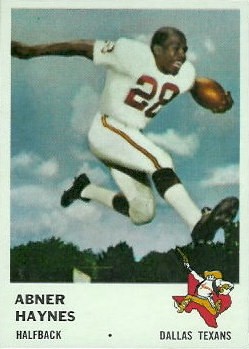
1961: Abner Haynes Scores 5 TDs as Texans Defeat Raiders


The Dallas Texans were in the midst of a disappointing season in the American Football League’s second year as they hosted the Oakland Raiders at the Cotton Bowl on November 26, 1961. The club had gone 8-6 in the inaugural ’60 season and had plenty of talent and an able head coach in Hank Stram. The Texans had hoped to challenge the Chargers for supremacy in the Western Division, but after a promising 3-1 start, they had lost six straight games coming into the contest against Oakland.

QB Cotton Davidson lacked accuracy and consistency, and the loss of FB Jack Spikes in the sixth game had hurt the inside running game. It was one of several injuries that had exposed issues with the club’s depth. Still, the team had HB Abner Haynes, an exciting multi-purpose talent who could run, catch, and return kicks equally well. Haynes had been suffering from a shoulder injury at the beginning of the season, but was now healthy – as Oakland would find out.

The Raiders were a 2-8 basket case. After losing their first two games by a combined score of 99-0, Eddie Erdelatz was fired as head coach and replaced by assistant Marty Feldman. It didn’t help much, but Oakland had given the Texans a tough contest in their earlier meeting (Feldman’s first game). The offense, led by capable QB Tom Flores, lacked enough punch and the defense had too many holes. It didn’t help that the situation with the front office was chaotic and the club played its home games across the bay from Oakland in San Francisco. The first meeting had been a back-and-forth struggle, but not this one.

There were 14,500 fans present at the Cotton Bowl as the Texans scored on their first possession. Davidson threw a pass to HB Johnny Robinson for a 30-yard touchdown and quick 7-0 lead. They never looked back.

Later in the first quarter, Haynes caught a pass from Davidson and went 66 yards for his first touchdown. In the second quarter, following a 65-yard run by FB Bo Dickinson, Haynes ran for a five-yard TD and Dallas was up by 21-0.

Meanwhile, Oakland’s offense reached the Dallas seven in the first quarter and came up empty, and a drive to the 11 in the second quarter also ended up without a score. George Fleming finally kicked a 45-yard field goal just before halftime, making it 21-3, but missed on three other attempts.

In the third quarter, Haynes accounted for all but seven of 61 yards in a drive that ended with the fleet halfback scoring from the one. He scored twice more in the same period, first on a 33-yard run over right tackle (followed by a successful two-point conversion) and then a 26-yard carry to the left side.

With the game well in hand at 43-3, Haynes sat out most of the fourth quarter, but did have a 25-yard run to finish off his day. Most of his successful runs came on pitchouts, giving him room to fake out defenders on the flanks.

Flores was relieved in the third quarter. Backup QB Nick Papac finally got the Raiders into the end zone in the fourth quarter with a quarterback sneak and they successfully converted for two points, providing the final score of 43-11.

The Texans piled up 495 yards, to 254 for the Raiders, with 284 on the ground and 228 through the air (147 by Davidson and 81 by backup Randy Duncan). Bo Dickinson, thanks to the long run in the second quarter, gained 79 yards on six carries and split end Chris Burford had a good performance with four catches for 68 yards. But the star of the game was Abner Haynes, who rushed for 158 yards on 14 carries with four touchdowns and caught two passes for 84 yards and a TD, thus accounting for 242 yards from scrimmage.

The touchdown and rushing yardage totals set new records for the young AFL. Haynes broke his old mark of 157, set against the New York Titans in ’60. He had also shared the old record for touchdowns in a game with three.

The 6’0”, 185-pound Haynes had been an unknown coming out of North Texas State in 1960, passing up offers from the NFL’s Pittsburgh Steelers and CFL’s Winnipeg Blue Bombers to sign with the new team in his native state of Texas. He made a huge impact in the AFL’s first season, leading the league in rushing with 875 yards on 156 carries (5.6 avg.) and punt returning with a 15.4 average on 14 returns. He also caught 55 passes for 576 yards and scored a total of 12 touchdowns while piling up 2100 all-purpose yards. For his efforts, he was named AFL Player of the Year by the Associated Press and UPI.

Haynes, considered the new league’s first home-grown star, had a distinctive running style, with deceiving speed and shiftiness – and a habit of carrying the football in his hand like a loaf of bread (he led the league with 11 fumbles).

The Texans ended the season on a high note, winning their last two games, for a 6-8 record that placed them second in the Western Division – well behind the Chargers. Oakland had the league’s worst record at 2-12.

Abner Haynes, despite missing three games, still finished third among the AFL’s rushers with 841 yards; his nine TDs on the ground tied for first (with San Diego’s Paul Lowe). He caught 34 passes for 558 yards and three more scores and ranked fourth with a 10.3 punt returning average. Haynes returned a kickoff for a TD, one of 13 on the year. His 1399 yards from scrimmage ranked third in the AFL and 1865 all-purpose yards ranked second.