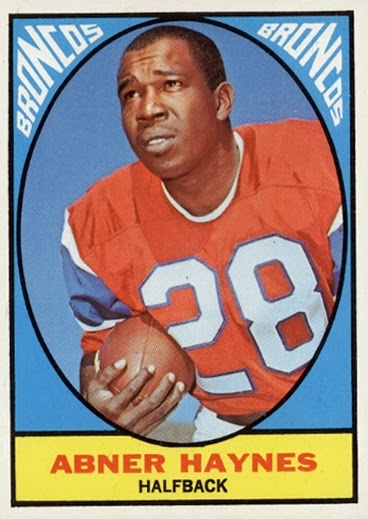
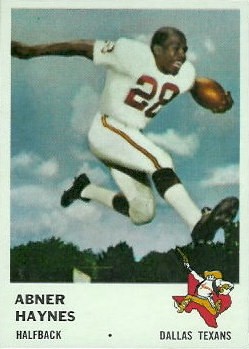
Showing posts with label Abner Haynes. Show all posts

September 8, 2015

1962: Haynes Scores 4 TDs as Texans Defeat Patriots


The Dallas Texans opened the 1962 American Football League season on September 8, hosting the Boston Patriots. Owned by league founder Lamar Hunt and coached by Hank Stram, the Texans finished second in the Western Division in each of the AFL’s first two campaigns, most recently posting a disappointing 6-8 record in ’61. Dynamic all-purpose HB Abner Haynes (pictured above) was the star on offense, with FB Jack Spikes providing solid power running when healthy, and the defense was effective, especially at linebacker. The big change for ’62 was at quarterback, where veteran Cotton Davidson had been found wanting and was being replaced by Len Dawson, an ex-Purdue star who had been a disappointment in the NFL. Under the tutelage of Stram, who had been Dawson’s backfield coach in college, it was hoped that he would provide the necessary upgrade.

Boston was coming off of a 9-4-1 record the previous year. The Patriots played their best after Mike Holovak was promoted to head coach during the season and he remained at the helm.  32-year-old QB Babe Parilli, who had split time with Butch Songin in 1961, now had the starting job to himself and there was talent around him on offense, including flanker Gino Cappelletti, a reliable, if not speedy, receiver who was also a productive placekicker.

There were 32,000 fans in attendance for the Saturday night game at the Cotton Bowl. The teams traded punts until late in the opening period, when the Texans put together a long drive of 86 yards in 15 plays that stretched into the second quarter. Len Dawson converted a third-and-six situation with a pass to TE Fred Arbanas for 25 yards and Abner Haynes and Jack Spikes ran effectively. Haynes finished the series off with a dive into the end zone from two yards out for a touchdown and Tom Pennington added the extra point.

The Patriots responded with a seven-play, 70-yard possession. Babe Parilli threw to split end Jim Colclough for 13 yards on a third-and-ten play and connected with FB Larry Garron for 22 yards to the Dallas 35. A 19-yard run by Garron had ten more yards tacked on due to a roughness penalty called on the Texans and two plays later Parilli passed to TE Tony Romeo (pictured at right) for an 11-yard TD. Gino Cappelletti kicked the point after to tie the score at 7-7.

DB Dave Grayson returned the ensuing kickoff 41 yards to the Boston 49. Haynes gained 11 yards on two carries to start the series and a pass interference penalty picked up ten more yards. A running play was followed by a Dawson pass to split end Chris Burford for 21 yards and two plays later Dawson found Burford again in the corner of the end zone for a five-yard touchdown. Pennington converted and the Texans were back in front by 14-7.


Following a punt by the Patriots, Dallas put together an 82-yard scoring drive in just five plays. Dawson, forced to scramble, ran for 14 yards and HB Frank Jackson (pictured at right) gained 35 yards, showing off good moves in the open field. After an incomplete pass and delay of game penalty, Jackson rushed for another 13 yards around end and Haynes gained the final 25 yards for a TD in spectacular fashion. Pennington again added the PAT and the home team extended its lead to 21-7.

The Patriots got the ball back with two minutes remaining and Parilli immediately threw to Romeo for 17 yards. A defensive holding penalty advanced the ball to the Dallas 25 and, four plays later, Parilli threw to HB Ron Burton for a pickup of 12 yards to the two yard line. From there Parilli ran the rest of the way, going around end for a TD with 34 seconds left in the first half. Cappelletti added the extra point and the Dallas lead was 21-14 at halftime.

Boston put together a promising drive to start the third quarter but, after reaching the Dallas 38, LB Sherrill Headrick intercepted a Parilli pass. The Texans advanced to their 28 and had to punt and the Patriots again moved the ball well, most notably on a Parilli pass to Cappelletti that gained 21 yards. However the visitors again came up empty when Garron, having grabbed a toss from Parilli in the backfield, was stuffed by Headrick for a 12-yard loss and Cappelletti’s field goal attempt from 46 yards was blocked by CB Duane Wood and recovered by the Texans at the Boston 39. Three plays later, Haynes carried 30 yards for a touchdown, Pennington converted, and instead of the Patriots possibly closing the gap, Dallas was up by 28-14.

A short Boston series resulted in a punt and the Texans were driving as the game headed into the fourth quarter. A sack of Dawson put Dallas in a second-and-22 hole but a completion to Jackson for 32 yards advanced the ball to the Boston 18. The 10-play, 58-yard drive concluded with Dawson throwing to Haynes in the end zone for a nine-yard TD, his fourth of the day. Once more Pennington booted the point after and the Texans were seemingly in control by a score of 35-14.

The Patriots responded with a quick tally, going 66 yards in three plays. Parilli completed passes to Colclough for 22 yards and Burton for 29, and Garron ran the last 15 yards for a touchdown. Cappelletti added the PAT to narrow the Dallas margin to 35-21.

A penalty and a sack forced the Texans to have to punt from their own seven on the next series, and Boston started off with excellent field position at the Dallas 35. Parilli threw to Romeo for 32 yards and Burton ran for a three-yard TD.  Cappelletti’s extra point made the game close at 35-28 with 5:25 remaining on the clock.

Starting from their 19 after the ensuing kickoff, the Texans went 81 yards in nine plays to settle the issue. A 15-yard personal foul on the Patriots on a second-and-eight play helped move Dallas along, Haynes had four carries for 21 yards, and Dawson completed a pass to split end Bill Miller for 30 yards. Jackson ran for an eight-yard touchdown with 33 seconds left, Pennington kicked the point after, and Dallas won by a final score of 42-28.

The Texans led in total yards (421 to 322), with 265 of that total coming on the ground, and first downs (27 to 22). Boston recorded five sacks to one by the home team, but also suffered the game’s only turnover. Both teams were penalized seven times apiece.

Abner Haynes was the headliner for the Texans with 122 yards on 19 carries that included three touchdowns and three catches for 14 yards and a fourth TD. Not to be overlooked, Len Dawson had a solid performance as he completed 16 of 23 passes for 202 yards and two touchdowns with no interceptions, and also ran for 32 yards on four carries. Additionally, Frank Jackson ran for 72 yards on 9 attempts that included a TD and gained another 32 yards on his one pass reception. Bill Miller caught 6 passes for 72 yards and Chris Burford contributed 5 receptions for 59 yards and a score.


For the Patriots, Babe Parilli was successful on 16 of 31 throws for 214 yards and a TD while giving up one interception. Larry Garron ran for 48 yards and a touchdown on five carries, had three catches for 18 yards, and averaged 28.0 yards on three kickoff returns. Tony Romeo (pictured at left) caught 5 passes for 84 yards and a TD.
   
Len Dawson’s performance emboldened owner Lamar Hunt to trade former starting QB Cotton Davidson to Oakland. The vote of confidence proved to be justified as the Texans went 11-3 to top the Western Division and defeat Houston for the AFL Championship. Boston won its next three contests before dropping the rematch to Dallas. The Patriots contended in the Eastern Division, finally ending up second to the Oilers at 9-4-1.

The opening-game performance by Abner Haynes launched a season in which he led the league with 19 touchdowns and finished second in rushing (1049 yards) and all-purpose yards (1768). He was a consensus All-AFL selection. Len Dawson received AFL Player of the Year honors from The Sporting News, leading the circuit in touchdown passes (29), completion percentage (61.0), yards per attempt (8.9), and overall passing (98.3 rating). 

October 30, 2014

1960: Texans Edge Broncos as Late Field Goal Attempt Fails


The Dallas Texans of the new American Football League were coming off of three straight losses and had a 2-4 record as they faced the Denver Broncos on October 30, 1960. Owned by the league’s founder, Lamar Hunt, and coached by Hank Stram, the Texans had a good defense and an exciting all-purpose weapon on offense in rookie HB Abner Haynes (pictured above). Split end Chris Burford was good, too, but QB Cotton Davidson lacked consistency and passing accuracy.

Denver, coached by Frank Filchock, was less talented overall but had a better record at 4-2. QB Frank Tripucka, a 32-year-old CFL veteran, directed the attack with little ground support (especially at fullback), other than ex-Green Bay HB Al Carmichael. Unheralded end Lionel Taylor was coming on as a possession receiver.

It was a cold, clear day at Bears Stadium with 13,002 fans in attendance. The Texans took the opening kickoff and drove into Denver territory with Abner Haynes and FB Jack Spikes running effectively. But facing second-and-11 at the 17, Cotton Davidson’s deflected pass was intercepted by safety Al Romine. However, Dallas got the ball back two plays later when Al Carmichael fumbled and LB Ted Greene recovered at the Denver 37. The Texans didn’t come up empty, scoring in four plays. The biggest was a screen pass from Davidson to Haynes that covered 34 yards and Spikes scored a touchdown standing up from a yard out. Spikes, who doubled as placekicker, added the extra point and the visitors led by 7-0.

The teams exchanged punts before the Broncos put together a 61-yard drive in three plays. Frank Tripucka threw to end Lionel Taylor for 14 yards and, after another long pass was almost picked off, Carmichael (pictured below), making up for the earlier fumble, broke away for a 47-yard TD. Gene Mingo converted to tie the score.


As the game moved into the second quarter, a three-and-out series by the Texans ended with a punt and the Broncos did the same. However, DB Clem Daniels fumbled the kick and OT Eldon Danenhauer recovered for Denver at the Dallas 31. Tripucka completed passes to Gene Mingo, a halfback as well as kicker, and Carmichael to reach the 16, but Taylor lost two yards on an end-around and Tripucka’s next two aerials were overthrown. Mingo attempted a 26-yard field goal that was wide to the right and the home team came up empty.

The clubs again traded punts before the Texans put together an eight-play, 64-yard drive. Haynes ran the ball five times for 19 yards and caught a swing pass for another ten, and his last carry of three yards was good for a touchdown. Spikes added the point after to put Dallas back in front by 14-7.

The Broncos drove into Dallas territory on their next series. Tripucka passed to Mingo for 18 yards to midfield on a third-and-eight play and two defensive holding penalties on the Texans helped keep the drive alive. But after reaching the 24, HB Bob Stransky fumbled after catching a pass and DT Ray Collins recovered for Dallas. The first half ended with Dallas still in front by seven.

Denver started the third quarter off with a short possession and punted. Starting from their 20, the Texans moved methodically down the field. Davidson threw to Chris Burford for 15 yards to convert a third-and-seven situation and, after Haynes and Spikes ran the ball to the Denver 22, Davidson completed a third-down pass to Haynes for 14 yards to give the visitors a first-and-goal at the eight. Davidson’s first down pass was incomplete, but he connected with Haynes on second down for a five-yard gain to the three.  Spikes plowed down to the one and, electing to go for it on fourth down, Davidson kept the ball on a quarterback sneak but was stopped a foot short of the goal line.

The Broncos ran three times and punted, and the Texans regained possession at the Denver 49. Once again the Texans chipped away as Spikes gained eight yards and Haynes six. Davidson threw to Burford for a 25-yard gain to the ten yard line but the drive stalled at the four and Spikes booted an 11-yard field goal. Dallas was now up by 17-7.

On Denver’s second play following the ensuing kickoff, Tripucka’s pass was intercepted by Daniels at the Broncos’ 26. However, the opportunity for the Texans to pad the lead was lost when Haynes fumbled and DE Chuck Gavin recovered for the Broncos at the Denver 16.

On the first play of the fourth quarter, a Tripucka bomb was intercepted by CB Duane Wood at the Dallas 10. The Texans picked up nine yards and punted, but retained possession when Carmichael fumbled and OT Jerry Cornelison recovered at his 42. Two plays later, CB John Pyeatt intercepted a throw by Davidson to give the Broncos the ball at their 24.

It didn’t look promising when Tripucka was sacked on first down by DE Paul Miller for a ten-yard loss, but after Mingo gained back four yards, on third-and-16 Tripucka threw to Carmichael for 22 yards. Carmichael picked up another five yards shortly thereafter and then Tripucka connected with HB Bob McNamara on a play that covered 55 yards for a touchdown. Mingo converted and the Broncos were now three points behind with 8:48 to play.

The Texans managed to convert two third downs as they ran the clock down to just over three minutes on their next series, but after reaching the Denver 47 they had to punt. Tripucka came out throwing, completing six passes, two of them on third down plays, to get the Broncos to the Dallas 21. McNamara dropped a pass at the 15 and Carmichael lost a yard on a draw play, setting up a 29-yard game-tying field goal attempt by Mingo. The kick was wide to the left and Dallas came away with a 17-14 win.

The Texans had the edge in total yards (308 to 302) and first downs (19 to 13). Denver turned the ball over five times, to four suffered by Dallas, while the Broncos recorded four sacks, to two by the Texans.

Abner Haynes was typically productive in his all-purpose role, rushing for 81 yards on 27 carries that included a touchdown, catching 7 passes for 96 yards, and returning two kickoffs for 38 yards. Cotton Davidson completed 12 of 23 throws for 187 yards and gave up two interceptions. Chris Burford contributed 78 yards on four pass receptions. Jack Spikes (pictured below) gained 50 yards on 18 rushes that included a TD and also kicked a field goal in addition to both extra points.


For the Broncos, Frank Tripucka was successful on 14 of 31 aerials for a TD as well as two interceptions. Al Carmichael ran for 61 yards on six attempts that included a touchdown and also caught three passes for 40 yards. Gene Mingo had a team-leading four receptions for 50 yards in addition to 42 rushing yards on 8 attempts, but missed both of his field goal tries. Bob McNamara had the most receiving yards with 55 on his lone scoring catch.

The team’s fortunes shifted as the season continued. Dallas went on to win its next two games, including the rematch with the Broncos, and finished strong for an overall 8-6 record that placed second in the Western Division. Meanwhile, Denver didn’t win another game, while tying one, and ended up at the bottom of the division at 4-9-1.

Abner Haynes had a spectacular first year, leading the AFL in rushing with 875 yards on 156 carries (5.6 avg.) and in all-purpose yards (2100) thanks to his team-leading 55 catches for 576 yards, 215 yards on 14 punt returns (a league-leading 15.4 avg.), and 19 kickoff returns that totaled 434 yards. He scored 12 touchdowns and was named AFL Player of the Year by UPI.

Al Carmichael ran for 211 yards on 41 attempts (5.1 avg.) and added 616 yards on 32 pass receptions (19.3 avg.), scoring a total of seven TDs, before a leg injury ended his season in the tenth game. Gene Mingo had better kicking performances as he led the AFL with 18 field goals, a 64.3 field goal percentage, and 123 points. Frank Tripucka led the league in pass attempts (478), completions (248), and yards (3038), but also interceptions (34). 

January 20, 2014

1965: Broncos Obtain Abner Haynes from the Chiefs


On January 20, 1965 the Kansas City Chiefs traded HB Abner Haynes straight-up to the Denver Broncos for LB/P Jim Fraser.

Haynes was considered the American Football League’s first home-grown star. A native Texan, he had played college football at North Texas State, where he was an outstanding performer. The Dallas Texans of the new league won a bidding war with the NFL’s Pittsburgh Steelers and Winnipeg of the CFL to get him for the 1960 season, and were rewarded when Haynes led the AFL in rushing (875 yards), punt returns (15.4 avg.), and all-purpose yards (2100). At 6’0” and 185 pounds, he was fairly small and lacked power, but was fast and shifty with excellent running instincts. He was a fine receiver out of the backfield (55 catches, 576 yards) and kick returner as well as runner from scrimmage. With his tendency to hold the ball away from his body when running, he was also prone to fumbling, but he made up for it with his exciting all-around play and quickly became a favorite of the fans. Haynes was named AFL Player of the Year as well as Rookie of the Year for ’60.

He continued to be an outstanding performer in 1961 and ’62, the latter being his greatest season. He rushed for over a thousand yards (1049) and led the league in yards from scrimmage (1622) and touchdowns (19). The Texans won the AFL Championship in a game that featured Haynes starting off at flanker before moving back to halfback and scoring a touchdown on a pass play. Dallas won in overtime, although Haynes nearly was the goat when, after winning the coin toss for OT, as a captain for the team he mistakenly elected to kick rather than choose an end of the field to defend, as instructed by Coach Hank Stram due to the windy weather conditions. Fortunately, it didn’t cost the Texans the game and Haynes crowned an outstanding three years in Dallas with being member of a Championship team.

The franchise may have achieved the pinnacle of success in Dallas, but had lost money in competition with the NFL’s Cowboys. Owner Lamar Hunt moved it to Kansas City, where the team was rechristened the Chiefs. However, during the preseason, a tragedy occurred which profoundly affected the team, and in particular Haynes. HB Stone Johnson, a sprinter with tremendous speed, was drafted by the Chiefs and suffered a fatal neck injury while attempting a tackle on a preseason kickoff return. Haynes had befriended the younger player and Johnson’s death had a profound effect on him. His style of play was more restrained and, in what became a lesser season for the entire club, Haynes rushed for just 352 yards on 99 carries (3.6 avg.) and his overall total of 1196 yards was well below his prior standards.

Haynes bounced back somewhat from the bad year in 1963 with 697 rushing yards on 139 attempts, 562 more yards on 38 catches, and a total of 1548 all-purpose yards in ’64. He was shifted to split end at the beginning of the year, when veteran Chris Burford was injured, but moved back to halfback with good results.

However, Haynes felt he was not being used properly by the Chiefs and welcomed the trade, saying “I think it will be better for me and for Kansas City.” The Chiefs were looking for depth at linebacker, especially after star MLB E.J. Holub underwent knee surgery. In addition, rookie FB Mack Lee Hill had played well, in addition to HB Bert Coan, which factored in the decision to deal Haynes.


As for the 28-year-old Jim Fraser (pictured at left), he had led the AFL in punting average for two straight years while also starting at outside linebacker. In Kansas City he was strictly a backup at linebacker and unneeded as a punter, with Jerrel Wilson ably handling that department. After one season, he was traded once again, this time to the Patriots.

The Broncos had been a perennially lackluster team and the trade for Haynes, along with a deal that brought in the temperamental but highly talented FB Cookie Gilchrist from Buffalo, was part of an effort to revive the franchise. Haynes was expected to compete with HB Charley Mitchell, who was coming off a good year in ’64, gaining 815 yards from scrimmage (590 rushing, 225 pass receiving). But it was HB Wendell Hayes who had an outstanding rookie year in ’65 and relegated Haynes to a backup role (Mitchell missed virtually the entire season with a thigh injury). Haynes ran the ball just 41 times for 166 yards (4.0 avg.) and caught 26 passes for 216 yards. He had a bigger impact as a kick returner, running back 34 kickoffs for 901 yards and a league-leading 26.5 average and also averaging 8.6 yards on 14 punt returns that included a touchdown.

Haynes moved back into the starting lineup in 1966 when Hayes was shifted to fullback. His rushing numbers were unimpressive as he gained just 304 yards on 129 carries for a 2.4-yard average. However, as a receiver out of the backfield he led the club with 46 pass receptions, gaining 480 yards. He was used less often as a kick returner, but still averaged 11.9 yards on 10 punt returns and had a total of 1132 all-purpose yards. On the downside, he also led the AFL by fumbling 11 times.

With the arrival of HB Floyd Little, the All-American out of Syracuse who was taken by the Broncos in the first round of the ’67 combined AFL/NFL draft, Haynes was dealt to the second-year Miami Dolphins. He had a big day in the season-opening game, which happened to be against Denver, and ran for 151 yards on 12 carries (his only hundred-yard rushing performance after leaving the Chiefs). However, he was used sparingly thereafter and was waived 11 games into the season. The Jets picked him up to shore up an injury-depleted backfield, but he saw little action and, at age 30, retired following the season.

An electrifying performer in his early years, Haynes showed flashes of that form in his two years in Denver. But with a poor team (the Broncos went 4-10 in each season), and no longer able to produce with the same consistency, his time in Denver was largely undistinguished. He left the AFL after having gained a career total of 12,065 all-purpose yards, 2536 of which were generated with the Broncos.

October 16, 2013

1966: Dolphins Defeat Broncos for Franchise’s First Win


As an American Football League expansion team, the Miami Dolphins were going through the typical growing pains in their inaugural season. They were 0-5 as they hosted the Denver Broncos on October 16, 1966. Head Coach George Wilson’s team was the usual first-year grouping of unwanted veterans and inexperienced young players. Quarterback was a problem area as veteran Dick Wood was found wanting and the coach’s son, George Wilson Jr., was getting a shot. Fullback was another problem area, as Billy Joe (pictured above), formerly of the Broncos and Bills, did not appear to be the answer. Coach Wilson had considered starting ex-Bears FB Rick Casares, but he missed the team’s Saturday practice and lost his starting chance. The defense had been the more impressive unit thus far, but even then the new team had suffered some bad defeats.

The Broncos were 7.5-point favorites coming into the game, although they were hardly any better. They were 1-4 and had already undergone a coaching change with Mac Speedie resigning after the second game and assistant coach Ray Malavasi taking his place. They also had problems at quarterback, where injury-prone John McCormick was starting. HB Abner Haynes’ best years were behind him, as were split end Lionel Taylor’s, and they were missing FB Cookie Gilchrist, highly productive in 1965 but who was holding out (and, as rumored at the time of the game in Miami, was about to be dealt to the Dolphins). The team that seemed constantly to be in rebuilding mode had 17 rookies on the roster.

There were 23,393 fans in attendance at the Orange Bowl. The teams traded punts to start the first quarter. On their second series, a well-executed screen pass from George Wilson Jr. to Billy Joe resulted in a 67-yard touchdown. Gene Mingo added the extra point to give the Dolphins the early 7-0 lead.

It immediately got worse for the Broncos when Abner Haynes fumbled the ensuing kickoff and TE Bill Cronin recovered for the Dolphins at the Denver 20. Three plays later, Mingo added more points with a 25-yard field goal.

Neither team was able to move effectively until the Broncos got a break when Miami HB Joe Auer fumbled the ball away at his own 22. John McCormick completed a pass to TE Al Denson and Haynes finished off the ensuing series with a five-yard touchdown carry. Gary Kroner added the extra point to narrow Miami’s lead to 10-7.

Heading into the second quarter, neither team was able to get out of its own end of the field. The Dolphins nearly scored again on a long carry by Joe in the second quarter, but a 62-yard run down the sideline was nullified by an illegal use of hands penalty. However, three plays later Miami got another big play when Wilson threw to flanker John Roderick for a 64-yard gain to the Denver six, but another Auer fumble that LB Archie Matsos recovered for the Broncos ended their chance to score again.

Neither team moved the ball to start the third quarter and Denver’s second series concluded with McCormick being intercepted by LB Tom Erlandson, giving the Dolphins possession at the Broncos’ 37. On the second play, Wilson took off for a 19-yard run and six plays later Auer scored a touchdown from a yard out. Mingo’s PAT extended the home team’s lead to 17-7.

The Broncos again fumbled the ball away on the ensuing kickoff, but the Dolphins fumbled it back to them two plays later. 38-year-old QB Tobin Rote relieved McCormick. Rote had played for Miami’s Coach Wilson in Detroit, made successful stops in the CFL and San Diego in the intervening years, and was lured out of retirement by the Broncos.  With the old pro at the helm, the Broncos reached the Miami 49 before Rote was sacked on consecutive plays for losses totaling 18 yards. Denver once again had to punt the ball away as the game entered the fourth quarter.

Both teams remained stymied on offense and McCormick re-entered the game, only to be intercepted on consecutive possessions by CB Dick Westmoreland. The second gave the Dolphins the ball at the Denver 16 and, four plays later, Auer ran for another TD from three yards out. With less than two minutes remaining on the clock, it only served to further bury the visitors as Miami came away with a 24-7 win.

In a game in which both teams had difficulty sustaining drives, the Dolphins outgained Denver (217 yards to 118) although the Broncos had the edge in first downs (11 to 10). Denver turned the ball over six times, to four suffered by Miami, and the Dolphins, who had recorded only two sacks in their previous games, had five, as opposed to three by the Broncos.

George Wilson Jr. (pictured below, handing off to Joe Auer) completed 9 of 18 passes for 176 yards and a touchdown with one intercepted; he also rushed for 21 yards on three carries. Billy Joe had only 15 rushing yards on 11 attempts, but caught three passes for 60 yards and the big first quarter touchdown. TE Dave Kocurek had four catches for 46 yards while John Roderick led the Dolphins in receiving yards with 64 on his lone reception. Joe Auer rushed for 32 yards on 17 carries that included two touchdowns, but he also had problems with fumbling. Defensively, DE Ed Cook unofficially was in on three of the sacks, DT Al Dotson, recently reactivated, was in on two along with his eight tackles and three assists, and Dick Westmoreland had the two fourth quarter interceptions.


For the Broncos, John McCormick had a dismal passing performance as he was successful on just 9 of 25 throws for 90 yards and gave up four interceptions. Tobin Rote was one-of-two for 12 yards and was sacked four times. Abner Haynes gained 38 rushing yards on 14 carries that included a TD and also caught three passes for 28 yards. Lionel Taylor also had three pass receptions, for 45 yards.

“We felt we could win this one before the game and they went out and did a fine job,” said Coach George Wilson of his team in the jubilant locker room. “The defense was great. Billy Joe’s was the big play (the 67-yard touchdown in the first quarter). It was a hell of a call.”

“When you get a taste of honey, you’re like a snowball going downhill,” said an elated Billy Joe. “You can throw all those mistakes of the past out the window. We got the momentum now.”

The Dolphins won again the next week at Houston but lost the remainder of their games until the season finale to finish at 3-11 and tied with the Oilers at the bottom of the Eastern Division. Denver continued to struggle and ended up last in the Western Division with a 4-10 record.

George Wilson Jr. was the starting quarterback for two of Miami’s wins but went down with an injury. As it was, he completed only 41.1 percent of his passes for 764 yards with five touchdowns and 10 interceptions. Billy Joe, who fell by the wayside following Cookie Gilchrist’s arrival, rushed for 232 yards on 71 carries (3.3 avg.) and caught 13 passes for 116 yards and the long touchdown against the Broncos – his only one of the season. Joe Auer led the team in rushing with 416 yards, caught 22 passes for 263 more yards, and led the club with nine touchdowns.

September 10, 2013

1960: Chargers Come From Behind to Defeat Texans


On September 10, 1960 two of the most highly-regarded teams in the new American Football League made their regular season debut at the Los Angeles Memorial Coliseum.

The Los Angeles Chargers were coached by Sid Gillman, the most experienced of the new circuit’s head coaches as he had previously led the NFL Rams and had one Western Conference title under his belt. LA had signed a fair amount of good young talent, some with pro experience, including QB Jack Kemp (pictured above) who had brief stints in the NFL and CFL after coming out of Occidental.

The visiting Dallas Texans were owned by AFL founder Lamar Hunt and coached by Hank Stram, a highly-regarded college assistant who had most recently been at Purdue. The team had a distinctively Lone Star State composition, starting with QB Cotton Davidson, formerly of Baylor, and including rookie FB Jack Spikes from TCU and quick-footed HB Abner Haynes of North Texas State. Dallas rolled impressively through the preseason without a loss.

There were 17,724 in attendance for the Saturday night game. The Texans went three-and-out on their first possession and Los Angeles fumbled the ball away to end its first series. Taking over at the LA 42, Dallas advanced to the 20 but a 27-yard field goal attempt by Jack Spikes was no good.

Following a punt by the Chargers, the Texans drove 60 yards in eight plays. They ran the ball effectively and Cotton Davidson completed three passes, including one for 16 yards to end Max Boydston and a 12-yard touchdown throw to end Chris Burford. Spikes missed the extra point try and the score remained 6-0 heading into the second quarter.

Following another LA punt early in the period, Dallas, starting from its own six yard line, put together a long drive. The Texans converted four third downs as Davidson completed four passes and ran for three yards on a quarterback sneak. Spikes ran for a touchdown from a yard out and this time was successful in adding the PAT. The visitors were ahead by 13-0.

The teams traded punts before the Chargers came through with a big play. Jack Kemp connected with end Ralph Anderson for a 46-yard TD and, with Ben Agajanian’s extra point, the Dallas lead was cut to six points.

The Texans responded by going 80 yards in 12 plays. Davidson (pictured below) started off with a screen pass to Abner Haynes that gained 17 yards and followed up with a throw to Boydston to the LA 47. With time running out in the half, Davidson primarily kept the ball in the air. Spikes ran for three yards to convert a fourth-and-one at the LA 26 and three plays later Davidson passed to Haynes for a 17-yard touchdown. Spikes again converted the extra point and the score stood at 20-7 in favor of Dallas at the half.


The Chargers went three-and-out to start the third quarter and again the Texans drove into scoring position. Reaching the LA 22, Dallas lined up to attempt a field goal but a bad snap sailed past holder Hunter Enis and gave Los Angeles the ball at the Dallas 49. However, the Chargers were unable to capitalize when their drive reached the 29 and Agajanian’s try for a field goal was blocked.

Following a punt by the Texans, the Chargers advanced to the Dallas eight. But HB Paul Lowe was stopped for no gain, Kemp tossed two incomplete passes, and on fourth-and-goal Kemp was sacked to end the threat. The Dallas lead appeared to be safe heading into the fourth quarter.

The Texans again punted and the Chargers took over at their 32. Kemp completed three straight passes to get the ball into Dallas territory. It seemed as though LA would again come up empty when Kemp threw an incomplete pass on a fourth-and-two play at the Dallas 43, but the Texans were called for pass interference and the series kept going. Lowe ran for seven yards and then tossed an option pass to Anderson for 24 yards to the eight yard line. Three plays later Kemp scrambled for a seven-yard touchdown and Agajanian’s extra point made the tally 20-14.

The Texans went three-and-out on their next possession and punted once more but had the Chargers backed up to their ten yard line. LA used 15 plays to cover the 90 yards. Along the way, a Kemp fumble was erased by a penalty on the Texans and a third-and-15 situation was converted when Kemp connected with flanker Royce Womble for a 36-yard gain to the Dallas 41. Again a pass interference penalty on a fourth-down play kept the Chargers alive and Kemp finally tossed a four-yard scoring pass to FB Howie Ferguson. Agajanian’s critical extra point try was successful and Los Angeles was ahead by one with just over two minutes remaining on the clock. The Texans still had a chance but Davidson threw an interception to seal the 21-20 win for the Chargers.

Los Angeles outgained the Texans (354 yards to 294) and had the edge in first downs (22 to 21). Each team turned the ball over once, although the Texans were penalized seven times to two flags thrown on the home team.

Jack Kemp completed 24 of 41 passes for 275 yards and two touchdowns with none intercepted; he also ran the ball 7 times for 19 yards and a TD. Royce Womble caught 7 passes for 92 yards and Ralph Anderson gained 103 yards on 5 receptions that included a score. Unheralded HB Paul Lowe led the ground game with just 20 yards on 8 carries while Howie Ferguson was right behind with his 19 yards on 8 attempts.

For the Texans, Cotton Davidson was successful on 22 of 40 throws for 230 yards and two TDs with one interception. Jack Spikes (pictured below) ran for 62 yards on 9 carries and scored a touchdown. Abner Haynes only rushed for 15 yards on three attempts but had 7 pass receptions for 62 yards and a score.


The Chargers lost their next two games and were 2-3 before winning eight of their last nine and topping the Western Division at 10-4. They lost the AFL title game to the Houston Oilers. They also relocated to San Diego for the 1961 season, having failed to draw in Los Angeles despite having an exciting offensive team.

Jack Kemp led the AFL in passing and was an All-League selection, throwing for 3018 yards and 20 touchdowns. Paul Lowe would carry more of the load on offense as the season progressed and finished second in the league with 855 rushing yards.

Dallas finished second in the division at 8-6. Abner Haynes ended up not only being Rookie of the Year but Player of the Year as well as he paced the AFL in rushing with 875 yards and in all-purpose yards with 2100. 

March 5, 2012

MVP Profile: Abner Haynes, 1960

Halfback, Dallas Texans


Age: 23 (Sept. 19)
1st season in pro football
College: North Texas State
Height: 6’0” Weight: 185

Prelude:
The fledgling Texans signed Haynes for the new AFL, winning a bidding war against the NFL Steelers, who drafted him in the fifth round of that league’s draft, and Winnipeg of the CFL. An unheralded small college star, he was an evasive all-purpose runner and quickly became the AFL’s first home-grown star.

1960 Season Summary
Appeared in all 14 games
[Bracketed numbers indicate league rank in Top 20]

Rushing
Attempts – 156 [1]
Most attempts, game - 27 (for 81 yds.) at Denver 10/30
Yards – 875 [1]
Most yards, game – 157 yards (on 11 carries) at NY Titans 11/24
Average gain – 5.6 [2]
TDs – 9 [1]
100-yard rushing games - 2

Pass Receiving
Receptions – 55 [5]
Most receptions, game – 7 (for 62 yds.) at LA Chargers 9/10, (for 96 yds.) at Denver 10/30
Yards – 576 [15]
Most yards, game - 96 (on 7 catches) at Denver 10/30
Average gain – 10.5
TDs – 3

Passing
Pass attempts – 1
Pass completions – 0
Passing yards – 0
TD passes – 0
Interceptions – 0

Kickoff Returns
Returns – 19 [6, tied with Ken Hall]
Yards – 434 [7]
Most yards, game – 111 at Buffalo 11/6
Average per return – 22.8 [8]
TDs – 0
Longest return – 82 yards

Punt Returns
Returns – 14 [2, tied with Johnny Robinson]
Yards – 215 [1]
Most yards, game – 74 vs. NY Titans 10/2
Average per return – 15.4 [1]
TDs – 0
Longest return – 46 yards

All-Purpose yards – 2100 [1]

Scoring
TDs – 12 [2, tied with Bill Groman & Lionel Taylor]
Points – 72 [7, tied with Bill Groman & Lionel Taylor]

Awards & Honors:
AFL Player of the Year: AP, UPI, Sporting News
1st team All-AFL: League, AP, UPI

Texans went 8-6 to finish second in the AFL Western Division while placing second in the league in rushing yards (2007).

Aftermath:
Haynes followed up his outstanding rookie year with 1899 all-purpose yards in 1961, including 841 rushing for a league-leading 9 TDs and 4.7 yards per carry, and 34 pass receptions for 558 more. He was selected to the first AFL All-Star Game. In ’62 he ran for 1049 yards and again had the most rushing TDs with 13, as well as the most TDs overall with 19, and also topped the AFL with 1622 yards from scrimmage as the Texans won the AFL title. Haynes was a consensus first-team All-AFL selection and was again chosen for the league’s All-Star contest. The franchise became the Kansas City Chiefs in 1963, but had a losing record and Haynes suffered a significant drop in production. The death of rookie HB Stone Johnson, who suffered a broken neck during the last preseason game, had a profound effect on Haynes and his style of play lacked the previous excitement. After improving in 1964, gaining a last All-Star selection after running for 697 yards and gaining another 562 on 38 catches, he was traded to the Denver Broncos. Haynes led the AFL in kickoff returns in ’65 (26.5 avg.), but his offensive production dropped again and, prone to carrying the ball away from his body, he led the league in fumbles in 1966 (11). His last season, 1967, was split between the second-year Miami Dolphins and the New York Jets, and while he showed flashes of the old form, the writing was on the wall and he retired. Haynes ended up gaining 12,065 total yards in the AFL (4630 rushing, 3535 receiving, 3025 returning kickoffs, 875 returning punts) and scored a total of 69 touchdowns.

--

MVP Profiles feature players who were named MVP or Player of the Year in the NFL, AAFC (1946-49), AFL (1960-69), WFL (1974), or USFL (1983-85) by a recognized organization (Associated Press, Pro Football Writers Association, Newspaper Enterprise Association, United Press International, The Sporting News, Maxwell Club – Bert Bell Award, or the league itself).

[Updated 2/9/14]

November 26, 2010

1961: Abner Haynes Scores 5 TDs as Texans Defeat Raiders


The Dallas Texans were in the midst of a disappointing season in the American Football League’s second year as they hosted the Oakland Raiders at the Cotton Bowl on November 26, 1961. The club had gone 8-6 in the inaugural ’60 season and had plenty of talent and an able head coach in Hank Stram. The Texans had hoped to challenge the Chargers for supremacy in the Western Division, but after a promising 3-1 start, they had lost six straight games coming into the contest against Oakland.

QB Cotton Davidson lacked accuracy and consistency, and the loss of FB Jack Spikes in the sixth game had hurt the inside running game. It was one of several injuries that had exposed issues with the club’s depth. Still, the team had HB Abner Haynes, an exciting multi-purpose talent who could run, catch, and return kicks equally well. Haynes had been suffering from a shoulder injury at the beginning of the season, but was now healthy – as Oakland would find out.

The Raiders were a 2-8 basket case. After losing their first two games by a combined score of 99-0, Eddie Erdelatz was fired as head coach and replaced by assistant Marty Feldman. It didn’t help much, but Oakland had given the Texans a tough contest in their earlier meeting (Feldman’s first game). The offense, led by capable QB Tom Flores, lacked enough punch and the defense had too many holes. It didn’t help that the situation with the front office was chaotic and the club played its home games across the bay from Oakland in San Francisco. The first meeting had been a back-and-forth struggle, but not this one.

There were 14,500 fans present at the Cotton Bowl as the Texans scored on their first possession. Davidson threw a pass to HB Johnny Robinson for a 30-yard touchdown and quick 7-0 lead. They never looked back.

Later in the first quarter, Haynes caught a pass from Davidson and went 66 yards for his first touchdown. In the second quarter, following a 65-yard run by FB Bo Dickinson, Haynes ran for a five-yard TD and Dallas was up by 21-0.

Meanwhile, Oakland’s offense reached the Dallas seven in the first quarter and came up empty, and a drive to the 11 in the second quarter also ended up without a score. George Fleming finally kicked a 45-yard field goal just before halftime, making it 21-3, but missed on three other attempts.

In the third quarter, Haynes accounted for all but seven of 61 yards in a drive that ended with the fleet halfback scoring from the one. He scored twice more in the same period, first on a 33-yard run over right tackle (followed by a successful two-point conversion) and then a 26-yard carry to the left side.

With the game well in hand at 43-3, Haynes sat out most of the fourth quarter, but did have a 25-yard run to finish off his day. Most of his successful runs came on pitchouts, giving him room to fake out defenders on the flanks.

Flores was relieved in the third quarter. Backup QB Nick Papac finally got the Raiders into the end zone in the fourth quarter with a quarterback sneak and they successfully converted for two points, providing the final score of 43-11.

The Texans piled up 495 yards, to 254 for the Raiders, with 284 on the ground and 228 through the air (147 by Davidson and 81 by backup Randy Duncan). Bo Dickinson, thanks to the long run in the second quarter, gained 79 yards on six carries and split end Chris Burford had a good performance with four catches for 68 yards. But the star of the game was Abner Haynes, who rushed for 158 yards on 14 carries with four touchdowns and caught two passes for 84 yards and a TD, thus accounting for 242 yards from scrimmage.

The touchdown and rushing yardage totals set new records for the young AFL. Haynes broke his old mark of 157, set against the New York Titans in ’60. He had also shared the old record for touchdowns in a game with three.

The 6’0”, 185-pound Haynes had been an unknown coming out of North Texas State in 1960, passing up offers from the NFL’s Pittsburgh Steelers and CFL’s Winnipeg Blue Bombers to sign with the new team in his native state of Texas. He made a huge impact in the AFL’s first season, leading the league in rushing with 875 yards on 156 carries (5.6 avg.) and punt returning with a 15.4 average on 14 returns. He also caught 55 passes for 576 yards and scored a total of 12 touchdowns while piling up 2100 all-purpose yards. For his efforts, he was named AFL Player of the Year by the Associated Press and UPI.

Haynes, considered the new league’s first home-grown star, had a distinctive running style, with deceiving speed and shiftiness – and a habit of carrying the football in his hand like a loaf of bread (he led the league with 11 fumbles).

The Texans ended the season on a high note, winning their last two games, for a 6-8 record that placed them second in the Western Division – well behind the Chargers. Oakland had the league’s worst record at 2-12.

Abner Haynes, despite missing three games, still finished third among the AFL’s rushers with 841 yards; his nine TDs on the ground tied for first (with San Diego’s Paul Lowe). He caught 34 passes for 558 yards and three more scores and ranked fourth with a 10.3 punt returning average. Haynes returned a kickoff for a TD, one of 13 on the year. His 1399 yards from scrimmage ranked third in the AFL and 1865 all-purpose yards ranked second.

December 23, 2009

1962: Dallas Texans Defeat Oilers in Overtime for AFL Championship


It was a gray, blustery day on December 23, 1962 as the Houston Oilers hosted the Dallas Texans in the AFL Championship game at Jeppesen Stadium. The Oilers, champions of the Eastern Division with an 11-3 record, had won the first two league championships and were looking to make it three straight. Under Head Coach Frank “Pop” Ivy, the team’s third coach in spite of their success, Houston had started slowly and was 4-3 at midseason, but won seven consecutive games to complete the regular season and get past the Boston Patriots. 34-year-old veteran QB George Blanda passed for 27 touchdowns, but also threw an astounding 42 interceptions. Stubby FB Charley Tolar (5’7”, 198 pounds) ran for 1012 yards and flanker Charley Hennigan led the receivers with 54 receptions for 867 yards and 8 TDs.

The Dallas Texans, owned by AFL founder Lamar Hunt, easily won the Western Division for the first time, also with an 11-3 tally (the second place Denver Broncos were a distant 7-7). Head Coach Hank Stram benefited from the arrival of QB Len Dawson, who led the league in passing after having ridden the bench in five NFL seasons. The Texans also had a thousand-yard rusher in flashy HB Abner Haynes (1049 yards and 13 TDs) and a well-balanced squad on both sides of the ball.


There were 37,981 fans filling the small stadium as Dallas dominated the first half. After Tommy Brooker booted a 16-yard field goal to give the Texans a 3-0 lead in the first quarter, Haynes (pictured at left) scored twice in the second quarter, first on a 28-yard pass from Dawson and then on a two-yard run. The Texans used two fullbacks in the backfield, Jack Spikes and rookie Curtis McClinton, with Haynes often moving out to the flank, and the combination provided excellent ball control. The half ended with the Texans holding a 17-0 lead.

However, in the second half it was all Houston. Blanda threw a 15-yard TD pass to TE Willard Dewveall in the third quarter and kicked a 31-yard field goal in the fourth period. When Tolar scored from a yard out with six minutes left, the score was tied at 17-17, and after a last-ditch Blanda field goal attempt was blocked by Texans LB Sherrill Headrick, that was how it stood after 60 minutes of play.

When it came time for the coin toss to start off the overtime period, Haynes made an error that could have cost Dallas the game. Due to concerns regarding the kicking game, Coach Stram had decided to kick off to start overtime, and instructed Haynes, the offensive captain, to take the wind advantage if he won the toss. The Texans did indeed win the toss, but when asked by referee Harold “Red” Bourne what his choice was, Haynes responded “We’ll kick to the clock”. Only the “we’ll kick” part mattered, and Houston was now able to get both the ball and the wind to start the “sudden death” overtime.

Blanda came out throwing, but on the first possession was intercepted by Dallas safety Johnny Robinson. The Texans were unable to capitalize and punted the ball back to the Oilers, and Blanda used short passes to methodically move the Oilers downfield. With time winding down in the fifth period, the veteran quarterback had the team in field goal range at the Dallas 35 yard line – Blanda was also one of the better kickers in the league, and with the wind at his back victory appeared to be in reach. But a second-down pass intended for Hennigan was intercepted by DE Bill Hull, who returned it 23 yards to midfield.

The first overtime period ended after the Texans ran their first play, and as the game continued into another extra period, they began to move down the field and now had the wind at their backs. On a crucial third and eight play, Dawson passed to Spikes for 10 yards to the Houston 38 yard line. Dawson then handed off to Spikes, who ran 19 yards for a first down at the 19, easily in field goal range. After a couple of short, safe runs to help line up the field goal, Brooker successfully booted it from 25 yards at 2:54 into the sixth period of play (pictured at top), and the Dallas Texans were the AFL champions with a 20-17 win.

Going 17:54 into overtime, the game was longer than the first postseason contest to go into “sudden death” (the 1958 NFL Championship game). That record fell in 1971, and was ultimately bested in turn by a 1984 USFL playoff game that went 33:33 into overtime.

Houston outgained Dallas by 359 to 237 yards. Dawson played conservatively, completing 9 of 14 passes for 88 yards and a TD – and most importantly, with no interceptions. The Texans, however, ran the ball effectively, accumulating 199 yards on 54 attempts; Spikes (pictured at bottom) led the team with 77 yards on 11 carries, with McClinton doing more of the heavy work at 24 rushes for 70 yards. Haynes led the receivers with three catches for 45 yards and a TD (and dodged a place in sports infamy when the Texans pulled out the win).

Blanda went to the air 46 times, completing 23 for 261 yards and a score, but also threw five interceptions. TE Dewveall and HB Billy Cannon both caught six passes, with Dewveall leading all receivers with 95 yards and scoring once. The Oilers gained just 98 yards on 30 rushes, with Tolar being limited to 58 yards on 17 attempts and a TD.

The AFL championship victory was the end of the road for the Texans; after battling the NFL’s Cowboys for attention in Dallas for three seasons, Lamar Hunt chose to move the franchise and they became the Kansas City Chiefs in 1963. The loss for Houston also signaled a change; the team had losing records over the next four seasons before returning to a league championship game in 1967.