Showing posts with label Babe Parilli. Show all posts

September 8, 2015

1962: Haynes Scores 4 TDs as Texans Defeat Patriots


The Dallas Texans opened the 1962 American Football League season on September 8, hosting the Boston Patriots. Owned by league founder Lamar Hunt and coached by Hank Stram, the Texans finished second in the Western Division in each of the AFL’s first two campaigns, most recently posting a disappointing 6-8 record in ’61. Dynamic all-purpose HB Abner Haynes (pictured above) was the star on offense, with FB Jack Spikes providing solid power running when healthy, and the defense was effective, especially at linebacker. The big change for ’62 was at quarterback, where veteran Cotton Davidson had been found wanting and was being replaced by Len Dawson, an ex-Purdue star who had been a disappointment in the NFL. Under the tutelage of Stram, who had been Dawson’s backfield coach in college, it was hoped that he would provide the necessary upgrade.

Boston was coming off of a 9-4-1 record the previous year. The Patriots played their best after Mike Holovak was promoted to head coach during the season and he remained at the helm.  32-year-old QB Babe Parilli, who had split time with Butch Songin in 1961, now had the starting job to himself and there was talent around him on offense, including flanker Gino Cappelletti, a reliable, if not speedy, receiver who was also a productive placekicker.

There were 32,000 fans in attendance for the Saturday night game at the Cotton Bowl. The teams traded punts until late in the opening period, when the Texans put together a long drive of 86 yards in 15 plays that stretched into the second quarter. Len Dawson converted a third-and-six situation with a pass to TE Fred Arbanas for 25 yards and Abner Haynes and Jack Spikes ran effectively. Haynes finished the series off with a dive into the end zone from two yards out for a touchdown and Tom Pennington added the extra point.

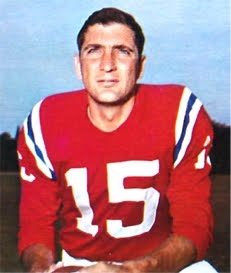
The Patriots responded with a seven-play, 70-yard possession. Babe Parilli threw to split end Jim Colclough for 13 yards on a third-and-ten play and connected with FB Larry Garron for 22 yards to the Dallas 35. A 19-yard run by Garron had ten more yards tacked on due to a roughness penalty called on the Texans and two plays later Parilli passed to TE Tony Romeo (pictured at right) for an 11-yard TD. Gino Cappelletti kicked the point after to tie the score at 7-7.

DB Dave Grayson returned the ensuing kickoff 41 yards to the Boston 49. Haynes gained 11 yards on two carries to start the series and a pass interference penalty picked up ten more yards. A running play was followed by a Dawson pass to split end Chris Burford for 21 yards and two plays later Dawson found Burford again in the corner of the end zone for a five-yard touchdown. Pennington converted and the Texans were back in front by 14-7.


Following a punt by the Patriots, Dallas put together an 82-yard scoring drive in just five plays. Dawson, forced to scramble, ran for 14 yards and HB Frank Jackson (pictured at right) gained 35 yards, showing off good moves in the open field. After an incomplete pass and delay of game penalty, Jackson rushed for another 13 yards around end and Haynes gained the final 25 yards for a TD in spectacular fashion. Pennington again added the PAT and the home team extended its lead to 21-7.

The Patriots got the ball back with two minutes remaining and Parilli immediately threw to Romeo for 17 yards. A defensive holding penalty advanced the ball to the Dallas 25 and, four plays later, Parilli threw to HB Ron Burton for a pickup of 12 yards to the two yard line. From there Parilli ran the rest of the way, going around end for a TD with 34 seconds left in the first half. Cappelletti added the extra point and the Dallas lead was 21-14 at halftime.

Boston put together a promising drive to start the third quarter but, after reaching the Dallas 38, LB Sherrill Headrick intercepted a Parilli pass. The Texans advanced to their 28 and had to punt and the Patriots again moved the ball well, most notably on a Parilli pass to Cappelletti that gained 21 yards. However the visitors again came up empty when Garron, having grabbed a toss from Parilli in the backfield, was stuffed by Headrick for a 12-yard loss and Cappelletti’s field goal attempt from 46 yards was blocked by CB Duane Wood and recovered by the Texans at the Boston 39. Three plays later, Haynes carried 30 yards for a touchdown, Pennington converted, and instead of the Patriots possibly closing the gap, Dallas was up by 28-14.

A short Boston series resulted in a punt and the Texans were driving as the game headed into the fourth quarter. A sack of Dawson put Dallas in a second-and-22 hole but a completion to Jackson for 32 yards advanced the ball to the Boston 18. The 10-play, 58-yard drive concluded with Dawson throwing to Haynes in the end zone for a nine-yard TD, his fourth of the day. Once more Pennington booted the point after and the Texans were seemingly in control by a score of 35-14.

The Patriots responded with a quick tally, going 66 yards in three plays. Parilli completed passes to Colclough for 22 yards and Burton for 29, and Garron ran the last 15 yards for a touchdown. Cappelletti added the PAT to narrow the Dallas margin to 35-21.

A penalty and a sack forced the Texans to have to punt from their own seven on the next series, and Boston started off with excellent field position at the Dallas 35. Parilli threw to Romeo for 32 yards and Burton ran for a three-yard TD.  Cappelletti’s extra point made the game close at 35-28 with 5:25 remaining on the clock.

Starting from their 19 after the ensuing kickoff, the Texans went 81 yards in nine plays to settle the issue. A 15-yard personal foul on the Patriots on a second-and-eight play helped move Dallas along, Haynes had four carries for 21 yards, and Dawson completed a pass to split end Bill Miller for 30 yards. Jackson ran for an eight-yard touchdown with 33 seconds left, Pennington kicked the point after, and Dallas won by a final score of 42-28.

The Texans led in total yards (421 to 322), with 265 of that total coming on the ground, and first downs (27 to 22). Boston recorded five sacks to one by the home team, but also suffered the game’s only turnover. Both teams were penalized seven times apiece.

Abner Haynes was the headliner for the Texans with 122 yards on 19 carries that included three touchdowns and three catches for 14 yards and a fourth TD. Not to be overlooked, Len Dawson had a solid performance as he completed 16 of 23 passes for 202 yards and two touchdowns with no interceptions, and also ran for 32 yards on four carries. Additionally, Frank Jackson ran for 72 yards on 9 attempts that included a TD and gained another 32 yards on his one pass reception. Bill Miller caught 6 passes for 72 yards and Chris Burford contributed 5 receptions for 59 yards and a score.


For the Patriots, Babe Parilli was successful on 16 of 31 throws for 214 yards and a TD while giving up one interception. Larry Garron ran for 48 yards and a touchdown on five carries, had three catches for 18 yards, and averaged 28.0 yards on three kickoff returns. Tony Romeo (pictured at left) caught 5 passes for 84 yards and a TD.
   
Len Dawson’s performance emboldened owner Lamar Hunt to trade former starting QB Cotton Davidson to Oakland. The vote of confidence proved to be justified as the Texans went 11-3 to top the Western Division and defeat Houston for the AFL Championship. Boston won its next three contests before dropping the rematch to Dallas. The Patriots contended in the Eastern Division, finally ending up second to the Oilers at 9-4-1.

The opening-game performance by Abner Haynes launched a season in which he led the league with 19 touchdowns and finished second in rushing (1049 yards) and all-purpose yards (1768). He was a consensus All-AFL selection. Len Dawson received AFL Player of the Year honors from The Sporting News, leading the circuit in touchdown passes (29), completion percentage (61.0), yards per attempt (8.9), and overall passing (98.3 rating). 

December 20, 2014

1964: Bills Defeat Patriots in Showdown for AFL Eastern Division Title


The American Football League’s Eastern Division title was on the line as the Buffalo Bills met the Boston Patriots on December 20, 1964. The Patriots had won the previous meeting of the teams, blemishing Buffalo’s undefeated record in doing so, and had also beaten Buffalo in a divisional playoff the previous year after the teams tied for first place. Now the Bills were 11-2, after getting off to a 9-0 start, and Boston was right behind at 10-2-1, so once again the winner of the season-ending showdown would advance to the AFL Championship game.

Buffalo’s head coach for the third year was Lou Saban, and the Bills ranked at the top of the league in both offense and defense. Starting QB Jack Kemp (pictured above) was benched the previous week in favor of Daryle Lamonica, who often relieved if the offense needed a spark, but the 29-year-old veteran was back behind center at Boston. FB Cookie Gilchrist was the key to the strong running attack and there were good receivers in flanker Elbert Dubenion, split end Glenn Bass, and TE Ernie Warlick. The tough defense was especially strong on the line and in the backfield. Rookie PK Pete Gogolak, a pioneering soccer-style kicker, added additional scoring ability.

Boston was coached by Mike Holovak and was the hotter team down the stretch, having won five straight contests. 34-year-old QB Babe Parilli was a savvy veteran and flanker Gino Cappelletti the AFL’s most prolific scorer, between catching passes for touchdowns and his reliable placekicking. The defense was a good one and, like the Bills, featured a strong defensive line as well as excellent MLB Nick Buoniconti, who led a linebacker corps known for its blitzing.

There was a crowd of 38,021 fans in attendance on a snowy day at Fenway Park. The field was slippery, making the footing treacherous. The teams traded punts to start the game before Jack Kemp threw to Elbert Dubenion for a 57-yard touchdown and Pete Gogolak added the extra point. The Patriots responded with a seven-play, 72-yard drive. In a third-and-ten situation, Babe Parilli completed a pass to split end Art Graham for 22 yards and, three plays later, connected with TE Tony Romeo for a 37-yard TD. However, Boston tried for a two-point conversion and Parilli’s pass intended for Gino Cappelletti was incomplete, leaving the Bills in the lead by 7-6.


On the first play after the ensuing kickoff, Kemp again went long for Dubenion (pictured at left), and it resulted in a gain of 52 yards to the Boston 20. Runs by Kemp and Cookie Gilchrist and a pass to Glenn Bass advanced the ball to the three, but after Gilchrist lost a yard on two carries, Kemp’s third down throw into the end zone was intercepted by FS Ron Hall.

The Patriots couldn’t move on offense and punted. Once again the Bills came through with a big pass play, with Kemp this time throwing to Ernie Warlick for 44 yards to the Boston 10. This time the visitors didn’t come up empty, with Kemp gaining the last yard for a touchdown. Gogolak’s point after made the score 14-6.

Parilli connected on passes for 15 yards to flanker Jim Colclough and 14 to Gino Cappelletti, but the drive stalled thereafter and the Patriots punted. Kemp threw a pass that was picked off by CB Don Webb, giving the Patriots the ball at the Buffalo 35, but two plays later the Bills returned the favor when FS George Saimes intercepted a Parilli throw.

Buffalo put together a long series that covered 65 yards in 14 plays. Kemp completed three passes, including one to Bass for 33 yards, and HB Wray Carlton carried six times. The advance halted at the Boston five and Gogolak kicked a 12-yard field goal with 24 seconds left on the clock. The Bills took a 17-6 lead into halftime.

The Patriots went three-and-out and punted to start the third quarter, regained possession on another interception by Hall, but had to punt again. Kemp connected on passes to Bass (pictured below) that covered 38 and 13 yards, but after reaching the Boston 21, a holding penalty backed the Bills up and they had to punt.


Boston reached the Buffalo 39 on the next series, with the big play a pass from Parilli to Cappelletti for 22 yards, but Cappelletti’s try for a 46-yard field goal hit the crossbar and was no good. As the game headed into the fourth quarter, the Bills had to punt again but regained possession four plays later when Parilli’s pass was intercepted by CB Charley Warner, who ran it back 38 yards to the Boston 17. Five plays later, Kemp scored another TD from a yard out and, with Gogolak’s kick, the Bills were ahead by 24-6.

With their backs to the wall, the Patriots struck back as Parilli threw to Colclough for a 43-yard gain and to Cappelletti for 17 yards to reach the Buffalo 11. But the next three passes fell incomplete and FB Larry Garron fumbled after making a catch on fourth down. Saimes recovered for the Bills, who were able to run vital time off the clock before punting it back. Boston scored a touchdown on its next series, with Parilli tossing a pass to Romeo that covered 15 yards, and also threw to Colclough for a two-point conversion. But with less than three minutes remaining to play, it was a case of too-little, too-late. The Bills won by a final score of 24-14.

Buffalo had the edge in total yards (380 to 319) and first downs (17 to 15). The Patriots, playing from behind for most of the game, ran the ball only 11 times for 33 yards. Each team turned the ball over three times.

Jack Kemp completed 12 of 24 passes for 286 yards and a touchdown, giving up three interceptions, and scored the two short rushing TDs. Glenn Bass had 6 catches for 103 yards and Elbert Dubenion gained 127 yards on his three receptions that included a long touchdown. Cookie Gilchrist rushed for 52 yards on 20 carries and Wray Carlton contributed 31 yards on 15 attempts.


For the Patriots, Babe Parilli was successful on 19 of 39 throws for 294 yards and two TDs, and was picked off twice. Jim Colclough (pictured at right) caught 6 passes for 134 yards and Tony Romeo gained 60 yards and scored twice on his three receptions. Larry Garron led the club with 26 yards on 8 rushing attempts.

“My everlasting thanks to you for beating Boston,” exclaimed Lou Saban to his players, who awarded him the game ball. Saban had been the original head coach of the Patriots, who fired him during the 1961 season, which added not only an additional element to the rivalry between the teams, but a personal note for the coach.

The Bills went on to defeat the San Diego Chargers for the AFL Championship, and did so again the next year. Boston dropped to 4-8-2 before rebounding to contend once more in 1966.

As was the case against the Patriots, Jack Kemp wasn’t a high-percentage passer, completing 44.2 percent over the course of the season, but when he connected, the yardage could be sizable. He led the AFL in yards per attempt (8.5) and yards per completion (19.2, which was a full three yards more than the runner-up). He was named to the AFL All-Star Game, as was Elbert Dubenion, who gained 1139 yards on his 42 catches for a league-leading 27.1 average gain. Glenn Bass averaged 20.9 yards on his 43 receptions for 897 yards. Between them, they scored a total of 17 touchdowns (Dubenion with 10, Bass 7).

Babe Parilli led the AFL in passing yards (3465) and TD passes (31). Gino Cappelletti, who received Player of the Year recognition, scored 155 points, which were 53 more than Pete Gogolak in second place. He scored seven touchdowns among his 49 catches for 865 yards (17.7 avg.) and also led the league with 25 field goals.

July 25, 2014

1974: NY Stars Edge Bell on Fourth Quarter Field Goal


For the third week of the World Football League’s 1974 season, a natural rivalry took center stage on July 25 as the Philadelphia Bell hosted the New York Stars. There were 64,719 enthusiastic fans in attendance at JFK Stadium for the nationally-televised Thursday night contest, including Commissioner Gary Davidson – although the luster would dim weeks later when it was found out that most of those present had received free or significantly-discounted tickets.

The Bell were 1-1, having won their opener in front of a similarly large crowd before bowing to Houston the previous week. Head Coach Ron Waller’s team featured an exciting offense directed by QB Jim “King” Corcoran, a colorful veteran of minor league football. The ground game was strong and featured running backs Claude Watts and John Land, who also were experienced minor league hands. The most notable player on the defense was LB Tim Rossovich, a colorful figure in his own right who had played for the NFL Eagles.

New York was coached by former pro quarterback Babe Parilli and had yet to win in two hard-fought contests. There were several ex-Jets on the roster, including WR George Sauer, DE Gerry Philbin, and DT John Elliott. QB Tom Sherman had spent three years with the Boston Patriots before toiling in the minor leagues.

The Bell struck first, completing an 89-yard drive in five plays when Jim Corcoran threw to Claude Watts for an 18-yard touchdown and then successfully added the action point on a quarterback sneak, following three offside penalties on New York, to gain an 8-0 lead (in the WFL, touchdowns counted for seven points and were followed by an action point, which couldn’t be kicked).

New York got on the board when RB Dave Richards scored on a one-yard carry to finish off an 85-yard series, but the Stars remained a point behind when the pass attempt for the action point was unsuccessful.

The Stars took a 14-8 lead just before the end of the first half when RB Bob Gladieux dove one yard for a touchdown following a 20-yard completion from Tom Sherman to WR Al Young. However, they again failed to convert on the action point.

Philadelphia moved back in front a little less than six minutes into the third quarter on a Corcoran pass to TE LeVell Hill that covered nine yards for a touchdown. The score was set up by a 19-yard completion to WR Don Shanklin on the previous play. The Bell were unable to add the action point.

Moses Lajterman (pictured at top), an Argentine kicker out of Montclair State, booted a 40-yard field goal at 3:12 into the fourth quarter to put the Stars in front, following an 11-play, 50-yard series. Lajterman was playing in his first pro game, having earlier been cut from the squad but then re-signed when PK Pete Rajecki suffered a rib injury, and adding to the drama was the fact that Larry Butler was making his first snap of the season, having moved over to center due to an injury to Bob Kuziel.

The Bell had two chances in the last two minutes as Corcoran effectively passed them down the field, but Jack Simcszak missed to the right on a 36-yard field goal attempt and George Chatlos failed from 26 yards at the end of the contest. New York won by a final score of 17-15.

The Stars led in total yards (322 to 301) and first downs (17 to 12). Most of their yardage came on the ground (201) while Philadelphia was more productive through the air (215 yards). The Bell turned the ball over four times, to three turnovers suffered by the Stars.

Tom Sherman completed 7 of 15 passes for 121 yards with no touchdowns and one intercepted. Bob Gladieux rushed for 74 yards on 21 carries that included a TD and RB Ed White was right behind with 70 yards on 18 attempts. Al Young was New York’s top receiver, catching four passes for 74 yards.

For the Bell, “King” Corcoran was successful on 14 of 24 throws for 215 yards and two TDs, but also tossed two interceptions. John Land gained 59 yards on 14 rushing attempts and Claude Watts was held to 19 yards on five carries that included a score while also pulling in three passes for 31 yards. WR Don Shanklin had three pass receptions for 87 yards and WR Linzy Cole added 55 yards on his three catches.

“We played better against Jacksonville and Birmingham, but I’ll take it,” said Babe Parilli. “This is a tough, competitive league. All the teams are evenly matched. Nothing could have been bigger for us.”

Having finally broken into the win column, the Stars proceeded to put together a five-game winning streak. They were 8-5 when the franchise was shifted to Charlotte, where they were renamed the Hornets, and finished out the year with a 10-10 record. The Stars won their next two games but remained inconsistent, going 9-11, although they reached the postseason and lost in the first round. The revelations that the high early-season attendance figures were inflated by free and discounted tickets damaged the credibility of both the WFL and the Bell, which resulted in a dramatic decrease in fan support for games later in the schedule.

Moses Lajterman went on to kick 7 field goals in 11 attempts in his only pro season. George Chatlos, whose missed field goal attempt at the end of the game sealed Philadelphia’s fate, never got another opportunity to try for another, although he did remain with the club as a linebacker and scored a touchdown. The Bell had trouble with placekicking all season, with three kickers accounting for eight field goals in all. 

April 4, 2014

1961: Patriots Obtain Babe Parilli in Five-Player Deal


On April 4, 1961 the Oakland Raiders traded QB Vito “Babe” Parilli and FB Billy Lott to the Boston Patriots for FB Alan Miller, HB Dick Christy, and DT Hal Smith. It was the biggest deal thus far in the year-old American Football League’s short history.

The Raiders were coming off a 6-8 first season and had problems at the organizational level with too many owners, which resulted in front office disarray. Thanks to the intervention of AFL Commissioner Joe Foss, the ownership situation had been sorted out just prior to swinging the trade with the Patriots.

Boston was 5-9 in 1960 and had finished at the bottom of the league in points scored. There was a particular need for depth at quarterback behind 36-year-old Butch Songin, and Parilli, a month short of his 31st birthday, looked to be a good fit. While Alan Miller had led the team in rushing, it was expected that the addition of Lott, a fine blocker who led the Raiders in receiving, along with returning FB Jim Crawford, hindered by a bout with pneumonia in ‘60, would be an overall improvement in the backfield.

As for the players obtained by the Raiders, Miller was expected to start at fullback, Christy was fast and versatile and could return kicks, and Smith filled a need for quality interior linemen on defense.

Babe Parilli, the key player in the trade, had been a star at Kentucky, where he was coached by Paul “Bear” Bryant and led the Wildcats to two bowl victories. A first-round draft choice by the Packers in 1952, he split time with Tobin Rote for two years with uneven results (a promising rookie year was followed by a season in which he tossed 19 interceptions and only four TDs) and moved on to the Cleveland Browns. He first went into the military, missing two years before seeing some action in 1956 and finding it difficult to endure criticism from Head Coach Paul Brown. Traded back to Green Bay in ’57, he was cut during training camp in 1959. Parilli played a year with Ottawa in the CFL before joining the Raiders of the new AFL for 1960. There he split time with talented young Tom Flores, completing 46.5 percent of his passes for 1003 yards and five touchdowns while giving up 11 interceptions.

Parilli started off the ‘61 season backing up Songin, but after Lou Saban was replaced as head coach by Mike Holovak, the two quarterbacks were platooned as the team went 7-1-1 on the way to a 9-4-1 overall record. Parilli led the AFL with a completion percentage of 52.5 and tossed 13 TD passes against 9 interceptions. While not always the most consistent passer, he had an excellent arm and was a good ball handler who was adept at play action, which fit well with Holovak’s offense. By 1962 Songin was gone and Parilli the unquestioned starting quarterback.

The Patriots got off to a 6-2-1 start in 1962 with Parilli having an even better year until, in a key Eastern Division loss to the Houston Oilers, he went down for the remainder of the season with a broken collar bone. With backup Tom Yewcic behind center, Boston ended up once again at 9-4-1 and in second place. Parilli had a career-high completion percentage of 55.3 as he threw for 1988 yards and 18 TDs, giving up just 8 interceptions.

The Patriots dipped to 7-6-1 in 1963, but paradoxically they won the division thanks to a tiebreaking playoff win over Buffalo. Parilli’s performance was more uneven as his completion percentage fell to 45.4 and his interception total rose to 24. And while he had a 300-yard passing day in the Eastern Division playoff win, the Patriots were routed by the Chargers in the AFL Championship game. Still, he was named to the AFL All-Star Game for the first time.

Parilli had his finest pro season in 1964 as he led the AFL with 3465 passing yards and 31 TD passes, although his 27 interceptions also led the circuit. The Patriots improved to 10-3-1 but failed to catch the Bills and once again settled into second place. Parilli was a consensus first-team All-AFL choice and an AFL All-Star once again, but he talked of retirement before being lured back for another year.

As it turned out, the “Sweet Kentucky Babe” lasted two more seasons with Boston. Over the course of seven years, Parilli threw for 16,747 yards and 132 touchdowns while being picked off 138 times. The team had a winning record in his starts and he was an AFL All-Star for a third time in 1966, when the Patriots went 8-4-2. He then spent two years backing up Joe Namath with the New York Jets and earned a Super Bowl ring following the 1968 season as a result, retiring in ’69.

As to the other player obtained by the Patriots, Billy Lott led the team in rushing in 1961, gaining 461 yards on an even 100 carries while catching 32 passes for 333 more yards and scoring a total of 11 touchdowns, but he ran the ball only 43 times over his two remaining seasons for 112 yards and caught four passes.

Things did not go so well for the Raiders in ‘61, who were blown out in their first two games of the season by a combined score of 99-0 on the way to a dismal 2-12 record. Alan Miller started at fullback, proved to be a good blocker, but was more productive as a pass receiver (36 catches, 315 yards) than a ground gainer (85 carries, 255 yards). He played a total of four seasons with Oakland, rushing for 979 yards, catching 111 passes for 1186 yards, and scoring 17 TDs.

Dick Christy appeared in one preseason game for the Raiders before being dealt again, this time to the New York Titans. A productive all-purpose back, his best year was 1962 when he accumulated 2147 total yards and was an AFL All-Star. Hal Smith appeared in eight games in 1961, his only season with the Raiders.

All in all, the trade worked out well for the Patriots, where Babe Parilli was a solid performer for a team that often contended during his time there, topping the division once. He was so well regarded for his knowledge and leadership that Mike Holovak held a spot open on his coaching staff that was reserved for Parilli to fill once he retired. While he never became an assistant under Holovak, he did become a pro assistant, serving as quarterback coach for the Steelers and Broncos before holding the same position with the Patriots in 1981. He was also a head coach in the World Football League and with several Arena Football League teams.

October 19, 2013

1962: Patriots Overcome 17-Point Deficit to Defeat Chargers


The Boston Patriots were 3-2 and trying to keep pace with the Oilers in the American Football League’s Eastern Division as they hosted the San Diego Chargers on October 19, 1962. Coached by Mike Holovak, the Patriots were a well-balanced offensive club with 32-year-old QB Babe Parilli directing an attack that featured HB Ron Burton, flanker Jim Colclough, and split end Gino Cappelletti, a slow-but-dependable receiver who was an equally dependable placekicker. The defense had some stars in DE Bob Dee, DT Houston Antwine, OLB Tom Addison, and up-and-coming rookie MLB Nick Buoniconti. However, the one problem area was that they were weak against the pass.

The Chargers, under the direction of Head Coach Sid Gillman, had won the Western Division in each of the AFL’s first two seasons, but they were 3-3 and experiencing problems. Those problems had started with the loss of star HB Paul Lowe for the year with a broken arm during the preseason and got worse when QB Jack Kemp suffered a hand injury that caused the team to place him on waivers, with the intent of bringing him back, but ended up with his being awarded to Buffalo. Rookie QB John Hadl was not yet ready to start and Dick Wood, older at age 26 but hardly more experienced, was behind center for the game at Boston.

The Patriots were favored coming into the Friday night contest at Nickerson Field and attendance was 20,888 at the small facility. Following a three-and-out possession by the Chargers, Boston went 57 yards in eight plays highlighted by Babe Parilli connecting with FB Jim Crawford on a 42-yard pass play to the San Diego seven yard line. The drive bogged down, but Gino Cappelletti kicked a 13-yard field goal to give the home team an early 3-0 lead.

The Chargers came right back as Dick Wood completed passes to end Don Norton for 18 and 16 yards. The series ended with Wood throwing to TE Dave Kocurek for a 36-yard touchdown and George Blair added the extra point to make it 7-3 in favor of San Diego.

A short Boston series ended with a punt and the Chargers moved well as Wood threw to HB Keith Lincoln for 23 yards. However, on a third-and-six play Wood was sacked for a 15-yard loss by DT Jess Richardson, although they put three more points on the board thanks to a 43-yard field goal by Blair.

The opening period ended with Parilli being intercepted by CB Claude Gibson, but the Chargers, after reaching the Boston 13, came up empty when Wood was picked off by Tom Addison. The Patriots again had to punt and the visitors struck quickly when Wood threw to Norton for a 49-yard gain to the Boston three. Two plays later, the Chargers scored a touchdown on a two-yard carry by FB Bobby Jackson and, with Blair’s successful conversion, San Diego was up by 17-3.

The Patriots still were struggling on offense and had to punt following the next possession. Lincoln reeled off 14 yards on two carries, but after reaching Boston territory Addison intercepted a pass. The teams traded punts until San Diego CB Dick Harris intercepted a Parilli throw to give the Chargers possession at the Boston 23. It led to Blair kicking a 27-yard field goal.

With time running out in the first half, Parilli completed three passes as the Patriots advanced to the San Diego 24, but a 31-yard field goal try by Cappelletti sailed wide. The Chargers took a comfortable 20-3 lead into halftime and the disgruntled home fans jeered their team’s disappointing performance as the players headed for the locker room.


The momentum shifted decisively in the second half. On their second series of the third quarter, the Patriots put together a nine-play, 56-yard series. Parilli threw to Ron Burton (pictured at left) for 20 yards and gained 16 yards on two carries himself before finishing the drive on a third-and-four play with a nine-yard touchdown pass to Jim Colclough. Cappelletti’s extra point try sailed under the crossbar, but the San Diego margin was narrowed to 20-9.

After a short series by the Chargers, Boston took over at its 30 and again moved the ball effectively. Parilli threw to Colclough for another TD, this time from 25 yards out, and then tossed a pass to Crawford for a two-point conversion that made it a three-point game.

End Jerry Robinson returned the ensuing kickoff 57 yards for the Chargers to give them outstanding field position at the Boston 33, but it was all for naught two plays later when Nick Buoniconti intercepted a pass by Wood. As the period wound down, the Patriots once again moved well on offense with Burton and Crawford running effectively and Parilli throwing for 10 yards. Three plays into the fourth quarter, Crawford, on his third straight carry, ran three yards for a touchdown to cap the 10-play, 68-yard series. Cappelletti added the extra point and the Patriots were now on top by four points.

With Wood shaken up, John Hadl entered the game at quarterback for the Chargers and they moved 26 yards before having to punt from their own 46. Boston went three-and-out and punted the ball back, but after Hadl threw to Kocurek for 18 yards, he was sacked on consecutive plays for losses totaling 21 yards. The visitors again had to kick the ball away.

While the Patriots had short possessions, the Chargers had the ball twice more, the first a three-and-out series and the second ending with Wood, now back behind center, being intercepted by safety Ross O’Hanley to effectively end the contest. Boston came away with a 24-20 win.

The Patriots outgained the Chargers (312 yards to 260) and had more first downs (20 to 11). They were especially productive on the ground, with 175 rushing yards to San Diego’s 90. San Diego turned the ball over four times, to two turnovers suffered by Boston, and was penalized 7 times at a cost of 55 yards, to three flags thrown on the Patriots.

Babe Parilli completed 14 of 26 passes for 166 yards and two touchdowns with two intercepted. Jim Crawford ran for 61 yards and a TD on 11 carries and also had 5 catches for 53 yards. Ron Burton ran for 32 yards on 11 attempts and was also productive as a receiver out of the backfield with 5 receptions for a team-leading 54 yards. Jim Colclough had two pass receptions for 34 yards, both of which were touchdowns.


For the Chargers, Dick Wood was successful on just 8 of 23 throws for 162 yards and a TD while also tossing three interceptions. John Hadl went four-of-eight for 44 yards and was picked off once. Don Norton (pictured at right) had four catches for 107 yards and Dave Kocurek also pulled in four passes, for 65 yards and a score. Keith Lincoln topped the running game with 48 yards on 12 carries.

The Patriots continued to play well, even after losing Parilli to a broken collarbone for the last month of the season. They still remained in contention until the final week and finished second in the Eastern Division with a 9-4-1 record. Meanwhile, the injury-riddled Chargers lost their next four games and won only once more the rest of the way, primarily with Hadl at quarterback, to end up third in the Western Division at 4-10.

Playing in ten games, Babe Parilli was the league’s second-ranked passer as he threw for 1988 yards with 18 touchdowns as opposed to 8 interceptions. Ron Burton ran the ball 134 times for 548 yards and caught 40 passes for 461 more yards while scoring seven touchdowns. Jim Colclough led the team with 10 TDs on his 40 pass receptions for 868 yards (21.7 avg.). He was named to the AFL All-Star Game. Gino Cappelletti scored 128 points, putting him in a tie for second with Buffalo’s Cookie Gilchrist behind Gene Mingo of the Broncos.

September 29, 2013

1957: Packers Upset Bears in First Game at New Stadium


On September 29, 1957 the Green Bay Packers not only played their opening game of the new NFL season, but achieved a significant milestone in the history of the franchise as well. That day marked the official opening of a new home venue, City Stadium (or New City Stadium, to distinguish it from its predecessor, until renamed Lambeau Field in 1965).

The Packers had endured mediocrity on the field throughout the decade of the fifties and the future of the franchise was in question. They were playing home games at a high school stadium, the original City Stadium, and owners of other NFL teams were complaining that the facility was no longer up to league standards. The Packers had also been playing some home games in Milwaukee each year (and would continue doing so until 1994), and there was sentiment to move the team there permanently. Upon receiving an ultimatum from the NFL, a bond issue was put before the voters of Green Bay to build a new stadium and received 70 percent approval. The result was the new 32,000-seat stadium.

As for the team itself, the Packers were coming off a 4-8 season in 1956 and had not posted a winning record since 1947. Coached by Lisle Blackbourn, who was commencing his fourth year at the helm, the team had traded star QB Tobin Rote to Detroit during the offseason and was going with 23-year-old second-year QB Bart Starr to start the opening game, although 28-year-old QB Babe Parilli, who had started out with the Packers in 1952, gone into the military, and been dealt to Cleveland, was back with the club. End Billy Howton was one of the NFL’s best receivers, center Jim Ringo was a solid performer on the offensive line, and safety Bobby Dillon a highly-regarded member of the defense. They also had high hopes for their first round draft choices, QB Paul Hornung from Notre Dame and Michigan end Ron Kramer, but by and large the Packers simply had too many holes on the roster.

The team they were hosting, the Chicago Bears, was coming off a 9-2-1 record in ’56 that had topped the Western Division, although they lost badly to the Giants in the NFL title game. Coached by Paddy Driscoll, the Bears had a fine quarterback tandem in Ed Brown and George Blanda with Zeke Bratkowski now in the mix after a stint in the Army. FB Rick Casares had led the league in rushing and end Harlon Hill was an outstanding deep threat.

Dignitaries were present for the stadium dedication, including Vice President Richard M. Nixon who pronounced the new facility the “best spectator stadium” he had visited. A capacity crowd of 32,132 was on hand on a windy but sunny day.

The Bears scored first on their third series in the opening period, following an interception of a Bart Starr pass.  Ed Brown capped a 77-yard drive with a five-yard run on the ninth play. Blanda added the extra point and it was 7-0 heading into the second quarter.

Starr was struggling and the Packers were also hurt by the loss of FB Howie Ferguson to an injury in the first quarter. Babe Parilli (pictured below) relieved at quarterback and the Packers put together a scoring drive that went 79 yards in 10 plays, the biggest a pass that Howton caught over his shoulder for a 37-yard touchdown. Fred Cone tied the score at 7-7 with the successful point after.


Chicago got another TD, again taking nine plays to advance 72 yards and scoring on a pass from Brown to Harlon Hill from eleven yards out. The second TD for the Packers culminated a nine-play, 59-yard drive that was helped by a pass interference call in the end zone after Chicago DHB Vic Zucco hit Howton in the end zone. With the ball at the one yard line, Cone dove into the end zone and added the extra point that made the score 14-14 at the half.

Early in the third quarter, George Blanda kicked a 13-yard field goal for the Bears to give them the lead, but the Green Bay defense began to assert itself. In addition to intercepting four passes during the second half, the Packers also made a key stop in the fourth quarter. On a fourth-and-one play near midfield, Chicago HB Bobby Watkins was unable to gain the necessary yardage and the Packers came alive with a three-play, 49-yard series that proved to be decisive.

Parilli first threw to Howton for a 41-yard gain and Cone ran for two yards. Then Parilli, breaking free of DE Jack Hoffman, fired the ball to end Gary Knafelc, who dropped to his knees between the goal posts and caught the ball squarely in his stomach for a six-yard touchdown.

With 8:21 remaining to play, there was still plenty of time left, but Green Bay’s defense rose to the occasion and the Bears were unable to get into Packers territory for the rest of the game. Chicago’s last opportunity came when the Packers had to punt with two minutes remaining, but HB Perry Jeter fumbled when hit hard by DE Jim Temp and center Larry Lauer recovered for the Packers, who were then able to run out the clock. The Packers came away with an upset 21-17 win.

Chicago led in total yards (362 to 297) and first downs (19 to 16). However, the Bears also turned the ball over six times, with most coming in the second half, to four suffered by Green Bay.


Babe Parilli completed 9 of 17 passes for 197 yards and two touchdowns and Billy Howton had 8 catches for 165 yards and a TD. Chicago’s quarterback combo of Ed Brown and Zeke Bratkowski gave up five interceptions, two of which were by Bobby Dillon.

While it made for a great opening in a new facility, the win over the Bears did not mark a turnaround for the Packers. They lost their next three games and ended up at the bottom of the Western Conference with a 3-9 record. Coach Blackbourn was dismissed, but it would take an even worse finish in 1958 and another coaching change to bring about a revival in the team’s fortunes.

The loss did presage a down year for the Bears, who sagged to 5-7 and fifth place in the conference, although they did beat Green Bay in the rematch at Chicago. The drop in fortunes persuaded owner George Halas to come out of his two-year coaching retirement in 1958.

Babe Parilli started one game for the Packers in ’57 and returned to the bench to back up Bart Starr. For the year, he completed 39 of 102 passes (38.2 %) for 669 yards with four touchdowns and 12 interceptions. He played one more season with Green Bay, was cut during the 1959 preseason and played in Canada, and then spent 10 years in the American Football League with the Raiders, Patriots (where he had his greatest success), and Jets.

Billy Howton had another fine season in 1957, catching 38 passes for 727 yards (19.1 avg.) and five touchdowns. He received consensus first-team All-NFL recognition for the second straight year and was named to the Pro Bowl for the fourth time.

As for City Stadium, the bond issue that financed its near-million dollar construction cost was paid off in 1978. Following several expansions, and the renaming to Lambeau Field, the seating capacity has since risen to over 73,000.

September 3, 2013

1967: Denson & Defense Star as Revamped Broncos Beat Patriots


The Denver Broncos had made several notable changes as they opened their AFL season against the Boston Patriots on September 3, 1967. The perennially losing franchise was coming off a second straight 4-10 record in ’66 and had hired a new head coach/GM, Lou Saban, who had won back-to-back AFL titles in Buffalo. HB Floyd Little was drafted in the first round out of Syracuse and became the first top draft pick in the team’s short history to sign with the club (no doubt helped by 1967 being the first year that the AFL wasn’t competing with the NFL for draft picks). Quarterback had been a major issue for the Broncos in recent seasons, and a trade was swung with San Diego to obtain the strong-armed Steve Tensi to take over the position for ’67.

The visiting Patriots were coached by Mike Holovak (who had replaced Saban when he was fired from that job during the 1961 season) and were coming off an 8-4-2 year in ’66. FB Jim Nance had blossomed into a star, setting an AFL record with 1458 rushing yards. 37-year-old QB Babe Parilli was coming off of a good season and OE/PK Gino Cappelletti was the league’s top scorer.

There was a record crowd of 35,488 in attendance at Bears Stadium ready to get a look at the refurbished club that had won its last three preseason games. The Broncos got the first break of the game when a deflected pass by Parilli was intercepted by DB Gene Sykes and returned 29 yards to the Boston 13. Two plays later Steve Tensi completed a 12-yard touchdown pass to flanker Al Denson and Gary Kroner added the extra point.

The teams traded punts until the Patriots came through with a big play. Parilli threw to split end Art Graham on a play that covered 79 yards for a TD. Gino Cappelletti’s PAT evened the score at 7-7.

Neither team was able to move the ball effectively for the remainder of the opening quarter. On the last play of the period Jim Nance fumbled and DT Dave Costa recovered for the Broncos at the Patriots’ 28. However, after advancing to the seven yard line Denver came up empty when FB Cookie Gilchrist, returning to the team after a sojourn with the expansion Dolphins in 1966, was stopped for no gain on a fourth-and-one play.

The teams again traded punts until Sykes again picked off a Parilli pass to give Denver the ball at the Boston 29. Floyd Little ran four straight times to pick up a total of 16 yards and the series ended with Kroner kicking a 20-yard field goal. The Broncos were back in front by 10-7, which remained the score at the half.

The Broncos extended their lead on the first series of the third quarter that was helped along when, initially forced to punt, the Patriots were penalized for roughing the kicker. Two plays later Tensi connected with Denson for a 55-yard touchdown. Kroner’s extra point try was blocked, however, and the score remained 16-7.

The Patriots wasted no time in coming back, driving 64 yards in five plays. After Boston ran the ball twice, Parilli threw to TE Jim Whalen for a 27-yard gain to the Denver 24. A pass interference call gained another 14 yards before Parilli threw to Nance for a 10-yard touchdown. Cappelletti added the extra point to make it a two-point game.

The Patriots got the ball back on the next series when DT Jim Hunt stripped Tensi at the Denver 37. Five plays later, Parilli passed to HB Larry Garron for a 20-yard touchdown and, with the successful conversion, Boston was in front by 21-16.

Heading into the fourth quarter, the Broncos got a big play on offense when Tensi connected with Denson for a 58-yard gain to the Boston 9. Little and Gilchrist were unable to pound the ball into the end zone but Denver came away with a 9-yard Kroner field goal to narrow the tally to 21-19.


Now midway through the fourth quarter the Patriots had the ball back after the ensuing kickoff but, on the second play, CB Goldie Sellers (pictured at left) intercepted a Parilli throw and returned it 24 yards for a touchdown. Kroner’s extra point gave the Broncos a five-point lead, but there were still over eight minutes to play.

Parilli immediately went to the air and connected with Cappelletti for a 30-yard gain to midfield, but his next pass was intercepted, this time by CB Nemiah Wilson. The Broncos couldn’t move the ball and, on a third-and-14 play, Tensi was sacked by LB Doug Satcher for an 11-yard loss to his own 10 yard line. HB Joe Bellino returned Bob Scarpitto’s punt 17 yards to the Denver 37 to give the Patriots excellent starting field position.

Garron took off for 15 yards on the first play of the series but Parilli was picked off for the sixth time, once again by Sellers. The Broncos had possession at their five yard line, went three-and-out, and Scarpitto boomed a punt that gave the Patriots the ball at their own 20 with less than two minutes remaining on the clock. They managed to reach the Denver 43 before Costa sacked Parilli for a 13-yard loss and a long desperation pass fell incomplete. The Broncos were winners by a score of 26-21.

Boston had more total yards (302 to 209) and first downs (14 to 11) than the Broncos, but the Patriots also turned the ball over seven times, to one suffered by Denver.

Al Denson was the offensive star for the Broncos as he caught four passes for 131 yards and two touchdowns. Steve Tensi completed 8 of 19 passes for 145 yards and the two TDs with none intercepted. Floyd Little, playing in his first regular season game, rushed for 66 yards on 25 carries, while Cookie Gilchrist, appearing in his last, gained 21 yards on 10 attempts (the talented and mercurial Gilchrist underwent knee surgery the next week and ultimately retired). Gene Sykes, Goldie Sellers, and Nemiah Wilson each intercepted two passes apiece.

For the Patriots, Babe Parilli was successful on 16 of 30 throws for 234 yards and three TDs but also gave up the six costly interceptions. Gino Cappelletti had 6 catches for 54 yards and, thanks to the long scoring reception, Art Graham gained 84 yards on his two receptions. Jim Nance ran the ball 15 times for 53 yards and Larry Garron contributed 37 yards on 6 carries while also gaining 53 yards on four catches that included a touchdown.

Tragedy dimmed Al Denson’s fine performance. He left immediately after the game for his home in Jacksonville, Florida due to the untimely death of his three-year-old son.

The exciting win did not herald a winning season in Denver. The Broncos lost their next nine games and finished at the bottom of the Western Division with a 3-11 record. The Patriots ended up at the bottom of the Eastern Division at 3-10-1.

Al Denson, a converted tight end, went on to catch 46 passes for 899 yards (19.5 avg.) and 11 touchdowns, received consensus second-team All-AFL honors (and was a first-team choice of the NEA), and was chosen to the AFL All-Star Game.

Steve Tensi had a decidedly uneven year, completing just 40.3 percent of his passes for 1915 yards and 16 touchdowns as well as 17 interceptions. Floyd Little led the club in rushing as a rookie, but with only 381 yards and averaging 2.9 yards per carry as opposing defenses focused on stopping him. However, he did lead the AFL in punt returning with a 16.9-yard average. While Tensi would ultimately not pan out as a starting quarterback, Little went on to an outstanding career worthy of his high draft status.

November 6, 2012

1964: Patriots Down Oilers on Game-Ending Cappelletti Field Goal


The Boston Patriots were in a battle for first place in the AFL Eastern Division as they hosted the Houston Oilers on November 6, 1964. Head Coach Mike Holovak’s team won its first four games and was 5-2-1 and competing with the Bills – the club they had defeated in a playoff for the division title in ’63. Key players on offense were 34-year-old QB Babe Parilli and Gino Cappelletti, a slow but dependable end who also was a dependable placekicker. The defense was outstanding, particularly the line and MLB Nick Buoniconti.

The Oilers, coached by Sammy Baugh, were a disappointing 2-6, having won two of their first three contests before dropping five straight. The team that had dominated the division for the first three years of the AFL’s existence slumped badly in 1963 and was clearly in trouble. There were promising younger players on the squad, but the nucleus on offense was still 37-year-old QB George Blanda, 29-year-old flanker Charley Hennigan, and fading fifth-year FB Charley Tolar.

The Friday night game at Fenway Park was billed as “do-or-die” for both teams. Houston got a break on the opening kickoff when HB J.D. Garrett fumbled at his 29. The ensuing series ended with Tolar powering two yards for a touchdown.

The Patriots came back with a 75-yard drive. FB Larry Garron ran effectively and Babe Parilli finished the series off with a one-yard run around end for a TD. Early in the second quarter, Gino Cappelletti put the Patriots ahead by 10-7 with a 25-yard field goal. Cappelletti added another field goal from 33 yards with six seconds remaining in the half and it was 13-7 at the intermission.

Boston’s lead disappeared quickly when, on the first play from scrimmage of the second half, the Oilers pulled off a spectacular play as Blanda threw to TE Willie Frazier for an 80-yard touchdown. With Blanda’s extra point, Houston was back in front at 14-13.

Late in the period Boston regained the lead when a five-play, 75-yard drive that was highlighted by a Parilli pass to split end Art Graham for 64 yards and ended with Cappelletti kicking his third field goal from 22 yards out for a 16-14 score.

At 6:46 into the fourth quarter the Oilers went ahead once again when Blanda threw to split end Charley Frazier for a 38-yard TD. A few minutes later it was Parilli once more rolling out and running for a touchdown, this time from five yards out. However, the try for a two-point conversion failed as Parilli’s pass intended for Graham fell incomplete.

With a minute to go in the game, the Patriots were up by a point and the Oilers had the ball at midfield. Blanda threw to Willie Frazier twice to get the ball down to the Boston four. Tolar wasn’t able to penetrate the end zone from there and Blanda kicked a 10-yard field goal. With 32 seconds remaining, it appeared that Boston’s fate was sealed.

There was still time, however, and Parilli completed two passes to TE Tony Romeo and Cappelletti to advance the Patriots into Houston territory. With the clock running down, Parilli rolled out, couldn’t find a receiver, and, keeping the ball, took off down the sideline. Knowing he couldn’t reach the end zone, he stepped out of bounds at the Houston 34 with one second remaining to play. Cappelletti was successful on his field goal attempt from 42 yards and the Patriots came away with a stunning 25-24 win.

Boston had more total yards than the Oilers (440 to 413) but Houston had the edge in first downs (22 to 21). The Patriots turned the ball over twice while the Oilers suffered one turnover. Houston was also very effective at returning kickoffs, with DB Benny Nelson gaining 66 yards on his two returns and HB Ode Burrell averaging 27.7 yards on three returns.


Babe Parilli completed 14 of 29 passes for 256 yards with no touchdowns and one intercepted, but also ran the ball 8 times for 96 yards and two TDs. Art Graham (pictured at left) had a big day with 8 catches for 167 yards. Larry Garron rushed for 91 yards on 23 carries.

For the Oilers, George Blanda went to the air 44 times and had 20 completions for 328 yards and two TDs with one intercepted. Charley Frazier had 9 pass receptions for 143 yards and a touchdown and Willie Frazier, thanks to the long scoring play, gained 102 yards on his two catches. Charley Tolar was the team’s top rusher as he gained 57 yards on 14 attempts and scored a TD.

“We’ve had many a tight ball game, but this was the best,” said Mike Holovak in reviewing his team’s performance. “(Art) Graham was a big factor in grabbing those passes and setting up scores, but a thing that hurt us was the way they were returning those kickoffs. That’s one thing we’ll be working on next week.”

The win over Houston was the first of five straight for the Patriots, who stayed in contention for the Eastern Division title until the final week of the season. As it was, they put together a 10-3-1 record in placing second to the Bills. Houston continued to fade and, with wins in the last two contests, ended up at 4-10 and at the bottom of the division.


Babe Parilli (pictured above) led the AFL in passing yards (3465) and TD passes (31) – and, more unfortunately, in interceptions (27, tied with George Blanda) – while ranking second in pass attempts (473) and completions (228). He was a consensus first-team All-AFL selection and was named to the league All-Star Game.

Gino Cappelletti led the league in scoring (155 points) and field goals (25, in an AFL-leading 39 attempts), each for the third time. He caught a career-high 49 passes for 865 yards and seven touchdowns and was named AFL Player of the Year by the Associated Press and United Press International. Cappelletti, too, was selected for the AFL All-Star Game.

October 9, 2012

1974: Danny White TD Passes Lead Memphis to Win Over Hornets


The Memphis Southmen (aka “Grizzlies”) were not only successful on the field but also one of the few World Football League teams that was financially sound. Owned by Canadian businessman John Bassett Jr., the Southmen were coached by John McVay, formerly of the University of Dayton, and had won nine straight games as they prepared to meet the Charlotte Hornets on October 9, 1974.

Rookie backup QB Danny White (pictured above) was filling in for injured veteran John Huarte for the third time, but it had not slowed the Southmen. The running game, featuring J.J. Jennings, John Harvey, and Willie Spencer was the new league’s best and WR Ed Marshall led an able group of receivers.

The team they were facing was only recently relocated and renamed. As the New York Stars, coached by Babe Parilli, the club played reasonably well and had an 8-5 record. However, their home venue was the substandard Downing Stadium, and they drew poorly in competition with the NFL Giants and Jets. The franchise was sold to Upton Bell, son of former NFL Commissioner Bert Bell, and moved to Charlotte, North Carolina. As the Charlotte Stars, they defeated the Chicago Fire on the road, but were now rechristened the Hornets as they faced Memphis in the first game at their new location.

There was a sellout crowd of 25,133 for the Wednesday night game at Charlotte’s Memorial Stadium, and with enthusiastic fans in attendance, the ex-Stars were clearly fired up. The teams traded fumbles in the first quarter before Memphis went 36 yards in five plays capped by J.J. Jennings scoring a one-yard touchdown. White passed to Ed Marshall to convert the action point to make it 8-0 (in the WFL, touchdowns counted as seven points and were followed by an “action point”, which could not be kicked).

Charlotte safety Ike Thomas returned the ensuing kickoff 56 yards to the Memphis 33. Ten plays later, the Hornets scored on a one-yard sneak by QB Tom Sherman that was greeted by a huge ovation from the home crowd. RB Jim Ford tied the score at 8-8 by running for the action point. The exchange of first quarter touchdowns remained the only points of the first half as White struggled in the early going, completing just four of his first 11 passes.

In the third quarter, Bob Etter put the Southmen back in front with a 28-yard field goal. In response, RB Don Highsmith ran for a four-yard touchdown to put the Hornets in the lead, although the action point attempt failed.

Charlotte was ahead by 15-11 heading into the fourth quarter, but two minutes into the final period White threw to Marshall for a 13-yard touchdown and Memphis was back in front. White then threw to WR Roger Wallace for the action point.

The lead increased when White connected with Marshall for another TD of 19 yards with 6:15 to play that gave the Southmen a 27-15 margin after John Harvey ran for the action point.

The Hornets fought back, driving 61 yards and Highsmith finishing the possession off by powering across the goal line from a yard out for a touchdown. They successfully added the action point as Sherman threw to WR Al Barnes, narrowing the Memphis lead to four points.

With just over two minutes to play, Charlotte executed a successful onsides kick as ex-Jets WR George Sauer recovered at the Charlotte 44. With the home crowd cheering wildly, Sherman completed a third down pass to Sauer that moved the ball to the Memphis 40. The Southmen were putting heavy pressure on Sherman, and after a bomb intended for Barnes fell incomplete, a screen pass was intercepted by CB David Thomas at the Memphis 11 with 1:10 remaining to snuff out the home team’s hopes and preserve the 27-23 win for the Southmen.

Memphis outgained the Hornets (369 to 211) and in particular outrushed them (242 yards to 69). The Southmen also had the edge in first downs (20 to 15). Charlotte turned the ball over three times, to two suffered by Memphis.


Danny White, recovering from the slow start, ended up completing 9 of 18 passes for 127 yards with two touchdowns and an interception. Willie Spencer gained 109 yards on 17 carries and J.J. Jennings had 104 yards, also on 17 attempts. Ed Marshall (pictured at right) caught three passes for 44 yards.

For Charlotte, Tom Sherman was successful on 12 of 27 throws for 142 yards and no TDs with two intercepted. Jim Ford was the leading rusher with 49 yards on 17 carries. George Sauer had 5 pass receptions for 57 yards.

“The crowd was just great, wonderful,” said Hornets Coach Babe Parilli. “It was a great thing for the players…There were never that many people cheering for us before.”

“We won a very tough game over an excellent team,” said John McVay. “Charlotte is lucky to get a team of this quality. I know they’ll get their share of wins before it’s over.”

The Southmen lost only one more game on their way to a league-best 17-3 record, putting them atop the Central Division. They were upset by the Florida Blazers in their playoff game. Despite the enthusiastic new fan base, Charlotte won only one of its last six contests to end up at 10-10 and second in the Eastern Division.

Danny White completed 79 of 155 passes for 1190 yards with 12 touchdowns and 9 interceptions. He also handled the team’s punting, averaging 40.9 yards on 80 kicks. Following the demise of the WFL in 1975, he moved on to the NFL’s Dallas Cowboys for 13 seasons.

August 21, 2012

1974: Bob Gladieux Scores 4 TDs as NY Stars Rout Texans


The New York Stars of the World Football League were riding high (at least on the field) as they faced the Houston Texans on August 21, 1974. Coached by former pro quarterback Babe Parilli, the Stars had lost their first two games but then reeled off four straight victories. The offense was directed by QB Tom Sherman, included ex-Jets star WR George Sauer, and had the new league’s top-ranked rushing attack, led by a former Notre Dame standout in RB Bob Gladieux (pictured). The defense featured a line that was anchored by two more ex-Jets, DE Gerry Philbin and DT John Elliott. However, the club was forced to play its home games at the substandard Downing Stadium on out-of-the-way Randalls Island in the shadow of the Triborough Bridge, and attendance (not to mention credibility) suffered as a result.

The visiting Texans seemed to match up well with the Stars, for they boasted the top-rated rushing defense in the WFL. Coached by former Giants assistant Jim Garrett, Houston had a club laden with veterans. On offense, that included former AFL standouts in WR Don Maynard and FB Jim Nance, plus QB Mike Taliaferro and TE Willie Frazier. The defense had end Don Brumm, tackle Jim Kanicki, and LB Garland Boyette. Still, they sported a mediocre 2-3-1 record, largely due to an inability to score points.

There was a meager crowd of 12,042 at the poorly-lit Downing Stadium for the Wednesday night matchup. Things went wrong for Houston on the game’s third play when FB Mike Richardson fumbled and Philbin recovered for the Stars at the Texans’ 37. A 10-yard Tom Sherman completion to WR Al Young got the ball down to the one and Bob Gladieux scored on the next play. The action point failed (in the WFL, touchdowns counted for seven points and were followed by an “action point” that could not be kicked).

Another turnover gave the Stars the ball when CB Steve Dennis intercepted a pass at the New York 47. Sherman passed to WR Kreg Kapitan for 16 yards to the eight yard line and, from five yards out, threw to Gladieux for a touchdown. The Stars again came up empty on the action point attempt, but were ahead by 14-0.

The third New York score was set up thanks to a shanked 16-yard punt. Sherman passed twice to Young, for 24 and 7 yards, and then Young drew a 13-yard pass interference penalty. Gladieux scored another touchdown, plowing in from a yard out.

The Texans finally got on the board 30 seconds before halftime when Charlie Durkee kicked a 43-yard field goal, but Houston was in a deep hole at 21-3. A furious Coach Garrett berated his team at halftime and promised to rid the club of players that weren’t giving an adequate effort.

Garrett’s outburst failed to inspire the Texans in the second half. Bob Gladieux made it four touchdowns with a four-yard run in the third quarter to add to the home team’s lead. This time New York was able to convert the action point as Sherman passed to Young. The Stars had the game well in hand at 29-3. The contest became a rout before the period was over, this time with Sherman tossing a 25-yard touchdown pass to Kapitan. The action point failed, but it didn’t matter.

Houston scored its only other points of the game with just under nine minutes remaining in the fourth quarter as Mike Richardson ran for a one-yard TD that was set up by QB Mike Taliaferro pass completions of 21 yards to Don Maynard and eight yards to TE Don Davis.

Sherman gave way at quarterback to rookie Gary Danielson, who completed two passes - to Kapitan for 16 yards and 23 yards to WR Tom Spinks to the Houston one yard line – and then scored on a quarterback sneak. Instead of a close battle, New York breezed to a 43-10 win.

The Stars rolled up an impressive 231 rushing yards and 405 overall to just 178 total yards for Houston. New York also held a huge edge in first downs, 25 to 11, and didn’t turn the ball over while the Texans suffered three, all of which proved costly.

Tom Sherman completed 10 of 20 passes for 135 yards and two touchdowns. Bob Gladieux was the most notable offensive star, rushing for 84 yards on 20 carries and catching one short scoring pass that gave him a total of four touchdowns. RB Ed White added 69 yards on 16 attempts and RB Dave Richards gained 63 on 14 rushes. Al Young caught 5 passes for 63 yards and Kreg Kapitan gained 64 yards on his 4 receptions that included a touchdown.

For Houston, Mike Taliaferro completed 12 of 25 passes for just 81 yards. Mike Richardson and FB Jim Nance each gained 26 yards rushing, on 11 and four carries, respectively. WR Rick Eber led the receivers with three catches for 39 yards.

“I can’t believe this game! I thought it would be close,” New York’s Gerry Philbin exclaimed afterward.

“We weren’t ready to play,” said a disappointed Coach Jim Garrett. “It was obvious in the warmup.”

It was the fifth straight win for the Stars, and also the high point for their season. They played the Texans again the following week in Houston and lost, in a contest best remembered for the legally abbreviated appearance by DE John Matuszak for the home team, and never won consistently again. Unable to draw in New York, the franchise was sold and moved to Charlotte, North Carolina where it concluded the season with a final record of 10-10.

The Texans also failed to complete the season where they started, ending up in Louisiana as the Shreveport Steamer and going 7-12-1.

Bob Gladieux led the Stars in rushing with 690 yards on 177 carries (3.9 avg.) and caught a total of 9 passes for 99 yards. Despite his four-TD performance against the Texans, he ended up with a total of 7 touchdowns (the pass receiving score was his only one of the year). It was the final season of a nondescript five-year pro career spent mostly with the Patriots in the AFL and NFL.

August 15, 2012

1952: Rams Rally in Fourth Quarter to Defeat College All-Stars


There were 88,316 fans present at Chicago's Soldier Field on a rainy Friday night for the 19th College All-Star Game on August 15, 1952. What they saw was an error-filled struggle that came down to a fourth quarter rally by the defending pro champions.

The Los Angeles Rams, coached by Joe Stydahar, had been an offensive juggernaut in 1951. They boasted the quarterback tandem of Bob Waterfield and Norm Van Brocklin (pictured at right), outstanding receivers in ends Elroy “Crazylegs” Hirsch and Tom Fears, and a good stable of running backs.

The All-Stars were coached by Bobby Dodd of Georgia Tech and included future pro standouts in QB Babe Parilli of Kentucky, Washington HB Hugh McElhenny, and offensive end Billy Howton from Rice.  

The rain began shortly before the game started and continued, on-and-off, through the entire contest. The All-Stars took the lead in the second quarter thanks to a nine-play, 69-yard drive directed by Parilli that included passes to end Bob Carey of Michigan State and McElhenny. Getting down to the LA three yard line, HB Vic Janowicz, a Heisman Trophy winner from Ohio State, powered into the end zone for a touchdown and then kicked the extra point.

Fumbles cost the All-Stars significantly as they missed out on opportunities to extend their lead. A 51-yard drive to the LA 26 came up empty when they fumbled the ball away, as did a similar 52-yard series that also reached the Rams’ 26. As a result, while the collegians kept the Rams off the scoreboard for three quarters, they were still only ahead by 7-0 heading into the final period.

Norm Van Brocklin had thrown two costly interceptions, but he and the Rams came alive during a drive that commenced in the third quarter and stretched into the fourth. The quarterback known as “The Dutchman” completed two passes, and there was a 30-yard pass interference call that moved the ball deep into scoring territory, on a 76-yard possession that was capped by his three-yard touchdown pass to FB Paul “Tank” Younger. Bob Waterfield successfully added the extra point to tie the game.

No sooner did Parilli connect with McElhenny for a 60-yard gain when another fumble by the All-Stars gave the Rams the ball in LA territory. Waterfield’s 24-yard field goal with seven minutes remaining put the Rams ahead, and another Parilli interception assured that the pros would win the sloppy contest, 10-7.

The All-Stars outgained LA on the ground (178 to 107) while the Rams had more yards through the air (170 to 104). The collegians also rolled up 33 first downs to just 18 for the Rams.

Splitting the quarterbacking as usual, Bob Waterfield completed 5 of 14 passes for 40 yards while Norm Van Brocklin was successful on just 8 of 23 throws for 106 yards and two interceptions as well as a TD.

Bobby Dodd used virtually every player on his roster. Babe Parilli (pictured below) completed 6 of 11 passes for 88 yards and was named All-Star MVP, but was intercepted twice and fumbled four times. California LB Les Richter, who would go on to play for the Rams, was a standout on defense for the All-Stars.


The Rams were widely derided for their poor play against the All-Stars and, following a season-opening loss, Coach Stydahar resigned and was replaced by assistant Hamp Pool. The team finished strong to tie the Detroit Lions for first place in the National Conference with a 9-3 record, although LA lost the resulting playoff game.

Babe Parilli went on to a 16-year pro career in the NFL, CFL, and AFL. Hugh McElhenny had his best seasons with the San Francisco 49ers on his way to the Pro Football Hall of Fame while Les Richter, enshrined in 2011, was selected to the Pro Bowl eight straight times as a mainstay of LA’s defense.