March 21, 2011

Past Venue: Municipal Stadium

Kansas City, MO


Year opened: 1923
Capacity: 35,561, up from 16,000 at opening

Names:
Muehlebach Field, 1923-37
Ruppert Stadium, 1937-43
Blues Stadium, 1943-54
Municipal Stadium, 1954-76

Pro football tenants:
Kansas City Blues/Cowboys (NFL), 1924-26
Kansas City Chiefs (AFL/NFL), 1963-71

Postseason games hosted:
AFC Divisional playoff, Dolphins 27 Chiefs 24, Dec. 25, 1971

Other tenants of note:
Kansas City Blues (minor league baseball), 1923-54
Kansas City Monarchs (baseball Negro leagues), 1923-31, 37-54
Kansas City Athletics (MLB – AL), 1955-67
Kansas City Royals (MLB – AL), 1969-72
Kansas City Spurs (NASL), 1968-70

Notes: Temporary stands erected in baseball’s left field in order to add seating for football. Stadium was significantly reconstructed into Municipal Stadium for the arrival of major league baseball in 1955. Originally named for George Muehlebach, owner of the minor league baseball Blues, who built the stadium but was renamed for Jacob Ruppert, owner of the New York Yankees, when that club purchased the Blues.

Fate: Demolished in 1976 and was replaced by a municipal garden. Currently the site of a housing development.

March 20, 2011

1983: Mazzetti Field Goals Lift Breakers Past Federals


The Boston Breakers had split their first two games on the road in the United States Football League’s inaugural season. On March 20, 1983 they played their first home game, drawing 18,430 to the 20,535-seat Nickerson Field at Boston University. Under Head Coach Dick Coury and offensive coordinator Roman Gabriel, they had 35-year-old John Walton at quarterback, a veteran of four different pro football leagues (Continental, Midwest, NFL, and WFL) who had come out of retirement as head coach at Elizabeth City State to lend his strong passing arm to a fifth league.

Their opponents, the Washington Federals, had lost both games thus far under Head Coach Ray Jauch. They were further handicapped coming into the contest at Boston by the loss to injury of starting QB Mike Hohensee and RB Craig James, two prize rookies.

Veteran NFL backup QB Kim McQuilken took over for Hohensee, and the Federals started off the scoring when Obed Ariri kicked a 38-yard field goal 5:43 into the first quarter. The Breakers responded when Tim Mazzetti, the former bartender-turned-NFL placekicker who spent three seasons with the Atlanta Falcons, booted a 20-yard field goal. The score stood at 3-3 after one quarter.

Mazzetti kicked a 47-yard field goal in the second quarter to put Boston ahead by 6-3, but Washington regained the lead by scoring the first touchdown of the game on a 17-yard pass from McQuilken to WR Joey Walters. A third Mazzetti field goal, from 21 yards, made it 10-9 in favor of the Federals at the half.

Washington extended its lead to 16-9 in the third quarter when DB Mike Guess returned a punt 43 yards, setting up a two-yard touchdown carry by RB James Mayberry. The extra point attempt was missed.

It seemed as though the underdog Federals would pull out the win on the road, especially since Boston’s offense was missing scoring opportunities. On four occasions, the Breakers made it inside the Washington ten yard line without scoring a TD - Walton had turned the ball over on two of those occasions, with a fumble and an interception. But turnovers on special teams by the Federals in the last five minutes of the game ultimately determined the outcome.

With the ball deep in their own territory, an attempted punt by Steve Coffman was botched due to a bad snap, forcing the punter to fall on the ball on the one yard line. With 4:37 remaining on the clock, Boston RB Richard Crump ran for the one-yard touchdown. The successful PAT tied the score at 16-16.

Then, with time running down, Washington got another chance to retake the lead, lining up for a 42-yard field goal attempt. However, the snap passed over Ariri’s head, and traveled all the way to the Federals’ 35 yard line, where Ariri finally fell on it, resulting in a 40-yard change of possession.

Walton completed passes of 13 yards to WR Dwayne Strozier and 9 yards to Crump to set up Mazzetti’s fourth field goal of the game, which was successful from 29 yards out with 27 seconds left on the clock. The Breakers came away with a 19-16 win.

Obed Ariri kicked a field goal for the Federals, but also missed an extra point and had a 33-yard field goal attempt blocked. C Dave Pacella was handling the long-snapping in place of another injured player, Bruce Byrom, with disastrous results. Breakers NT Jeff Gaylord disrupted Pacella, causing the bad snaps that ultimately cost the Federals the game.

Boston outgained Washington (390 yards to 335) and had the edge in first downs (19 to 18), although the Federals held onto the ball longer (31:42 to 28:18). As would prove typical throughout the season, the Breakers gave up no sacks as the line gave Walton good protection.

The veteran Walton had a relatively ordinary day, completing 21 of 42 passes for 247 yards with no TDs and two interceptions. Richard Crump (pictured below) had an outstanding game, rushing for 130 yards on 15 carries, including the short touchdown, and caught 5 passes for another 50 yards. WR Nolan Franz had 5 receptions for a team-leading 73 yards and ex-Patriots RB Andy Johnson also grabbed 5 passes for 55 yards.


For the Federals, Kim McQuilken went to the air 47 times, with 25 completions for 322 yards, but also gave up four interceptions. RB Eric Robinson caught 9 passes for 98 yards and Joey Walters gained 112 yards on 7 catches. However, the running game was ineffective, with a total of 27 yards on 27 attempts – Robinson led the club by gaining 32 yards on 20 carries.

The narrow win would come to characterize the Breakers throughout the ’83 season. 11 of their 18 games were decided by fewer than nine points, and the outcome of 10 weren’t determined until the fourth quarter. Overall, Boston went 11-7 to finish second in the Atlantic Division, just missing a chance at the playoffs. Washington ended up at the bottom with a 4-14 record.

John Walton suffered a knee injury late in the season, but still managed to lead the USFL with 589 pass attempts, of which he completed 56 percent for 3772 yards with 20 touchdowns against 18 interceptions. Richard Crump ran for 990 yards on 190 carries for a good 5.2-yard average and 8 touchdowns – he scored another four TDs among his 44 pass receptions. Tim Mazzetti was the league’s second-leading scorer with 119 points that included 27 field goals and 38 extra points.

March 19, 2011

MVP Profile: Lance Alworth, 1963

Flanker, San Diego Chargers


Age: 23
2nd season in pro football & with Chargers
College: Arkansas
Height: 6’0” Weight: 180

Prelude:
Chosen by the Raiders in the 2nd round of the 1962 AFL draft, Alworth’s draft rights were obtained by San Diego. Due to injuries, he had a quiet rookie season, appearing in four games and catching 10 passes for 226 yards, although three of those went for touchdowns.

1963 Season Summary
Appeared in all 14 games
[Bracketed numbers indicate league rank in Top 20]

Pass Receiving
Receptions – 61 [6, tied with Charley Hennigan]
Most receptions, game – 13 (for 210 yds.) at Boston 11/10
Yards – 1205 [2]
Most yards, game - 232 (on 9 catches) at Kansas City 10/20
Average gain – 19.8 [3]
TDs – 11 [2]
200-yard receiving games - 2
100-yard receiving games - 4

Rushing
Attempts – 2
Yards – 14
Average gain – 7.0
TDs – 0

Punt Returns
Returns – 11 [8, tied with Willie West & Frank Jackson]
Yards – 120 [8]
Average per return – 10.9
TDs – 0
Longest return – 61 yards

Kickoff Returns
Returns – 10 [16, tied with Dick Westmoreland]
Yards – 216 [16]
Average per return – 21.6
TDs – 0
Longest return – 34 yards

Scoring
TDs – 11 [3]
Points – 66 [7, tied with George Blanda]

Postseason: 1 G (AFL Championship vs. Boston)
Pass receptions – 4
Pass receiving yards - 77
Average yards per reception – 19.3
Pass Receiving TDs – 1

Kickoff returns – 2
Kickoff return yards – 47
Average per return – 23.5
TDs – 0

Awards & Honors:
AFL Player of the Year: UPI
1st team All-AFL: League, AP, NEA, UPI, NY Daily News
AFL All-Star Game

Chargers went 11-3 to win AFL Western Division while leading league in points scored (399), touchdowns (50), and total yardage (5145). Defeated Boston Patriots (51-10) for AFL Championship.

Aftermath:
The breakout year in 1963 was just the beginning for Alworth. It was the first of seven straight 1000-yard receiving seasons, three in which he led the AFL, and four straight (of an eventual five) years in which he reached double figures in receiving TDs (he led the league in each of the next three). Alworth led the AFL in pass receptions three times, was a consensus 1st-team All-AFL honoree for six straight years, and was selected to seven consecutive league All-Star games. Alworth spent his last two seasons (1971 and ’72) with the Dallas Cowboys. His #19 was retired by the Chargers and he was inducted into the Pro Football Hall of Fame, Class of 1978 (the first inductee whose career was primarily in the AFL).

--

MVP Profiles feature players who were named MVP or Player of the Year in the NFL, AAFC (1946-49), AFL (1960-69), WFL (1974), or USFL (1983-85) by a recognized organization (Associated Press, Pro Football Writers Association, Newspaper Enterprise Association, United Press International, The Sporting News, Maxwell Club – Bert Bell Award, or the league itself).

[Updated 2/15/14]

March 18, 2011

1984: Greenwood Interception Saves Michigan Win Over Wranglers


Coming into the March 18, 1984 game against the Arizona Wranglers at the Pontiac Silverdome, the Michigan Panthers had won their first three games of the United States Football League’s second season. Indeed, the defending USFL champions had won nine straight, going back to ’83. The offense, centered around QB Bobby Hebert and WR Anthony Carter, was continuing to roll up yardage, but the defense would be without two key players heading into the contest with the Wranglers. LB John Corker, the USFL’s Defensive Player of the Year in 1983 with 28 sacks, and veteran DE Larry Bethea were suspended indefinitely by Head Coach Jim Stanley for missing practice the day before.

Arizona was, for all intents and purposes, the continuation of the Chicago Blitz franchise of 1983 – the teams had switched venues in the offseason. Thus, the veteran-laden Wranglers, coached by George Allen, were a formidable opponent.

There were 43,130 fans in attendance at the Silverdome, and they saw the Panthers score the first two times they had the ball. Midway through the first quarter, RB John Williams ran for a one-yard touchdown and, following an answering 31-yard field goal by Frank Corral of Arizona, Hebert connected with WR Derek Holloway for a ten-yard TD in the last minute of the period. Michigan led by 14-3.

There was only one more score during the first half as Corral kicked a 20-yard field goal half way through the second quarter. The halftime tally was 14-6.

Arizona got to within a point of the Panthers in the third quarter, thanks to a nine-yard touchdown pass from 16th-year veteran QB Greg Landry to WR Lenny Willis and Corral’s extra point. However, Michigan responded quickly with an 87-yard drive in five plays that resulted in a TD pass from Hebert to TE Mike Cobb of 13 yards.

Three minutes later, Arizona closed to a 21-19 margin on a nine-yard scoring carry by RB Kevin Long, but on the attempt to tie the game with a two-point conversion, Landry’s pass intended for Long was broken up.

Michigan struck quickly to extend the margin once more, with Hebert again throwing to the small (5’7”) but fast Holloway for a 60-yard touchdown. The third quarter ended shortly thereafter with the Panthers leading by 28-19.

The Wranglers scored in the fourth quarter, on another run by Long, this time of two yards. Corral kicked the extra point, which again put them just two points back – a field goal could win the game.

However, Michigan’s Novo Bojovic kicked a 47-yard field goal with just over three minutes remaining to give the Panthers a five-point lead, thus necessitating that Arizona score a touchdown in order to win. It seemed as though they might pull it off, as the Wranglers reached the Michigan four yard line with under a minute to play. But a pass into the end zone by Landry that was intended for WR Trumaine Johnson was intercepted by star SS David Greenwood, who made a leaping grab to save the game for the Panthers. The final score was 31-26.

“You really don't think that much in a situation like that,” Greenwood said of the game-saving interception. “It's all reaction. I remember tipping it and the ball falling into my
hands.” Greenwood further stated that the Arizona assistant coaches were heckling the Panthers – “I was very, very glad to stick it in their face.”

Arizona outgained the Panthers (473 yards to 321), had more first downs (28 to 17), and led in time of possession (32:02 to 27:58). However, the Wranglers also turned the ball over three times, to one suffered by Michigan, and were penalized 12 times to just four flags thrown against the Panthers.

Bobby Hebert completed 12 of 20 passes for 251 yards with three touchdowns and none intercepted. Derek Holloway bested Anthony Carter on this occasion, catching three passes for 108 yards and two TDs to two receptions for 42 yards for Carter. John Williams led the club with 52 rushing yards on 15 carries while RB Cleo Miller contributed 31 yards on 9 attempts.


For Arizona, Greg Landry was successful on 26 of 39 passes for 289 yards with two touchdowns, but also two interceptions. Trumaine Johnson caught 7 passes for 95 yards. Kevin Long was the leading rusher with 75 yards on 13 carries, including the two TDs.

Of the suspensions of Corker and Bethea, NT Dave Tipton indicated that it forced the defense to work harder. “You've got to treat it the same way as if someone's injured,” Tipton said. “You don't cry about it and you don't whine about it. Hopefully we've
surrounded ourselves and Coach Stanley has with people that can win regardless.” The two were reinstated the following week.

Michigan got to 6-0 before finally losing, but in that sixth game Anthony Carter was lost for the remainder of the season with a broken arm. The team struggled the rest of the way, not helped when Greenwood went down with torn knee ligaments in Week 11. They lost four straight contests and 9 of 13 to close out the regular season with a 10-8 record, making it into the playoffs as a wild card entry. The Panthers lost in a triple-overtime Quarterfinal game to the Los Angeles Express.

Arizona also went 10-8 and finished second in the Pacific Division, but went farther in the postseason as they advanced to the USFL Championship game. They lost, 23-3, to the Philadelphia Stars.

March 17, 2011

1965: Happy Chandler Named Commissioner of Continental Football League


With pro football booming in the 1960s and a second major league, the American Football League, providing evidence that there were still untapped markets for pro teams, another venture was launched in 1965. The Continental Football League was made up primarily of franchises from two minor leagues, with five from the defunct United Football League and four that pulled away from the Atlantic Coast Professional Football League.

On March 17, 1965 the new league took a significant step at generating publicity, and at least some credibility, by introducing 66-year-old Albert B. “Happy” Chandler as its first commissioner at a press conference.

The jovial Chandler had been Commissioner of Baseball from 1945 to ’51, succeeding Judge Kenesaw Mountain Landis and presiding over the integration of the major leagues. He was also a two-time Governor of Kentucky (1935-39 and 1955-59) and US Senator (1939-45).

Teams in the new league would play a 14-game schedule, and the 1965 season was to start on August 14 – a month before the NFL and AFL. Games would typically be on Saturday or Sunday nights and, in a move that the NFL would not adopt until 1974, sudden death overtime would decide regular season games that were tied after four quarters.

No television deals had been signed, although Chandler indicated that “we have hopes” (those hopes would ultimately prove to be in vain). Many players were already under contract. Each team had a 36-player roster limit and was allowed to carry a five-player taxi squad. Each had also paid a $5000 franchise fee and posted a $25,000 letter of credit. While there was no college draft for the first season, Chandler hoped that the new league would be able to compete for college talent with the NFL and AFL.

The ten-team league was organized into two divisions, with the East consisting of the Newark Bears (New Jersey), Norfolk Neptunes (originally the Springfield Acorns, from Massachusetts), Philadelphia Bulldogs, Toronto Rifles, and Wheeling Ironmen and the West containing the Charleston Rockets (West Virginia), Ft. Wayne Warriors (Indiana), Hartford Charter Oaks, Rhode Island Indians (Providence), and Richmond Rebels. Newark, Springfield/Norfolk, Richmond, and Hartford had come from the ACFL. Wheeling, Charleston, Toronto, Philadelphia, and Ft. Wayne came out of the UFL. The team in Providence was the only truly new franchise.

While the league belied its name by hardly spanning the continent – there were no clubs west of the Mississippi River or south of Virginia – there was talk of future expansion and Chandler insisted on promoting the enterprise as a new major league. In that spirit, teams were restricted from loaning players to NFL or AFL clubs, or from receiving optioned players from those leagues.

The name Continental League had been consciously lifted from a proposed third major baseball league that had been fronted by the innovative Branch Rickey in the late 50s and was finally nipped in the bud when the two existing leagues agreed to expand in 1961 and ’62. There was speculation that the new football league was a front for franchises looking to receive favorable attention from the AFL, which was due to expand beyond its initial eight clubs.

The Continental Football League got much farther than its baseball namesake, not only playing a complete season in 1965, but lasting for five years, until folding after the ’69 season. However, Chandler, who had been signed to a five-year contract, lasted just ten months as commissioner, resigning in January of 1966 after several teams sought to develop working relationships with NFL and AFL teams, thus abandoning any pretense of being a major league.

Few of the original franchises lasted all five years, with some, such as Ft. Wayne and Newark, relocating by the second year. The Charleston Rockets went a perfect 14-0 in the 1965 regular season and defeated Toronto for the ContFL’s first championship, but folded during the ’68 season. The Philadelphia Bulldogs, who won the ’66 title, weren’t back in 1967. Teams came and went during the league’s five-year run, although it did finally span the continent in 1967, fielding clubs in San Jose, Sacramento, Long Beach (for one game), and Orange County in California as well as Eugene, Oregon, and Orlando, Florida (the relocated Newark franchise). There were even more Canadian teams, the Montreal Beavers (formerly Ft. Wayne) and Victoria Steelers, and, in the last year, one in Monterrey, Mexico, the Golden Aztecs. There were 22 teams in 1969, not all of which completed the season.

Brooklyn hosted a franchise in 1966, but even though it had notable names running the operation – former baseball great Jackie Robinson (pictured below) as general manager and ex-Giant Andy Robustelli at head coach – it failed to draw and was a league-operated road team by the end of the season. It was typical of the instability that characterized the ContFL to the end.

While the Continental Football League never achieved the major league status that was envisioned when Happy Chandler took the helm, it did help launch some NFL playing and coaching careers, including QB Ken Stabler (Spokane Shockers), DE Coy Bacon (Charleston Rockets), DE Otis Sistrunk (Norfolk Neptunes), DB Pete Athas (Norfolk Neptunes), and PK Garo Yepremian (Michigan Arrows). QB John Walton of the Indianapolis Capitals went on to play in the WFL (San Antonio Wings), NFL (Philadelphia Eagles), and USFL (Boston/New Orleans Breakers). Two-time league MVP Don Jonas of the Orlando Panthers went on to become a star quarterback in Canada. And the head coach of the 1967 San Jose Apaches eventually coached at Stanford before entering into a Hall of Fame career as head coach of the NFL’s 49ers: 35-year-old Bill Walsh.

March 16, 2011

Past Venue: Gator Bowl

Jacksonville, FL


Year opened: 1928
Capacity: 62,000, up from 7600 at opening

Names:
Fairfield Stadium, 1928-48
Gator Bowl, 1948-93

Pro football tenants:
Jacksonville Robins (SFL), 1963-65
Jacksonville Jaguars (NAFL), 1966
Jacksonville Sharks/Express (WFL), 1974-75
Jacksonville Bulls (USFL), 1984-85

Postseason games hosted:
None

Other tenants of note:
Jacksonville Tea Men (NASL), 1981-82

Notes: Hosted AFL All-Star Game, Jan. 21, 1968 & Jan. 19, 1969. Hosted annual Gator Bowl football game, 1946-93. Hosted annual Univ. of Georgia vs. Univ. of Florida Football Classic, 1933-93. Originally constructed as home football field for Jacksonville’s three high schools.

Fate: Almost entirely demolished in 1994 and reconstructed as Jacksonville Municipal Stadium (later Alltel Stadium and EverBank Field). Upper deck on west side was the only part of the stadium to be incorporated into the new facility.

[Updated 2/3/14]

March 15, 2011

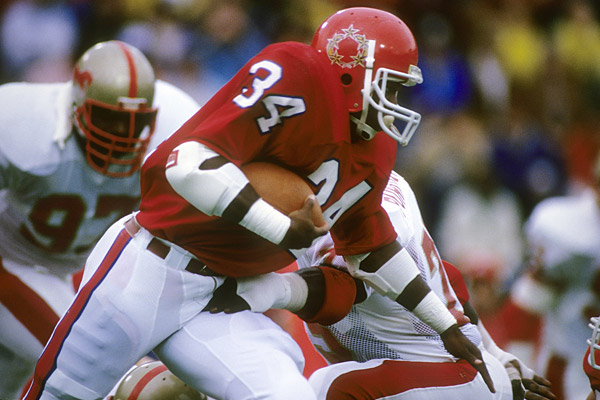
MVP Profile: Herschel Walker, 1985

Running Back, New Jersey Generals


Age: 23 (Mar. 3)
3rd season in pro football & with Generals
College: Georgia
Height: 6’1” Weight: 223

Prelude:
After winning the Heisman Trophy as a junior in 1982, Walker stunned the football world by signing with the Generals of the new USFL for the ’83 spring season. He led the league in rushing (1812 yards) in 1983 and, playing with a sore shoulder in ’84, added another 1339 yards. Was a consensus All-League first-team selection in ’83.

1985 Season Summary
Appeared and started in all 18 games
[Bracketed numbers indicate league rank in Top 20]

Rushing
Attempts – 438 [1]
Most attempts, game - 36 (for 142 yds.) at Denver 5/19
Yards – 2411 [1]
Most yards, game – 233 yards (on 34 carries) vs. Houston 4/7
Average gain – 5.5 [2]
TDs – 21 [1]
200-yard rushing games - 3
100-yard rushing games - 14

Pass Receiving
Receptions – 37
Most receptions, game – 5 (for 35 yds.) vs. Portland 4/14
Yards – 467
Most yards, game - 106 (on 3 catches) at Denver 5/19
Average gain – 12.6
TDs – 1
100-yard receiving games - 1

Scoring
TDs – 22 [1]
Points – 132 [1]

Postseason: 1 G (USFL Quarterfinal playoff vs. Baltimore)
Rushing attempts – 25
Rushing yards – 66
Average gain rushing – 2.6
Rushing TDs – 1

Pass receptions – 4
Pass receiving yards - 44
Average yards per reception – 11.0
Pass Receiving TDs - 0

Awards & Honors:
USFL Player of the Year: League, Sporting News, College & Pro Football Newsweekly
1st team All-USFL: League, Sporting News, College & Pro Football Newsweekly

Generals went 11-7 to place second in USFL Eastern Conference and gain wild card spot in postseason. Lost Quarterfinal playoff game to Baltimore Stars (20-17).

Aftermath:
Following the demise of the USFL, Walker joined the NFL Dallas Cowboys, who had drafted him in the fifth round in 1985 (his first year eligible under the rules then in effect). Splitting time with veteran RB Tony Dorsett, he gained 1574 yards from scrimmage in ’86 and led the league with 1606 yards in ’87. Walker was selected to the Pro Bowl following the 1987 and ’88 seasons – his 1514 rushing yards in ’88 were his NFL career high. Traded to Minnesota during the 1989 season, although still productive, he was unable to fit comfortably into the offense. Moving on to Philadelphia in 1992, he had his only other thousand-yard rushing season in the NFL (1070), and while an effective runner-receiver-kick returner, found himself sharing time in the offensive backfield. Following a 1995 season in which he was primarily used as a kick returner by the New York Giants, Walker returned to the Cowboys for his last two pro seasons.

--

MVP Profiles feature players who were named MVP or Player of the Year in the NFL, AAFC (1946-49), AFL (1960-69), WFL (1974), or USFL (1983-85) by a recognized organization (Associated Press, Pro Football Writers Association, Newspaper Enterprise Association, United Press International, The Sporting News, Maxwell Club – Bert Bell Award, or the league itself).

[Updated 2/15/14]