March 31, 2011

1964: Eagles Trade Sonny Jurgensen to Redskins for Norm Snead


Following the 1963 NFL season, the Philadelphia Eagles began a transformation under a new owner, Jerry Wolman, and a new head coach/GM, Joe Kuharich. Having finished at the bottom of the Eastern Conference in both 1962 and ’63, Kuharich decided that a housecleaning was in order. The first major deal was the trade of popular star flanker Tommy McDonald to the Dallas Cowboys for a kicker and two backup linemen. If that wasn’t enough to shock Eagles fans, on March 31, 1964 he swung an even more significant trade, sending QB Sonny Jurgensen and CB Jimmy Carr to the Washington Redskins for QB Norm Snead and CB Claude Crabb.

Kuharich justified the deal by indicating that he was trading for youth - Snead and Crabb were 24, while Jurgensen was 29 and Carr was 31. Head Coach Bill McPeak of the Redskins looked at it from the other side. “Winning in 1964 is imperative. Jurgensen, at this stage of his career, is more advanced than Snead, and I think, with the right supporting cast, he can take you all the way.”

The 6’0”, 200-pound Jurgensen (pictured above) had been drafted by the Eagles out of Duke in the fourth round in 1957. After a promising rookie season, he sat on the bench for three years backing up veteran QB Norm Van Brocklin, who was obtained from the Rams in ’58. Van Brocklin led Philadelphia to the 1960 title and retired, and Jurgensen was thrust into the starting lineup. He responded with an outstanding season in 1961, setting a new NFL record for passing yards (3723) and also leading the league in touchdown passes (32). The Eagles nearly repeated as Eastern Conference champions, finishing a close second to the Giants.

However, in the ensuing Playoff Bowl against the Western Conference’s second-place team, the Detroit Lions, Jurgensen suffered a severe shoulder separation that hindered his performance the next season (and even beyond). While he again led the NFL with 3261 passing yards, he also threw a league-high 26 interceptions (as opposed to 22 TDs). The team was riddled by injuries and plummeted to the bottom with a 3-10-1 record. Jurgensen began to hear the boos from the disgruntled fans at Franklin Field.

During 1963 training camp, Jurgensen and backup QB King Hill walked out in a joint contract holdout. The dispute was resolved in short order by GM Vince McNally, but not without rancor, and Jurgensen hardly endeared himself to the organization. During the regular season, injuries limited him to nine games for the 2-10-2 club, and he threw for only 1413 yards with 11 touchdowns against 13 interceptions.

Still, dealing Jurgensen came as a surprise to fans, as well as to him - “I talked to Kuharich 10 days ago and we talked about a lot of things but he didn’t mention the trade or any other trade,” said the quarterback immediately after the deal was announced. “Sure, I was surprised.” (it was reported that he was first offered to the Vikings for Fran Tarkenton, but Van Brocklin, now coach in Minnesota, vetoed the trade). Jurgensen was considered one of the best pure passers in the NFL, with a strong and accurate arm. But while a flashy and exciting competitor, he also was known as an off-field carouser during his years in Philadelphia (he joked that “when I left Philadelphia, all the bartenders wore black armbands”).

The less colorful Norm Snead had been drafted by the Redskins in the first round in 1961 and started every game of his rookie season. At 6’4” and 215 pounds, and with a strong arm, he had the tools, but Washington was a dreadful team that ended up at the bottom with a 1-12-1 record – they only avoided a winless season by beating the second-year Dallas Cowboys in the finale.

While Snead took plenty of lumps, he also received credit as a rising talent. When the Redskins got off to a 4-0-2 start in 1962, he and flanker Bobby Mitchell, the ex-Cleveland halfback who had been obtained during the offseason, were the talk of the league. But the Giants exposed Washington’s weak pass defense in a 49-34 pounding at Yankee Stadium, Mitchell was slowed by an injury as well as increased coverage by defenses, and the Redskins finished at 5-7-2. The whispers were already beginning that the young quarterback didn’t seem to be improving, and the talk became louder (as well as boos from the fans) when the club went 3-11 in ’63 and Snead tossed a league-leading 27 interceptions.

As for the defensive backs that were almost afterthoughts in the trade, Carr had been with the Eagles since 1959, had started during the 1960 championship season, but was on the downside of his career (he lasted two years with the Redskins before retiring). In two years with the Redskins, Crabb, who had been a fullback and linebacker in college at Colorado, intercepted 9 passes, but was part of a much-maligned defensive backfield in Washington. Like Carr, he played two undistinguished years for the Eagles before departing for the Rams, where he lasted for three seasons in a reserve role.

Jurgensen played in Washington for 11 years, finally retiring at age 40 following the 1974 season. Along the way, he led the NFL in passing once, in passing yards three times (breaking his own record with 3747 yards in 1967), and completion percentage twice. He was a consensus first-team All-Pro selection in 1969 and was named to the Pro Bowl four times.

The Redskins were a mediocre team during his prime, however. While Bill McPeak might have hoped that Jurgensen would immediately lift the team to a winning record, Washington went 6-8 in both 1964 and ’65 and he was let go. Otto Graham, a former all-time great quarterback in his own right with the Browns, emphasized the passing game in three years as head coach that produced an overall 17-22-3 record. The arrival of Vince Lombardi in 1969 brought improvement (and Jurgensen responded with an outstanding year), with the team posting a 7-5-2 tally. However, Lombardi’s tenure was cut short when the legendary coach died of cancer just prior to the 1970 season – the last in which Jurgensen was the full-time starter. The Redskins were 6-8 under Bill Austin.

Washington’s fortunes improved with the coming of George Allen as head coach/GM in 1971, but it was Bill Kilmer primarily lining up behind center, not the increasingly-brittle Jurgensen. Still, the team went 10-2 in games that Jurgensen started during his last four years, a sign that he played well even if no longer often. At the time of his retirement, the paunchy redhead was the top-rated passer in NFL history - he was inducted into the Pro Football Hall of Fame in 1983.


As for Norm Snead (pictured at left) and the Eagles, the road was far more rocky. After a fair year for a 6-8 club in 1964, Snead had a good season in 1965, passing for 2346 yards with 15 touchdowns and 13 interceptions, and earned selection to the Pro Bowl. He had his most productive statistical season in 1967, passing for 3399 yards and 29 TDs (as well as 24 interceptions). However, in between, he had a dreadful year in 1966 and was benched in favor of backups King Hill and Jack Concannon during the last month of the season – the Eagles finished 9-5 that year, their only winning record during Snead’s tenure with the team.

Following the big performance in 1967, Snead broke his leg in the first 1968 preseason game and returned to the starting lineup four weeks into a disastrous 2-12 campaign. Despite his late start, Snead led the NFL by being picked off 21 times. A new owner (Leonard Tose) fired Kuharich in favor of Jerry Williams, but Snead remained and the result was much the same as he again led the league in throwing interceptions (23).

After one more mediocre year in 1970, he was dealt to the Minnesota Vikings, where he split time with Gary Cuozzo in ‘71. It was on to the New York Giants in 1972, in the trade that brought Fran Tarkenton back to Minnesota. Snead led the NFC in passing for the 8-6 Giants, but fell back into his old ways, tossing a league-leading 22 interceptions against just seven TD passes in 1973. Midway through the ’74 season, he was traded once again, to the 49ers, and eventually returned to the Giants as a backup for his final season of 1976.

Lacking Sonny Jurgensen’s quick release and ability to read defenses, Snead was prone to making poor decisions that, as the record indicates, resulted in far too many interceptions. His lack of mobility also caused him to be sacked many times, and he was not a strong leader. He was relentlessly maligned by the frustrated Eagles fans and, during his time in Philadelphia, lived in the shadow of Jurgensen; as if it were not enough, in games between the Eagles and Redskins with Snead and Jurgensen facing off, Washington went 9-2-2 (the Eagles won a game against the Redskins in 1966 with King Hill at quarterback).

March 30, 2011

MVP Profile: Johnny Unitas, 1957

Quarterback, Baltimore Colts


Age: 24
2nd season in pro football & with Colts
College: Louisville
Height: 6’1” Weight: 190

Prelude:
Unitas was chosen in the 9th round of the 1955 NFL draft by the Steelers, but failed to make the team in the preseason. After playing semi-pro football, he was signed by the Colts to back up starting QB George Shaw. When Shaw went down with a broken kneecap four games into the ’56 season, Unitas got his chance, showed potential, and held onto the job.

1957 Season Summary
Appeared in all 12 games
[Bracketed numbers indicate league rank in Top 20]

Passing
Attempts – 301 [1]
Most attempts, game – 37 at San Francisco 12/8
Completions – 172 [2]
Most completions, game – 23 at San Francisco 12/8
Yards – 2550 [1]
Most yards, game – 296 at San Francisco 12/8
Completion percentage – 57.1 [3]
Yards per attempt – 8.5 [2]
TD passes – 24 [1]
Most TD passes, game – 4 vs. Detroit 9/29, at Detroit 10/20
Interceptions – 17 [2]
Most interceptions, game – 3 vs. Detroit 9/29, vs. Pittsburgh 11/3
Passer rating – 88.0 [1](Ranked 3rd in system used at time)
200-yard passing games – 8

Rushing
Attempts – 42
Yards – 171
Yards per attempt – 3.5
TDs – 1

Scoring
TDs – 1
Points – 6

Awards & Honors:
NFL MVP: NEA
1st team All-NFL: NEA
2nd team All-NFL: AP, UPI, NY Daily News
Pro Bowl

The Colts went 7-5 to finish third in the NFL Western Conference, contending throughout the season but finishing a game behind the leaders after losing their last two games on the West Coast.

Aftermath:
The 1957 breakout season was just the beginning for Unitas. He led the Colts to back-to-back championships in 1958 and ’59, the first culminating in a sudden death classic against the Giants. Unitas was an outstanding play-caller as well as passer with a quick release and adept at throwing long, short, or in between. His 1957 season was part of a record 47-straight-game TD passing streak that ended in 1960. Unitas passed for 40,239 yards and 290 touchdowns in a career that extended until 1973. He was an MVP three more times, was named to 10 Pro Bowls, and selected to the NFL’s 75th Anniversary All-Time team. Unitas had his #19 retired by the Colts and was inducted into the Pro Football Hall of Fame, Class of 1979.

--

MVP Profiles feature players who were named MVP or Player of the Year in the NFL, AAFC (1946-49), AFL (1960-69), WFL (1974), or USFL (1983-85) by a recognized organization (Associated Press, Pro Football Writers Association, Newspaper Enterprise Association, United Press International, The Sporting News, Maxwell Club – Bert Bell Award, or the league itself).

[Updated 2/15/14]

March 29, 2011

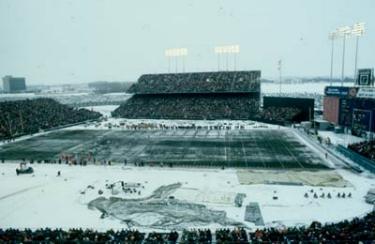
Past Venue: Metropolitan Stadium

Bloomington, MN


Year opened: 1956
Capacity: 48,446, up from 18,000 at opening

Names:
Metropolitan Stadium, 1956-85

Pro football tenants:
Minnesota Vikings (NFL), 1961-81

Postseason games hosted:
NFL Western Conf. Championship, Vikings 23 Rams 20, Dec. 27, 1969
NFL Championship, Vikings 27 Browns 7, Jan. 4, 1970
NFC Divisional playoff, 49ers 17 Vikings 14, Dec. 27, 1970
NFC Divisional playoff, Cowboys 20 Vikings 12, Dec. 25, 1971
NFC Divisional playoff, Vikings 27 Redskins 20, Dec. 22, 1973
NFC Divisional playoff, Vikings 30 Cardinals 14, Dec. 21, 1974
NFC Championship, Vikings 14 Rams 10, Dec. 29, 1974
NFC Divisional playoff, Cowboys 17 Vikings 14, Dec. 28, 1975
NFC Divisional playoff, Vikings 35 Redskins 20, Dec. 18, 1976
NFC Championship, Vikings 24 Rams 13, Dec. 26, 1976

Other tenants of note:
Minneapolis Millers (minor league baseball), 1956-60
Minnesota Twins (MLB – AL), 1961-81
Minnesota Kicks (NASL), 1976-81

Notes: The NFL’s Chicago Cardinals hosted two regular season games at the stadium in 1959 and there were five NFL preseason games played there from 1956-60, prior to the debut of the Vikings. First pro football game held at stadium was a preseason game between the Steelers and Eagles on Sept. 15, 1956.

Fate: Demolished in 1985, the site is now occupied by the Mall of America.

March 27, 2011

MVP Profile: Marcus Allen, 1985

Running Back, Los Angeles Raiders


Age: 25
4th season in pro football & with Raiders
College: Southern California
Height: 6’2” Weight: 205

Prelude:
After winning the 1981 Heisman Trophy at USC, Allen was chosen by the Raiders in the first round of the ’82 draft. In the strike-shortened 1982 season, he led the NFL with 1098 yards from scrimmage, 14 TDs, and 84 points. He gained over a thousand yards rushing in each of the next two seasons, with a high of 1168 yards in ’84, when he again led the league in touchdowns with 18. He also was the MVP of the Super Bowl following the ’83 season, after rushing for 191 yards. Allen caught a total of 170 passes for 1749 yards in his first three years. He was a consensus first-team All-Pro in 1982 and was selected to the Pro Bowl twice.

1985 Season Summary
Appeared and started in all 16 games
[Bracketed numbers indicate league rank in Top 20]

Rushing
Attempts – 380 [2]
Most attempts, game - 31 (for 135 yds.) vs. Cincinnati 11/17
Yards – 1759 [1]
Most yards, game – 173 yards (on 24 carries) vs. Denver 11/24
Average gain – 4.6 [14]
TDs – 11 [3, tied with Ron Davenport, 1st in AFC]
100-yard rushing games - 11

Pass Receiving
Receptions – 67 [16, tied with Wes Chandler]
Most receptions, game – 8 (for 53 yds.) vs. San Francisco 9/22, (for 25 yds.) at LA Rams 12/23
Yards – 555
Most yards, game - 54 (on 6 catches) vs. Cincinnati 11/17
Average gain – 8.3
TDs - 3

Passing
Attempts – 2
Completions – 1
Yards – 16
TD passes – 0
Interceptions – 0

Scoring
TDs – 14 [4]
Points – 84


Postseason: 1 G (AFC Divisional playoff vs. New England)
Rushing attempts – 22
Rushing yards – 121
Average gain rushing – 5.5
Rushing TDs – 1

Pass receptions – 3
Pass receiving yards - 8
Average yards per reception – 2.3
Pass Receiving TDs - 0

Awards & Honors:
NFL MVP: AP, PFWA, Sporting News
NFL Offensive Player of the Year: AP
1st team All-NFL: AP, PFWA, NEA, Sporting News
1st team All-AFC: UPI
Pro Bowl

Raiders went 12-4 to finish first in the AFC West with the best record in the conference. Lost Divisional playoff to New England Patriots (27-20).

Aftermath:
Allen played another 12 years in the NFL, and went to the Pro Bowl again in 1986, ’87, and ’93, but never again ran for a thousand yards or caught more than 51 passes. Bothered by injuries (and involved in disputes with owner Al Davis), he shared time with other running backs during the remainder of his career with the Raiders, most notably Bo Jackson. Signing with the Chiefs as a free agent in 1993 reinvigorated his career at age 33, and he led the NFL with 12 rushing touchdowns. Allen retired in 1997 with 123 career touchdowns, as well as 12,243 rushing yards and 587 pass receptions for another 5412 yards. He was inducted into the Pro Football Hall of Fame, Class of 2003.

--

MVP Profiles feature players who were named MVP or Player of the Year in the NFL, AAFC (1946-49), AFL (1960-69), WFL (1974), or USFL (1983-85) by a recognized organization (Associated Press, Pro Football Writers Association, Newspaper Enterprise Association, United Press International, The Sporting News, Maxwell Club – Bert Bell Award, or the league itself).

[Updated 2/15/14]
[Updated 11/28/14]

March 26, 2011

1985: Rams Sign CFL Star Dieter Brock


On March 26, 1985 the Los Angeles Rams announced the signing of QB Dieter Brock, an 11-year veteran of the Canadian Football League who had played out his option with the Hamilton Tiger-Cats. It was reported that the 34-year-old Brock agreed to a four-year deal (three years plus option) with the Rams for $2.1 million.

The acquisition sealed the fate of Vince Ferragamo, who had himself signed a four-year contract extension with the Rams a year earlier. Ferragamo had come off the bench to lead LA to the Super Bowl in 1979 after starter Pat Haden went down with an injury, followed up with a 30-TD year in ’80, jumped to Montreal of the CFL in 1981, and, after performing poorly in Canada, returned to the Rams in ’82. He was inconsistent, but kept regaining the starting job, before going down for the year with a hand injury suffered in the third game of the 1984 season. Head Coach John Robinson made clear, in announcing Brock’s signing, that Ferragamo would be dealt.

While not guaranteed the starting job off the bat, Brock said “I just feel this is an excellent opportunity for me and I'm not afraid of competition. This is a dream come true.”

Brock’s 11 seasons in the CFL included the first 9 1/2 with the Winnipeg Blue Bombers and the last 1 1/2 with Hamilton. He was traded by Winnipeg to Hamilton during the ’83 season for QB Tom Clements after staging a series of walkouts in an effort to get out of his contract. His career numbers in the CFL were 2602 completions in 4535 attempts for 34,830 yards with 210 touchdowns and 158 interceptions; he led the CFL in passing four times and won the Schenley Award in 1980 and ’81 as the league’s MVP.

Brock, from Birmingham, Alabama, had backed up Heisman Trophy winner Pat Sullivan at Auburn before transferring to Jacksonville State. Sensing little interest from the NFL, he signed with Winnipeg before the NFL draft in 1974 (consequently, no team had prior rights to him).

Before signing with Los Angeles, Brock tried out with Buffalo, Green Bay, and Cleveland. Buffalo was rumored to have the inside track, especially since they were looking to replace 34-year-old Joe Ferguson (ironically, they ended up getting Ferragamo). The Packers reportedly made the highest offer, but were committed to veteran Lynn Dickey as the starter.

The club Brock was joining had made it to the postseason in 1984 as a wild card team with a 10-6 record (they lost in the first round). But while RB Eric Dickerson had performed brilliantly in his first two seasons, gaining a rookie-record 1808 yards in 1983 followed by a NFL record 2105 yards in ‘84, the team had not done well through the air. Young QB Jeff Kemp went 9-4 starting in place of Ferragamo, but the Rams ranked at the bottom of the NFC in passing offense.

Kemp was still with the team, as were the untested Scott Tinsley and veteran backup Steve Dils, but it was clear that the starting job was Brock’s to lose. While Coach Robinson preferred a run-oriented attack (going back to his years as a college coach at USC), he hoped that improving the passing game would, if nothing else, make Dickerson even more effective (he also expressed a desire to utilize the star runner, who had caught 51 passes in 1983 but only 21 in ’84, more often as a receiver out of the backfield).

The 1985 Rams, even with Dickerson holding out at the beginning of the season, won their first seven games and ended up at the top of the NFC West with an 11-5 record. Brock set a then-club record by completing 59.7 percent of his 365 passes for 2658 yards with 16 touchdowns and 13 interceptions. However, he played conservatively, rarely throwing long, and, even with one of the best offensive lines in the league in front of him, was sacked 51 times. The Rams still ranked low in passing yards.

In the postseason, Brock's performance was especially disappointing. While LA beat the Cowboys 20-0 in the Divisional round, it was primarily because of Dickerson rushing for 248 yards - Brock completed only 6 of 22 passes for 50 yards with an interception and no touchdowns. Playing for the NFC Championship against Chicago, Brock was successful on just 10 of 31 throws for 66 yards, again with one picked off and no TDs, and the Bears won handily, 24-0. Chicago Head Coach Mike Ditka remarked afterward that “I’m glad they didn’t play Jeff Kemp.”

Brock returned for the 1986 season, but back and knee injuries, the latter of which required surgery, kept him from playing. Steve Dils and veteran Steve Bartkowski, who had been obtained from the Falcons, handled the starting quarterback duties initially, but an early-season trade with Houston brought highly-touted rookie Jim Everett to the team, and he was the starter by the end of the year – and clearly the first choice to start going forward. Brock chose to retire.

Dieter Brock’s NFL career was brief and undistinguished, but he was recognized for his outstanding play in the CFL by being selected as one of the Top 20 All-Time Greats for the Winnipeg Blue Bombers to mark the franchise’s 75th anniversary, and he was inducted into the Canadian Football Hall of Fame in 1995.

March 25, 2011

1984: Walton Throws for 440 Yards as Breakers Beat Blitz in Overtime


The New Orleans Breakers of the United States Football League were riding a four-game winning streak to start the season as they hosted the winless Chicago Blitz on March 25, 1984 at the Louisiana Superdome. The Breakers, who had represented Boston in ’83 and played at little (capacity 20,535) Nickerson Field, had a much larger (capacity 69,658) and more luxurious venue in their second season, and were playing well. Unchanged were the head coach (Dick Coury) and starting quarterback (36-year-old John Walton, pictured above with WR Frank Lockett).

The Blitz were a transformed club, bearing little resemblance to the team of the same name that had been coached by George Allen in 1983. That team had moved to Arizona and was, for the most part, replaced by the former Arizona Wranglers franchise. Chicago had a new head coach, however, in Marv Levy and a veteran quarterback, Vince Evans, formerly of the NFL Bears.

There were 43,692 enthusiastic fans in attendance at the Superdome, and they saw the home team take a 14-0 lead in the first quarter. First, RB Marcus Dupree, a rookie from Oklahoma who joined the club two weeks into the season after signing a $6 million contract, scored on a one-yard run. Dupree reinjured his hamstring, however, and sat out the rest of the game after gaining three yards on two carries. His replacement, RB Buford Jordan (pictured below left), scored the next touchdown on a 14-yard pass from Walton.


The Blitz started off the second quarter with Evans completing a six-yard touchdown pass to WR Marcus Anderson to cut the Breakers’ lead to 14-7. Jordan scored again for New Orleans, on a one-yard carry, three minutes later, but Chicago came back as Evans connected with TE Mark Keel for a 14-yard touchdown and Kevin Seibel kicked a 30-yard field goal in the last minute of the half. The Breakers led by 21-17 at halftime.

Late in the third quarter, Walton threw to veteran TE Dan Ross for a four-yard touchdown to make it 28-17. It seemed as though New Orleans would put the game away early in the fourth quarter, but Jordan fumbled at the Chicago eight yard line after being hit hard by DT Dennis Puha and LB Tom Kilkenny, and safety Mike Fox grabbed the loose ball and ran 92 yards for a TD. Evans followed up with a successful pass to Keel for the two-point conversion, and instead of the Breakers extending their lead, it was cut to 28-25 with 12:46 left in regulation.

Six minutes later, the Blitz went in front when Evans connected with Anderson for a 50-yard touchdown. With the score now 32-25, the New Orleans offense started the ensuing possession from its own four yard line after the kickoff bounced past the kick return team. The Breakers couldn’t get a first down and had to punt after, on a third-and-two play at the nine, Blitz CB Virgil Livers broke into the backfield and tackled Jordan for a loss. It appeared that an upset was in the making.

Chicago wasn’t able to take advantage, however, and had to punt the ball back. The Breakers proceeded to drive 80 yards in seven plays to regain the lead on a nine-yard TD pass from Walton to WR Charlie Smith (a former teammate with the NFL Eagles) with 1:52 left on the clock.

The Blitz got the ball back with one timeout remaining. Evans used sideline routes to move down the field and manage the clock. A 21-yard completion to TE Gary Lewis got the ball to the New Orleans 23, and a pass interference penalty advanced it to the 12 with 40 seconds to go. Breakers LB Ben Needham nearly intercepted a pass that Evans threw on the run with the clock down to 11 seconds, and Chicago tied score at 35-35 with no time remaining as Seibel kicked a 23-yard field goal.

The Breakers won the toss for the overtime period and held onto the ball the entire time. After advancing across midfield, and helped by a 10-yard completion to WR Marion Brown on a third-and-seven play that barely stayed inbounds, Walton faked a short pass and then fired long to WR Frank Lockett, who caught the ball in full stride along the left sideline and proceeded into the end zone for a 44-yard touchdown at 2:59 into OT. New Orleans remained undefeated by a score of 41-35.

The Breakers significantly outgained Chicago (591 yards to 414) and led in first downs (30 to 20). There was only one turnover in the game – the fumble by Buford Jordan that was returned for a touchdown. Neither defense recorded a sack.

John Walton was outstanding, completing 29 of 43 passes for 440 yards and four touchdowns with, of course, none intercepted. Frank Lockett’s game-winning touchdown capped a performance in which he gained 155 yards on 5 catches. Dan Ross had 7 receptions for 92 yards, including a TD, and Buford Jordan also caught 7 passes, for 71 yards and a score. Jordan, a rookie from McNeese State, set a then-team record with 135 yards on 19 carries, making the most of the opportunity to fill in for Dupree.


For the Blitz, Vince Evans was successful on 22 of 32 passes for 292 yards and three touchdowns. RB Larry Canada, formerly of the NFL Broncos, led the club with 68 yards rushing on 13 attempts as well as 7 pass receptions for 48 yards. Marcus Anderson gained 81 yards on four catches that included two TDs.

Frank Lockett said of the game-winning TD pass that it was “a hell of a throw. I just turned and the ball was there.” Coach Levy of the Blitz stated simply that “their guy threw a pass, our guy missed it, their guy caught it.”

“I'm frustrated we don't play tough on defense,” Levy added. “We have some guys who played real well, but we just did not play well as a team.”

New Orleans failed to maintain the early momentum, losing the next week at Birmingham and going just 3-10 the rest of the way to finish up at 8-10 and in third place in the Southern Division. The Blitz ended up at the bottom of the Central Division with a 5-13 record.

In the final season of a pro career that included play in five different leagues, John Walton passed for 3554 yards and 17 touchdowns. Frank Lockett caught 56 passes for 1199 yards, for a very respectable 21.4-yard average, and scored eight TDs. Dan Ross led the club with 65 catches for 833 yards. Buford Jordan outgained Marcus Dupree, 1276 yards (averaging 6.0 yards per carry) to 684.

March 23, 2011

Past Venue: Orange Bowl

Miami, FL


Year opened: 1937
Capacity: 74,476, up from 23,330 at opening and down from 80,010 when seating was added to what had been an open (west) end but was removed in 1977.

Names:
Burdine Stadium, 1937-59
Orange Bowl, 1959-2008

Pro football tenants:
Miami Seahawks (AAFC), 1946
Miami Dolphins (AFL/NFL), 1966-86
Miami Tropics (SFL), 2000

Postseason games hosted:
Super Bowl II, Packers 33 Raiders 14, Jan. 14, 1968
Super Bowl III, Jets 16 Colts 7, Jan. 12, 1969
Super Bowl V, Colts 16 Cowboys 13, Jan. 17, 1971
AFC Championship, Dolphins 21 Colts 0, Jan. 2, 1972
AFC Divisional playoff, Dolphins 20 Browns 14, Dec. 24, 1972
AFC Divisional playoff, Dolphins 34 Bengals 16, Dec. 23, 1973
AFC Championship, Dolphins 27 Raiders 10, Dec. 30, 1973
Super Bowl X, Steelers 21 Cowboys 17, Jan. 18, 1976
AFC Wild Card playoff, Oilers 17 Dolphins 9, Dec. 24, 1978
Super Bowl XIII, Steelers 35 Cowboys 31, Jan. 21, 1979
AFC Divisional playoff, Chargers 41 Dolphins 38, Jan. 2, 1982
AFC First Round playoff, Dolphins 28 Patriots 13, Jan. 8, 1983
AFC Divisional playoff, Dolphins 34 Chargers 13, Jan. 16, 1983
AFC Championship, Dolphins 14 Jets 0, Jan. 23, 1983
AFC Divisional playoff, Seahawks 27 Dolphins 20, Dec. 31, 1983
AFC Divisional playoff, Dolphins 31 Seahawks 10, Dec. 29, 1984
AFC Championship, Dolphins 45 Steelers 28, Jan. 6, 1985
AFC Divisional playoff, Dolphins 24 Browns 21, Jan. 4, 1986
AFC Championship, Patriots 31 Dolphins 14, Jan. 12, 1986

Other tenants of note:
Univ. of Miami (college football), 1937-2007
Miami Gatos/Toros (NASL), 1971-76
Miami Freedom (ASL/APSL), 1988-92
Florida International Univ. (college football), 2007

Notes: Hosted annual NFL Playoff Bowl, 1961-70. Hosted NFC/AFC Pro Bowl, Jan. 20, 1975. Hosted annual Orange Bowl football game, 1938-95 and ’99. Hosted annual North-South Shrine Game, 1948-73. Hosted a CFL exhibition game between the Birmingham Barracudas and Baltimore Stallions, 1995. Last pro football team to use the stadium was the Miami Tropics of the Spring Football League that existed only for one mini-season in 2000. Used as venue for FIFA World Cup, 1994, and as a soccer venue for the 1996 Summer Olympics. Occasionally used for minor league baseball games by the Miami Marlins, 1956-60. Originally named for Roddy Burdine, a significant figure in the development of Miami. The natural grass field was replaced with PolyTurf in 1970 and then Prescription Athletic Turf in 1976.

Fate: Demolished in 2008, to be replaced by a new baseball stadium for major league baseball’s Florida Marlins.