May 23, 2010

List of the Day: Best Pass Receiving Seasons, 1970s NFC


Ahmad Rashad

NOTE: Due to the adoption of the 16-game schedule as well as rules changes that had a major effect on opening up the passing game, the 1978 and ’79 seasons significantly skew the Top 10 results. Therefore, following the Top 10 is a list of the next 5 best performances that occurred exclusively from 1970-77.

TOP 10 RECEPTIONS
1- Rickey Young, 1978 Minnesota Vikings*
88 rec., 704 yards, 8.0 avg., 5 TD

2- Ahmad Rashad, 1979 Minnesota Vikings
80 rec., 1156 yards, 14.5 avg., 9 TD

3(tied)- Tony Galbreath, 1978 New Orleans Saints*
74 rec., 582 yards, 7.9 avg., 2 TD

3(tied)- Wallace Francis, 1979 Atlanta Falcons
74 rec., 1013 yards, 13.7 avg., 8 TD

5- Chuck Foreman, 1975 Minnesota Vikings*
73 rec., 691 yards, 9.5 avg., 9 TD

6- Rickey Young, 1979 Minnesota Vikings*
72 rec., 519 yards, 7.2 avg., 4 TD

7- Dick Gordon, 1970 Chicago Bears
71 rec., 1026 yards, 14.5 avg., 13 TD

8- Harold Carmichael, 1973 Philadelphia Eagles
67 rec., 1116 yards, 16.7 avg., 9 TD

9- Ahmad Rashad, 1978 Minnesota Vikings
66 rec., 769 yards, 11.7 avg., 8 TD

10-Wes Chandler, 1979 New Orleans Saints
65 rec., 1069 yards, 16.4 avg., 6 TD

* Running Back
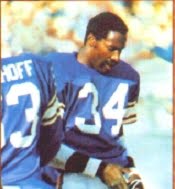

Rickey Young

NEXT 5 (1970-77)
1- Charle Young, 1974 Philadelphia Eagles
63 rec., 696 yards, 11.0 avg., 3 TD

2(tied)- Harold Jackson, 1972 Philadelphia Eagles
62 rec., 1048 yards, 16.9 avg., 4 TD

2(tied)- Drew Pearson, 1974 Dallas Cowboys
62 rec., 1087 yards, 17.5 avg., 2 TD

4(tied)- Bob Tucker, 1971 New York Giants
59 rec., 791 yards, 13.4 avg., 4 TD

4(tied)- Charley Taylor, 1973 Washington Redskins
59 rec., 801 yards, 13.6 avg., 7 TD


Dick Gordon


Harold Carmichael

BEST BY FRANCHISES NOT IN TOP 10
St. Louis Cardinals: Pat Tilley, 1978
62 rec., 900 yards, 14.5 avg., 3 TD

Detroit Lions: Freddie Scott, 1979
62 rec., 929 yards, 15.0 avg., 5 TD

Green Bay Packers: Ken Payne, 1975
58 rec., 766 yards, 13.2 avg., 0 TD

San Francisco 49ers: Paul Hofer, 1979*
58 rec., 662 yards, 11.4 avg., 2 TD

Los Angeles Rams: Jack Snow, 1970
51 rec., 859 yards, 16.8 avg., 7 TD

Tampa Bay Buccaneers: Jimmie Giles, 1979**
40 rec., 579 yards, 14.5 avg., 7 TD

* Running Back
** Buccaneers joined NFL in 1976 as AFC team, moved to NFC in ‘77


Gene Washington


Harold Jackson

TOP 10 YARDS
1- Ahmad Rashad, 1979 Minnesota Vikings
1156 yards, 80 rec., 14.5 avg., 9 TD

2- Harold Carmichael, 1973 Philadelphia Eagles
1116 yards, 67 rec., 16.7 avg., 9 TD

3- Gene Washington, 1970 San Francisco 49ers
1100 yards, 53 rec., 20.8 avg., 12 TD

4- Drew Pearson, 1974 Dallas Cowboys
1087 yards, 62 rec., 17.5 avg., 2 TD

5- Harold Carmichael, 1978 Philadelphia Eagles
1072 yards, 55 rec., 19.5 avg., 8 TD

6- Wes Chandler, 1979 New Orleans Saints
1069 yards, 65 rec., 16.4 avg., 6 TD

7- Tony Hill, 1979 Dallas Cowboys
1062 yards, 60 rec., 17.7 avg., 10 TD

8- Harold Jackson, 1972 Philadelphia Eagles
1048 yards, 62 rec., 16.9 avg., 4 TD

9- John Gilliam, 1972 Minnesota Vikings
1035 yards, 47 rec., 22.0 avg., 7 TD

10(tied)-Dick Gordon, 1970 Chicago Bears
1026 yards, 71 rec., 14.5 avg., 13 TD

10(tied)-Drew Pearson, 1979 Dallas Cowboys
1026 yards, 55 rec., 18.7 avg., 8 TD


Drew Pearson

NEXT 5 (1970-77)
1- John Gilliam, 1970 St. Louis Cardinals
952 yards, 45 rec., 21.2 avg., 5 TD

2- Mel Gray, 1975 St. Louis Cardinals
926 yards, 48 rec., 19.3 avg., 11 TD

3- Gene Washington, 1972 San Francisco 49ers
918 yards, 46 rec., 20.0 avg., 12 TD

4- John Gilliam, 1973 Minnesota Vikings
907 yards, 42 rec., 21.6 avg., 8 TD

5(tied)- Dan Abramowicz, 1970 New Orleans Saints
906 yards, 55 rec., 16.5 avg., 5 TD

5(tied)- Sammy White, 1976 Minnesota Vikings
906 yards, 51 rec., 17.8 avg., 10 TD


John Gilliam


Wallace Francis

BEST BY FRANCHISES NOT IN TOP 10
Atlanta Falcons: Wallace Francis, 1979
1013 yards, 74 rec., 13.7 avg., 8 TD

Green Bay Packers: James Lofton, 1979
968 yards, 54 rec., 17.9 avg., 4 TD

Detroit Lions: Freddie Scott, 1979
929 yds., 62 rec., 15.0 avg., 5 TD

Los Angeles Rams: Harold Jackson, 1973
874 yards, 40 rec., 21.9 avg., 13 TD

Washington Redskins: Frank Grant, 1976
818 yards, 50 rec., 16.4 avg., 5 TD

New York Giants: Bob Tucker, 1971
791 yards, 59 rec., 13.4 avg., 4 TD

Tampa Bay Buccaneers: Isaac Hagins, 1979**
692 yards, 39 rec., 17.7 avg., 3 TD

** Buccaneers joined NFL in 1976 as AFC team, moved to NFC in ‘77


Charley Taylor


Bob Tucker

May 22, 2010

1983: Gold Loses to Express After Firing of Head Coach


As the Denver Gold hosted the Los Angeles Express on May 22, 1983, they not only were in the midst of a four-game losing streak but were under the direction of an interim head coach, Charley Armey. Owner Ron Blanding, concerned that the team was on the verge of falling out of the running in the Pacific Division, had dismissed Head Coach Red Miller (pictured) following the previous week’s 17-9 loss to the Boston Breakers. Miller thus became the first USFL head coach to be fired.

However, the move was not a popular one with Denver football fans. Miller had coached the NFL’s Broncos to their first Super Bowl appearance in 1977 and was thus held in great esteem. He had compiled a 42-25 record in four seasons with the Broncos, easily the best up to that time in the club’s history. For Blanding to hire him to coach the Denver USFL franchise was great for public relations – firing him was not. Moreover, even though the Gold was a mediocre 4-7, they were only a game out of first place in a weak division.

The Express, 5-6 and tied for first with Oakland, had lost three of their last four contests. The teams may have been far from the cream of the crop in the league, but were in the running for the postseason, thus making this a key division matchup.

At halftime Denver held a 7-0 lead thanks to a 31-yard touchdown pass play from QB Alvin White to RB Harry Sydney. LA tied the score in the third quarter as QB Mike Rae connected with RB John Barnett for a 19-yard TD. Brian Speelman moved the Gold back in front later in the period with a 50-yard field goal, but the Express won in the fourth quarter as Barnett dove into the end zone from a yard out with 3:32 left to play. Los Angeles went home the winner by a 14-10 margin.

The lackluster effort by the Gold was reflected in the statistics. The Express led in time of possession (34:28 to 24:32), first downs (22 to 10), and yards from scrimmage (373 to 185). There was no dominant runner for LA - RB Wilbert Haslip led the club with 36 yards on 8 carries while John Barnett, with the two TDs, contributed 33 yards on 9 attempts and RB LaRue Harrington added 30 yards on 12 rushes. Mike Rae, formerly of Toronto in the CFL and a backup with Oakland and Tampa Bay in the NFL, completed 21 of 43 passes for 275 yards with the one TD and two interceptions. WR Anthony Allen led the receivers with 5 catches for 68 yards.


As he did all season, RB Harry Sydney (pictured at left) led Denver in rushing with 46 yards on 13 carries and added another 44 yards on three pass receptions, including the team’s lone touchdown. Alvin White saw his only action of the year at quarterback, completing 2 of 7 passes for 38 yards with two interceptions and the one TD. QB Ken Mortensen completed 9 of 15 throws for 109 yards with no touchdowns and none picked off. Along with Sydney, two other receivers had three catches apiece (TE Bob Niziolek and WR Johnnie Dirden), with Dirden accumulating the most yards with 54.

Owner Blanding sought to mollify the loyal Denver fans (the team led the USFL in attendance in 1983, averaging 41,736 per game). He hired Craig Morton, quarterback of the 1977 AFC Championship team, as head coach in the week following the loss to the Express. The Gold won their first two contests with Morton at the helm, but ultimately ended up in third place with a 7-11 record. Los Angeles also missed out on winning the league’s weakest division, finishing second at 8-10.

Denver had sought to remain competitive while adhering closely to the original USFL philosophy of eschewing high-priced players in order to control costs. The defensive unit was respectable, but the offense lacked firepower – the Gold had the lowest-rated passing offense. Harry Sydney was one of the few notable offensive performers, rushing for 801 yards on 176 carries (4.6 average) with 9 touchdowns and catching 31 passes for 306 yards and another two scores. Bob Niziolek also performed well, catching 37 passes for 373 yards and three TDs. But the quarterbacks combined for just 4.6 yards per pass attempt with 36 interceptions against 19 touchdowns.

May 20, 2010

1984: Gary Anderson Scores 3 TDs as Bandits Defeat Breakers


The Tampa Bay Bandits had started slowly in the United States Football League’s second season, but after a 3-3 beginning they won six straight contests. Coached by the offensive-minded Steve Spurrier, the team was adept at both passing and running.

On May 20, 1984 the Bandits (9-3) hosted the New Orleans Breakers (8-4) in a key Southern Division matchup before a crowd of 42,592 at Tampa Stadium. The Breakers had gotten off to the better start, going 7-2 before losing two of the prior three contests.

Tampa Bay scored first, thanks to a three-yard touchdown pass from the 34-year-old veteran QB John Reaves to WR Eric Truvillion. 20-year-old rookie RB Marcus Dupree tied the score for the Breakers near the end of the opening period on a one-yard run. The lead changed hands twice in the second quarter as Tim Mazzetti put New Orleans ahead 10-7 with a 31-yard field goal, followed by a two-yard TD run by Tampa Bay’s multi-talented RB Gary Anderson (pictured above), which was in turn followed by another Dupree one-yard touchdown carry that gave the Breakers a 17-14 advantage at halftime.

New Orleans turnovers in the third quarter proved crucial. The first was recovered by Tampa Bay LB Kelly Kirchbaum at the Breakers 20 yard line and resulted in a game-tying field goal by Zenon Andrusyshyn. On the very next New Orleans possession, it was DB Dwayne Anderson recovering a fumble for the Bandits, again deep in Breakers territory at the 30. This time it resulted in a touchdown as Gary Anderson ran for a three-yard score and 24-17 lead.

Mazzetti kicked a 19-yard field goal just over four minutes into the fourth quarter to narrow the margin, but Anderson’s third touchdown of the day, on a two-yard run with just under two minutes left to play, capped Tampa Bay’s 31-20 win.


Marcus Dupree was the game’s leading rusher, with 104 yards on 18 carries, while RB Buford Jordan contributed another 53 yards on 12 attempts as the Breakers outran the Bandits, 160 yards to 137. FB Greg Boone led Tampa Bay with 61 yards on 14 rushes while Gary Anderson, who scored all three of his TDs on the ground, had 57 yards on 16 carries. However, as an outstanding receiver out of the backfield as well as runner, Anderson gained 74 yards on 6 catches.

John Reaves had a typically solid passing performance, completing 23 of 32 throws for 276 yards with a TD and an interception. Eric Truvillion led the Bandits with 7 catches for 80 yards and a score. Meanwhile, John Walton connected on 19 of 32 passes for 258 yards with no touchdowns or interceptions. WR Frank Lockett had an outstanding game with 5 pass receptions for 127 yards.

Neither team dominated the statistics, with Tampa Bay enjoying slight advantages in first downs (22 to 20) and time of possession (30:09 to 29:51). Both squads fumbled the ball away three times, but the Bandits better capitalized on their opportunities. Neither quarterback was sacked (not a surprise in the case of the Breakers, who allowed Walton to be sacked only 13 times all season).

Tampa Bay ended up with a 14-4 record, placing second in the Southern Division to Birmingham due to tiebreakers but losing to the Stallions in the first playoff round. New Orleans limped to an 8-10 mark to finish third in the division. Having moved from Boston after the ’83 season, the Breakers relocated to Portland, Oregon for 1985.

Gary Anderson gained 1008 yards rushing on 268 carries (3.8 average) with 19 touchdowns; he also caught 66 passes for another 682 yards and two more TDs. A sore hamstring ultimately hobbled Marcus Dupree, who compiled 684 yards on 145 carries (4.7 average) with 9 touchdowns.

John Reaves, who had been a disappointment in the NFL but a prolific USFL passer, ranked fourth in passing, including second in yards (4092) and completions (313) and third in TD passes (28). John Walton, a 36-year-old veteran of the Continental, World, and National Football Leagues, finished out his career with 3554 yards passing and 17 TDs to 19 interceptions.

Eric Truvillion had a second strong season as he caught 70 passes for 1044 yards (14.9 average) with 9 touchdowns. Frank Lockett snagged fewer passes (56) but for more yards (1199) and a 21.4 average with 8 TDs.

May 19, 2010

List of the Day: Best Passing Yardage Seasons, 1970s AFC


Dan Fouts

NOTE: Due to the adoption of the 16-game schedule as well as rules changes that had a major effect on opening up the passing game, the 1978 and ’79 seasons significantly skew the Top 10 results. Therefore, following the Top 10 is a list of the next 5 best performances that occurred exclusively from 1970-77.

TOP 10
1- Dan Fouts, 1979 San Diego Chargers
4082 yards, 332-530, 62.6 %, 24 TD, 24 INT

2- Brian Sipe, 1979 Cleveland Browns
3793 yards, 286-535, 53.5 %, 28 TD, 26 INT

3- Terry Bradshaw, 1979 Pittsburgh Steelers
3724 yards, 259-472, 54.9 %, 26 TD, 25 INT

4- Jim Zorn, 1979 Seattle Seahawks
3661 yards, 285-505, 56.4 %, 20 TD, 18 INT

5- Ken Stabler, 1979 Oakland Raiders
3615 yards, 304-498, 61.0 %, 26 TD, 22 INT

6- Joe Ferguson, 1979 Buffalo Bills
3572 yards, 238-458, 52.0 %, 14 TD, 15 INT

7- Steve Grogan, 1979 New England Patriots
3286 yards, 206-423, 48.7 %, 28 TD, 20 INT

8- Jim Zorn, 1978 Seattle Seahawks
3283 yards, 248-443, 56.0 %, 15 TD, 20 INT

9- Ken Anderson, 1975 Cincinnati Bengals
3169 yards, 228-377, 60.5 %, 21 TD, 11 INT

10-Bert Jones, 1976 Baltimore Colts
3104 yards, 207-343, 60.3 %, 24 TD, 9 INT


Terry Bradshaw


Jim Zorn

NEXT 5 (1970-77)
1- John Hadl, 1971 San Diego Chargers
3075 yards, 233-431, 54.1 %, 21 TD, 25 INT

2- Joe Namath, 1972 New York Jets
2816 yards, 162-324, 50.0 %, 19 TD, 21 INT

3- Joe Ferguson, 1977 Buffalo Bills
2803 yards, 221-457, 48.4 %, 12 TD, 24 INT

4- Ken Stabler, 1976 Oakland Raiders
2737 yards, 194-291, 66.7 %, 27 TD, 17 INT

5- Bert Jones, 1977 Baltimore Colts
2686 yards, 224-393, 57.0 %, 17 TD, 11 INT


Ken Stabler


Joe Ferguson

BEST BY FRANCHISES NOT LISTED
Kansas City Chiefs: Mike Livingston, 1976
2682 yards, 189-338, 55.9 %, 12 TD, 13 INT

Denver Broncos: Craig Morton, 1979
2626 yards, 204-370, 55.1 %, 16 TD, 19 INT

Houston Oilers: Dan Pastorini, 1978
2473 yards, 199-368, 54.1 %, 16 TD, 17 INT

Miami Dolphins: Bob Griese, 1977
2252 yards, 180-307, 58.6 %, 22 TD, 13 INT


Ken Anderson


Bert Jones


Brian Sipe

May 17, 2010

1966: Pete Gogolak Jumps From AFL to NFL


Pete Gogolak had a place in American football history just by being the first to use the soccer-style approach to kicking the ball that is now standard practice. His success at Cornell led to him being drafted by the AFL’s Buffalo Bills in 1964 and in two seasons he made good on 47 of 75 field goal attempts (62.7 %) including an AFL-leading 28-of-46 record in ’65.

However, on May 17, 1966 Gogolak took a pivotal step in the battle between the AFL and NFL when, having played out his option in Buffalo, he signed a contract with the NFL’s New York Giants.

No player had jumped leagues since offensive end Willard Dewveall went from the Bears to the Oilers in 1961, and there had been an unofficial understanding in place that, while rookies were fair game, no veteran would be signed by a team from the other league until it was clear that no other club in his own circuit was interested. That was hardly the case with Gogolak, who had shown that soccer-style kicking was effective and thus helped Buffalo to back-to-back AFL titles.

It was no surprise that the Giants would be interested in Gogolak as they certainly had a need to upgrade the kicking game - their placekickers in 1965 were successful on a woeful 4 of 25 field goal attempts. But it was stunning that they would abrogate the understanding between the leagues and that Commissioner Pete Rozelle would approve the deal.

For Al Davis, the head coach/GM of the Oakland Raiders who had succeeded Joe Foss as AFL commissioner just five weeks before, the Gogolak signing was an unquestioned declaration of war by the NFL. As he told a sportswriter, “It was a declaration of war all right. And we had to do what the generals do in a way. Go after the supply lines. Hit the enemy where it hurts most.”

It didn’t take long for the repercussions to be felt. The day after Gogolak switched leagues, the Associated Press reported that two AFL teams had been in contact with at least four members of the Giants. Rumors spread very quickly thereafter that several NFL veterans had expressed interest in entertaining offers from the rival league, and that AFL teams were actively pursuing veteran NFL players.

Commissioner Davis promoted a strategy of signing select NFL quarterbacks to future contracts, and in the next few weeks it was reported that Roman Gabriel of the Rams had come to an agreement with Oakland and San Francisco’s John Brodie had accepted a significant offer from the Houston Oilers.

The war was escalating quickly, but in fact negotiations between the two leagues that had already been occurring behind the scenes reached fruition a short time later. While there was plenty of bad feeling and suspicion between officials of the NFL and AFL, they came to a merger agreement less than a month after Pete Gogolak became a member of the New York Giants. Of course, the player raiding came to an abrupt end.

The pairing of Gogolak and the Giants proved lasting. The Hungarian refugee, who had originally signed a one-year contract with Buffalo, received a four-year deal at significantly more money from the Giants. He ended up staying nine seasons (he missed a few games in 1967 due to military duty) and connected on 57.5 % of his field goal attempts (126 of 219).

Gogolak never matched his best season in Buffalo, and didn’t have great range. Reliable inside of 30 yards but spotty from beyond, he connected on just one kick longer than 50 yards – it was a then-team record 54-yard boot during the 1970 season in which he reached his high for field goals in a Giants uniform (25). Still, he stabilized the placekicking game and was generally consistent. And by his last season, 1974, nearly half of the teams in the league were using soccer-style kickers.

May 15, 2010

1983: Stars Come from Behind to Defeat Blitz


By the eleventh week of the inaugural United States Football League season, the Philadelphia Stars had put together a league-best 9-1 record. However, the Chicago Blitz, a team stocked with ex-NFL veterans and coached by George Allen, was 7-3 and, in the minds of many sportswriters, still the team to beat in the USFL.

On May 15, 1983 the Stars hosted the Blitz before 20,931 fans at Veterans Stadium, and for three quarters Chicago held the upper hand. 15-year veteran QB Greg Landry passed to WR Lenny Willis for a 24-yard first quarter touchdown. While the Stars got on the board with a 46-yard David Trout field goal and took the lead in the second quarter thanks to a 12-yard TD pass from QB Chuck Fusina to WR Tom Donovan, the Blitz went up 14-10 before halftime with a seven-yard touchdown run by RB Kevin Long.

Chicago was ahead 24-10 at the end of the third quarter, and appeared to have the game under control, after a nine-yard TD throw from Landry to WR Trumaine Johnson and a 37-yard field goal by Frank Corral.

But Philadelphia came back in the fourth quarter. First, the Stars engineered a 57-yard drive that culminated in a three-yard scoring run by star rookie RB Kelvin Bryant. LB Jon Brooks recovered a fumble on the Chicago 16 yard line that led to another touchdown run by Bryant, this from five yards out, that tied the score.

The defense made another big play on Chicago’s next possession, with LB Sam Mills (pictured above) recovering a fumble on the Blitz 19. Shortly thereafter, Fusina rolled out to his right and scrambled 17 yards for the winning touchdown. The Blitz could not come back – the final score was 31-24.


While the passing yardage was virtually identical (156 to 155 in favor of Philadelphia), the Stars outrushed the Blitz, 204 yards to 141. Kelvin Bryant had a typically strong performance, rushing for 98 yards and the two touchdowns on 23 carries. Chuck Fusina (pictured at left) completed 16 of 28 passes for 187 yards with a TD and one intercepted; crucially, he also ran for 87 yards on 12 attempts, including the winning score. WR Willie Collier was the team’s top receiver with 5 catches for 79 yards.

Chicago’s solid running game, as usual, featured Kevin Long (76 yards on 16 carries), formerly of the New York Jets, and standout rookie RB Tim Spencer (65 yards on 15 rushes). Greg Landry completed 13 of his 24 passes for 156 yards with both a TD and an interception. The other star rookie on offense, Trumaine Johnson, led the receivers with 6 catches for 82 yards and the TD.

The result was in keeping with the season’s outcome for each team. Philadelphia ended up on top of the Atlantic Division with a 15-3 record and lost the league title game to the Michigan Panthers in a close-fought 24-22 contest. Chicago wound up at 12-6, second in the Central Division to the Panthers as a result of tiebreakers. They lost to the Stars in the Semifinal round, once again due to a late comeback. The veteran team that had entered the season with such high expectations exhibited a tendency to lose leads late in the going.

Kelvin Bryant ended up second in the USFL in rushing with 1442 yards. Greg Landry ranked third in passing in the league, two ahead of Fusina, although Fusina’s 2.4 interception percentage was the lowest among qualifiers. Trumaine Johnson had the most pass receptions and yards receiving in the USFL’s first season, with 81 for 1322 yards and 10 TDs.

Significantly for the Stars, as was demonstrated by the two timely fumble recoveries in the fourth quarter, the defense had the best turnover ratio in the USFL (+35) and recovered the most fumbles (28). Fourth in total defense, they averaged the fewest points yielded (11.3 per game) of any unit in the league. Sam Mills and safety Scott Woerner were both All-League selections.

May 13, 2010

List of the Day: Best Passing Yardage Seasons, 1970s NFC


Roger Staubach

NOTE: Due to the adoption of the 16-game schedule as well as rules changes that had a major effect on opening up the passing game, the 1978 and ’79 seasons significantly skew the Top 10 results. Therefore, following the Top 10 is a list of the next 5 best performances that occurred exclusively from 1970-77.

TOP 10
1- Steve DeBerg, 1979 San Francisco 49ers
3652 yards, 347-578, 60.0 %, 17 TD, 21 INT

2- Roger Staubach, 1979 Dallas Cowboys
3586 yards, 267-461, 57.9 %, 27 TD, 11 INT

3- Fran Tarkenton, 1978 Minnesota Vikings
3468 yards, 345-572, 60.3 %, 25 TD, 32 INT

4- Archie Manning, 1978 New Orleans Saints
3416 yards, 291-471, 61.8 %, 17 TD, 16 INT

5- Tommy Kramer, 1979 Minnesota Vikings
3397 yards, 315-566, 55.7 %, 23 TD, 24 INT

6- Roman Gabriel, 1973 Philadelphia Eagles
3219 yards, 270-460, 58.7 %, 23 TD, 12 INT

7- Roger Staubach, 1978 Dallas Cowboys
3190 yards, 231-413, 55.9 %, 25 TD, 16 INT

8- Archie Manning, 1979 New Orleans Saints
3169 yards, 252-420, 60.0 %, 15 TD, 20 INT

9- Jim Hart, 1978 St. Louis Cardinals
3121 yards, 240-477, 50.3 %, 16 TD, 18 INT

10-Pat Haden, 1978 Los Angeles Rams
2995 yards, 229-444, 51.6 %, 13 TD, 19 INT


Steve DeBerg


Fran Tarkenton

NEXT 5 (1970-77)
1- Fran Tarkenton, 1975 Minnesota Vikings
2994 yards, 273-425, 64.2 %, 25 TD, 13 INT

2- Fran Tarkenton, 1976 Minnesota Vikings
2961 yards, 255-412, 61.9 %, 17 TD, 8 INT

3- Jim Hart, 1976 St. Louis Cardinals
2946 yards, 218-388, 56.2 %, 18 TD, 13 INT

4- John Brodie, 1970 San Francisco 49ers
2941 yards, 223-378, 59.0 %, 24 TD, 10 INT

5- Archie Manning, 1972 New Orleans Saints
2781 yards, 230-448, 51.3 %, 18 TD, 21 INT


Archie Manning


Roman Gabriel

BEST BY FRANCHISES NOT LISTED
Washington Redskins: Joe Theismann, 1979
2797 yards, 233-395, 59.0 %, 20 TD, 13 INT

New York Giants: Fran Tarkenton, 1970
2777 yards, 219-389, 56.3 %, 19 TD, 12 INT

Atlanta Falcons: Steve Bartkowski, 1979
2505 yards, 204-380, 53.7 %, 17 TD, 20 INT

Tampa Bay Buccaneers: Doug Williams, 1979*
2448 yards, 166-397, 41.8 %, 18 TD, 24 INT

Detroit Lions: Gary Danielson, 1978
2294 yards, 199-351, 56.7 %, 18 TD, 17 INT

Green Bay Packers: David Whitehurst, 1979
2247 yards, 179-322, 55.6 %, 10 TD, 18 INT

Chicago Bears: Jack Concannon, 1970
2130 yards, 194-385, 50.4 %, 16 TD, 18 INT

* Buccaneers joined NFL in 1976 as AFC team, switched to NFC in ‘77


Jim Hart


Pat Haden


John Brodie