October 4, 2010

1964: Tarkenton’s Heroics Lead Vikings to First-Ever Win Over Packers


The Minnesota Vikings had endured the typical growing pains of an NFL expansion team in the first three years of existence (1961-63). Under Head Coach Norm Van Brocklin, there was reason for optimism entering the 1964 season that the pieces were coming together. They had gone 5-8-1 in ’63 and nearly upset the Bears and Colts – two of the most powerful teams in the Western Conference – along the way (they fought the eventual-champion Bears to a late-season tie).

24-year-old QB Fran Tarkenton had grown along with the team and, while his propensity for scrambling away from the pocket grated on Van Brocklin, it made him one of the most exciting quarterbacks in the league as well as one of the most promising. The running back tandem of HB Tommy Mason and FB Bill Brown was a good one, and split end Paul Flatley was coming off of an outstanding rookie season. The offensive line was anchored by C Mick Tingelhoff and OT Grady Alderman. The defense contained some good players, including DE Jim Marshall, DT Paul Dickson, and linebackers Bill Jobko and Rip Hawkins, and they were being joined by first draft choice DE Carl Eller.

The Vikings beat Baltimore in the opening game but were coming off losses to the Bears and Rams as they prepared to take on the Green Bay Packers at City Stadium on October 4, a club they had never beaten in six tries.

After winning the Western Conference title three straight years, including NFL Championships in 1961 and ’62, Head Coach Vince Lombardi’s team had barely lost out to the Bears in 1963. They were 2-1 and the only loss had come by one point against the Colts. However, the Packers were missing star FB Jim Taylor due to a shoulder injury; Tom Moore, normally a halfback, took his place in the lineup. Also out were two more future Hall of Famers, CB Herb Adderley and DT Henry Jordan.

Tarkenton utilized his scrambling ability throughout the game to keep the Packers defense off balance and complete key passes. In their second possession, the Vikings covered 67 yards in 10 plays, highlighted by passes of 25 and 32 yards to end Tom Hall. Bill Brown went straight ahead for a TD on the first play of the second quarter to give Minnesota the early lead.

The Packers bounced back as QB Bart Starr connected with flanker Boyd Dowler on a 50-yard pass play for a TD that featured Dowler leaping high and bouncing off of two Vikings defenders. However, the extra point attempt by Paul Hornung was blocked by Rip Hawkins.

Minnesota responded with a 14-play, 78-yard drive that again ended with a short carry by Brown for the touchdown. Tarkenton set up the score with a 12-yard run. Green Bay again came back to score, with Hornung diving in for a TD and successfully converting the PAT attempt with 43 seconds left in the half. The Vikings led 14-13 at halftime.

Green Bay got a break on the first play from scrimmage of the third quarter when Brown fumbled and safety Willie Wood recovered at the Minnesota 32. The Packers took advantage as Starr hit Dowler for a second TD pass completion, this time covering 32 yards. Hornung’s point after was good and Green Bay was ahead for the first time, 20-14.

The Vikings were subsequently able to keep the Packers pinned deep in their own territory thanks to good punts. Later in the third quarter, Hornung fumbled at the end of a nine-yard run on the Green Bay 19 and Bill Jobko recovered for the Vikings. Five plays later, from the six yard line, Tarkenton scrambled all the way back to the 20 before connecting with Hall for a touchdown.

In the fourth quarter and down by a point, Starr directed the Green Bay offense on a drive that finally stalled at the Minnesota 10. Hornung booted a 20-yard field goal with 4:52 left to play and the Packers were once again in the lead at 23-21.

Green Bay appeared to have the win sewn up when the Vikings, in the ensuing possession, faced a fourth-and-22 situation at their own 36 yard line with under a minute remaining on the clock. At that point, the biggest play of the game occurred when Tarkenton, seeing no receivers open, scrambled for time and barely eluded the grasp of DE Willie Davis to complete a 43-yard pass to TE Gordon Smith down to the Green Bay 21. Shortly thereafter, Fred Cox kicked a 27-yard field goal and the Vikings were the winners by a score of 24-23.

The statistics reflected the closely-fought nature of the game. Minnesota had slight edges in total yards (332 to 325), rushing yards (179 to 128), and first downs (21 to 17). Each team surrendered three sacks and turned the ball over once.

Fran Tarkenton completed 11 of 16 passes for 177 yards with a touchdown and no interceptions; he also ran for 49 yards on six carries. Tom Hall led the receivers with 6 catches for 97 yards and a TD. Bill Brown (pictured below) was the top runner with 67 yards on 24 carries and the two short touchdowns while HB Tom Michel, playing in place of the injured Tommy Mason, added another 55 yards on 16 attempts.


For Green Bay, Bart Starr was successful on 11 of 21 passes for 216 yards and two TDs against no interceptions. Boyd Dowler grabbed 6 passes for 128 yards and two scores. Tom Moore, in place of Jim Taylor, gained 68 yards on 12 carries and Paul Hornung was right behind at 60 yards, also on 12 attempts, with a touchdown but also the one costly fumble.

It was the second one-point loss of the season for the Packers, and in both instances a missed extra point attempt by Hornung had made the difference in the final score. Hornung had missed the 1963 season due to a suspension by the commissioner for gambling, and while he was still a capable halfback, his kicking woes were a nagging issue throughout the year – he didn’t miss any further extra points, but he was good on only 12 of 38 field goal attempts.

However, on this day, as the Vikings defeated the Packers for the first time, the bigger story was Tarkenton’s performance. Vince Lombardi expressed admiration for the young quarterback, talking about “fantastic catches on passes other quarterbacks wouldn’t even throw…That Tarkenton is a tough little guy.” Willie Davis added, “You think you have him and he just gets away.”

His own coach, Van Brocklin, said, “We try to keep him in the pocket, but his ability to get away sure is a plus for him.” On this day, The Dutchman could not complain.

The Packers turned the tables on the Vikings four weeks later in Minnesota by a convincing 42-13 margin. But overall, both teams ended up tied for second place in the Western Conference with 8-5-1 records. For Green Bay, it was a disappointing season, but for the Vikings it was the first winning record in franchise history and a sign of progress (a fleeting sign, however, as they dropped to 7-7 in ’65 and didn’t post another tally over .500 until 1968, in Bud Grant’s second year as head coach).

For the year, Fran Tarkenton ranked second in the league in yards per attempt (8.2), completion percentage (55.9), and percentage of touchdown passes (7.2), third in passing (91.8 rating) and TD passes (22), and fourth with 2506 passing yards.

October 3, 2010

1993: Eric Allen’s 94-Yard INT Return Caps Eagles Win Over Jets


The Philadelphia Eagles had gotten off to a good start in 1993, winning their first three games under Head Coach Rich Kotite. 30-year-old QB Randall Cunningham, in his second year back from a devastating knee injury that had cost him virtually the entire ’91 season, was in good form and coming off a 360-yard passing performance in a 34-31 victory over Washington. Wide receivers Fred Barnett and Calvin Williams were productive and while the defense had lost stalwart Reggie White to free agency, there was still plenty of talent remaining.

In Week 4, the Eagles traveled to the New Jersey Meadowlands to face the New York Jets on October 3 at Giants Stadium. The Jets, coached by Bruce Coslet, had a new quarterback in veteran Boomer Esiason (pictured below right), who was prospering in fresh surroundings while tossing passes to WR Rob Moore and TE Johnny Mitchell as the club got off to a 2-1 start.

The Jets scored on each of their first two possessions, with an opening 11-play, 78-yard drive that resulted in a seven-yard touchdown pass from Esiason to TE James Thornton. New York CB James Hasty then recovered a fumble by Barnett that he returned 30 yards to set up a 14-yard Esiason TD pass to Mitchell.


The score remained at 14-0 as the Eagles did nothing on their next two possessions. After veteran safety Ronnie Lott picked off a Cunningham pass early in the second quarter, it took just four plays to put New York up by a 21-0 margin as Esiason tossed another touchdown pass to Mitchell, this one covering 12-yards.

The Eagles offense came alive on the next series, moving 78 yards in eight plays that included runs of 9 and 10 yards by RB Herschel Walker and passes of 12 yards to RB James Joseph and 21 yards to Barnett. Walker finished the drive with an eight-yard touchdown run.

However, the series had been costly for the Eagles as Barnett suffered a torn knee ligament when tackled by Jets CB Eric Thomas and safety Brian Washington at the conclusion of his 21-yard reception - while he was able to walk off the field, he was in fact finished for the season. An even more devastating loss occurred on the next possession when Cunningham suffered a broken leg, also season-ending.

Backup QB Bubby Brister, who had played seven years with Pittsburgh before being released prior to training camp and signed by the Eagles, concluded the drive by tossing a 10-yard TD pass to TE Mark Bavaro with just seconds remaining in the half. The Jets lead was down to a touchdown at 21-14 as the teams left the field at halftime.

After Philadelphia went three-and-out to start the second half, Esiason immediately passed to Mitchell who gathered the ball in at midfield and eluded tacklers on the way to a 65-yard touchdown. However, the Eagles got a break later in the third quarter when Jets RB Johnny Johnson fumbled and LB William Thomas recovered at the New York 17 yard line. Three plays later Brister threw an 11-yard touchdown pass to Williams and the Jets’ lead was cut to 28-21.

After New York punted, the Eagles put together a long, 87-yard drive in 13 plays that culminated early in the fourth quarter with a one-yard touchdown run by RB Vaughn Hebron. With the successful PAT, the score was now tied at 28-28.

The Jets struck back quickly. On their first play following the kickoff, Esiason fired a pass to WR Chris Burkett for a 60-yard gain to the Philadelphia 20. However, safety Rich Miano intercepted a pass two plays later to seemingly end the scoring threat. But Brister, fading back to the goal line, threw the ball away under heavy pressure and was called for intentional gounding in the end zone, which resulted in a safety. The Jets had regained the lead at 30-28.

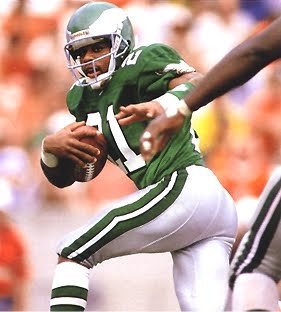
RB Adrian Murrell returned the ensuing free kick to the 50 yard line, and it appeared that the Jets would drive to another score with the help of a roughing the passer penalty that moved the ball deep into Eagles territory at the 21. But two plays later Esiason’s pass intended for Burkett was intercepted by CB Eric Allen (pictured at top) at the six yard line. With a spectacular return, Allen went 94 yards for the touchdown that proved to be the game-winner. The Eagles came away with a 35-30 victory.

The win had been a costly one for Philadelphia – in addition to Cunningham and Barnett, special teams standout WR Jeff Sydner also went down with a season-ending injury.


The Jets outgained the Eagles with 412 yards to 303. Boomer Esiason passed for 297 yards while completing 19 of 33 passes and had four TDs along with two interceptions. Johnny Mitchell (pictured at left) had an outstanding day with 7 catches for 146 yards and three touchdowns, and Chris Burkett contributed four receptions for 103 yards. Johnny Johnson led the running attack with 36 yards on 9 carries, closely followed by RB Blair Thomas with 7 rushes for 33 yards and FB Brad Baxter, who gained 29 yards on 9 attempts.

Bubby Brister had a solid outing in relief, completing 11 of 17 passes for 108 yards with two TDs and no interceptions; Randall Cunningham was 10 for 13 with 89 yards and had one picked off before his injury. WR Victor Bailey had the most pass receptions for the Eagles, with 5 for 36 yards, while the veteran tight end Bavaro gained 60 yards on four catches with a TD. RB Heath Sherman was the team’s top rusher, gaining 37 yards on 12 carries.

From promising beginnings, both clubs suffered through disappointing seasons the rest of the way. The Eagles, without Cunningham and Barnett, lost their next six games and ended up with an 8-8 record to place third in the NFC East. New York, after winning five midseason games in a row, lost four of the last five contests to also end up at 8-8 and third in the AFC East. Coach Coslet was dismissed afterward.

Boomer Esiason passed for 3421 yards, but his production dropped off significantly in the last six games of the season following a neck injury. Johnny Mitchell’s production also fell off after he suffered a sprained knee and he ended up with just 39 catches for 630 yards (16.2 avg.) and six TDs.

Eric Allen’s long touchdown return was no fluke – he intercepted six passes in ‘93 and tied the league record by returning four of them for touchdowns. Not surprisingly, he also led the NFL with 201 yards in interception return yardage. He was selected to the Pro Bowl for the third consecutive year and fourth time overall, on his way to eventually being chosen six times in the course of his career.

Bubby Brister passed for a respectable 84.9 rating while tossing 14 touchdowns against just five interceptions in place of Cunningham. His 1.6 interception percentage was second lowest in the NFC.

October 2, 2010

1983: Redskins Overcome Raiders in 37-35 Thriller


The Washington Redskins, defending NFL champions, were off to a 3-1 start in 1983 as they hosted the undefeated Los Angeles Raiders on October 2 at RFK Stadium. Washington, under third-year Head Coach Joe Gibbs, had an outstanding offense built around power-running RB John Riggins operating behind an excellent line and the passing of QB Joe Theismann (pictured at right) to wide receivers Charlie Brown, Art Monk, and Alvin Garrett.

The Raiders, in Head Coach Tom Flores’ fifth season and the second year in LA, were led by 36-year-old QB Jim Plunkett, second-year RB Marcus Allen, and a tough veteran defense that included a colorful band of characters such as DE Lyle Alzado, linebackers Ted Hendricks and Matt Millen, and CB Lester Hayes. Combined with rising young stars like DE Howie Long and FS Vann McElroy, the Raiders defense had given up no more than 14 points in any of the first four games.

Sloppy play on the part of the Raiders offense, which was handicapped by not having Allen available due to a hip pointer, highlighted the first quarter. Plunkett tossed an interception in LA’s first offensive series that the Redskins capitalized on as Riggins ran for a two-yard touchdown. The turnovers continued as the veteran quarterback was picked off a second time and RB Kenny King fumbled the ball away, but the score stood at 7-0 after the opening period as the normally-reliable Mark Moseley missed on a 36-yard field goal attempt for Washington.

Moseley was successful on his next field goal attempt, from 28 yards out early in the second quarter. The teams traded punts, and it appeared that the Redskins had the Raiders offense boxed in after a Jeff Hayes kick was downed on the one yard line. But Plunkett immediately went long to WR Cliff Branch, who gathered in the pass at his 44 yard line and proceeded to tie the league record with a 99-yard touchdown.

Despite all of the errors, the Raiders were down only 10-7, but Washington came back with an 80-yard, seven-play drive that ended with Theismann throwing a five-yard TD pass to RB Joe Washington. The first half ended with the Redskins ahead, 17-7.

The second half didn’t start off any better for LA as the offense went three-and-out and Washington padded its lead with a 29-yard field goal by Moseley. But two possessions later, the passing game came alive as Plunkett connected with TE Todd Christensen for a 41-yard gain and, two plays later, tossed to WR Calvin Muhammad for a 35-yard touchdown.

After the Redskins were forced to punt, the Raiders drove to another score with Plunkett again throwing a TD pass to Muhammad, this time covering 22 yards. With the successful extra point, Los Angeles was now ahead by 21-20.

Riggins fumbled the ball away on the second play of Washington’s ensuing possession, and ten plays later, now in the fourth quarter, Plunkett hit Christensen for a three-yard touchdown and 28-20 lead.

Theismann and the Redskins came out passing, with consecutive completions to Charlie Brown that covered 25 yards. However, the drive stalled at the Washington 43 and Jeff Hayes punted it away. His 54-yard kick was fielded by RB Greg Pruitt at his own three yard line, and he proceeded to return it 97 yards for a touchdown; the Raiders were up by 35-20.

Just as it seemed that the momentum had shifted overwhelmingly to LA, the Redskins fought back with a Theismann pass to Joe Washington that covered 67 yards and set up an 11-yard touchdown pass to Brown three plays later.

With 6:15 left to play and the Redskins down by two scores, the Raiders were watching for an onside kick. What they got was a low and hard kick by Hayes that made it through the front line, hit a player’s foot, and spun wildly away. WR Dokie Williams initially fell on the ball for the Raiders but couldn’t hold on and safety Greg Williams finally recovered it for Washington at the LA 32. Moseley kicked a 34-yard field goal five plays later to narrow the Raiders’ lead to five points.

Hayes kicked deep for the Redskins with 4:28 remaining on the clock. Los Angeles went three-and-out and was forced to punt after a third-and-11 pass from Plunkett to Christensen gained nine yards. Starting at his own 31 and with just under two minutes to play in the game, Theismann completed three consecutive passes to Brown that covered a total of 63 yards. From the LA six yard line, Theismann found Washington in the end zone for a diving touchdown catch, and the Redskins ended up with a wild 37-35 win.

The statistics reflected the wildly shifting momentum of the game. Both teams accumulated over 400 yards, with the Redskins slightly ahead (as with the score) by 459 yards to 431. Washington also led in first downs (25 to 19) while the Raiders led in rushing yards (105 to 98) and sacks (six to five). However, LA also suffered six turnovers, to just one for the Redskins.


Joe Theismann passed for 417 yards as he completed 23 of 39 passes with three TDs and none intercepted. Charlie Brown caught 11 of those passes for 180 yards and a touchdown while Joe Washington (pictured above), seeing a great deal of action in the second half as the preferred running back in passing situations, grabbed 5 passes for 99 yards and the two TDs. John Riggins gained 91 yards rushing on 26 attempts with a score.

For the Raiders, after the shaky start Jim Plunkett ended up completing 16 of 29 passes for 372 yards with four touchdowns and four interceptions. Calvin Muhammad caught 5 passes for 112 yards and two TDs while Todd Christensen added 70 more yards on his 5 catches. Cliff Branch gained 99 yards on his one long reception of the day. In place of Marcus Allen, RB Frank Hawkins led the team on the ground with 64 yards on 15 carries.

Afterward, Washington guard Mark May said “I wouldn’t be surprised if we met them again in January.” He proved to be a good prophet. The Redskins lost just one more game the rest of the way as they finished atop the NFC East with a 14-2 record. While they were at it, they set a new league team scoring record with 541 points (since broken). The Raiders topped the AFC West with a 12-4 tally. Both clubs won their respective conference championships and met in Super Bowl XVIII where the Raiders got the last laugh with a stunning 38-9 upset victory (Marcus Allen’s presence was very much in evidence, as he gained 191 yards rushing and scored two touchdowns).


Joe Theismann ranked second in the NFL in passing (97.0 rating) and touchdown passes (29, tied with Danny White of the Cowboys) while throwing for 3714 yards. He received All-Pro honors and was selected to the Pro Bowl, along with Charlie Brown (pictured at left), who caught 78 passes for 1225 yards and 8 TDs.

John Riggins set a new record for touchdowns (24) while rushing for 1347 yards on 375 carries. Mark Moseley scored 161 points (at the time, the record for scoring by placekicking alone) while hitting on 33 of 47 field goal attempts.

Todd Christensen led the NFL in pass receptions with 92 while accumulating 1247 yards and 12 touchdowns. Jim Plunkett, in an up-and-down season, lost his starting job to Marc Wilson, regained it, and finished with 2935 yards, 20 TDs, and 18 interceptions; he was also sacked 42 times and was second in the league in yards lost due to sacks (363), but in the end was a championship quarterback for the second time.

October 1, 2010

1950: Giants “Umbrella” Defense Shuts Down the Browns


After dominating the All-America Football Conference (AAFC) for four seasons, winning all four league title games, the Cleveland Browns took up residence in the NFL in 1950 and continued to win there as well. The Browns opened at Philadelphia, against the defending NFL champion Eagles, and beat them handily, 35-10. The following week they rolled over the Baltimore Colts, who also came over from the AAFC, by a 31-0 score.

Under innovative Head Coach Paul Brown, Cleveland had been utilizing a precision passing attack that NFL teams had not seen before (a prototype of the modern West Coast offense). QB Otto Graham threw to ends running sideline routes and backs on flare-out passes that the predominant defenses of the time – the 5-3-3 and 5-2-4 (Eagle) devised by Eagles Head Coach Greasy Neale – were unable to stop. Not only were the passes difficult to defend against, but by forcing the defensive linemen and linebackers to spread out, they became vulnerable to trap and draw plays up the middle.

On October 1 the Browns hosted the New York Giants at Municipal Stadium. However, the Giants came prepared. Head Coach Steve Owen (pictured above) devised a new defensive scheme in response to Cleveland’s passing attack. In addition to four defensive backs, as in the Eagle defense, he put six players on the line, but the ends often dropped back into pass coverage (like modern outside linebackers) and the middle guard was frequently backed off the line, creating a new position – middle linebacker.

The new scheme came to be called the “Umbrella” defense as, when diagramed, the defensive backs were fanned out behind the middle linebacker, who appeared to be the stem of the defensive umbrella. Essentially a 6-1-4 alignment, when the ends dropped back into coverage it became like a modern 4-3-4 defense.

The defensive backfield was made up of solid performers that included halfbacks Emlen Tunnell and Harmon Rowe and safeties Tom Landry and Otto Schnellbacher. John Cannady was the pioneering middle linebacker, behind a line anchored by All-Pro tackles Arnie Weinmeister and Al DeRogatis. The new defense proved more than adequate to the task against the Browns.

There were 37,647 fans in attendance on a humid but dry day as the Giants scored in the first quarter. Capping a 51-yard drive in which HB Gene Roberts rushed for 34 yards, FB Eddie Price bulled over for a touchdown from three yards out, but the extra point attempt was missed due to a fumbled snap (Roberts, pictured below, proved to be the key player on the Giants offense, rushing for 77 yards on 12 carries).


That was all that the Giants could muster, playing conservatively against the equally tough Cleveland defense, but the Browns were unable to advance into New York territory at all during the first half. Graham failed to complete any of his first seven passes.

Cleveland finally made it across the 50 yard line on three occasions during the second half, but twice gave up the ball on downs, at the New York 38 and 12 yard lines, to end long drives. On the last advance, late in the fourth quarter, the Browns were at the Giants’ eight when Graham and FB Marion Motley collided in the backfield when attempting a hand off on a trap play and fumbled; LB Dick Woodard recovered for the Giants to end the threat. New York held on to win by a 6-0 score.

It was the first time the powerful Browns had ever been shut out. They also had not lost a home game since three seasons before, in 1947 to the Los Angeles Dons.


Safeties Schnellbacher and Landry (pictured at left), who had both faced the Browns in the AAFC, played especially well in thwarting the vaunted Cleveland passing attack. Otto Graham completed just 12 of 30 passes for 127 yards and was intercepted three times.

Afterward, a philosophical Paul Brown said “At least we weren’t beaten by a big score. We just lost to a better team. New York was ready for us.”

The Giants proved to be ready when the teams met again in New York three weeks later, winning 17-13. No other club was able to beat Cleveland and the Giants lost games to the Steelers and Cardinals along the way; as a result, both clubs ended up tied atop the American Conference with 10-2 records at the end of the regular season. However, in the tiebreaking playoff, the Browns finally beat the Giants in another defensive struggle, 8-3, and went on to win the NFL Championship game against the Rams.

The new defense didn’t take hold right away, but the 4-3-4 became the predominant alignment by the end of the decade and, along with the 3-4-4 that was adopted by some teams starting in the 1970s, continues to be used.

The mastermind of the “Umbrella” defense, Steve Owen, was dismissed as head coach of the Giants following the 1953 season after 23 years. His innovative defensive coaching, combined with a preference for conservative, run-oriented offenses produced a 151-100-17 record (2-8 in the postseason).

September 30, 2010

1990: Bills Score 20 Points in 1:33 to Beat Broncos


Both the Buffalo Bills and Denver Broncos had won two of their first three games of the 1990 season prior to meeting at Rich Stadium on September 30. The host Bills, under Head Coach Marv Levy, had won the AFC East title the previous two years, although with only a 9-7 record in ’89. The talented club had been mired in controversy in 1989, and had underachieved. Denver, coached by Dan Reeves for the preceding nine seasons, was the defending AFC champion, although the Broncos had been badly beaten in the Super Bowl by the 49ers.

The Broncos scored on the first possession of the game, going 80 yards in 12 plays with RB Bobby Humphrey running for a touchdown from a yard out. The teams traded fumbles, but there was no further scoring in the opening period.

The Bills blocked a 49-yard field goal attempt by David Treadwell early in the second quarter, but came up empty when Scott Norwood’s 47-yard attempt hit the right upright and bounced away. In their next possession, Bills QB Jim Kelly was intercepted by FS Steve Atwater, giving Denver good field position at the Buffalo 30 yard line. The Broncos capitalized as QB John Elway completed a 25-yard pass to WR Vance Johnson and two plays later RB Steve Sewell scored on another short touchdown run. Buffalo finally got on the board just before the end of the half on a 37-yard field goal by Norwood, but it was Denver leading comfortably by 14-3 at the intermission.

Buffalo got a break in the third quarter when DE Bruce Smith sacked Elway, forcing a fumble that LB Darryl Talley recovered for the Bills at the Denver 10. After Kelly was sacked for a two-yard loss, RB Don Smith ran for a 12-yard touchdown, but the extra point attempt failed. However, the Broncos extended their lead to 21-9 later in the period after a fumbled handoff to RB Thurman Thomas gave Denver the ball on the Buffalo 19. Following an Elway pass and a penalty on Bills LB Shane Conlan for a late hit, RB Sammy Winder ran for a three-yard touchdown.

With Denver seemingly in control in the fourth quarter, the game took a dramatic twist. The Broncos appeared set to score again, having driven to the Buffalo six yard line, but Treadwell’s field goal attempt was blocked by CB Nate Odomes – LB Cornelius Bennett (pictured at top) picked up the loose ball at the 20 and returned it for an 80-yard touchdown. Instead of being down 24-9, the Bills had cut the Denver margin to 21-16.

On the second play of Denver’s ensuing possession, an Elway pass was deflected at the line by DE Leon Seals and intercepted by safety Leonard Smith, who returned it 39 yards for another Buffalo TD. While Norwood missed the extra point attempt, the Bills had gone from being down by 12 points to up by one at 22-21. And it wasn’t over.

An illegal block on the kickoff return by the Broncos put the ball on the Denver five yard line. On the first play, Elway fumbled the snap and Cornelius Bennett recovered at the two. It took just one play for RB Kenneth Davis to run for a two-yard touchdown; this time the PAT attempt was successful and the Buffalo lead was now 29-21. The Bills had scored a total of 20 points in just 1:33 of playing time.

The shaken Broncos had to punt on their next possession after Bruce Smith again sacked Elway, this time for a ten-yard loss on a third-and-12 play. Buffalo moved into Denver territory, but Norwood’s 48-yard field goal attempt was wide to the right.


Now with under four minutes remaining, it looked as though the Broncos were finished when Elway threw three straight incompletions, but on fourth-and-ten he connected with WR Ricky Nattiel for a 20-yard gain to midfield. Suddenly, Elway was passing Denver downfield with four more completions that included a seven-yard TD to Nattiel - with the successful conversion, Buffalo’s lead was narrowed to one point. However, the onside kick was recovered by the Bills who were then able to run out the clock. The final score was 29-28 in favor of Buffalo.

It was a stunning win for the Bills, who were outgained by the Broncos, 410 yards to 197. Buffalo gained just 64 yards on the ground, to Denver’s 208. Bobby Humphrey (pictured above right) had an outstanding day running the ball, gaining 177 yards on 34 carries with one TD. John Elway completed 15 of 28 passes for 221 yards with a touchdown, but also with two interceptions (part of five overall turnovers by the Broncos). Ricky Nattiel was the club’s leading receiver with four catches for 62 yards and the TD.

Buffalo’s offensive performance was not strong. Reflecting the low rushing total, Thurman Thomas gained just 36 yards on 13 attempts – he caught four passes for 25 more yards. WR James Lofton also caught four passes, and led the Bills with 57 receiving yards. Jim Kelly completed 18 of 34 passes for 167 yards with no TDs and one interception.


The big defensive plays – including the one on special teams – made the difference in the outcome. Bruce Smith (pictured at left), with five tackles in addition to the two key sacks and the forced fumble, was recognized as the NFL’s Defensive Player of the Week, although there were several other members of the unit who played significant roles in the dramatic win.

The Bills won their next six games and 10 of 12 to finish the regular season at 13-3, winning a third straight AFC East title and this time advancing to the Super Bowl where they lost to the New York Giants by one point - the previous year’s underachievers broke through to a higher level, even if they fell short of the pinnacle. Denver, meanwhile, went in the opposite direction, losing 9 of the remaining 12 contests to end up at 5-11 and at the bottom of the AFC West.

September 29, 2010

1974: Dolphins Score 3 TDs in Fourth Quarter to Defeat Chargers


The Miami Dolphins had won back-to-back NFL titles in 1972 and ’73 under Head Coach Don Shula and were certainly contenders to potentially win a third in 1974. While the pro football world had been stunned when the Toronto Northmen of the World Football League (later to become the Memphis Southmen) signed three key members of the Miami offense – FB Larry Csonka, HB Jim Kiick, and WR Paul Warfield – to contracts for the 1975 season, those players were still in Dolphins uniforms in ’74. In addition, the club had QB Bob Griese, HB Mercury Morris, and a stingy defense.

The Dolphins were stunned by New England in the opening game, but righted the ship in a win at Buffalo and now faced the San Diego Chargers on September 29 at San Diego Stadium. The Chargers, under new Head Coach Tommy Prothro, were coming off of consecutive last place finishes, including 2-11-1 in 1973. Aging veteran QB Johnny Unitas had not been the answer after being obtained from the Colts, and retired during training camp in ’74. Second-year QB Dan Fouts was now running the offense, but he was still a work in progress and the club was a hodgepodge collection of players who were either over-the-hill or mediocrities to begin with. While the Chargers had beaten Cincinnati the previous week, it did not seem likely that they would give the Dolphins, who were 15-point favorites, much of a contest.

Defense dominated a first half that ended with the score tied at 7-7. Miami scored first, in the second quarter, when Csonka bulled over for a one-yard touchdown. The Chargers tied the game late in the period. On the scoring drive, Fouts completed all four of his passes, for 50 yards, including a 21-yard touchdown throw to TE Wayne Stewart with 49 seconds remaining in the half.

San Diego dominated the third quarter, with RB Don Woods scoring two touchdowns. First, a 75-yard drive ended with Woods plowing over from the one yard line for a TD. Less than two minutes later, the rookie from New Mexico took off on a 56-yard touchdown run to put the upset-minded Chargers ahead by 21-7.

Converting from college quarterback to pro running back, Woods (pictured below) had failed to make the Packers, who had drafted him in the sixth round, and he was waived at the end of the preseason. Claimed by the Chargers, he carried the ball a grand total of two times in his first regular season action the week before against the Bengals. Now, he was putting on a sensational display against the defending champions.


Midway through the fourth quarter, the Chargers were still ahead by two touchdowns. But after Dennis Partee missed a 33-yard field goal attempt that would have padded San Diego’s lead, the Dolphins went 80 yards and scored on a 13-yard touchdown pass from QB Bob Griese to WR Nat Moore.

After San Diego was forced to punt, Miami drove downfield on a 58-yard possession highlighted by a 38-yard pass from Griese to TE Jim Mandich and 14-yard run by Csonka; Csonka finished it off with a three-yard run to tie the score with 3:38 remaining.

Again the Chargers had to kick, and with under two minutes left, Moore returned the low punt 30 yards. A few plays later, Jim Kiick ran five yards up the middle for the game-winning touchdown with 15 seconds remaining on the clock. The final score was 28-21 in favor of the Dolphins.

Afterward, Coach Shula said “The Dolphins played one of the finest fourth quarters since I have been associated with the team.”

Dan Fouts summed it up for the Chargers: “We felt pretty damn good the first three quarters, but it’s a four-quarter game.”


Total yardage was almost evenly matched, with San Diego gaining 392 yards to Miami’s 391. Bob Griese completed 14 of 27 passes for 248 yards with a TD and two interceptions; he clearly saved his best for last. The Dolphins, with their typically proficient ground game, compiled 173 yards rushing. Larry Csonka (pictured at left) led the way with 106 yards on 21 carries and two TDs. Both Jim Mandich and WR Howard Twilley caught four passes, with Mandich compiling 101 yards (Twilley had 45). Rookie Nat Moore (pictured at top) gained 183 total yards with 49 on three receptions (including a touchdown), 88 on three kickoff returns (29.3 average), and 46 on two punt returns, including the one that set up the tying TD.

Don Woods was the big story for the Chargers as he gained 157 yards on 18 carries with two touchdowns; he also caught a pass for 10 yards. Dan Fouts completed 14 of 22 passes for 189 yards with a TD and none intercepted. WR Jerry LeVias caught the most passes (5 for 58 yards) while Wayne Stewart gained 71 yards on his three receptions, including the TD.

Miami finished the season at the top of the AFC East once again with an 11-3 record; they lost an epic Divisional playoff game to Oakland to end the pursuit of a potential third straight title. San Diego ended up at 5-9 and tied with the Chiefs at the bottom of the AFC West.

Woods had a career year, gaining 1162 yards rushing (second in the NFL) on 227 carries for a 5.1-yard average gain and seven touchdowns; he also caught 26 passes for 349 yards and another three TDs. He was named AFC Rookie of the Year by the Associated Press. However, injuries held Woods to five games in ’75 and he never gained more than 514 yards on the ground in any of his remaining six seasons.

Nat Moore also had a notable rookie season, although he proved to have far more staying power. He gained 1344 total yards, including 605 on 37 pass receptions. When Paul Warfield departed the team for the WFL in ’75, it was Moore who took up the slack and lasted 13 seasons, all with the Dolphins, catching 510 passes for 7546 yards and 74 touchdowns.

September 28, 2010

1951: Norm Van Brocklin Passes for 554 Yards vs. NY Yanks


The high-powered Los Angeles Rams offense of the early 1950s was capable of big performances. In 1950, they scored over 50 points in three games that included a 70-27 thrashing of the Baltimore Colts, newly arrived from the AAFC, and 65-24 pounding of the Detroit Lions a week later. Not surprisingly, they ran up a record 466 points in ’50 and nearly won the NFL championship. While at it, they set another standard with 5420 total yards.

As one would expect, Head Coach Joe Stydahar’s offense was loaded with outstanding players. The quarterbacking was split between two future Hall of Famers, Bob Waterfield and Norm Van Brocklin. The stable of running backs included power-running fullbacks Dick Hoerner and Dan Towler and speedy halfbacks Glenn Davis, the former Heisman Trophy winner out of Army, and Verda “Vitamin” Smith. Ends Elroy “Crazylegs” Hirsch and Tom Fears provided a Hall of Fame tandem for the Canton-bound passers to throw to.

On September 28, 1951 the Rams opened a new season against the New York Yanks at the Memorial Coliseum. With Waterfield sidelined by a knee injury, Van Brocklin had an opportunity to play the entire game and made the most of it.

The Yanks, a third-year franchise coached by Jimmy Phelan that played at Yankee Stadium (and paid a $25,000 annual fee for the right to play in the Giants’ territory), had been a respectable 7-5 in 1950. However, QB George Ratterman left the club to play in Canada and the suspect defense of ’50 had further degraded.

There were 30,316 fans on hand for the Friday night game, and they saw a record-setting offensive display. LA was up 21-0 after the first quarter as Van Brocklin threw touchdown passes of 41 yards to Hirsch and 67 yards to Smith. In between, Hoerner ran for a 22-yard TD. The Dutchman connected with Hirsch for a 47-yard touchdown in the second quarter, after he had already scored on a quarterback sneak, and the Rams were comfortably in front at halftime by a 34-7 margin.

The final score was 54-14. The Rams set new team single-game marks with 735 yards and 34 first downs. By contrast, the Yanks managed just 111 yards and 13 first downs, with only 8 net passing yards as a result of losing 55 yards on six sacks by the Rams defense.


The Dutchman completed 27 of 41 passes for 554 yards with five touchdowns and two interceptions. Four of Van Brocklin’s touchdown passes were to Hirsch (pictured at left), who had a total of 9 receptions for 173 yards. Tom Fears had 7 receptions for 162 yards and Vitamin Smith gained 103 yards on just two catches that included a 67-yard TD. The 554 yards broke the record set by Johnny Lujack of the Bears with 468 yards in a 1949 contest.

Most of New York’s offense came from punt returns by halfbacks Buddy Young and George Taliaferro, with Young returning one in the second quarter for a 79-yard touchdown. The only other score the Yanks managed was on a 30-yard interception return by DE Art Tait in the fourth quarter. Any chance for the offense to make something happen ended when QB John Rauch was ejected for fighting late in the second quarter. They ended up punting 14 times.

The Rams again went on to place first in the National Conference, this time with an 8-4 tally, and succeeded in defeating the Browns for the NFL title. While they didn’t reach their record scoring total of 1950, their 392 points still ranked at the top of the league and they did exceed their total yardage mark with 5506. The Yanks suffered through a 1-9-2 season to finish at the bottom of the National Conference and folded (remnants of the club, including Buddy Young and George Taliaferro, became part of the Dallas Texans franchise in 1952).

Van Brocklin’s single-game passing record continues to hold up, despite the development of the passing game in the years since. Warren Moon’s 527 yards for Houston against Kansas City in a 1990 contest has, to date, been the closest that any quarterback has come to The Dutchman’s performance.

For the 1951 season, Van Brocklin finished behind his teammate Waterfield in the passing statistics (based on yards per attempt, the edge was a very narrow 8.898 to 8.892. By the modern rating system, Waterfield’s edge was 81.8 to 80.8). As a team, the Rams topped the NFL in passing yards (3199) with Van Brocklin throwing for 1725 and Waterfield 1566.

“Crazylegs” Hirsch built upon his outstanding performance in the opening game to lead the league with 66 pass receptions and set then-NFL records in receiving yards (1495 – a full 669 yards more than runner-up Gordie Soltau of the 49ers) and touchdown receptions (17). The yardage record lasted ten years and the touchdown record for 33.