Showing posts with label Rich Kotite. Show all posts

November 10, 2015

1991: McMahon Spurs Eagles from 23-0 Deficit to Defeat Browns


The Philadelphia Eagles, with their top-ranked defense, were at 4-5 as they faced the Cleveland Browns on November 10, 1991. Head Coach Rich Kotite’s first season at the helm had gotten off to a rough start when star QB Randall Cunningham was lost for the year in the opening week. Backup QB Jim McMahon (pictured at right), once a title-winner with the Bears, performed ably when healthy, but that was not the case for several games when lesser performers were behind center and the offense struggled. The team lost four straight games after starting off at 3-1 before beating the Giants the previous week. McMahon was available but playing with an assortment of injuries, most notably to his throwing elbow.

Cleveland also had a first-year head coach in Bill Belichick and was in transition. Seventh-year QB Bernie Kosar was still in place from the winning years in the late ‘80s, as were FB Kevin Mack and the corps of wide receivers led by Webster Slaughter. However, the Browns were hampered by some key injuries. Anthony Blaylock was starting at cornerback in place of the aging but capable Frank Minnifield and all-purpose HB Eric Metcalf, who returned punts, was also out.

It was a cool, dry day at Cleveland Municipal Stadium with 72,086 fans in attendance. The Browns took the opening kickoff and drove 37 yards in seven plays, helped along by four penalties on the defense. Matt Stover kicked a 50-yard field goal for the early 3-0 lead. Three plays after the ensuing kickoff, the Browns scored again when FS Eric Turner intercepted a Jim McMahon pass and returned it 42 yards for a touchdown. Stover converted and the home team led by 10-0 with four minutes elapsed.

The Eagles were forced to punt after their next series and the Browns struck quickly. Kevin Mack ran for four yards and then Bernie Kosar threw to RB Leroy Hoard, who rambled 65 yards for a TD. Stover’s extra point attempt hit the left upright and was no good, but Cleveland was now up by 16-0.

Once again Philadelphia had to punt and, as the game headed into the second quarter, the Browns were on the move. Kosar completed passes to Webster Slaughter for 14 yards, TE Scott Galbraith for 13, and WR Reggie Langhorne for nine yards to reach the Philadelphia 20 and, four plays later he connected with Slaughter for an 18-yard touchdown. Stover’s point after was successful this time and, following the nine-play, 54-yard possession, Cleveland held a commanding 23-0 lead.


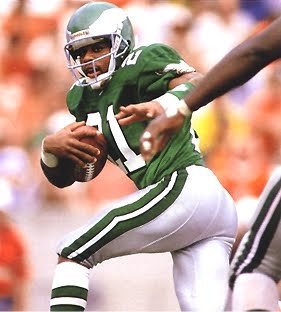
Now in a deep hole, the Eagles responded by advancing 80 yards in seven plays. McMahon completed two passes before RB James Joseph (pictured above) broke away for a 23-yard run. Facing third-and-seven at the Cleveland 38, the visitors benefited from a pass interference penalty on CB Anthony Blaylock that gave them a first down at the 19 and, two plays after that, McMahon threw to TE Keith Jackson for a 16-yard TD. Roger Ruzek converted and the Eagles were on the board, although still down by 23-7.

The Browns had to punt following their series and Philadelphia quickly narrowed the score further when, on first down, McMahon passed to WR Fred Barnett for a 70-yard touchdown. Ruzek again made good on the extra point and the score was 23-14 with 6:47 left in the first half.

WR Danny Peebles returned the ensuing kickoff 32 yards to give the Browns good starting field position at their 44, but two plays later a Kosar pass intended for Langhorne was intercepted by CB Ben Smith, who returned it six yards to midfield. McMahon immediately threw to Jackson for a gain of 33 yards to the Cleveland 17, but Philadelphia was moved back by a holding penalty on the next play. While McMahon completed his next three passes, the drive stalled at the four and Ruzek kicked a 21-yard field goal. The once-formidable Cleveland lead was narrowed to six points at 23-17.

The Browns regained possession with 1:32 remaining in the half. Mack ran for 10 yards and Kosar then threw to WR Brian Brennan for 11 yards and Slaughter for 17 in a play that cost the Eagles Ben Smith (for the remainder of the season with a serious knee injury, it turned out). Kosar then connected on two passes to Langhorne, first for 23 yards and then for 24 yards and a TD. Stover kicked the point after and Cleveland took a 30-17 lead into halftime.

The Eagles had the first possession in the third quarter and drove 60 yards in 11 plays. Joseph handled the bulk of the running and McMahon completed three passes, the longest to WR Calvin Williams for 30 yards. Ruzek booted a 37-yard field goal to make the score 30-20.

The Browns went three-and-out, but Brian Hansen’s punt traveled 65 yards and went out of bounds at the Philadelphia four. McMahon quickly got the Eagles out of the hole with a pass to Barnett (pictured below) for 38 yards and a throw to Jackson had them nearly to midfield. Tosses to Barnett and Williams gained another 14 yards and, after Joseph ran for five yards, McMahon connected with RB Keith Byars for seven yards. A defensive pass interference penalty gave Philadelphia a first down at the Cleveland seven, but the drive stalled as three passes fell incomplete and Ruzek kicked a 24-yard field goal.


The Browns punted after their next series and the Eagles had the ball as the game headed into the fourth quarter. They moved methodically and converted a third-and-12 situation with a 16-yard McMahon-to-Williams pass play. Joseph had a 21-yard carry to the Cleveland 22 but Jackson dropped McMahon’s next toss and another fell incomplete to set up third-and-10. Once again the Browns were flagged for pass interference and once again the Eagles were unable to reach the end zone after getting first-and-goal inside the ten. A 19-yard Ruzek field goal finished off the 13-play, 78-yard drive and narrowed the score to 30-26.

Kosar completed a 14-yard pass to Slaughter to start Cleveland’s next series, but two sacks with an incompletion in between forced the Browns to punt. The Eagles had good field position at their 48 but moved backward thanks to a penalty and a sack and were forced to punt in turn. However, Slaughter, who typically didn’t return punts and unwisely fielded the ball at the one when it appeared certain to be a touchback, ran laterally and fumbled when hit by RB Robert Drummond. LB Britt Hager recovered at the Cleveland two.

Joseph was dropped for a three-yard loss on first down, but two plays later McMahon completed a five-yard touchdown pass to Williams. DE Rob Burnett blocked Ruzek’s kick but the Eagles were in front by two points with 5:19 remaining in regulation.

Another short series by the Browns resulted in a punt and Philadelphia, taking over with 4:28 to play, managed to control the ball for nearly the remainder of the game. McMahon threw to WR Roy Green for nine yards on a third-and-four play and yet another defensive pass interference penalty converted a third down. The Eagles finally had to punt, but there were only ten seconds remaining for the Browns to work with from their own 20 and two Kosar passes fell incomplete. Philadelphia won by a final score of 32-30.

The Eagles, in overcoming the 23-point deficit, led in total yards (418 to 258), first downs (24 to 16), and time of possession (41:14 to 18:46) with Cleveland managing just 24 total yards in the second half as the Eagles adjusted and dominated on defense. The Browns turned the ball over twice, to one by Philadelphia, and while the Eagles drew 10 penalties, at a cost of 72 yards to 7 penalties for 86 yards on Cleveland, the Browns were flagged five times for defensive pass interference to significant effect.

Jim McMahon completed 26 of 43 passes for 341 yards and three touchdowns while giving up the one early interception. Fred Barnett had 8 catches for 146 yards and a TD and Calvin Williams and Keith Jackson had identical totals of 6 receptions for 76 yards and a score apiece. James Joseph rushed for 89 yards on 20 attempts.


For the Browns, Bernie Kosar was successful on just 14 of 33 throws for 246 yards and three TDs with one interception, completing only two of 13 in the second half. Webster Slaughter caught five passes for 74 yards and a TD, but his critical misplay of the punt in the fourth quarter drew the most comments. Reggie Langhorne (pictured above) was right behind in pass receiving yards with 73 on his four receptions that included a score. Cleveland gained just 25 yards on the ground and Kevin Mack accounted for 23 of them on 10 carries.

“You guys don’t know how bad Jim McMahon felt last night and this morning,” said Philadelphia’s Coach Kotite. “He could barely move his arm. I just can’t get over this guy.”

The dramatic win against the Browns was the second of six straight, and seven in their last eight games, for the Eagles. Injuries continued to plague McMahon and, while the formidable defense was able to keep them in games, they finished third in the NFC East at 10-6, just missing a playoff berth. Cleveland placed third in the AFC Central with a 6-10 record.

Jim McMahon started 11 games, with the Eagles winning eight of them, and completed 60.1 percent of his passes for 2239 yards and 12 touchdowns while giving up 11 interceptions. The 341-yard passing total against the Browns was the second-highest of his 15-season career. Fred Barnett caught 62 passes for 948 yards (15.3 avg.) and four touchdowns. Rookie James Joseph’s 89-yard rushing performance against Cleveland was his best of the year as he led the club with just 440 yards on 135 carries, averaging 3.3 yards-per-attempt.

December 2, 2014

1991: Eagles Dominate on Defense to Stifle Oilers in “House of Pain Game”


The NFL Monday night game on December 2, 1991 featured the team with the best defense in the league, the Philadelphia Eagles, visiting the club with the second-most-productive offense, the Houston Oilers.

Philadelphia was coached by Rich Kotite, who had replaced Buddy Ryan, the architect of the defense, the previous offseason, and the unit was now under the tutelage of defensive coordinator Bud Carson. The line, anchored by DE Reggie White and including DE Clyde Simmons and DT Jerome Brown, was the key to the defense’s success, but there was plenty of talent at linebacker and in the defensive backfield as well. The offense was far less impressive, however, in particular after losing star QB Randall Cunningham to a season-ending knee injury in the first game of the season. Backup QB Jim McMahon was talented but brittle, and when he was forced to the sidelines, the team floundered with the likes of Brad Goebel and Pat Ryan in his place. But after dropping to 3-5, the Eagles caught fire and won four straight games to come into the contest in Houston with a 7-5 record and a shot at the playoffs.

The high-flying Oilers, coached by Jack Pardee, were 9-3 and adept at rolling up offensive yards, especially at home in the Astrodome, which was thus dubbed “the House of Pain”. QB Warren Moon was a prolific passer in the team’s run-and-shoot attack and had a capable receiving corps. Philadelphia’s approach to stopping the offense was to use a 4-2-5 defense, dropping a linebacker and adding an extra defensive back on most downs.

There were 62,141 fans in attendance for the nationally televised game at the Astrodome. The Oilers had the first possession and, on the second play, turned the ball over when Warren Moon fumbled and LB Byron Evans recovered at the Houston 33. However, the Eagles were unable to capitalize as Jim McMahon threw two incomplete passes and, in between, was sacked by DE William Fuller for a loss of 11 yards. Forced to punt, they buried the Oilers deep in their own territory.

The teams exchanged punts before Houston, starting from its 20, drove into Philadelphia territory, helped along by a pass from Moon to WR Ernest Givins that gained 20 yards. However, WR Haywood Jeffires fumbled when hit hard by SS Andre Waters following a catch for a short gain. LB Seth Joyner (pictured at top) recovered and returned it to the Philadelphia 48.

The teams again traded punts, with neither offense able to move effectively. As the scoreless game headed into the second quarter, McMahon completed three passes, the longest to WR Roy Green for a pickup of 22 yards, to reach the Houston 31. But FS Bo Orlando intercepted the next throw to end the threat. Philadelphia’s aggressive defense continued to thwart Houston’s passing attack, forcing a punt and, when the Oilers, benefiting from improved field position on the exchange of kicks, reached the Philadelphia 36, the Eagles forced another turnover. Joyner jarred the ball loose from RB Allen Pinkett and DE Clyde Simmons recovered.

The exchange of punts continued until the Oilers, taking possession with 57 seconds remaining in the first half, advanced 33 yards in seven plays. Moon completed passes to Pinkett for 13 yards and Givins for 15 to set up a 42-yard field goal by Al Del Greco on the last play before halftime. Houston led by 3-0 at the intermission.


McMahon was knocked out of the game with an elbow injury during the first series of the third quarter and Jeff Kemp (pictured at left), who was claimed off waivers from Seattle in mid-October, came on at quarterback for the Eagles. Philadelphia had to punt but got the ball back on the next play when Joyner recovered a Moon fumble at the Houston eight. The visitors couldn’t reach the end zone in three plays, but they did tie the score when Roger Ruzek kicked a 23-yard field goal.

The Oilers went three-and-out on their next series, unable to gain any ground at all from their 12 yard line. The resulting punt gave Philadelphia possession at the Houston 48. RB James Joseph ran for 24 yards on first down and, after a short running play, Kemp connected with TE Keith Jackson for a 21-yard touchdown. Ruzek added the extra point and the Eagles were ahead by 10-3.

In response, the Oilers advanced 41 yards in seven plays as Moon ran for six yards and completed two passes, to WR Leonard Harris for eight yards and Jeffires for 22. The drive stalled at the Philadelphia 29 and Del Greco connected for another field goal, this time from 47 yards.

The teams traded punts once more as the game entered the fourth quarter. The Eagles then put together a long possession of 50 yards in 16 plays, converting four third downs along the way and eating up over ten minutes. Kemp completed five short passes and Ruzek finished off the series with a 29-yard field goal that extended Philadelphia’s lead to seven points.

With the clock down to 3:52 in regulation, Moon went to the air on every play but WR Drew Hill fumbled when hit by CB Otis Smith, who recovered at the Philadelphia 41. Another punt was followed by one last shot for the Oilers. Starting from his 23, Moon threw to Harris for 24 yards and had back-to-back 15-yard completions to Givins and Jeffires. But the game ended for Houston at the Philadelphia 23, where three straight passes fell incomplete. The Eagles won the hard-fought contest by a final score of 13-6.

The Oilers, who failed to score a touchdown for the first time in nearly two years, had the edge in total yards (247 to 240), which was well below their season average thus far of 392.9 yards, and in first downs (15 to 14). But Houston also turned the ball over five times, all on fumbles, to one suffered by the Eagles. Philadelphia recorded four sacks, to three for the Oilers. Further emphasizing the defensive nature of the contest, the Eagles punted nine times while Houston kicked it away on six occasions.

Seth Joyner, who had been battling the flu prior to the game, was the biggest star on defense. He recovered two fumbles, forced two more, and recorded two sacks in addition to eight solo tackles. Jim McMahon completed 12 of 20 passes for 84 yards with one interception and, in relief, Jeff Kemp also threw for 84 yards, completing 10 of 17 throws with a touchdown and none picked off. James Joseph rushed for 56 yards on 12 carries and Keith Byars, in addition to contributing 29 yards on 9 rushing attempts, led the Eagles with 7 pass receptions, although for just 19 yards. Calvin Williams had 5 receptions for 32 yards and Roy Green gained 44 yards on his three catches.

For the Oilers, Warren Moon was successful on 24 of 46 throws for 262 yards with no interceptions but also no TDs. Haywood Jeffires caught 8 passes for 82 yards and Ernest Givins gained 89 yards on 6 receptions. The team accumulated just 21 yards on the ground, and Allen Pinkett led with 10 yards on 6 carries.

The contest came to be called “the House of Pain Game” for Philadelphia’s hard-hitting defensive dominance, thus turning around the original meaning of the phrase, which was further accented by Ernest Givins suffering a broken nose and Drew Hill leaving with a concussion. As Jerome Brown said afterward, “They brought the house and we brought the pain.”

“We felt they would complete balls, and when they did complete them we wanted to hit them hard and make them pay,” said Coach Kotite of his team’s approach to dealing with Houston’s passing offense. “We played hard NFL football tonight.”

“They did a great job, no question,” summed up Warren Moon in reference to Philadelphia’s defense. “They put a lot of pressure on me and forced me to do things too fast. They punished our little guys. They are everything they’re written up to be.”

The Eagles made it six consecutive wins the following week against the Giants, but a loss to Dallas in the next contest effectively eliminated them from the postseason. They ended up with a 10-6 record, placing third in the NFC East. Houston cruised to the AFC Central title at 11-5, marking their fifth straight year of making it to the playoffs, but after defeating the Jets in the Wild Card round, they lost to Denver at the Divisional level.

While Philadelphia fell short due to the lack of offense, the defense achieved the rare feat of ranking number one not only overall, but against both the pass and the run individually. The unit also led the NFL in turnovers forced (48, tied with New Orleans), fumble recoveries (22), and sacks (55). Seth Joyner, who performed so well against Houston, was named to the Pro Bowl, as was CB Eric Allen. Reggie White, Clyde Simmons, and Jerome Brown were consensus first-team All-NFL selections in addition to being selected for the Pro Bowl. (Pictured below, L to R, are Simmons, Allen, Brown, Joyner, and White)


October 2, 2012

1994: Eagles Dominate 49ers in Stunning Upset


The San Francisco 49ers had made it to the NFC Championship game in 1992 and ’93 and were 3-1 thus far in 1994 as they hosted the Philadelphia Eagles on October 2. Head Coach George Seifert’s team had outstanding talent, with QB Steve Young, WR Jerry Rice, and RB Ricky Watters on offense and a revamped defense that included DT Dana Stubblefield, CB Deion Sanders, and safeties Tim McDonald and Merton Hanks.

Philadelphia was coming off its bye week and had a 2-1 record. Under Head Coach Rich Kotite, the Eagles were coming off an 8-8 record in ’93 and hoping to bounce back with a healthy Randall Cunningham at quarterback, a good wide receiver tandem in Fred Barnett and Calvin Williams, multipurpose RB Herschel Walker – and a small (5’9”, 181) but promising rookie, RB Charlie Garner, who was ready to see action after missing the previous contests with a rib injury. DE William Fuller was a solid free agent addition to the defense that, while decimated by key players who had gone elsewhere as free agents in recent offseasons, still included CB Eric Allen, MLB Byron Evans, and OLB William Thomas.

It was a pleasant afternoon at Candlestick Park with 64,711 fans in attendance. The Eagles set the tone in the first drive of the game as Cunningham completed all five of his passes, including three to Calvin Williams that totaled 56 yards, and Charlie Garner took a pitchout and ran the final yard for a touchdown to cap an impressive 10-play, 75-yard series.

San Francisco no sooner got the ball for the first time when Steve Young was intercepted by Allen and, on the next play, Garner ran off tackle for a 28-yard TD. It was 14-0 and the 49ers had run just one play from scrimmage.

The Niners punted following their next possession and the Eagles, taking over from their nine yard line, advanced to the San Francisco 35 before punting on the final play of the opening period. Mitch Berger’s kick was a good one, going out of bounds on the three and setting the stage for another Philadelphia score early in the second quarter when Young was tackled in the end zone by William Fuller for a safety.

Philadelphia drove to another score after receiving the free kick. Garner started the series off with a 16-yard run and, on two more consecutive plays, ran for another 12 yards. Following two incomplete passes, Cunningham fired long for WR Victor Bailey on third-and-10, who made a leaping catch in the end zone for a touchdown. Eddie Murray’s third successful extra point increased Philadelphia’s lead by 23-0 at barely over three minutes into the second quarter.

Young came out passing when the 49ers got the ball back and the result was a 15-play drive that covered 66 yards. Along the way, he completed a throw to Rice for a 16-yard gain on third-and-17 and then converted the resulting fourth-and-one play with another toss to Rice for nine more yards. Young capped the possession with a one-yard sneak for a touchdown and then threw to TE Brent Jones for a two-point conversion that made the tally 23-8. It would prove to be the high point of the day for San Francisco.

The Eagles responded by going 65 yards in eight plays following WR Jeff Sydner’s 28-yard kickoff return. The big play was a 28-yard gain on a pass from Cunningham to Garner out of the backfield. Herschel Walker ran for a two-yard TD and Philadelphia took a stunning 30-8 lead into halftime.

In a half of action, Charlie Garner had gained 94 yards rushing on 12 carries and Calvin Williams accumulated 95 yards on 7 pass receptions.

The second half was anticlimactic. On their second possession of the third quarter, Murray kicked a 36-yard field goal to add to Philadelphia’s lead. Elvis Grbac replaced Young before the period was over after the veteran passer, who was hit hard and often, was sacked by Fuller. Cunningham’s 18-yard touchdown pass to TE Mark Bavaro in the fourth quarter made the final score an improbable 40-8.

Philadelphia’s domination was complete as the Eagles outgained the 49ers by 437 yards to 189 and generated 26 first downs to 11 for San Francisco. The Eagles didn’t turn the ball over at all or give up any sacks while the Niners turned the ball over three times and gave up three sacks. It was the worst defeat the 49ers had suffered during George Seifert’s coaching reign (he succeeded Bill Walsh in 1989) and the worst since a 49-3 postseason loss to the Giants in 1986.

Charlie Garner was the breakout star for the Eagles, running for 111 yards on 16 carries that included two touchdowns and also catching the one pass for 28 more yards before leaving the game in the third quarter with a back injury. Randall Cunningham completed 20 of 29 passes for 246 yards and two TDs with no interceptions. Calvin Williams (pictured below) had 9 pass receptions for 122 yards.


For the Niners, the normally-proficient Steve Young was successful on just 11 of 23 throws for 99 yards with no touchdowns and two intercepted. Ricky Watters was the leading ground-gainer with a mere 22 yards on 7 carries. Jerry Rice caught 6 passes for 66 yards.

“I probably should have changed earlier,” said Coach Seifert regarding his decision to pull Young in the third quarter. “When he took that shot in the shoulder, I said the hell with it, I’m not leaving him in. We have a lot of football left.”

There was indeed a lot of football left and things got much better for Steve Young and the 49ers. After the big loss to Philadelphia, they reeled off 10 straight wins on the way to a 13-3 record and third straight NFC West title. They made it to the Super Bowl, handily defeating the San Diego Chargers. Young led the NFL in passing for the fourth consecutive season (112.8) while also receiving consensus MVP honors.

As for the Eagles, they advanced to 7-2 before the bottom fell out and they didn’t win again, ending up at 7-9 and fourth in the NFC East. By the end, Randall Cunningham had been benched and Byron Evans was out with a broken leg, which had a major impact on the defense. Rich Kotite’s coaching tenure came to an end after the season.

Charlie Garner had a second hundred-yard rushing performance the week after his spectacular debut against the 49ers, making him the seventh rookie in NFL history (and first Eagle) to do so in his first two games. He was worn down by further injuries, however, and ended up with 399 yards on 109 carries (3.7 avg.). Garner would go on to create an effective tandem with Ricky Watters, who came to Philadelphia as a free agent in 1995, and later played for the 49ers (as well as Oakland and Tampa Bay), where he gained selection to the Pro Bowl in 2000. 

October 25, 2011

1992: “One-Yard War” Allows Eagles to Hold Off Cards in 7-3 Win


The Philadelphia Eagles were 4-2 as they hosted the lowly Phoenix Cardinals at Veterans Stadium on October 25, 1992. Much was expected of the Eagles under second-year Head Coach Rich Kotite. The star-studded defense that was anchored by future Hall of Fame DE Reggie White had been superb in 1991, and was equally adept against both the run and pass. However, star QB Randall Cunningham had been lost to a season-ending knee injury in the first week of the ’91 season, and the offense struggled. The team barely missed the playoffs, and with Cunningham back and joined by free agent RB Herschel Walker, the Eagles were considered to be Super Bowl contenders. The death of star DT Jerome Brown in an offseason car accident had been the one key loss on the defensive unit that had originally been built by Kotite’s predecessor, Buddy Ryan, and was now ably directed by defensive coordinator Bud Carson.

Philadelphia started strong in ’92 with four straight wins, including one by a 31-14 margin at Phoenix, but had lost the previous two games coming into the contest against the Cards. The Cardinals, meanwhile, had endured seven straight losing seasons, appeared well on the way to an eighth, and were frustrating the fans in Arizona, where the franchise had relocated in 1988. Coached by Joe Bugel for the third year, they had a decent passing game operated by QB Chris Chandler, but a mediocre running attack. The defense ranked near the bottom of the league.

There were 64,676 fans in attendance at The Vet on a typical partly-cloudy autumn afternoon in Philadelphia. The Cardinals had first possession and punted, and the Eagles drove to the Phoenix 29 with the key play being a Cunningham pass to WR Vai Sikahema for 19 yards in a third-and-four situation. However, Roger Ruzek’s 46-yard field goal attempt was wide and the game was still scoreless after a quarter.

Philadelphia had the ball heading into the second quarter and again drove into Phoenix territory as Cunningham completed a pass to WR Fred Barnett for 16 yards and two to WR Calvin Williams that gained 25. The Eagles failed to convert a fourth-and-one at the Cards’ 24, but they got the ball back on the next play when Chandler threw to FB Larry Centers, who gained 11 yards but fumbled. LB Seth Joyner recovered at the 50, and Philadelphia scored four plays later when Cunningham completed a pass to Williams for a 40-yard touchdown.

The Cardinals responded by driving into Eagles territory, with Chandler throwing to RB Johnny Bailey for a 34-yard gain to the Philadelphia 41 yard line. Getting down to the 27, Chandler passed to WR Randal Hill in a third-and-eight situation, and while Hill gained 13 yards, he fumbled when hit by CB Otis Smith and SS Rich Miano recovered at the one yard line.

It looked like trouble for the Eagles two plays later, however, when a long Cunningham pass was intercepted by CB Aeneas Williams, who returned it 23 yards. The Cardinals had a first down at the Philadelphia three with 3:33 left in the first half, and the visitors were well-positioned to possibly tie the score.

Coach Bugel had been a longtime offensive line coach and his inclination up close to the goal line was to run at the defense – even one as strong as Philadelphia’s, which had not allowed a rushing touchdown thus far in the season. On first down, Bailey gained two yards down to the one. With second-and-goal, Chandler tried a quarterback sneak but was pushed backward and, when he attempted to reach the ball over the goal line, it was slapped out of his hand and recovered by DT Mike Pitts. However, the celebration was cut short when LB Britt Hager was penalized for jumping offside, nullifying the play.

The Cards had dodged a bullet and not only still had a second down but were a half-yard closer to the end zone. They went back to Bailey, who gained nothing as DT Mike Golic and MLB Byron Evans knocked him backward for the loss of a half yard. On third-and-one, Bailey was again stopped – and again, Hager was flagged for being offside. The ball was advanced a half-yard and with another third down play, Chandler again tried to sneak it in. He gained nothing, but the Eagles were penalized once more for being offside – this time, the offender was the other outside linebacker, William Thomas.

While officially there was no gain for Phoenix, the ball was moved half the distance, which meant that the Cardinals still had a third down play, this time from a quarter-of-a-yard. With the home fans in a frenzy and the Eagles defense fired up, Phoenix again sent Bailey toward the line, who dove and was hit hard and repelled by Evans.

There were no flags this time, and it was now fourth-and-goal, with the ball moved back to the one. Coach Bugel called a timeout, but there was no question that the Cardinals would go for it – and that it would be a running play into the line. With the stadium rocking, Bailey took the handoff and headed toward right tackle, directly at Reggie White, who pushed the lead blocker backward and, along with Hager, stopped the play for no gain. Seven plays, six of them from the one yard line or closer, had come up empty. The Eagles, having won what came to be referred to as “The One-Yard War”, ran out the clock and went into halftime with a 7-0 lead.

The rest of the game was anticlimactic. On their first possession of the third quarter, the Cardinals got to the Philadelphia six, but Greg Davis missed a 24-yard field goal attempt. Midway through the period, Ruzek missed for a second time for the Eagles, this time from 42 yards.

Timm Rosenbach replaced Chandler at quarterback for Phoenix, and in the first minute of the fourth quarter, Davis got the Cards on the board with a 34-yard field goal, but that was it. The Eagles recovered a fumble at the Cards’ 26, but any chance to add to the lead ended when Cunningham was sacked for a 15-yard loss on a third-and-20 play that put them out of field goal range. Phoenix responded with a 14-play drive that got to the Philadelphia 22 but came up empty when Rosenbach threw two straight incomplete passes to turn the ball over on downs. The Eagles came away with a hard-fought 7-3 win.


The Cardinals actually outgained Philadelphia (253 yards to 247) and had the edge in first downs (13 to 11). They hurt themselves by turning the ball over four times – and not being able to take advantage of scoring opportunities. As for the Eagles, Cunningham was sacked five times and they had just 84 net passing yards as the offense slumped badly. Philadelphia was also penalized 13 times, as opposed to four flags thrown on the Cards.

Randall Cunningham was successful on just 9 of 20 passes for 121 yards with the lone touchdown and one interception; he also ran for 20 yards on five carries. Herschel Walker had a good day on the ground as he gained 112 yards on 20 attempts. Calvin Williams and Vai Sikahema both caught three passes, with Williams gaining 65 yards and scoring a TD (Sikahema, better known for his abilities as a kick returner, gained 31 yards).

For the Cardinals, Chris Chandler completed 8 of 16 throws for 118 yards with an interception while Timm Rosenbach went 6 of 13 for 45 yards. Johnny Bailey, who had such difficulty in the goal-line stand, was the top ground gainer with 55 yards on 14 carries and also caught three passes for 53 yards. Randal Hill had 5 receptions for 76 yards.

The Eagles remained an inconsistent club through the middle of the season, but won their last four games to finish in second place in the NFC East with an 11-5 record; they qualified for a wild card berth in the postseason and beat the Saints in the first round before losing to division-rival Dallas at the Divisional level. Phoenix won its next two games but only one more thereafter to end up at the bottom of the division with a 4-12 tally.

The Philadelphia defense, missing Jerome Brown and suffering some injuries during the year, didn’t rank as high as in 1991, but was still formidable (fifth vs. the run, 12th against the pass, sixth overall). It would begin to fall apart in the offseason, most notably with the departure of Reggie White through free agency, and over the next few years other key players would follow.

October 3, 2010

1993: Eric Allen’s 94-Yard INT Return Caps Eagles Win Over Jets


The Philadelphia Eagles had gotten off to a good start in 1993, winning their first three games under Head Coach Rich Kotite. 30-year-old QB Randall Cunningham, in his second year back from a devastating knee injury that had cost him virtually the entire ’91 season, was in good form and coming off a 360-yard passing performance in a 34-31 victory over Washington. Wide receivers Fred Barnett and Calvin Williams were productive and while the defense had lost stalwart Reggie White to free agency, there was still plenty of talent remaining.

In Week 4, the Eagles traveled to the New Jersey Meadowlands to face the New York Jets on October 3 at Giants Stadium. The Jets, coached by Bruce Coslet, had a new quarterback in veteran Boomer Esiason (pictured below right), who was prospering in fresh surroundings while tossing passes to WR Rob Moore and TE Johnny Mitchell as the club got off to a 2-1 start.

The Jets scored on each of their first two possessions, with an opening 11-play, 78-yard drive that resulted in a seven-yard touchdown pass from Esiason to TE James Thornton. New York CB James Hasty then recovered a fumble by Barnett that he returned 30 yards to set up a 14-yard Esiason TD pass to Mitchell.


The score remained at 14-0 as the Eagles did nothing on their next two possessions. After veteran safety Ronnie Lott picked off a Cunningham pass early in the second quarter, it took just four plays to put New York up by a 21-0 margin as Esiason tossed another touchdown pass to Mitchell, this one covering 12-yards.

The Eagles offense came alive on the next series, moving 78 yards in eight plays that included runs of 9 and 10 yards by RB Herschel Walker and passes of 12 yards to RB James Joseph and 21 yards to Barnett. Walker finished the drive with an eight-yard touchdown run.

However, the series had been costly for the Eagles as Barnett suffered a torn knee ligament when tackled by Jets CB Eric Thomas and safety Brian Washington at the conclusion of his 21-yard reception - while he was able to walk off the field, he was in fact finished for the season. An even more devastating loss occurred on the next possession when Cunningham suffered a broken leg, also season-ending.

Backup QB Bubby Brister, who had played seven years with Pittsburgh before being released prior to training camp and signed by the Eagles, concluded the drive by tossing a 10-yard TD pass to TE Mark Bavaro with just seconds remaining in the half. The Jets lead was down to a touchdown at 21-14 as the teams left the field at halftime.

After Philadelphia went three-and-out to start the second half, Esiason immediately passed to Mitchell who gathered the ball in at midfield and eluded tacklers on the way to a 65-yard touchdown. However, the Eagles got a break later in the third quarter when Jets RB Johnny Johnson fumbled and LB William Thomas recovered at the New York 17 yard line. Three plays later Brister threw an 11-yard touchdown pass to Williams and the Jets’ lead was cut to 28-21.

After New York punted, the Eagles put together a long, 87-yard drive in 13 plays that culminated early in the fourth quarter with a one-yard touchdown run by RB Vaughn Hebron. With the successful PAT, the score was now tied at 28-28.

The Jets struck back quickly. On their first play following the kickoff, Esiason fired a pass to WR Chris Burkett for a 60-yard gain to the Philadelphia 20. However, safety Rich Miano intercepted a pass two plays later to seemingly end the scoring threat. But Brister, fading back to the goal line, threw the ball away under heavy pressure and was called for intentional gounding in the end zone, which resulted in a safety. The Jets had regained the lead at 30-28.

RB Adrian Murrell returned the ensuing free kick to the 50 yard line, and it appeared that the Jets would drive to another score with the help of a roughing the passer penalty that moved the ball deep into Eagles territory at the 21. But two plays later Esiason’s pass intended for Burkett was intercepted by CB Eric Allen (pictured at top) at the six yard line. With a spectacular return, Allen went 94 yards for the touchdown that proved to be the game-winner. The Eagles came away with a 35-30 victory.

The win had been a costly one for Philadelphia – in addition to Cunningham and Barnett, special teams standout WR Jeff Sydner also went down with a season-ending injury.


The Jets outgained the Eagles with 412 yards to 303. Boomer Esiason passed for 297 yards while completing 19 of 33 passes and had four TDs along with two interceptions. Johnny Mitchell (pictured at left) had an outstanding day with 7 catches for 146 yards and three touchdowns, and Chris Burkett contributed four receptions for 103 yards. Johnny Johnson led the running attack with 36 yards on 9 carries, closely followed by RB Blair Thomas with 7 rushes for 33 yards and FB Brad Baxter, who gained 29 yards on 9 attempts.

Bubby Brister had a solid outing in relief, completing 11 of 17 passes for 108 yards with two TDs and no interceptions; Randall Cunningham was 10 for 13 with 89 yards and had one picked off before his injury. WR Victor Bailey had the most pass receptions for the Eagles, with 5 for 36 yards, while the veteran tight end Bavaro gained 60 yards on four catches with a TD. RB Heath Sherman was the team’s top rusher, gaining 37 yards on 12 carries.

From promising beginnings, both clubs suffered through disappointing seasons the rest of the way. The Eagles, without Cunningham and Barnett, lost their next six games and ended up with an 8-8 record to place third in the NFC East. New York, after winning five midseason games in a row, lost four of the last five contests to also end up at 8-8 and third in the AFC East. Coach Coslet was dismissed afterward.

Boomer Esiason passed for 3421 yards, but his production dropped off significantly in the last six games of the season following a neck injury. Johnny Mitchell’s production also fell off after he suffered a sprained knee and he ended up with just 39 catches for 630 yards (16.2 avg.) and six TDs.

Eric Allen’s long touchdown return was no fluke – he intercepted six passes in ‘93 and tied the league record by returning four of them for touchdowns. Not surprisingly, he also led the NFL with 201 yards in interception return yardage. He was selected to the Pro Bowl for the third consecutive year and fourth time overall, on his way to eventually being chosen six times in the course of his career.

Bubby Brister passed for a respectable 84.9 rating while tossing 14 touchdowns against just five interceptions in place of Cunningham. His 1.6 interception percentage was second lowest in the NFC.