December 9, 2010

1967: Blocked Punt Sets Up Winning TD as Rams Defeat Packers


The December 9, 1967 contest at the Los Angeles Memorial Coliseum featured the Green Bay Packers, two-time defending NFL champions, against the Rams, a team on the rise and in a tough battle for a division title. In this first season in which the Eastern and Western conferences were split into two four-team divisions apiece, Green Bay was 9-2-1 and had already clinched the Central Division, while Los Angeles had a 9-1-2 record, putting the Rams just behind the 10-0-2 Baltimore Colts in the Coastal Division.

While Head Coach Vince Lombardi’s Packers had won four titles in six seasons, the team was beginning to show its age and injuries had added to the challenge of keeping the run going. 33-year-old QB Bart Starr had been playing hurt at the beginning of the year, and running backs Elijah Pitts and Jim Grabowski were lost to injury, forcing the club to bring in journeymen replacements in Ben Wilson and Chuck Mercein. Still, after a slow start, Green Bay was rolling and rode a four-game winning streak into LA.

The Rams had strung together seven consecutive losing seasons prior to the arrival of George Allen as head coach in 1966. His impact had been immediate, as the team went 8-6 in his first year, and now it had become a title contender. The offense played conservatively, with QB Roman Gabriel (pictured above) and a solid group of running backs led by HB Les Josephson and FB Dick Bass. The defense was outstanding, starting with the line that was known as “The Fearsome Foursome” and included ends Deacon Jones and Lamar Lundy and tackles Merlin Olsen and Roger Brown (acquired from Detroit in the preseason after Roosevelt Grier was lost for the year with a knee injury).

There were 76,837 fans on hand under sunny skies for the Saturday contest. Both teams failed on field goal attempts before Green Bay scored first, late in the first quarter, on a 30-yard touchdown pass from Starr to flanker Carroll Dale. The Rams came back to tie the game early in the second quarter with a 73-yard drive that concluded with Gabriel throwing to split end Jack Snow for a 16-yard TD. Following an interception by Green Bay safety Willie Wood, the Packers scored on a 32-yard Don Chandler field goal just before the half to take a 10-7 lead into the intermission.


In the third quarter, LA regained the lead when Gabriel again tossed a scoring pass to Snow, this one covering 11 yards. It was 17-10 later in the period when Bruce Gossett kicked a 23-yard field goal. But instead of squib-kicking the ensuing kickoff, as they had been doing to keep the ball away from Green Bay’s sensational kick returner, rookie HB Travis Williams (pictured at left), Gossett kicked away. Williams fielded the kick four yards deep in his end zone and proceeded to sprint 104 yards for a touchdown – his record fourth such return of the year. From a seven-point Rams lead, the game was now tied at 17-17.

Early in the fourth quarter, CB Clancy Williams intercepted a pass for LA and the Rams capitalized with a 16-yard Gossett field goal to retake the lead. But the Packers took advantage of a turnover when Bass fumbled and they drove 43 yards to a four-yard touchdown run by Mercein. With 2:19 left on the clock, Green Bay led by 24-20.

It looked good for the Packers when the defense stifled the Rams, who had to punt after three plays. But Green Bay was unable to penetrate the LA defense for a game-clinching first down and was forced to kick the ball back.

With the ball at the Packers’ 27 yard line, Donny Anderson, the team’s punter as well as the heir apparent to the departed Paul Hornung at halfback, prepared to punt with 54 seconds now remaining to play. But before Anderson could get off the kick, Rams reserve LB Tony Guillory ran untouched through the line and blocked it. DB Claude Crabb picked up the loose football and ran 20 yards before being pulled down at the five by Anderson.

Gabriel had to throw the ball away on the first play, but on the second, after a play-action fake to HB Tommy Mason, he threw the ball into the end zone where it was caught by flanker Bernie Casey for a touchdown. Gossett’s conversion was good, and the Rams came away with a big 27-24 win.


Los Angeles outgained the Packers (324 yards to 218) and had more first downs (20 to 12), although they also gave up three turnovers to Green Bay’s two. Roman Gabriel completed 20 of 36 passes for 227 yards with three touchdowns and two interceptions. Les Josephson led the ground game with 73 yards on 19 carries and also caught 5 passes for 51 yards. Bernie Casey caught 6 passes for 97 yards, including the winning TD. Jack Snow (pictured at right) had two touchdowns among his four receptions for 48 yards.

For the Packers, Bart Starr was successful on 10 of 20 passes for 138 yards with a touchdown and two picked off. Boyd Dowler led the club by catching four of those passes for 71 yards. The Rams managed to hold the normally potent Green Bay running game to 98 yards on 32 attempts, with Travis Williams the leading rusher with 26 yards on 12 attempts.

The Rams thrashed the Colts 34-10 the next week in the climactic battle for the division crown, and finished 11-1-2. For the first time in NFL history, a division title was determined by tiebreaker (as opposed to playing an extra game), and due to LA’s better point differential in head-to-head contests, they finished ahead of Baltimore. Green Bay lost its season finale to complete the regular season at 9-4-1, but in the Western Conference Championship game, won the rematch with the Rams by a convincing 28-7. The Packers went on to win a third straight NFL title by beating Dallas and capped it all with a Super Bowl triumph over the AFL champion Oakland Raiders.

Roman Gabriel threw a career-high 25 touchdown passes and his 2779 passing yards were his most with the Rams (his career high was 3219 with the Eagles in 1973). By the passer rating system in use at the time, he placed fourth in the league, although by the current rating system he was third (85.2). Gabriel was named to the Pro Bowl for the first of three straight years.

Bart Starr’s numbers dropped off significantly from 1966, when he was the NFL’s top passer (105.0 rating by current system). He threw a career-high 17 interceptions and only nine TD passes. Yet his 8.7 yards per attempt and 15.9 yards per completion were both league-leading figures and, along with the Packers finishing on top once again, attested to his continued effectiveness.

In addition to scoring four touchdowns on kickoff returns, Travis Williams set a record for kick return average of 41.1 on 18 returns. While Cecil Turner of the Bears also returned four kickoffs for TDs in 1970, the average per return still remains the best to date.

December 8, 2010

1940: Bears Demolish Redskins 73-0 for NFL Title


The NFL Championship game on December 8, 1940 remains the most one-sided in pro football history. It represents an astounding domination of one championship-caliber team by another. It also served as a demonstration of the capabilities of the revamped T-formation which, over the coming decade, would replace the single-wing as the offense of choice for most pro football teams.

There were 36,034 fans at Washington’s Griffith Stadium to see the Redskins, champions of the Eastern Division, take on the first place team in the Western Division, the Chicago Bears. The Redskins, under Head Coach Ray Flaherty, ran a double-wing offense and had the league’s best passer, tailback Sammy Baugh, to direct it. He had good receivers to throw to in ends Wayne Millner and Charley Malone, and FB Jimmy Johnson and HB Dick Todd were both effective receivers out of the backfield as well. In an era when defenses operated with three defensive backs, Washington typically sent four receivers down the field, and Baugh could usually find an open one.

Chicago, under the direction of George Halas, the owner and head coach, had been using variations of the T-formation for several years, but had recently refined it. He had an outstanding quarterback to operate it in Sid Luckman, a second-year ex-tailback out of Columbia. The club also had rookie HB George McAfee, who had quickly laid claim to being the best open-field runner in the league, Ray Nolting at the other halfback spot, and FB Bill Osmanski, as well as a stable of capable players who could spell them. The line was anchored by another rookie, center Clyde “Bulldog” Turner, and contained other eventual Hall of Famers in guard Danny Fortmann and tackle Joe Stydahar.

The two teams had met three weeks previously in Washington and the Redskins won by a score of 7-3. Also owning a better record (9-2 to Chicago’s 8-3), they were the favorites coming into the title contest. However, the motivational seeds had been sown after that earlier game when several of the Bears complained about a referee’s call that had nullified a potential game-winning touchdown. Washington’s imperious owner, George Preston Marshall, publicly referred to the Bears as “cry-babies” and “first-half ballplayers” – quotes that the Chicago players took careful note of.

Not only was there a motivational element to fuel the Bears, but Halas had been meeting with his offensive consultant, Stanford’s Head Coach Clark Shaughnessy, and several new plays were developed to attack the Redskins’ defense (primarily counter plays to take advantage of the tendency of the linebackers to shift toward the man-in-motion). The club was well-prepared and sky-high emotionally upon arrival in Washington.

It didn’t take long for the Bears to strike. On the second play of the game, Osmanski took a handoff, found a big hole at left tackle, cut to the sideline, and ran 68 yards for a touchdown (pictured at top). The last two Redskins with an opportunity to catch him were taken out in a single block by end George Wilson. Chicago was up by 7-0 less than a minute into the first quarter.

Washington came right back, however, getting a good kickoff return and then running the ball effectively. On a third down play, Baugh passed for the first time and had Malone open for what would have been an easy touchdown – he dropped it and the Redskins came up empty. Chicago responded by driving 80 yards in 17 plays. Only one was a pass, and it was to McAfee for 15 yards to the Washington two yard line. Shortly thereafter, Luckman scored on a quarterback sneak from less than a yard out.

The Bears got the ball back at the Redskins’ 42, and on the first play Luckman pitched out to FB Joe Maniaci, who went the distance. It was 21-0 after one quarter of play. Baugh was pulled out of the game and played little the rest of the way. The Bears scored just once in the second quarter, as Luckman connected with end Ken Kavanaugh for a 30-yard TD, and the quarterback was rested during the second half.

Chicago poored it on in the third quarter, adding another 26 points, three on interceptions that were returned for touchdowns (15 yards by end Hamp Pool, 34 yards by McAfee, and 24 by Turner). The offense also contributed a 23-yard scoring run by Nolting. Two of the extra point attempts failed, but it didn’t matter as the Bears were leading 54-0 with a quarter to go.

HB Harry Clarke made it 60-0 in the fourth quarter with a 44-yard touchdown run, followed by a failed extra point attempt, and as there was now a shortage of footballs due to PAT attempts sailing into the stands (there were just a dozen balls available for the game), for the remaining scores Halas told the team to run plays for the extra point attempts (under the rules of the time, they still counted for just one point). FB Gary Famiglietti ran for a two-yard TD, followed by a successful pass from QB Solly Sherman to Maniaci, and Clarke ended the scoring with a one-yard touchdown, after which the pass for the extra point fell incomplete. The lead was large enough, in any event, as the Bears became NFL Champions by a score of 73-0.

The domination was complete statistically, too. The Bears rolled up 519 total yards, to 231 for Washington. The Redskins gained just five net yards on 15 carries, to 381 on 53 attempts by Chicago, and also turned the ball over nine times (eight interceptions, one fumble). The Bears suffered just one turnover, on a fumble.

Bill Osmanski, who started it all, ran for 109 yards on 10 carries. Twelve Bears ran with the ball during the course of the game, with other notable contributors being Harry Clarke (73 yards on 8 carries and two TDs), Ray Nolting (68 yards on 13 attempts and a score), and Joe Maniaci (60 yards on 6 rushes and a TD).


As a whole, the Bears threw ten passes, and Sid Luckman (pictured at left with Halas) was good on three of four attempts for 88 yards and a touchdown. Maniaci was the leading receiver with three catches for 39 yards.

Sammy Baugh was successful on 10 of 17 passes for 102 yards with two intercepted. His capable backup, Frank Filchock, completed 7 of 23 throws for 87 yards and was picked off four times; he also led the Redskins with 20 yards on two carries. Wayne Millner caught 5 passes for 84 yards.

Afterward, Baugh was asked if the result might have been different if Malone had not dropped the sure scoring pass in the first quarter. The laconic Texan reportedly replied, “Yeah, it would have been 73-7.” He also called the game “the most humiliating thing I ever went through on the football field.” Such was Chicago’s total domination.

The Bears went on to repeat as champions in 1941 and, by 1943, had gone to four straight title games and won three of them. They aptly earned the nickname “Monsters of the Midway”. Washington fell short of a rematch in ’41 but won the Eastern Division in 1942 and upset Chicago for the championship to gain at least some measure of revenge for the trouncing in 1940.

December 7, 2010

2008: Schaub Passes for 414 Yards as Texans Beat Packers


The Houston Texans had reached the .500 mark for the first time in 2007, but were having difficulty progressing in 2008. After ten games, they were 3-7, but by the time they faced the Packers at Green Bay’s Lambeau Field on December 7, they were riding a two-game winning streak and stood at 5-7.

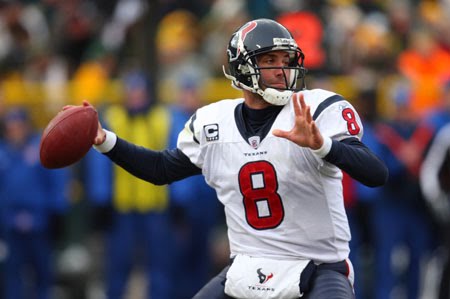
While Head Coach Gary Kubiak’s team had some good performers on defense, most notably DE Mario Williams and LB DeMeco Ryans, overall the unit was inconsistent. Offensively, QB Matt Schaub (pictured above) had been plagued by a knee injury and missed the four games leading up to the contest in Green Bay. Backup Sage Rosenfels had been effective in relief, but was prone to turning the ball over. With star WR Andre Johnson and productive RB Steve Slaton, the team was capable of making big plays, but had not been able to do so with regularity.


The Packers, under Head Coach Mike McCarthy, were in transition entering the season. For the first time since 1992, going back some 253 games, Brett Favre was not the starting quarterback. His departure to the New York Jets had been accompanied by plenty of offseason dramatics. Fourth-year QB Aaron Rodgers (pictured at right) was now running the offense, and while he was playing as well as could be hoped, the club, which had gone 13-3 in 2007 and advanced to the NFC Championship game, was struggling at 5-7 as it prepared to host the Texans and had lost four of the last five games.

Schaub was wearing a knee brace and the temperature at game time was just three degrees, making it the coldest contest in the franchise’s brief history to date. Neither the quarterback nor the team appeared to be hindered, however, as Schaub’s second pass went for a 58-yard touchdown to WR Kevin Walter.

The Packers didn’t complete a pass until their second possession, and both teams traded punts for the remainder of the opening period. The second quarter opened with Houston at the Green Bay 30, however, and it looked likely that the visitors would score when Schaub tossed a pass to Johnson that was good for a 19-yard gain to the 11. But TE Owen Daniels, after making a catch at the one, fumbled and CB Tramon Williams recovered for Green Bay at the three.

The Packers drove into Houston territory but, after DE Tim Bulman sacked Rodgers for a seven-yard loss on a third down play, once again had to punt. However, Schaub was intercepted by Williams at the Texans’ 28 and two plays later Green Bay tied the score as Rodgers connected with TE Donald Lee for a 20-yard TD with just over five minutes remaining in the half.

Schaub made up for the pickoff on Houston’s next play when he threw a pass to Walter for a 46-yard gain to the Green Bay 25. The drive finally stalled at the 11 and Kris Brown kicked a 30-yard field goal to put the Texans back in the lead. After an apparent 99-yard kickoff return by CB Will Blackmon was nullified by a holding penalty, Houston CB Dunta Robinson intercepted a Rodgers pass on the ensuing series, but the Texans were unable to add to their lead when Brown was wide on a 41-yard field goal attempt on the last play of the half. Houston led by 10-7 at halftime.

The Packers went three-and-out to start the third quarter and the Texans, helped by a 21-yard gain on a pass from Schaub to FB Vonta Leach, scored on a 41-yard field goal by Brown.

Following a short Green Bay possession, the Texans got the ball back on a punt and it appeared that they would have to punt again in turn, facing a fourth-and-six situation at their own 35. But veteran punter Matt Turk stunned both the Packers and his own team by taking off for an 18-yard gain and a first down. However, after driving to the Green Bay 16, Slaton fumbled and the Packers took over at their 21. On the last play of the third quarter, Rodgers passed to WR Greg Jennings for a 63-yard gain to the Houston six yard line. RB Ryan Grant ran the remaining six yards for a touchdown to start the final period, and with the successful PAT, the Packers took the lead at 14-13.

The Texans came back on a drive in which Schaub completed five passes for 55 yards, the last of which was for an 11-yard touchdown to Johnson. Following up with another pass to Johnson for a successful two-point conversion, Houston was now back in front at 21-14.

It appeared that the defense had successfully held the Packers after a short possession in which they only advanced to their own 18, but the ensuing punt was muffed by WR Jacoby Jones and recovered by long snapper Brett Goode for Green Bay. Back in possession of the ball at their own 49, the Packers took full advantage and seven plays later Rodgers threw a nine-yard scoring pass to WR Jordy Nelson. With the successful kick for the extra point, the game was tied at 21-21 with just under six minutes to play.

The Texans failed to advance on their next possession and punted. Rodgers passed to WR Donald Driver for a 59-yard gain to the Houston 25, but a holding call and sack backed the Packers to the 38 and out of field goal range. Punter Jeremy Kapinos pinned Houston down with a 35-yard kick to the three yard line.

Now with 1:49 remaining on the clock, Schaub proceeded to move the Texans downfield, completing passes to Leach for 22 yards, WR David Anderson for 17 yards, and Daniels for 27. After Slaton ran three yards to get the ball down to the Green Bay 22, Brown kicked a 40-yard field goal on the game’s final play to give Houston a 24-21 win.

The Texans accumulated a team-record 549 total yards, to 387 for the Packers, and had 25 first downs to Green Bay’s 16, although they were nearly undone by giving up four turnovers. But the Packers converted only one of 10 third downs, while Houston succeeded on 7 of 13 third down plays (and their one fourth down play).

Matt Schaub, showing no ill effects from the time off, threw for 414 yards as he completed 28 of 42 passes with two touchdowns and one intercepted. Kevin Walter (pictured below) caught 6 of those passes for 146 yards and a TD and Owen Daniels contributed another 65 yards on his 6 receptions. Steve Slaton ran for 120 yards on 26 carries.


Aaron Rodgers was successful on 19 of 30 passes for 295 yards with two TDs and an interception. Ryan Grant also reached the hundred-yard threshold with 104 on 19 attempts that included a touchdown. Donald Driver caught three passes for 75 yards.

There was much rejoicing by the Texans over what was considered one of the greatest wins in franchise history.

“Our group had every reason at some point to fold with the turnovers hurting us,” said Coach Kubiak. “But this group is made of a lot of character and it's as good a win as I've ever been around.”

Houston went on to win two of its last three contests (as part of five of the final six) to again finish at 8-8 and third in the AFC South. Green Bay lost the next two games before winning the season finale to end up at 6-10 for third place in the NFC North.

While Matt Schaub’s overall statistics of 3043 yards passing with 15 touchdowns (against 10 interceptions) were held down due to losing five games to injury, his 8.0 yards per attempt ranked second in the NFL (tied with Drew Brees of the Saints) and 276.6 yards per game ranked fourth. Schaub also ranked fourth in completion percentage (66.1) and seventh in overall passing (92.7 rating).

Andre Johnson led the NFL in both pass receptions (115) and receiving yards (1575). Kevin Walter added 60 catches for 899 yards (15.0 avg.) and eight TDs.


Rookie Steve Slaton (pictured at left) ran for 1282 yards on 268 carries for a 4.8-yard average and nine touchdowns. With 50 catches for 377 more yards, he garnered 1659 yards from scrimmage. However, the production dropped off significantly the following year.

Aaron Rodgers finished just ahead of Schaub with a 93.8 passer rating. While the team slumped, the new starting quarterback drew good reviews as he placed fourth in passing yards (4038), TD passes (28), and percentage of TD passes (5.2).

December 6, 2010

1987: Saints Beat Bucs, Qualify for Playoffs for First Time


Prior to the 1987 NFL season, the New Orleans Saints had symbolized pro football futility. Since the franchise first took the field in 1967, the club had not only never qualified for the postseason in its first 20 seasons, but had never finished with a winning record (the Saints had gone 8-8 in 1979 and 1983).

However, the arrival of Jim Mora (pictured at right) as head coach in 1986 marked a significant change in the team’s direction. After a successful stint coaching the Philadelphia/Baltimore Stars to two USFL championships, he was hired by the Saints (after a flirtation with the Eagles, who went with the brash Buddy Ryan instead). They had gone 7-9 in ’86, which was an improvement, and one they built upon. Coming into the December 6, 1987 game against the Tampa Bay Buccaneers, the Saints were 8-3 and close to locking up a playoff spot.

The team’s strength was its defense, in particular the linebacker corps of Vaughan Johnson, Rickey Jackson, Pat Swilling, and Sam Mills (who had played for Mora with the Stars). They were at their best stopping the run and ended up leading the league in takeaways (30 interceptions, 18 recovered fumbles). The offense was conservative and run-oriented, featuring RB Rueben Mayes and QB Bobby Hebert, another former USFL star.

Tampa Bay, under the guidance of Head Coach Ray Perkins, was a dismal 4-7 and had lost four straight games coming into the contest at the Louisiana Superdome (two of the wins came while replacement players were in use during the month-long strike by the players’ union; the New Orleans replacement team also went 2-1). The season was a lost cause, but there was some anticipation as rookie QB Vinny Testaverde, the overall first draft choice and Heisman Trophy winner out of the University of Miami, was making his first start for the Buccaneers.

The game started out well for the Saints, playing before a home crowd of 66,471. On the third play from scrimmage, Testaverde fumbled and DE Bruce Clark recovered at the Tampa Bay 19 yard line. Four plays later, Hebert threw an eight-yard touchdown pass to TE John Tice.

No sooner did the Bucs get the ball back, following a 40-yard kickoff return by DB Bobby Futrell, and Testaverde again fumbled the ball away. Swilling recovered for the Saints at the Tampa Bay 38, and the resulting possession again ended in a Hebert to Tice TD pass, this time from six yards out. Barely six minutes into the game, New Orleans had a 14-0 lead.

Two possessions later, the Buccaneers went 48 yards in seven plays to get on the board. Testaverde completed passes to RB James Wilder and WR Bruce Hill along the way that converted third downs (a 17-yard pass interference call on the Saints also helped) and capped the drive himself by running the final yard for a touchdown. The first quarter ended with the Saints leading by 14-7.

New Orleans responded with a 10-play possession that covered 77 yards and was highlighted by a Hebert pass to WR Mark Pattison that covered 36 yards to the Tampa Bay 29. Mayes swept around end for a seven-yard touchdown and the lead was extended to 21-7.

The Bucs were forced to punt and the star kick returner for the Saints, RB Mel Gray (another USFL refugee), fielded the kick at his 16 and ran it back 80 yards to the Tampa Bay four yard line. In short order, RB Dalton Hilliard ran three yards for a TD that put New Orleans up by 21 points.

The Buccaneers managed to put together a long, 14-play drive that resulted in a 37-yard field goal by Donald Igwebuike and the score at halftime was 28-10.

New Orleans started off the third quarter by driving for a 40-yard field goal by the dependable Morten Andersen, and essentially had the game in hand. The Bucs fought back and Testaverde threw touchdown passes of 37 yards to WR Mark Carrier in the third quarter and 12 yards to Hill in the final period. Igwebuike also kicked a 43-yard field goal and RB Bobby Howard ran for a two-yard touchdown.

But the Saints added points on a two-yard run by Mayes and Andersen field goals of 24 and 32 yards. New Orleans won by a final score of 44-34 and clinched a postseason berth for the first time.

Going to the air often in attempting to catch up, Tampa Bay actually outgained the Saints (449 yards to 365) and had more first downs (27 to 19). However, they turned the ball over four times (to once by New Orleans) and the two early fumbles that led to touchdowns put the Bucs in a hole they were unable to dig out of.

Vinny Testaverde made up for the early miscues by setting a new rookie passing yardage record with 369 while completing 22 of 47 passes with two touchdowns and two interceptions apiece. Mark Carrier set a franchise record with 212 receiving yards on 8 catches, including one TD. The Buccaneers gained 97 yards on the ground, with RB Jeff Smith leading the way at 31 yards on 8 carries and James Wilder following close behind at 30 yards on six attempts.


In winning, Bobby Hebert (pictured at left) completed 16 of 24 passes for 255 yards with two touchdowns and none intercepted. WR Eric Martin gained 101 yards on just two catches thanks to a 67-yard reception, and WR Lonzell Hill caught three passes to lead the club (he gained 27 yards). Dalton Hilliard and Rueben Mayes ground out 117 rushing yards between them, with Hilliard gaining 62 yards on 16 carries, including one TD, and Mayes contributing 55 yards on 21 attempts with two scores.

“You bet we’re a playoff team,” said an exultant Coach Mora afterward. “Our guys are happy, but their attitude is they’re not done yet. They want more.”

The Saints kept winning, ending up with nine straight victories to close out the season with a 12-3 tally. Coming in second in the NFC West to the 49ers, they claimed a wild card spot and hosted Minnesota in the first round of the postseason. Their first playoff game proved to be a great disappointment as the Vikings rolled over them, 44-10. Meanwhile, Tampa Bay kept losing and finished at 4-11, tied with Detroit at the bottom of the NFC Central division.

Bobby Hebert, who had been experiencing difficulty in transferring his USFL success to the NFL, showed marked improvement as he threw for 2119 yards with 15 touchdowns against 9 interceptions. His 12.9 yards per completion ranked fourth in the NFC.

Rueben Mayes was selected for the Pro Bowl for the second time as he ranked second in the NFC (fifth in the league) with 917 yards on 243 carries (3.8 avg.) and five touchdowns. Injuries would steadily erode his production thereafter, and he didn’t start a game after 1990.


Mel Gray’s 80-yard punt return was no anomaly as he led the NFL with a 14.7-yard average on 24 returns. He would go on to be a highly-productive kick returner for the next decade, although his greatest notoriety would come as a member of the Detroit Lions.

In the first of 21 up-and-down seasons, Vinny Testaverde (pictured at right) completed 43 % of his passes for 1081 yards and five TDs along with six interceptions. Fellow rookie Mark Carrier caught 26 passes and accounted for half of his 423 receiving yards in the game against the Saints. He would go on to a productive 12-year career.

December 5, 2010

1971: Willie Ellison Runs for 247 Yards as Rams Beat Saints


Prior to the December 5, 1971 game between the Los Angeles Rams and New Orleans Saints, halfback Willie Ellison had largely labored in obscurity. In his fifth year out of Texas Southern, as part of a stable of good backs in LA he had only occasionally started; in his best season, 1968, he gained 616 yards, but had a combined total of 521 in the other three years. At 6’2” and 210 pounds, he had good speed but was stuck behind bigger backs more to the liking of Head Coach George Allen such as Les Josephson and Larry Smith.

1971 was a year of transition for the Rams, as Allen had been let go following the ’70 season and replaced by Tommy Prothro, a career college coach who had been at UCLA. One of the changes the new head coach made was to utilize Ellison more, and it would lead to his not only achieving a career high in rushing but a place in the record book as well.

Los Angeles was 6-4-1 coming into the game against the Saints at the Memorial Coliseum, a half-game behind the 49ers (7-4) in the NFC West. New Orleans, under Head Coach J.D. Roberts, was struggling at 4-5-2, although the Saints were coming off of a win the week before at Green Bay and had beaten the Rams in the first game of the season. However, rookie QB Archie Manning, who had starred in that opening-day contest, was injured against the Packers and out for the rematch with LA – third-year backup Edd Hargett started in his place.

There were 73,610 fans present at the huge stadium, and they didn’t have to wait long for the Rams to get on the board. On the third play from scrimmage, Ellison ran around end for an 80-yard touchdown. Sprung thanks to a block by perennial Pro Bowl guard Tom Mack on New Orleans FS D’Artagnan Martin, Ellison had clear sailing until he reached the Saints’ 20 and dodged the strong safety, Hugo Hollas, to continue on to the end zone.

The next score was set up when New Orleans punter Julian Fagan, after fielding a bad snap that had gone over his head, launched a punt that went just four yards. LA took over on the New Orleans 33 and capitalized when QB Roman Gabriel completed a 37-yard TD pass to WR Jack Snow.

The Saints then capped an eight-play drive at 9:38 into the opening period as Hargett completed a 25-yard touchdown pass to WR Dan Abramowicz. But no sooner had they cut LA’s lead to seven points when RB Travis Williams returned the ensuing kickoff 105 yards for a TD. The Rams led by 21-7 after one quarter of play.

On LA’s first series of the second quarter, Ellison broke loose for a 48-yard run to the New Orleans 12, but David Ray ended up missing a 15-yard field goal attempt to make it all for naught. However, when the Saints were forced to punt again, WR Lance Rentzel returned it 24 yards to the New Orleans 37. In a drive assisted by a roughing-the-passer penalty on DT Dave Long, Larry Smith ran the final five yards for a TD.

In the final seconds of the second quarter, Gabriel threw an eight-yard touchdown pass to Rentzel that capped a drive of 69 yards in 13 plays which included three runs for 33 yards by Ellison. After one half, Los Angeles was comfortably leading 35-7 and Ellison had gained 186 yards rushing on 13 carries.

After building the big first half lead, the Rams played poorly in the third quarter. A series of penalties kept them in bad field position - one was an unsportsmanlike conduct penalty on Prothro, who stormed onto the field after Gabriel was called for intentional grounding.

New Orleans took advantage of LA’s miscues to score twice. After a 17-yard punt by Pat Studstill from his two yard line, the Saints had excellent field position at the LA 19 and HB Bob Gresham scored from a yard out. Then Ellison fumbled after taking a hard hit and the ball was recovered by Saints LB Jim Flanigan. New Orleans drove 60 yards in seven plays that resulted in a short TD carry by Hargett.

The score was 35-21 after three quarters, putting the Saints in striking distance, but early in the fourth quarter, Gabriel connected with Rentzel for a 39-yard touchdown to cap a 10-play, 65-yard drive that got the Rams back on track. Hargett followed by throwing a desperation pass while pressured by DT Merlin Olsen that was intercepted by CB Jim Nettles at the New Orleans 45. While the Saints scored once more on a second short, one-yard run by Gresham, the outcome was essentially decided.

The only drama remaining pertained to Ellison as he closed in on the single-game rushing record. The existing NFL record had been 237, twice achieved by Cleveland’s Jim Brown, but with the adopting of the American Football League’s records following the merger in 1970, the target was now the 243 yards gained by Cookie Gilchrist of the Bills against the Jets in 1963.

A ten-yard gain put Ellison even with Gilchrist at 243 yards, but then Prothro pulled the halfback for a breather with two minutes left to play, much to the displeasure of the crowd. He returned, to cheers, and broke the record with a two-yard run off left tackle. Ellison added another two-yard run for good measure, bringing his new record total to 247 yards, and left the field to a standing ovation.

The result of the game was almost an afterthought, as Ray kicked a 12-yard field goal to make the final score 45-28.

The Rams easily outgained the Saints, by 421 yards to 263, although they gave up 119 yards as a result of 14 penalties (New Orleans was flagged six times). Willie Ellison’s 247 rushing yards came on 26 carries for a 9.5-yard average gain and included the one long touchdown.

Roman Gabriel completed 10 of 18 passes for 137 yards with three TDs and no interceptions. Lance Rentzel caught 5 passes for 65 yards and two scores to lead the receivers.

For the Saints, Edd Hargett threw 36 passes and was successful on 19 of them for 213 yards with a touchdown and one picked off. Dan Abramowicz and TE Dave Parks both caught five passes, with Abramowicz gaining 91 yards (and scoring a TD) to 46 for the veteran tight end. New Orleans gained just 56 yards on the ground, on 23 carries, and FB Jim Strong led with 33 yards on 7 attempts. While Bob Gresham scored the two short TDs, he averaged less than a yard a carry with 9 yards on 11 attempts.

“Yes, they made me aware of the records (at halftime),” said Ellison afterward. “I knew I needed something like 60 yards to break the NFL mark. But really, I didn't let it concern me. I felt whatever comes will come.”

“Willie Ellison ran like hell all day,” said Saints Coach North. “He has a little bit of everything – including blocking.”

“You need 11 guys to block,” added veteran Rams G Joe Scibelli. “But you also need a guy who knows how to hit the hole. Personally I feel honored to be a part of Willie Ellison's record.”

The record-setting performance (it was broken by Buffalo’s O.J. Simpson in the first week of the 1973 season) gave Willie Ellison 929 yards in 12 games, on his way to an even 1000 yards on 211 carries (4.7 avg.). He also caught 32 passes for 238 yards, but all four of his touchdowns came on the ground. Ellison led the team with 764 yards in ’72, but by the following year he was playing fullback in Kansas City, where his career ended in 1974 (returning to the obscurity from whence he had come).

The Rams ended up with an 8-5-1 record to again finish second to San Francisco in the NFC West; following a losing season in 1972, Prothro would be out as coach. New Orleans lost its last two games to conclude with a 4-8-2 tally, once again at the bottom of the division (the Saints would not escape the NFC West cellar until 1974).

December 4, 2010

2005: Chambers Has Record-Setting Day as Dolphins Rally to Beat Bills


The December 4, 2005 game at Dolphin Stadium between host Miami and the Buffalo Bills featured two 4-7 teams. The Dolphins, under the direction of first-year Head Coach Nick Saban, had just won for the first time in four weeks the game before. The offense was led by QB Gus Frerotte, a 34-year-old journeyman, and had been without RB Ricky Williams for the first four weeks due to a suspension for substance abuse.

The Bills were reeling under Head Coach Mike Mularkey. The club had parted company with veteran QB Drew Bledsoe in the offseason and handed the offense over to their 2004 first draft pick and quarterback-in-waiting, J.P. Losman. The inexperienced quarterback was struggling, and it was showing in the won-lost column.

The first quarter was dominated by the Bills. On the fourth play from scrimmage, Losman connected with WR Lee Evans for a 46-yard touchdown and quick 7-0 lead. On Miami’s third play, WR Chris Chambers (pictured above) caught a pass from Frerotte that gained 20 yards, but he fumbled when hit by CB Nate Clements and the Bills recovered at their own 44 yard line. Losman immediately went to Evans again, this time for a 56-yard TD.

Later in the period, following a 36-yard punt return by WR Roscoe Parrish to the Miami 26, Buffalo took six plays to score again, on a much shorter Losman-to-Evans pass that covered four yards. The score stood at 21-0 after one quarter of action.

The Dolphins snuffed out another threat in the second quarter when the Bills drove to the Miami 15 but Losman fumbled when sacked by LB Donnie Spragan and LB Channing Crowder recovered for the Dolphins. Still, Miami’s offense couldn’t move until the last drive of the half. Frerotte completed five passes as the Dolphins advanced to the Buffalo five yard line, but had to settle for a 23-yard field goal by Olindo Mare. The Bills led by 21-3 at halftime.

Buffalo added to its lead in the third quarter when Frerotte was sacked in his end zone by LB London Fletcher for a safety. Suffering a concussion on the play, the veteran quarterback did not return. Meanwhile, the Bills drove to the Dolphins’ three and faced a first-and-goal situation when Losman was intercepted by CB Sam Madison. The Dolphins weren’t able to immediately capitalize, as backup QB Sage Rosenfels, running a no-huddle offense through much of the ensuing possession, drove the team down to the Buffalo nine but turned the ball over on downs with just seconds remaining in the period.

Following a Buffalo punt, the Dolphins were more successful on their next possession as Williams capped a nine-play, 70-yard drive with a five-yard touchdown run. Still, the score was 23-10 in favor of the visitors. But the Bills had to punt again, and once more Miami, going without a huddle for much of the way, scored on 23-yard pass play from Rosenfels to RB Ronnie Brown. Buffalo’s lead was narrowed to 23-17.

It seemed as though the margin would hold up when Rosenfels was intercepted by DE Aaron Schobel near midfield on the next Miami possession. The Bills took over with 2:29 remaining to play. The Dolphins called two timeouts and took advantage of the two-minute warning to get the ball back at their 27 yard line following a punt.

Only about 25,000 of the original crowd of 72,051 were still on hand as the Dolphins drove down the field. Rosenfels hit Chambers for a 57-yard gain to the Buffalo 16. Eight plays later, on fourth-and-four and with six second left, Rosenfels lobbed a pass from four yards out that Chambers came down with for a touchdown. Mare kicked the extra point and the Dolphins came away with a 24-23 comeback win. All of their touchdowns had occurred in the final period.

The Dolphins had not overcome a margin as large as 20 points since 1974. They outgained Buffalo, 434 yards to 294, and had 26 first downs to 16 for the Bills. Miami accumulated 387 net passing yards, going to the air a team-record 65 times, with Chris Chambers setting new franchise single game records with 15 catches for 238 yards.

Sage Rosenfels (pictured below) accounted for 272 of the passing yards while completing 22 of 37 passes with two touchdowns and an interception. Before getting knocked out of the game, Gus Frerotte was successful on 12 of 28 throws for 115 yards and had no scores or interceptions. Ricky Williams was the leading rusher, gaining 46 yards on 11 carries with a TD.


J.P. Losman completed 13 of 26 passes for 224 yards and three touchdowns – all in the first quarter – and had one picked off. Wasted (and overshadowed by Chambers) was a fine performance by Lee Evans with 5 pass receptions for 117 yards and all three TDs. RB Willis McGahee gained 81 yards rushing on 27 attempts. The failure to take advantage of opportunities to pad the lead ultimately proved disastrous for Buffalo.

“We really like for everyone to get their money's worth,” Nick Saban joked afterward. “You talk about playing 60 minutes, and it's a cliche, but this was an example of that today.”

“I took a quick, deep breath and said, ‘Relax,’” Rosenfels said regarding the pass to Chambers for the game-winning score. “The clock was running. We figured whatever coverage they were in, the best play was to throw it up for Chris.”

From the Buffalo perspective, a disappointed Losman said, “Nobody will know how this feels unless they've been in the locker room. I can't really describe it, because I'm no Shakespeare.”

The win proved to be a high point in a season-ending surge for Miami. The Dolphins won six straight to close out the schedule for a 9-7 tally. It was good enough for second place in the AFC East, although not a playoff spot. Buffalo kept going in the wrong direction, winning just once more and finishing at 5-11 and third in the division. Both Coach Mularkey and GM Tom Donahoe were dismissed.

In his fifth season, the huge performance against Buffalo by Chris Chambers was considered a turning point. He ended up setting career highs in receptions (82), yards (1118), matched his previous best with 11 touchdowns, and was selected to the Pro Bowl. But his performance dropped off in ’06 and during a disastrous 2007 season for the team, he was dealt away to the Chargers. As the record-setting game against Buffalo showed, Chambers had outstanding ability, but he lacked consistency and was dogged by injuries (he wasn’t helped by instability at quarterback).

In his second year, Lee Evans (pictured below) caught 48 passes for 743 yards (15.5 avg.) and seven touchdowns; his best seasons were yet to come. J.P. Losman passed for 1340 yards with eight touchdowns and as many interceptions – more critically, the team’s won-lost record with him as the starting quarterback was a woeful 1-7 and, between ineffectiveness and injury, twice lost the job to Kelly Holcomb. While 2006 proved to be a better year for him, ultimately his tenure in Buffalo was a disappointment.

December 3, 2010

2000: Four NFL Runners Reach 200 Yards on Same Day


As much as modern pro football has become more pass-oriented, running the ball is still an integral part of the game and running backs still achieve big performances. December 3, 2000 was a day for ground-gaining achievements as an unprecedented four NFL runners gained 200 yards rushing on the same date.

The highest total was registered by rookie RB Mike Anderson of the Denver Broncos (pictured at right), who had 251 yards on 37 carries in a game against the Saints at the Louisiana Superdome. Both the 6’0”, 230-pound Anderson and the Broncos had been on a hot streak. Denver had won six of its last seven games, including four straight, coming into the contest against the 8-4 Saints. Anderson had already gone over 100 yards on four occasions and twice flirted with 200, including 195 the week before at Seattle, making the most of his opportunity to play after injuries had cut down veterans Terrell Davis and Olandis Gary.

Anderson scored the first of his four touchdowns (all by rushing) in the opening period and his second TD, of five yards, in the second quarter put the Broncos ahead to stay. They won handily, 38-23.

Cincinnati RB Corey Dillon, who at the time held the NFL single-game record with 278 yards in a game that he set just six weeks before on October 22 (coincidentally, against Denver), reached the 200-yard threshold for the second time in 2000 with 216 on 35 attempts against the 3-9 Arizona Cardinals at Paul Brown Stadium. The Bengals had not been as successful as the 6’1”, 225-pound fourth-year running back out of Washington – they were 2-10 entering the game and had lost four straight.


Dillon (pictured at left) set the pace from the start, running for 57 yards on the team’s second play from scrimmage to set up a short TD pass from QB Scott Mitchell to TE Tony McGee. By the half, he had gained 134 yards and scored on a one-yard TD run to extend Cincinnati’s lead to 14-0. It was 21-0 in the third quarter before the Cardinals began to come back and narrowed the margin to 21-13. But Dillon, along with RB Brandon Bennett, keyed a long, 17-play fourth quarter drive that ran the clock down and ended with a 32-yard Neil Rackers field goal to cap the 24-13 win.

At Tampa Bay’s Raymond James Stadium, fourth-year RB Warrick Dunn gained 210 yards on 22 rushes with two touchdowns against the Dallas Cowboys. The Buccaneers were 7-5, and had won four of their last five, while Dallas was a dismal 4-8. The 5’8”, 180-pound Dunn typically split duty with FB Mike Alstott, who was struggling with injuries, and with more of an opportunity to run the ball had his first 100-yard game of the year the previous week (106 vs. Buffalo).

Tampa Bay dominated the Cowboys throughout the game. It was already 3-0 in the first quarter when Dunn took off on a 70-yard run for the first touchdown of the game. He scored again in the fourth quarter on a seven-yard carry that made the final tally 27-7. It was the third 200-yard rushing performance of the year against the Cowboys, who had given up just two such performances over the previous 40 seasons, and also marked Tampa Bay’s first-ever win over Dallas.


Finally, RB Curtis Martin of the New York Jets (pictured at right) rolled up a then-club-record 203 yards on 30 carries at Giants Stadium against the Indianapolis Colts. The Jets were 8-4 and battling the 7-5 Colts in the AFC East. The 5’11”, 210-pound Martin was in his third year in New York after three seasons with the Patriots and had been to the Pro Bowl three times. He had been over a hundred yards twice thus far in 2000.

The Jets were ahead by 7-0 in the first quarter when Martin’s 36-yard run keyed a drive that was capped by a 13-yard touchdown pass from QB Vinny Testaverde to WR Dedric Ward. It was 20-0 at halftime, but the Colts came back in the second half to close to within 20-17. A fumble recovery by the Jets set up a two-yard scoring run by Martin that clinched the 27-17 win for New York.

Mike Anderson not only led the day but, of the four, had the highest yardage total of the season with 1487, fourth-ranked in the league, on 297 carries. His 5.0 average gain ranked third and 15 rushing touchdowns second (and first in the AFC). It was the high point of his seven-season career in which he reached the thousand-yard mark just once more (1014 in 2005). He did not have any more 200-yard games.

Corey Dillon was right behind Anderson at fifth in the NFL with 1435 yards on 315 carries. He averaged 4.6 yards per carry and scored seven touchdowns. It was the fourth of an eventual six straight thousand-yard seasons and was his highest yardage total with the Bengals, although his career high of 1635 came with New England in 2004. Dillon was named to the Pro Bowl for the second of three straight years (and four overall).Including a 246-yard game as a rookie in 1997, and with the two in 2000, he ended up with a total of three 200-yard games for his career.

Curtis Martin ended up with a 12th-ranked 1204 yards on 316 attempts for a 3.8-yard average and nine touchdowns. Factoring in pass receiving yards, however, he ranked ninth in yards from scrimmage with 1712, the highest total of the four. Also the most prolific rusher of the group, his thousand-yard season was the sixth of an eventual 10 straight to start his career, a distinction he shares with Detroit’s Barry Sanders (Emmitt Smith had 11 consecutive, but that streak started with his second season). Martin led the NFL with a career-high 1697 yards in 2004, at age 31, when he was a consensus 1st-team All-NFL selection. He was chosen for the Pro Bowl five times. The performance against the Colts was his only career 200-yard game.


Warrick Dunn (pictured at left) ranked 18th with 1133 yards on 248 attempts. His 4.6-yard average gain ranked considerably higher, tying him for seventh in the league with Dillon. He scored eight touchdowns on the ground. It was the second thousand-yard season of an eventual five for Dunn, with his career high being 1416 with the Falcons in 2005. He was selected to the Pro Bowl in 2000 for the second of three times. Like Anderson and Martin, the game against the Cowboys marked his only rushing total over 200 yards.