Showing posts with label 2008 NFL season. Show all posts

April 21, 2017

Highlighted Year: Stephen Gostkowski, 2008

Placekicker, New England Patriots


Age: 24
3rd season in pro football & with Patriots
College: Memphis
Height: 6’1”   Weight: 210

Prelude:
Gostkowski scored 367 points in college, including 70 field goals. He was selected by the Patriots in the fourth round of the 2006 NFL draft and was successful on 20 of 26 field goal attempts as a rookie as well as 43 of 44 PATs. Gostkowski followed up with 27 field goalsand a league-record 74 PATs without a miss on the way to scoring 137 points for the high-scoring Patriots in 2007.


2008 Season Summary
Appeared in all 16 games
[Bracketed numbers indicate league rank in Top 20]

Kicking
Field goals – 36 [1]
Most field goals, game – 4 at NY Jets 9/14, vs. Arizona 12/21
Field goal attempts – 40 [1, tied with David Akers]
Most field goal attempts, game – 4 at NY Jets 9/14, vs. Arizona 12/21
Field goal percentage – 90.0 [7]
PATs – 40 [11, tied with Rob Bironas, Ryan Longwell & Dan Carpenter]
PAT attempts – 40 [11, tied with four others]
Longest field goal – 50 yards at Seattle 12/7

Scoring
Field Goals – 36
PATs – 40
Points – 148 [1]

Awards & Honors:
1st team All-NFL: AP, PFWA, Sporting News
Pro Bowl

Patriots went 11-5 to finish second in the AFC East.  

Aftermath:
Gostkowski kicked 26 field goals in 2009 and was successful on just 10 of 13 attempts in a 2010 season in which he was sidelined for eight games by a thigh injury. He connected on 28 of 33 field goal tries in 2011 and was a perfect five-for-five in the postseason. Gostkowski once again led the NFL in scoring in 2012’13, ’14, and ’15, and also in field goals in 2013 with38 out of 41 attempts. He was selected to the Pro Bowl in 2013, ’14 , and ’15, the same year in which he received consensus first-team All-NFL honors.In 11 seasons thus far through 2016, all with New England, Gostkowski has made good on 303 of 348 field goal attempts (87.1%) and has added 548 PATs for a total of 1457 points. In the postseason he has added another 31 field goals out of 33 attempts and including 67 PATs has scored another 160 points. Gostkowski has received consensus first-team All-NFL recognition once and has received at least some first-team honors following three other seasons. He has also been selected to four Pro Bowls.


--

Highlighted Years features players who were consensus first-team All-League* selections or league* or conference** leaders in the following statistical categories:

Rushing: Yards, TDs (min. 10)
Passing: Yards, Completion Pct., Yards per Attempt, TDs, Rating
Receiving: Catches, Yards, TDs (min. 10)
Scoring: TDs, Points, Field Goals (min. 5)
All-Purpose: Total Yards
Defense: Interceptions, Sacks
Kickoff Returns: Average
Punt Returns: Average
Punting: Average

*Leagues include NFL (1920 to date), AFL (1926), AFL (1936-37), AAFC (1946-49), AFL (1960-69), WFL (1974-75), USFL (1983-85)

**NFC/AFC since 1970

July 1, 2016

Highlighted Year: Nick Collins, 2008

Safety, Green Bay Packers


Age: 25
4th season in pro football & with Packers
College: Bethune-Cookman
Height: 5’11” Weight: 200

Prelude:
Collins started at both safety positions in college and was an All-Mid-Eastern Athletic Conference selection in 2004 when he intercepted 6 passes and was credited with 54 tackles. He was chosen by the Packers in the second round of the 2005 NFL draft and, with the departure of Darren Sharper due to contract issues, Collins moved directly into the starting lineup at free safety. With good speed and work ethic, he grew into the role and was credited with 84 tackles and two forced fumbles along with one interception. Collins picked off three passes in 2006, one of which he returned for a touchdown, and his play continued to improve.

2008 Season Summary
Appeared in all 16 games
[Bracketed numbers indicate league rank in Top 20]

Interceptions – 7 [2, tied with Michael Griffin, Troy Polamalu & Charles Woodson; 1st in NFC]
Most interceptions, game – 1 on seven occasions
Int. return yards – 295 [1]
Most int. return yards, game – 62 (on 1 int.) vs. Indianapolis 10/19
Int. TDs – 3 [1]
Sacks – 0
Fumble recoveries – 0
Forced fumbles – 1
Tackles – 60
Assists – 12

Scoring
TDs – 3
Points – 18

Awards & Honors:
2nd team All-NFL: AP
Pro Bowl

Packers went 6-10 to finish third in the NFC North while tying the Tampa Bay Buccaneers for the conference lead in interceptions (22).

Aftermath:
Collins followed up his outstanding 2008 season by gaining second-team All-NFL honors from the Associated Press as well as selection to the Pro Bowl in each of the next two years while intercepting a total of 10 passes. He also scored a TD on an interception return in the Super Bowl XLV win over Pittsburgh following the 2010 season. However, a serious neck injury suffered in the second week of 2011 not only ended his season but cut short his career. Overall, he started 95 games, all with the Packers, and intercepted 21 passes that he returned for 507 yards and four touchdowns. He was a three-time AP second-team All-NFL selection and was chosen for as many Pro Bowls.

--

Highlighted Years features players who were first-team All-League* selections or league* or conference** leaders in the following statistical categories:

Rushing: Yards, TDs (min. 10)
Passing: Yards, Completion Pct., Yards per Attempt, TDs, Rating
Receiving: Catches, Yards, TDs (min. 10)
Scoring: TDs, Points, Field Goals (min. 5)
All-Purpose: Total Yards
Defense: Interceptions, Sacks
Kickoff Returns: Average
Punt Returns: Average
Punting: Average

*Leagues include NFL (1920 to date), AFL (1926), AFL (1936-37), AAFC (1946-49), AFL (1960-69), WFL (1974-75), USFL (1983-85)

**NFC/AFC since 1970

April 16, 2016

Highlighted Year: John Carney, 2008

Placekicker, New York Giants


Age: 44
21st season in pro football, 1st with Giants
College: Notre Dame
Height: 5’11” Weight: 180

Prelude:
Carney kicked 51 field goals in college and set a Notre Dame season record with his 89.5 percentage in 1984 (17 of 19). He was signed as an undrafted free agent by the Cincinnati Bengals in 1987 but failed to make the team and sat out the year. Carney finished out the last four games for the Tampa Bay Buccaneers in 1988, substituting for the injured Donald Igwebuike, and started the year in ’89, playing in a total of five games and making good on two of five field goal attempts and all six of his PAT attempts. After failing to make the Chargers during the 1990 preseason, he appeared in one game with the Rams and was then re-signed by San Diego, succeeding on 19 of 21 field goal attempts. Following a lesser year in ’91, Carney bounced back to play a total of 10 full seasons with the Chargers. Highlights included hitting on 31 of 40 field goal tries in 1993, with two games in which he kicked six field goals in as many attempts, and a 1994 season in which he led the NFL with 34 field goals, out of just 38 attempts, as well as totaling a league-leading 135 points. Carney was a consensus first-team All-NFL choice that year and was selected to the Pro Bowl. Carney departed following the 2000 season as the club’s all-time leader in field goals (261) and scoring (1076 points). While not strong on kickoffs, and with concerns about his range, he joined the New Orleans Saints in 2001 and stayed for six years, providing reliability if not long distance. Carney split time with the Jaguars and Chiefs in 2007 before moving on to the New York Giants in ’08 after regular PK Lawrence Tynes was sidelined by injury.

2008 Season Summary
Appeared in 15 of 16 games
[Bracketed numbers indicate league rank in Top 20]

Kicking
Field goals – 35 [2, 1st in NFC]
Most field goals, game – 4 vs. Cincinnati 9/21, at Pittsburgh 10/26, at Minnesota 12/28
Field goal attempts – 38 [3, tied with Matt Bryant & Rian Lindell]
Most field goal attempts, game – 5 at Minnesota 12/28
Field goal percentage – 92.1 [4]
PATs – 38 [17]
PAT attempts – 38 [17]
Longest field goal – 51 yards at Minnesota 12/28

Scoring
Field Goals – 35
PATs – 38
Points – 143 [3]

Postseason: 1 G (NFC Divisional playoff vs. Philadelphia)
Field goals – 3
Field goal attempts – 5
PATs – 0
PAT attempts – 0
Longest field goal – 36 yards

Awards & Honors:
2nd team All-NFL: AP
Pro Bowl

Giants went 12-4 to finish first in the NFC East while leading the NFL in rushing yards (2518). Lost NFC Divisional playoff to Philadelphia Eagles (23-11).  

Aftermath:
With the younger, and stronger-legged, Lawrence Tynes recovered from his injury, Carney’s contract was not renewed by the Giants and he spent parts of the 2009 and ’10 seasons back with the Saints, finishing his 23-year career at 46 years old. Overall, Carney kicked 478 field goals in 580 attempts (82.4 %) and added 628 extra points (with 10 misses) for a total of 2062 points. At the time of his retirement, the field goal and point totals ranked third all-time in NFL history. He received first-team All-NFL recognition once, second-team honors twice, and was chosen to two Pro Bowls. Carney was named to the Chargers’ 50th anniversary all-time team.

--

Highlighted Years features players who were consensus first-team All-League* selections or league* or conference** leaders in the following statistical categories:

Rushing: Yards, TDs (min. 10)
Passing: Yards, Completion Pct., Yards per Attempt, TDs, Rating
Receiving: Catches, Yards, TDs (min. 10)
Scoring: TDs, Points, Field Goals (min. 5)
All-Purpose: Total Yards
Defense: Interceptions, Sacks
Kickoff Returns: Average
Punt Returns: Average
Punting: Average

*Leagues include NFL (1920 to date), AFL (1926), AFL (1936-37), AAFC (1946-49), AFL (1960-69), WFL (1974-75), USFL (1983-85)

**NFC/AFC since 1970

March 19, 2016

Highlighted Year: Jay Cutler, 2008

Quarterback, Denver Broncos


Age: 25
3rd season in pro football & with Broncos
College: Vanderbilt
Height: 6’3”   Weight: 233

Prelude:
Cutler set school records in pass attempts (1242) and completions (710) as well as passing yards (8697) and TD passes (59) and was SEC Player of the Year as a senior in 2005. He was chosen by the Broncos in the first round of the 2006 NFL draft (11th overall) and replaced Jake Plummer as starting quarterback for the last five games of the season. Mobile and with a strong and accurate arm, Cutler showed enough of his potential, completing 59.1 percent of his passes for 1001 yards and 9 TDs, to take over the starting job in 2007. While he passed for 3497 yards and 20 TDs, he lost weight and was lacking energy as the season progressed. Diagnosed with Type 1 diabetes in the offseason, he was fitted with an insulin pump.

2008 Season Summary
Appeared in all 16 games
[Bracketed numbers indicate league rank in Top 20]

Passing
Attempts – 616 [2]
Most attempts, game – 50 vs. San Diego 9/14
Completions – 384 [3]
Most completions, game – 36 vs. San Diego 9/14
Yards – 4526 [3, 1st in AFC]
Most yards, game – 447 at Cleveland 11/6
Completion percentage – 62.3 [15]
Yards per attempt – 7.3 [12]
TD passes – 25 [7]
Most TD passes, game – 4 vs. San Diego 9/14
Interceptions – 18 [2]
Most interceptions, game – 3 vs. Miami 11/2
Passer rating – 86.0 [16]
400-yard passing games – 1
300-yard passing games – 8
200-yard passing games – 13

Rushing
Attempts – 57
Most attempts, game – 8 (for 16 yds.) vs. Kansas City 12/7, (for 30 yds.) vs. Buffalo 12/21
Yards – 200
Most yards, game – 30 yards (on 8 carries) vs. vs. Buffalo 12/21
Average gain – 3.5
TDs – 2

Scoring
TDs – 2
2-pt conversions – 1 [2, tied with many others]
Points – 14

Awards & Honors:
Pro Bowl

Broncos went 8-8 to finish second in the AFC West while leading the conference in total yards (6333) and passing yards (4471).

Aftermath:
After appearing to have established himself in Denver, Cutler, in conflict with newly-hired head coach Josh McDaniels, demanded a trade and was accommodated by being dealt to the Chicago Bears in 2009. He had difficulties, passing for 3666 yards and 27 TDs but giving up a league-leading 26 interceptions. In 2010, although sacked a NFL-high 52 times, he had a better year overall and the Bears went 11-5 and reached the NFC title game, although Cutler was criticized when he left that contest, a loss to the Packers, with a knee sprain. Injuries were a factor in 2011, when he missed six games with a broken thumb, and 2013, missing five contests due to a groin injury. Cutler achieved career highs in 2014 with a 66.0 completion percentage and 28 TD passes, but he again led the league in interceptions with 18 in a losing season for the club. He threw for 3659 yards and 21 TDs in 2015, with just 11 interceptions. Overall, over ten seasons he has passed for 31,408 yards and 204 TDs, with 141 interceptions, for a passer rating of 86.0. Of those totals, 9024 yards and 54 touchdowns, with 37 INTs, came with the Broncos, where he achieved his only Pro Bowl selection to date.

--

Highlighted Years features players who were consensus first-team All-League* selections or league* or conference** leaders in the following statistical categories:

Rushing: Yards, TDs (min. 10)
Passing: Yards, Completion Pct., Yards per Attempt, TDs, Rating
Receiving: Catches, Yards, TDs (min. 10)
Scoring: TDs, Points, Field Goals (min. 5)
All-Purpose: Total Yards
Defense: Interceptions, Sacks
Kickoff Returns: Average
Punt Returns: Average
Punting: Average

*Leagues include NFL (1920 to date), AFL (1926), AFL (1936-37), AAFC (1946-49), AFL (1960-69), WFL (1974-75), USFL (1983-85)

**NFC/AFC since 1970

November 30, 2015

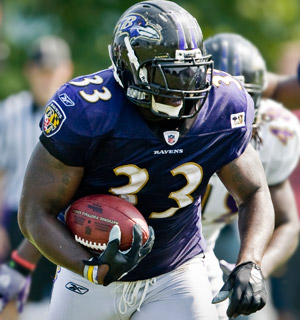
Highlighted Year: Le’Ron McClain, 2008

Fullback, Baltimore Ravens


Age: 24 (Dec. 27)
2nd season in pro football & with Ravens
College: Alabama
Height: 6’0”   Weight: 260

Prelude:
Recognized for his strong blocking ability in college, McClain was chosen by the Ravens in the fourth round of the 2007 NFL draft. He showed promise as a rookie, although rarely touching the ball (8 rushing attempts for 18 yards, 9 catches for 55 yards and a TD). He saw more action in ’08, often used as a tailback in combination with RB Willis McGahee and rookie RB Ray Rice due to his punishing running style.

2008 Season Summary
Appeared in all 16 games
[Bracketed numbers indicate league rank in Top 20]

Rushing
Attempts – 232 [18]
Most attempts, game – 25 (for 86 yds.) at Cincinnati 11/30, (for 70 yds.) vs. Jacksonville 12/28
Yards – 902 [20]
Most yards, game – 139 yards (on 22 carries) at Dallas 12/20
Average gain – 3.9
TDs – 10 [8, tied with four others]
100-yard rushing games – 1

Pass Receiving
Receptions – 19      
Most receptions, game – 3 (for 26 yds.) at Pittsburgh 9/29, (for 10 yds.) at Miami 10/19, (for 31 yds.) at NY Giants 11/16
Yards – 123
Most yards, game – 31 (on 3 catches) at NY Giants 11/16
Average gain – 6.5
TDs – 1

Scoring
TDs – 11 [13, tied with Anquan Boldin & Randy Moss]
Points – 66

Postseason: 3 G
Rushing attempts – 32
Most rushing attempts, game – 19 at Miami, AFC Wild Card playoff
Rushing yards – 90
Most rushing yards, game – 75 at Miami, AFC Wild Card playoff
Average gain rushing – 2.8
Rushing TDs – 1

Kickoff returns – 1
Kickoff return yards – 23
Kickoff return TDs – 0

Awards & Honors:
1st team All-NFL: AP
Pro Bowl

Ravens went 11-5 to finish second in the AFC North while leading the conference in rushing yards (2376) and qualified for a Wild Card spot in the postseason. Won AFC Wild Card playoff over Miami Dolphins (27-0) and AFC Divisional playoff over Tennessee Titans (13-10). Lost AFC Championship to Pittsburgh Steelers (23-14).

Aftermath:
McClain never again carried more than 46 times in a season as he returned to a primarily blocking role in 2009. Still, he received second-team All-NFL recognition from the Associated Press and Pro Football Focus and was named to the Pro Bowl again. After one more year with Baltimore in 2010, McClain signed with Kansas City in 2011 and moved on to the San Diego Chargers in 2012 and ’13, his last two seasons, where he was still an effective lead blocker but rarely touched the ball and saw scant action. Overall, McClain rushed for 1310 yards and caught 94 passes for another 557 yards, scoring a total of 16 touchdowns. Most of his production came with the Ravens, amounting to 1185 yards on 314 carries (3.8 avg.) and 70 pass receptions for 453 yards, with 14 total TDs. He was a first-team All-NFL selection once and was twice chosen to the Pro Bowl.

--

Highlighted Years features players who were consensus first-team All-League* selections or league* or conference** leaders in the following statistical categories:

Rushing: Yards, TDs (min. 10)
Passing: Yards, Completion Pct., Yards per Attempt, TDs, Rating
Receiving: Catches, Yards, TDs (min. 10)
Scoring: TDs, Points, Field Goals (min. 5)
All-Purpose: Total Yards
Defense: Interceptions, Sacks
Kickoff Returns: Average
Punt Returns: Average
Punting: Average

*Leagues include NFL (1920 to date), AFL (1926), AFL (1936-37), AAFC (1946-49), AFL (1960-69), WFL (1974-75), USFL (1983-85)

**NFC/AFC since 1970

March 26, 2015

Highlighted Year: Jared Allen, 2008

Defensive End, Minnesota Vikings


Age:  26
5th season in pro football, 1st with Vikings
College: Idaho State
Height: 6’6”   Weight: 270

Prelude:
Chosen by the Kansas City Chiefs in the fourth round of the 2004 NFL draft, Allen was initially viewed as strictly a situational player who would add depth on the defensive line, but surprised by leading the team in sacks as a rookie with 9. Intense, tenacious, and with good instincts, he followed up with 11 sacks in ’05 and improved his play against the run. Allen led the league in fumble recoveries in 2006 with 6, although his sacks fell to 7.5, and there was friction with the front office as well as a suspension from the league for a second DUI offense heading into 2007. Still, he led the NFL with 15.5 sacks in ’07 and was a consensus first-team All-NFL and Pro Bowl choice for the first time. The Chiefs traded him to Minnesota in the offseason where he continued to excel while a member of a stronger overall defensive line.

2008 Season Summary
Appeared in all 16 games
[Bracketed numbers indicate league rank in Top 20]

Sacks – 14.5 [5, tied with Julius Peppers]
Most sacks, game – 2.5 vs. Chicago 11/30
Multi-sack games – 5
Interceptions – 0
Fumble recoveries – 0
Forced fumbles – 3
Tackles – 41
Assists – 13

Scoring
Safeties – 2 [1, tied with Jameel McClain]
Points – 4

Postseason: 1 G (NFC Wild Card playoff vs. Philadelphia)
Sacks – 2
Interceptions – 0
Forced fumbles – 1
TD – 0

Awards & Honors:
1st team All-NFL: AP
Pro Bowl

Vikings went 10-6 to finish first in the NFC North while leading the NFL in fewest rushing yards allowed (1230). Lost NFC Wild Card playoff to Philadelphia Eagles (26-14).  

Aftermath:
Allen recorded another 14.5 sacks and received All-NFL and Pro Bowl honors again in 2009. 2010 was a down year for the franchise as a whole, and Allen had a comparative off-year, although he still led the team with 11 sacks, his fourth consecutive season in double figures. He bounced back strongly with a 22-sack season in 2011 and was named NFL Defensive Player of the Year by The Sporting News as well as receiving consensus first-team All-NFL and Pro Bowl recognition. Allen followed up with 12 sacks in 2012 and was selected to the Pro Bowl for the fifth time. He registered 11.5 sacks in 2013 and signed with the Chicago Bears as a free agent for 2014. A bout with pneumonia caused Allen to lose 18 pounds, snapped a 113-game playing streak, and had him playing at less than full-strength. The defense as a whole suffered through a disastrous year and Allen’s sack total fell to 5.5. Through 11 seasons and 172 games, Allen has been credited with 134 sacks, as well as five interceptions and 19 fumble recoveries. He has been a consensus first-team All-NFL honoree four times in addition to the five Pro Bowl selections.

--

Highlighted Years features players who were consensus first-team All-League* selections or league* or conference** leaders in the following statistical categories:

Rushing: Yards, TDs (min. 10)
Passing: Yards, Completion Pct., Yards per Attempt, TDs, Rating
Receiving: Catches, Yards, TDs (min. 10)
Scoring: TDs, Points, Field Goals (min. 5)
All-Purpose: Total Yards
Defense: Interceptions, Sacks
Kickoff Returns: Average
Punt Returns: Average
Punting: Average

*Leagues include NFL (1920 to date), AFL (1926), AFL (1936-37), AAFC (1946-49), AFL (1960-69), WFL (1974-75), USFL (1983-85)

**NFC/AFC since 1970

January 18, 2014

2009: Cards Overcome Rally & Defeat Eagles for NFC Championship


The NFC Championship game on January 18, 2009 featured two teams that had won fewer than ten games during the regular season and were hardly expected to get so far. The Arizona Cardinals, winners of the mediocre NFC West with a 9-7 record, which made them the fourth-seeded team in the conference, hosted the Philadelphia Eagles, who were the sixth-seeded team after finishing second in the NFC East and qualifying as a Wild Card at 9-6-1.

Under Head Coach Ken Whisenhunt, the Cardinals were a pass-oriented team on offense with QB Kurt Warner (pictured above) throwing to wide receivers Larry Fitzgerald, Anquan Boldin, and Steve Breaston, all three of whom reached a thousand receiving yards. RB Edgerrin James, once an outstanding runner with the Colts, was on the downside at age 30. The defense was suspect and ranked 28th in points allowed. The Cards had been long-time underachievers and, after getting off to a 7-3 start, seemed to revert to form as they lost four of their last six games. Some of those defeats had been by lopsided scores, including a 48-20 blowout at the hands of the Eagles when they met on Thanksgiving night in Philadelphia. However, with expectations low as the postseason commenced, Arizona defeated the Falcons in the Wild Card round and then dominated the 12-4 Panthers on the road at the Divisional level to advance to the NFC title game.

The Eagles, under Head Coach Andy Reid, had been inconsistent and were 5-5-1 after being routed by the Ravens before winning four of five to make it into the playoffs. QB Donovan McNabb passed for a career-high 3916 yards, but was benched during the second half of the loss to Baltimore and not as much the running threat he had been in his early years. RB Brian Westbrook was an outstanding all-purpose back and rookie WR DeSean Jackson was developing into a big-play receiver. The heart of the defense was still FS Brian Dawkins, who had been joined in the backfield by Pro Bowl CB Asante Samuel. Philadelphia defeated the Vikings in the Wild Card round and then the top-seeded Giants at the Meadowlands and was back in the conference championship game for the fifth time under Coach Reid.


There were 70,650 fans present at University of Phoenix Stadium in Glendale, AZ. While the weather was pleasant, the stadium’s retractable roof was closed in order to amplify the sound of the partisan crowd. The Cardinals took the opening kickoff and drove 79 yards in nine plays. Kurt Warner completed his first three passes, two of them to Anquan Boldin for a total of 16 yards and one to Larry Fitzgerald (pictured at right) for 19. Edgerrin James then ran three straight times, the last two for 16 and 12 yards to the Philadelphia 12 yard line. A short gain by RB Tim Hightower was followed by a Warner throw to Fitzgerald for a nine-yard touchdown. Neil Rackers added the extra point and Arizona had the early 7-0 lead.

The Eagles came right back with a long drive of their own that covered 33 yards in eight plays. Starting at their own 40 after Rackers kicked off out of bounds, Donovan McNabb scrambled for 21 yards to the Arizona 39. Short passes by McNabb interspersed with carries by Brian Westbrook got the ball to the 22, but with the crowd roaring, a five-yard penalty for a false start backed the Eagles up five yards to force third-and-nine and, after McNabb threw an incomplete pass, David Akers kicked a 45-yard field goal.

The Cards went three-and-out on their next series and the Eagles, following the punt, regained possession at their 33. Facing third-and-10 after two incomplete passes, McNabb’s next throw was intercepted by FS Aaron Francisco, but he fumbled at the end of a 27-yard return and OT Jon Runyan recovered for Philadelphia. Given a reprieve, the Eagles moved into Arizona territory as McNabb threw to WR Hank Baskett for 14 yards, Westbrook had a 14-yard run, and RB Correll Buckhalter carried twice for 12 yards to the Arizona 35. Now into the second quarter, the drive finally stalled at the 29, but this time Akers was wide on a 47-yard field goal try and the visitors came up empty.

On the next play, Warner went long for Fitzgerald on a flea-flicker and it was good for a 62-yard touchdown.  Rackers added the extra point for a 14-3 lead. Philadelphia came back with a seven-play, 65-yard series. A third down sack was negated by defensive holding and McNabb then threw to WR Kevin Curtis for a 47-yard gain to the Arizona 19. Once again, the visitors couldn’t reach the end zone, but this time Akers was successful on a field goal attempt from 33 yards.

The Cardinals started off their next drive with James running for 22 yards up the middle to his own 49. Warner completed passes to RB J.J. Arrington for 16 yards, TE Leonard Pope for 12, and Steve Breaston for 10 yards, with running plays interspersed, to reach the Philadelphia four. Warner connected with Fitzgerald for a third TD, this time from a yard out as the wide receiver outmaneuvered CB Sheldon Brown in the corner of the end zone. Arizona was ahead by 21-6.

The Eagles had to punt following their next series and the Cards again drove to a score, going 80 yards in nine plays. A Warner pass to Boldin that was initially ruled complete for a 32-yard gain was overturned following a challenge, but the Cardinals managed to overcome a third-and-15 situation as Warner threw complete to WR Jerheme Urban for 18 yards to the Arizona 49. A pass to Fitzgerald picked up 14 yards but DE Trent Cole sacked Warner two plays later and the Cards settled for a 49-yard Rackers field goal. Still, they went into halftime with a commanding 24-6 lead.

Philadelphia came out throwing to start the third quarter. McNabb had completions of 20 yards to FB Dan Klecko, 14 yards to WR Jason Avant, and 8 to DeSean Jackson to reach the Arizona 49. But on third down, McNabb fumbled the ball away when sacked and DE Bertrand Berry recovered at the Philadelphia 43. The Cards were unable to move, however, and punted, seemingly pinning the visitors down at their 10 yard line.

The Eagles drove 90 yards in 13 plays, converting three third downs along the way. Short passes interspersed with runs by Westbrook got the ball to the Philadelphia 39, but after SS Adrian Wilson sacked McNabb for an eight-yard loss, the Eagles faced a third-and-18 situation. McNabb went deep for Curtis, who made the catch for a 50-yard gain to the Arizona 19. The possession ended with McNabb connecting with TE Brent Celek for a six-yard touchdown and, with Akers adding the PAT, Arizona’s lead was narrowed to 24-13.

The Cardinals went three-and-out on their next series, and following the punt the Eagles drove to another score. McNabb threw to Curtis for 14 yards and, on a third-and-six play, tossed to Jackson for nine yards to the Arizona 34. McNabb completed another touchdown pass to Celek, this time covering 31 yards, and while Akers missed the extra point, the Eagles were down by just five points heading into the fourth quarter.


Arizona’s seemingly unstoppable offense of the first half was unable to move effectively thus far in the second, and the Cards punted the ball back to the Eagles early in the final period. It took Philadelphia just four plays to score again. Starting at their 14, McNabb threw to Buckhalter for 12 yards and Avant for nine before Westbrook carried for three yards up the middle. McNabb then went long for Jackson, who was covered by CB Dominique Rodgers-Cromartie. The cornerback tipped the ball as he fell down, but Jackson was able to make the catch and proceed to the end zone for a 62-yard TD (pictured above). The Eagles tried for two points, but McNabb’s pass failed. Still, the Eagles were ahead by a score of 25-24 with just under eleven minutes remaining on the clock.

Breaston returned the ensuing kickoff 29 yards to his 28 yard line. Warner threw to Fitzgerald for 15 yards and Pope for nine before James lost a yard on a running play. Hightower gained the yard back, but the Cards now faced fourth-and-one at the Philadelphia 49. They converted when Hightower ran for six yards around right end. After a short carry by James, Warner connected with Fitzgerald for 18 yards to the 23. A three-yard run by James was followed by Fitzgerald catching a pass for six yards and, on third-and-one, Hightower came through again with a five-yard carry. Runs by James and Hightower netted a yard and it was third-and-goal at the eight. With his receivers spread out, Warner threw to Hightower out of the backfield for a touchdown. The Cards went for two and converted as Warner connected with TE Ben Patrick, putting Arizona back in front by seven points.

Taking over at their 20 with 2:53 remaining, the Eagles drove to the Arizona 47 as McNabb completed three straight passes, the longest to Westbrook for 19 yards. But that was as far as they got. The next four passes fell incomplete and the Cardinals took over on downs, effectively ending the game. Arizona was the winner by a final score of 32-25.

The Eagles had the edge in total yards (454 to 369) and first downs (22 to 21). However, Philadelphia also turned the ball over three times, to one suffered by the Cardinals. The Eagles also were penalized seven times, at a cost of 64 yards, to just three flags thrown on Arizona, for 15 yards.

Kurt Warner completed 21 of 28 passes for 279 yards and four touchdowns with no interceptions. Larry Fitzgerald had 9 catches for 152 yards and three TDs. Edgerrin James ran for 73 yards on 16 carries and Tim Hightower (pictured below) contributed 33 yards on 11 attempts as well as the game-winning touchdown on his lone pass reception. Defensively, Adrian Wilson recorded both of Arizona’s sacks.


For the Eagles, Donovan McNabb came on strong in the second half comeback and was successful on 28 of 47 throws for 375 yards and three TDs with one interception. Brent Celek had 10 pass receptions for 83 yards and two touchdowns while Kevin Curtis gained 122 yards on four catches and DeSean Jackson added 6 receptions for 92 yards and a score. Brian Westbrook was the team’s top rusher with 45 yards on 12 carries.

The Cardinals went on to lose to the Pittsburgh Steelers in a close Super Bowl battle. They had a 10-6 record in 2009, again topping the NFC West but losing to the Saints in the Divisional playoff round. Philadelphia also had a better record in ’09, going 11-5 and qualifying as a Wild Card after placing second in the NFC East. The Eagles lost to Dallas in the first round. 

December 14, 2013

2008: Andre Johnson Gains 207 Yards as Texans Edge Titans


The Houston Texans were coming off three straight wins and, while not in playoff contention, looking to achieve the first winning season in franchise history as they hosted the Tennessee Titans on December 14, 2008. In their third season under Head Coach Gary Kubiak, the Texans had a productive offense directed by QB Matt Schaub (when healthy), who had an outstanding target in WR Andre Johnson (pictured at right), plus rookie RB Steve Slaton to bolster the ground game. The defense, however, was less proficient and streaky Houston had a 6-7 record.

The Titans, coached by Jeff Fisher, were 12-1 and had already clinched the AFC South, but were still looking to gain home field advantage throughout the playoffs. Third-year QB Vince Young had been benched in favor of veteran Kerry Collins, to good effect, and rookie RB Chris Johnson was exceeding expectations. The defensive line was anchored by star DT Albert Haynesworth and there were other fine players in LB Keith Bulluck, CB Cortland Finnegan, SS Chris Hope, and FS Michael Griffin. Rob Bironas also provided reliable placekicking.

There were 70,831 fans present at Houston’s Reliant Stadium. The Titans had the first possession and moved into Houston territory largely on the strength of Chris Johnson’s running as he gained 29 yards on three carries. But after reaching the 37, Kerry Collins threw a long pass that was intercepted by CB Fred Bennett in the end zone and returned 23 yards. However, after Matt Schaub passed to Andre Johnson for 15 yards, he fumbled while being sacked by DE Jevon Kearse and Albert Haynesworth recovered at the Houston 32. Six plays later, Rob Bironas (pictured below) kicked a 26-yard field goal.


The Texans responded by putting together a long, 16-play drive that covered 70 yards. Schaub connected with Johnson for 22 yards on a third-and-ten play and followed right up with another pass to Johnson that gained 14 yards. A roughing-the-passer penalty helped Houston out of a third-and-23 jam and Steve Slaton had a 19-yard run along the way. Finally, on the first play of the second quarter, Kris Brown kicked a 32-yard field goal to tie the score.

The Titans went three-and-out on their next series, and after the ensuing punt had the Texans starting at their own 11, Schaub went long for Johnson down the middle for a 65-yard gain to the Tennessee 24. After three running plays, Schaub went to Johnson again and the result was a 13-yard touchdown. Brown added the extra point and Houston was ahead by 10-3.

The teams traded punts before the Titans reached midfield and Collins threw to WR Justin McCareins for 17 yards, only to have the receiver fumble and DE Tim Bulman recover for the Texans at their 31. The clubs returned to exchanging punts until, with 39 seconds remaining in the half, the Titans took over the ball at their own two and quickly moved 93 yards in four plays. The biggest was a pass from Collins to WR Brandon Jones for 40 yards and that was followed by a 36-yard gain on a pass interference penalty. Bironas kicked a 23-yard field goal and the score was 10-6 at halftime.

Following a short possession to start the third quarter, the Texans punted and Tennessee drove 30 yards in nine plays. Collins completed two passes, both to TE Bo Scaife, and RB LenDale White ran three times for 18 yards. Bironas kicked his third field goal, this time from 51 yards, and Houston’s lead was down to one point.

That was the way it stayed for the remainder of the period. A long series by the Texans reached the Tennessee seven, but it was all for naught when Brown missed a 26-yard field goal attempt. As the game headed into the fourth quarter, the Titans had the ball deep in their own territory and had to punt. An apparent 23-yard return by WR Jacoby Jones was wiped out by an illegal block and the Texans had to start at their 36. But a pass interference penalty got them to midfield and back-to-back pass completions to TE Owen Daniels – the second of which was good for 19 yards in a third-and-five situation – got them to the Tennessee 12. Once again they tried for a field goal, and this time Brown was successful from 24 yards to give the home team a 13-9 lead.

The Titans reached the Houston 48 on the next series and punted. The Texans had a short series that also resulted in a punt, with Matt Turk booming it 57 yards but DB Chris Carr returning it 17 yards to the Tennessee 39. Collins immediately went long and WR Justin Gage caught it for a 28-yard gain to the Houston 33. Chris Johnson ran for 13 yards but the drive finally stalled at the 16 and Bironas was once again called on to kick a field goal, which was successful from 34 yards.

Schaub threw to Andre Johnson for 40 yards on a series that reached the Tennessee 41 and resulted in a punt. The Titans came right back with a big pass play of their own as Collins connected with Gage for 34 yards, but facing fourth-and-three at the Houston 32, Tennessee passed up a long field goal attempt and came up empty when Collins tossed an incomplete pass.

That came with just under two minutes remaining to play, and proved to be Tennessee’s last shot. The Titans used all three of their timeouts on the next series, but a 12-yard carry by Slaton gave the Texans a game-clinching first down as they were able to run out the clock. Houston was the winner by a final score of 13-12.

The Texans had the edge in total yards (375 to 281) and first downs (22 to 14). However, they hurt themselves with 11 penalties at a cost of 127 yards, as opposed to 7 flags thrown on Tennessee totaling 64 yards. Houston also gave up three sacks while not getting to Kerry Collins at all. The Titans turned the ball over twice, to one suffered by the Texans.

Andre Johnson, who was largely shut down by the Titans when the two teams met earlier in the season, had a huge performance with 11 catches for 207 yards and the game’s only touchdown. Matt Schaub completed 23 of 39 passes for 284 yards and a touchdown with none intercepted. Steve Slaton (pictured below) ran for an even 100 yards on 24 carries.


For the Titans, Kerry Collins was successful on 15 of 33 throws for 181 yards and no TDs with one intercepted. Chris Johnson rushed for 65 yards on 13 attempts. Justin Gage caught three passes for 76 yards. Rob Bironas was the scoring star as he was successful on all four of his field goal attempts – but one that he didn’t get to try on Tennessee’s last possession might have made the difference in the outcome.

The Texans lost the next week but won their season finale to finish at 8-8 for the second straight year, again missing out on a winning record and placing third in the AFC South. They would finally finish over .500 for the first time in 2009. Tennessee split its last two games but ended up with the conference’s best record at 13-3. The season ended in disappointment with a loss to the Ravens in the Divisional round of the postseason.

Andre Johnson, in his sixth year, led the NFL with 115 catches and 1575 receiving yards. He averaged 13.7 yards per catch and scored eight touchdowns. It all resulted in his receiving consensus first-team All-NFL recognition as well as selection to the Pro Bowl for the third time. His 207 receiving yards against the Titans set a franchise record that he broke in 2012.  

October 28, 2013

MVP Profile: James Harrison, 2008

Linebacker, Pittsburgh Steelers


Age:  30
6th season in pro football & with Steelers
College: Kent State
Height: 6’0”   Weight: 242

Prelude:
Joining the Steelers as an undrafted free agent in 2002, Harrison spent most of his time on the practice squad and was briefly signed by the Ravens in 2003, who sent him to the Rhein Fire of NFL Europe. Cut by Baltimore, Harrison returned to Pittsburgh and finally caught on for good in 2004 as he showed great improvement and started four games. Versatile and a good special teams performer, he got his chance to start full-time at outside linebacker in 2007 after Joey Porter was released and had a breakout year. He recorded 8.5 sacks and was named team MVP as well as to the Pro Bowl. Showing great strength and toughness, he was good against the run as well as rushing opposing quarterbacks.

2008 Season Summary
Appeared in 15 of 16 games
[Bracketed numbers indicate league rank in Top 20]

Sacks – 16 [4]
Most sacks, game – 3 vs. Houston 9/7
Multi-sack games (2 or more) – 4
Interceptions – 1
Int. yards – 33
Int. TDs – 0
Fumble recoveries – 0
Forced fumbles – 7
Tackles – 59
Assists – 34

Scoring
Safeties – 1
Points – 2

Postseason: 3 G
Sacks – 1
Interceptions – 1
Int. return yards – 100
Tackles – 10
Assists – 4
TDs – 2

Awards & Honors:
NFL Defensive Player of the Year: AP
1st team All-NFL: AP, PFWA, Sporting News
Pro Bowl

Steelers went 12-4 to finish first in the AFC North while leading the NFL in fewest yards allowed (3795), fewest passing yards allowed (2511), and fewest points (223) and the AFC in sacks (51) and fewest rushing yards allowed (1284). Won AFC Divisional playoff over San Diego Chargers (35-24), AFC Championship over Baltimore Ravens (23-14), and Super Bowl over Arizona Cardinals (27-23).

Aftermath:
Harrison’s sack total dropped to 10 in 2009 as he was also receiving more attention from opposing blockers, but he still played well in tandem with LaMarr Woodley. He was selected to a third straight Pro Bowl. Harrison made it five straight in 2010 and ’11, and was again a consensus first-team All-NFL selection in 2010 although his aggressive play often had him targeted by the league for illegal hits that led to multiple fines and a one-game suspension in 2011. Following a lesser year at age 34 in 2012, Harrison was released by the Steelers and joined the Cincinnati Bengals for 2013, converting to outside linebacker in a 4-3 defense. Through 2012, he had accumulated a total of 64 sacks, 29 forced fumbles, and five interceptions. Harrison has been chosen to the Pro Bowl a total of five times and received at least some first- or second-team All-NFL honors in four seasons.

--


MVP Profiles feature players who were named MVP or Player of the Year in the NFL, AAFC (1946-49), AFL (1960-69), WFL (1974), or USFL (1983-85) by a recognized organization (Associated Press, Pro Football Writers Association, Newspaper Enterprise Association, United Press International, The Sporting News, Maxwell Club – Bert Bell Award, or the league itself). Also includes Associated Press NFL Offensive and Defensive Players of the Year.

October 21, 2013

MVP Profile: Peyton Manning, 2008

Quarterback, Indianapolis Colts


Age:  32
11th season in pro football & with Colts
College: Tennessee
Height: 6’5”   Weight: 230

Prelude:
Son of NFL quarterback Archie Manning and a star in college, Manning was chosen by the Colts with the first overall draft pick in 1998. It didn’t take long for him to justify the selection as he set NFL rookie records with 3739 passing yards and 26 TD passes. He led the league with 575 pass attempts, also a record for a rookie at the time, but also with 28 interceptions on a 3-13 club. The record turned around to 13-3 in ’99, the Colts qualified for the postseason, and Manning was selected to the Pro Bowl for the first time as he passed for 4135 yards and, while he again threw 26 TD passes, his interceptions dropped to 15. A classic drop-back passer, he lacked his father’s mobility but made up for it with a quick release – not to mention an excellent work ethic. Manning led the NFL with 357 completions, 4413 yards, and 33 TD passes in 2000 and again was chosen for the Pro Bowl. Following a lesser year in ’01 as the Colts dropped to 6-10, he bounced back with a third Pro Bowl season in 2002, passing for 4200 yards (his fourth straight year over 4000) and 27 touchdowns. Manning received MVP recognition in 2003 after leading the NFL in completions (379), yards (4267), and completion percentage (67.0). He again received MVP honors and was a consensus first-team All-Pro in 2004 as he set a record with 49 TD passes while leading the league in passing (121.1 rating) for the first of three straight years and also topped the NFL in TD percentage (9.9) and yards per attempt (9.2). He was consensus first-team All-Pro for the third consecutive year in 2005 and, in ’06, finally overcame years of frustration in the playoffs as the Colts won the Super Bowl. Manning led the NFL in TD passes with 31 that year, against just 9 interceptions. In 2007, he was selected to his sixth straight Pro Bowl (eighth overall) and was over 4000 passing yards for the eighth time, but the Colts were upset by the Chargers in the AFC Divisional playoff round.

2008 Season Summary
Appeared and started in all 16 games
[Bracketed numbers indicate league rank in Top 20]

Passing
Attempts – 555 [5]
Most attempts, game – 49 vs. Chicago 9/7
Completions – 371 [4]
Most completions, game – 32 at San Diego 11/23
Yards – 4002 [6]
Most yards, game – 364 at Jacksonville 12/18
Completion percentage – 66.8 [3]
Yards per attempt – 7.2 [13, tied with four others]
TD passes – 27 [5]
Most TD passes, game – 3 vs. Baltimore 10/12, at Pittsburgh 11/9, vs. Cincinnati 12/7, at Jacksonville 12/18
Interceptions – 12 [11, tied with four others]
Most interceptions, game – 2 on five occasions
Passer rating – 95.0 [5]
300-yard passing games – 4
200-yard passing games – 14

Rushing
Attempts – 20
Most attempts, game - 4 (for 8 yds.) at Houston 10/5
Yards – 21
Most yards, game – 12 yards (on 1 carry) vs. Jacksonville 9/21
Yards per attempt – 1.1
TDs – 1

Scoring
TDs – 1
Points – 6

Postseason: 1 G (AFC Wild Card playoff at San Diego)
Pass attempts – 42
Pass completions – 25
Passing yardage – 310
TD passes – 1
Interceptions – 0

Rushing attempts – 1
Rushing yards – -1
Average gain rushing – -1.0
Rushing TDs – 0

Awards & Honors:
NFL MVP: AP, PFWA, Sporting News
1st team All-NFL: AP, PFWA
Pro Bowl

Colts went 12-4 to finish second in the AFC South and qualify for a Wild Card berth in the postseason. Lost AFC Wild Card playoff to San Diego Chargers (23-17).

Aftermath:
Manning was again a consensus first-team All-NFL selection and MVP honoree in 2009 as the Colts won the AFC Championship. He started 208 regular season games at quarterback until sidelined for all of 2011 with a neck injury. Released by the Colts and signed by the Denver Broncos for 2012, Manning made a successful comeback and led the NFL in completion percentage (68.6) while passing for 4659 yards and 37 TDs, garnering consensus first-team All-Pro honors for the sixth time as well as selection to a 12th Pro Bowl. Through 2012, he had passed for 59,487 yards, with 12 seasons over 4000, and 436 TD passes.

--


MVP Profiles feature players who were named MVP or Player of the Year in the NFL, AAFC (1946-49), AFL (1960-69), WFL (1974), or USFL (1983-85) by a recognized organization (Associated Press, Pro Football Writers Association, Newspaper Enterprise Association, United Press International, The Sporting News, Maxwell Club – Bert Bell Award, or the league itself).