April 4, 2011

1985: Late Collier TD Clinches Orlando Win Over Memphis


After two unsuccessful seasons as the Washington Federals (a combined 7-29 record and average attendance in 1984 of 7694 fans per home game), the franchise moved south to Florida and became the Orlando Renegades for the 1985 United States Football League season. They had a new owner (Donald Dizney) and head coach (Lee Corso) in addition to a new name and surroundings. However, they still yielded the same results, losing their first six games. To be sure, the club was becoming more competitive, losing one game in overtime and, in the sixth contest, led the Gold by 17-0 at halftime before succumbing by a final score of 21-17.

On April 4, 1985 the Renegades hosted the Memphis Showboats at Orlando Stadium. The Showboats, in their second USFL season under colorful Head Coach Pepper Rodgers, had started strong with three wins, but then lost the next three games prior to the contest in Orlando.

There were 21,223 fans in attendance for the Thursday night game and they saw it get off to a rousing start as WR Jerry Parrish took the opening kickoff for the Renegades, found a hole up the middle of the field and then broke for the right sideline on his way to an 87-yard touchdown.

Midway through the first quarter, the Showboats responded as QB Walter Lewis completed a 10-yard TD pass to TE Mark Raugh to cap an eight-play, 64-yard drive. Just under two minutes later, Orlando culminated an eight-play possession that covered 70 yards, including three straight pass completions that moved the ball from the Memphis 38 to the one. QB Reggie Collier, starting his second game in place of injured veteran Jerry Golsteyn, sneaked for a one-yard TD to put the Renegades back in front at 14-7 after one period.

That was all the scoring until the fourth quarter as neither team was able to generate much offense. Collier ran for his second TD, this time from two yards out on the second play of the final period. At that point, with a 21-7 lead, it seemed as though Orlando had the game in hand, but the Showboats mounted a comeback.

RB Harry Sydney ran for a 13-yard touchdown to culminate a quick possession by Memphis in which QB Mike Kelley, who took over for Lewis, completed two passes that covered 49 yards, including a 30-yard throw to Raugh.

Kelley passed the Showboats into scoring position again with a crucial completion to RB Ricky Porter that covered 34 yards on a third-and-23 play. When Chuck Bushbeck kicked a 26-yard field goal with 4:25 left on the clock, Orlando’s margin shrank to 21-17.

The Showboats again threatened, and it seemed as though another late defeat was in the offing for the Renegades. But Kelley then missed on four straight passes, including a fourth-and-ten play at the Orlando 30 with the clock running down to 58 seconds in which his throw was just beyond the outstretched fingertips of RB Anthony Parker. Three plays later, Collier dropped back to pass, couldn’t find an open receiver, eluded two Memphis linemen in the backfield, and took off down the right sideline on an electrifying 63-yard run for a touchdown to nail down the win with 33 seconds remaining. The final score was 28-17.

Memphis had more first downs (24 to 15) and led in both rushing (185 yards on 33 attempts) and passing yards (216). The Renegades had 147 rushing yards on 29 carries and 136 passing yards. In addition, Memphis missed two costly field goals, to one by Orlando.

Reggie Collier ran for a team-leading 70 yards on 6 carries and completed 12 of 19 passes for 136 yards with none intercepted. RB Curtis Bledsoe ran for 45 yards on 12 attempts and caught three passes for 25 yards. FB Rickey Claitt had 29 yards on three catches.

For Memphis, Walter Lewis, who entered the game as the USFL’s top-rated passer, completed 6 of 13 throws for 64 yards with a TD and had none picked off before being benched, while Mike Kelley was successful on 7 of 15 passes for 152 yards with one intercepted in relief. Harry Sydney rushed for 95 yards on 16 attempts. Mark Raugh caught 5 passes for 97 yards.

“I said all along that we were becoming a better team each week,” Coach Lee Corso commented afterward. “Our philosophy this week was that if we could win this week we could wipe out all the other games and get respect.”
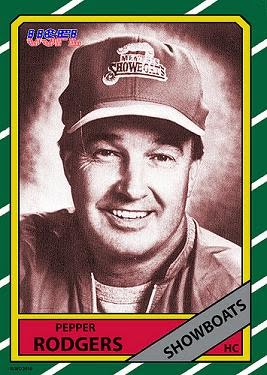

While there was jubilation among the Renegades and their fans, an angry Coach Pepper Rodgers and GM Steve Ehrhart of the Showboats locked the locker room door, refusing to admit reporters after the game in violation of USFL rules. The club’s PR director appeared with a statement from Rodgers that read, “To say that I'm disappointed is the understatement of the year. This is undoubtedly one of the low points of the season for the.Showboats.”

It was the fourth straight loss for Memphis after a 3-0 start. They recovered to end up at 11-7 for third place in the Eastern Conference and qualified for the postseason – after dismantling the Denver Gold by a score of 48-7 in the Quarterfinal round, they lost to the Oakland Invaders in the Semifinal game. Orlando continued to improve, at least offensively (the defense gave up a league-high 481 points), and went 5-7 after the 0-6 start, which still left them in the Eastern Conference basement with a record of 5-13.

Third-year QB Reggie Collier, as he did decisively against Memphis, continued to make the most of his mobility by running for 606 yards on 92 carries (6.6 avg.) with 12 touchdowns. His passing statistics were less impressive as he was successful on 53.6 percent of his passes for 2578 yards with 13 touchdowns and 16 interceptions.

April 3, 2011

MVP Profile: Ken Anderson, 1981

Quarterback, Cincinnati Bengals


Age: 32
11th season in pro football & with Bengals
College: Augustana (Illinois)
Height: 6’2” Weight: 212

Prelude:
Anderson was chosen by the Bengals in the third round of the 1971 NFL draft, despite coming from a small college, and took over as starting quarterback in his second season. Mobile and intelligent, he also adapted well to QB coach Bill Walsh’s early version of the West Coast passing attack with short timing passes. Anderson led the NFL in passing, passing yards, and yards per attempt in 1974 and ’75, as well as completion percentage in ’74, and was selected to the Pro Bowl in 1975 and ’76. The team regularly contended during that period, but through coaching changes and attrition, the Bengals slumped later in the decade and Anderson, who also battled injuries, even briefly lost his job during the 1980 season.

1981 Season Summary
Appeared and started in all 16 games
[Bracketed numbers indicate league rank in Top 20]

Passing
Attempts – 479 [9]
Most attempts, game – 52 at Houston 10/4
Completions – 300 [5]
Most completions, game – 30 at Houston 10/4
Yards – 3754 [5]
Most yards, game – 396 vs. Denver 11/22
Completion percentage – 62.6 [2, 1st in AFC]
Yards per attempt – 7.8 [6]
TD passes – 29 [3]
Most TD passes, game – 4 at Cleveland 11/29
Interceptions – 10
Most interceptions, game – 2 vs. Seattle 9/6, vs. San Francisco 12/6
Passer rating – 98.4 [1]
300-yard passing games – 3
200-yard passing games – 12

Rushing
Attempts – 46
Most attempts, game - 8 (for 37 yds.) at Pittsburgh 12/13
Yards – 320
Most yards, game – 58 yards (on 4 carries) vs. LA Rams 11/15
Average gain – 7.0
TDs – 1

Scoring
TDs – 1
Points - 6

Postseason: 3 G
Pass attempts – 77
Most pass attempts, game – 34 vs. San Francisco, Super Bowl
Pass completions – 53
Most pass completions, game – 25 vs. San Francisco, Super Bowl
Passing yardage – 653
Most passing yards, game – 300 vs. San Francisco, Super Bowl
TD passes – 5
Most TD passes, game – 2 vs. San Diego, AFC Championship, vs. San Francisco, Super Bowl
Interceptions – 2
Most interceptions, game – 2 vs. San Francisco, Super Bowl

Rushing attempts – 11
Most rushing attempts, game – 5 vs. San Diego, AFC Championship
Rushing yards – 69
Most rushing yards, game – 39 vs. San Diego, AFC Championship
Average gain rushing – 6.3
Rushing TDs – 1

Awards & Honors:
NFL MVP: AP, PFWA, NEA, Bert Bell Award, Sporting News
NFL Offensive Player of the Year: AP
1st team All-NFL: AP, PFW, NEA, Pro Football Weekly, Sporting News
1st team All-AFC: UPI, Pro Football Weekly
Pro Bowl

Bengals went 12-4 to win AFC Central with best record in conference. Won Divisional playoff over Buffalo Bills (28-21) and AFC Championship over San Diego Chargers (27-7). Lost to San Francisco 49ers in Super Bowl (26-21).

Aftermath:
Anderson again led the NFL in passing during the strike-shortened 1982 season (95.3) and completed a then-record 70.6 % of his passes. He led the league once more in completion percentage in ’83 (66.7) but after one last year as the starting quarterback, he backed up Boomer Esiason in 1985 and ’86, his last two seasons, all spent with the Bengals.

--

MVP Profiles feature players who were named MVP or Player of the Year in the NFL, AAFC (1946-49), AFL (1960-69), WFL (1974), or USFL (1983-85) by a recognized organization (Associated Press, Pro Football Writers Association, Newspaper Enterprise Association, United Press International, The Sporting News, Maxwell Club – Bert Bell Award, or the league itself).

[Updated 2/15/14]
[Updated 11/28/14]

April 2, 2011

1983: Luther Bradley Intercepts 6 Passes as Chicago Routs Bandits


Luther Bradley had been a first round draft choice of the Detroit Lions out of Notre Dame in 1978 and played cornerback for the Lions without much distinction. Getting a new chance in the United States Football League, the 27-year-old joined the Chicago Blitz and was moved to free safety by Head Coach George Allen. The change of position paid off, and on April 2, 1983 Bradley had a record-breaking performance.

The Blitz had gotten off to a slower-than-expected start in the USFL’s inaugural 1983 season and the veteran-laden club was 2-2 coming into the game against the Tampa Bay Bandits. By contrast, the Bandits, coached by Steve Spurrier, were undefeated at 4-0 and were especially adept at the passing game with veteran QB John Reaves.

There were 46,585 fans at Tampa Stadium for the Saturday night contest, even though there had been heavy rain up until kickoff. Chicago got off to a quick start. In the first possession of the game, the Blitz went 69 yards in six plays, capped by a 45-yard TD pass from veteran QB Greg Landry to WR Trumaine Johnson. Bradley intercepted a pass in the first quarter and the score remained 7-0 after one period.

Early in the second quarter, Chicago’s John Roveto had a 37-yard field goal attempt blocked. The Bandits turned that into a score as Zenon Andrusyshyn kicked a 32-yard field goal that cut the Blitz’s lead to 7-3. It was the high point of the game for the Bandits.

Bradley’s second interception gave Chicago the ball at the Tampa Bay 27 with 4:17 remaining in the half and set up a touchdown. It took four plays to score, including a swing pass from Landry to rookie RB Tim Spencer that covered 23 yards. FB Kevin Long leaped into the end zone from a yard out to make it 14-3 in favor of the Blitz at halftime.

Landry suffered a bruised shoulder when sacked on the final play of the first half but was back for the second half. Chicago proceeded to put the game away with a 21-point third quarter, moving quickly downfield on the first possession of the half. WR Lenny Willis returned the second-half kickoff 32 yards to the Chicago 43. Landry threw to Johnson for a 52-yard gain and then a five-yard touchdown for a 21-3 lead at just over a minute into the period.

The Bandits appeared on the verge of getting back into the game six minutes later as they drove to the Chicago 11, where they faced a second-and-nine situation. However, in the pivotal play of the game, Reaves overthrew his receiver across the middle and Bradley intercepted, returning it 93 yards for a touchdown and 28-3 margin.

Landry ran for a four-yard touchdown to finish off the third quarter scoring, and left the game midway through the final period staked to a safe 35-3 lead. Bradley intercepted a fourth pass, which tied the still-existing NFL record, but was not done. John Reaves was, however, as Spurrier pulled him late in the third quarter and replaced him with rookie Jimmy Jordan.

Bradley, who had intercepted Reaves four times, picked off Jordan twice in the last period to finish up with an incredible six interceptions – all the more amazing when considering that, with the outcome long decided, he sat out the last eight minutes of the game.

Chicago’s rookie QB Tim Koegel led the team on a final 31-yard scoring drive in the fourth quarter. HB Jim Stone ran eight yards for the TD that provided the final margin of 42-3.

In addition to Bradley, DE Junior Ah-You, previously a star in the CFL, had an outstanding performance, as did the defense as a whole. The Bandits were held to 35 rushing yards on 22 attempts and 265 yards overall while Chicago gained a total of 383. The Blitz also had the advantage in first downs (21 to 14) and time of possession (32:06 to 27:54).

Greg Landry completed 19 of 26 passes for Chicago, gaining 277 yards with two touchdowns and no interceptions. Star rookie Trumaine Johnson caught 7 passes for 146 yards and both TDs. The other key rookie on offense, Tim Spencer, led the ground attack with 42 yards on 14 carries while former Cowboy Doug Dennison added 29 yards on 8 attempts and Kevin Long also ran the ball 8 times, for 26 yards. Luther Bradley accumulated 127 return yards on his 6 interceptions, with the one long TD and one that set up another score.

For the Bandits, John Reaves had an uncharacteristically bad day, going to the air 29 times with just 12 completions for 180 yards, and of course four of his passes were picked off by Bradley while none resulted in touchdowns. In relief, Jimmy Jordan was successful on 6 of 12 throws for 72 yards and two more Bradley interceptions. RB Sam Platt caught 5 passes for 35 yards and WR Danny Buggs had the most receiving yards with 64 on his two receptions.

Naturally, most of the talk afterward was about Luther Bradley’s stunning performance. “Luther is a natural centerfielder and should have been playing free safety all along,” said George Allen. Bradley went on to lead the USFL with 12 interceptions in ’83 and was selected to the All-League team.

The win pulled the Blitz (3-2) to a game behind Tampa Bay (4-1). Ultimately, Chicago came out ahead with a 12-6 record and a wild card spot in the playoffs (they lost in the Semifinal round to the Philadelphia Stars). The Bandits were third in the Central Division at 11-7 and just missed the postseason.

April 1, 2011

Past Venue: Fenway Park

Boston, MA


Year opened: 1912
Capacity: 37,400, was 33,375 when Patriots played there

Names:
Fenway Park, 1912 to date

Pro football tenants:
Boston Bulldogs (AFL), 1926
Boston Redskins (NFL), 1933-36
Boston Shamrocks (AFL), 1936-37
Boston Bears (AFL), 1940
Boston Yanks (NFL), 1944-48
Boston Patriots (AFL), 1963-68

Postseason games hosted:
None

Other tenants of note:
Boston Red Sox (MLB – AL), 1912 to date
Boston Braves (MLB – NL), 1914-15
Boston Beacons (NASL), 1968

Notes: Both the Boston Bulldogs and Boston Shamrocks split their home games between Fenway Park and Braves Field. Stadium occasionally hosted college football games for Dartmouth College, Boston College, and Boston University. Hosted NHL Winter Classic, Jan. 1, 2010.

Fate: Still in use

March 31, 2011

1964: Eagles Trade Sonny Jurgensen to Redskins for Norm Snead


Following the 1963 NFL season, the Philadelphia Eagles began a transformation under a new owner, Jerry Wolman, and a new head coach/GM, Joe Kuharich. Having finished at the bottom of the Eastern Conference in both 1962 and ’63, Kuharich decided that a housecleaning was in order. The first major deal was the trade of popular star flanker Tommy McDonald to the Dallas Cowboys for a kicker and two backup linemen. If that wasn’t enough to shock Eagles fans, on March 31, 1964 he swung an even more significant trade, sending QB Sonny Jurgensen and CB Jimmy Carr to the Washington Redskins for QB Norm Snead and CB Claude Crabb.

Kuharich justified the deal by indicating that he was trading for youth - Snead and Crabb were 24, while Jurgensen was 29 and Carr was 31. Head Coach Bill McPeak of the Redskins looked at it from the other side. “Winning in 1964 is imperative. Jurgensen, at this stage of his career, is more advanced than Snead, and I think, with the right supporting cast, he can take you all the way.”

The 6’0”, 200-pound Jurgensen (pictured above) had been drafted by the Eagles out of Duke in the fourth round in 1957. After a promising rookie season, he sat on the bench for three years backing up veteran QB Norm Van Brocklin, who was obtained from the Rams in ’58. Van Brocklin led Philadelphia to the 1960 title and retired, and Jurgensen was thrust into the starting lineup. He responded with an outstanding season in 1961, setting a new NFL record for passing yards (3723) and also leading the league in touchdown passes (32). The Eagles nearly repeated as Eastern Conference champions, finishing a close second to the Giants.

However, in the ensuing Playoff Bowl against the Western Conference’s second-place team, the Detroit Lions, Jurgensen suffered a severe shoulder separation that hindered his performance the next season (and even beyond). While he again led the NFL with 3261 passing yards, he also threw a league-high 26 interceptions (as opposed to 22 TDs). The team was riddled by injuries and plummeted to the bottom with a 3-10-1 record. Jurgensen began to hear the boos from the disgruntled fans at Franklin Field.

During 1963 training camp, Jurgensen and backup QB King Hill walked out in a joint contract holdout. The dispute was resolved in short order by GM Vince McNally, but not without rancor, and Jurgensen hardly endeared himself to the organization. During the regular season, injuries limited him to nine games for the 2-10-2 club, and he threw for only 1413 yards with 11 touchdowns against 13 interceptions.

Still, dealing Jurgensen came as a surprise to fans, as well as to him - “I talked to Kuharich 10 days ago and we talked about a lot of things but he didn’t mention the trade or any other trade,” said the quarterback immediately after the deal was announced. “Sure, I was surprised.” (it was reported that he was first offered to the Vikings for Fran Tarkenton, but Van Brocklin, now coach in Minnesota, vetoed the trade). Jurgensen was considered one of the best pure passers in the NFL, with a strong and accurate arm. But while a flashy and exciting competitor, he also was known as an off-field carouser during his years in Philadelphia (he joked that “when I left Philadelphia, all the bartenders wore black armbands”).

The less colorful Norm Snead had been drafted by the Redskins in the first round in 1961 and started every game of his rookie season. At 6’4” and 215 pounds, and with a strong arm, he had the tools, but Washington was a dreadful team that ended up at the bottom with a 1-12-1 record – they only avoided a winless season by beating the second-year Dallas Cowboys in the finale.

While Snead took plenty of lumps, he also received credit as a rising talent. When the Redskins got off to a 4-0-2 start in 1962, he and flanker Bobby Mitchell, the ex-Cleveland halfback who had been obtained during the offseason, were the talk of the league. But the Giants exposed Washington’s weak pass defense in a 49-34 pounding at Yankee Stadium, Mitchell was slowed by an injury as well as increased coverage by defenses, and the Redskins finished at 5-7-2. The whispers were already beginning that the young quarterback didn’t seem to be improving, and the talk became louder (as well as boos from the fans) when the club went 3-11 in ’63 and Snead tossed a league-leading 27 interceptions.

As for the defensive backs that were almost afterthoughts in the trade, Carr had been with the Eagles since 1959, had started during the 1960 championship season, but was on the downside of his career (he lasted two years with the Redskins before retiring). In two years with the Redskins, Crabb, who had been a fullback and linebacker in college at Colorado, intercepted 9 passes, but was part of a much-maligned defensive backfield in Washington. Like Carr, he played two undistinguished years for the Eagles before departing for the Rams, where he lasted for three seasons in a reserve role.

Jurgensen played in Washington for 11 years, finally retiring at age 40 following the 1974 season. Along the way, he led the NFL in passing once, in passing yards three times (breaking his own record with 3747 yards in 1967), and completion percentage twice. He was a consensus first-team All-Pro selection in 1969 and was named to the Pro Bowl four times.

The Redskins were a mediocre team during his prime, however. While Bill McPeak might have hoped that Jurgensen would immediately lift the team to a winning record, Washington went 6-8 in both 1964 and ’65 and he was let go. Otto Graham, a former all-time great quarterback in his own right with the Browns, emphasized the passing game in three years as head coach that produced an overall 17-22-3 record. The arrival of Vince Lombardi in 1969 brought improvement (and Jurgensen responded with an outstanding year), with the team posting a 7-5-2 tally. However, Lombardi’s tenure was cut short when the legendary coach died of cancer just prior to the 1970 season – the last in which Jurgensen was the full-time starter. The Redskins were 6-8 under Bill Austin.

Washington’s fortunes improved with the coming of George Allen as head coach/GM in 1971, but it was Bill Kilmer primarily lining up behind center, not the increasingly-brittle Jurgensen. Still, the team went 10-2 in games that Jurgensen started during his last four years, a sign that he played well even if no longer often. At the time of his retirement, the paunchy redhead was the top-rated passer in NFL history - he was inducted into the Pro Football Hall of Fame in 1983.


As for Norm Snead (pictured at left) and the Eagles, the road was far more rocky. After a fair year for a 6-8 club in 1964, Snead had a good season in 1965, passing for 2346 yards with 15 touchdowns and 13 interceptions, and earned selection to the Pro Bowl. He had his most productive statistical season in 1967, passing for 3399 yards and 29 TDs (as well as 24 interceptions). However, in between, he had a dreadful year in 1966 and was benched in favor of backups King Hill and Jack Concannon during the last month of the season – the Eagles finished 9-5 that year, their only winning record during Snead’s tenure with the team.

Following the big performance in 1967, Snead broke his leg in the first 1968 preseason game and returned to the starting lineup four weeks into a disastrous 2-12 campaign. Despite his late start, Snead led the NFL by being picked off 21 times. A new owner (Leonard Tose) fired Kuharich in favor of Jerry Williams, but Snead remained and the result was much the same as he again led the league in throwing interceptions (23).

After one more mediocre year in 1970, he was dealt to the Minnesota Vikings, where he split time with Gary Cuozzo in ‘71. It was on to the New York Giants in 1972, in the trade that brought Fran Tarkenton back to Minnesota. Snead led the NFC in passing for the 8-6 Giants, but fell back into his old ways, tossing a league-leading 22 interceptions against just seven TD passes in 1973. Midway through the ’74 season, he was traded once again, to the 49ers, and eventually returned to the Giants as a backup for his final season of 1976.

Lacking Sonny Jurgensen’s quick release and ability to read defenses, Snead was prone to making poor decisions that, as the record indicates, resulted in far too many interceptions. His lack of mobility also caused him to be sacked many times, and he was not a strong leader. He was relentlessly maligned by the frustrated Eagles fans and, during his time in Philadelphia, lived in the shadow of Jurgensen; as if it were not enough, in games between the Eagles and Redskins with Snead and Jurgensen facing off, Washington went 9-2-2 (the Eagles won a game against the Redskins in 1966 with King Hill at quarterback).

March 30, 2011

MVP Profile: Johnny Unitas, 1957

Quarterback, Baltimore Colts


Age: 24
2nd season in pro football & with Colts
College: Louisville
Height: 6’1” Weight: 190

Prelude:
Unitas was chosen in the 9th round of the 1955 NFL draft by the Steelers, but failed to make the team in the preseason. After playing semi-pro football, he was signed by the Colts to back up starting QB George Shaw. When Shaw went down with a broken kneecap four games into the ’56 season, Unitas got his chance, showed potential, and held onto the job.

1957 Season Summary
Appeared in all 12 games
[Bracketed numbers indicate league rank in Top 20]

Passing
Attempts – 301 [1]
Most attempts, game – 37 at San Francisco 12/8
Completions – 172 [2]
Most completions, game – 23 at San Francisco 12/8
Yards – 2550 [1]
Most yards, game – 296 at San Francisco 12/8
Completion percentage – 57.1 [3]
Yards per attempt – 8.5 [2]
TD passes – 24 [1]
Most TD passes, game – 4 vs. Detroit 9/29, at Detroit 10/20
Interceptions – 17 [2]
Most interceptions, game – 3 vs. Detroit 9/29, vs. Pittsburgh 11/3
Passer rating – 88.0 [1](Ranked 3rd in system used at time)
200-yard passing games – 8

Rushing
Attempts – 42
Yards – 171
Yards per attempt – 3.5
TDs – 1

Scoring
TDs – 1
Points – 6

Awards & Honors:
NFL MVP: NEA
1st team All-NFL: NEA
2nd team All-NFL: AP, UPI, NY Daily News
Pro Bowl

The Colts went 7-5 to finish third in the NFL Western Conference, contending throughout the season but finishing a game behind the leaders after losing their last two games on the West Coast.

Aftermath:
The 1957 breakout season was just the beginning for Unitas. He led the Colts to back-to-back championships in 1958 and ’59, the first culminating in a sudden death classic against the Giants. Unitas was an outstanding play-caller as well as passer with a quick release and adept at throwing long, short, or in between. His 1957 season was part of a record 47-straight-game TD passing streak that ended in 1960. Unitas passed for 40,239 yards and 290 touchdowns in a career that extended until 1973. He was an MVP three more times, was named to 10 Pro Bowls, and selected to the NFL’s 75th Anniversary All-Time team. Unitas had his #19 retired by the Colts and was inducted into the Pro Football Hall of Fame, Class of 1979.

--

MVP Profiles feature players who were named MVP or Player of the Year in the NFL, AAFC (1946-49), AFL (1960-69), WFL (1974), or USFL (1983-85) by a recognized organization (Associated Press, Pro Football Writers Association, Newspaper Enterprise Association, United Press International, The Sporting News, Maxwell Club – Bert Bell Award, or the league itself).

[Updated 2/15/14]

March 29, 2011

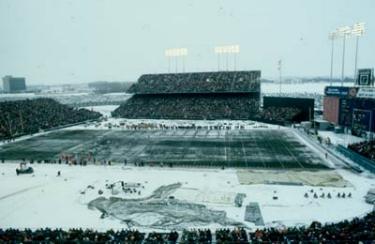
Past Venue: Metropolitan Stadium

Bloomington, MN


Year opened: 1956
Capacity: 48,446, up from 18,000 at opening

Names:
Metropolitan Stadium, 1956-85

Pro football tenants:
Minnesota Vikings (NFL), 1961-81

Postseason games hosted:
NFL Western Conf. Championship, Vikings 23 Rams 20, Dec. 27, 1969
NFL Championship, Vikings 27 Browns 7, Jan. 4, 1970
NFC Divisional playoff, 49ers 17 Vikings 14, Dec. 27, 1970
NFC Divisional playoff, Cowboys 20 Vikings 12, Dec. 25, 1971
NFC Divisional playoff, Vikings 27 Redskins 20, Dec. 22, 1973
NFC Divisional playoff, Vikings 30 Cardinals 14, Dec. 21, 1974
NFC Championship, Vikings 14 Rams 10, Dec. 29, 1974
NFC Divisional playoff, Cowboys 17 Vikings 14, Dec. 28, 1975
NFC Divisional playoff, Vikings 35 Redskins 20, Dec. 18, 1976
NFC Championship, Vikings 24 Rams 13, Dec. 26, 1976

Other tenants of note:
Minneapolis Millers (minor league baseball), 1956-60
Minnesota Twins (MLB – AL), 1961-81
Minnesota Kicks (NASL), 1976-81

Notes: The NFL’s Chicago Cardinals hosted two regular season games at the stadium in 1959 and there were five NFL preseason games played there from 1956-60, prior to the debut of the Vikings. First pro football game held at stadium was a preseason game between the Steelers and Eagles on Sept. 15, 1956.

Fate: Demolished in 1985, the site is now occupied by the Mall of America.