April 28, 2011

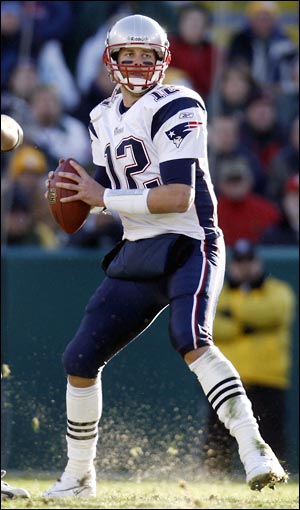
MVP Profile: Tom Brady, 2007

Quarterback, New England Patriots


Age: 30
8th season in pro football & with Patriots
College: Michigan
Height: 6’4” Weight: 225

Prelude:
A lightly-regarded sixth-round draft choice by New England in 2000, Brady got his chance when starting QB Drew Bledsoe was injured in the second game of the ’01 season. With the young quarterback showing surprising poise and leadership ability, the team surged in the second half and ended up with a stunning win over the St. Louis Rams in the Super Bowl. Brady was selected to the Pro Bowl, as he also would be in 2004 and ‘05. The Patriots won two more championships over the next three seasons, and he led the NFL with 28 TD passes in 2002. Brady also led the league with 4110 yards passing in 2005.

2007 Season Summary
Appeared and started in all 16 games
[Bracketed numbers indicate league rank in Top 20]

Passing
Attempts – 578 [2]
Most attempts, game – 54 vs. Philadelphia 11/25
Completions – 398 [2]
Most completions, game – 34 vs. Philadelphia 11/25
Yards – 4806 [1]
Most yards, game – 399 vs. Pittsburgh 12/9
Completion percentage – 68.9 [1]
Yards per attempt – 8.3 [1]
TD passes – 50 [1]
Most TD passes, game – 6 at Miami 10/21
Interceptions – 8
Most interceptions, game – 2 at Indianapolis 11/4, vs. Miami 12/23
Passer rating – 117.2 [1]
300-yard passing games – 8
200-yard passing games – 15

Rushing
Attempts – 37
Most attempts, game - 5 (for 14 yds.) at Indianapolis 11/4
Yards – 98
Most yards, game – 16 yards (on 3 carries) vs. Philadelphia 11/25
Yards per attempt – 2.6
TDs – 2

Scoring
TDs – 2
Points - 12

Postseason: 3 G
Pass attempts – 109
Most attempts, game - 48 vs. NY Giants, Super Bowl
Pass completions – 77
Most completions, game - 29 vs. NY Giants, Super Bowl
Passing yardage – 737
Most yards, game - 266 vs. NY Giants, Super Bowl
TD passes – 6
Most TD passes, game - 3 vs. Jacksonville, AFC Divisional playoff
Interceptions – 3
Most interceptions, game - 3 vs. San Diego, AFC Championship

Rushing attempts – 4
Most rushing attempts, game – 2 (for 1 yd.) vs. Jacksonville, AFC Divisional playoff, (for -2 yds.) vs. San Diego, AFC Championship
Rushing yards – -1
Most rushing yards, game - 1 vs. Jacksonville, AFC Divisional playoff
Average gain rushing – -0.3
Rushing TDs – 0

Awards & Honors:
NFL MVP: AP, PFWA, NEA, Bert Bell Award, Sporting News
NFL Offensive Player of the Year: AP
1st team All-NFL: AP, PFWA, Sporting News
Pro Bowl

Patriots went 16-0 to win the AFC East and complete the first undefeated regular season in the NFL since 1972. The team also paced the NFL in points (589), touchdowns (75), total yards (6580), and passing yards (4731). Won Divisional playoff over Jacksonville Jaguars (31-20) and AFC Championship over San Diego Chargers (21-12). Lost Super Bowl to New York Giants (17-14).

Aftermath:
Brady’s 2008 season ended prematurely due to a knee injury in the opening game. He came back to throw for 4398 yards and 28 TDs in 2009 and had another MVP season in 2010, in which he led the NFL in passing (111.0 rating) and TD passes (36). Brady was selected to the Pro Bowl in both 2009 and ’10.

--

MVP Profiles feature players who were named MVP or Player of the Year in the NFL, AAFC (1946-49), AFL (1960-69), WFL (1974), or USFL (1983-85) by a recognized organization (Associated Press, Pro Football Writers Association, Newspaper Enterprise Association, United Press International, The Sporting News, Maxwell Club – Bert Bell Award, or the league itself).

[Updated 2/15/14]

April 27, 2011

1982: Forced to Settle, Eagles Draft Mike Quick in First Round


With the 20th pick in the first round of the NFL draft on April 27, 1982, the Philadelphia Eagles were looking to take a wide receiver. There were a few who were considered likely first round choices, and the Eagles were most interested in Perry Tuttle out of Clemson.

The Kansas City Chiefs snagged WR Anthony Hancock of Tennessee with the 11th pick. New Orleans took Georgia WR Lindsay Scott two choices later. It appeared that Tuttle would be available, but the Broncos, just ahead of Philadelphia in the 19th spot, traded the choice to Buffalo, and the Bills used it to take Tuttle.

Head Coach Dick Vermeil and the Eagles staff, disappointed at losing out on Tuttle, settled on WR Mike Quick from North Carolina State. To be sure, Quick had size (6’2”, 185 pounds) and was known as a good blocker, but was considered too slow.

“We actually were ready to pick Tuttle, but Denver made that trade and Buffalo got him,”
Vermeil said. “We are satisfied. We rated him (Quick) the third best wide receiver in the draft.”

“He's a big kid, very tough, and mature,” Vermeil added. “I think he can come in the first year and make a contribution.”

The contribution did not come quite so soon as Quick had a quiet rookie year in the strike-shortened ’82 season, catching 10 passes for 156 yards and a touchdown while playing behind the 33-year-old veteran Harold Carmichael and Ron Smith. The Eagles, who had gone to the Super Bowl two years before, suffered through a difficult 3-6 campaign and Vermeil resigned afterward.

It was a very different story for Quick in 1983, as he moved into the starting lineup across from Carmichael. He caught 69 passes for a league-leading 1409 yards and 13 touchdowns, and was a consensus first-team All-Pro as well as Pro Bowl selection. He had six 100-yard receiving games, including four straight early in the season. What he lacked in speed, Quick made up for in his ability to catch in traffic and run well after getting the ball. The young wide receiver’s performance was a highlight for a team that lost nine of its last 10 games to finish at 5-11 while also embroiled in front office instability.

Better things were hoped for in 1984, especially with the aging Carmichael let go to make room for another first round wide receiver, Kenny Jackson of Penn State. However, both receivers encountered injury problems, although Quick recovered to grab 61 passes for 1052 yards and nine touchdowns. Jackson, who failed to live up to expectations, had just 26 catches for 398 yards and a TD.

The Eagles were a losing team from 1983 to ‘87, but Quick continued to perform well. During that period, he scored more touchdowns (53) than any other NFL receiver and had the third-most receiving yards (5437). He went to five consecutive Pro Bowls and was again a consensus first-team All-NFL selection in 1985. The league-leading yardage total of ’83 remained his career high, but was the first of three straight thousand-yard receiving totals for Quick, who caught a career-high 73 passes in ’85. His 99-yard touchdown on a slant pass from QB Ron Jaworski in 1985 tied the unbreakable NFL record and won a game against the Falcons in overtime.

Unfortunately, at the point that the Eagles were beginning to develop into a winning team again under Head Coach Buddy Ryan, Quick suffered injuries that greatly hindered his performance and ultimately forced his retirement following the 1990 season.

Five weeks into the ’88 season, in the process of making a difficult catch against the Houston Oilers, Quick suffered a broken leg that sidelined him for eight weeks. In 1989, a knee injury in the sixth game finished him for the year. In his last season, he appeared in just four games and caught 9 passes for 135 yards and one last touchdown.

Over the course of his career, Quick easily justified his first round selection in 1982. He caught a total of 363 passes for 6464 yards (17.8 avg.) and 61 TDs.

As for the receivers chosen ahead of Quick in ’82, Anthony Hancock lasted five years, returned kicks, and caught a total of 73 passes for 1266 yards and five touchdowns. Lindsay Scott stayed with the Saints for four seasons and ended up with 69 receptions for 864 yards and a score. Perry Tuttle, the receiver the Eagles had really wanted, played for three years and had 25 catches for 375 yards and three TDs.

The player that the Eagles had settled on in the first round proved far better than those rated higher at his position – one of many examples of the surprises that regularly occur in the NFL draft process.

April 25, 2011

Past Venue: Forbes Field

Pittsburgh, PA


Year opened: 1909
Capacity: 41,000, up from 23,000 at opening

Names:
Forbes Field, 1909-71

Pro football tenants:
Pittsburgh Pirates/Steelers (NFL), 1933-63
Pittsburgh Americans (AFL), 1936-37

Postseason games hosted:
NFL Eastern Division playoff, Eagles 21 Steelers 0, Dec. 21, 1947

Other tenants of note:
Pittsburgh Pirates (MLB – NL), 1909-70
University of Pittsburgh (college football), 1909-24
Homestead Grays (baseball Negro Leagues), 1922-39
Pittsburgh Phantoms (NPSL), 1967

Notes: Hosted some home games of combined Phil-Pitt team (“Steagles”, 1943) and Card-Pitt team (1944). The Steelers began splitting home games between Forbes Field and the Univ. of Pittsburgh’s Pitt Stadium in 1958 before moving to Pitt Stadium exclusively in 1964. Stadium was bought by Univ. of Pittsburgh in 1958, with university agreeing to lease to the Pirates until a new stadium was built.

Fate: Demolished in 1971, the site contains the Forbes Quadrangle, a library and dormitories for the Univ. of Pittsburgh. Home plate remains on display in its exact location in what is now first floor walkway of Forbes Quadrangle and a portion of the left field wall still stands.

April 24, 2011

1987: Bucs Trade Steve Young to 49ers


Coming off of a second straight 2-14 record in 1986, the Tampa Bay Buccaneers had the first overall choice in the NFL draft and came to terms with QB Vinny Testaverde, the Heisman Trophy-winner out of the University of Miami, ahead of time. Three weeks later, on April 24, 1987, with the draft coming up in a matter of days, the Bucs traded QB Steve Young to the San Francisco 49ers for two picks (second and fourth round) and an unspecified amount of cash (reportedly enough to cover Young’s 1985 signing bonus).

The southpaw Young had been a college star in his own right at Brigham Young (he was a direct descendant of the namesake) and signed a huge 10-year, $40 million contract to play for the Los Angeles Express in the United States Football League. He played well for a mediocre team, and with the USFL on hiatus following the spring ’85 season, bought himself out of the big contract. Two days into the 1985 NFL season, he joined the Buccaneers, who had taken him in the first round of the ’84 supplemental draft.

After quarterbacking a subpar USFL team, Young found himself in an even worse situation in Tampa Bay. He took over for the veteran Steve DeBerg as the starting QB after the team got off to a 1-10 start in ’85 and completed 52.2 percent of his passes for 935 yards with three touchdowns and eight interceptions. With his outstanding mobility, Young also rushed for 233 yards and a TD on 40 carries (5.8 avg.). In his third start at Minnesota, he had a rough outing, completing just 13 of 32 passes, three of which were intercepted. But he passed for over 200 yards in each of the last two games, including 277 in a three-point loss to the Packers (his high with the Bucs).

Young lost the starting job back to DeBerg during the ’86 preseason but got it back after the veteran tossed nine interceptions in the first two regular season games. He had five 200-yard passing performances, was never intercepted more than twice in any contest, and ran for two touchdowns in a win over Buffalo. In all, Young started 19 games in two seasons with Tampa Bay, completing 267 of 501 passes for 3217 yards and 11 touchdowns, as opposed to 21 interceptions. He also ran the ball 114 times for 658 yards and six touchdowns. The team went just 3-16 in his starts, but there were far too many weaknesses on the club that the promising young quarterback couldn’t overcome.

Meanwhile, the 49ers were looking for someone to back up star QB Joe Montana, who would be 31 years old by the start of the ’87 season and had been sidelined for part of 1986 with a back injury that required surgery. While he amazingly missed only eight weeks, his passes lacked the usual velocity when he came back, his running ability was hindered, and he was knocked out of a playoff loss to the Giants with a concussion.

“We think that Steve's style of play will fit into our system and he will be able to display his vast talents,” San Francisco Head Coach Bill Walsh said. “This move is not a reflection on Joe Montana. We fully expect Joe to continue as the leader and mainstay of our team,” Walsh added.

“I'm pretty excited,” Young said in reaction to the deal. “There are a lot of plusses for me. First, playing in the city itself. The town's 49er-crazy. And playing for Coach Walsh. He's obviously a genius in coaching quarterbacks. Being around a legend
like Joe Montana will help me.”

For the next four years, those initial sentiments were tested as an increasingly-impatient Young backed up Montana, who returned to form and led San Francisco to back-to-back NFL titles in 1988 and ’89. He did get to start ten games, and the talented 49ers went 7-3 under Young’s direction. Young threw 23 touchdowns to just six interceptions during that period, and his spectacular 49-yard touchdown carry that pulled out a win over the Vikings in a 1988 contest not only became an often-replayed highlight, but served as a reminder of the outstanding running ability that complemented his passing.

Following an injury to Montana in the 1990 postseason that required surgery and effectively kept him off the field for the next two seasons, Young got his chance to start regularly. There were questions about his discipline in the pocket and whether he fit in San Francisco’s offensive scheme, and he missed time due to injury. The club went just 5-5 during his starts in ‘91 (as opposed to 5-1 under backup Steve Bono), but Young won his first NFL passing title with a 101.8 rating.

It was the first of four straight passing championships, and six in seven years, and Young received NFL MVP recognition in both 1992 and ’94 while also garnering selection to seven consecutive Pro Bowls from ’92 to ’98. The 49ers also won the Super Bowl following the 1994 season, thus relieving him of the inevitable pressure that came with succeeding Montana and his four championships. There was tumult and retooling along the way, but Young rose to the occasion as he also displayed toughness, such as overcoming a broken thumb early in ’93 that hindered his performance. He played until the 1999 season and retired with a 96.8 career passer rating (101.4 in 13 years with the Niners) and 4239 rushing yards in the NFL. In 2005, he joined Montana (who finished out his career in Kansas City) as a member of the Pro Football Hall of Fame.

Vinny Testaverde had a far more difficult time in Tampa Bay, lasting six seasons before being dealt to Cleveland and throwing 112 interceptions (twice leading the league in that category) as opposed to 77 TDs. He would go on to play a total of 21 years in the NFL, and while he often showed off the ability that made him a first-overall draft choice, he also remained inconsistent and pickoff-prone.

The two draft picks obtained from the 49ers were used to take LB Winston Moss from Miami and Arizona State WR Bruce Hill. Moss moved into the starting lineup during his rookie season and stayed there for four years before moving on to the Raiders. Hill played five years, all with the Bucs, and caught 58 passes for 1040 yards and nine touchdowns in 1988. He worked out well in combination with another 1987 rookie, WR Mark Carrier, but tended to drop too many passes and his numbers progressively diminished after his good second season.

The 49ers had been strong throughout the decade of the 1980s and would remain so with Young at the helm in the ‘90s. Tampa Bay continued to flounder, despite the efforts of coaches, including Ray Perkins (newly arrived in 1987, who traded Young and made other deals in an effort to stockpile draft choices), to turn the franchise around. It would not be until the arrival of Tony Dungy as head coach in 1996 that the team’s fortunes would begin to change for the better.

April 23, 2011

MVP Profile: Thurman Thomas, 1991

Running Back, Buffalo Bills


Age: 25
4th season in pro football & with Bills
College: Oklahoma State
Height: 5’10” Weight: 198

Prelude:
Drafted in the second round by Buffalo in 1988, Thomas led the NFL in total yardage in 1989 and ’90 (as he would in 1991), had over 1200 yards rushing (1244 & 1297), and was named to the Pro Bowl in both seasons as well. He also had a high of 60 catches for 669 yards in 1989. Thomas was a consensus first-team All-Pro in 1990 and performed well in the narrow Super Bowl loss to the Giants following that season.

1991 Season Summary
Appeared and started in 15 of 16 games
[Bracketed numbers indicate league rank in Top 20]

Rushing
Attempts – 288 [3]
Most attempts, game - 32 (for 126 yds.) vs. New England 11/3
Yards – 1407 [3, 1st in AFC]
Most yards, game – 165 yards (on 25 carries) vs. Miami 9/1
Average gain – 4.9 [3]
TDs – 7 [12, tied with Reggie Cobb & Vince Workman]
100-yard rushing games - 8

Pass Receiving
Receptions – 62
Most receptions, game – 13 (for 112 yds.) at NY Jets 9/15
Yards – 631
Most yards, game - 112 (on 13 catches) at NY Jets 9/15
Average gain – 10.2
TDs – 5
100-yard receiving games - 2

All-purpose yards - 2038 [1]

Scoring
TDs – 12 [4, tied with Mark Clayton & Andre Rison]
Points – 72

Postseason: 3 G
Rushing attempts – 58
Most rushing attempts, game - 26 vs. Denver, AFC Championship
Rushing yards – 185
Most rushing yards, game - 100 vs. Kansas City, AFC Divisional playoff
Average gain rushing – 3.2
Rushing TDs – 1

Pass receptions – 11
Most pass receptions, game - 4 vs. Kansas City, AFC Divisional playoff, vs. Washington, Super Bowl
Pass receiving yards - 63
Most pass receiving yards, game - 27 vs. Washington, Super Bowl
Average yards per reception – 5.7
Pass Receiving TDs - 0

Awards & Honors:
NFL MVP: AP, PFWA, NEA, Sporting News
NFL Offensive Player of the Year: AP
1st team All-NFL: AP, PFWA, NEA, Pro Football Weekly, Sporting News
1st team All-AFC: UPI, Pro Football Weekly
Pro Bowl

Bills went 13-3 to win AFC East while leading the league in rushing (2381 yards) and touchdowns (58). They repeated as conference champions by winning a Divisional playoff over the Kansas City Chiefs (37-14) and AFC Championship over the Denver Broncos (10-7), but again lost the Super Bowl, this time to the Washington Redskins (37-24).

Aftermath:
Thomas ran for a career-high 1487 yards in 1992 and led the NFL in total yards for the fourth straight year. He was named to the Pro Bowl following the ’92 and ’93 seasons, but while Thomas continued to run for over a thousand yards for the next five years, his average gain slipped under four yards per carry from 1993 to ’96 and his pass receiving production also began to drop off, with one 50-catch season after ’92 and his average gain falling consistently under 10 yards per reception. In 1997, his last full year as a starting RB, Thomas ended up with under a thousand yards (643) for the first time since his rookie season and totaled 533 yards and 29 catches in his last two years with the Bills (1998 and ’99). He spent one last year as a backup with Miami in 2000. Overall, Thomas ran for 12,074 yards, caught 472 passes for 4458 more yards, and scored 88 touchdowns. He was inducted into the Pro Football Hall of Fame, Class of 2007.

--

MVP Profiles feature players who were named MVP or Player of the Year in the NFL, AAFC (1946-49), AFL (1960-69), WFL (1974), or USFL (1983-85) by a recognized organization (Associated Press, Pro Football Writers Association, Newspaper Enterprise Association, United Press International, The Sporting News, Maxwell Club – Bert Bell Award, or the league itself).

[Updated 2/15/14]
[Updated 11/28/14]

April 21, 2011

Past Venue: Baker Bowl

Philadelphia, PA


Year opened: 1887
Capacity: 18,800

Names:
Huntingdon Grounds, 1895-1913
Baker Bowl, 1913-50 (unofficial)
aka National League Park, 1895-1938 (official)
Also at various times referred to as Philadelphia Base Ball Park and Phillies Ball Park

Pro football tenants:
Frankford Yellow Jackets (NFL), 1931
Philadelphia Eagles (NFL), 1933-35

Postseason games hosted:
None

Other tenants of note:
Philadelphia Phillies (MLB – NL), 1887-1938

Notes: Extra seating was added for football when the Eagles moved in. The stadium was owned by major league baseball’s Phillies and was named for a one-time owner of that club, William F. Baker. Also used for bicycle racing and for a time contained a banked track for that purpose. Tragic mishaps occurred in 1903, when a section of the left field balcony collapsed onto the street below, killing 12 and injuring over 200, and 1927 when a section of the grandstand collapsed, causing some 50 injuries. After Phillies left for Shibe Park, upper deck was removed and stadium was used for midget car racing, ice skating, and other sports.

Fate: Demolished in 1950, the site is now occupied by a bus maintenance facility for the Philadelphia School District.

April 20, 2011

1990: Colts Trade Rison & Hinton to Falcons to Draft Jeff George


On April 20, 1990, two days before the NFL draft commenced, the Atlanta Falcons (a 3-13 club in ’89) traded the first overall pick and a fourth-round draft choice to the Indianapolis Colts for OT Chris Hinton, WR Andre Rison, and two draft picks (fifth round in 1990, first round in ’91). The deal was contingent upon the Colts reaching a contract agreement with Illinois QB Jeff George, which they accomplished at 5:30 that morning following an all-night bargaining session.

George (pictured above), an Indianapolis native, signed a six-year, $15 million contract that included a $3.5 million signing bonus. The package made him the third-highest-paid quarterback in the league without playing a down as a pro, behind Buffalo’s Jim Kelly and Randall Cunningham of Philadelphia (and ahead of such notable veteran quarterbacks as Joe Montana, Dan Marino, and John Elway).

While many Colts fans objected to the deal, General Manager Jim Irsay made clear his commitment to it. “Obviously, we feel that this trade will prove to be very significant for this organization,” he said. “Our position is, let's let time decide.”

The price was very steep. Hinton had been selected to the Pro Bowl six times since joining the Colts in 1983 when they were still in Baltimore – ironically, they obtained him from the Broncos as part of the deal that sent the draft rights to QB John Elway to Denver. Rison was the team’s top draft choice in 1989 and showed great promise during his rookie season, catching 52 passes for 820 yards.

“I'm an action guy. This is just an ideal place for me. I expect a lot of great things are going to happen for me and Indianapolis in the next year,” the confident George said. He had passed for 2932 yards and 22 touchdowns in his last season at Illinois. His college career had started at Purdue, but when the head coach was fired, he transferred to Illinois (after initially committing to Miami). George passed up his last year of college eligibility to enter the draft. While he had ideal size at 6’4” and 218 pounds, and there was no question as to his athletic ability, the lack of stability during his college career raised some questions.

Indianapolis had two veteran quarterbacks on the roster, Chris Chandler, who started as a rookie in 1988 but went down with a knee injury in ’89, and Jack Trudeau, who also played collegiately at Illinois. Head Coach Ron Meyer indicated that one of them would likely be dealt (it was Chandler, to Tampa Bay).

It looked as though the Colts had made the right decision during the second half of the ’90 season. After getting off to a 2-6 start (not helped by star RB Eric Dickerson being suspended for the first five games), Indianapolis won five of the remaining eight games with George starting at quarterback and playing well. In the five wins, he threw for 1070 yards with 10 touchdowns and only one picked off, and overall for the year totaled 2152 yards with more TD passes (16) than interceptions (13).

However, it was all down hill from there. The team collapsed to 1-15 in 1991 and Meyer was replaced as head coach by Ted Marchibroda – a move that was anticipated as being one that would spur George’s progress. The team’s record improved, but for all of his ability, George was highly erratic (not helped by the lack of a strong ground game once Dickerson departed plus poor pass protection) as well as prone to complain, a poor leader, and resistant to being coached. By his fourth year (1993), he was at odds with Marchibroda, his teammates, and the fans and the offense often seemed more effective when Trudeau was behind center. George was traded after the season – ironically enough, to the Falcons.


As for Atlanta, trading the first overall pick in 1990 had worked out well. Rison (pictured at left) proved to be an excellent fit in new Head Coach Jerry Glanville’s run-and-shoot passing offense. He set a new team record with 82 pass receptions while accumulating 1208 yards and 10 touchdowns and was a consensus first-team All-Pro. Hinton started off slowly due to a contract holdout, but was back in good form by midseason and part of an improved offensive line. However, the fifth-round draft choice obtained from the Colts was used to take Reggie Redding, a tight end from Cal State-Fullerton who was converted to offensive tackle and had a short and inconsequential career.

The Falcons were back in the postseason in 1991 with a 10-6 record and Rison put together another Pro Bowl season (81 catches, 976 yards, 12 TDs). The first-round draft choice for ’91 that had been picked up from the Colts was used to take WR Mike Pritchard, who contributed 50 receptions for 624 yards as the Falcons boasted an exciting passing offense. Hinton was selected to his seventh Pro Bowl after the season.


The team’s fortunes ultimately declined again, but in five years in Atlanta, Rison caught 423 passes for 5633 yards and 56 touchdowns (he led the NFL in TD receptions with 15 in 1993, when he also gained a career-high 1242 yards; his high for catches was 93 in 1992). Hinton played four years with the Falcons and was a consensus first-team All-Pro selection in 1993. In three seasons before moving on to Denver, Pritchard caught 201 passes for 2187 yards (10.9 avg.) and 10 TDs.

Jeff George never achieved the level of success that was anticipated when he came into the NFL. Despite a strong arm and quick release, good performances were all-too-frequently followed by ineffectiveness and controversy, and the stops along the way over the course of his NFL career became progressively shorter. Two productive years in Atlanta were followed by his being suspended during the ’96 season after a nationally-televised tirade directed at Head Coach June Jones; from there it was on to two years in Oakland (where he led the NFL with 3917 passing yards in 1997, but didn’t fit into new Head Coach Jon Gruden’s West Coast-style offense in ‘98), a season with the Vikings, and two in Washington (where he became a source of friction between owner Dan Snyder and head coaches Norv Turner and Marty Schottenheimer). Efforts at staging a comeback in the ensuing years went nowhere.

To be sure, the quarterback crop in 1990 had not been a strong one – only one other was taken in the first round, and it was Heisman Trophy-winner Andre Ware out of Houston, chosen by Detroit with the seventh pick and a complete bust as a pro. The only signal-callers of consequence taken in that entire draft were Neil O’Donnell (chosen by Pittsburgh, third round), Scott Mitchell (fourth round by the Dolphins), and John Friesz (sixth round, San Diego). On the other hand, outstanding players at other positions selected in the first round that year included DT Cortez Kennedy (Seattle), LB Junior Seau (San Diego), and RB Emmitt Smith (Dallas). The fourth round draft pick that the Colts obtained from Atlanta went for WR Stacey Simmons out of Florida, who played just one year as a kick returner.