May 12, 2012

Rookie of the Year: Steve Bartkowski, 1975

Quarterback, Atlanta Falcons


Age:  23 (Nov. 12)
College: California
Height: 6’4”    Weight: 213

Prelude:
The Falcons traded star OT George Kunz to the Colts to obtain the first overall pick in the 1975 NFL draft in order to select Bartkowski, who passed for 2580 yards as a senior and was already acclaimed for having a strong throwing arm, although he was also immobile and strictly a pocket passer. He was immediately inserted into the starting lineup.

1975 Season Summary
Appeared and started in 11 of 14 games
[Bracketed numbers indicate league rank in Top 20]

Passing
Attempts – 255 [19]
Most attempts, game – 37 vs. San Francisco 12/14
Completions – 115
Most completions, game – 19 vs. San Francisco 12/14
Yards – 1662 [19]
Most yards, game – 305 vs. San Francisco 12/14
Completion percentage – 45.1
Yards per attempt – 6.5 [20]
TD passes – 13 [14, tied with Roman Gabriel]
Most TD passes, game – 3 vs. Washington 12/7
Interceptions – 15 [13, tied with James Harris]
Most interceptions, game – 3 at LA Rams 10/19, vs. Denver 11/23, vs. Washington 12/7
Passer rating – 59.3 
300-yard passing games – 1
200-yard passing games – 3

Rushing
Attempts – 14
Most attempts, game - 5 (for 5 yds.) at St. Louis 9/21
Yards – 15
Most yards, game – 7 yards (on 3 carries) at Oakland 11/30
Yards per attempt – 1.1
TDs – 2

Scoring
TDs – 2
Points – 12

Awards & Honors:
NFC Rookie of the Year: NEA, Sporting News

Falcons went 4-10 to finish third in the NFC West and ranked 20th in the league in total offense (3861 yards) and 19th in passing offense (2067 yards) and scoring (240 points).

Aftermath:
Bartkowski followed up his promising rookie year with two poor seasons in 1976 and ’77, missing much time to injury and playing badly when healthy, and seemed on his way to becoming a major first-round bust. However, he regained his starting job four weeks into the 1978 season and led the Falcons to the first postseason appearance in franchise history. He also played well in the Wild Card playoff win over the Eagles and a near-upset of the Cowboys in the Divisional round. While the team dipped in ’79, Bartkowski continued to improve and had two Pro Bowl years in 1980 and ’81. He threw for 3544 yards and a league-leading 31 TDs in ’80 and a career-high 3829 yards and 30 touchdowns in 1981. Atlanta was 12-4 and back in the postseason in 1980 although again dropped back to 7-9 in ’81. The Falcons were back in the playoffs following the strike-shortened 1982 season. Bartkowski led the NFL in passing in 1983 (97.6 rating) as he threw for 3167 yards with 22 TDs and just 5 interceptions and led the league in completion percentage (67.3) in ’84. However, the team’s performance was dropping off and the effect of taking many sacks was causing shoulder and knee injuries. After appearing in just five games in 1985, he was dealt to the Rams where he was 4-2 as a starter in ’86 before knee problems finally finished his career. Overall, he played 11 years for the Falcons, as well as the one abbreviated season in LA, and completed 55.9 % of his passes for 24,124 yards with 156 TDs and 144 interceptions. His 23,470 yards and 154 TDs with Atlanta remain franchise career records.

--

Rookie of the Year Profiles feature players who were named Rookie of the Year in the NFL (including NFC/AFC), AFL (1960-69), or USFL (1983-85) by a recognized organization (Associated Press – Offense or Defense, Newspaper Enterprise Association, United Press International, The Sporting News, or the league itself – Pepsi NFL Rookie of the Year). 

[Updated 2/9/14]

May 11, 2012

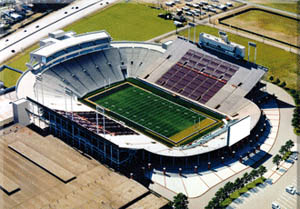
Past Venue: Independence Stadium


Shreveport, LA
aka State Fair Stadium


Year opened: 1925
Capacity: 53,000, up from 40,000

Names:
State Fair Stadium
Independence Stadium

Pro football tenants:
Shreveport Steamer (WFL), 1974-75
Shreveport Pirates (CFL), 1994-95

Postseason games hosted:
None

Other tenants of note:
Shreveport and Bossier City high schools

Notes: Hosts annual Independence Bowl, 1976 to date. Owned by City of Shreveport and located in Louisiana State Fairgrounds along with two other sports venues, Fairgrounds Field and Hirsch Coliseum. Venue is used for high school football and soccer matches. FieldTurf installed in 2010. WFL Steamer started 1974 as Houston Texans but franchise was shifted to Shreveport at midseason. 

Fate: Still in use.


May 9, 2012

MVP Profile: Jamal Lewis, 2003

Running Back, Baltimore Ravens


Age:  24
3rd season in pro football & with Ravens
College: Tennessee
Height: 5’11”  Weight: 231

Prelude:
It was anticipated that Lewis would immediately start at running back when he was taken by the Ravens in the first round (fifth overall) of the 2000 NFL draft. He did, improving as the season went along and gaining 1364 yards on the ground and 296 more on 27 pass receptions for a team that won the Super Bowl. However, he missed all of 2001 due to a knee injury suffered in training camp, but came back strong in ’02, rushing for 1327 yards. With speed as well as power, he also was a productive receiver out of the backfield and caught 47 passes for 442 yards.

2003 Season Summary
Appeared and started in all 16 games
[Bracketed numbers indicate league rank in Top 20]

Rushing
Attempts – 387 [2]
Most attempts, game - 32 (for 134 yds.) vs. Denver 10/26
Yards – 2066 [1]
Most yards, game – 295 yards (on 30 carries) vs. Cleveland 9/14
Average gain – 5.3 [4]
TDs – 14 [3, tied with Shaun Alexander & Clinton Portis]
200-yard rushing games – 2
100-yard rushing games – 12

Pass Receiving
Receptions – 26       
Most receptions, game – 6 (for 43 yds.) vs. Seattle 11/23
Yards – 205
Most yards, game - 44 (on 4 catches) vs. Kansas City 9/28
Average gain – 7.9
TDs – 0

Total yards – 2271 [3]

Scoring
TDs – 14 [6, tied with Clinton Portis]
Points – 84

Postseason: 1 G (AFC Wild Card playoff vs. Tennessee)
Rushing attempts – 14
Rushing yards – 35
Average gain rushing – 2.5
Rushing TDs – 0

Pass receptions – 2
Pass receiving yards - 4
Average yards per reception – 2.0
Pass Receiving TDs - 0

Awards & Honors:
NFL MVP: PFWA
NFL Offensive Player of the Year: AP
1st team All-NFL: AP, PFWA, Sporting News
1st team All-AFC: Pro Football Weekly
Pro Bowl

Ravens went 10-6 to finish first in the AFC North while leading the NFL in rushing yards (2674). Lost AFC Wild Card playoff to Tennessee Titans (20-17).

Aftermath:
Some luster was lost from the outstanding 2003 season when Lewis was indicted on federal drug conspiracy charges in the offseason. He was suspended for two games in 2004 after pleading guilty and then missed two more games with an ankle injury. He was thus limited to 1006 rushing yards – less then half his ’03 total – and caught only 10 passes. Lewis followed up with a poor year in 2004, running for just under a thousand yards (906) while averaging a substandard 3.4 yards per carry. After gaining 1132 yards with a low 3.6-yard average, he was dealt to Cleveland for 2007. Lewis was effective for much of the season, including a 216-yard rushing performance against the Bengals, and ended up with 1304 yards with a 4.4 average gain. He played two more years with the Browns with steadily diminishing returns, putting together his last of seven thousand-yard seasons in ’07 and finishing up with an even 500 yards in 2008. For his career, he rushed for 10,607 yards on 2542 carries for a 4.2-yard average and 58 touchdowns and caught 221 passes for 1879 yards and four more TDs.

--

MVP Profiles feature players who were named MVP or Player of the Year in the NFL, AAFC (1946-49), AFL (1960-69), WFL (1974), or USFL (1983-85) by a recognized organization (Associated Press, Pro Football Writers Association, Newspaper Enterprise Association, United Press International, The Sporting News, Maxwell Club – Bert Bell Award, or the league itself). 

[Updated 2/9/14]

May 8, 2012

1983: Stars Defeat Gold in Lowest-Scoring USFL Game


The Philadelphia Stars had the United States Football League’s best record at 8-1 and were sporting a five-game winning streak as they hosted the Denver Gold on May 8, 1983. Head Coach Jim Mora’s team utilized a conservative, ball-control offense that featured rookie RB Kelvin Bryant and had QB Chuck Fusina behind center. The “Doghouse Defense” was the new league’s best against the run and had also given up the fewest points thus far (83).

The Gold had hosted the Stars in the first week of the regular season, a low-scoring 13-7 win by Philadelphia. It had been a tough road since for Denver, coached by former Broncos Head Coach Red Miller. While the defense kept the club competitive, the offense had difficulty putting points on the board. But while the team’s record was a mediocre 4-5, it matched the other three clubs in the Pacific Division and thus placed the Gold very much in the thick of the race in the USFL’s weakest grouping.

There were 14,306 fans in attendance at Veterans Stadium, and they sat through a scoreless first quarter. It didn’t look like it would be when the Stars went 72 yards in 10 plays on their opening possession, but after reaching the six yard line they were backed up by two penalties and David Trout’s 32-yard field goal attempt hit the right upright.

Brian Speelman finally kicked a 23-yard field goal for Denver to cap a 53-yard drive with 9:39 remaining in the first half. Philadelphia, unable to move the ball effectively after the opening series, responded with a 53-yard field goal by Trout and the game was tied 3-3 at the half.

The Stars, in a third quarter possession that stretched into the first minute of the final period, drove to the Denver one. However, Fusina threw an incomplete pass intended for RB Jeff Rodenberger on third down and Trout kicked another field goal, this time from 18 yards.

Mistakes by the Gold prevented a possible tie or win during the remainder of the fourth quarter. A fumble at the Philadelphia 46 was recovered by safety Mike Lush with 7:31 remaining, snuffing out a potential threat. Denver had another chance to tie late. A drive stalled at the Philadelphia six yard line when Lush and LB Sam Mills stopped a running play on third down, but with 2:07 left a bad snap on the resulting field goal attempt flew to the right of QB Ken Johnson, also the holder on placekicks, and was recovered by the Stars to clinch the 6-3 win.

Philadelphia outgained the Gold (227 yards to 174), had more first downs (16 to 12), and held onto the ball longer (32:53 to 27:07). Both clubs suffered two turnovers and four sacks apiece. The Stars had eight penalties, at a cost of 65 yards, to just three flags thrown on Denver.


Kelvin Bryant, as usual, was the key to the Philadelphia offense, rushing for 94 yards on 23 carries and catching 6 passes for another 50 yards. Chuck Fusina completed just 15 of 29 throws for 135 yards with no TDs and one intercepted. Only four passes were completed to wide receivers, for 43 yards, while TE Steve Folsom had three receptions for 31 yards. In a game dominated by defense, Mike Lush was the standout with an interception that set up the team’s first field goal, a fumble recovery, and a hand in the big third-down stop that set up the Gold’s ill-fated three-point try.

For Denver, 32-year-old CFL veteran Ken Johnson went to the air 24 times and had 11 completions for 107 yards and was intercepted once. Tellingly, Johnson was also the team’s leading rusher with 35 yards on three carries. Harry Sydney had the most yards among the stable of running backs, with 21 on 8 attempts. Running backs Terry Miller and Larry Canada each caught four passes, for 37 and 29 yards, respectively, and two completions went to wide receivers.

The nine total points scored proved to be the lowest over the three years that the USFL existed. There were three ten-point games (two in 1984, one in ’85), with the last one also involving the Stars.

The low offensive output did not presage trouble for the Stars, who bounced back with 24 points in a convincing win at Arizona the following week on the way to topping the Atlantic Division with a 15-3 record. They advanced to the USFL Championship game, losing a close 24-22 decision to the Michigan Panthers.

Offensive problems continued to plague Denver, however, and after scoring just nine points in a loss to Boston in the next contest, Red Miller became the new league’s first coaching casualty. Owner Ron Blanding replaced him with ex-Broncos QB Craig Morton and the Gold ultimately finished third in the Pacific Division at 7-11.

May 6, 2012

Past Venue: Alamo Stadium


San Antonio, TX


Year opened: 1940
Capacity: 23,000

Names:
Alamo Stadium, 1940 to date

Pro football tenants:
San Antonio Toros (TFL/ContFL), 1968, 1970
San Antonio Wings (WFL), 1975
San Antonio Gunslingers (USFL), 1984-85
San Antonio Riders (WLAF), 1991

Postseason games hosted:
TFL Championship, Toros 21 Texarkana 16, Dec. 7, 1968
ContFL Western Conf. Playoff, Toros 21 Las Vegas 17, Dec. 7, 1969
TFL Championship, Toros 21 Fort Worth 17, Nov. 21, 1970

Other tenants of note:
San Antonio high school teams, 1940 to date

Notes: Served as home field for the San Antonio Matadors of the short-lived Spring Football League, 2000.  In addition to seasons indicated, Toros used venue for one Texas Football League home game in 1967 and the one Continental Football League postseason game in 1969. Hosted US Army All-American Bowl, 2002. A WPA project that was primarily constructed of limestone and concrete and nicknamed “the Rock Pile”. Owned and operated by San Antonio Independent School District and currently the home venue for several area high schools and is the largest high school football stadium in Texas. Venue was added to National Register of Historic Places in 2011.

Fate: Still in use.


[Updated 2/3/14]
[Updated 5/11/15]

May 5, 2012

1964: Packers Deal Jim Ringo to Eagles in Multiplayer Swap


On May 5, 1964 the Green Bay Packers took a step toward revamping their defense by trading C Jim Ringo and FB Earl Gros to the Philadelphia Eagles for LB Lee Roy Caffey and a first round draft pick for 1965.

The trade of the 32-year-old Ringo (pictured at right) was considered a shocking move at the time. Already an established star when Vince Lombardi arrived as head coach/GM in 1959, he had been chosen to seven straight Pro Bowls and was coming off his sixth year (fifth straight) as a consensus first-team All-Pro. Undersized at 6’1” and 235 pounds, Ringo made up for it with outstanding mobility and was recognized for his downfield blocking ability as well as pass protection. He was the savvy veteran that Lombardi built his offensive line around and played a major role in bringing two championships to Green Bay. Ringo was also durable, having not missed a game in ten years.

While it was rumored in later years that Lombardi dealt the star center because he showed up for contract negotiations with an agent (a story that Ringo denied and that also didn’t account for the fact that Lombardi had an assistant GM who handled contract negotiations), the trade was motivated by a perceived need to retool on defense, in particular at linebacker. RLB Bill Forester had retired and LLB Dan Currie was becoming more brittle with age.

“We fell down a little bit on defense last year and we had to help it,” explained Lombardi. “Caffey has great speed and he was good enough to play regular in his first year.”

The 6’3”, 230-pound Lee Roy Caffey was drafted in the seventh round by the Eagles in ‘63, having played as a fullback and linebacker at Texas A&M, and became a starter as a rookie at left LB. A promising player, the highlight of his first season was returning a pass interception 87 yards for a touchdown. It was anticipated that, along with Dave Robinson, another second-year linebacker, he would help augment the position.

The deal left Green Bay without an experienced center, and OT Bob Skoronski, who occasionally backed up at the position, was shifted there. However, Ken Bowman had been drafted in the eighth round out of Wisconsin and took over the starting job in 1965. He withstood a challenge from Bill Curry (who was dispatched to the Colts) and a shoulder injury to hold down the starting job until 1973.

As for the Eagles, it was the fourth major trade in two months by the new head coach/GM, Joe Kuharich. The center for the previous two years, Jim Schrader, had once been a Pro Bowl-level player (three times with the Redskins), but was now playing on bad knees. Combined with the drafting of OT Bob Brown out of Nebraska in the first round, the move promised to make the offensive line much better.

The other player acquired from the Packers, Earl Gros (pictured at left), was a highly-regarded young fullback who had been drafted in the first round out of LSU in 1962 but was stuck behind star FB Jim Taylor in Green Bay. Fast for his size (6’3”, 230), he rushed for 358 yards in 77 carries (4.6 avg.) in his rare appearances, but was also considered to be fumble-prone.

The trade ultimately worked out well for both clubs. The aging Ringo still had plenty of talent and lasted four seasons in Philadelphia. He was selected to the Pro Bowl three more times in 1964, ’65, and in his final year, 1967, when he also broke the record for consecutive games played with 182 (the record lasted until 1970, when it was surpassed by Green Bay teammate Forrest Gregg). He was enshrined in the Pro Football Hall of Fame in 1981.

Gros stepped into the starting lineup and led the Eagles in rushing in 1964 with 748 yards. While injuries diminished his performances thereafter, he gained 1623 yards on the ground over three seasons and proved to be an able receiver out of the backfield, catching 76 passes for 719 yards. He was dealt to Pittsburgh following the 1966 season and put in another three years before finishing up in 1970 with a short stint in New Orleans (a homecoming of sorts for the Louisiana Cajun).

As for Lee Roy Caffey in Green Bay (pictured below), he immediately moved into Forester’s spot at right linebacker and played there for six seasons, becoming a part of three consecutive NFL titles from 1965 through ’67. He was selected to the Pro Bowl once, in ’65, and was also a first-team All-Pro in 1966.

The first round draft pick obtained from the Eagles was used to select HB Donny Anderson out of Texas Tech in 1965 (as a future choice for ’66), who played six years for the Packers as a multi-talented back and punter and went to one Pro Bowl. 


May 4, 2012

MVP Profile: Don Hutson, 1941

End/Defensive Back, Green Bay Packers


Age:  28
7th season in pro football & with Packers
College: Alabama
Height: 6’1”    Weight: 185

Prelude:
Coming out of college, where he had been an All-American at Alabama, there were questions as to whether Hutson was suited to the pro game. He quickly allayed such concerns as a rookie in 1935, catching 18 passes for 420 yards (23.3 avg.) and 6 TDs (he led the league with a total of 7). The numbers improved dramatically as he became the top receiver in the NFL, leading the league in receptions (34), yards (536), and TDs (8) in 1936 and receptions (41) and TDs (7) in ’37. Fast and innovative in the maneuvers he utilized and routes he ran, Hutson became the first deep threat and caused defenses to utilize new strategies, such as double- and triple-teaming, to contain him. He led the NFL in receiving yards (548) as well as TDs (9) in 1938 and in receptions (34), yards (849), and yards per catch (24.9) in ’39. While he didn’t lead the league in receptions in 1940, he still had a then-career high with 45.

1941 Season Summary
Appeared in all 11 games
[Bracketed numbers indicate league rank in Top 20]

Pass Receiving
Receptions – 58 [1]  
Most receptions, game – 9 (for 135 yds.) at Washington 11/30
Yards – 738 [1]
Most yards, game - 135 (on 9 catches) at Washington 11/30
Average gain – 12.7 [6]
TDs – 10 [1]
100-yard receiving games - 2

Rushing
Attempts – 4
Yards – 22
Average gain – 5.5
TDs – 2

Kicking
Field goals – 1 [12, tied with twelve others]
Field goal attempts – 1
Percentage – 100.00
PATs – 20 [1, tied with Bob Snyder]
PAT attempts – 24 [1, tied with Bob Snyder]
Longest field goal – 13 yards at Cle. Rams 10/19

Interceptions
Interceptions – 1
Return yards – 32
TDs – 0

Kickoff Returns
Returns – 1   
Yards – 8
Average per return – 8.0
TDs – 0

Scoring
TDs – 12 [1]
FG – 1
PATs – 20
Points – 95 [1]

Postseason: 1 G (Western Division playoff at Chicago Bears)
Pass receptions – 1
Pass receiving yards - 19
Average yards per reception – 19.0
Pass Receiving TDs – 0

Field goals - 0
Field goal attempts – 0
PATs – 2
PAT attempts – 2

Awards & Honors:
NFL MVP: Joe F. Carr Trophy
1st team All-NFL: League, AP, UPI, Chicago Herald American, Collyers, NY Daily News
NFL All-Star Game

Packers went 10-1 to tie for first place in the Western Division. Lost Division playoff to Chicago Bears (33-14).

Aftermath:
Having tied the league record for pass receptions in 1941, Hutson set a new standard in 1942 – another MVP season – with 74 while also setting records with 1211 yards and 17 TDs in just 11 games. Taking advantage of diluted competition during World War II, he continued to be the NFL’s dominant pass receiver. He retired following the 1945 season as the career leader in receptions (488), receiving yards (7991), TD receptions (99), and overall TDs (105). Many of those records lasted for decades – the one for TD receptions lasted until 1989. Used as a defensive back (rather than end) on defense, he intercepted 30 passes in his last six seasons (individual interceptions were first compiled in 1940). As a placekicker, he compiled 7 field goals and 172 extra points and his overall point total was 823, which also was the NFL career record at the time. Hutson was a consensus first-team All-Pro on eight occasions. The Packers retired his #14 and he was inducted into the Pro Football Hall of Fame as a Charter Member in 1963.

--

MVP Profiles feature players who were named MVP or Player of the Year in the NFL, AAFC (1946-49), AFL (1960-69), WFL (1974), or USFL (1983-85) by a recognized organization (Associated Press, Pro Football Writers Association, Newspaper Enterprise Association, United Press International, The Sporting News, Maxwell Club – Bert Bell Award, or the league itself). 

[Updated 2/9/14]