February 6, 2013

2005: Patriots Defeat Eagles in Super Bowl XXXIX for Third Title in Four Years


The New England Patriots were coming off of a championship in 2003, and two in a three-year period, as they entered the 2004 NFL season. It was more of the same as Head Coach Bill Belichick’s team again went 14-2 and defeated the Colts and Steelers to advance to the Super Bowl. Ever-improving QB Tom Brady was joined in the backfield by eighth-year veteran RB Corey Dillon, who rushed for 1635 yards. WR Deion Branch (pictured at right) missed several games due to injury but was back healthy in the playoffs. The tough and savvy defense was anchored by DE Richard Seymour, linebackers Mike Vrabel and Tedy Bruschi, and SS Rodney Harrison.

Their opponents in the Super Bowl on February 6, 2005 were the Philadelphia Eagles. The Eagles, in their sixth year under Head Coach Andy Reid, had finally broken through after losing three straight NFC title games. A fundamentally sound club on both sides of the ball, the Eagles had made major free agent signings in bringing in WR Terrell Owens and DE Jevon Kearse. QB Donovan McNabb had his best year as he passed for 3875 yards and 31 touchdowns. Owens contributed 77 catches for 1200 yards and 14 TDs before going down with a major ankle injury – he was back in action for the Super Bowl after a seven-week layoff with a metal plate and two screws in his right ankle. RB Brian Westbrook was an outstanding all-purpose back. Defensive coordinator Jim Johnson employed an attacking, blitz-heavy scheme that benefited from the addition of Kearse and included Pro Bowlers in MLB Jeremiah Trotter, CB Lito Sheppard, SS Michael Lewis, and FS Brian Dawkins. The Eagles went 13-3 in topping the NFC East and had gotten by the Vikings in the Divisional round of the playoffs and Falcons for the conference title. They came into the Super Bowl as seven-point underdogs against the defending champs.

There were 78,125 fans in attendance at Alltel Stadium in Jacksonville, plus a huge television viewing audience. The teams traded punts until midway through the first quarter when the Eagles finally put a solid drive together. In a third-and-seven situation at the New England 47, McNabb threw to Owens on a crossing pattern that picked up 30 yards and a roughing penalty added an additional nine yards. However, a sack of McNabb by Mike Vrabel cost Philadelphia 16 yards. McNabb’s poorly-thrown pass into the end zone was then intercepted by CB Asante Samuel, but the Eagles got a break when LB Roman Phifer was penalized for illegal contact. But McNabb followed up with another bad pass that was picked off by Rodney Harrison, and this time the play stood.

The Patriots were unable to move on offense and punted with the Eagles getting the ball back in good field position at the New England 45. Once again they turned the ball over when, three plays later, TE L.J. Smith fumbled after being hit by CB Randall Gay and Samuel recovered for the Patriots.


Again the Philadelphia defense held and, with the scoreless game now early in the second quarter, the Eagles got the ball back at their 19. This time they went 81 yards in nine plays highlighted by McNabb completions to WR Todd Pinkston (pictured at left) that covered 17 and 40 yards. On a third-and-six play, McNabb threw to Smith for a touchdown.

The Patriots came alive on offense, spurred by Brady passes to Corey Dillon for 13 and 16 yards to start off the next series. They advanced deep into Philadelphia territory, but Brady fumbled and DT Darwin Walker recovered at the 13.

The Eagles had to punt after the resulting short possession, with Dirk Johnson getting off a 29-yard kick that allowed New England to start the next series at the Philadelphia 37. The Patriots took seven plays in driving to the tying score, with Brady completing all five of his passes. The last was to WR David Givens in the right corner of the end zone for a four-yard TD. The score was 7-7 at the half.

In the third quarter, the Patriots advanced 69 yards in nine plays despite facing a heavy blitz. Deion Branch caught four passes along the way, the last for a 21-yard gain to the Philadelphia two. From there, Vrabel, used as a short-yardage pass receiver on offense, caught a touchdown pass to put New England back in front at 14-7.

The teams again traded punts until the Eagles responded with a 74-yard drive in 10 plays - eight of them passes - that ended with McNabb firing a throw down the middle to Brian Westbrook for a 10-yard TD.

As the period wound down and the contest entered the fourth quarter, the Patriots were methodically driving down the field against a tiring Eagles defense. RB Kevin Faulk had two catches on screen passes, the second for 14 yards to set up a two-yard Dillon scoring run that put the Patriots back in the lead.

The Eagles had to punt following their next series and the Patriots again drove to a score. On second down, Brady (pictured below) threw to Branch for a 19-yard gain and a roughing the passer penalty on DT Corey Simon moved the ball to the Philadelphia 16. Two runs by Dillon advanced the ball to the four and, while the defense held, Adam Vinatieri kicked a 22-yard field goal to put New England up by ten points.


On the next Eagles possession, McNabb was intercepted by Tedy Bruschi, but the resulting New England series was a short one and Philadelphia got the ball back with 5:40 left to play. The Eagles showed a surprising lack of urgency on the next drive as they moved methodically down the field, huddling after each play and using up a great deal of time. McNabb completed eight passes during the 13-play series that covered 79 yards. He tossed a 30-yard touchdown pass to WR Greg Lewis, but there was just 1:48 remaining in the game.

An onside kick was recovered by New England. Using all of their timeouts as the Patriots ran the ball three times and punted, the Eagles got the ball back at their four yard line with 46 seconds left. It was too much to overcome - Rodney Harrison’s second interception with nine seconds remaining on the clock clinched the 24-21 win for the Patriots.

The Eagles gained the most yards (369 to 331) and had more first downs (24 to 21). However, the vast majority of those yards came through the air as they were only able to run for 45 yards on 17 carries against the New England defense. Philadelphia also turned the ball over four times, to one suffered by the Patriots, and McNabb was sacked on four occasions while the Eagles got to Brady twice.

Deion Branch tied the Super Bowl record for pass receptions as he had 11 catches for 133 yards and was the game’s MVP. Tom Brady completed 23 of 33 passes for 236 yards with two touchdowns and none intercepted. Corey Dillon ran for 75 yards on 18 carries that included a TD.

For the Eagles, Donovan McNabb was successful on 30 of 51 throws for 357 yards and three TDs but also tossed three interceptions. Terrell Owens (pictured below) caught 9 of those passes for 122 yards. Brian Westbrook had just 44 rushing yards on 15 attempts but also had 7 pass receptions for 60 yards and a TD. Todd Pinkston contributed four receptions for 82 yards.


“I was proud of the effort and they battled, but we came up just short – too many turnovers,” said Andy Reid in defeat. “And against such a tough football team you can’t do that.”

With three championships in four years, the Patriots received many accolades and the word dynasty was liberally employed. “We’ve never really self-proclaimed ourselves anything,” said Tom Brady. “If you guys say we’re great, we’ll accept the compliment.”

New England still topped the AFC East in 2005, although with a lesser 10-6 record as they endured the offseason loss of both offensive coordinator Charlie Weis and defensive coordinator Romeo Crennel, and had to deal with a spate of injuries during the regular season. The effort to win a third straight NFL title ended with a loss to the Denver Broncos in the Divisional playoff round. They would next return to the Super Bowl following the 2007 season.

For Philadelphia, the Super Bowl defeat led to a difficult offseason in which several players became embroiled in contract squabbles – most notably Terrell Owens, who publicly questioned Donovan McNabb’s performance during the slow-moving fourth quarter drive. Owens returned to the club but was eventually suspended during the season, McNabb (pictured below) was lost in the 10th game, and the Eagles dropped to the bottom of the NFC East with a 6-10 record. They bounced back to win the division in ’06 – with Owens gone to Dallas and Jeff Garcia spelling an injured McNabb. 


February 4, 2013

Rookie of the Year: Robert Awalt, 1987

Tight End, St. Louis Cardinals


Age: 23
College: San Diego State
Height: 6’5”   Weight: 240

Prelude:
One of the Cards’ two third-round draft choices in 1987 (62nd overall), it was hoped that Awalt would be able to compete against veteran TE Doug Marsh and backup Jay Novacek. When Novacek went down with an injury, he started nine games in the strike-interrupted season.

1987 Season Summary
Appeared in 12 of 15 games
[Bracketed numbers indicate league rank in Top 20]

Pass Receiving
Receptions – 42      
Most receptions, game – 9 (for 97 yds.) vs. Philadelphia 11/1, (for 124 yds.) vs. Tampa Bay 11/8
Yards – 526
Most yards, game – 124 (on 9 catches) vs. Tampa Bay 11/8
Average gain – 12.5
TDs – 6 [16, tied with seven others]
100-yard receiving games - 1

Rushing
Attempts – 2
Yards – -9
Average gain – -4.5
TDs – 0

Scoring
TDs – 6
Points – 36

Awards & Honors:
NFL Rookie of the Year: Sporting News
NFC Rookie of the Year: UPI
2nd team All-NFL: NEA

Cardinals went 7-8 in the strike-shortened season (three games were played with replacement players) to finish third in the NFC East.

Aftermath:
The franchise moved west to Phoenix in 1988 and, while his production dropped due to splitting time with Novacek and battling a foot injury, Awalt had a good year with 39 catches for 454 yards and four TDs. There were concerns about his blocking, but he was a sure-handed receiver and caught another 33 passes for 360 yards in ’89. Initially slated to be shifted to H-back in 1990, Awalt instead was dealt to the Dallas Cowboys and settled into a backup role. He caught 18 passes in two seasons and moved on to Buffalo, where he had six catches in 1992 and ’93. For his seven-season career, he caught 138 passes for 1583 yards (11.5 avg.) and 10 touchdowns. Awalt’s first year remained his best. 

--

Rookie of the Year Profiles feature players who were named Rookie of the Year in the NFL, AFL (1960-69), or USFL (1983-85) by a recognized organization (Associated Press – Offense or Defense, Newspaper Enterprise Association, United Press International, The Sporting News, or the league itself – Pepsi NFL Rookie of the Year). 

[Updated 2/5/14]

February 3, 2013

2008: Giants Stun Patriots in Super Bowl XLII to Derail Perfect Season


Since the Miami Dolphins had gone 14-0 in 1972 and advanced to win the Super Bowl, no other NFL team had put together a perfect record. Entering Super Bowl XLII on February 3, 2008 the New England Patriots were coming off a 16-0 campaign in the 2007 regular season and had beaten the Jaguars and Chargers in the playoffs to win the AFC title. To be sure, Head Coach Bill Belichick’s club had struggled in some late-season contests, but the Patriots were as formidable as the record indicated, having set league records by scoring 589 points and 75 touchdowns. The offense was directed by QB Tom Brady, who threw for 4806 yards and set a new standard with 50 TD passes. Veteran WR Randy Moss, a newcomer to the Patriots in ’07, caught 23 touchdown passes and gained 1493 yards and steady WR Wes Welker pulled in 112 receptions. RB Laurence Maroney was the best of an unexceptional but solid group of backs. The defense was tough and filled with savvy veterans such as NT Vince Wilfork, OLB Mike Vrabel, and CB Asante Samuel. Not even allegations of spying on opponents in past seasons could cause the confident Patriots to lose focus.

Their opponents in the Super Bowl were the New York Giants, a team they had barely gotten past in the regular season finale. Coached by Tom Coughlin, the Giants were hardly as dominating during a 10-6 campaign in which they finished second to the Cowboys in the NFC East and entered the playoffs as a fifth-seeded Wild Card. They then won three straight road games, over the Buccaneers, Cowboys, and Packers, to advance to the Super Bowl – the latter two wins coming as decided underdogs. QB Eli Manning (pictured above) had struggled with consistency but he had risen to the occasion in the postseason. The team had a fine group of running backs and, despite playing with an injured ankle, WR Plaxico Burress was a dependable target for Manning’s passes. The defense was the key to the team’s success, however, in particular its ability to mount a pass rush and stop the run. New York’s defense had led the league in quarterback sacks with 53. Still, the Giants came into the game as 12-point underdogs against the undefeated Patriots.

It was a chilly night at University of Phoenix Stadium in Glendale, AZ with 71,101 fans in attendance plus the typically-massive television audience. The Giants showed poise in their first possession, taking 16 plays to go 63 yards and using up almost ten minutes while converting four third downs along the way. Eventually, they ended up with a Lawrence Tynes field goal from 32 yards.

New England responded with a long drive as well that followed a 43-yard kickoff return by Laurence Maroney. On a third-and-10 play at the New York 17, LB Aaron Pierce ran into TE Benjamin Watson as he reached for the ball in the end zone and drew a pass interference penalty. Two plays later, and at the start of the second quarter, Maroney ran for a one-yard TD and, with the successful extra point, the Patriots took the lead at 7-3.

The Giants drove inside the New England 20, with the big play a pass to WR Amani Toomer for 38 yards. But for the first time in the postseason, a Manning pass was intercepted when WR Steve Smith bobbled a low throw and CB Ellis Hobbs grabbed it. New York’s defense held and the teams traded punts. Midway through the period, the Giants sacked Brady on back-to-back plays. LB Kawicka Mitchell and DE Michael Strahan combined for a six-yard sack and then DE Justin Tuck dumped Brady.

A promising series for the Giants reached the New England 25, but Manning had the ball knocked out of his hand when hit by LB Adalius Thomas and, while New York recovered, the Giants were penalized ten yards for an illegal touch by RB Ahmad Bradshaw. They were ultimately forced to punt.

The Patriots were driving just before halftime when Brady fumbled when hit by Tuck. New York recovered but a Hail Mary pass into the end zone fell incomplete. The Giants had run more plays (34 to 27) and dominated time of possession (19:27 to 10:33) but were down by four points at the half.

The Patriots had a long series to start the third quarter and it was extended when the Giants, thanks to an astute challenge by Coach Belichick, were found to have 12 men on the field during a punt that thus gave New England a first down. The drive was further helped along when Brady connected with RB Kevin Faulk for 14 yards in a third-and-13 situation. But after advancing to the New York 25, Brady was sacked on a third down play by Strahan and, rather than try for a field goal, the ensuing fourth down pass fell incomplete.

Early in the fourth quarter, the Giants put together an 80-yard drive that started with Manning tossing a pass to rookie TE Kevin Boss that turned into a 45-yard gain when SS Rodney Harrison missed the tackle. The series was capped by a five-yard touchdown on a Manning pass to WR David Tyree that put New York in front with just over 11 minutes remaining to play.

Following a trade of punts, New England came back with a 12-play scoring possession. Brady found Randy Moss alone in the end zone for a seven-yard TD that, followed by the successful conversion, put the Patriots back in the lead at 14-10.


There was 2:39 to play as the Giants regained possession. Manning threw to Toomer for 11 yards and, four plays later, they converted a fourth-and-one situation to stay alive. Shortly thereafter New York faced third-and-five with time running down. Manning, barely avoiding being sacked, threw to Tyree who, clutching the ball against his helmet, made a sensational catch for a 32-yard gain to the New England 44 (pictured at right). A toss to Smith picked up 12 yards on a third-and-11 play and then Manning tossed a pass over Ellis Hobbs that Plaxico Burress caught for a 13-yard touchdown with 35 seconds left on the clock.

Starting at their own 26, the Patriots were unable to pull off a final comeback as Brady threw two incomplete passes, was sacked, and then unsuccessfully went long for Moss on the final play. The crowd erupted as the stunning 17-14 upset was completed and the Giants, having won a road game for the eleventh straight time, were officially champions.

The Giants led in total yards (338 to 274) although New England had the edge in first downs (22 to 17). New York stuffed the Patriots’ running game (45 yards on 16 carries) and sacked Brady five times for a loss of 37 yards. New England’s defense got to Manning three times, at a loss of just eight yards, and the Giants gained 91 yards on the ground in 26 attempts. Each team suffered one turnover.

The game’s MVP, Eli Manning, completed 19 of 34 passes for 255 yards with two touchdowns and one interception. Amani Toomer caught 6 passes for 84 yards and Steve Smith contributed 5 receptions for 50 yards while Plaxico Burress (pictured below), held to two catches for 27 yards, had the game-winning TD. Ahmad Bradshaw rushed for 45 yards on 9 carries and Brandon Jacobs gained 42 yards on his 14 attempts.


For the Patriots, Tom Brady, under heavy pressure throughout the contest, was successful on 29 of 48 throws for 266 yards and a TD with none intercepted. Wes Welker had 11 pass receptions for 103 yards and Randy Moss caught 5 passes for 62 yards and a touchdown. Laurence Maroney paced the running game with 36 yards and a TD on 14 carries.

“The guys on this team and the run we’ve made, it’s hard to believe – it really is,” said Eli Manning. “The drive at the end, there were so many clutch plays by so many guys. It is an unbelievable game and an unbelievable feeling.”

“We shocked the world but not ourselves,” summed up Giants LB Aaron Pierce.

New York won the NFC East with a 12-4 record in 2008 but was ousted in the Divisional playoff round by the Eagles. The Patriots, having lost out on a perfect season, lost Tom Brady for the year in the season-opening game but, with backup Matt Cassel at quarterback, still went 11-5, although it wasn’t quite enough to return to the postseason. There was a rematch of the two clubs in the Super Bowl following the 2011 season – with similar results. 

February 1, 2013

MVP Profile: Drew Brees, 2008

Quarterback, New Orleans Saints


Age:  29
8th season in pro football, 3rd with Saints
College: Purdue
Height: 6’0”   Weight: 209

Prelude:
Chosen by the San Diego Chargers in the 2nd round of the 2001 draft, Brees spent a year as backup to veteran Doug Flutie before taking over as starting quarterback in ’02. A good first year as starter was followed by a season in which he had difficulties, and the Chargers swung the deal that brought rookie Philip Rivers to San Diego in 2004. Brees bounced back that year with a Pro Bowl season in which his passer rating was 104.8. Brees badly injured his shoulder in the last game of the ’05 season, the final year of his contract, and with the team committing to Rivers, he signed with the New Orleans Saints. He was a consensus first-team All-Pro and was selected to the Pro Bowl in ’06, leading the NFL with 4418 passing yards and guiding the Saints, with a high-powered offense, to the NFC Championship game. Brees started poorly and the team didn’t do as well in 2007, but he recovered to lead the league in pass attempts (652) and completions (440) while throwing for another 4423 yards.

2008 Season Summary
Appeared and started in all 16 games
[Bracketed numbers indicate league rank in Top 20]

Passing
Attempts – 635 [1]
Most attempts, game – 58 at Atlanta 11/9
Completions – 413 [1]
Most completions, game – 39 at Denver 9/21
Yards – 5069 [1]
Most yards, game – 422 at Atlanta 11/9
Completion percentage – 65.0 [9]
Yards per attempt – 8.0 [3]
TD passes – 34 [1, tied with Philip Rivers]
Most TD passes, game – 4 vs. Green Bay 11/24, vs. Carolina 12/28
Interceptions – 17 [3]
Most interceptions, game – 3 at Atlanta 11/9, at Tampa Bay 11/30
Passer rating – 96.2 [4]
400-yard passing games – 2
300-yard passing games – 10
200-yard passing games – 16

Rushing
Attempts – 22
Most attempts, game - 3 (for -2 yds.) vs. Tampa Bay 9/7, (for 6 yds.) vs. Minnesota 10/6, (for -2 yds.) at Kansas City 11/16, (for -3 yds.) at Detroit 12/21
Yards – -1
Most yards, game – 10 yards (on 2 carries) at Atlanta 11/9
Yards per attempt – 0.0
TDs – 0

Awards & Honors:
NFL Offensive Player of the Year: AP
1st team All-NFL: Sporting News
2nd team All-NFL: AP
Pro Bowl

Saints went 8-8 to finish fourth in the NFC South while leading the NFL in total offense (6571 yards), passing offense (4977 yards), scoring (463 points), and touchdowns (57).

Aftermath:
Brees and the Saints reached the top in 2009, with the quarterback leading the league in TD passes (34), completion percentage (70.6), and passing overall (109.6) while the club won the Super Bowl for the first time in franchise history. In 2010, Brees threw for 4620 yards and 33 touchdowns and led the NFL in completion percentage (68.1). However, he also threw a career-high 22 interceptions and, while the team qualified for the postseason as a wild card with an 11-5 record, the Saints were upset in the first round of the playoffs by Seattle. Brees set a new NFL record with 5476 passing yards in 2011 and topped the league in completions (468), completion percentage (71.2), and TD passes (46). He broke the record long held by Johnny Unitas for consecutive games with a touchdown pass in 2012, which finally ended at 54 straight, on his way to recording a third 5000-yard passing season (5177) and again topping the NFL in TD passes (43) although also in interceptions (19) in a difficult year for the club both on and off the field. Through 2012, he had completed 65.6 percent of his career passes for 45,919 yards and 324 TDs and had been selected to the Pro Bowl seven times.

--

MVP Profiles features players who were named MVP or Player of the Year in the NFL, AAFC (1946-49), AFL (1960-69), WFL (1974), or USFL (1983-85) by a recognized organization (Associated Press, Pro Football Writers Association, Newspaper Enterprise Association, United Press International, The Sporting News, Maxwell Club - Bert Bell Award, or the league itself). Also includes Associated Press NFL Offensive and Defensive Players of the Year.

[Updated 2/6/14]

January 31, 2013

1999: Elway Caps Career as Broncos Beat Falcons in Super Bowl XXXIII


The Denver Broncos, winners of the Super Bowl following the 1997 season, were even stronger in 1998 as they topped the AFC West with a 14-2 record and breezed past the Dolphins and Jets in the playoffs to again earn another conference title. On January 31, 1999 they faced the Atlanta Falcons in Super Bowl XXXIII to defend their crown.

Coached by Mike Shanahan for the fourth season, the Broncos had regained the services of 38-year-old star QB John Elway (pictured above) for another year after he had considered retirement in the previous offseason. It was widely anticipated that this would be his finale for sure. RB Terrell Davis was a vital cog in the offense as he rushed for 2008 yards. Wide receivers Rod Smith and Ed McCaffrey both gained over a thousand receiving yards and TE Shannon Sharpe added 64 catches for 768 yards and 10 touchdowns.

The NFC Champion Falcons were coached for the second year by Dan Reeves, the longtime mentor in Denver who had led the Broncos to three AFC titles (and as many Super Bowl defeats), and had been forced to leave the club for a time in the late season due to heart bypass surgery. They had also gone 14-2, but were not as highly regarded as the defending champs, having won a close Divisional playoff game against the 49ers and then stunning the Minnesota Vikings in overtime for the NFC title. Atlanta featured a strong running attack led by RB Jamal Anderson (1846 yards) while 33-year-old veteran QB Chris Chandler, often injured and cast aside by five teams thus far in his career, stayed healthy and performed capably with his accurate passing. The opportunistic defense, anchored by MLB Jessie Tuggle, led the league with 44 takeaways and a +20 turnover differential. However, they received a jolt when Pro Bowl FS Eugene Robinson was arrested for soliciting a prostitute the night before the game, providing an unneeded distraction.

Still, the Falcons got off to a fast start before 74,803 fans at Miami’s Pro Player Stadium plus the mammoth television audience. Jamal Anderson gained 13 yards on his first carry and, with the help of a pass interference penalty, they reached the Denver eight yard line. However, on third down Chandler was sacked by LB Bill Romanowski for a seven-yard loss and Atlanta settled for a 32-yard Morten Andersen field goal to take the early 3-0 lead.

Denver came right back with a scoring drive that was highlighted by an Elway throw to Rod Smith that gained 41 yards on a third-and-seven play. Following a 14-yard Elway completion to Shannon Sharpe, FB Howard Griffith, who only carried the ball four times during the regular season, gained the last yard of the series for a touchdown (pictured below).


Late in the opening period, Atlanta got a break when an Elway pass bounced off the hands of Sharpe and was intercepted by CB Ronnie Bradford at the Denver 35. After advancing to the 26, in the first play of the second quarter Anderson was stopped for no gain in a third-and-one situation. Rather than go for the field goal, the Falcons tried to convert the fourth down and Anderson, taking a pitch from Chandler, was thrown for a two-yard loss.

Denver proceeded to put together a long 11-play drive that ended with Jason Elam kicking a 26-yard field goal that increased the lead to 10-3. Again the Falcons reached Denver territory in the following series but a field goal try by Morten Andersen from 26 yards flew wide to the right – likely not helped by a high snap from center. On the next play, Elway went deep for Rod Smith who beat Eugene Robinson and went all the way for an 80-yard touchdown.

Aided by a 42-yard kickoff return by WR Tim Dwight, Atlanta finally scored again before halftime, but it was a case of settling for a field goal of 28 yards by Andersen and they were down 11 points going into the intermission.

The Broncos failed to add to their lead when Elam missed two field goal attempts in the third quarter, from 38 and 48 yards. The first came at the end of the opening series of the second half in which Elway completed four passes in a 13-play possession. The second followed an interception by CB Darrius Johnson that gave the Broncos the ball at the Atlanta 42.

The Falcons were unable to capitalize on the missed field goals, although after the second they mounted a drive that carried to the Denver 21 – a touchdown could have put them very much back in the game. However, Chandler’s pass intended for an open TE O.J. Santiago was deflected at the line by DE Keith Traylor and CB Darrien Gordon (pictured below) intercepted and returned it 58 yards before he was brought down by the pursuing quarterback at the Atlanta 24.


The Broncos took full advantage of the break as Elway threw to WR Ed McCaffrey for a 15-yard gain and Griffith scored a TD, again from a yard out to start the fourth quarter, expanding Denver’s lead to 24-6.

The Falcons once more advanced into Denver territory but, after reaching the 26 yard line, a poorly-thrown pass by Chandler was picked off by Gordon and returned 50 yards to the Atlanta 48. Elway threw short for Terrell Davis, who gained 39 yards, and two plays later Elway ran for a three-yard TD on a quarterback draw that made it 31-6 with 11:20 left in the game.

Dwight returned the ensuing kickoff 94 yards for a TD, but the Broncos responded by driving 34 yards in seven plays that concluded with Elam kicking a 37-yard field goal. A long possession yielded one more touchdown for the Falcons, on a three-yard Chandler pass to WR Terance Mathis, which was followed by an unsuccessful two-point conversion attempt as well as an onside kick that the Broncos recovered. With two minutes remaining, however, the result was not in doubt. Denver repeated as NFL Champion by a score of 34-19.

The Broncos had the edge in total yards (457 to 337) and first downs (22 to 21). The Falcons turned the ball over four times, however, to one by Denver and all in all did poorly at taking advantage of scoring opportunities.

John Elway, the MVP of the game, completed 18 of 29 passes for 336 yards with a touchdown and an interception and also had the short rushing TD. Rod Smith (pictured below) was the receiving star with 5 catches for 152 yards and a TD. Terrell Davis gained 102 yards on 25 carries and added 50 more yards on two pass receptions. Howard Griffith, who with four rushes matched his total for the entire season, gained just nine yards but had the two short touchdowns. Darrien Gordon’s two interception returns that totaled 108 yards set a Super Bowl record.


For the Falcons, Chris Chandler was successful on 19 of 35 throws for 219 yards and a TD but also with three interceptions. Jamal Anderson ran the ball 18 times for 96 yards. Terance Mathis caught 7 passes for 85 yards and a touchdown and WR Tony Martin added 79 yards on 5 receptions.

“We just didn’t play well,” summed up Dan Reeves. “We just couldn’t get it done. We missed the field goal, missed the fourth down attempt, settled for two field goals, threw two interceptions. You can’t win if you don’t get it in the end zone.”

“I don’t know if it’s John’s last game,” said Mike Shanahan. “I think it’s a good chance it could be. If you’re going to go out, what a way to go out.”

While there was speculation that John Elway would come back once more with the opportunity to win a third straight championship, he did indeed retire. For his 16-season career, he completed 4123 passes for 51,475 yards, which both ranked second all-time at that point, and 300 touchdowns, which ranked third, and was selected to the Pro Bowl on nine occasions. Elway was inducted into the Pro Football Hall of Fame in 2004.

With inexperienced Brian Griese at quarterback and Terrell Davis limited to 67 carries due to injury, the Broncos sank to 6-10 in 1999. They did return to the postseason in 2000. Atlanta, with Jamal Anderson also being lost for most of the year due to injury, dropped to 5-11. The Falcons would not post a winning record or make a playoff appearance again until 2002. 

January 29, 2013

1968: Vikings Obtain Gary Cuozzo from Saints


On January 29, 1968, which was the eve of the combined NFL/AFL draft, it was announced that the Minnesota Vikings traded their first-round draft picks for both 1968 and ‘69 to the New Orleans Saints for QB Gary Cuozzo.

The deal gave the Saints the seventh pick in the ’68 draft. They had lost their first round choice as compensation to the Packers for signing FB Jim Taylor as a free agent in ‘67. Meanwhile, Minnesota still held the first overall pick thanks to their trade with New York the previous year involving QB Fran Tarkenton. It was widely speculated that they would take a lineman with that first choice, and so they did, choosing USC tackle Ron Yary, who would go on to a Hall of Fame career.

Cuozzo was 27 years old and had played collegiately at the University of Virginia, where he had also been a Phi Beta Kappa student. He signed with the Baltimore Colts as an undrafted free agent in 1963 and backed up all-time great QB Johnny Unitas for four years, drawing attention when Unitas was injured during the ’65 season. Cuozzo performed capably in relief – in particular, a five-TD passing performance against the Vikings – before he also went down with a shoulder separation.  

So highly was he regarded that the expansion Saints acquired him from the Colts in 1967 for first and third draft choices plus C Bill Curry. However, he proved to be a poor fit as an immobile quarterback on a weak first-year club and was unable to hold on to the starting job. He completed 51.5 percent of his passes for 1562 yards, averaging just 6.0 yards per attempt, with seven touchdowns against 12 interceptions.

“We feel Gary will upgrade our offensive team,” said Minnesota GM Jim Finks. “If he can execute the forward pass like he has done in the past, he will help our offensive team considerably.”

“Gary has been in the league for five years. It’s time for him to assert himself,” was the challenge put forth by second-year Head Coach Bud Grant.

Finks declined comment on how the trade would affect the status of the three quarterbacks already on the roster, including starter Joe Kapp plus Ron VanderKelen and Bob Berry. The position had been at issue since Tarkenton was traded away. VanderKelen, the long-time apprentice, failed in the early going in 1967 and 29-year-old Joe Kapp, an eight-year veteran of the CFL, was signed to take over the starting job. With his fiery leadership to compensate for a lack of pure passing skill, Kapp did a creditable job – especially considering he had not had the benefit of a training camp with his new team. Minnesota scored just 11 touchdowns through the air in ’67.

With some good running backs and a promising group of receivers – not to mention an up-and-coming defense – it was widely believed that obtaining a solid quarterback could make the Vikings a contender in the NFL Central, and that Cuozzo would most likely land the starting job.

In fact, it was Kapp starting for the Vikings in 1968 and ’69 as they won the first two division titles in franchise history and the NFL Championship in the second year – although they fell short against the Chiefs in the last pre-merger Super Bowl. But the 1969 season proved to be the last for Kapp in a Minnesota uniform – a contract dispute led to his holding out in ’70 and he was dealt to the Patriots.

Cuozzo was finally the starting quarterback for the Vikings in his third season with the club. The team went 12-2 to again top its division (now the NFC Central) but it was the strong defense, not the offense, leading the way. Cuozzo was the conference’s tenth-ranked passer, completing 128 of his 257 throws (49.8 %) for 1720 yards with just seven touchdowns against 10 interceptions, averaging 6.7 yards per attempt and 13.4 yards per completion - only the last number ranked in the league’s top 10. Moreover, Minnesota lost in the Divisional playoff round to the 49ers in a home game in which he performed poorly.

In the offseason, the Vikings swung a trade with the Eagles for ten-year veteran QB Norm Snead. Cuozzo ended up starting most of Minnesota’s games in 1971, with young Bob Lee also in the mix along with Snead. Once again the Vikings topped their division with a fine 11-3 tally, and once again they were quickly dispatched in the postseason.

The Vikings dealt both Cuozzo and Snead in the offseason. Snead went to the Giants for Fran Tarkenton, the quarterback whose departure following the 1966 season had first set off the process of finding a capable replacement. Cuozzo was traded to the St. Louis Cardinals for WR John Gilliam and a second-round draft choice. Competing with Jim Hart and Tim Van Galder in St. Louis, Cuozzo started six games in his final year in the NFL.

An intelligent player and accurate passer, he had neither the arm strength nor leadership ability to succeed consistently as a starting quarterback in the NFL despite being highly sought after.  He started a total of 40 games and had a record of 21-19 while completing just under half of his passes (49.4 %) for 7402 yards and 43 touchdowns along with 55 interceptions. His postseason performances were no better.

As a footnote, the two first-round draft choices that the Saints received for Cuozzo were used to take Kevin Hardy, a defensive end out of Notre Dame, in 1968 and Xavier guard John Shinners in ’69. Hardy never played for New Orleans, being awarded during the summer to the 49ers along with a 1969 first-round pick as compensation for the signing of free agent WR Dave Parks. He lasted one season in San Francisco and played as a backup for the Packers and Chargers before his disappointing career ended in 1972. Shinners did play with New Orleans for three years before moving on to the Colts for a year and then Cincinnati for five undistinguished seasons. 

January 28, 2013

Rookie of the Year: Charle Young, 1973

Tight End, Philadelphia Eagles


Age: 22
College: Southern California
Height: 6’4”   Weight: 230

Prelude:
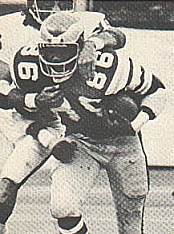
An All-American in college, Young was the second of two first-round draft picks (sixth overall) by the Eagles in 1973. The outspoken rookie moved directly into the starting lineup and backed up his words with production as part of the “Fire High Gang” along with tall wide receivers Harold Carmichael (6’8”) and Don Zimmerman (6’4”).

1973 Season Summary
Appeared in all 14 games
[Bracketed numbers indicate league rank in Top 20]

Pass Receiving
Receptions – 55 [4, tied with Ed Podolak]     
Most receptions, game – 8 (for 108 yds.) vs. New England 11/4
Yards – 854 [4]
Most yards, game – 113 (on 4 catches) at Dallas 11/18
Average gain – 15.5 (19)
TDs – 6 [12, tied with Jerome Barkum, Otto Stowe & Larry Brown]
100-yard receiving games - 4

Rushing
Attempts – 4
Yards – 24
Average gain – 6.0
TDs – 1

Kickoff Returns
Returns – 1
Yards – 14
TDs – 0

Scoring
TDs – 7 [18, tied with seven others]
Points – 42

Awards & Honors:
NFC Rookie of the Year: UPI
1st team All-NFL: AP, PFWA, Pro Football Weekly
2nd team All-NFL: NEA
1st team All-NFC: AP, Pro Football Weekly
2nd team All-NFC: UPI
Pro Bowl

Eagles went 5-8-1 to finish third in the NFC East while leading the NFL in passing offense (2998 yds.).

Aftermath:
Young followed up his outstanding rookie season by gathering in a NFC-leading 63 catches for 696 yards (11.0 avg.) and three touchdowns in 1974. He was again selected to the Pro Bowl in 1974 and ’75, although his production dropped with the offensively-challenged Eagles in 1975 and ’76. His first name also went through several different changes, from Charles to Charlie, Charli, and finally Charle. A contract dispute forced the trade of his rights to the Los Angeles Rams in 1977 for QB Ron Jaworski, and he dropped into obscurity behind Terry Nelson. In three seasons in LA, he caught just 36 passes. Moving on to San Francisco, Young was a better fit and, in the 1981 Super Bowl-winning season, had 37 pass receptions for 400 yards and five TDs. Following three years with the 49ers, he finished up with three seasons with the Seattle Seahawks. For his 13-season career, Young caught 418 passes for 5106 yards (12.2 avg.) and 27 touchdowns and was selected to the Pro Bowl three times.

--

Rookie of the Year Profiles feature players who were named Rookie of the Year in the NFL, AFL (1960-69), or USFL (1983-85) by a recognized organization (Associated Press – Offense or Defense, Newspaper Enterprise Association, United Press International, The Sporting News, or the league itself – Pepsi NFL Rookie of the Year). 

[Updated 2/6/14]