March 17, 2014

1984: Fourth Quarter FGs Give Express Narrow Win Over Gunslingers


Two United States Football League teams that were having difficulty generating offense in the early going met on March 17, 1984 in San Antonio. The visiting Los Angeles Express were off to a 1-2 start while the San Antonio Gunslingers remained winless at 0-3.

The Express, under Head Coach John Hadl, had made a change at quarterback from Tom Ramsey to Frank Seurer and there was hope for the future in rookie Steve Young out of Brigham Young, who had recently signed a mammoth $40 million contract. However, Young was not yet ready to play and would not be suiting up against the Gunslingers.

San Antonio, one of six expansion teams for the USFL’s second season and coached by Gil Steinke, had quarterback problems of its own. The Gunslingers were without their prize rookie, QB Rick Neuheisel, as well as backup QB Mike Ford due to injuries. 34-year-old Karl Douglas was behind center for the game against the Express.

There were 9821 fans in attendance for the Saturday contest at Alamo Stadium. As could be expected, they didn’t see much scoring, especially in the first half. The Express got on the board when Frank Seurer threw to WR Ricky Ellis for a 15-yard touchdown. Tony Zendejas added the extra point, and that was it for the scoring in the first thirty minutes.

San Antonio’s offense may have been feeble, but the defense was tough and in the third quarter LB Putt Choate intercepted a Seurer pass and returned it 45 yards for a TD. However, Nick Mike-Mayer’s extra point attempt was blocked by LB Howard Carson and the Express remained ahead by 7-6.

Later in the period, a blocked punt led to points for San Antonio. DB Peter Raeford blocked the kick by Jeff Partridge and DB Maurice Tyler recovered for the Gunslingers at the LA 32 and returned it to the six yard line. At the beginning of the fourth quarter, the Gunslingers scored when RB Scott Stamper ran two yards for a TD. But once again San Antonio failed to add points after a touchdown when the pass for a two-point conversion failed.

With just under nine minutes on the clock, Zendejas booted a 36-yard field goal to make it a 12-10 contest. The Express got a break as time was running down when a poor punt by San Antonio’s Ken Hartley into a stiff wind gave them good field position. Zendejas kicked another field goal, this time from 39 yards with 1:09 remaining to play to put LA ahead by a point. It was enough as the Express held on to win by a final score of 13-12.

In a game in which both offenses struggled, Los Angeles led in total yards (287 to 227) and first downs (15 to 12). The Gunslingers managed only 52 net yards through the air and were penalized 10 times, at a cost of 66 yards, to 7 flags thrown on the Express. San Antonio also turned the ball over three times, to two suffered by the Express. The failure to convert, by kicking or passing, following the two touchdowns ultimately proved fatal to the Gunslingers.

Frank Seurer completed 11 of 17 passes for 125 yards and a touchdown while giving up one interception. Tom Ramsey saw action and was 8-of-12 for 83 yards and also tossed an interception. RB Kevin Nelson rushed for 43 yards on 19 carries. Ricky Ellis had four catches for 32 yards and a TD and WR Malcolm Moore also had four receptions, gaining 30 yards. WR Anthony Allen led in receiving yards with 83 on his three catches. Tony Zendejas made the two key field goals in the fourth quarter that produced the win.


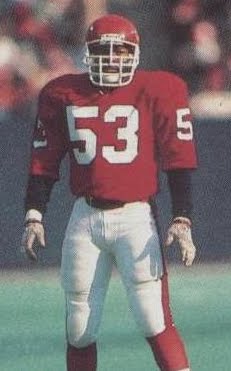
For the Gunslingers, Scott Stamper (pictured at left) was the star on offense with 87 yards on 20 carries that included a touchdown. Karl Douglas was successful on only three of ten throws for 25 yards, giving up two interceptions, while his replacement J Torchio was three-of-nine for 52 yards and was intercepted once. WR Jerry Gordon was the top receiver with three catches for 31 yards.

The Express lost another low-scoring game the next week, but Steve Young took over at quarterback two weeks later, and the results were beneficial. Los Angeles topped the Pacific Division with a 10-8 record and reached the Western Conference title game.

As for the Gunslingers, Rick Neuheisel was back in action the following week and they won for the first time. The pattern of weak offense offsetting a solid defense continued as they went on to finish third in the Central Division at 7-11.

March 16, 2014

Rookie of the Year: Boyd Dowler, 1959

Offensive End, Green Bay Packers


Age: 22 (Oct. 18)
College: Colorado
Height: 6’5”   Weight: 225

Prelude:
Highly versatile, Dowler played quarterback in a single-wing offense in college and, while passing for 769 yards, he proved to be a proficient pass receiver with 41 receptions for 628 yards and 6 touchdowns and also handled the punting. The Packers chose him in the third round of the 1959 NFL draft with the intention of using him as an offensive end.

1959 Season Summary
Appeared in all 12 games
[Bracketed numbers indicate league rank in Top 20]

Pass Receiving
Receptions – 32 [19, tied with Bill Barnes]  
Most receptions, game - 8 (for 147 yds.)  vs. Baltimore 11/15       
Yards – 549 [14]
Most yards, game – 147 (on 8 catches) vs. Baltimore 11/15
Average gain – 17.2 [11]
TDs – 4 [13, tied with eight others]

Rushing
Attempts – 1
Yards – 20
TDs – 0

Scoring
TDs – 4
Points – 24

Awards & Honors:
NFL Rookie of the Year: UPI

Packers went 7-5 to tie for third in the NFL Western Conference in their first season under Head Coach Vince Lombardi, the team’s best record since 1945.

Aftermath:
Dowler followed up his fine rookie season by catching 30 passes for 505 yards as the Packers won the Western Conference in 1960 for the first of three straight years. With good speed as well as size, he proved to be a dependable short receiver who was capable of breaking away for long gains as a flanker or split end, becoming a fixture in the offense for the remainder of the decade. His punting ability also came into play, beginning in ’60. Dowler gained a career-high 901 yards, on 53 catches, in 1963 and was selected to the Pro Bowl for the first time in ’65. His production dropped in an injury-filled 1966 season (which also knocked him out of the first Super Bowl), but Dowler bounced back with a career-best 54 catches, for 836 yards, in ’67 and again received Pro Bowl recognition. He played through 1969 before retiring to become an assistant coach under George Allen with the Rams and, following Allen to Washington, came out of retirement in 1971 when injuries depleted the receiving corps before quitting for good. Overall, Dowler caught 474 passes for 7270 yards (15.3 avg.) and 40 touchdowns (of that total, 448 catches, 6918 yards, and all of the TDs came with Green Bay). He also averaged 42.9 yards on 93 punts. He was chosen to the Pro Bowl twice.

--


Rookie of the Year Profiles feature players who were named Rookie of the Year in the NFL, AFL (1960-69), or USFL (1983-85) by a recognized organization (Associated Press – Offense or Defense, Newspaper Enterprise Association, United Press International, The Sporting News, or the league itself – Pepsi NFL Rookie of the Year). 

[Updated 2/22/17]

March 15, 2014

MVP Profile: Otto Graham, 1955

Quarterback, Cleveland Browns


Age:  34 (Dec. 6)
10th season in pro football & with Browns
College: Northwestern
Height: 6’1”   Weight: 205

Prelude:
A single-wing tailback in college, Graham chose to sign with the Browns of the new AAFC rather than the NFL Detroit Lions, who had drafted him in the first round in 1944, after coming out of the Navy. An outstanding athlete, he first played pro basketball before joining the Browns for the 1946 season. Mobile and an accurate passer, Graham threw for 1834 yards as a rookie and led the AAFC with 17 TD passes as the Browns won the league championship. He was the league’s MVP for the first time in ’47 as he led the AAFC in overall passing as well as completion percentage (60.6), yards (2753), TD passes (25), and yards per attempt (10.2). Graham was co-MVP with San Francisco’s Frankie Albert in ’48, a season in which he once more led the AAFC in passing yards (2713) while tossing another 25 TD passes and the Browns went undefeated. The Browns won the AAFC title for the fourth straight year in 1949, and Graham led the league in passing yards (2785) and yards per attempt (9.8). While no MVP was awarded by the league, he was a consensus first-team All-AAFC selection. Graham and the Browns moved to the NFL in 1950 and kept up their winning ways by achieving another championship. Graham was selected to the Pro Bowl. He was named league MVP by UPI in ’51 as the Browns went 11-1, although they lost the Championship game to the Rams. In 1952, Graham led the league in pass attempts (364), completions (181), yards (2816), and TD passes (20), as well as interceptions (24), and was once again named to the Pro Bowl. He received MVP honors from UPI again in ’53 after leading the league in passing yards (2722), yards per attempt (10.6), and completion percentage (64.7) and, while the Browns lost the NFL Championship game for a third straight year, they returned to the top in 1954 as Graham again led the NFL in completion percentage (59.2). He retired at that point, although when the Browns had difficulty in the 1955 preseason, he was coaxed back into action for one more year.

1955 Season Summary
Appeared in all 12 games
[Bracketed numbers indicate league rank in Top 20]

Passing
Attempts – 185 [10]
Most attempts, game – 31 at NY Giants 11/27
Completions – 98 [8, tied with Charlie Conerly]
Most completions, game – 17 at NY Giants 11/27
Yards – 1721 [6]
Most yards, game – 319 at NY Giants 11/27
Completion percentage – 53.0 [1, tied with Bobby Layne]
Yards per attempt – 9.3 [1]
TD passes – 15 [3]
Most TD passes, game – 3 at NY Giants 11/27, vs. Chi. Cardinals 12/11
Interceptions – 8 [12]
Most interceptions, game – 2 vs. Washington 9/25, at Philadelphia 11/13
Passer rating – 94.0 [1]
300-yard passing games – 1
200-yard passing games – 2

Rushing
Attempts – 68
Yards – 121
Yards per attempt – 1.8
TDs – 6 [4, tied with Ed Modzelewski & Lew Carpenter]

Scoring
TDs – 6 [17, tied with four others]
Points – 36

Postseason: 1 G (NFL Championship at LA Rams)
Pass attempts – 25
Pass completions – 14
Passing yardage – 209
TD passes – 2
Interceptions – 3

Rushing attempts – 9
Rushing yards – 21
Average gain rushing – 2.3
Rushing TDs – 2

Awards & Honors:
NFL MVP: UPI, Sporting News
1st team All-NFL: AP, UPI, NY Daily News, Sporting News
2nd team All-NFL: NEA

Browns went 9-2-1 to finish first in the NFL Eastern Conference while leading league in scoring (349 points) and touchdowns (45). Won NFL Championship over Los Angeles Rams (38-14).

Aftermath:
Graham retired for good following the 1955 season. Altogether, over 10 seasons (four in the AAFC, 6 in the NFL) he averaged 9.0 yards per attempt (a record 8.6 in the NFL alone) while throwing for 23,584 yards (10,085 in AAFC, 13,499 in NFL) with 174 TDs (86 in AAFC, 88 in NFL). He also ran for 882 yards and scored 44 TDs, with a high of 8 in 1954. Graham was a first-team All-league selection three times in the AAFC as well as three more times in the NFL and was chosen for the first five Pro Bowls. Perhaps most significantly of all, he quarterbacked Cleveland to a championship game in all ten years, winning seven of them. The Browns retired his #14 and he was inducted into the Pro Football Hall of Fame, Class of 1965.

--


MVP Profiles feature players who were named MVP or Player of the Year in the NFL, AAFC (1946-49), AFL (1960-69), WFL (1974), or USFL (1983-85) by a recognized organization (Associated Press, Pro Football Writers Association, Newspaper Enterprise Association, United Press International, The Sporting News, Maxwell Club – Bert Bell Award, or the league itself). 

March 13, 2014

1960: NFL Approves Move of Cards from Chicago to St. Louis


On the evening of March 13, 1960 the NFL approved the transfer of the Chicago Cardinals franchise to St. Louis. The owners agreed to the move upon two conditions. First, a satisfactory lease agreement had to be worked out with Busch Stadium, which was owned by the major league baseball Cardinals, as well as arrangements for television coverage (as anticipated, these were not problematic conditions. A new stadium, which would come to be Busch Memorial Stadium, was in the planning stages and was finally available in 1966).

The team’s managing director, Walter Wolfner, strongly denied that a move was imminent right up to the day of the vote. He indicated afterward that the league had unexpectedly agreed to meet certain conditions that made the franchise shift possible.

The NFL agreed to pay the team $500,000 to help defray the costs of the relocation, which included paying off the lease for use of Soldier Field. The Bears were especially willing to assist with the cost in anticipation of increased revenue due to the freeing up of the Chicago territory.

While sentimentalists were sorry to see the move of the league’s oldest franchise, which had such long ties to the Windy City, the club had long played second fiddle to the more successful Bears.

The Cardinals had Chicago roots dating back to 1898, when they began life as an amateur community team called the Morgan Athletic Club. From there they became the Racine Normals, due to their venue being Normal Field on Racine Avenue, and then the Racine Cardinals after obtaining a supply of faded maroon jerseys from the University of Chicago. The team disbanded and reorganized on two occasions and joined the fledgling NFL (then the American Professional Football Association) in 1920, quickly becoming known as the Chicago Cardinals.

While the Cardinals had sporadic success, winning NFL titles in 1925 and ’47, for the most part they quickly fell behind the rival Bears, who won far more regularly. The club was bought by Charles W. Bidwill in 1933, and by the late 40s he had begun to assemble a winning squad that featured the “Million-Dollar Backfield” of QB Paul Christman, FB Pat Harder, and halfbacks Charley Trippi and Elmer Angsman. But he died before the championship-winning season in 1947 and his widow, Violet, married businessman Walter Wolfner two years later, who became managing director in 1951.

Organizationally, the Cards floundered in the 1950s, putting together just one winning season. Attendance was poor and not helped by the move from Comiskey Park to Soldier Field in 1959, also playing two games in Bloomington, Minnesota, a potential NFL market (the Vikings arrived on the scene in 1961). The Wolfners turned down suitors willing to buy the franchise (two of whom, Lamar Hunt and Bud Adams, went on to found the American Football League), but they were losing money. With a study showing that St. Louis was a viable candidate to field a NFL team, the decision was made to relocate. Additionally, a St. Louis brewer named Joe Griesedieck bought a ten percent interest in the club.

The team’s fortunes immediately improved on the field. After having finished at the bottom of the Eastern Conference with a 2-10 record in 1959, the Cardinals were 6-5-1 in their first St. Louis season. They were the NFL’s top rushing team, with star HB John David Crow leading the way with 1071 yards and second-year split end Sonny Randle led the league with 15 receiving touchdowns among his 62 catches. The defense was greatly improved and included DE Leo Sugar, DT Frank Fuller, plus an established star safety in Jerry Norton, who was also an excellent punter, and Larry Wilson, a rookie who would go on to a Hall of Fame career, in the other spot.

Violet Wolfner died in 1962 and a legal battle ensued between her sons from her marriage to Charles Bidwill, Charles W. Jr. (aka Stormy) and Bill, and the pugnacious Wolfner who contested the will leaving the bulk of her estate – including the majority ownership in the Cardinals – to the brothers. The nasty legal battle was finally settled out of court. Stormy ran the team until selling his interest to Bill in 1972.

Meanwhile, on the field there was difficulty at quarterback, and the acquisition of 31-year-old Sam Etcheverry, a legendary player in Canada, failed to resolve the issue when it was found that his arm was worn out. However, in 1962 a promising young quarterback from New Mexico State named Charley Johnson took over and, in 1963 and ’64, the Cards exhibited a productive offense and contended in the Eastern Conference. Randle, in combination with flanker Bobby Joe Conrad, continued to excel and the offensive backfield was deep enough to withstand injuries. Wally Lemm had been grabbed away from the AFL’s Houston Oilers in ’62 to become the head coach, with encouraging results.

However, the Cardinals failed to break through to the postseason. The team would not do so until 1974, under offensive-minded Head Coach Don Coryell, but he left after five years and two non-winning postseason appearances, frustrated by the team’s continued organizational failings under Bill Bidwill.

Ultimately, the relocation to St. Louis that began with such promise of success soured badly. Bidwill chose to be his own general manager, too often with unfortunate results. Along with some notable highly-drafted busts such as QB Steve Pisarkiewicz, WR Clyde Duncan, and kicker Steve Little, there were plenty of talented players along the way. In addition to those named previously, notable among them on offense were quarterbacks Jim Hart and Neil Lomax, running backs Terry Metcalf and Ottis Anderson, wide receivers Mel Gray, Pat Tilley, Roy Green, and J.T. Smith, linemen Dan Dierdorf, Conrad Dobler, Bob DeMarco, and Tom Banks and, on defense, linebackers Dale Meinert, Larry Stallings, and E.J. Junior and backs Pat Fischer and Roger Wehrli. Jim Bakken was a standout placekicker for many years and Vai Sikahema a notable kick returner. But the team underachieved far too often, and attendance fell until the franchise shifted again, this time moving to Phoenix in 1988. The overall record over the course of 28 years in the Gateway City was 187-202-13 and 0-3 in the postseason.


March 11, 2014

1984: Turnovers Help Generals Edge Stars


The United States Football League’s Atlantic Division matchup between the New Jersey Generals and Philadelphia Stars on March 11, 1984 featured two teams that had thus far been carried by their defenses in achieving 2-0 records.

The Generals, coached by Walt Michaels, were benefiting from an influx of veteran talent on defense that included linebackers Bobby Leopold, Jim LeClair, and Willie Harper, CB Kerry Justin, and FS Gary Barbaro. The offense, which had relied most heavily on RB Herschel Walker in 1983, added ex-Browns QB Brian Sipe, but he had gone down with an injury in the first week and backup Gene Bradley was behind center.

Philadelphia, which barely lost the USFL Championship game the previous year, continued to rely on a ball control attack led by QB Chuck Fusina and featuring RB Kelvin Bryant. But the offense had scored just 17 points in each of the first two games and it was the blitz-heavy defense keeping opponents in check.

There were 46,716 fans in attendance at Giants Stadium in the New Jersey Meadowlands for the Generals’ home-opening game. The contest was played in near-freezing temperatures with wind gusts of nearly 35 miles per hour. Fans occasionally tossed snowballs onto the field despite the dire warnings coming over the public address system and, as a result, 14 were arrested and 57 ejected during the course of the afternoon.

The Generals got the first break of the game when, forced to punt after their first series, the ball bounced into CB Jonathan Sutton and New Jersey recovered at the Philadelphia 29, but they were unable to move afterward. The Stars had a drive that was helped along by a fake punt that converted a fourth down, but David Trout’s 52-yard field goal attempt hit the right upright and was unsuccessful.

In a 10-play, 65-yard series that extended into the second quarter, the Generals, who ran the ball effectively, were helped along the way when a pass by Gene Bradley was overthrown in the end zone but SS Antonio Gibson was penalized for defensive holding. FB Maurice Carthon scored a touchdown on a one-yard dive into the end zone two plays later and Roger Ruzek added the extra point.

The Stars responded by driving 74 yards in 16 plays that culminated in a scrambling Chuck Fusina firing a pass to WR Willie Collier, who made a diving catch in the end zone for a seven-yard TD on third-and-goal. Trout tied the game at 7-7 with the successful conversion.

That was the score at halftime. With 53 seconds left in the period, FS Mike Lush intercepted a Bradley pass to give the Stars the ball at the New Jersey 43. However, they came up empty when Trout again hit the right upright on a 45-yard field goal try.

The Generals forced a turnover on the first play from scrimmage of the third quarter, with Bobby Leopold causing Kelvin Bryant to fumble at his own 42. New Jersey made the most of it, driving to another Carthon one-yard scoring carry that was set up by a 20-yard run by Walker. Ruzek’s PAT gave the home team a 14-7 lead.

Once again the Stars followed a New Jersey TD with one of their own, driving methodically down the field and ending with Fusina tossing a four-yard scoring pass to TE Steve Folsom. Trout tied the score at 14-14 with the PAT.

The Generals had to punt on their next series, but on the last play of the third quarter, a fumble by Bryant at the Philadelphia 40 was recovered by New Jersey’s Jim LeClair. It set up a 38-yard field goal by Ruzek six plays later that put the home team in front once more with over ten minutes left to play.

The teams traded punts, and the Stars appeared to be on their way to a score with time running down, converting a fourth down and moving into Generals territory. However, LeClair recovered a fumble by WR Willie Collier, who lost the handle on the ball after making a catch at the New Jersey 21 with 1:23 left in the contest. Philadelphia got one last shot with the clock down to ten seconds, but Fusina’s long pass was intercepted by Leopold to seal the 17-14 win for the Generals.

The Stars won the statistical battle, leading in total yards (245 to 164) and first downs (18 to 10). However, they also turned the ball over five times, to one suffered by New Jersey, and had the two close misses on field goal attempts.

Maurice Carthon led the Generals with 71 yards on 18 carries that included the two short touchdowns and Herschel Walker, who was generally well defensed by Philadelphia, added 56 yards on 17 attempts. Gene Bradley completed just 5 of 13 passes for 37 yards and had one intercepted. WR Tom McConnaughey led the receivers with two catches for 23 yards. On defense, Bobby Leopold (pictured below) forced both of Bryant’s fumbles and made the game-clinching interception while Jim LeClair had two key fumble recoveries.


For the Stars, Kelvin Bryant ran for 87 yards on 24 attempts had four catches for 34 more yards, but also fumbled the ball away twice. Chuck Fusina was successful on 19 of 30 throws for 125 yards and two TDs along with the late interception. Steve Folsom caught 6 passes for 43 yards and a score.

“I was hit from the blind side on both fumbles,” explained Kelvin Bryant. “That’s the way it goes. We made some mistakes, that’s why we lost.”

“The frustrating thing was the fumbles and the penalties,” added Coach Jim Mora of the Stars. “The turnovers, that’s what did it.”

The Stars recovered to win all of their remaining games – with the exception of the last-week rematch with New Jersey – to finish atop the Atlantic Division once again at 16-2. The Generals lost the following week but ended up with a 14-4 record to place second in the division. In the First Round playoff game, the clubs met for a third time and it was Philadelphia winning by a decisive 28-7 score, on the way to attaining the USFL Championship.

March 9, 2014

Rookie of the Year: Buddy Curry, 1980

Linebacker, Atlanta Falcons


Age: 22
College: North Carolina
Height: 6’3”   Weight: 221

Prelude:
An All-ACC selection, Curry was a second-round draft choice by the Falcons for 1980, one of four linebackers they took. Starting on the inside, he combined with fellow rookie Al Richardson (who he ended up sharing AP Defensive Rookie of the Year honors with), veteran Fulton Kuykendall, and second-year OLB Joel Williams to create an outstanding corps of linebackers.

1980 Season Summary
Appeared in all 16 games
[Bracketed numbers indicate league rank in Top 20]

Sacks – N/A
Interceptions – 3
Most interceptions, game – 1 at New England 9/14, vs. Washington 11/30, at Philadelphia 12/7
Int. return yards – 13
Most int. return yards, game – 9 (on 1 int.) at New England 9/14
Int. TDs – 0
Fumble recoveries – 1
Fumble rec. TDs – 1

Scoring
TDs – 1
Points – 6

Postseason: 1 G (NFC Divisional playoff vs. Dallas)
Interceptions – 0

Awards & Honors:
NFL Defensive Rookie of the Year: AP (co-winner), PFWA
1st team All-NFC: Pro Football Weekly

Falcons went 12-4 to finish first in the NFC West with the best record in the conference. Lost NFC Divisional playoff to Dallas Cowboys (30-27).  

Aftermath:
Curry had another solid season in 1981, despite the team’s overall decline, and scored his only NFL touchdown on an interception return. He led the Falcons in tackles in the strike-shortened ’82 season (something he regularly did throughout his career), but a knee injury prevented him from appearing in the playoff game afterward. Moved to the outside in 1983, Curry recorded a career-high four sacks, but was shifted to the middle as the team went to a 4-3 defense in ’84. After appearing in 105 straight games through 1986, Curry was limited to four games due to injury in ’87 and retired in the offseason. Overall, he played eight years with the Falcons and led the team in tackles in each of the first seven.

--


Rookie of the Year Profiles feature players who were named Rookie of the Year in the NFL, AFL (1960-69), or USFL (1983-85) by a recognized organization (Associated Press – Offense or Defense, Newspaper Enterprise Association, United Press International, The Sporting News, or the league itself – Pepsi NFL Rookie of the Year). 

March 8, 2014

MVP Profile: Troy Polamalu, 2010

Safety, Pittsburgh Steelers


Age: 29
8th season in pro football & with Steelers
College: Southern California
Height: 5’10” Weight: 207

Prelude:
Highly regarded coming out of college due to his speed and hard-hitting style, Polamalu was chosen by the Steelers in the first round (16th overall) of the 2003 NFL draft. He had difficulty adjusting to the pro game as a rookie, but moved into the starting lineup at strong safety in ’04 and came on strong, intercepting five passes and gaining selection to the Pro Bowl. It was the first of five consecutive Pro Bowl seasons for Polamalu, and after receiving second-team All-NFL honors from the Associated Press in 2004, he was a consensus first-team All-NFL choice in 2005. Polamalu was utilized in a variety of ways, both in coverage as well as like an extra linebacker, in order to take advantage of his disruptive playmaking ability. However, his style of play began to take a physical toll. He missed five games in 2007, came back to intercept 7 passes as his coverage skills improved in ’08, but then appeared in only five contests in 2009 due to a knee injury.

2010 Season Summary
Appeared in 14 of 16 games
[Bracketed numbers indicate league rank in Top 20]

Sacks – 1
Interceptions – 7 [2, tied with Devin McCourty & Asante Samuel]
Most interceptions, game – 2 vs. Cincinnati 12/12
Int. return yards – 101 [9, tied with Joe Haden & Bryan McCann]
Most int. return yards, game – 57 (on 2 int.) vs. Cincinnati 12/12
Int. TDs – 1
Fumble recoveries – 1
Forced fumbles – 1
Tackles – 49
Assists – 15

Scoring
TDs – 1
Points – 6

Postseason: 3 G
Interceptions – 0

Awards & Honors:
NFL Defensive Player of the Year: AP
1st team All-NFL: AP, PFWA, Sporting News
2nd team All-NFL: Pro Football Focus
Pro Bowl

Steelers went 12-4 to finish first in the AFC North while leading the NFL in sacks (48), fewest rushing yards allowed (1004), and fewest points allowed (232). Won AFC Divisional playoff over Baltimore Ravens (31-24) and AFC Championship over New York Jets (24-19). Lost Super Bowl to Green Bay Packers (31-25).

Aftermath:
Polamalu followed up in 2011 by playing in every game and once more achieving consensus first-team All-NFL as well as Pro Bowl honors. However, durability again became an issue in 2012 as he missed nine games with a calf injury and there were questions regarding his future in Pittsburgh. He bounced back in 2013, playing in all 16 games and returning to the Pro Bowl. Overall through 2013, Polamalu has been a consensus first-team All-NFL selection four times, garnered second-team honors twice, and been chosen to the Pro Bowl after eight seasons. He has intercepted 32 passes, three of which were returned for TDs, and been credited with 12 sacks and 539 solo tackles.

--


MVP Profiles feature players who were named MVP or Player of the Year in the NFL, AAFC (1946-49), AFL (1960-69), WFL (1974), or USFL (1983-85) by a recognized organization (Associated Press, Pro Football Writers Association, Newspaper Enterprise Association, United Press International, The Sporting News, Maxwell Club – Bert Bell Award, or the league itself). Also includes Associated Press NFL Offensive and Defensive Players of the Year.