Showing posts with label 1945 NFL season. Show all posts

January 24, 2016

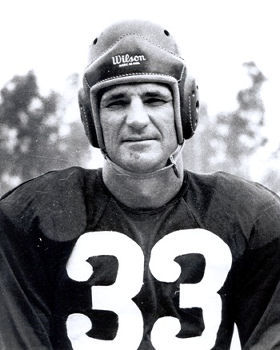
Highlighted Year: Jim Benton, 1945

End, Cleveland Rams


Age: 29 (Sept. 25)
7th season in pro football, 6th with Rams
College: Arkansas
Height: 6’3”   Weight: 195

Prelude:
A star receiver at Arkansas, where he caught 48 passes for 814 yards as a senior in 1937, Benton was chosen by the Rams in the second round of the 1938 NFL draft. His 19.9-yard average on 21 catches as a rookie led the league and he topped the NFL with seven TDs among his 27 receptions in ’39, when he was a second-team All-NFL choice and selected to the Pro All-Star Game (predecessor to the Pro Bowl). Benton took a year off in 1941 to coach high school football in his native Arkansas, but he rejoined the team in ’42. Due to the Rams suspending play for a year in 1943, Benton played for the Chicago Bears and, while his numbers dropped off, he was a key receiver in clutch situations for the NFL title-winning club. He rejoined the Rams in ’44 and achieved new personal highs with 39 catches for 505 yards.

1945 Season Summary
Appeared in 9 of 10 games
[Bracketed numbers indicate league rank in Top 20]

Pass Receiving
Receptions – 45 [2] 
Most receptions, game – 10 (for 303 yds.) at Detroit 11/22
Yards – 1067 [1]
Most yards, game – 303 (on 10 catches) at Detroit 11/22
Average gain – 23.7 [3]
TDs – 8 [3]
300-yard receiving games – 1
100-yard receiving games – 5

Kickoff Returns
Returns – 3
Yards – 16
Average per return – 5.3
TDs – 0
Longest return – 10 yards

Scoring
TDs – 8 [5, tied with Ted Fritsch & Fred Gehrke]
Points – 48 [7, tied with Fred Gehrke]

Postseason: 1 G (NFL Championship vs. Washington)
Pass receptions – 9
Pass receiving yards – 125
Average yards per reception – 13.9
Pass receiving TDs – 1

Awards & Honors:
1st team All-NFL: AP, Chicago Herald-American, Pro Football Illustrated, NY Daily News
2nd team All-NFL: INS, UPI

Rams went 9-1 to finish first in the NFL Western Division while leading the league in rushing yards (1714). Won NFL Championship over Washington Redskins (15-14).

Aftermath:
With the franchise moving from Cleveland to Los Angeles, Benton followed up his outstanding 1945 season by leading the NFL in both pass receptions (63) as well as receiving yards (981) in ’46. He was again a consensus first-team All-NFL selection. Benton played one more season for the Rams in 1947, catching 35 passes for 511 yards (14.6 avg.) and six TDs. Overall, over nine seasons he caught 288 passes for 4801 yards (16.7 avg.) and 45 touchdowns, with all but 13 receptions, 235 yards, and three TDs occurring while with the Rams. Benton was a consensus first-team All-NFL selection twice and received at least some second-team honors following two other seasons. He was chosen to the NFL All-1940s team selected by the Pro Football Hall of Fame as well as the Arkansas Sports Hall of Fame. Benton’s NFL single-game record of 303 pass receiving yards lasted until 1985.

--

Highlighted Years features players who were consensus first-team All-League* selections or league* or conference** leaders in the following statistical categories:

Rushing: Yards, TDs (min. 10)
Passing: Yards, Completion Pct., Yards per Attempt, TDs, Rating
Receiving: Catches, Yards, TDs (min. 10)
Scoring: TDs, Points, Field Goals (min. 5)
All-Purpose: Total Yards
Defense: Interceptions, Sacks
Kickoff Returns: Average
Punt Returns: Average
Punting: Average

*Leagues include NFL (1920 to date), AFL (1926), AFL (1936-37), AAFC (1946-49), AFL (1960-69), WFL (1974-75), USFL (1983-85)

**NFC/AFC since 1970

August 20, 2015

Highlighted Year: Steve Bagarus, 1945

Halfback, Washington Redskins


Age: 26
5th season in pro football, 1st in NFL & with Redskins
College: Notre Dame
Height: 6’0”   Weight: 170

Prelude:
Recipient of a basketball scholarship to attend Notre Dame, Bagarus had his biggest football moment when he returned an interception for a touchdown in a 14-0 win over Army in 1939. He went into the military during World War II and also played for the San Diego Bombers of the Pacific Coast Football League from 1941 to ‘44. He led the league in touchdowns three times and scoring twice, with highs of 12 TDs and 72 points in 1943. Bagarus joined the Redskins in 1945 and proved to be an outstanding receiver out of the backfield as well as an excellent open-field runner.

1945 Season Summary
Appeared in all 10 games
[Bracketed numbers indicate league rank in Top 20]

Rushing
Attempts – 39
Yards – 154
Average gain – 3.9
TDs – 1

Pass Receiving
Receptions – 34 [3]
Yards – 617 [3]
Most yards, game – 162 (on 8 catches) at NY Giants 10/28
Average gain – 18.1 [7]
TDs – 5 [6, tied with John Greene]

Kickoff Returns
Returns – 12 [4]
Yards – 325 [3]
Average per return – 27.1 [2]
TDs – 0
Longest return – 55 yards

Punt Returns
Returns – 21 [1]
Yards – 251 [1]
Average per return – 12.0 [4]
TDs – 0
Longest return – 28 yards

All-Purpose yards – 1347 [2]

Scoring
TDs – 6 [9, tied with Frank Akins, Ken Kavanaugh & Pug Manders]
Points – 36 [13, tied with Frank Akins, Ken Kavanaugh & Pug Manders]

Postseason: 1 G (NFL Championship at Cleveland)
Rushing attempts – 5
Rushing yards – -4
Average gain rushing – -0.8
Rushing TDs – 0

Pass receptions – 3
Receiving yards – 95
Average yards per reception – 31.7
Pass receiving TDs – 1

Kickoff returns – 1
Kickoff return yards – 29
Average yards per return – 29.0
Kickoff return TDs – 0

Punt returns – 4
Punt return yards – 52
Average yards per return – 13.0
Punt return TDs – 0

Awards & Honors:
1st team All-NFL: AP
2nd team All-NFL: Chicago Herald-American, NY Daily News

Redskins went 8-2 to finish first in the NFL Eastern Division while leading the league in total yards (3546). Lost NFL Championship to Cleveland Rams (15-14).

Aftermath:
Bagarus gained 771 yards from scrimmage in 1946 and also averaged 10.7 yards on 18 punt returns and 25.5 yards returning 13 kickoffs. He was traded to the Rams in 1947 and broke his leg, sidelining him for most of the season. Waived early in ’48, the Redskins re-signed him for the last five games. He caught 15 passes for 100 yards and a TD and retired, although he did see action with Wilmington and Richmond of the minor league AFL in 1949. Overall in the NFL, Bagarus had 80 pass receptions for 1155 yards (14.4 avg.), ran the ball 98 times for 343 yards (3.5 avg.), returned 41 punts for an 11.2-yard average and 27 kickoffs for an average of 25.3 yards. He also intercepted five passes on defense and scored a total of 10 touchdowns.  

--

Highlighted Years features players who were first-team All-League* selections or league* or conference** leaders in the following statistical categories:

Rushing: Yards, TDs (min. 10)
Passing: Yards, Completion Pct., Yards per Attempt, TDs, Rating
Receiving: Catches, Yards, TDs (min. 10)
Scoring: TDs, Points, Field Goals (min. 5)
All-Purpose: Total Yards
Defense: Interceptions, Sacks
Kickoff Returns: Average
Punt Returns: Average
Punting: Average

*Leagues include NFL (1920 to date), AFL (1926), AFL (1936-37), AAFC (1946-49), AFL (1960-69), WFL (1974-75), USFL (1983-85)

**NFC/AFC since 1970

March 10, 2015

Highlighted Year: Charley Brock, 1945

Center/Linebacker, Green Bay Packers


Age: 29
7th season in pro football & with Packers
College: Nebraska
Height: 6’2”   Weight: 210

Prelude:
Brock was chosen in the third round of the 1939 NFL draft by the Packers and quickly became a contributor on the line. The team advanced to the NFL Championship game, and Brock intercepted two passes as Green Bay defeated the Giants. He followed up in 1940 by gaining first-team All-NFL recognition from Collyers Eye and playing in the Pro All-Star Game (predecessor to the Pro Bowl) for the second time. Brock was considered to be equally outstanding as a center on offense and a “ball thief” at linebacker, where he intercepted a career-high six passes in 1942 and was again named to the Pro All-Star Game. An appendectomy cost Brock four games during the 1943 season but he still garnered consensus second-team All-NFL honors. He was named team captain in 1944, a season that the Packers capped with another NFL Championship, and was a second-team All-NFL selection of UPI.

1945 Season Summary
Appeared in all 10 games
[Bracketed numbers indicate league rank in Top 20]

Interceptions – 4 [6, tied with seven others]
Int. return yards – 122 [1]
Int. TDs – 2 [1]
Fumble recoveries – 5

Scoring
TDs – 2
Points – 12

Awards & Honors:
1st team All-NFL: AP, UPI, INS, Pro Football Illustrated, NY Daily News
2nd team All-NFL: Chicago Herald-American

Packers went 6-4 to finish third in the NFL Western Division.

Aftermath:
Brock followed up in 1946 by recovering six fumbles and gaining first-team All-NFL honors from Pro Football Illustrated. He played one more season in ’47 before accumulated wear-and-tear forced his retirement. Overall, he played in 92 regular season games over nine seasons, all with Green Bay. He was officially credited with 20 interceptions, three of which were returned for touchdowns, and he also had a TD on a fumble recovery. He was inducted into the Green Bay Packers Hall of Fame.

--

Highlighted Years features players who were consensus first-team All-League* selections or league* or conference** leaders in the following statistical categories:

Rushing: Yards, TDs (min. 10)
Passing: Yards, Completion Pct., Yards per Attempt, TDs, Rating
Receiving: Catches, Yards, TDs (min. 10)
Scoring: TDs, Points, Field Goals (min. 5)
All-Purpose: Total Yards
Defense: Interceptions, Sacks
Kickoff Returns: Average
Punt Returns: Average
Punting: Average

*Leagues include NFL (1920 to date), AFL (1926), AFL (1936-37), AAFC (1946-49), AFL (1960-69), WFL (1974-75), USFL (1983-85)

**NFC/AFC since 1970

December 16, 2014

1945: Rams Edge Redskins Thanks to Odd Safety to Win NFL Championship


The NFL Championship game on December 16, 1945 featured a postseason newcomer, the Cleveland Rams, against the Washington Redskins, a team that regularly contended for the title.

The Rams had never had a winning season since coming into the league in 1937, but topped the Western Division with a 9-1 record in ’45. Head Coach Adam Walsh implemented the T-formation and had the good fortune of having rookie QB Bob Waterfield  (pictured above) to operate it. The first-year player out of UCLA was the league MVP after performing well not only as a passer, but as a defensive back, kicker, and overall team leader. Halfbacks Fred Gehrke and Jim Gillette and FB Don Greenwood fueled the ground attack while end Jim Benton led the NFL with 1067 yards on his 45 catches.

The Washington Redskins, coached by Dudley DeGroot, topped the Eastern Division for the fourth time in six seasons with an 8-2 tally. QB Sammy Baugh was well-established as the league’s outstanding passer, having set a record with his 70.3 completion percentage during the season, and there were good receivers led by HB Steve Bagarus. However, Baugh had been injured in the season finale against the Giants and was not at his best.

There were 32,178 fans in attendance on a bitterly cold and windy day at Municipal Stadium in Cleveland. The field had been covered with bales of hay in the days leading up to the game, and there were also big piles of snow on the sidelines.

The Redskins had the game’s first possession and punted. Cleveland moved the ball well in its initial series as Fred Gehrke ran for a 16-yard gain and Bob Waterfield completed two passes to Jim Benton, who was covered by rookie HB Bob DeFruiter. The second was good for 30 yards to the Washington 15, but the Redskins held the Rams up at their five yard line, with Jim Gillette stopped short on a fourth down play to regain possession. On second down, Sammy Baugh, dropping back into his end zone and feigning a punt, threw a pass that hit the goal post and bounced back. Under the rules at the time, the play was declared a safety and the home team had an early 2-0 lead.


Baugh was injured shortly thereafter and returned to play for only a few minutes during the second half. Following an interception by Washington LB Ki Aldrich early in the second quarter, QB Frank Filchock, subbing for Baugh, threw long to Steve Bagarus (pictured at left) for a 38-yard touchdown. Joe Aguirre added the extra point and Washington was ahead by 7-2.

With less than four minutes to play in the first half, Waterfield connected with Jim Benton for a 37-yard TD that capped a six-play, 70-yard series in which Gillette had a 19-yard run and Benton caught a pass for 14 yards. Waterfield’s extra point attempt was partially blocked and hit the crossbar, but it bounced over and the Rams took a 9-7 lead.

The Rams had another chance with a minute remaining in the first half when LB Pat West intercepted a pass, but Aldrich picked off another Waterfield throw and the score remained unchanged at halftime.

In the first series of the third quarter, Waterfield threw a long, arching pass that Jim Gillette caught for a 44-yard touchdown that concluded an 81-yard series. This time the extra point attempt failed but the Rams were in front by 15-7.

Late in the period, a Waterfield punt had the Redskins starting from their five yard line, but they moved effectively down the field. Following a 15-yard carry by DeFruiter, Filchock threw to Bagarus for a 50-yard gain that set up an eight-yard TD pass to wide-open FB Bob Seymour. Aguirre added the point after to make it a one-point contest.

Washington had two chances in the fourth quarter, but Aguirre missed field goals from 31 and 44 yards. The first followed a Filchock pass to end Les Dye that gained 44 yards to the Cleveland 31 and three running plays that picked up seven more yards. With time running out, Filchock threw long from deep in his own territory and DB Albie Reisz intercepted to nail down the 15-14 win for the Rams.

Cleveland gained more total yards (372 to 214) and led in first downs as well (14 to 8). The Redskins were held to 35 rushing yards on 34 attempts while the Rams were well balanced with 180 yards on the ground and 192 through the air. Cleveland turned the ball over three times, to two suffered by Washington. But the game came down to two plays involving the goal posts, with one leading to a safety and the other a kick that just made it over the crossbar for an extra point.


Bob Waterfield completed 14 of 27 passes for 192 yards and two touchdowns, giving up two interceptions, and was excellent with his play-calling and punting, too. Jim Gillette (pictured at right) rushed for 101 yards on 17 carries and also caught two passes for 45 yards and a TD. Jim Benton had 9 catches for 125 yards and a score.

Sammy Baugh ended up completing just one of six throws for seven yards. In his place, Frank Filchock was 8-of-14 for 172 yards and two touchdowns as well as two interceptions. Steve Bagarus caught three passes for 95 yards and a TD. HB Merl Condit led the rushers by gaining 18 yards on 9 attempts.

The Rams, having lost money despite putting together a championship season, left for Los Angeles the following year and placed second to the Bears with a 6-4-1 record. They next reached the Championship game in 1949. Washington went into a long period of decline, dropping to 5-5-1 in 1946 and not reaching the postseason again until 1971.

August 30, 2014

1945: Hutson TD on Interception Caps Win for Packers Over College All-Stars


The 12th College All-Star Game on August 30, 1945 featured the Green Bay Packers, NFL Champions of the previous year, against an All-Star team coached by Bernie Bierman of Minnesota. The Packers, appearing in the annual contest for the third time, were coached by Curly Lambeau and featured end Don Hutson (pictured above), the NFL’s top receiver and scorer, who would also prove his value as a defensive back.

Bernie Bierman was head coach of the All-Stars for the second time, having been coach when the collegians tied the Detroit Lions in 1936. The roster featured future pro stars such as halfbacks Charlie Trippi of Georgia (pictured below) and Tom Harmon of Michigan, tackles Bill Willis from Ohio State and Purdue’s Dick Barwegan, who had all appeared in prior All-Star Games due to the liberalized wartime eligibility rules that allowed underclassmen to play.


There were 92,753 fans in attendance at Soldier Field on a very hot night, most of them rooting for the collegians, but the All-Stars were rarely able to dent the Packers, and were hurt by turnovers when they did. Green Bay took the opening kickoff and, with tailback Irv Comp passing effectively, the Packers drove to the All-Star 12 yard line and Don Hutson kicked a 20-yard field goal.

A quick kick by Charlie Trippi pinned the pro champs back and gave the All-Stars good field position on the ensuing punt, but C/LB Charley Brock intercepted a pass on his eight yard line and returned it 25 yards.

The Packers reached the All-Star 20 on the first play of the second quarter thanks to a run by FB Don Perkins, but a pass into the end zone was intercepted by Washington State FB/DB Bob Kennedy. However, after crossing the goal line, he retreated back into the end zone and was tackled for a safety. Instead of giving the ball up on a turnover, Green Bay was ahead by an extended margin of 5-0.

Following a fumble by Texas Tech FB Walter Schlinkman that was recovered by tackle Buford “Baby” Ray, the Packers struck quickly on a 20-yard touchdown pass from tailback Tex McKay to HB Herman Rohrig. Hutson added the point after to lengthen Green Bay’s lead to 12-0.

The All-Stars responded by moving well on offense and scoring on a pass from Kennedy to St. Joseph end Nick Scollard that covered 63 yards, with the receiver evading one defender and going the last 20 yards unmolested. Tom Harmon kicked the extra point and the tally remained 12-7 at the half.

The All-Stars got a break in the third quarter when Comp fumbled when hit by Bill Willis and G Damon Tassos of Texas A & M recovered at the Green Bay 34. The All-Stars, however, once again came up empty.

The Packers passed their way to midfield but a long throw by HB Lou Brock was picked off by Trippi at the eight, and he returned it to the 34. Any momentum shift ended when Harmon, caught from behind by Hutson and end Clyde Goodnight after breaking away for a 46-yard gain, fumbled and Brock recovered for the defending champs. However, the All-Stars got the ball back on the last play of the period when Indiana tackle Ed Bell recovered a fumble by HB Joe Laws at the Green Bay 31.

It looked like trouble for the Packers until Hutson intercepted a pass by HB Perry Moss from Tulsa on his own 15 and returned it 85 yards for a game-breaking touchdown. For good measure, Hutson also kicked the extra point.

The All-Stars threatened once more when Trippi intercepted a pass, returning it to the Green Bay two before being knocked out of bounds, and out of the game, by Laws. After the collegians were flagged for being offside, Ohio State QB Les Horvath fumbled and end Harry Jacunski recovered for the Packers at the 17 to end the threat. The final score was 19-7 for the Packers.

The All-Stars had more yards through the air (162 to 95) while the Packers outgained the collegians on the ground (132 yards to 68). Green Bay had the edge in first downs (15 to 12). Don Hutson accounted for 11 points on a touchdown, field goal, and two extra points.

The win for Green Bay put the NFL ahead of the collegians in the series by seven to three, with two ties. The Packers went on to post a 6-4 record in the regular season, finishing third in the Western Division. Don Hutson, in his final year, led the NFL in pass receptions for the eighth time with 47 catches and scored 97 points, which ranked second in the league.

Charlie Trippi, the MVP for the All-Stars, went on to a nine-year career with the Chicago Cardinals that resulted in his being inducted into the Pro Football Hall of Fame. He would go on to appear in one more College All-Star Game, this time as a member of the Cards in 1948.

October 28, 2012

1945: Baugh Passes Redskins Over Giants


The Washington Redskins had a 2-1 record as they faced their traditional division rivals, the New York Giants, on October 28, 1945. In their second year under Head Coach Dudley DeGroot, the team’s key player was still QB Sammy Baugh (pictured above), who was successfully completing the transition from single-wing tailback to T-formation quarterback. Other formidable weapons on offense were FB Frank Akins, HB Steve Bagarus, and end Joe Aguirre, who also handled the placekicking.

The Giants, in their 15th year under Head Coach Steve Owen, had topped the Eastern Division in 1944 but had taken a much more significant hit in key personnel lost to the military in the offseason than had Washington. They came into the contest at 1-1-1.

There was a sellout crowd of 55,461 on hand at the Polo Grounds. The Giants scored first when, five minutes into the game, they recovered a Baugh fumble at the Washington 33. After losing ground on a pass attempt, QB Marion Pugh threw for a 39-yard touchdown to end John Weiss, who outmaneuvered Baugh for the score. This was the high point of the contest for the Giants, as well as the nadir for Sammy Baugh.

The Redskins were held on downs in their next possession, but tied the score on a second quarter drive in which Baugh threw to Bagarus for 21 yards, end Doug Turley for 17 more, and then HB Wilbur Moore for a 17-yard touchdown. Joe Aguirre’s successful extra point made it 7-7. Just before the half, the Redskins scored again on an Aguirre field goal from 37 yards.

Washington kept up the momentum on the first series of the third quarter, taking the second half kickoff and driving to another TD. Moore started the possession off with a 27-yard run and Baugh completed a 26-yard throw to Bagarus along the way. Frank Akin plowed into the line for a three-yard touchdown to finish the drive.

Penalties nullified two apparent Washington touchdowns later in the second half as the visitors completely dominated the Giants. Baugh, a fine safety on defense, intercepted a pass and returned it 69 yards to set up the final Washington score. It was Baugh passing to end Wayne Millner for a six-yard TD following the long return.

New York took the ensuing kickoff and scored one last time in the last 30 seconds of the fourth quarter. The Redskins came away with a 24-14 win that was not as close as the tally implied.

Washington was well ahead in total yards (413 to 237) and first downs (18 to 11). The Redskins not only were strong through the air but on the ground, outgaining the Giants in rushing yardage by 182 yards to 30. Each team turned the ball over twice.

Aside from Sammy Baugh, with the two touchdown passes and long interception return, the top performer for Washington was Steve Bagarus, who caught 8 passes for 162 yards.

“That guy (Baugh) is getting better all the time,” said Steve Owen. “And I don’t mean better for us. He’s the best ever.”

The Redskins lost just one of their remaining games to finish atop the Eastern Division with an 8-2 record. They lost a close-fought NFL Championship game by one point to the Cleveland Rams. New York dropped to 3-6-1, the franchise’s first losing record in nine years, to end up tied for third in the division with the Boston Yanks.

Sammy Baugh, in his ninth season with the Redskins, set a league record that lasted until 1982 by completing 70.3 percent of his passes. He led the NFL in pass completions (128), ranked second in yards (1669), and third in touchdown passes (11). “Slingin’ Sammy” was intercepted just four times, thus also giving him the league’s lowest interception percentage among qualifiers (2.2). By today’s passer rating system he registered a 109.9 – a formidable rating by current standards, let alone those of the 1940s.

Frank Akins ran the ball 147 times, more than any other NFL back, and ranked second in rushing with 797 yards (5.4 avg. per attempt). Steve Bagarus (pictured below) was third in pass receptions (34) and receiving yards (617), thus averaging 18.1 yards per catch. 


October 14, 2012

1945: Rams Explode in 4th Quarter to Beat Packers


The NFL contest in Green Bay on October 14, 1945 was a faceoff between two Western Division teams that had started off the season at 2-0. The Green Bay Packers were the defending NFL Champions and still a potent squad, especially after their all-time great end Don Hutson had been persuaded to put off retirement and come back for another year. Coached by Curly Lambeau, the franchise’s founder, the Packers were a team that was used to contending.

As for the visiting Cleveland Rams, they had never been above .500 in any season since joining the NFL in 1937. But they had a new head coach in Adam Walsh, who installed a T-formation offense, and a talented rookie quarterback out of UCLA to run it in Bob Waterfield (pictured above). The Rams had an outstanding receiver of their own in end Jim Benton, who was ably complemented by Steve Pritko, plus a good group of running backs.

There were 24,607 fans in attendance at Green Bay’s City Stadium on a bright and clear day. The Rams scored on their first possession, driving 49 yards and finishing with a 17-yard touchdown pass from Waterfield to Benton. While Waterfield’s first extra point attempt was successful, it was nullified by a holding penalty and the second try was no good when it sailed wide. Still, Cleveland was ahead by 6-0.

That remained the situation until the third quarter when Rams HB Tom Colella fumbled and Green Bay tackle Paul Lipscomb recovered at the Cleveland 25. FB Ted Fritsch ran three times to get to the one and tailback Irv Comp went the last yard for a TD. Hutson kicked the extra point to put the Packers ahead by 7-6.

In the fourth quarter, the Packers went 54 yards, with the highlight a pass from tailback Roy McKay to Hutson for 24 yards. Fritsch plowed through the middle for a three-yard touchdown and Hutson added the point after.

Down by 14-6 in the final period, the Rams had possession at their own 27 and put together a seven-play scoring drive. Waterfield capped it by passing to Colella for a nine-yard TD. Cleveland then received a big break when Green Bay’s McKay fumbled and tackle Roger Eason recovered for the Rams at the Packers’ 17. FB Don Greenwood, Colella, and Waterfield each took a turn running the ball to get to the one yard line and Greenwood scored from there.

McKay and Comp took turns trying to connect on passes to Don Hutson until DB Albie Reisz intercepted one and returned it to the Green Bay 5. Colella ran the ball in from there for a touchdown that sealed the win for the Rams. Thanks to the three fourth quarter TDs, and Waterfield’s successful conversions after each, Cleveland came away the winner by a final score of 27-14.

The Rams led in total yards (289 to 232) but Green Bay had the edge in first downs (16 to 12). However, Cleveland ran the ball more effectively (154 yards on 45 carries to 81 yards on 39 attempts) and the Packers turned the ball over six times, as opposed to four turnovers by the Rams.

As usual, Don Hutson was Green Bay’s chief offensive weapon, catching 7 passes for 110 yards, but he was unable to penetrate the end zone (he had done so four times in one quarter the previous week against Detroit). Jim Benton caught 5 passes for 85 yards and a touchdown for the Rams.

The win moved the Rams into first place in the Western Division and that’s where they stayed, going 9-1 and beating Washington for the NFL title. Green Bay dropped to third with a 6-4 record.

Bob Waterfield overcame a severe rib injury to achieve league MVP honors while passing for 1609 yards and leading the league in yards per attempt (9.4) and touchdown passes (14, tied with Sid Luckman of the Bears).

Jim Benton (pictured below) and Don Hutson were the NFL’s most productive receivers. In his final season, Hutson led the league for the eighth time (fifth consecutive) with 47 pass receptions while his 834 yards ranked second to Benton’s 1067. Benton placed second to Hutson with 45 catches.

The 1945 season marked a change in direction for the two franchises. Green Bay went into a decline that wasn’t reversed until the arrival of Vince Lombardi as head coach and general manager in 1959. The Rams, who moved to Los Angeles in 1946, won four division or conference titles over the course of the next decade and a league championship while regularly being among the NFL’s contending teams.


March 14, 2011

1945: Rams Hire Adam Walsh as Head Coach


On March 14, 1945 the Cleveland Rams signed Adam Walsh to a five-year contract as head coach. Walsh, the line coach at Notre Dame, was the brother of Rams GM Charles “Chile” Walsh and succeeded Aldo “Buff” Donelli, who left to join the Navy.

The 43-year-old Walsh had been on the staff at Notre Dame since mid-1944, when he left Bowdoin, where he had been a successful head coach who turned a losing program around - his teams won the Maine Intercollegiate football championship in seven out of eight years. His overall record was 34-15-6. In 1943, Bowdoin suspended the athletic program for the remainder of World War II, and Walsh was allowed to go on leave of absence to Notre Dame.

Going to Notre Dame was something of a homecoming for Walsh. He played there collegiately and was an All-American center who captained the team in 1924 that contained the legendary starting backfield known as “The Four Horsemen”. After college, and prior to going to Bowdoin, Walsh was head coach and athletic director at Santa Clara from 1925 to ’28 and later served as line coach at both Yale and Harvard.

Walsh was a proponent of the T-formation, which was finding new-found popularity at both the pro and college levels in the 1940s. He was fortunate to have a rookie quarterback out of UCLA, Bob Waterfield, who could run the new offense very effectively. There was also HB Fred Gehrke, returning from a four-year stint in the military, holdover HB Jim Gillette, and rookie FB Don Greenword to handle the running game. End Jim Benton was a proven veteran, and the other starting end, Steve Pritko, had played well in ’44. Two more rookies, tackle Gil Bouley from Boston College and guard/linebacker Milan Lazetich, bolstered the line which also added veteran tackle Eberle Schultz from the Card-Pitt combined team of ’44. Guard Riley Matheson was already there, an established talent who had been a consensus first-team All-Pro in 1942 and ’44.

From a 4-6 record in 1944, the Rams went 9-1 under Walsh in ’45. Waterfield had a MVP season, leading the league with 14 touchdown passes (tied with Sid Luckman of the Bears) and 9.9 yards per attempt. He also showed outstanding toughness (he played one game heavily taped due to torn rib muscles) and leadership to go along with his fine passing, and was an asset on defense (six interceptions, tied for second in the NFL) and as a punter. Benton had a sensational year, catching 45 passes for a league-leading 1067 yards (including 303 in one game) and eight touchdowns. Gehrke, Gillette, and Greenwood all finished in the top ten in rushing and the team was top-ranked in that category. Matheson was again a consensus first-team All-Pro.

The Rams won the Western Division and hosted the Washington Redskins in the NFL Championship game on a bitterly cold day at Municipal Stadium. They won, 15-14, and Walsh had a title in his first year as a pro head coach.

While the franchise performed well on the field, it didn’t do so well at the gate. Owner Daniel F. Reeves lost some $50,000 and petitioned the league to allow him to move the club to Los Angeles. Initially turned down by the other owners, an angry Reeves had threatened to sell the team, but the NFL finally allowed the move.

The Rams went west, and faced the immediate challenge of another team, the Los Angeles Dons of the newly-formed All-America Football Conference (AAFC), competing against them for fans and sharing the massive Memorial Coliseum. Under pressure from the commission that governed the stadium, the Rams added two players – first, HB Kenny Washington, who had been a star at UCLA, and then end Woody Strode, also from UCLA – who became the first two African-Americans in the NFL since 1933. They also added HB Tom Harmon, former Heisman Trophy winner from Michigan.

The team was still very competitive at its new location. Waterfield, returning to the city where he had starred collegiately, led the NFL in passing (although by the modern rating method, he finished second to Luckman) as well as touchdowns (17). Benton again led the league in receiving yards (981) and in pass receptions as well (63, which was 31 more than runner-up Hal Crisler of the Boston Yanks). Gehrke had the top rushing average (5.2 on 71 carries for 371 yards).

The team played respectably but not consistently as they failed to win consecutive games until the last two contests of the year. It made for a second place finish at 6-4-1. In the end, the Rams lost even more money in Los Angeles than in Cleveland. Presaging decades of front office upheaval that would characterize the franchise, GM Walsh fired his brother, Coach Walsh, and was then fired himself by owner Reeves, who chose to act as his own general manager. Bob Snyder was hired as coach for 1947, and the team dropped to fourth place with a 6-6 tally.

Adam Walsh left the Rams with a 15-5-1 record as a pro head coach, and a win in the ’45 NFL title game. He returned to Bowdoin (which had always considered him to still be on leave, even after leaving Notre Dame for pro coaching). While not as successful in his second stint with the team, Walsh stayed from 1947 to ’58 and went 63-67-9 for an overall record at the school of 80-85-11.

Following his retirement from football coaching, Walsh served in the Maine House of Representatives and was later appointed U.S. Marshal for Maine by President Kennedy.

While Walsh’s pro coaching career may have been short, his college playing and coaching career earned him later recognition - he was inducted into the College Football Hall of Fame in 1968 and the Maine Sports Hall of Fame in 1976.

February 25, 2011

MVP Profile: Bob Waterfield, 1945

Quarterback, Cleveland Rams


Age: 25
1st season in pro football
College: UCLA
Height: 6’1” Weight: 200

Prelude:
Following a college career at UCLA, interrupted by a stint in the army during World War II, in which he led the Bruins to the Rose Bowl and starred in the East-West Shrine Game, Waterfield finally joined the Rams, who had chosen him in the 5th round of the 1944 NFL draft. He won the starting quarterback job during the preseason for a team that was just installing the T-formation under new Head Coach Adam Walsh.

1945 Season Summary
Appeared in all 10 games
[Bracketed numbers indicate league rank in Top 20]

Passing
Attempts – 171 [4]
Completions – 89 [3, tied with Paul Christman]
Yards – 1609 [3]
Completion percentage – 52.0 [4]
Yards per attempt – 9.4 [1]
TD passes – 14 [1, tied with Sid Luckman]
Most TD passes, game – 3 at Chicago Cardinals 11/18
Interceptions – 17 [1]
Passer rating – 72.4 [4]

Rushing
Attempts – 18
Yards – 18
Yards per attempt – 1.0
TDs – 5

Kicking
Field goals – 1 [8, tied with Pete Gudauskas, Dave Ryan & Robert Nelson]
Field goal attempts – 3 [9, tied with Dave Ryan & Joe Kuharich]
Percentage – 33.3
PATs – 31 [1, tied with Don Hutson]
PAT attempts – 34 [2]
Longest field goal – 28 yards vs. Chicago Bears 10/7

Punting
Punts – 39 [4]
Yards – 1585 [4]
Average – 40.6 [3]
Punts blocked – 1
Longest punt – 68 yards

Interceptions
Interceptions – 6 [2, tied with Bob Davis & Bob Margarita]
Return yards – 92 [3]
TDs – 0

Punt Returns
Returns – 2
Yards – 34
Average per return – 17.0
TDs – 0
Longest return – 18 yards

Scoring
TDs – 5 [13, tied with four others]
Field goals – 1
PATs - 31
Points – 64 [3]

Postseason: 1 G (NFL Championship vs. Washington)
Pass attempts – 14
Pass completions – 27
Passing yardage – 192
TD passes – 2
Interceptions – 2

Rushing attempts – 3
Rushing yards – -1
Average gain rushing – -0.3
Rushing TDs – 0

Punt returns – 1
Yards – 0
Average per return – 0.0
TDs – 0

Awards & Honors:
NFL MVP: Joe F. Carr Trophy
1st team All-NFL: AP, UPI, Chicago Herald-American, Pro Football Illustrated, NY Daily News
2nd team All-NFL: INS

Rams went 9-1 to win Western Division. Defeated Washington Redskins (15-14) for NFL Championship.

Aftermath: Played 7 more seasons, all with the Rams, who moved to Los Angeles in 1946. Was a consensus 1st team All-Pro selection two more times, and was selected to the first two Pro Bowls. Led league in passing once, although after 1949 he split the quarterbacking with Norm Van Brocklin – an arrangement neither player liked but that proved highly effective. He also became an accomplished placekicker as well as punter, leading the NFL in field goals on three occasions and field goal percentage twice. A true all-purpose talent, Waterfield intercepted a total of 20 passes over the course of his first four seasons. His #7 was retired by the Rams and Waterfield was inducted into the Pro Football Hall of Fame, Class of 1965.

--

MVP Profiles feature players who were named MVP or Player of the Year in the NFL, AAFC (1946-49), AFL (1960-69), WFL (1974), or USFL (1983-85) by a recognized organization (Associated Press, Pro Football Writers Association, Newspaper Enterprise Association, United Press International, The Sporting News, Maxwell Club – Bert Bell Award, or the league itself).

[Updated 2/15/14]

October 7, 2010

1945: Packers Score 41 Points in 2nd Quarter Against Lions


The Green Bay Packers, defending NFL champions, won their first game of the 1945 season against the arch-rival Chicago Bears and now faced the Detroit Lions on October 7 at the Wisconsin State Fair Park in West Allis. Still under the direction of founding Head Coach Curly Lambeau, Green Bay had coaxed the great end Don Hutson (pictured at right), who had wanted to retire, into coming back for another year.

The Lions, under third-year Head Coach Gus Dorais, had won six straight games, dating back to the ’44 season. An 0-11 doormat as recently as 1942, the Lions had improved under Dorais and gone 6-3-1. They had lost star tailback Frank Sinkwich to military duty (and afterward would lose him to the rival AAFC), thus diminishing the passing attack, but the Lions had compensated by beefing up the running game.

There was a capacity crowd of 23,500 in attendance for the key division matchup. They witnessed a scoreless first quarter. However, late in the period, a short punt by tailback Roy McKay gave the Lions the ball on the Green Bay 29. Tailback Chuck Fenenbock threw a pass to end Jack Matheson that covered 16 yards and followed up with a seven-yard run. Fenenbock started off the second quarter by running the remaining eight yards for a touchdown and 7-0 Lions lead.

For the remainder of the quarter, it was all Green Bay. Following the kickoff, McKay immediately hit Hutson on a 56-yard touchdown pass play. The Packers followed up with a 41-yard TD pass play from tailback Irv Comp to reserve end Clyde Goodnight.

It was McKay-to-Hutson again for a 46-yard touchdown completion and 21-7 Green Bay lead. Shortly thereafter, an interception by back Ben Starret set up another Hutson touchdown, this on a 17-yard pass from McKay. However, Hutson’s extra point attempt (he also typically handled the team’s placekicking) was blocked by the Lions.

Still, the onslaught continued as FB/LB Ted Fritsch intercepted a pass by Detroit tailback Cotton Price and returned it 69 yards for a touchdown. Before the half, Hutson scored his fourth touchdown of the second quarter on a six-yard pass from McKay. Green Bay led at the intermission by a score of 41-7, made all the more remarkable because all 41 points had been scored in one quarter.

Hutson accounted for a total of 29 of those points with five extra points in addition to the four touchdowns.

The second half was anticlimactic. The Packers got a safety in the third quarter when Goodnight tackled halfback Dave Ryan in the end zone on a punt return. However, Ryan connected with end John Greene on a 62-yard touchdown pass play late in the fourth quarter. The final score was 57-21.

Remarkably, the Lions had 15 first downs to Green Bay’s 7 and outgained the Packers on the ground, 137 yards to 53. They even had a slight edge in passing yards, 244 to 242. However, Detroit also turned the ball over six times, to just once for the Packers. And, of course, Green Bay’s second quarter bombardment easily determined the outcome. The 41 points remain the record for a single team in one NFL quarter.

The offensive stars for the Packers were Hutson, with six catches for 144 yards and four touchdowns, and Roy McKay, who completed 6 of 14 passes for 151 yards with the four TDs and none intercepted. Hutson also added two more extra points to give him a single-game point total of 31.

The strong start did not translate into season-long success for the Packers, who were swept by the eventual-champion Cleveland Rams in both of their meetings and ended up at 6-4 and in third place in the Western Division. The Lions, who beat the Packers when the clubs met again at the end of the year, came in second at 7-3.

In his final season, Don Hutson led the NFL in pass receptions (47) and was second in receiving yards (834), touchdown receptions (9), total touchdowns (10, tied with Frank Liebel of the Giants), and scoring (97 points). He retired as the all-time career leader in pass receptions (488 – the runner-up at the time had 298), receiving yards (7991), touchdown receptions (99 – which stood until 1989), total touchdowns (105), and scoring (823 points).

Roy McKay, typically splitting the tailback duties with Irv Comp, threw just one more touchdown pass the rest of the way (Comp threw 7) and had a total of 520 passing yards.

November 22, 2009

1945: Jim Benton Catches 10 Passes for 303 Yards vs. Lions


End Jim Benton had been a solid receiver for the Cleveland Rams (and one season with the Chicago Bears) since coming into the league in 1938, when he led the league in yards per reception (19.9 on 21 catches). The Rams had not been a winning team, with a 5-5-1 record in 1939 their best since joining the NFL in 1937. But both Benton and the Rams rose to new heights in 1945.

By the time the Rams met up with the Detroit Lions on November 22 for a Thanksgiving showdown at Briggs Stadium, they were sporting a 7-1 record under the guidance of Head Coach Adam Walsh. The Lions were 6-2 and, with just one more week to play in the ten-game season, control of the Western Division was at stake.

Benton had caught 27 passes for 645 yards, resulting in a very healthy 23.9-yard average, with six touchdowns and three hundred-yard games. Coach Walsh had installed the T-formation, and the offense benefited from the arrival of rookie QB Bob Waterfield from UCLA to run it. The 6’3”, 200-pound Benton was his favorite target.

Earlier in the season, Green Bay’s Don Hutson had scored four TDs and accumulated 144 yards against the Lions, which had exposed a deficiency in their pass defense. The Rams took advantage. They broke out to a 21-7 lead in the first half and went on to win 28-21. Benton scored on a 70-yard touchdown pass from Waterfield in the second quarter and, when it was all done, had caught 10 passes for 303 yards.

The 303 yards not only set a new single-game pass receiving yardage record, but remained the NFL record for 40 years until broken by Stephone Paige of the Kansas City Chiefs in 1985 (Cloyce Box of the Lions came within a yard of the record in 1950). It was also the first occasion that any player had accumulated over 300 yards from scrimmage in an NFL game.

Benton accounted for virtually all of Cleveland’s passing yards – Waterfield in all completed 12 of 21 passes for 329 yards and two touchdowns. A 17-yard throw to the other end, Steve Pritko, accounted for the second TD pass and most of the remaining yards that didn’t belong to Benton. The rookie quarterback’s showing was especially impressive because he was suffering from a painful rib injury and had been tightly wrapped up by the team’s trainer prior to the game.

With the win, the Rams clinched the West and won again in the season finale (with Benton chalking up his fifth hundred-yard receiving game of the year) to finish with a 9-1 record. They defeated the Washington Redskins in the NFL Championship game, as Benton capped his outstanding year with 9 catches for 125 yards and a TD. Detroit remained the runner-up in the Western Division at 7-3.

It was typical throughout the season for the Rams to not throw often – they were actually the league’s top rushing team with 1714 yards – but they passed very effectively. Waterfield threw 171 passes, averaged 9.4 yards per attempt and tied for the lead in touchdown throws with 14.

Benton ended up catching 45 passes for 1067 yards (a 23.7-yard average) and eight touchdowns. The reception total put him two behind the league leader, Hutson; the yards led the NFL and made him the second pass receiver to reach the thousand-yard threshold in a season. The mark is all the more remarkable in that Benton played in just nine games, missing a contest against the Bears earlier in the season due to injury, so his per game average was a gaudy 118.6.

While Benton’s outstanding season came in the last year of World War II manpower shortages, he proved it was no fluke in 1946 by leading the league both in pass receptions (63) and yards (981). At this point he was now playing for the Los Angeles Rams; in spite of winning the championship, the team had lost some $50,000 and owner Dan Reeves moved the franchise to the West Coast.