Showing posts with label Deion Sanders. Show all posts

October 13, 2015

1991: Opportunistic Falcons Outlast 49ers for Wild Win


The Atlanta Falcons were off to a 2-3 start as they traveled to San Francisco to take on the 49ers on October 13, 1991. Coached by Jerry Glanville, the Falcons were coming off of eight consecutive losing seasons and had lost in their last five meetings with the 49ers. The club employed a run-and-shoot offense directed by talented but injury-prone QB Chris Miller (pictured at right) with WR Andre Rison as the leading receiver. The defense featured an outstanding cornerback tandem in Deion Sanders, who was also excellent at returning kicks, and Tim McKyer, a sixth-year veteran who started out with the 49ers.

San Francisco had been to the playoffs in each of the previous eight years under, first, Bill Walsh and now George Seifert, and that included three Super Bowl victories, most recently in 1988 and ’89. The 49ers reached the NFC Championship game in 1990 but were in a transition year. Most notably, the team lost 35-year-old star QB Joe Montana, who was out for the season with a torn elbow tendon in his throwing arm. Backup QB Steve Young was getting his chance, but the results had been uneven thus far and the Niners were also at 2-3.

There were 57,343 fans in attendance at Candlestick Park on a sunny afternoon. The Falcons had the ball first and quickly went 73 yards in four plays. Chris Miller started off with a completion to Andre Rison for 39 yards to the San Francisco 34 and, following two carries by RB Erric Pegram, Miller fired long for WR Michael Haynes in the end zone and it was good for a 27-yard touchdown. Norm Johnson added the extra point.


Steve Young (pictured at left) threw to Jerry Rice for a 15-yard pickup on the Niners’ first play from scrimmage, but RB Dexter Carter fumbled on the next one and SS Brian Jordan recovered for the Falcons at the San Francisco 49. Miller rolled out and threw to Haynes for a gain of 41 yards on first down and, three plays later, it was Miller to Rison for a seven-yard TD. Johnson’s point after put the visitors ahead by 14-0.

The teams traded punts before FS Scott Case intercepted a Young pass at the San Francisco 38. The Falcons made their way to the San Francisco 12 as the opening period came to an end and, two plays into the second quarter, Johnson kicked a 29-yard field goal to make it a 17-0 contest.

The 49ers responded by driving 72 yards in six plays. Young completed two passes to TE Jamie Williams for 16 and 15 yards and a long throw to WR Mike Sherrard picked up 31 yards to the Atlanta 10. FB Tom Rathman gained four yards up the middle and then Young, rolling to his left, ran for a six-yard touchdown. Mike Cofer converted to narrow Atlanta’s lead to 17-7.

The Falcons reached midfield on their next series before punting and the 49ers had to punt from their own 25 in turn, with Joe Prokop’s deflected kick traveling only 17 yards to give the visitors good field position at the San Francisco 41. They reached the 23 at the two-minute warning and Johnson kicked a 43-yard field goal to put the Falcons up by 20-7.

There was still time for the 49ers following Carter’s 34-yard kickoff return, and they advanced 66 yards in five plays. The big one was a long pass by Young that WR John Taylor caught for a 54-yard touchdown. Cofer’s extra point narrowed the Atlanta lead to 20-14 at halftime.

San Francisco had the first possession of the third quarter and traveled 70 yards in five plays. Young ran twice for 14 yards and, while an apparent 20-yard completion to Taylor was called back due to an illegal motion penalty, a Young throw to Rice was good for a 57-yard TD. Atlanta’s Jordan blocked Cofer’s extra point attempt, but the game was now tied at 20-20.

It didn’t stay tied for long when Deion Sanders gathered in the ensuing kickoff and returned it 100 yards for a touchdown. Johnson’s conversion put the Falcons back in front by seven points. The 49ers came back with a nine-play, 69-yard drive. Young completed four passes, most notably to Rice for 22 yards in a third-and-six situation and to Williams for 15 yards to the Atlanta 10. Two passes into the end zone fell incomplete but, following a defensive holding penalty, RB Harry Sydney swept around end to a five-yard TD. Cofer made the point after and the score was knotted once more at 27-27.

The Falcons drove 80 yards in 10 plays in response. Miller had four completions along the way, connecting with WR Mike Pritchard for 15 yards and Rison and Haynes for 10 yards apiece. RB Steve Broussard ran for 10 yards on a draw play and an end run picked up 23 yards to set up a one-yard Miller to Rison touchdown pass. The extra point attempt failed when holder/punter Scott Fulhage fumbled the snap, but the visitors were again in the lead by 33-27.

Carter returned the ensuing kickoff 39 yards to the San Francisco 49 and the Niners had the ball heading into the fourth quarter, putting together a 51-yard drive in eight plays. Young threw to Taylor for 20 yards and scrambled to a seven-yard touchdown, leaping into the end zone at the end. Cofer kicked the extra point and the 49ers had a one-point lead at 34-33 with 12 minutes to play.


Once more the Falcons fought back, advancing 48 yards in six plays that resulted in a 44-yard Johnson field goal and a regained lead of 36-34. The 49ers methodically drove into Atlanta territory, but after reaching the 20 thanks to an 11-yard completion to Rice, Sydney lost nine yards when attempting to reverse field on a failed running play, an intentional grounding penalty moved the Niners back another 10 yards, and a third-and-29 pass by Young was intercepted by Tim McKyer (pictured above), the ex-49er. McKyer returned it 24 yards, cutting to the middle of the field, and then tossed a lateral to Sanders, who picked up another 13 yards to the San Francisco 35.

Broussard, following a short gain, ran for 23 yards and while the Falcons couldn’t reach the end zone, they added a 30-yard field goal by Johnson to pad their lead to five points with 1:45 left on the clock. It was the icing on the cake. Young completed passes to Rice for 14 yards and WR Sanjay Beach for 20, but a desperate fourth down pass from his own 39 was intercepted by McKyer, his second of the fourth quarter, to seal the 39-34 win for Atlanta.  

The 49ers, playing catchup throughout the game, led in total yards (437 to 368) and first downs (24 to 19). However, San Francisco also turned the ball over four times, to none by the Falcons. Atlanta was also very effective running the ball, gaining 160 yards on the ground to San Francisco’s 94.

Chris Miller completed 16 of 28 passes for 208 yards and three touchdowns, with no interceptions. Andre Rison had 6 catches for 69 yards and two TDs and Michael Haynes gained 94 yards on his five receptions that included a score. Steve Broussard rushed for 104 yards on just 10 attempts.

For the 49ers, Steve Young was successful on 22 of 38 throws for 348 yards and two TDs, but also gave up three interceptions, and led the club in rushing with 68 yards on 11 carries that included two more touchdowns. Jerry Rice caught 7 passes for 138 yards and a TD and John Taylor contributed 80 yards on his three catches that also included a score.

“There was one bad play and boom-boom, there were two more bad plays and we were out of it,” said San Francisco’s Coach Seifert. “There are a number of disappointing things happening. I’m obviously devastated.”

The Falcons lost to Phoenix the next week but then won seven of eight games, including the rematch with the 49ers, on the way to a 10-6 record. San Francisco won two, lost two, and was at 4-6 before putting together a six-game winning streak to finish the season also at 10-6. However, the sweep of the season series by Atlanta made the difference in which team went to the postseason. As a result, the Falcons attained second place in the NFC West and grabbed a Wild Card slot, beating New Orleans in the first round before succumbing to the Redskins at the Divisional level. The 49ers ended up in third place and out of the playoffs for the first time since 1982.


Chris Miller passed for 3103 yards and a career-high 26 touchdowns and was selected to the Pro Bowl. Andre Rison also received Pro Bowl honors as he caught 81 passes for 976 yards (12.0 avg.) and 12 TDs and Michael Haynes led the NFL by averaging 22.4 yards-per-catch on his 50 receptions for 1122 yards that included 11 scores. Deion Sanders (pictured at left) intercepted 6 passes, one of which was returned for a touchdown, and averaged 22.2 yards on 26 kickoff returns, with his return against the 49ers the lone TD, and 8.1 yards on 21 punt returns. He was chosen to the first of eight Pro Bowls in this, his third pro season.

Things would get better for Steve Young, who led the league with a 101.8 passer rating, although he also missed time due to a knee injury. Jerry Rice had a typically outstanding year, catching 80 passes for 1207 yards and a NFL-leading 14 touchdowns.  

November 20, 2014

1994: Rice Has 16 Catches, 3 TDs as 49ers Overcome Rams


The San Francisco 49ers were cruising along at 8-2 as they hosted the rival Los Angeles Rams on November 20, 1994. Head Coach George Seifert’s team had an outstanding offense built around the nucleus of QB Steve Young, WR Jerry Rice (pictured at right), and RB Ricky Watters, and there were plenty of other fine players around them. The defense benefited from the addition of CB Deion Sanders and was anchored by young DTs Dana Stubblefield and Bryant Young.  

The Rams, coached by Chuck Knox, were struggling at 4-6 and had been beaten handily by the 49ers at home earlier in the season. QB Chris Miller was talented but injury prone and RB Jerome Bettis was having difficulty duplicating his first-year exploits, although rookie WR Isaac Bruce was showing promise.

There were 62,774 fans in attendance for the Sunday night game at Candlestick Park. The 49ers took the opening kickoff and drove 72 yards in eight plays. Steve Young completed five passes, three of them to Jerry Rice and the last to WR John Taylor for a seven-yard touchdown. Doug Brien added the extra point.

The Rams responded with a seven-play drive of their own that covered 48 yards. Chris Miller was sacked by DT Bryant Young for a loss of eight yards on first down and had to leave the game, but backup QB Tommy Maddox completed passes to RB David Lang for ten yards and WR Todd Kinchen for 39 to the San Francisco 21. Los Angeles reached the 14 before the drive stalled and Tony Zendejas kicked a 31-yard field goal.

San Francisco put together another methodical drive of 67 yards in 13 plays. Young completed five more passes, two of them to Ricky Watters and two to Rice, the second for a seven-yard TD. Brien converted and the Niners took a 14-3 lead into the second quarter.

LA benefited from a roughing-the-passer penalty on Miller, who was back in the game, and two completions to Isaac Bruce picked up 18 yards to the San Francisco 10. Once again the Rams were unable to reach the end zone, but Zendejas added another field goal from 27 yards to narrow the home team’s lead to 14-6.

The scoring parade finally ended as the teams exchanged punts. Starting from their own eight, the 49ers advanced 92 yards in 12 plays. Watters gained 22 yards on two carries to start, RB Dexter Carter ran twice more for 17 yards, and Young completed five passes and scrambled once for a first down. Rice again had two catches, and again the second was good for a touchdown, this time from six yards out. Brien added the PAT and the Niners took a 21-6 lead into halftime.

The Rams took the second half kickoff and drove 70 yards in six plays, the biggest of which was an end-around in which Kinchen raced 44 yards for a TD. The try to pass for two points failed and the score stayed at 21-12.

Once again the 49ers moved effectively down the field. Young had completions to Rice for 29 yards and Watters for 14, but this time they ended up with a field goal by Brien from 28 yards, still keeping them comfortably in the lead by 24-12.

LA faced a third-and-12 situation on its next series but Miller completed a pass to Kinchen for the needed yards and, three plays later, the Rams pulled off another big play when Miller threw long down the left sideline for WR Willie “Flipper” Anderson, who beat Deion Sanders and went the distance for a 50-yard touchdown. Zendejas added the extra point and the visitors were now just five points behind at 24-19.


On San Francisco’s second play after the ensuing kickoff, Young (pictured at left) went deep for Watters to pick up 35 yards and, adding on an unnecessary roughness penalty, the Niners advanced all the way to the LA 26. But the 49ers were able to gain only three more yards and Brien’s 41-yard field goal attempt was wide to the right.

The Rams were on the move as the game headed into the fourth quarter. Miller completed passes to Anderson for 14 yards and Jerome Bettis for 20 to reach the San Francisco 36. Two runs by Bettis, plus a facemask penalty, picked up another 14 yards before Miller fired a pass toward the goal line that WR Jessie Hester caught for a 22-yard TD. Bettis successfully ran for a two-point conversion and the upset-minded Rams were ahead by 27-24.

The 49ers again reached Los Angeles territory, but a penalty for an illegal forward pass by Young, who was a yard past the line of scrimmage on what would have been a long completion to TE Brent Jones, forced them to punt. The Rams went three-and-out and had to punt in turn and the 49ers, starting from their 43, advanced back into LA territory. But after a six-yard run by Watters gave the Niners a first down at the 25, Rice fumbled when hit by LB Shane Conlan after catching a pass and DE Gerald Robinson recovered for the Rams.

LA again couldn’t move on offense and punted following a short series, and San Francisco responded with a 10-play, 67-yard drive. Young threw to Jones for 19 yards and to Rice for 14 yards in a third-and-six situation. The drive was capped by another Young pass to Rice that resulted in an 18-yard touchdown. Brien’s extra point put the 49ers back on top by four.

The Rams regained possession with 1:56 remaining in regulation. Miller passed them to the San Francisco 38, but a holding penalty backed them up, Deion Sanders deflected a throw into the end zone that was intended for Anderson, and Lang dropped a fourth-down pass to seal the 31-27 win for the 49ers.

San Francisco had significant edges in total yards (459 to 358) and first downs (32 to 17). They also recorded the game’s only two sacks, but also the only turnover and led in penalties (7 for 60 yards to five for 50).

Jerry Rice set a then- club record with 16 catches, good for 165 yards and three TDs, and made up for his fourth quarter fumble with the game-winning reception. Steve Young completed 30 of 44 passes for 325 yards and four touchdowns with none intercepted and also ran for 23 yards on 10 carries. Ricky Watters gained 81 yards on 20 rushing attempts and added 74 more yards on five pass receptions. John Taylor also had five catches, for 49 yards and a score.


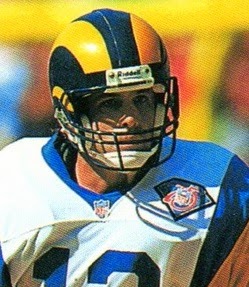
For the Rams, Chris Miller (pictured above) was successful on 16 of 33 throws for 228 yards and two touchdowns, also with no interceptions. Willie Anderson caught five passes for 99 yards and a TD while Todd Kinchen contributed 51 yards on two receptions and had the one 44-yard scoring run, which made him the team’s leading rusher. Jerome Bettis was held to 29 yards on 15 attempts.

San Francisco kept on winning, finishing atop the NFC West with a league-best 13-3 record and going on to thrash San Diego in the Super Bowl. The Rams didn’t win again the rest of the way, ending up at the bottom of the division with a 4-12 tally. It was the franchise’s last season in Los Angeles as it departed for St. Louis the following year.

Jerry Rice led the NFL with 1499 yards on 112 catches that included 13 touchdowns. It marked his ninth consecutive season with over a thousand receiving yards and he was a consensus first-team All-NFL selection for the eighth time and a Pro Bowl selectee for the ninth straight year. Steve Young led the league in passing with a 112.8 rating and in touchdown passes with 35. He received consensus league MVP honors in addition to being a first-team All-NFL choice for the third year in a row and a Pro Bowl selection.

October 14, 2013

MVP Profile: Deion Sanders, 1994

Cornerback, San Francisco 49ers


Age: 27
6th season in pro football, 1st with 49ers
College: Florida State
Height: 6’1”   Weight: 185

Prelude:
The brash and flamboyant Sanders was a two-time All-American in college, where he also excelled in baseball and track. He was drafted in the first round (fifth overall) by the Atlanta Falcons in 1989 and was with them for five seasons. “Neon Deion” made an immediate impression both at cornerback, where he intercepted five passes, and as a kick returner, scoring a touchdown on his first pro punt return. He was selected to the Pro Bowl for the first of four straight seasons in 1991 and was a consensus first-team All-NFL selection in ’92 for the first of three consecutive years. He also split his time playing major league baseball with the New York Yankees and Atlanta Braves and led the NL in triples with 14 in 97 games in 1992. In the NFL, he was tremendous at coverage if not tackling and a fine kick returner who led the league in kickoff return yards (1067) in ’92. Through the 1993 season, he had intercepted 24 passes, with a high of 7 in ’93, and scored three TDs on INT returns and had also scored touchdowns on two punt returns and three kickoff returns. Sanders was occasionally used as a wide receiver on offense, with 11 catches for 160 yards and two TDs. Sanders left the Falcons as a free agent following the 1993 season and signed a one-year contract with the 49ers for ’94.

1994 Season Summary
Appeared in 14 of 16 games
[Bracketed numbers indicate league rank in Top 20]

Interceptions – 6 [8, tied with Greg Jackson]
Most interceptions, game – 1 on six occasions
Int. return yards – 303 [1]
Most int. return yards, game – 93 (on 1 int.) at Atlanta 10/16
Int. TDs – 3 [1, tied with Ray Buchanan]
Sacks – 0
Fumble recoveries – 1
Forced fumbles – 0
Tackles – 34
Assists – 2

Scoring
TDs – 3
Points – 18

Postseason: 3 G
Interceptions – 2
Int. return yards – 15
TDs – 0

Kickoff Returns – 1
Kickoff Return Yards – 25
TDs – 0

Awards & Honors:
NFL Defensive Player of the Year: AP
1st team All-NFL: AP, PFWA, Sporting News
1st team All-NFC: UPI, Pro Football Weekly
Pro Bowl

49ers went 13-3 to finish first in the NFC West with the top seed in the conference while tying for the NFL lead in interceptions (23). Won NFC Divisional playoff over Chicago Bears (44-15), NFC Championship over Dallas Cowboys (38-28), and Super Bowl over San Diego Chargers (49-26).

Aftermath:
Sanders moved on to the Dallas Cowboys in 1995, where he debuted late due to arthroscopic surgery, but contributed to a NFL title. He played with Dallas for another four seasons and was a consensus first-team All-NFL selection three more times and a Pro Bowl choice in all four. After playing baseball for the Cincinnati Reds and San Francisco Giants in 1994 and ’95, he took the 1996 major league season off (he would return to baseball sporadically) and concentrated on doubling as a wide receiver for the Cowboys on offense, resulting in 36 catches for 475 yards and a TD. But it was at cornerback and kick returning where Sanders continued to excel – he picked off a total of 14 passes with Dallas, two of which were returned for TDs, and he also led the NFL with a 15.6 punt return average in 1998. Sanders played one year with Washington in 2000 before retiring, although he returned for two years with the Ravens in 2004 and ’05. Overall, Sanders intercepted 53 passes that were returned for 1331 yards and 9 touchdowns, and he averaged 10.4 yards on 212 punt returns with 6 TDs and 22.7 yards on 155 kickoff returns with three scores. He was a consensus All-NFL choice six times, received at least some consideration in three other seasons, and was a Pro Bowl selection 8 times. The player known as “Prime Time” could be a polarizing figure with fans and other players, but his talent was undeniable. Sanders was inducted into the Pro Football Hall of Fame, Class of 2011.

--


MVP Profiles feature players who were named MVP or Player of the Year in the NFL, AAFC (1946-49), AFL (1960-69), WFL (1974), or USFL (1983-85) by a recognized organization (Associated Press, Pro Football Writers Association, Newspaper Enterprise Association, United Press International, The Sporting News, Maxwell Club – Bert Bell Award, or the league itself). Also includes Associated Press NFL Offensive and Defensive Players of the Year.