Showing posts with label Harold Jackson. Show all posts

September 3, 2016

1978: Dusek Fumble Return Lifts Redskins Past Patriots


The Washington Redskins were under new leadership and facing long odds (they were 9.5-point underdogs) as they faced the New England Patriots in a season-opening game on September 3, 1978.

Jack Pardee was making his debut as head coach of the Redskins, the successor to George Allen and his seven straight winning records, including 9-5 in ‘77. Allen had dealt away draft picks to stockpile veterans, and there were concerns about retooling at certain positions. Foremost was at quarterback, where Bill Kilmer was almost 39 years old and being pressed by Joe Theismann, who was named the starter just prior to the opener. HB Mike Thomas was capable and it was hoped that FB John Riggins would rebound from an injury-plagued year. The defense was tough but old and there were concerns in particular about the backfield.

New England, coached by Chuck Fairbanks, had also been 9-5 the previous year but was considered to be a contender in the highly competitive AFC East. Steve Grogan brought grit and mobility to the quarterback position and there was a promising group of runners led by FB Sam Cunningham. WR Darryl Stingley’s career was cut short by a spinal cord injury suffered during the preseason and WR Harold Jackson was obtained from the Rams to take his place. The defense was fifth overall in 1977 and especially strong against the run.

There were 55,037 fans in attendance at Schaeffer Stadium in Foxboro, MA. The Redskins came through with a big gain on their first play from scrimmage as Joe Theismann fired a pass to WR Danny Buggs that picked up 63 yards to the New England 17. From there, the visitors made it to the eight before Mark Moseley came on to kick a 26-yard field goal for the early 3-0 lead.

That lead held up through the first half as both quarterbacks were erratic and the Patriots failed to take advantage of several opportunities. Drives to the Washington 23 and 26 both came up empty, the last when CB Lamar Parrish picked off a Grogan pass at his 18 with 20 seconds remaining in the second quarter.

Three minutes into the third quarter, the Patriots finally got on the board as the result of an 80-yard drive in seven plays when QB Steve Grogan passed to WR Stanley Morgan for a 33-yard touchdown. John Smith added the extra point for a 7-3 advantage.

The Redskins responded later in the period thanks to 18-year veteran DE Ron McDole’s interception of a Grogan pass that he batted into the air at the line of scrimmage and that resulted in an 11-play, 55-yard advance. Mike Thomas converted one third down with a six-yard run and then another in which he made a diving catch for 14 yards to the New England 22. After reaching the 10, a fumbled snap lost five yards and Theismann’s throw to WR Frank Grant in the end zone was dropped. Once more it was Thomas, circling out of the backfield and getting open for a 15-yard TD toss from Theismann. Moseley’s extra point attempt hit the goal post and was unsuccessful but the visitors were in front by 9-7.


As the game headed into the fourth quarter, the Patriots put together an 80-yard drive as two reserves, HB Horace Ivory and TE Don Hasselbeck, made key plays and Grogan went long to Harold Jackson for a 45-yard touchdown. Smith’s conversion put New England back on top by 14-9.

Up by five points, the Patriots were attempting to run out the clock as they took possession in the last three minutes. But on a second down play Ivory, attempting to sweep around right end, was hit hard by DT Dave Butz, causing a fumble. LB Brad Dusek, a former member of the Patriots, grabbed the ball on one bounce and raced down the left sideline along with a convoy of teammates for a 31-yard touchdown. Moseley this time made good on the PAT and the visitors clung to a two-point lead with 2:40 left to play.

The Patriots still had time and a brisk wind at their backs. They got a break on the next series as Grogan fumbled when sacked by DE Diron Talbert and the Redskins recovered, but the play was nullified by an illegal bump on Parrish. That gave the Patriots a first down at their 32, but a handoff to HB Andy Johnson was botched, DE Coy Bacon sacked Grogan for a 13-yard loss, and a third down pass was dropped by WR Don Westbrook to force a punt. Washington then put the game away when John Riggins broke away for a 31-yard gain to the New England 16 in the last minute, allowing the Redskins to run out the clock and win by a final score of 16-14.

Total yards were nearly even, with the Patriots having a slight edge (326 to 324) although New England more decisively led in first downs (21 to 14). However, the Patriots also turned the ball over three times, to two suffered by Washington, and the Redskins recorded three sacks, to one by New England.


Joe Theismann completed 10 of 24 passes for 184 yards and a touchdown while giving up an interception. Mike Thomas ran for 70 yards on 11 carries and also led the Redskins with four catches, for 46 yards and a TD. With the long gain to start the game, Danny Buggs gained 89 yards on two pass receptions. John Riggins contributed 60 rushing yards on 16 attempts.

For the Patriots, Steve Grogan was successful on just 12 of 31 throws for 199 yards and two TDs with two interceptions. Despite the late fumble, Horace Ivory had a fine overall performance with 89 yards on 16 carries. Harold Jackson caught 7 passes for 124 yards and a touchdown.

The opening win was the first of six straight for the Redskins, but they slipped badly during the second half of the season to finish at 8-8 and third in the NFC East. New England recovered to win eight of the next nine games, and topped the AFC East with an 11-5 record. However, the announcement by Coach Fairbanks that he was resigning to take over at the University of Colorado just prior to the season finale, and his immediate dismissal by owner William H. Sullivan effectively pulled the plug on the season. The Patriots lost decisively to Houston in the AFC Divisional playoff round.

Brad Dusek, who was originally drafted by the Patriots, was in his fifth season with Washington and well established as the starting left linebacker. His game-winning fumble recovery was one of two for the year and 16 over the course of his career, three of which he returned for touchdowns.

November 8, 2014

1970: Eagles Upset Dolphins for First Win of Season


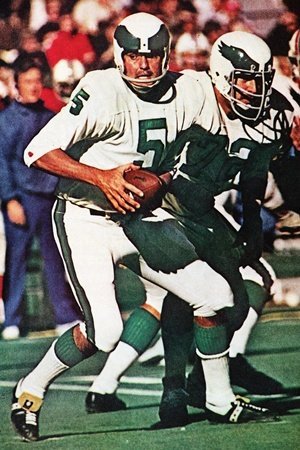
The Philadelphia Eagles were winless at 0-7 and, going back to the previous year, were struggling with an 11-game losing streak as they hosted the Miami Dolphins on November 8, 1970. QB Norm Snead, in his seventh season with the team, had a strong arm but was immobile and interception-prone. There were good receivers, most notably WR Harold Jackson (pictured at right), but the running game missed FB Tom Woodeshick, who had gone down for the year with an ankle injury. The defense had some talent, especially at linebacker and in the backfield, but the pass rush had not been impressive thus far. Head Coach Jerry Williams made some lineup changes coming into the game, inserting rookie first draft choice Steve Zabel at tight end and moving Gary Ballman from tight end to flanker, thus benching Ben Hawkins, in the hope of improving blocking for the running game.

Miami was in its first season under Head Coach Don Shula, having suffered through four lackluster years as an AFL expansion team (1970 was the first year with AFL teams merged into the reorganized NFL). Another new arrival, WR Paul Warfield, was obtained from Cleveland and proved beneficial to the young offense with his ability to stretch defenses. QB Bob Griese was still a work in progress, while halfbacks Jim Kiick and Eugene “Mercury” Morris, and FB Larry Csonka, were all talents on the rise. The young defense was anchored by veteran MLB Nick Buoniconti, who had rookies Mike Kolen and Doug Swift starting on either side of him, and also benefited from the presence of FS Jake Scott, a CFL veteran. After getting off to a surprising 4-1 start, however, the Dolphins had been shut out in their previous two contests and were 4-3 coming into Philadelphia.

There were 58,171 fans in attendance at Franklin Field. The teams started off the game trading punts, with each blunting promising drives by committing penalties. Miami got the first break when CB Curtis Johnson recovered a fumble by FB Lee Bouggess at the Philadelphia 45. Bob Griese ran the ball himself for a 16-yard gain, but the drive stalled at the 21 and Garo Yepremian missed on a 28-yard field goal attempt.

The Eagles were driving as the first quarter came to an end. Norm Snead completed consecutive passes to Harold Jackson for 15 and 9 yards and HB Cyril Pinder ran effectively. Snead capped the 80-yard, nine-play series with another pass to Jackson that was good for a 31-yard touchdown, Mark Moseley added the extra point, and the home team was ahead by 7-0.


The teams again exchanged punts, with the Eagles pinning the Dolphins back at their four yard line. The visitors dug out of the hole, however. After reaching their 13, Griese threw to Paul Warfield (pictured at left) for 15 yards and Larry Csonka followed up with a 14-yard carry to the 42. But Jim Kiick lost two yards and Griese’s next pass was intercepted by FS Steve Preece, who returned it 19 yards to the Miami 37. The Eagles advanced to the 16 and Moseley booted a 23-yard field goal.

Mercury Morris returned the ensuing kickoff 51 yards to give the Dolphins good field position at the Philadelphia 49 with 1:45 remaining in the first half. Kiick ran for 12 yards and caught a pass for another seven, but Griese again was picked off, this time by LB Adrian Young. Philadelphia drove 71 yards in six plays, with Snead throwing to Bouggess for a gain of 34 yards and Pinder running up the middle for 15 yards along the way. Snead connected with Jackson once again for a 15-yard TD and, with Moseley’s conversion, the Eagles took a 17-0 lead into halftime.

The teams started off the third quarter with an exchange of punts before Griese again gave up an interception, this time by CB Ray Jones, who returned it 17 yards to the Miami 16. The Eagles again took advantage of the turnover and Snead passed to Steve Zabel for a two-yard touchdown. Moseley added the PAT.

Down by 24-0, John Stofa replaced Griese at quarterback for the Dolphins. Miami had to punt after a short series, but this time the visitors were the beneficiaries of an interception as Jake Scott picked off a Snead pass and returned it 47 yards to the Philadelphia 19. On the third play of the fourth quarter, Yepremian finally got the Dolphins on the board with a 24-yard field goal.

The Eagles went three-and-out and punted, and the Dolphins struck quickly as Stofa threw long to Warfield for a 52-yard touchdown. Yepremian’s extra point made it a 14-point game with plenty of time remaining.

Philadelphia got a 23-yard gain on a pass from Snead to WR Ben Hawkins on the next series, but once again had to punt, and both teams followed up with short possessions leading to punts. Finally, starting at their own 38 with 5:16 to go, the Dolphins put together a six-play, 62-yard drive. Stofa converted a third down with a pass to Kiick that gained 20 yards and finished off the series with a toss to WR Willie Richardson for a 27-yard TD. Yepremian again converted and Philadelphia’s margin was down to seven points.

That was the last gasp for Miami, however. Following a short series that led to a punt by the Eagles, the Dolphins got the ball back at their 20 with the clock showing 1:40 to play. Stofa completed a pass to Morris for 14 yards but then was intercepted by Young, whose second pickoff of the day sealed the 24-17 win for the Eagles.

Philadelphia had the edge in total yards (291 to 245) and first downs (17 to 14). The inspired Eagles defense accounted for four sacks and four interceptions, which accounted for Miami’s turnover total. Philadelphia turned the ball over twice and gave up just one sack. The Dolphins also were penalized eight times, at a cost of 62 yards, while the Eagles were flagged on six occasions.


Norm Snead (pictured above) completed 15 of 29 passes for 187 yards and three touchdowns while giving up one interception. Harold Jackson had 5 catches for 74 yards, two of them for TDs. Lee Bouggess also had 5 receptions, for 57 yards, although he gained only two rushing yards on 12 carries. Cyril Pinder ran for 99 yards on 23 attempts. Defensively, Adrian Young accounted for two of Philadelphia’s four interceptions.

For the Dolphins, Bob Griese was successful on just 6 of 14 throws for 42 yards with no TDs and three interceptions. In relief, John Stofa went five-of-15 for 120 yards, two of them good for touchdowns and with one picked off. Willie Richardson caught three passes for 39 yards and a TD and Paul Warfield gained 67 yards on his two receptions that included one for a long score.

The Eagles tied Atlanta the next week and then upset the Giants on the way to a 3-10-1 record that placed last in the NFC East. The season turned around in a good way for Miami, which won its remaining six games to end up second in the AFC East at 10-4. The Dolphins qualified for a Wild Card playoff spot in the revamped postseason format brought about by the AFL/NFL merger and lost in the Divisional round to Oakland.

Norm Snead, in his last year with the Eagles, passed for 2323 yards and 15 touchdowns, but with 20 interceptions. Harold Jackson caught 41 passes for 613 yards (15.0 avg.) and five TDs. The performance by the rookie Lee Bouggess was characteristic as he led the club with 50 pass receptions, for 401 yards (8.0 avg.) and two TDs, but averaged just 2.5 yards per rushing attempt with 401 yards on 159 carries.

Just as Miami’s fortunes improved, so did Bob Griese’s. The fourth-year quarterback completed 58.0 percent of his passes for 2019 yards and 12 touchdowns, although with 17 interceptions, and was named to the Pro Bowl. Paul Warfield missed three games due to injury but averaged 25.1 yards on 28 catches for 703 yards and six TDs.

June 8, 2013

1973: Eagles Pay Heavy Price in Trade with Rams for Roman Gabriel


On June 8, 1973 the Philadelphia Eagles took a major step in revamping their offense by acquiring QB Roman Gabriel from the Los Angeles Rams. The acquisition of the 32-year-old quarterback came at great cost, however – they gave up All-Pro WR Harold Jackson, FB Tony Baker, and their first round draft choices for 1974 and ’75 plus a third round choice for 1975.

Gabriel had been taken by the Rams in the first round of the 1962 NFL draft out of North Carolina State (second overall). Big, especially for his time at 6’5” and 220 pounds, and with an accurate throwing arm, he showed potential during his first four seasons but shared time with Zeke Bratkowski, Terry Baker, and Bill Munson. The arrival of George Allen as head coach in 1966 brought improvement to the team in general and Gabriel in particular, who no longer faced challenges for the starting job. Operating in a ball control offense that complemented a ferocious defense, Gabriel took few risks and threw few interceptions. Over the course of the five seasons through 1970, the Rams went 49-17-4 during the regular season, although they lost both of their postseason games. The big quarterback was selected to the Pro Bowl three times (1967, ’68, and ’69) and was a consensus NFL MVP selection in 1969.

Things began to unravel after Allen’s departure following the 1970 season, and Gabriel suffered with tendonitis in his throwing elbow in ’72. His numbers dropped appreciably as he passed for 2027 yards (his lowest total since 1965) and he tossed more interceptions (15) than touchdowns (12).

Earlier in the offseason, the Rams acquired QB John Hadl from San Diego and Gabriel sought a trade. Because he had a no-trade, as well as no-cut, clause in his contract, he filed suit against the Rams, saying that his no-trade clause had been invalidated when Carroll Rosenbloom became owner of the Rams through a franchise swap for the Baltimore Colts with Robert Irsay.

Since Gabriel’s approval was necessary for any trade to occur, he was allowed to negotiate with other teams and agreed to terms with the Eagles the week before the deal, with the condition that a trade could be worked out. The suit was withdrawn in order to clear the way for the transaction with Philadelphia, but Rosenbloom, reacting to negative local press, nearly called off the trade at the last minute.

With regard to the players the Rams received in the trade, WR Harold Jackson was returning to the organization he had been with originally. A 12th round draft pick by LA in 1968, he appeared in just two games on special teams and was traded to the Eagles. His star rose quickly in Philadelphia as he led the NFL in pass receiving yards in ’69 with 1116 while catching 65 passes and scoring nine touchdowns. In four years with Philadelphia he caught a total of 215 passes for 3493 yards (16.2 avg.) and 21 TDs and was twice selected to the Pro Bowl, including after a 1972 season in which he led the league in both pass receiving (62 catches) and yards (1048).

FB Tony Baker played for the Saints before coming to Philadelphia, gaining selection to the Pro Bowl in 1969 when he led the NFL in average gain per carry (4.8) while rushing for 642 yards on 134 attempts and catching 34 passes for 352 more yards and another TD. Dealt to the Eagles during the ’71 season, he was coming off a year in which he ran the ball 90 times for 322 yards (3.6 avg.). He had nearly been traded to Atlanta during the ’72 season for RB Jim “Cannonball” Butler, but Butler flunked the team physical. The acquisition of FB Norm Bulaich from the Colts made Baker expendable.

The Eagles were coming off a 2-11-1 record in 1972 and were especially dreadful on offense, despite the presence of Jackson. They ranked at the bottom of the league in points scored (145) and touchdowns (12). Veteran QB Pete Liske gave way to John Reaves, the team’s first round draft choice out of Florida, and while Reaves had his moments, he also lost all of his starts. Head Coach Ed Khayat was fired and successor Mike McCormack sought to bolster the attack.

Gabriel did indeed make a difference in 1973. Dubbed “The Messiah” by the media and hopeful fans, his offseason regimen of martial arts training helped in overcoming his arm problems. 6’8” WR Harold Carmichael took over Harold Jackson’s place in the starting lineup with admirable results as he led the NFL in catches (67) and receiving yards (1116). Together with 6’4” rookie TE Charle Young and 6’3” WR Don Zimmerman, the receiving corps became known as “The Fire High Gang”. Gabriel led the NFL in pass attempts (460), completions (270), yards (3219), and TD passes (23) and he was selected to the Pro Bowl as well as receiving Comeback Player of the Year recognition. The team scored 310 points and 34 touchdowns, and while the record was still under .500 at 5-8-1, it was a notable improvement.

Gabriel played another four years with the Eagles, but with far less success. When a strike by the NFL Players Association delayed the start of training camps in 1974, Gabriel chose to report after three weeks and prior to a settlement, which damaged his relationship with his teammates. The club started out at 4-1 but then lost six straight games and Coach McCormack benched Gabriel in favor of rookie QB Mike Boryla for the final three contests of the season. His numbers declined to 1867 passing yards with 9 TD passes and 12 interceptions.

Gabriel regained the starting job in 1975 but lost it again to Boryla during a poor season that proved to be the last for McCormack. With the arrival of Dick Vermeil as head coach in ’76, he remained in a backup role for the last two years of his career, first to Boryla and then Ron Jaworski. Overall with the Eagles, Gabriel completed 661 of 1185 passes (55.8 %) for 7221 yards and 47 touchdowns with 37 interceptions. The team went 12-25-1 during his starts.

Meanwhile in Los Angeles, the Rams improved to 12-2 and won the NFC West in 1973 under new Head Coach Chuck Knox. Harold Jackson (pictured below) maintained his All-Pro form, catching fewer passes in a ball control offense (40) but averaging 21.9 yards per reception as he gained 874 yards and scored 13 TDs, including four in one game in which he accumulated 238 yards on 7 catches against the Cowboys. In five years with the Rams, he was selected to the Pro Bowl on three occasions. Tony Baker, utilized as a short-yardage specialist, ran the ball 85 times for 344 yards and 7 TDs. He lasted just one more year before moving on to San Diego.


The first round draft choices that the Rams obtained in the Gabriel deal were used to take RB John Cappelletti, the Heisman Trophy winner out of Penn State, in 1974 and G Dennis Harrah from the Univ. of Miami in ’75. The third round pick in 1975 went for Auburn TE Dan Nugent. Cappelletti was a serviceable back in LA for five years before moving on to the Chargers, rushing for a total of 2246 yards. Harrah became a mainstay on the offensive line for 13 seasons and was selected to the Pro Bowl six times. Nugent saw no action with the Rams and, converted to guard, was traded to the Redskins in 1976 for two draft choices.

The Gabriel trade was typical of deals made by the Rams that allowed them to stockpile high draft picks. They remained contenders throughout the decade, going to the playoffs in eight straight seasons and reaching the Super Bowl once. Meanwhile, the Eagles traded away more high draft choices in 1974 for LB Bill Bergey, who helped solidify the defense. They remained a mediocre team, breaking even at 7-7 that year and dropping to 4-10 in 1975. The situation would not improve until 1978, Dick Vermeil’s third year with the franchise. Ultimately, Roman Gabriel would not be a part of the team’s rise, and despite his fine first year with the club, the trade ultimately proved to be more of a hindrance to the club’s progress than a benefit.

October 3, 2012

1976: Harris Throws for 436 Yards as Rams Defeat Dolphins


The Los Angeles Rams were 2-0-1 and featured the NFL’s best rushing offense as they faced the Miami Dolphins on October 3, 1976. Head Coach Chuck Knox preferred a conservative offense paired with a solid defense, and the running of HB Lawrence McCutcheon and FB John Cappelletti had accounted for 682 yards on the ground in the first three contests. There was uncertainty at quarterback, however, as James Harris (pictured at right) had been sidelined for the first two weeks of the season due to a broken thumb on his throwing hand – Ron Jaworski and Pat Haden had each taken a turn behind center in his place.

The Dolphins, under Head Coach Don Shula for the seventh year, were 2-1 and in the midst of retooling after having won three straight AFC titles and back-to-back NFL Championships. They still had the outstanding Bob Griese at quarterback, but the running game was not as proficient as it had once been and Griese had dislocated the middle finger of his throwing hand during practice the previous week. Furthermore, injuries amid the linebackers were making the defense vulnerable and the Dolphins were forced to shift to a formation with a five-man front and two linebackers.

Harris, wearing a brace on the injured thumb of his throwing hand, largely shifted away from the running game to take advantage of the weakness in the middle of Miami’s passing defense. The Rams were further helped by the added wrinkle of using three wide receivers in key situations and, in particular, having WR Ron Jessie line up in the backfield where he was used as a man-in-motion.

Still, the home crowd at the Orange Bowl saw the Dolphins take an early lead in the first quarter when HB Benny Malone ran for a touchdown from two yards out. They extended the lead in the second quarter thanks to a 28-yard carry for a TD by FB Norm Bulaich.

Meanwhile Harris threw for 197 yards in the first half, but LA couldn’t get on the board as DE Vern Den Herder blocked a 49-yard field goal attempt by Tom Dempsey and FS Barry Hill blocked another try from 22 yards. Dempsey failed a third time when he was wide on a 29-yard attempt.

Down 14-0 at the half, the Rams struck quickly in the third quarter as Harris threw to Ron Jessie for a 58-yard touchdown. Miami responded with a scoring drive that led to a one-yard TD carry by FB Stan Winfrey.

Harris again went to Jessie, who made an over-the-shoulder catch of a perfectly-thrown bomb in the end zone for a 43-yard touchdown that cut Miami’s lead to 21-14. As the third quarter was winding down, the Rams put together a drive that took them inside the Miami 20. On a third-and-seven play at the 15, McCutcheon took a handoff but then flipped a lateral back to Harris, which he picked up on the first bounce and advanced all the way to the three for first-and-goal. On the second play of the fourth quarter, Harris leaped into the end zone from a yard out to complete the 46-yard series and, with the successful extra point, the score was tied at 21-21.


LA put together a 75-yard drive in seven plays to take the lead, with Harris throwing to Jessie for 26 yards and WR Harold Jackson for 25 along the way. McCutcheon ran a sweep for a nine-yard touchdown to cap the series and, with the successful extra point, the Rams were in front by 28-21.

The Dolphins weren’t finished, however, and two minutes after Los Angeles took the lead, using just three plays, they came back with a 47-yard touchdown pass from Griese to WR Nat Moore to tie the game.

Now it was LA’s turn and Harris came through with another big play, throwing to Jackson for a 50-yard gain to get to the Miami 11. Three running plays advanced the ball to the two and Dempsey, making up for earlier failures, kicked a 19-yard field goal with just 1:56 remaining to provide the winning points. Interceptions of Griese desperation passes by SS Dave Elmendorf and FS Bill Simpson snuffed out any further hopes for the Dolphins and the Rams came away with a 31-28 win.

The Rams outgained Miami (593 yards to 319) and had the edge in first downs (23 to 21). The visitors accumulated the bulk of their yardage (426) through the air while the Dolphins gained most of theirs on the ground (219). LA also had more penalties (8, at a cost of 76 yards, to three flags on the home team) but, with the late interceptions, the Dolphins led in turnovers (two to one).

James Harris had a huge performance, completing 17 of 29 passes for 436 yards with two touchdowns and one interception – he also ran the ball six times for 29 yards and a TD. Ron Jessie caught 7 of those throws for 220 yards and the two long scores. Harold Jackson contributed another 99 yards on just 4 catches. Lawrence McCutcheon uncharacteristically had more receiving than rushing yards as he gained 99 yards on 5 pass receptions and led the team with 91 yards on 22 carries with a TD.

For the Dolphins, Bob Griese went to the air just 11 times and completed 6 of them for 100 yards and a touchdown with two intercepted. Benny Malone led the running game with 19 attempts for 111 yards and a TD and also caught two passes for five more yards. Nat Moore gained 66 yards on his two receptions that included a TD.

“I’m not much of a statistics man,” said James Harris. “I like to think I’m a team man. I’m just as happy when we win with the running game.”

The single-game yardage total was easily the most of Harris’ career (his second highest output was 294) and the most by any NFL quarterback in 1976 – in fact, it wouldn’t be exceeded until 1980. It did not assure the 29-year-old veteran security as the starting quarterback, however, and by the end of the season Pat Haden was behind center. While typical of LA’s unstable quarterback situation during the Knox years, it did not sit well with the African-American Harris, who suggested that race might be a factor in the decision-making – especially when he ended up as the NFC’s leading passer for the year (89.6 rating) while going to the air just 158 times in seven games. He was traded to San Diego in the offseason (an equally frustrated Ron Jaworski refused to sign a new contract and was dealt to the Eagles).

Despite the quarterback carousel, the Rams won the NFC West for the fourth straight year with a 10-3-1 record, leading the conference in ground-gaining. And for the third consecutive season they advanced to the NFC Championship game and lost, this time to Minnesota.

The injury problems that plagued Miami continued throughout the year and the Dolphins finished third in the AFC East with a 6-8 record. It was the first losing tally they had posted during the Don Shula coaching reign.

Ron Jessie continued to be a formidable deep-threat for the Rams, averaging 22.9 yards per catch on 34 receptions for 779 yards with six touchdowns. He was selected to the Pro Bowl for the only time in his career. 

July 7, 2012

1969: Eagles Obtain Harold Jackson from Rams


On July 7, 1969 the Los Angeles Rams and Philadelphia Eagles completed a seemingly minor transaction. The Eagles sent RB Israel “Izzy” Lang to Los Angeles for second-year WR Harold Jackson and rookie DE John Zook. Zook was immediately dealt by the Eagles to Atlanta along with DT Frank Molden, DB John Mallory, and a draft pick for LB Jim Purnell, who the Falcons had only recently obtained from Chicago (and who was, in turn, dealt to the Rams shortly thereafter).

LA’s running back corps had been badly depleted by injury in ’68 and especially missed HB Les Josephson, who was lost for the year with a foot injury. It was hoped that the 27-year-old Lang would provide a suitable running mate for FB Dick Bass. At 232 pounds, he fit Head Coach George Allen’s preference for big backs. In five years with the Eagles, mostly in a reserve role, Lang rushed for 872 yards on 244 carries (3.6 avg.) and caught 63 passes for 554 more yards. More of a natural fullback, he had also seen action at halfback and, while he had briefly started, fell behind FB Tom Woodeshick on the depth chart and finally requested a trade.

This followed an earlier transaction in which the Rams obtained All-Pro OT Bob Brown from the Eagles. At that time, CB Irv Cross returned to Philadelphia, where he had played his first five seasons before being dealt to Los Angeles, and he gave a favorable scouting report on Harold Jackson, an obscure backup receiver.

Jackson was an unheralded twelfth-round draft pick by the Rams in 1968 out of Jackson State. He started out the season on the practice squad and was activated for just two games, catching no passes. On the small side at 5’10” and 175 pounds, Jackson nevertheless had outstanding speed and good hands.

Izzy Lang was ultimately a disappointment with the Rams, lasting just one season and carrying the ball only once. Josephson’s successful return to the lineup, combined with the arrival of HB Larry Smith, kept him on the bench and he retired after the season. John Zook proved valuable in Atlanta, lasting seven years and gaining selection to one Pro Bowl before moving on to the Cardinals.

Harold Jackson moved directly into the starting lineup for the Eagles, who were attempting to rebuild once again under a new owner (Leonard Tose), general manager (Pete Retzlaff), and head coach (Jerry Williams). He caught his first touchdown pass in the second week against the Steelers (a game in which veteran WR Ben Hawkins caught four TD passes) and two weeks later had a hundred-yard receiving game against the Colts (8 catches, 138 yards), which became the first of three consecutive and a total of five for the year. When it was all over, Jackson had caught 65 passes for a league-leading 1116 yards (17.2 avg.) and nine touchdowns. He was selected for the Pro Bowl – a huge accomplishment for a player who had been on his team’s practice squad a year earlier.

Jackson was with the Eagles for four seasons. While the team never rose above mediocrity during his time with it, Jackson continued to play well and had another Pro Bowl year in 1972 when he led the NFL in pass receptions (62) and receiving yards (1048) for a 2-11-1 club that was otherwise starved for talent on offense. Along the way, he set a team record for consecutive 100-yard receiving performances with five (three to close out the 1971 season plus the first two contests of ’72) and had a total of 13 such performances in his 56 games with the team – remarkable considering Philadelphia’s mediocre attack. He caught a total of 215 passes for 3493 yards (16.2 avg.) and 21 touchdowns. With the Eagles taking advantage of his speed on end-around plays (especially in ’72), Jackson carried the ball 17 times for 122 yards – a 7.2-yard average.

The Eagles were seeking to revitalize the offense under a new head coach in 1973 and Jackson was traded back to the Rams along with RB Tony Baker and three high draft choices for veteran QB Roman Gabriel. With a LA club that had a conservative offense but was also much better than the Eagles overall, Jackson had an outstanding year in ’73 – while his 40 catches were 22 fewer than his league-leading total of 1972, they were good for 874 yards and a 21.9-yard average plus a NFL-topping 13 touchdowns. Along the way, he burned the Cowboys for 238 yards and four TDs on 7 catches in a game at the Memorial Coliseum. Afterward, he was not only selected to his third Pro Bowl but received consensus first-team All-NFL recognition.  

Jackson’s second stint in Los Angeles lasted for five years and, while he never again caught as many as 50 passes in a single season (more a reflection of the era he played in and LA’s offensive style than his talent), he was still highly regarded and was selected twice more for the Pro Bowl, in 1975 and ’77. From there it was on to New England, where he stayed for four years, his best coming in 1979 when he caught 45 passes for 1013 yards (a career-high 22.5 avg.) and seven touchdowns at age 33.

Following inconsequential stops in Minnesota and Seattle, Jackson’s career came to an end in 1983. At that point he had caught 579 passes and his 10,372 yards ranked second only to Don Maynard in NFL history at the time. A low-key individual who was too often overlooked, he was very consistent and certainly justified Philadelphia’s interest in 1969.

October 14, 2010

1973: Harold Jackson Keys LA Win Over Dallas With 238 Yards & 4 TDs


Following a 6-7-1 season in 1972 (their first sub-.500 record since 1965), the Los Angeles Rams had a new look for 1973. Gone was Head Coach Tommy Prothro, successor to George Allen, and in his place was Chuck Knox, a long-time assistant with the Jets and Lions. Gone also was QB Roman Gabriel after 11 years with the Rams, traded to Philadelphia and replaced by another 11-year veteran, John Hadl, who was obtained from the San Diego Chargers.

The Eagles, desperate for a franchise quarterback, had given up much to obtain Gabriel. The Rams received two number one draft picks, a number two selection, RB Tony Baker, and most significantly, WR Harold Jackson (pictured above). The swift 5’10” (at most), 175-pound Jackson had led the NFL in both pass receptions (62) and receiving yards (1048) with the offensively-challenged Eagles. He had originally been drafted by the Rams in the 12th round out of Jackson State in 1968, was only active for two games, caught no passes, and was dealt to Philadelphia, where he quickly blossomed. His homecoming would prove to be a productive one.

The revamped Rams got off to a 4-0 start and on October 14 faced their biggest test to date as they hosted the Dallas Cowboys at the Memorial Coliseum. The Cowboys, perennial contenders under Head Coach Tom Landry, were 3-1 and coming off of a tough loss at Washington the previous Monday night.

There was a big and enthusiastic crowd of 81,428 present in the cavernous stadium. The Rams came out throwing as Hadl passed to FB Jim Bertelsen for a 12-yard gain on their first offensive play. Two plays later, Jackson caught his first touchdown pass of the game, speeding past FS Charlie Waters to go 63 yards.

Jackson caught a second scoring pass, of 16 yards, before Dallas got on the board thanks to a 30-yard interception return by CB Mel Renfro to make the score 14-7 at the end of the first quarter.

Turnovers put the Cowboys in a deep hole as they lost two fumbles by kick returner Les Strayhorn and had two passes intercepted in the first half, by CB Eddie McMillan and LB Isiah Robertson, that set up a touchdown and field goal, respectively.

Hadl connected with Jackson for two more long touchdowns, of 67 and 36 yards, in the second quarter. In addition, David Ray kicked field goals of 27 and 37 yards. Meanwhile, the Cowboys scored once, on an eight-yard run by RB Calvin Hill. The Rams had a 34-14 lead at halftime and Hadl had already completed 9 of 14 passes for 217 yards with the four TDs to Jackson.

However, Dallas made a strong comeback in the second half. QB Roger Staubach threw two touchdown passes, of six and 10 yards, to WR Otto Stowe. The Rams scored just once more, on a 35-yard field goal by Ray in the third quarter.

After the second Stowe touchdown, the Cowboys were at the LA one yard line and down by 9 points at 37-28 with five minutes left in the game; they elected to go for the short eight-yard Toni Fritsch field goal. Now behind by six points, Dallas got the ball back but DB Al Clark intercepted a Staubach pass at the LA 32 with 2:31 left on the clock. With the time running down to under two minutes remaining and the crowd cheering wildly, the Rams needed to maintain possession to run the clock out and seal the win; RB Larry Smith did the job as he gained five yards and a first down. Los Angeles held on for a 37-31 win.

The ground-oriented Rams had difficulty running against the number one-ranked “Doomsday Defense” of the Cowboys. Adding to LA’s running woes, RB Lawrence McCutcheon, second-leading rusher in the NFC coming into the game, suffered a pulled hamstring and didn’t play in the second half (he gained just 15 yards on three carries). McCutcheon was another new face who had contributed mightily to LA’s early success, having appeared in just three games – all on special teams – in his 1972 rookie season. Short-yardage specialist Tony Baker (12 rushes for 24 yards) also went down with a shoulder separation. Jim Bertelsen led the team with 52 yards on 17 carries.

However, the line protected Hadl well and allowed the passing game to compensate to devastating effect. While the Rams gained 104 rushing yards on 40 attempts (2.6 average gain), Hadl (pictured below) completed 12 of 22 passes for 279 yards with four touchdowns and two interceptions. Of that, Harold Jackson caught 7 passes for 238 yards and the four TDs.


For Dallas, Roger Staubach was successful on 15 of 25 throws for 173 yards with two TDs and three interceptions. Otto Stowe led the receivers with 6 catches for 86 yards and both touchdowns. Calvin Hill paced the team in rushing with 51 yards on 15 attempts and a TD.

“This is my finest hour in the NFL”, Harold Jackson said. “I feel I can run the deep post and just about get open every time. The key is I have to outrun the free safety. Charlie Waters told me after the game he made me look like I was All-World. He's a good player and I appreciate his saying that.”

Added John Hadl, “The two long touchdown passes were both off play action. Harold runs a post pattern and I just look for the last move he makes and try to throw it where I think he'll be."

“The Rams are a fine, great team with momentum,” said Dallas Coach Landry. “But the Rams beat a good football team. It's tough to come back from a Monday night game like we had to play. We wanted to win more than anything but we left everything on the field in Washington, particularly emotionally.”

Los Angeles went on to win the NFC West with a 12-2 record and the Cowboys recovered to win the NFC East at 10-4. The two teams met again in the postseason, in a Divisional playoff game, and Dallas came away the winner by a 27-16 score. The Cowboys went on to lose the NFC Championship game to the Minnesota Vikings.

Harold Jackson’s performance against the Cowboys came in the midst of a string of four games in which he caught a total of 13 passes for 422 yards for an impressive 32.5-yard average with 8 TDs. For the year, he had 40 receptions for 874 yards (21.9 average) and 13 touchdowns. He was a consensus first-team All-NFL selection (AP, NEA, Pro Football Writers of America, Pro Football Weekly) and went to the Pro Bowl for the third (of an eventual five) times. Upon his retirement, following the 1983 season, Jackson ranked second in career pass receiving yards (10,372) on his 579 catches, even though during his prime he played for a running team and in an era when zone defenses had largely curtailed the long passing game.

John Hadl ranked first in the NFL in percentage of TD passes (8.5) and yards per completion (14.9, tied with Atlanta’s Bob Lee), second in yards-per-attempt (7.8, again tied with Lee), and third in passing (88.8 rating) and touchdown passes (22). He, too, received All-Pro and Pro Bowl recognition, although in his case it was something of a last hurrah. Showing signs of decline the following year (and with the younger James Harris ready to take over), he was traded to Green Bay at midseason, and by his last two seasons (1976-77) was strictly a backup.