Showing posts with label Jim Trimble. Show all posts

October 26, 2013

1952: Willey Has Big Sack Performance as Eagles Defeat Giants


Sacks became an officially-compiled NFL statistic in 1982, with the single-game record to date for an individual being seven by Derrick Thomas of the Chiefs in 1990. Prior to ’82, and beginning in the 1960s, team sacks were compiled (the term sack did not come into use until the ‘60s as well), and earlier, yards lost while passing were subtracted from a team’s passing yards in order to come up with a net passing yardage total, but individual records were typically a matter of conjecture (although it should be noted that some researchers are doing good work in piecing together the historical record).

On October 26, 1952, DE Norm “Wild Man” Willey of the Philadelphia Eagles (pictured above) may have set the real individual sack record, although that is by no means certain. What is known about the game on that date between the Eagles and Giants is that it was highlighted by a dominating performance by Willey and the Philadelphia defense.

The Eagles, with a 2-2 record, were 15-point underdogs coming into the contest, having lost to the Giants in Philadelphia three weeks earlier by a decisive 31-7 score. First-year Head Coach Jim Trimble had made changes heading into the season, most notably moving star offensive end Pete Pihos to defense and replacing him with Bud Grant. They lost Hall of Fame HB Steve Van Buren to a career-ending knee injury during the preseason, but had added QB Bobby Thomason, who came from Green Bay.

New York, under Head Coach Steve Owen for the 22nd year, was at 3-1 and coming off the team’s first loss the previous week. QB Charlie Conerly directed a ball control running attack led by FB Eddie Price and HB Kyle Rote, plus rookie all-purpose HB Frank Gifford, who played on defense as well. Safety Emlen Tunnell starred both on defense and as a kick returner.

There were 21,458 fans at the Polo Grounds for the rematch of the two division rivals. The Giants got the first break on the opening kickoff when it rolled free and they recovered at the Philadelphia 15. Ray Poole kicked a 30-yard field goal to start the scoring.

Late in the period, the Giants drove to the Philadelphia one yard line but the Eagles stopped them with a rugged goal line stand. The tally remained at 3-0 until, in a five-minute segment in the latter part of the second quarter, the Eagles scored twice.

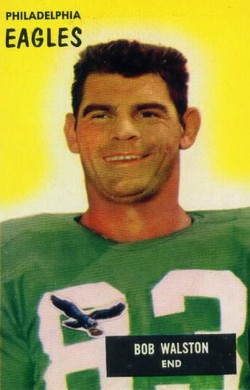
First, safety Ed “Bibbles” Bawel took a Tom Landry punt and returned it 52 yards for a touchdown, regaining his footing after being hit at the New York 30. Then, getting the ball back in the closing minutes of the first half, the Eagles mounted a 72-yard scoring drive. With seven seconds left on the clock, end Bobby Walston made an impressive leaping catch in the corner of the end zone of a pass from Bobby Thomason for a 19-yard touchdown, pulling it away from defenders Harmon Rowe and Frank Gifford. Walston successfully added the extra point after each TD and the Eagles took a 14-3 lead into halftime.

The Giants started off the second half in good fashion when Gifford returned the kickoff 60 yards to the Philadelphia 32. QB Fred Benners, who took over for a battered Charlie Conerly, completed a pass to end Bob McChesney for 24 yards and a run by Kyle Rote put the ball at the two yard line. However, the Eagles defense once again pulled off a successful goal line stand and the Giants turned the ball over on downs.

The only other score of the game came a little later in the third quarter when New York LB Jon Baker blocked a punt by Adrian Burk and DE Bud Sherrod recovered in the end zone for a touchdown. Poole added the extra point to make it a four-point contest, but that was it.

The Eagles physically punished the Giants, especially on defense, with a half dozen New York players sidelined by injuries. Those injured included Charlie Conerly, Eddie Price, and Frank Gifford. While the Eagles weren’t able to mount any further offense themselves, they held on to win by a final score of 14-10.

Game accounts indicated that Willey was a one-manning wrecking crew, and sportswriter Hugh Brown of the Philadelphia Bulletin credited him with an incredible 17 sacks during the course of the contest (or “dumping Charlie Conerly…while he was attempting to pass”, although Fred Benners was clearly a victim as well), including 11 in sequence. In addition to Willey, MG Bucko Kilroy and Pete Pihos had big days. Whatever the truth of the number of sacks – Willey himself years later thought it was 15, Kilroy suggested 12, and veteran pro football writer Paul Zimmerman, who was charting the game that day, gave the Eagles credit for 14 overall and Willey a total of 8 – it is clear that the Eagles had a great day defensively.

Philadelphia outgained the Giants by 225 yards to 109, with New York managing only 54 rushing yards on 34 attempts and a net of 55 passing yards thanks to 127 yards lost due to quarterbacks Conerly and Benners being tackled while attempting to throw. Interestingly, the Eagles suffered the only turnover of the game, on a fumble. Kyle Rote carried 7 times for 12 yards and Eddie Price was held to just 7 yards on 11 rushing attempts.

“I almost felt sorry for Charlie (Conerly),” said Jim Trimble later. “I remember vividly Charlie having a heck of a time just getting up. He was just mauled by Norm (Willey).”

The Eagles lost the following week at Green Bay but then reeled off three straight wins while the Giants won their next two contests but lost three of their last five games. The clubs ended up with identical 7-5 records, tying them for second place in the American Conference, a game behind the Browns.

Norm Willey’s performance against the Giants, which has taken on something  of a legendary status, was the highlight of an eight-season NFL career, all spent with the Eagles. The 6’2”, 224-pound Willey was a 13th round draft pick out of Marshall in 1950, and with his speed off the defensive line, he regularly harassed opposing quarterbacks. He was twice named to the Pro Bowl and received at least some first-team All-NFL recognition in 1953, ‘54 and ’55. 

November 8, 2012

1953: Thomason Passes for 437 Yards as Eagles Defeat Giants


Following a slow 0-2-1 start, the Philadelphia Eagles had put together a three-game winning streak as they faced the New York Giants on November 8, 1953. Head Coach Jim Trimble’s team had an outstanding pass receiving tandem of ends Pete Pihos and Bobby Walston (who also handled the placekicking) and QB Bobby Thomason (pictured at right) had emerged over Adrian Burk as the starting quarterback. Thomason, originally drafted by the Rams and then discarded by Green Bay, started his second season with the Eagles on the bench.

The Giants, under long-time Head Coach Steve Owen, were clearly a team in trouble and had a 2-4 record. Injuries were a problem, most notably to FB Eddie Price and members of the defense, and the addition of promising younger players such as HB Frank Gifford was not yet paying off.

There was a crowd of 24,331 in attendance at Philadelphia’s Connie Mack Stadium. Two minutes into the first quarter the Eagles scored when Bobby Walston kicked a 15-yard field goal after Philadelphia’s first drive came to a halt at the New York eight yard line.

The game moved slowly from that point until the last few minutes of the half. Eleven minutes into the second quarter, Thomason threw a pass that Walston caught behind three New York defenders at the Giants’ 45 and covered a total of 62 yards for a touchdown. Two minutes later the Eagles struck again as Thomason passed to Pihos for a 26-yard TD. Philadelphia took a 17-0 lead into halftime.

The Eagles added to their margin in the third quarter, moving 80 yards with Thomason completing five passes along the way including a seven-yard toss to Pihos for a touchdown. The extra point attempt failed, but Philadelphia was now ahead by a commanding 23-0.

It became 30-0 in the fourth quarter when Thomason threw a fourth touchdown pass, this time of 13 yards to Walston. Several fights broke out in the final period and three players were ejected in all. The Giants finally scored with six minutes remaining in the game as QB Charlie Conerly tossed a 32-yard TD pass to Frank Gifford to finish off a 74-yard drive. It salvaged pride but nothing else as the Eagles coasted to a 30-7 win.

Philadelphia thoroughly dominated the Giants in total yards (514 to 92), although it was the aerial game that made the difference as neither club did particularly well on the ground (64 yards to 54 in favor of New York). The Eagles also had far more first downs (21 to 10), but were also penalized 13 times, at a cost of 123 yards, to three flags thrown on the Giants. New York turned the ball over three times, Philadelphia twice.

Bobby Thomason completed 22 of 44 passes for 437 yards and four touchdowns. Pete Pihos caught 7 passes for 145 yards and two TDs and Bobby Walston had 8 receptions for 176 yards in addition to scoring 18 points (two touchdowns, a field goal, and three extra points).


Thomason’s passing yardage total was the fourth-best in NFL history at the time as well as an Eagles club record that stood until 1989.

The Eagles won twice more before losing to the Giants at New York. They ended up second in the Eastern Conference with a 7-4-1 record. The loss was the fifth in seven games for the Giants who ended up fifth in the conference at 3-9. It marked the end of Steve Owen’s 23-year coaching tenure with the club.

Bobby Thomason had a 329-yard passing game the following week against the Colts (although he also tossed five interceptions) in what was his finest season. He led the NFL with 21 touchdown passes while ranking second in attempts (304) and yards (2462). Thomason was selected to the Pro Bowl for the first of an eventual three times, but his career was marked by inconsistency and he continued to split time with Burk during most of his six years in Philadelphia.

December 7, 2011

1952: Bud Grant Gains 203 Receiving Yards as Eagles Defeat Dallas Texans


In their first season under 34-year-old Head Coach Jim Trimble, the Philadelphia Eagles underwent several changes. It was not promising when Hall of Fame HB Steve Van Buren suffered a career-ending knee injury in training camp. But there were good additions in Bobby Thomason, a 24-year-old quarterback obtained from the Packers, and rookie LB/C Wayne Robinson. In perhaps the most extraordinary move, star offensive end Pete Pihos was shifted almost exclusively to defensive end. Replacing him, across from second-year end/placekicker Bobby Walston, was Harold “Bud” Grant (pictured above), also in his second season out of Minnesota.

An accomplished all-around athlete in college, Grant had been a seventh-round draft choice of the Eagles in 1950, but when he considered their $7000 salary offer too low, he played pro basketball with the Minneapolis Lakers instead. He finally signed with Philadelphia for the ’51 season and mostly played on defense. Coach Trimble felt his 6’3” height would be helpful as a receiver on offense.

The Eagles, who had slipped badly after winning back-to-back NFL Championships in 1948 and ’49, were much improved as the various personnel changes worked out (Pihos proved his versatility by gaining All-Pro recognition as a defensive player). By the time they hosted the Dallas Texans on December 7, 1952, they were 6-4 and chasing the Browns in the NFL’s American Conference.

The visiting Texans were a failed team playing out the string. Much was anticipated when the New York Yanks franchise was transferred to Dallas, but the club played poorly, turnout at the Cotton Bowl was dismal, and the league was forced to take it over halfway through the schedule. Playing all games on the road and based out of Hershey, Pennsylvania, the Texans were 1-9 after having won for the first time in their previous contest on Thanksgiving Day against the Bears at the Rubber Bowl in Akron. Head Coach Jimmy Phelan’s team had talent, including halfbacks George Taliaferro and Buddy Young and future greats such as DE Gino Marchetti and DT Art Donovan, but there was not nearly enough.

There were 18,376 fans in attendance at Shibe Park and they saw the home team take control of the game in the first quarter. The Eagles scored the first time they had the ball, driving 41 yards in seven plays. FB John Huzvar powered over from five yards out for a touchdown.

On the next possession, Philadelphia went 70 yards in four plays with Thomason tossing a pass to Grant for a 41-yard TD. Walston kicked a 29-yard field goal before the period was over and the Eagles were up by 17-0 after a quarter of play.

It didn’t get any better in the second quarter for the Texans. QB Bob Celeri fumbled when attempting to throw from his end zone and Eagles safety Ebert Van Buren, brother of the rushing star, recovered to make it 24-0. Dallas did finally get on the board thanks to a one-yard run by Buddy Young and the tally was 24-7 at the half.

In the third quarter, Grant scored for the second time on a 23-yard pass play from Thomason. The Eagles scored again when eleventh-year veteran DT Vic Sears intercepted a pass for the only time in his career. Celeri was in punt formation for the Texans, but the snap went over his head. He made the recovery and dodged tacklers until hit by DT Mike Jarmoluk, at which point he lateraled, with the ball going directly to Sears. Sears lumbered nine yards into the end zone and Philadelphia led comfortably by 38-7 heading into the fourth quarter.

The Texans scored two meaningless touchdowns in the final quarter, one when DB Stan Williams returned a fumble 24 yards for a touchdown. The last was on a pass from QB Frank Tripucka to end Dick Wilkins that covered 42 yards. The Eagles won by a final tally of 38-21.

The Eagles outgained Dallas, 391 yards to 241, although the Texans gained more first downs, 17 to 15. The game was sloppy and had many penalties - 18 for 165 yards in all, 13 of which were called on the Eagles. There were also eight fumbles, seven of which resulted in turnovers. Four of those were by the Texans, who turned the ball over a total of seven times, to five by Philadelphia.

Bud Grant was the game’s biggest star as he shredded the Dallas secondary to catch 11 passes for 203 yards and the two TDs. Bobby Thomason completed 10 of 14 passes, two for touchdowns. Grant caught six passes from Thomason and the other five from Adrian Burk who, in an arrangement that would remain in effect for the next few years, split the quarterbacking with Thomason.

The Eagles kept their slim postseason hopes alive, but they lost the season finale to the Redskins to end up tied for second with the Giants at 7-5. Dallas finished the sorry year at the bottom of the National Conference with a 1-11 record and headed into oblivion (the remnants of the team, including Marchetti and Donovan, resurfaced as the Baltimore Colts in 1953).

Bud Grant had an outstanding season overall, placing second in the NFL in both pass receptions (56) and yards (997). His seven touchdowns tied for fifth with Gordie Soltau of the 49ers and 17.8 average gain-per-catch placed seventh. Having gone through the season without signing a contract, Grant went to Canada in ‘53 and played for Winnipeg for four years, where he continued to excel as a receiver. Named the team’s head coach at age 30 in 1957, he enjoyed great success as his clubs won two Grey Cup titles. He returned to the NFL in 1967, this time as coach of the Minnesota Vikings, and lasted a total of 18 years with four Super Bowl appearances along the way.

October 17, 2010

1954: Adrian Burk Throws 7 TD Passes as Eagles Beat Redskins


The Philadelphia Eagles were off to a 3-0 start in 1954 as they traveled to Washington to take on the Redskins on October 17 at Griffith Stadium. Since taking over as head coach in 1953, Jim Trimble had split the duties at quarterback between Adrian Burk and Bobby Thomason. That was the case again in ’54 and each threw at least one touchdown in each of the three wins. Washington, under first-year Head Coach Joe Kuharich (who would later coach the Eagles as well), was 0-3 and had been beaten badly in each instance.

Washington’s defensive backfield was inexperienced and the Eagles capitalized. On their second possession midway through the first quarter, Burk tossed his first (and longest) touchdown pass of the game, connecting with end Bobby Walston for 26 yards.

QB Al Dorow led the Redskins on a 35-yard drive that ended with a 14-yard touchdown pass to end Ed Barker. But Burk hit star end Pete Pihos twice for touchdowns in the second quarter, covering 18 and 19 yards, and the Eagles held a 21-7 lead at the half.

Burk’s fourth touchdown pass of the game came in the third quarter, finding Walston in the end zone from five yards out. The Redskins made it interesting when rookie FB Dale Atkeson returned the ensuing kickoff 99 yards for a touchdown, which at the time set a team record. But Burk tossed two more TD passes to pull the Eagles away - to Walston for a third time for four yards and to HB Toy Ledbetter from nine yards out.

The Redskins made another big play, although it was too-little, too-late, as QB Jack Scarbath threw a pass to end Hugh Taylor that covered 60 yards. Scarbath then connected with Taylor again for a five-yard touchdown.

Up 42-21, Burk was relieved by Thomason. But when Philadelphia’s publicity director realized that Burk was just one short of Sid Luckman’s NFL single-game record of seven touchdown passes, Trimble reinserted him into the contest. In the final seconds, he threw the record-tying seventh touchdown pass to Pihos. Characteristically, it was short, covering three yards, and the Eagles won, 49-21.

Adrian Burk completed 19 of 27 passes for 232 yards with the 7 touchdowns against just one interception. Pete Pihos was the top receiver with 9 catches for 132 yards and three of the TDs. Bobby Walston scored three as well, in addition to the one by Ledbetter.

Burk, the team’s regular punter, also had an outstanding game punting the ball. On three occasions he managed to angle kicks out of bounds inside the Washington 10 yard line (at the two, three, and nine yard lines, to be exact).

Overall, the Eagles outgained Washington with 432 yards to 115 and compiled 30 first downs to 9 for the Redskins. In addition to 289 passing yards, Philadelphia rolled up 172 yards on the ground, while the defense held the Redskins to just 28 yards on 20 carries. The Redskins further hurt their cause by turning the ball over seven times, against two committed by the Eagles.

Philadelphia failed to maintain its winning momentum, losing the next two games and four of five on the way to a 7-4-1 record and second place finish in the Eastern Conference. Washington ended up in fifth with a 3-9 tally.

Burk had another big performance later in the season when the Redskins came to Philadelphia, throwing for more yards (345) as well as five more TD passes. Not surprisingly, it was the best year of his seven-season career as he led the NFL in touchdown passes (23) and percentage of TD passes (10.0) and was selected to the Pro Bowl. He also had career highs in passing yards (1740) and completion percentage (53.2). Of course, the two games against Washington certainly fueled his success, as he threw for a combined 577 yards and 12 touchdowns.


With 60 catches, Pete Pihos (pictured at left) tied for the league lead with San Francisco’s Billy Wilson. His 872 yards and 10 touchdowns ranked third. In the last three seasons of his Hall of Fame career (1953-54-55), Pihos led the NFL in pass receiving in each and in receiving yards twice.

Bobby Walston was leading the league with 45 points heading into the game and helped his cause by adding another 25 to give him 70 after just four contests. The team’s placekicker as well as a starting end, he went on to lead the NFL in scoring with 114 points. In addition to 11 touchdowns scored (all on pass receptions), he booted 36 extra points and four field goals.

The record of seven TD passes in a game has been tied three more times (George Blanda of the Oilers in the AFL in 1961, Y.A. Tittle of the Giants in ’62, and Joe Kapp of the Vikings in 1969) – Burk’s yardage total remains the lowest of any of the seven-TD performances (the others, including Luckman, were all over 400, and Tittle passed for 505).

Coincidentally, Burk, who went on to become an NFL official (as well as a successful lawyer in his hometown of Houston) following his retirement as a player, was a member of the officiating crew when Kapp had his seven-TD game. He also was the back judge who signaled touchdown when RB Franco Harris of the Steelers scored the “Immaculate Reception” TD in the 1972 postseason against Oakland.