Showing posts with label Bobby Walston. Show all posts

December 15, 2015

1956: Giants Defeat Eagles to Clinch Eastern Conference Crown


The New York Giants were looking to lock up the NFL Eastern Conference title as they faced the Philadelphia Eagles on December 15, 1956. Under the guidance of Head Coach Jim Lee Howell, the Giants had roared out to a 6-1 record and, following a 1-2-1 stretch, were now coming into the season finale at 7-3-1 and could gain a slot in the NFL Championship game with a win. New York operated a power-T offense that was the responsibility of assistant coach Vince Lombardi and emphasized a strong running game that utilized halfbacks Frank Gifford and Alex Webster (pictured above) and FB Mel Triplett. A platoon system was used at quarterback where Don Heinrich started games and the more-talented Charlie Conerly relieved when needed. Assistant coach Tom Landry handled the tough and talented defense.

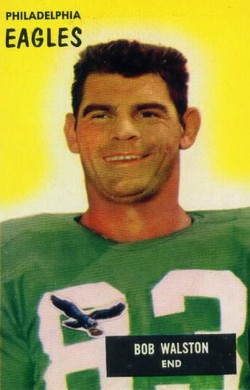
The Eagles were going nowhere at 3-7-1 in their first year under Head Coach Hugh Devore.  They also used a two-quarterback platoon with Adrian Burk and Bobby Thomason and there was an able receiver in end Bobby Walston, but the ground attack was average at best. The defense was particularly sound at linebacker with All-Pro Chuck Bednarik and Wayne Robinson, but the backfield was a problem, particularly after the loss of safety Jerry Norton to injury.  

There were 15,562 fans in attendance on a foggy afternoon at Connie Mack Stadium and the contest was also nationally televised. It had rained the previous three days and the field was soft. The Giants had the first possession with Don Heinrich at quarterback and punted and, while the Eagles started off with runs by HB Ted Wegert for six yards and FB Dick Bielski for 12, they were forced to punt in turn. New York advanced into Philadelphia territory thanks primarily to the running of Mel Triplett and Frank Gifford, but the drive stalled at the 43 and Don Chandler punted into the end zone.

Following another punt by the Eagles, the Giants were driving as the game headed into the second quarter. Alex Webster started the series with a 14-yard carry and Heinrich threw to end Kyle Rote for a gain of 15 yards to the Philadelphia 30. An eight-yard run by Webster and 11-yard carry by Gifford (pictured below) got the ball inside the ten and Gifford then threw an option pass to Rote for a six-yard touchdown to complete the eight-play, 65-yard series. Ben Agajanian added the extra point.


Bobby Thomason was at quarterback for the Eagles on their next possession but a clipping penalty nullified a pass completion and Thomason was sacked for a loss of ten yards on third down to force another punt. Once again the running of Triplett and Webster advanced the ball into Philadelphia territory and Heinrich completed a pass to Gifford for nine yards to convert a third down. Following a five-yard carry by Triplett, Webster ran wide to the left for 10 yards that set up a 10-yard run by Gifford for a TD. Agajanian again converted to give the visitors a 14-0 lead.

The Eagles turned the ball over on the next series when DE Walt Yowarsky recovered an errant pitchout at the Philadelphia 35. But while the productive ground game got the Giants to the 14, Heinrich’s pass was intercepted by safety Lee Riley. The score remained unchanged at the half.

The Eagles had the ball first in the third quarter but a Thomason pass was picked off by safety Emlen Tunnell, who returned it 14 yards to the Philadelphia 27. Six plays later the Giants capitalized as Webster ran seven yards for a touchdown. Agajanian again booted the point after and New York held a comfortable 21-0 lead.

The teams exchanged punts and Riley briefly provided some excitement for the home team with a 35-yard return to midfield. But with Thomason giving way to Burk, the Eagles lost yardage from there and punted once again. Chuck Bednarik recovered a Triplett fumble on the next series at the Philadelphia 45 and the Eagles advanced into New York territory. Burk completed four passes, three of them to end Bobby Walston for gains totaling 36 yards, in the closing minutes of the period. But a run for negative yardage followed by a penalty on the offense to start the third quarter and an incomplete pass set up a fourth-and-30 situation, and Burk’s throw to Walston gained just 18 yards to turn the ball over on downs at the New York 12.

The Giants were able to put together a long series that was extended by a roughing-the-kicker call on a punt by Chandler. New York failed to extend its lead when Agajanian was wide on a 46-yard field goal attempt, but time was running out on the Eagles, who again had to punt.

Philadelphia finally put together a scoring drive of 64 yards in 14 plays that was helped along by a 26-yard pass interference penalty on the Giants. Burk completed two passes, one of which converted a fourth down, and had an 11-yard scramble in a third-and-10 situation. After an incomplete pass and 13-yard sack, the Eagles faced third-and-23 and Burk threw to end Hank Burnine for 13 yards and, on fourth down, to Walston for a 15-yard touchdown. Walston kicked the extra point, but while it averted a shutout, it was of no consequence with only 1:08 remaining in the contest. New York won by a final score of 21-7.

The Giants led significantly in total yards (332 to 174), with 291 of that total coming on the ground, and in first downs (22 to 13). Both teams turned the ball over twice. New York recorded four sacks, to none by the Eagles.

Alex Webster led the New York rushers with 132 yards on 23 carries that included a TD. Frank Gifford accumulated 81 yards and a touchdown on 16 attempts and Mel Triplett contributed 72 yards on 14 carries. With the Giants in control, Don Heinrich remained in for the full game and completed three of 10 passes for 35 yards. Gifford and Kyle Rote each caught two passes, for 20 and 21 yards, respectively, and Rote scored a touchdown on a Gifford pass.


For the Eagles, Adrian Burk was successful on 12 of 26 throws for 124 yards and a TD while Bobby Thomason was two of four for 17 yards. Bobby Walston (pictured at right) led the receivers with 5 catches for 69 yards and a touchdown. Ted Wegert rushed for 31 yards on 11 attempts.

The win allowed the Giants to finish atop the Eastern Conference with an 8-3-1 record. In their first NFL Championship game appearance in ten years, they thrashed the Chicago Bears 47-7. For Philadelphia, the loss closed out the club’s worst season since 1942, finishing at the bottom of the conference with a 3-8-1 tally.

Frank Gifford received MVP honors as he led the league in yards from scrimmage (1422, with 819 rushing and 603 receiving). Alex Webster also ranked among the Top 10 rushers with 694 yards and seven TDs and Mel Triplett added 515 yards on the ground.  

October 26, 2013

1952: Willey Has Big Sack Performance as Eagles Defeat Giants


Sacks became an officially-compiled NFL statistic in 1982, with the single-game record to date for an individual being seven by Derrick Thomas of the Chiefs in 1990. Prior to ’82, and beginning in the 1960s, team sacks were compiled (the term sack did not come into use until the ‘60s as well), and earlier, yards lost while passing were subtracted from a team’s passing yards in order to come up with a net passing yardage total, but individual records were typically a matter of conjecture (although it should be noted that some researchers are doing good work in piecing together the historical record).

On October 26, 1952, DE Norm “Wild Man” Willey of the Philadelphia Eagles (pictured above) may have set the real individual sack record, although that is by no means certain. What is known about the game on that date between the Eagles and Giants is that it was highlighted by a dominating performance by Willey and the Philadelphia defense.

The Eagles, with a 2-2 record, were 15-point underdogs coming into the contest, having lost to the Giants in Philadelphia three weeks earlier by a decisive 31-7 score. First-year Head Coach Jim Trimble had made changes heading into the season, most notably moving star offensive end Pete Pihos to defense and replacing him with Bud Grant. They lost Hall of Fame HB Steve Van Buren to a career-ending knee injury during the preseason, but had added QB Bobby Thomason, who came from Green Bay.

New York, under Head Coach Steve Owen for the 22nd year, was at 3-1 and coming off the team’s first loss the previous week. QB Charlie Conerly directed a ball control running attack led by FB Eddie Price and HB Kyle Rote, plus rookie all-purpose HB Frank Gifford, who played on defense as well. Safety Emlen Tunnell starred both on defense and as a kick returner.

There were 21,458 fans at the Polo Grounds for the rematch of the two division rivals. The Giants got the first break on the opening kickoff when it rolled free and they recovered at the Philadelphia 15. Ray Poole kicked a 30-yard field goal to start the scoring.

Late in the period, the Giants drove to the Philadelphia one yard line but the Eagles stopped them with a rugged goal line stand. The tally remained at 3-0 until, in a five-minute segment in the latter part of the second quarter, the Eagles scored twice.

First, safety Ed “Bibbles” Bawel took a Tom Landry punt and returned it 52 yards for a touchdown, regaining his footing after being hit at the New York 30. Then, getting the ball back in the closing minutes of the first half, the Eagles mounted a 72-yard scoring drive. With seven seconds left on the clock, end Bobby Walston made an impressive leaping catch in the corner of the end zone of a pass from Bobby Thomason for a 19-yard touchdown, pulling it away from defenders Harmon Rowe and Frank Gifford. Walston successfully added the extra point after each TD and the Eagles took a 14-3 lead into halftime.

The Giants started off the second half in good fashion when Gifford returned the kickoff 60 yards to the Philadelphia 32. QB Fred Benners, who took over for a battered Charlie Conerly, completed a pass to end Bob McChesney for 24 yards and a run by Kyle Rote put the ball at the two yard line. However, the Eagles defense once again pulled off a successful goal line stand and the Giants turned the ball over on downs.

The only other score of the game came a little later in the third quarter when New York LB Jon Baker blocked a punt by Adrian Burk and DE Bud Sherrod recovered in the end zone for a touchdown. Poole added the extra point to make it a four-point contest, but that was it.

The Eagles physically punished the Giants, especially on defense, with a half dozen New York players sidelined by injuries. Those injured included Charlie Conerly, Eddie Price, and Frank Gifford. While the Eagles weren’t able to mount any further offense themselves, they held on to win by a final score of 14-10.

Game accounts indicated that Willey was a one-manning wrecking crew, and sportswriter Hugh Brown of the Philadelphia Bulletin credited him with an incredible 17 sacks during the course of the contest (or “dumping Charlie Conerly…while he was attempting to pass”, although Fred Benners was clearly a victim as well), including 11 in sequence. In addition to Willey, MG Bucko Kilroy and Pete Pihos had big days. Whatever the truth of the number of sacks – Willey himself years later thought it was 15, Kilroy suggested 12, and veteran pro football writer Paul Zimmerman, who was charting the game that day, gave the Eagles credit for 14 overall and Willey a total of 8 – it is clear that the Eagles had a great day defensively.

Philadelphia outgained the Giants by 225 yards to 109, with New York managing only 54 rushing yards on 34 attempts and a net of 55 passing yards thanks to 127 yards lost due to quarterbacks Conerly and Benners being tackled while attempting to throw. Interestingly, the Eagles suffered the only turnover of the game, on a fumble. Kyle Rote carried 7 times for 12 yards and Eddie Price was held to just 7 yards on 11 rushing attempts.

“I almost felt sorry for Charlie (Conerly),” said Jim Trimble later. “I remember vividly Charlie having a heck of a time just getting up. He was just mauled by Norm (Willey).”

The Eagles lost the following week at Green Bay but then reeled off three straight wins while the Giants won their next two contests but lost three of their last five games. The clubs ended up with identical 7-5 records, tying them for second place in the American Conference, a game behind the Browns.

Norm Willey’s performance against the Giants, which has taken on something  of a legendary status, was the highlight of an eight-season NFL career, all spent with the Eagles. The 6’2”, 224-pound Willey was a 13th round draft pick out of Marshall in 1950, and with his speed off the defensive line, he regularly harassed opposing quarterbacks. He was twice named to the Pro Bowl and received at least some first-team All-NFL recognition in 1953, ‘54 and ’55. 

November 8, 2012

1953: Thomason Passes for 437 Yards as Eagles Defeat Giants


Following a slow 0-2-1 start, the Philadelphia Eagles had put together a three-game winning streak as they faced the New York Giants on November 8, 1953. Head Coach Jim Trimble’s team had an outstanding pass receiving tandem of ends Pete Pihos and Bobby Walston (who also handled the placekicking) and QB Bobby Thomason (pictured at right) had emerged over Adrian Burk as the starting quarterback. Thomason, originally drafted by the Rams and then discarded by Green Bay, started his second season with the Eagles on the bench.

The Giants, under long-time Head Coach Steve Owen, were clearly a team in trouble and had a 2-4 record. Injuries were a problem, most notably to FB Eddie Price and members of the defense, and the addition of promising younger players such as HB Frank Gifford was not yet paying off.

There was a crowd of 24,331 in attendance at Philadelphia’s Connie Mack Stadium. Two minutes into the first quarter the Eagles scored when Bobby Walston kicked a 15-yard field goal after Philadelphia’s first drive came to a halt at the New York eight yard line.

The game moved slowly from that point until the last few minutes of the half. Eleven minutes into the second quarter, Thomason threw a pass that Walston caught behind three New York defenders at the Giants’ 45 and covered a total of 62 yards for a touchdown. Two minutes later the Eagles struck again as Thomason passed to Pihos for a 26-yard TD. Philadelphia took a 17-0 lead into halftime.

The Eagles added to their margin in the third quarter, moving 80 yards with Thomason completing five passes along the way including a seven-yard toss to Pihos for a touchdown. The extra point attempt failed, but Philadelphia was now ahead by a commanding 23-0.

It became 30-0 in the fourth quarter when Thomason threw a fourth touchdown pass, this time of 13 yards to Walston. Several fights broke out in the final period and three players were ejected in all. The Giants finally scored with six minutes remaining in the game as QB Charlie Conerly tossed a 32-yard TD pass to Frank Gifford to finish off a 74-yard drive. It salvaged pride but nothing else as the Eagles coasted to a 30-7 win.

Philadelphia thoroughly dominated the Giants in total yards (514 to 92), although it was the aerial game that made the difference as neither club did particularly well on the ground (64 yards to 54 in favor of New York). The Eagles also had far more first downs (21 to 10), but were also penalized 13 times, at a cost of 123 yards, to three flags thrown on the Giants. New York turned the ball over three times, Philadelphia twice.

Bobby Thomason completed 22 of 44 passes for 437 yards and four touchdowns. Pete Pihos caught 7 passes for 145 yards and two TDs and Bobby Walston had 8 receptions for 176 yards in addition to scoring 18 points (two touchdowns, a field goal, and three extra points).


Thomason’s passing yardage total was the fourth-best in NFL history at the time as well as an Eagles club record that stood until 1989.

The Eagles won twice more before losing to the Giants at New York. They ended up second in the Eastern Conference with a 7-4-1 record. The loss was the fifth in seven games for the Giants who ended up fifth in the conference at 3-9. It marked the end of Steve Owen’s 23-year coaching tenure with the club.

Bobby Thomason had a 329-yard passing game the following week against the Colts (although he also tossed five interceptions) in what was his finest season. He led the NFL with 21 touchdown passes while ranking second in attempts (304) and yards (2462). Thomason was selected to the Pro Bowl for the first of an eventual three times, but his career was marked by inconsistency and he continued to split time with Burk during most of his six years in Philadelphia.

October 23, 2010

1960: Late Walston Field Goal Gives Eagles Key Win Over Browns


The Philadelphia Eagles were off to a good start in 1960, but faced their toughest test in traveling to Cleveland to face the Browns at Municipal Stadium on October 23. The Browns had beaten the Eagles decisively in the season-opening game at Franklin Field and were undefeated at 3-0. Philadelphia had recovered to win three straight games and arrived in Cleveland with a 3-1 tally (the Browns had already had a bye week).

The Eagles had a veteran head coach in 61-year-old Buck Shaw and were led on offense by the tough 34-year-old QB Norm Van Brocklin, in his 12th season overall and third in Philadelphia after being obtained from the Rams. The running game was average, at best, and it was the passing game that made the difference thanks to The Dutchman having outstanding receivers in flanker Tommy McDonald and ends Pete Retzlaff and Bobby Walston (pictured above; he was also the team’s placekicker).

The Eagles came into the game as 13-point underdogs and had not won in Cleveland since 1952. Head Coach Paul Brown’s club had the best one-two running back punch in pro football with FB Jim Brown and HB Bobby Mitchell, and also featured the precision passing of QB Milt Plum.

Eagles LB John Nocera was out with an injury, and his replacement Bob Pellegrini went down early in the contest. As a result, 35-year-old Chuck Bednarik, once one of the top linebackers in the game but now the starting center, had to return to linebacking duty in addition to his role on the offensive line.

Less than four minutes into the first quarter, after stopping the Browns on their opening series, Philadelphia scored on its first play from scrimmage as Van Brocklin threw a 49-yard touchdown pass to Walston that gave the Eagles the early 7-0 advantage.

Cleveland drove down the field but came up short of a touchdown thanks to a goal line stand by the Eagles defense. They settled for a 12-yard field goal by Sam Baker. Baker, who had been obtained from Washington to replace the retired Lou Groza (who would return the following year), booted another field goal, of 23 yards, early in the second quarter to narrow Philadelphia’s lead to 7-6.

Plum put the Browns ahead later in the period with an 86-yard scoring pass to flanker Leon Clarke, who was substituting for the injured Ray Renfro. Baker’s extra point attempt failed, but he added a 44-yard field goal to extend Cleveland’s lead to 15-7 at halftime.

The Browns led by 22-7 early in the third quarter after Jim Brown took off on a 71-yard touchdown run. The Eagles came back, though, as FB Clarence Peaks ran up the middle on a draw play for 57 yards to put the Eagles in scoring position. Van Brocklin followed up with a six-yard pass to Walston and HB Billy Barnes plunged into the end zone for a touchdown from a yard out.

Shortly thereafter, Philadelphia struck again as Van Brocklin connected with McDonald for a 57-yard TD that cut Cleveland’s margin to 22-21 after three quarters.

Van Brocklin put the Eagles in the lead at 28-22 early in the fourth quarter with a swing pass to Barnes that covered eight yards for a touchdown. But the Browns responded with an 88-yard drive the ended on a three-yard TD pass from Plum to Mitchell. Cleveland was back in front at 29-28 with just over six minutes remaining to play.

The Eagles again drove into Browns territory, but safety Don Fleming intercepted a Van Brocklin pass. The Eagles defense held the Browns and forced them to punt, giving the Eagles one more shot.

With time running down, the Eagles took over at their 10 yard line. Van Brocklin passed to Retzlaff for 27 yards and then McDonald for 12 to just short of midfield. However, it appeared that Cleveland would win when safety Bobby Franklin came up with an interception, but LB Vince Costello was flagged for pass interference and the Eagles, instead of losing the ball, now had a first down at the Browns 30.

With 15 seconds remaining, Walston kicked a 38-yard field goal and the Eagles came away with a big 31-29 win.

Both teams put up plenty of yards, with the Browns outgaining Philadelphia by 451 yards to 428; they also had more first downs (21 to 18).


Norm Van Brocklin (pictured at left) completed 17 of 26 passes for 292 yards with three touchdowns and the one interception. Thanks to the long run in the third quarter, Clarence Peaks had a season-high 102 yards on 13 carries. Billy Barnes, who ran for 25 yards on 9 attempts and a TD, caught 7 passes for 48 yards and another score. Bobby Walston, in addition to kicking the winning field goal, also led all receivers with 94 yards on four catches. Pete Retzlaff and Tommy McDonald contributed significantly, with the former gaining 80 yards on three receptions and the latter 66 yards and a TD on two catches.

Jim Brown, as usual, put up big numbers for the Browns with 167 rushing yards on 22 carries, including the long touchdown run, and added another 57 yards on four pass receptions. Bobby Mitchell, who had devastated the Eagles in the opening game with 156 yards on 14 carries, was held to 35 yards on 14 rushes this time, although he still caught 7 passes for 70 yards and a TD. Milt Plum had 16 completions in 22 pass attempts for 289 yards with two touchdowns and no interceptions.

Costello, who was flagged for the interference call, was angry afterward. “I didn’t think there was any interference.” Coach Paul Brown avoided controversy, saying “You couldn’t tell anything from the bench. Vince was pretty hot about it.”

But Van Brocklin insisted the call was correct, saying “(Halfback) Ted Dean had been knocked down and I had to throw to the other side. The call was made right away. Two of the Browns linebackers seemed to sandwich Dean and he went down.”

Regarding the performance by the Eagles’ quarterback, Coach Brown summed up after the game, “As for Van Brocklin, he is one of the finest football players of all time.”

The Eagles were able to rest up with a bye the following week and then kept on winning to end up atop the Eastern Conference with a 10-2 record. They defeated the Green Bay Packers for the NFL Championship. Cleveland went 2-2-1 over the next five games and finished second with an 8-3-1 tally.

Norm Van Brocklin received unanimous MVP recognition (AP, UPI, NEA, and the Bert Bell Award) in his greatest – and last – season. He ranked second in the league in pass attempts (284), completions (153), yards (2471), and touchdowns (24).

Bobby Walston finished second in the league in scoring with 105 points. He had the best field goal percentage (70 %) as a result of connecting on 14 of 20 attempts. Walston also caught 30 passes for 563 yards (18.8 avg.) and four TDs.


Chuck Bednarik (pictured at right) played 59 minutes against Cleveland and led the club with 15 tackles, 11 of them unassisted. With the injuries plaguing the linebacking corps, Concrete Charley showed the critics who said he was too old to play linebacker that they were wrong, and did so while playing both ways (the last NFL player to do so regularly) all the way to the title game (he averaged over 50 minutes per game).

Jim Brown led the NFL in rushing for the fourth consecutive season with 1257 yards on 215 attempts (5.8 avg.) and nine touchdowns. Milt Plum was the league’s top passer - by the current system, his 110.4 rating was the best until Joe Montana’s 112.4 in 1989.

October 17, 2010

1954: Adrian Burk Throws 7 TD Passes as Eagles Beat Redskins


The Philadelphia Eagles were off to a 3-0 start in 1954 as they traveled to Washington to take on the Redskins on October 17 at Griffith Stadium. Since taking over as head coach in 1953, Jim Trimble had split the duties at quarterback between Adrian Burk and Bobby Thomason. That was the case again in ’54 and each threw at least one touchdown in each of the three wins. Washington, under first-year Head Coach Joe Kuharich (who would later coach the Eagles as well), was 0-3 and had been beaten badly in each instance.

Washington’s defensive backfield was inexperienced and the Eagles capitalized. On their second possession midway through the first quarter, Burk tossed his first (and longest) touchdown pass of the game, connecting with end Bobby Walston for 26 yards.

QB Al Dorow led the Redskins on a 35-yard drive that ended with a 14-yard touchdown pass to end Ed Barker. But Burk hit star end Pete Pihos twice for touchdowns in the second quarter, covering 18 and 19 yards, and the Eagles held a 21-7 lead at the half.

Burk’s fourth touchdown pass of the game came in the third quarter, finding Walston in the end zone from five yards out. The Redskins made it interesting when rookie FB Dale Atkeson returned the ensuing kickoff 99 yards for a touchdown, which at the time set a team record. But Burk tossed two more TD passes to pull the Eagles away - to Walston for a third time for four yards and to HB Toy Ledbetter from nine yards out.

The Redskins made another big play, although it was too-little, too-late, as QB Jack Scarbath threw a pass to end Hugh Taylor that covered 60 yards. Scarbath then connected with Taylor again for a five-yard touchdown.

Up 42-21, Burk was relieved by Thomason. But when Philadelphia’s publicity director realized that Burk was just one short of Sid Luckman’s NFL single-game record of seven touchdown passes, Trimble reinserted him into the contest. In the final seconds, he threw the record-tying seventh touchdown pass to Pihos. Characteristically, it was short, covering three yards, and the Eagles won, 49-21.

Adrian Burk completed 19 of 27 passes for 232 yards with the 7 touchdowns against just one interception. Pete Pihos was the top receiver with 9 catches for 132 yards and three of the TDs. Bobby Walston scored three as well, in addition to the one by Ledbetter.

Burk, the team’s regular punter, also had an outstanding game punting the ball. On three occasions he managed to angle kicks out of bounds inside the Washington 10 yard line (at the two, three, and nine yard lines, to be exact).

Overall, the Eagles outgained Washington with 432 yards to 115 and compiled 30 first downs to 9 for the Redskins. In addition to 289 passing yards, Philadelphia rolled up 172 yards on the ground, while the defense held the Redskins to just 28 yards on 20 carries. The Redskins further hurt their cause by turning the ball over seven times, against two committed by the Eagles.

Philadelphia failed to maintain its winning momentum, losing the next two games and four of five on the way to a 7-4-1 record and second place finish in the Eastern Conference. Washington ended up in fifth with a 3-9 tally.

Burk had another big performance later in the season when the Redskins came to Philadelphia, throwing for more yards (345) as well as five more TD passes. Not surprisingly, it was the best year of his seven-season career as he led the NFL in touchdown passes (23) and percentage of TD passes (10.0) and was selected to the Pro Bowl. He also had career highs in passing yards (1740) and completion percentage (53.2). Of course, the two games against Washington certainly fueled his success, as he threw for a combined 577 yards and 12 touchdowns.


With 60 catches, Pete Pihos (pictured at left) tied for the league lead with San Francisco’s Billy Wilson. His 872 yards and 10 touchdowns ranked third. In the last three seasons of his Hall of Fame career (1953-54-55), Pihos led the NFL in pass receiving in each and in receiving yards twice.

Bobby Walston was leading the league with 45 points heading into the game and helped his cause by adding another 25 to give him 70 after just four contests. The team’s placekicker as well as a starting end, he went on to lead the NFL in scoring with 114 points. In addition to 11 touchdowns scored (all on pass receptions), he booted 36 extra points and four field goals.

The record of seven TD passes in a game has been tied three more times (George Blanda of the Oilers in the AFL in 1961, Y.A. Tittle of the Giants in ’62, and Joe Kapp of the Vikings in 1969) – Burk’s yardage total remains the lowest of any of the seven-TD performances (the others, including Luckman, were all over 400, and Tittle passed for 505).

Coincidentally, Burk, who went on to become an NFL official (as well as a successful lawyer in his hometown of Houston) following his retirement as a player, was a member of the officiating crew when Kapp had his seven-TD game. He also was the back judge who signaled touchdown when RB Franco Harris of the Steelers scored the “Immaculate Reception” TD in the 1972 postseason against Oakland.