Showing posts with label 1956 NFL season. Show all posts

September 7, 2016

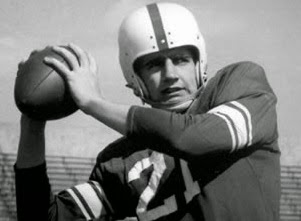
Highlighted Year: Lindon Crow, 1956

Defensive Halfback, Chicago Cardinals


Age: 23
2nd season in pro football & with Cardinals
College: Southern California
Height: 6’1”   Weight: 187

Prelude:
Crow played both baseball and football in college and as a sophomore moved into the starting lineup as a defensive back and wingback on offense. He captained the team in 1954 and was chosen by the Cardinals in the second round of the 1955 NFL draft. A raw talent, Crow intercepted three passes during his rookie season.

1956 Season Summary
Appeared in all 12 games
[Bracketed numbers indicate league rank in Top 20]

Interceptions – 11 [1]
Int. return yards – 170 [6]
Int. TDs – 0

Punt Returns
Returns – 1
Yards – 21
TDs – 0

Awards & Honors:
2nd team All-NFL: AP
Pro Bowl

Cardinals went 7-5 to finish second in the NFL Eastern Conference while leading the league in interceptions (33).

Aftermath:
Crow was shifted to safety in 1957 and, while his interception total dropped to one, he was again a Pro Bowl selection. He was traded to the New York Giants and moved back to defensive halfback for the next three years, once again receiving Pro Bowl as well as second-team All-NFL honors from the New York Daily News in ’59. He was dealt to the Los Angeles Rams in 1961, where he played safety and eventually became a player/coach, getting by on savvy as his speed diminished. Overall in a ten-year career that ended in 1964, Crow intercepted 38 passes, 15 of which came with the Cards, and two of which he returned for touchdowns. He also recovered nine fumbles, one of which was run back for a 65-yard TD. Crow twice received second-team All-NFL recognition and was selected to three Pro Bowls. His brother Wayne was a halfback and punter in the AFL with Oakland and Buffalo.

--

Highlighted Years features players who were consensus first-team All-League* selections or league* or conference** leaders in the following statistical categories:

Rushing: Yards, TDs (min. 10)
Passing: Yards, Completion Pct., Yards per Attempt, TDs, Rating
Receiving: Catches, Yards, TDs (min. 10)
Scoring: TDs, Points, Field Goals (min. 5)
All-Purpose: Total Yards
Defense: Interceptions, Sacks
Kickoff Returns: Average
Punt Returns: Average
Punting: Average

*Leagues include NFL (1920 to date), AFL (1926), AFL (1936-37), AAFC (1946-49), AFL (1960-69), WFL (1974-75), USFL (1983-85)

**NFC/AFC since 1970

December 15, 2015

1956: Giants Defeat Eagles to Clinch Eastern Conference Crown


The New York Giants were looking to lock up the NFL Eastern Conference title as they faced the Philadelphia Eagles on December 15, 1956. Under the guidance of Head Coach Jim Lee Howell, the Giants had roared out to a 6-1 record and, following a 1-2-1 stretch, were now coming into the season finale at 7-3-1 and could gain a slot in the NFL Championship game with a win. New York operated a power-T offense that was the responsibility of assistant coach Vince Lombardi and emphasized a strong running game that utilized halfbacks Frank Gifford and Alex Webster (pictured above) and FB Mel Triplett. A platoon system was used at quarterback where Don Heinrich started games and the more-talented Charlie Conerly relieved when needed. Assistant coach Tom Landry handled the tough and talented defense.

The Eagles were going nowhere at 3-7-1 in their first year under Head Coach Hugh Devore.  They also used a two-quarterback platoon with Adrian Burk and Bobby Thomason and there was an able receiver in end Bobby Walston, but the ground attack was average at best. The defense was particularly sound at linebacker with All-Pro Chuck Bednarik and Wayne Robinson, but the backfield was a problem, particularly after the loss of safety Jerry Norton to injury.  

There were 15,562 fans in attendance on a foggy afternoon at Connie Mack Stadium and the contest was also nationally televised. It had rained the previous three days and the field was soft. The Giants had the first possession with Don Heinrich at quarterback and punted and, while the Eagles started off with runs by HB Ted Wegert for six yards and FB Dick Bielski for 12, they were forced to punt in turn. New York advanced into Philadelphia territory thanks primarily to the running of Mel Triplett and Frank Gifford, but the drive stalled at the 43 and Don Chandler punted into the end zone.

Following another punt by the Eagles, the Giants were driving as the game headed into the second quarter. Alex Webster started the series with a 14-yard carry and Heinrich threw to end Kyle Rote for a gain of 15 yards to the Philadelphia 30. An eight-yard run by Webster and 11-yard carry by Gifford (pictured below) got the ball inside the ten and Gifford then threw an option pass to Rote for a six-yard touchdown to complete the eight-play, 65-yard series. Ben Agajanian added the extra point.


Bobby Thomason was at quarterback for the Eagles on their next possession but a clipping penalty nullified a pass completion and Thomason was sacked for a loss of ten yards on third down to force another punt. Once again the running of Triplett and Webster advanced the ball into Philadelphia territory and Heinrich completed a pass to Gifford for nine yards to convert a third down. Following a five-yard carry by Triplett, Webster ran wide to the left for 10 yards that set up a 10-yard run by Gifford for a TD. Agajanian again converted to give the visitors a 14-0 lead.

The Eagles turned the ball over on the next series when DE Walt Yowarsky recovered an errant pitchout at the Philadelphia 35. But while the productive ground game got the Giants to the 14, Heinrich’s pass was intercepted by safety Lee Riley. The score remained unchanged at the half.

The Eagles had the ball first in the third quarter but a Thomason pass was picked off by safety Emlen Tunnell, who returned it 14 yards to the Philadelphia 27. Six plays later the Giants capitalized as Webster ran seven yards for a touchdown. Agajanian again booted the point after and New York held a comfortable 21-0 lead.

The teams exchanged punts and Riley briefly provided some excitement for the home team with a 35-yard return to midfield. But with Thomason giving way to Burk, the Eagles lost yardage from there and punted once again. Chuck Bednarik recovered a Triplett fumble on the next series at the Philadelphia 45 and the Eagles advanced into New York territory. Burk completed four passes, three of them to end Bobby Walston for gains totaling 36 yards, in the closing minutes of the period. But a run for negative yardage followed by a penalty on the offense to start the third quarter and an incomplete pass set up a fourth-and-30 situation, and Burk’s throw to Walston gained just 18 yards to turn the ball over on downs at the New York 12.

The Giants were able to put together a long series that was extended by a roughing-the-kicker call on a punt by Chandler. New York failed to extend its lead when Agajanian was wide on a 46-yard field goal attempt, but time was running out on the Eagles, who again had to punt.

Philadelphia finally put together a scoring drive of 64 yards in 14 plays that was helped along by a 26-yard pass interference penalty on the Giants. Burk completed two passes, one of which converted a fourth down, and had an 11-yard scramble in a third-and-10 situation. After an incomplete pass and 13-yard sack, the Eagles faced third-and-23 and Burk threw to end Hank Burnine for 13 yards and, on fourth down, to Walston for a 15-yard touchdown. Walston kicked the extra point, but while it averted a shutout, it was of no consequence with only 1:08 remaining in the contest. New York won by a final score of 21-7.

The Giants led significantly in total yards (332 to 174), with 291 of that total coming on the ground, and in first downs (22 to 13). Both teams turned the ball over twice. New York recorded four sacks, to none by the Eagles.

Alex Webster led the New York rushers with 132 yards on 23 carries that included a TD. Frank Gifford accumulated 81 yards and a touchdown on 16 attempts and Mel Triplett contributed 72 yards on 14 carries. With the Giants in control, Don Heinrich remained in for the full game and completed three of 10 passes for 35 yards. Gifford and Kyle Rote each caught two passes, for 20 and 21 yards, respectively, and Rote scored a touchdown on a Gifford pass.


For the Eagles, Adrian Burk was successful on 12 of 26 throws for 124 yards and a TD while Bobby Thomason was two of four for 17 yards. Bobby Walston (pictured at right) led the receivers with 5 catches for 69 yards and a touchdown. Ted Wegert rushed for 31 yards on 11 attempts.

The win allowed the Giants to finish atop the Eastern Conference with an 8-3-1 record. In their first NFL Championship game appearance in ten years, they thrashed the Chicago Bears 47-7. For Philadelphia, the loss closed out the club’s worst season since 1942, finishing at the bottom of the conference with a 3-8-1 tally.

Frank Gifford received MVP honors as he led the league in yards from scrimmage (1422, with 819 rushing and 603 receiving). Alex Webster also ranked among the Top 10 rushers with 694 yards and seven TDs and Mel Triplett added 515 yards on the ground.  

November 13, 2015

Highlighted Year: Sam Baker, 1956

Fullback/Kicker, Washington Redskins


Age:  27 (Nov. 12)
2nd season in pro football & with Redskins
College: Oregon State
Height: 6’2”   Weight: 210

Prelude:
Baker didn’t placekick at all in college, where he played fullback and left as Oregon State’s all-time rushing leader at the time with 2043 yards. He was chosen as a future pick by the Los Angeles Rams in the 11th round of the 1952 NFL draft, but was traded to the Redskins in ‘53, where he was a backup fullback and punter. Baker missed the next two seasons due to a stint in the military and, upon his return in 1956, took on placekicking duties in addition to punting.

1956 Season Summary
Appeared in all 12 games
[Bracketed numbers indicate league rank in Top 20]

Kicking
Field goals – 17 [1]
Most field goals, game – 3 vs. Detroit 11/11
Field goal attempts – 25 [2]
Field goal percentage – 68.0 [2]
PATs – 16 [11, tied with Gary Glick]
PAT attempts – 19 [9]
Longest field goal – 49 yards vs. NY Giants 11/18

Punting
Punts – 59 [3, tied with Don Chandler]
Yards – 2510 [3]
Average – 42.5 [3]
Punts blocked – 0
Longest punt – 56 yards

Rushing
Attempts – 25
Yards – 117
Average gain – 4.7
TDs – 0

Pass Receiving
Receptions – 4
Yards – 35
Average gain – 8.8
TDs – 0

Punt Returns
Returns – 1  
Yards –0
TDs – 0

Scoring
Field Goals – 17
PATs – 16
Points – 67 [7]

Awards & Honors:
Pro Bowl

Redskins went 6-6 to finish third in the NFL Eastern Conference.

Aftermath:
Baker followed up by tying for the NFL lead in scoring with Cleveland’s Lou Groza as he totaled 77 points on 14 field goals, 29 extra points, and a touchdown on a fake field goal. He led the league in punting in ’58 with a 45.4-yard average. Baker was dealt to Cleveland in 1960 to take over for the retired Groza, but when “The Toe” returned in ’61 he handled only the punting and was then traded to the Dallas Cowboys for 1962. He was selected to the Pro Bowl in ’63 after kicking 16 field goals and averaging 42.3 punting yards. Baker was traded to the Philadelphia Eagles in 1964 as part of a deal that brought flanker Tommy McDonald to Dallas and spent the remaining six years of his career there. He set a new franchise record (which he twice broke) with 16 field goals in his first season with the Eagles and was again named to the Pro Bowl. He led the NFL with a 72.0 percent success rate on his field goals (18 of 25) in 1966 and was named to another Pro Bowl following a ’68 season in which he booted a career-high 19 field goals, out of 30 attempts, although he also missed four of 21 tries for extra points. He gave up punting duties in 1969, his last season at age 40, and finished with a then-NFL record of having scored in 110 consecutive games. Overall, Baker kicked 179 field goals out of 316 attempts (56.6 %) and added 428 extra points, out of 444 attempts. Adding in two TDs, he scored a total of 977 points, which ranked second in NFL history at the time (as did the field goal total). Of those totals, 54 field goals, 91 PATs, both touchdowns, and 265 points were scored with the Redskins. Baker also averaged 42.6 yards on 703 punts, 223 for a 43.4 average coming with Washington. Virtually all of his 234 career rushing yards and seven pass receptions were with the Redskins while he completed one pass, for a 58-yard TD out of punt formation, with the Eagles in 1968. Baker was selected to a total of four Pro Bowls, one with Washington.

--

Highlighted Years features players who were consensus first-team All-League* selections or league* or conference** leaders in the following statistical categories:

Rushing: Yards, TDs (min. 10)
Passing: Yards, Completion Pct., Yards per Attempt, TDs, Rating
Receiving: Catches, Yards, TDs (min. 10)
Scoring: TDs, Points, Field Goals (min. 5)
All-Purpose: Total Yards
Defense: Interceptions, Sacks
Kickoff Returns: Average
Punt Returns: Average
Punting: Average

*Leagues include NFL (1920 to date), AFL (1926), AFL (1936-37), AAFC (1946-49), AFL (1960-69), WFL (1974-75), USFL (1983-85)

**NFC/AFC since 1970

September 14, 2015

Highlighted Year: Rick Casares, 1956

Fullback, Chicago Bears


Age: 25
2nd season in pro football & with Bears
College: Florida
Height: 6’2”   Weight: 225

Prelude:
Casares was an All-SEC selection in both football and basketball in college and scored the first touchdown in Florida’s 14-13 Gator Bowl win following the 1952 season. He was chosen by the Bears in the second round of the 1954 NFL draft but spent a year in the Army before joining the club for the ’55 season. While there were concerns as to his having enough speed for the NFL, Casares rushed for 672 yards, including an 81-yard TD carry, and averaged a league-high 5.4 yards per carry. He was selected to the Pro Bowl and was a first-team All-NFL selection by the New York Daily News.

1956 Season Summary
Appeared in all 12 games
[Bracketed numbers indicate league rank in Top 20]

Rushing
Attempts – 234 [1]
Most attempts, game - 27 (for 104 yds.) vs. LARams 11/18
Yards – 1126 [1]
Most yards, game – 190 yards (on 17 carries) vs. Detroit 12/16
Average gain – 4.8 [7]
TDs – 12 [1]

Pass Receiving
Receptions – 23
Yards – 203
Average gain – 8.8
TDs – 2

Passing
Pass attempts – 3
Pass completions – 0
Passing yardage – 0
Interceptions – 1

Punting
Punts – 1
Yards – 51

Kickoff Returns
Returns – 3
Yards – 95
Average per return – 31.7
TDs – 0
Longest return – 49 yards

All-Purpose yards – 1424 [4]

Scoring
TDs – 14 [1]
Points – 84 [2]

Postseason: 1 G (NFL Championship at NY Giants)
Rushing attempts – 14
Rushing yards – 43
Average gain rushing – 3.1
Rushing TDs – 1

Pass receptions – 4
Pass receiving yards – 41
Average yards per reception – 10.3
Pass Receiving TDs – 0

Awards & Honors:
1st team All-NFL: AP, UPI, NEA, NY Daily News, Sporting News
Pro Bowl

Bears went 9-2-1 to finish first in the NFL Western Conference while leading the league in total yards (4537), rushing yards (2468), touchdowns (47), and scoring (363 points). Lost NFL Championship to New York Giants (47-7).

Aftermath:
Casares rushed for 700 yards on a NFL-high 204 carries in 1957 and received consensus second-team All-NFL honors in addition to being a first-team selection by The Sporting News. He was also selected to the Pro Bowl for the third of an eventual five straight seasons. Casares, who was valued for his blocking as well as power-running, went on to play a total of ten seasons for Chicago, although he never had 100 carries or gained 500 yards in a season after 1961 as assorted injuries slowed him down and Joe Marconi became the starting fullback. He departed the Bears following the 1964 season and was the franchise’s all-time rushing leader at the time with 5657 yards. Casares saw limited action with Washington in 1965 and the AFL expansion Miami Dolphins in ’66, his last season. Overall, he ran for 5797 yards on 1431 carries (4.1 avg.) and caught 191 passes for 1588 yards (8.3 avg.), scoring a total of 60 touchdowns.

--

Highlighted Years features players who were consensus first-team All-League* selections or league* or conference** leaders in the following statistical categories:

Rushing: Yards, TDs (min. 10)
Passing: Yards, Completion Pct., Yards per Attempt, TDs, Rating
Receiving: Catches, Yards, TDs (min. 10)
Scoring: TDs, Points, Field Goals (min. 5)
All-Purpose: Total Yards
Defense: Interceptions, Sacks
Kickoff Returns: Average
Punt Returns: Average
Punting: Average

*Leagues include NFL (1920 to date), AFL (1926), AFL (1936-37), AAFC (1946-49), AFL (1960-69), WFL (1974-75), USFL (1983-85)

**NFC/AFC since 1970

[Updated 2/21/17]

December 9, 2014

1956: Caroline Stars as Bears Edge Cards


The game between the NFL’s two Chicago franchises, the Bears and Cardinals, on December 9, 1956 had significant meaning for both teams. While the rivalry was always significant, in this instance both clubs were battling to remain in contention in their respective conferences.

The Bears, coached by Paddy Driscoll, the replacement for the (briefly) retired George Halas, had a 7-2-1 record and were trying to keep pace in the Western Conference with the Lions, who had beaten them badly at Detroit the previous week. FB Rick Casares was leading the NFL in rushing and QB Ed Brown was a productive passer who had an outstanding target available in end Harlon Hill. Injuries were a problem at halfback, however, and J.C. Caroline (pictured above), a NFL rookie who had spent a year in the CFL and was performing well in the defensive backfield, was to get a shot on offense.

The Cardinals were under the guidance of second-year Head Coach Ray Richards and had a 6-4 tally that put them behind the Giants in the Eastern Conference. While the Bears regularly contended, the Cards had not finished with a winning record since 1949. They featured the league’s second-best rusher, all-purpose HB Ollie Matson. They also had a good defensive backfield that included DHBs Dick “Night Train” Lane and Lindon Crow. QB Lamar McHan had potential and was a good fit in the team’s split-T offense, but could be temperamental and lost his starting job at one point during the season.


There were 48,606 fans in attendance on a cold day at Wrigley Field, and they saw a game that proved to be a tense and hard-fought affair. In the first quarter, Ollie Matson (pictured at left) took a pitchout and raced 65 yards for an apparent touchdown, but it was called back due to a penalty on the offense.

The game remained scoreless until the second quarter, when a shanked punt by John Roach of the Cardinals that traveled only 17 yards gave the Bears the ball at the Cards’ 27. The result was a 36-yard field goal by George Blanda to break the deadlock.

With time running out in the first half, an Ed Brown pass was intercepted by Lindon Crow and the Cards tied the score at 3-3 on the last play before halftime as Pat Summerall booted a field goal from 42 yards that barely cleared the crossbar.

In the third quarter, the Bears put together a 60-yard drive highlighted by the running of Casares and J. C. Caroline and a pass by Ed Brown to Harlon Hill that picked up 21 yards to the Cards’ 16. The series was capped by Caroline running for the last three yards and a touchdown. Blanda added the extra point for the seven-point lead.

On the next series by the Cards, Matson ran 83 yards down the sideline for another apparent TD, but again the play was nullified, this time by a holding penalty. The game had no more scoring the rest of the way. There were opportunities, but it was a rough day for the placekickers. George Blanda missed three of his four field goal attempts, all of which were blocked, and Pat Summerall was successful on only one of five tries, with two of them blocked.

With time running out in the fourth quarter, the contest came down to a wild finish. Following the interception of a Bears’ pass at the goal line, a free-for-all broke out that involved a half dozen players and a number of fans, bringing police and ushers onto the field to help restore order. Linebackers Bill George of the Bears and Carl Brettschneider of the Cardinals were ejected once the situation was calmed. On the next play, “Night Train” Lane, put in as a receiver, caught a pass from Lamar McHan that traveled 40 yards in the air. The play covered 75 yards and it appeared that Lane was sure to score a potentially game-tying touchdown, but he was caught by Caroline at the Chicago seven, the rookie’s flying tackle causing a fumble that safety McNeil Moore recovered for the Bears. The fumble was of no consequence as the final gun sounded shortly thereafter and the Bears came away with a tough 10-3 win.

The Bears had the edge in total yards (302 to 265), with258 yards of their total coming on the ground while they completed only three passes out of 15 attempts. They also led in first downs (16 to 11). The Cards turned the ball over five times, to four suffered by the Bears, but the Cards were undone by penalties, two of which negated the long potential scoring runs by Ollie Matson.


J.C. Caroline rushed for 68 yards on 16 carries that included the game’s only touchdown while making the biggest defensive play at the end. Rick Casares (pictured at right) gained 117 yards on 25 carries and Ollie Matson ended up rushing for just 26 yards on 9 attempts.

The win for the Bears kept them a half-game behind Detroit in the Western Conference standings, setting up a showdown with the Lions in the season finale that they won. Ending up with a 9-2-1 record, Chicago was thrashed by the Giants in the NFL Championship game.  The loss officially eliminated the Cardinals from contention in the Eastern Conference. They won their finale to finish in second place at 7-5.

“He was simply great out there,” said Coach Driscoll of the Bears about J.C. Caroline. “We hadn’t intended on using him much on offense, but what could we do after he took over?”

Caroline received Rookie of the Year honors from The Sporting News and was named to the Pro Bowl after intercepting six passes, two of which he returned for touchdowns. In his stint on offense, he rushed for 141 yards on 34 carries (4.1 avg.) and scored twice more.

Rick Casares finished as the NFL rushing leader with 1126 yards on 234 carries (4.8 avg.) and 12 touchdowns. He scored another two TDs among his 23 pass receptions and led the league in that category as well with 14. Ollie Matson remained the runner-up in rushing as he gained a career-high 924 yards on 192 attempts (4.8 avg.) and scored five times. Adding in pass receptions and kick returns, he topped the NFL in all-purpose yards with 1524.

The long pass reception for “Night Train” Lane was his only one of the season and one of eight, for 253 yards and a TD, over the course of his career. He was a consensus first-team All-NFL and Pro Bowl selection for his prowess in the defensive backfield as he intercepted seven passes, returning them for 206 yards and a TD.

November 4, 2014

1956: Lions Hold Off 49ers to Remain Undefeated


The Detroit Lions were undefeated at 5-0 as they faced the San Francisco 49ers on November 4, 1956. Coached by Buddy Parker, the Lions had an offense led by fiery QB Bobby Layne, recovered from a shoulder injury that devastated both him and the team in ’55. Big Leon Hart (6’5”, 255) had been shifted from end to fullback with favorable results and rookie Howard “Hopalong” Cassady, the Heisman Trophy winner out of Ohio State, was at halfback. The tough defense continued to be the key to the team’s success and featured MLB Joe Schmidt and safeties Jack Christiansen and Yale Lary.

The 49ers had a first-year head coach in Frankie Albert, formerly a star quarterback for the team, and were stumbling along at 1-4. Veteran QB Y.A. Tittle had been benched in favor of rookie Earl Morrall but there was still plenty of talent, especially in the backfield and among the receivers. San Francisco had lost a close game to the Lions two weeks earlier in Detroit.

There were 46,706 fans in attendance at Kezar Stadium and they saw a scoreless first quarter. A promising possession for the 49ers ended at the Detroit 10 when FB John Henry Johnson, whose 54-yard carry was the big play in the series, tried to convert a fourth down and was stopped for a four-yard loss.

Early in the second quarter the Lions drove 70 yards in 10 plays. Leon Hart (pictured above), who gained 29 yards on five carries along the way, blasted into the end zone from three yards out to put the visitors on the board. Bobby Layne, now also the team’s placekicker, added the extra point. The lead didn’t hold up for long as HB Joe Arenas took the ensuing kickoff and returned it 90 yards for a TD. Gordie Soltau converted to tie the score.

The Niners then retained possession with a successful onside kick that gave them the ball at the Detroit 47. They advanced 22 yards before Soltau kicked a 30-yard field goal to give San Francisco the lead. Layne kicked a 30-yard field goal for the Lions before the first half was over and the score was tied at 10-10 at halftime.

The Lions went 80 yards to score again in the third quarter, with Hart and “Hopalong” Cassady gaining 58 yards on the ground between them, Layne completed a pass to end Jim Doran for 17 yards, and it was Hart once more reaching paydirt from a yard out. Layne kicked the point after.

San Francisco came right back with a series that led to another Soltau field goal, this time from 40 yards. With five minutes remaining, Hart left the contest with an ankle injury and the Lions began to bog down on offense.

Taking possession at their 11 in the game’s climactic series, the 49ers drove to the Detroit two yard line. But, following a one-yard gain, an apparent dive across the goal line by Johnson was nullified by a penalty. Johnson was tossed for a seven-yard loss on the next play and HB Hugh McElhenny’s option pass into the end zone was intercepted by Jack Christiansen. With less than two minutes remaining, it clinched the win for the Lions by a score of 17-13.

The Lions had the edge in total yards (283 to 246), with 194 yards of that total coming on the ground, and also in first downs (19 to 15). Each team turned the ball over three times.


Leon Hart rushed for 77 yards on 16 carries that included two touchdowns before leaving the game and “Hopalong” Cassady gained 78 yards on 19 attempts. Bobby Layne had trouble with his passing accuracy, completing only 7 of 18 throws for 80 yards, but completions to Jim Doran of 14 and 17 yards kept each of the touchdown drives going. John Henry Johnson (pictured above) accounted for 92 of San Francisco’s 93 rushing yards.

The Lions finally lost for the first time the next week at Washington and ended up second in the Western Conference with a 9-3 record after losing a season-ending game to the Bears in which Layne was knocked out of the contest on a notorious late hit by DE Ed Meadows. San Francisco fell to 1-6 before catching fire and going 4-0-1 to finish out the season at 5-6-1, placing third in the conference.

Bobby Layne was a consensus first-team All-NFL selection as he not only passed well but, thanks to his additional placekicking duties, led the league in scoring with 99 points. Leon Hart was not consistently as strong at fullback as he was against the 49ers, running for 348 yards on 76 carries (4.6 avg.) and five touchdowns. “Hopalong” Cassady was also something of a disappointment, with 97 carries for 413 yards (4.3 avg.) and the less-heralded Gene Gedman supplanted him in the lineup.

John Henry Johnson ran for 301 yards on 80 attempts (3.8 avg.) and remained the third wheel in the San Francisco backfield behind Hugh McElhenny and FB Joe Perry.

August 19, 2014

Highlighted Year: Ed Brown, 1956

Quarterback, Chicago Bears


Age:  28 (Oct. 26)
3rd season in pro football & with Bears
College: San Francisco
Height: 6’2”   Weight: 205

Prelude:
Brown was the starting quarterback for the undefeated 1951 Univ. of San Francisco team and then went into the Marines for two years. He was chosen by the Bears in the sixth round of the ’52 NFL draft and joined them in 1954 as backup to George Blanda and Zeke Bratkowski. With Bratkowski leaving for military duty, Brown took over the starting job in 1955 as well as handling the punting. He threw for 1307 yards and nine touchdowns and was chosen to the Pro Bowl. With a strong arm, he quickly established himself as the best deep passer in the league.

1956 Season Summary
Appeared and started in all 12 games
[Bracketed numbers indicate league rank in Top 20]

Passing
Attempts – 168 [8]
Most attempts, game - 19 vs. LA Rams 11/18
Completions – 96 [6]
Most completions, game - 13 vs. LA Rams 11/18
Yards – 1667 [3]
Most yards, game - 271 vs. LA Rams 11/18
Completion percentage – 57.1 [1]
Yards per attempt – 9.9 [1]
TD passes – 11 [3]
Most TD passes, game – 2 at Baltimore 9/30, at Green Bay 10/7, vs. Baltimore 10/21
Interceptions – 12 [6, tied with Norm Van Brocklin & Y.A. Tittle]
Passer rating – 83.1 [1]
200-yard  passing games - 1

Rushing
Attempts – 40
Yards – 164
Yards per attempt – 4.1
TDs – 1

Punting
Punts – 42 [7, tied with Yale Lary]
Yards – 1644 [8]
Average – 39.1 [9]
Punts blocked – 1
Longest punt – 53 yards

Scoring
TDs – 2
Points - 12

Postseason: 1 G (NFL Championship at NY Giants)
Pass attempts – 20
Pass completions – 8
Passing yardage – 97
TD passes – 0
Interceptions – 1

Rushing attempts – 5
Rushing yards – -3
Average gain rushing – -0.6
Rushing TDs – 0

Punts – 6
Punt yards – 255
Punt avg. – 42.5

Awards & Honors:
Pro Bowl

Bears went 9-2-1 to finish first in the NFL Western Conference while leading the league in total yards (4537), rushing yards (2468), touchdowns (47), and scoring (363 points). Lost NFL Championship to New York Giants (47-7).

Aftermath:
Brown split time, primarily with Bratkowski, over the next few years and his performance suffered. He achieved highs for his career with the Bears with 1881 yards and 13 TD passes in 1959, and completed 50.6 percent of his passes, the only time he completed more than half of his passes between 1956 and ‘62. Brown lost the starting job to newcomer Bill Wade in 1961 and was traded to Pittsburgh, where he backed up Bobby Layne for a year before taking over the starting job in ’63. The Steelers contended and Brown passed for 2982 yards and 21 TDs but came up short in the climactic battle for the Eastern Conference crown against the Giants. He lasted two more seasons, with diminishing returns, finishing up with the Colts in 1965 who obtained him after injuries depleted the quarterback corps and HB Tom Matte was pressed into service behind center. Overall, Brown passed for 15,600 yards and 102 TDs, and while he averaged 7.9 yards per attempt and 16.4 yards per catch, he also completed just 47.8 percent of his passes and gave up 138 interceptions. He rushed for 960 yards, mostly early in his career with the Bears before his mobility diminished. As a punter, he averaged 40.6 yards on 493 kicks. Brown was named to the Pro Bowl twice.

--

Highlighted Years features players who were consensus first-team All-League* selections or league* or conference** leaders in the following statistical categories:

Rushing: Yards, TDs (min. 10)
Passing: Yards, Completion Pct., Yards per Attempt, TDs, Rating
Receiving: Catches, Yards, TDs (min. 10)
Scoring: TDs, Points, Field Goals (min. 5)
All-Purpose: Total Yards
Defense: Interceptions, Sacks
Kickoff Returns: Average
Punt Returns: Average
Punting: Average

*Leagues include NFL (1920 to date), AFL (1926), AFL (1936-37), AAFC (1946-49), AFL (1960-69), WFL (1974-75), USFL (1983-85)

**NFC/AFC since 1970

[Updated 2/21/17]

August 10, 2014

1956: Groza Kicks 4 FGs as Browns Dominate College All-Stars


The 23rd annual College All-Star Game on August 10, 1956 featured the Cleveland Browns, defending NFL Champions for the second straight year, against a squad coached by Curly Lambeau, who had guided the All-Stars to a 30-27 upset win in the previous contest.

The Browns, coached by Paul Brown, were again without QB Otto Graham, who retired for good after the 1955 NFL title game. George Ratterman, who started at quarterback in the previous year’s defeat, was again behind center. Cleveland was better prepared than when facing the All-Stars in ’55, however, and it would show.

The All-Stars featured a lineup that included the reigning Heisman Trophy winner, HB Howard “Hopalong” Cassady from Ohio State, as well as future pro stars such as Michigan State QB Earl Morrall, halfbacks Lenny Moore of Penn State and Preston Carpenter from Arkansas (who had been drafted by the Browns), West Virginia guard Sam Huff, and SMU tackle Forrest Gregg.  

There were 75,000 fans in attendance at Soldier Field for the Friday night game. The All-Stars looked strong on offense as they took the opening kickoff and, with Earl Morrall behind center, got two first downs on an 11-yard pass completion to Navy end Ron Beagle and a ten-yard carry by the quarterback. Cassady ran for nine yards to put the All-Stars at the Cleveland 34. However, Morrall suffered an injury to his throwing hand and, on the next play, DHB Warren Lahr intercepted a pass by QB Jerry Reichow of Iowa in the end zone to snuff out the threat. It would be all downhill for the collegians, as they never again penetrated Cleveland territory for the remainder of the contest.

Cleveland methodically moved 80 yards in 12 plays that concluded with George Ratterman passing to HB Fred “Curly” Morrison for a 13-yard touchdown. Lou Groza (pictured at top) added the extra point and the pro champs were up by 7-0.

Early in the second quarter, the Browns reached the All-Star 25 but, after being backed up by a holding penalty, settled for a 47-yard Groza field goal (some sources show shorter distances on the field goals because, under the college rules that the game was played under, field goals were measured from the line of scrimmage rather than the spot of the kick). On the next Cleveland series, the Browns lined up for another field goal try but pulled a fake instead, with DB Tommy James carrying the ball. However, he came up two yards short of the necessary distance for a first down. James made up for it a short time later when he intercepted a pass that set up another Groza field goal, from 37 yards, just before the end of the first half. Cleveland led by 13-0 at the intermission.

Dominating on defense, Cleveland kept it very conservative on offense, making for a dull display for the crowd. Even with Morrall’s return to action for the second half, the All-Stars could not mount a threat. Midway through the third quarter, the Browns had good starting field position due to a shanked punt. A successful Groza field goal try from short range was wiped out by a holding penalty, but he then connected from 31 yards.

Shortly thereafter the collegians, trying to convert a fourth down, lost the ball when FB Don Schaefer fumbled and the Browns recovered at the All-Star 45. That led to a 34-yard field goal that made the score 19-0 heading into the final period.

Early in the fourth quarter, Lenny Moore created some excitement with a 24-yard run for the All-Stars, but the Browns once again stifled the collegians on offense. One final touchdown came at the end of a 38-yard, seven-play series, with HB Gene Filipski running the last two yards to paydirt. It was set up when Preston Carpenter fumbled a punt and DE Jim Ray Smith recovered for the Browns. Groza’s successful PAT put the cap on a convincing 26-0 win.

The Browns led in first downs (18 to 5) and ground out 191 yards on the ground. The All-Stars, who rushed for 121 yards, managed to complete only two of 10 pass attempts for 12 yards and two were intercepted. The All-Stars also fumbled the ball away three times while the Browns suffered no turnovers at all.

Lou Groza’s 14 points, thanks to his four field goals and two extra points, represented the largest individual total since Don Hutson accumulated 19 in 1940. George Ratterman was successful on 7 of 14 passes for 84 yards and a touchdown and his understudy, Babe Parilli, completed one of four throws for four yards but rushed for 39 yards on seven carries. FB Ed Modzelewski led the ground attack, rushing for 76 yards on 21 carries.


For the All-Stars, Earl Morrall (pictured above) completed one of four throws for 11 yards and Jerry Reichow managed one completion for one yard. Don Schaefer topped the collegians with 42 rushing yards on 11 carries while “Hopalong” Cassady, who was playing with an injured heel, was held to 21 yards on six attempts.

Cleveland’s win put the pro champs ahead in the series by 14 to 7, with two ties. However, it didn’t herald another big year for the Browns. They lost four of their first five games on the way to a 5-7 finish, the first losing record in franchise history.

Earl Morrall spent his rookie season with the 49ers and would play for five other teams in a pro career that lasted 21 years. He would return to the College All-Star Game as a member of the Baltimore Colts in 1971.

August 7, 2013

Rookie of the Year: J.C. Caroline, 1956

Defensive Halfback, Chicago Bears


Age: 23
College: Illinois
Height: 6’1”   Weight: 190

Prelude:
Caroline led the nation in rushing with 1256 yards as a sophomore at Illinois, but was declared academically ineligible the next year. He spent 1955 playing for Toronto and Montreal in Canada, where he rushed for 575 yards in 10 games. Eligible for the NFL draft in 1956, he was taken by the Bears in the 7th round and was used on defense until injuries depleted the backfield later in his rookie season.

1956 Season Summary
Appeared in all 12 games
[Bracketed numbers indicate league rank in Top 20]

Interceptions – 6 [9, tied with Jack Butler, Dicky Moegle & Emlen Tunnell]
Int. return yards – 182 [4, tied with Yale Lary]
Int. TDs – 2 [1]
Fumble recoveries – 1

Rushing
Attempts – 34
Yards – 141
Average gain – 4.1
TDs – 2

Punt Returns
Returns – 2
Yards – 29
Average per return – 14.5
TDs – 0
Longest return – 16 yards

Kickoff Returns
Returns – 2
Yards – 32
Average per return – 16.0
TDs – 0
Longest return – 18 yards

Scoring
TDs – 4
Points – 24

Postseason: 1 G (NFL Championship at New York Giants)
Interceptions – 0
Fumble recoveries – 0

Kickoff returns – 1
Kickoff ret. yds. – 14
Kickoff ret. TDs – 0

Awards & Honors:
NFL Rookie of the Year: Sporting News
1st team All-NFL: NY Daily News
Pro Bowl

Bears went 9-2-1 to finish first in the Western Conference. Lost NFL Championship to New York Giants (47-7).

Aftermath:
Caroline continued to be a versatile performer with the Bears over the course of a 10-season career that ended in 1965. He saw action on offense and as a kick returner in 1957 and ’58 but was most effective on defense where he was used at both cornerback and safety. Caroline intercepted a total of 24 passes and scored six touchdowns, three of them on offense.

--

Rookie of the Year Profiles feature players who were named Rookie of the Year in the NFL (including NFC/AFC), AFL (1960-69), or USFL (1983-85) by a recognized organization (Associated Press – Offense or Defense, Newspaper Enterprise Association, United Press International, The Sporting News, or the league itself – Pepsi NFL Rookie of the Year).

May 12, 2013

Rookie of the Year: Lenny Moore, 1956

Halfback, Baltimore Colts


Age:  23 (Nov. 25)
College: Penn State
Height: 6’1”   Weight: 190

Prelude:
An outstanding all-around talent in college, Moore rushed for 2380 yards, intercepted 10 passes, and averaged 15.8 yards on punt returns and 24.3 yards on kickoff returns. He was taken in the first round of the 1956 NFL draft by the Colts (9th overall).

1956 Season Summary
Appeared in all 12 games
[Bracketed numbers indicate league rank in Top 20]

Rushing
Attempts – 86
Most attempts, game - 13 (for 185 yds.) vs. Green Bay 10/28
Yards – 649 [8]
Most yards, game – 185 yards (on 13 carries) vs. Green Bay 10/28
Average gain – 7.5 [1]
TDs – 8 [3, tied with Alan Ameche & Hugh McElhenny]
100-yard rushing games – 2

Pass Receiving
Receptions – 11      
Most receptions, game – 2 on four occasions
Yards – 102
Most yards, game - 27 (on 1 catch) vs. Green Bay 10/28
Average gain – 9.3
TDs – 1

Passing
Attempts – 4
Completions – 1
Yards – 8
Touchdowns – 1
Interceptions – 1

Punt Returns
Returns – 8
Yards – 38
Average per return – 4.8
TDs – 0
Longest return – 15 yards

Kickoff Returns
Returns – 10 [18]
Yards – 129
Average per return – 12.9
TDs – 0
Longest return – 21 yards

All-purpose yards – 918

Scoring
TDs – 9 [6, tied with Frank Gifford]
Points – 54 (14)

Awards & Honors:
NFL Rookie of the Year: UPI
2nd team All-NFL: NY Daily News
Pro Bowl

Colts went 5-7 to finish fourth in the NFL Western Conference while placing second in the league in rushing (2202 yards).

Aftermath:
While he never carried the ball more than 98 times in any of his first six years, he was highly effective when he did, leading the NFL in yards per carry three more times. He was perhaps even more effective as a pass receiver, often lining up out wide as a flanker, and was a formidable offensive weapon for the Colts, leading the league in yards from scrimmage in 1957 (1175) and twice gaining over 900 receiving yards in a season as he achieved consensus first-team All-Pro honors in four consecutive years (1958-61) and five straight Pro Bowl selections (1958-62). He also had over a thousand yards from scrimmage in five consecutive years (1957-61) with a high of 1536 in Baltimore’s first championship season of 1958. In the meantime Moore, nicknamed “Spats” for the manner in which he taped up his football shoes, was shifted full-time to halfback in 1961. In ’62, injuries limited his effectiveness and in 1963 he played in only seven games and saw limited action. It appeared that his days with the Colts were numbered, but Moore wasn’t traded during the offseason and started 1964 as backup to Tom Matte at halfback. He had a remarkable comeback season, gaining 1056 yards from scrimmage and setting a then-NFL record with 20 touchdowns. Moore gained 878 yards from scrimmage in 1965 (464 rushing, 414 receiving) and played another two years, although he carried the ball just 105 times (for 431 yards) and caught 34 passes as his playing time diminished. Following his retirement after the 1967 season, he had gained 5174 yards rushing on 1069 carries (4.8 avg.) and caught 363 passes for 6039 more yards (16.6 avg.) while accumulating a total of 113 TDs, which ranked second all-time. He totaled 12,449 all-purpose yards. The Colts retired his #24 and Moore was inducted into the Pro Football Hall of Fame, Class of 1975.

[Updated 8/4/13]

--

Rookie of the Year Profiles feature players who were named Rookie of the Year in the NFL, AFL (1960-69), or USFL (1983-85) by a recognized organization (Associated Press – Offense or Defense, Newspaper Enterprise Association, United Press International, The Sporting News, or the league itself – Pepsi NFL Rookie of the Year).