Showing posts with label Lou Groza. Show all posts

March 7, 2017

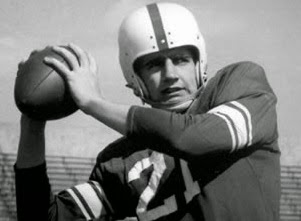
Highlighted Year: Lou Groza, 1946

Tackle/Placekicker, Cleveland Browns


Age: 22
1st season in pro football
College: Ohio State
Height: 6’3”   Weight: 215

Prelude:
Groza saw little college action before going into the military during World War II, but Paul Brown signed him for the Browns of the new AAFC for 1946. In his first season, he was used primarily as a placekicker who backed up on the offensive line.
1946 Season Summary
Appeared in all 14 games
[Bracketed numbers indicate league rank in Top 20]

Kicking
Field goals – 13 [1]
Most field goals, game – 3 vs. Miami 9/6
Field goal attempts – 29 [1]
Field goal percentage – 44.8
PATs – 45 [1]
PAT attempts – 47 [1]
Longest field goal – 51 yards vs. Chicago 11/17

Scoring
Field Goals – 13
PATs – 45
Points – 84 [1]

Postseason: 1 G (AAFC Championship vs. New York)
Field goals – 0
Field goal attempts – 3
PATs – 2
PAT attempts – 2

Punts – 2
Yards – 80
Average – 40.0

Awards & Honors:
2nd team All-AAFC: UPI

Browns went 12-2 to finish first in the AAFC Western Divisionwhile leading the league in total yards (4244), touchdowns (55), and scoring (423 points). Won AAFC Championship over New York Yankees (14-9).

Aftermath:
Groza became a starting tackle during the1947 season and excelled there, if not as visibly as he did with his kicking. With Cleveland joining the NFL in 1950, he led the league in field goals (13) and field goal percentage (68.4), kicked the game-winning field goal in the NFL title game, and was named to the Pro Bowl for the first of six straight seasons. He again led the league in field goals in 1952 (19) and ’53 (23) and was successful on 88.5 % of his attempts in the latter year. Groza receivedleague MVP recognition from TheSporting News in 1954when he led the NFL with16 field goals out of 24 attempts for a league-leading 66.7 percentage and along with 37 extra points ranked third in scoring  with 85 points. The best placekicker of his era, “The Toe” also continued to be an outstanding tackle. He was again a consensus first-team All-Pro and Pro Bowl selection in 1955, led the NFL in field goals in 1957 (15) and was named to the Pro Bowl in ’57, ’58, and ’59 for a total of 9 in all. 1959 marked his last season as a tackle and he retired for a year in 1960 due to a back injury. He returned as strictly a placekicking specialist in 1961 and led the league in field goal pct. that year (69.6) and again in 1963 (65.2). He finally retired for good following the 1967 season at age 43 and after a total of 21 years (four in the AAFC, 17 in the NFL). At the time, he was the NFL career leader in games played (216), scoring (1349 points), field goals (234), and extra points (641). Adding in his AAFC totals, he played in 268 games, scored 1608 points, and kicked 264 field goals and 810 extra points. The Browns retired his #76 (which he wore for the last 15 years of his long career) and he was inducted into the Pro Football Hall of Fame, Class of 1974.

--

Highlighted Years features players who were consensus first-team All-League* selections or league* or conference** leaders in the following statistical categories:

Rushing: Yards, TDs (min. 10)
Passing: Yards, Completion Pct., Yards per Attempt, TDs, Rating
Receiving: Catches, Yards, TDs (min. 10)
Scoring: TDs, Points, Field Goals (min. 5)
All-Purpose: Total Yards
Defense: Interceptions, Sacks
Kickoff Returns: Average
Punt Returns: Average
Punting: Average

*Leagues include NFL (1920 to date), AFL (1926), AFL (1936-37), AAFC (1946-49), AFL (1960-69), WFL (1974-75), USFL (1983-85)

**NFC/AFC since 1970

November 24, 2016

1966: Cowboys Defeat Browns in Pivotal Thanksgiving Matchup


It was a Thanksgiving showdown for control of the NFL Eastern Conference as the Dallas Cowboys hosted the Cleveland Browns on November 24, 1966.

The Cowboys, meticulously guided by Head Coach Tom Landry since the franchise’s creation in 1960, had a 7-2-1 record and were on the way to their first winning season, with the possibility of also topping the conference. QB Don Meredith (pictured at right) was often maligned but coming into his own and HB Dan Reeves had proven to be effective in tandem with FB Don Perkins. Split end Bob Hayes provided speed on the outside, adding to the explosiveness of the offense. The defense was tough and aggressive, especially on the line anchored by DT Bob Lilly and at linebacker, with Chuck Howley and Dave Edwards on the outside and Lee Roy Jordan in the middle.

Cleveland, at 7-3 under Head Coach Blanton Collier, had topped the Eastern Conference in each of the previous two seasons and won a NFL title in ’64. While the Browns lost star FB Jim Brown to retirement, HB Leroy Kelly had proven to be a more-than-capable replacement and combined effectively with FB Ernie Green. QB Frank Ryan remained a good field general and had fine receivers in flanker Gary Collins and split end Paul Warfield. The Browns had won the previous meeting between the teams in Cleveland but the defense was injury-depleted.

There was a record crowd of 75,504 fans in attendance at the Cotton Bowl. Dallas got the first scoring opportunity following a 38-yard punt return by FS Mel Renfro to the Cleveland 20. But while the Cowboys advanced inside the ten yard line, they had to settle for an 11-yard Danny Villanueva field goal.

Dallas again had the ball in excellent field position shortly thereafter when Leroy Kelly fumbled and Bob Lilly recovered at the Cleveland 24. Once again the home team had to settle for three points, however, and Villanueva again connected, this time from 31 yards.

As the game headed into the second quarter, Cleveland had a shot at getting on the board, but Lou Groza missed wide on a 28-yard field goal attempt. On their next series, the Browns drove 81 yards, and this time didn’t come up empty. Frank Ryan threw to Gary Collins for 21 yards to the Dallas one and from there Kelly plunged into the end zone for a touchdown. Groza’s extra point put Cleveland ahead by 7-6.

The Cowboys put together an 87-yard advance that featured Don Meredith completing passes of 12 yards to Don Perkins, 17 to Dan Reeves, and 14 yards to TE Frank Clarke. Meredith completed the series by throwing a swing pass to Reeves for a six-yard TD on a third down play and, with Villanueva’s point after, the home team was back in front by 13-7.


Cleveland responded with an eight-play, 76-yard series that was helped along by a pass interference penalty on CB Warren Livingston. Ryan lobbed a pass to Ernie Green (pictured at left), who easily outran LB Chuck Howley for a 16-yard touchdown. Groza converted and, with 1:07 remaining in the first half, the visitors were ahead by 14-13.

In the third quarter, the Cowboys moved into scoring position thanks to a long pass interference penalty on CB Mike Howell at the Cleveland 21. Meredith picked up a first down on a 10-yard carry to the nine, but the Browns held and Dallas again turned to Villanueva, who was successful on a 12-yard field goal that put the Cowboys back in front by 16-14.

The Browns failed to put points on the board when Groza’s woes continued as he was again wide on a field goal attempt, this time from 31 yards. The Cowboys again drove into Cleveland territory and once more had to call on Villanueva, who was good on a 13-yard field goal that made the score 19-14 with seven seconds remaining in the period.

The Dallas lead was a tenuous 19-14 as the game headed into the fourth quarter, and the Browns were once again in scoring position. But in a pivotal turn of events, a 20-yard field goal attempt by Groza was blocked by SS Mike Gaechter and the Cowboys proceeded to drive 72 yards in 13 plays. The home team converted three third downs along the way as Meredith connected with Bob Hayes for 19 yards in a third-and-15 situation, ran for five yards on third-and-three, and passed to Reeves for seven yards when facing third-and-four at the Cleveland 16. The series ended with Don Perkins running 10 yards for a touchdown. Villanueva converted and, for all intents, sealed the 26-14 Dallas win.

The Browns had the edge in total yards (321 to 304) although Dallas had more first downs (25 to 18). Cleveland suffered the game’s only turnover and the Cowboys, who were aggressive in their pass rushing, recorded five sacks, to none by the visitors. A key factor was the kicking game as Danny Villanueva was perfect on four field goal attempts while Lou Groza failed three times (at age 42, there was speculation that Groza was at the end of his Hall of Fame career, but he did come back for one final season in 1967).


Don Meredith completed 16 of 24 passes for 131 yards and a touchdown while giving up no interceptions. Don Perkins (pictured at right) ran for 111 yards on 23 carries that included the game-clinching TD and Dan Reeves contributed 49 yards on 14 attempts as well as four catches for 32 yards and a score. Bob Hayes led the Dallas receivers with 6 catches for 54 yards.

For the Browns, Frank Ryan, who was constantly pressured by the Dallas pass rush, was successful on 12 of 26 throws for 190 yards and a TD and with none intercepted. Leroy Kelly gained 115 yards on 15 rushing attempts that included a touchdown and Ernie Green gained 24 yards on 8 attempts and also scored on his lone pass reception. Gary Collins had 5 pass receptions for 92 yards to top the club.

“Dallas just executed better than we did,” summed up Cleveland’s Coach Collier. “We had field position, we had our chances, but we couldn’t capitalize on them.”

The win gave the Cowboys the upper hand in the Eastern Conference race and they ended up first with a 10-3-1 record, losing a closely-fought NFL Championship game to the Green Bay Packers. Cleveland finished in a tie for second with Philadelphia at 9-5.

As a footnote, the arrival of Dallas as a playoff contender would prove to be lasting as the Cowboys went to the postseason in each of the next seven seasons and 18 of 20 between 1966 and ’85.

October 20, 2016

1946: Browns Surge in Second Half to Defeat Dons


The undefeated Cleveland Browns faced a major test in the inaugural All-America Football Conference season as they hosted the Los Angeles Dons on October 20, 1946. The Browns were off to a sensational start under innovative Head Coach Paul Brown and had a 6-0 record. Brown had assembled a team that included many players that he was familiar with from coaching in the college and service ranks, such as QB Otto Graham, ends Dante Lavelli and Mac Speedie, FB Marion Motley (pictured at right), G Bill Willis, and OT/PK Lou Groza, and they were all excelling.

The Dons were at 3-1-1 under Head Coach Dudley DeGroot. Viewed as the more glamorous team coming into the AAFC season, LA had several established pro veterans. They also had QB Angelo Bertelli, the Heisman Trophy winner out of Notre Dame, although Charlie O’Rourke had done the better job thus far behind center.

There were 71,134 fans in attendance, which was the largest crowd in pro football history at the time. The Browns threatened first as they reached Los Angeles territory thanks to a pass from Otto Graham to Dante Lavelli that gained 46 yards, but they came up empty when a fake field goal attempt failed. The Dons then drove 67 yards, resulting in QB Charlie O’Rourke throwing to end Bob Nowaskey for an 18-yard touchdown. Joe Aguirre added the extra point to make it 7-0.

Los Angeles was able to keep the Browns in check on offense for the remainder of the first half, but was also unable to add more points. In the second quarter, Cleveland stopped another advance by the Dons when Graham, showing his skill on defense, intercepted an O’Rourke pass at his 31 and returned it to the LA 45. HB Don Greenwood ran for two yards and two passes were incomplete but the Browns scored on a 48-yard Lou Groza field goal. The score remained 7-3 at halftime.

In the third quarter Cleveland’s offense came to life and put together an 85-yard drive. Key plays were runs by HB Edgar “Special Delivery” Jones for 15 yards and FB Gaylon Smith for 16 before a pass from Graham to Lavelli gained 36 yards and set up Graham’s two-yard carry for a TD. Groza added the point after and the Browns were in front by 10-7.

As the fourth quarter started, Joe Aguirre of the Dons attempted a 34-yard field goal that was blocked by tackle Chet Adams. Three plays later, Graham connected with Mac Speedie for a 47-yard touchdown, Groza again converted, and the home team’s lead was up to 17-7.

LA responded with a 50-yard series but, after reaching the Cleveland 26, had to turn the ball over on downs. Two running plays, the longest for 17 yards by Greenwood, got the ball past midfield and then, with the Dons looking for a pass, Marion Motley broke away for a 48-yard TD. Groza added the extra point to make it 24-7.

The Dons again drove into Cleveland territory, going 62 yards. Following an O’Rourke throw to Nowaskey to make it first-and-goal on the six, O’Rourke kept the ball himself on the next play, running around end for a touchdown. Aguirre’s PAT made it a ten-point game, but it didn’t take long for the Browns to respond. On their first play from scrimmage after the ensuing kickoff, Motley struck again, running 68 yards for a touchdown. Groza converted, thus sealing the 31-14 Cleveland win.

The Dons had the edge in total yards (395 to 353) and first downs (21 to 10), outrushing Cleveland by 274 yards to 224, but the Browns made the bigger plays in the second half that overcame LA’s statistical edge. Each team turned the ball over three times.

With the two long touchdowns, Marion Motley rushed for 143 yards on just eight carries. Otto Graham completed four of 10 passes for 129 yards with a touchdown and an interception. For the Dons, Charlie O’Rourke and Angelo Bertelli combined for 10 pass completions out of 20 attempts for 121 yards and a touchdown along with an interception.

The Browns finally lost the next week to another Western Division rival, the San Francisco 49ers. They were defeated again in the rematch with the Dons but didn’t lose another game on the way to a 12-2 record and a title game victory over the New York Yankees. Los Angeles placed third in the Western Division at 7-5-2.

Otto Graham went on to lead the AAFC in touchdown passes (17) and yards per attempt (10.5) and placed second in passing yards (1834) and completion percentage (54.6). He received first-team All-AAFC honors. Marion Motley rushed for 601 yards on just 73 carries for an 8.2 average and five touchdowns.

September 20, 2015

1964: Browns and Cards Battle to Tie in Back-and-Forth Contest


The Cleveland Browns hosted the St. Louis Cardinals on September 20, 1964, the second week of the NFL season, in what was an early showdown between two teams widely viewed as contenders in the Eastern Conference. Both had won their opening-week games.

The Browns, coached by Blanton Collier, finished second in 1963 with a 10-4 record. The key to the offense, as it had been since he joined the club in 1957, was FB Jim Brown (pictured above), but QB Frank Ryan and flanker Gary Collins were up-and-coming talents, and they were being joined by rookie split end Paul Warfield, who brought needed speed to the receiving corps. The defense was capable, if showing some age, and was especially shaky in the backfield.

St. Louis was coming off of a 9-5 record in ’63 under Head Coach Wally Lemm. QB Charley Johnson was a productive passer with excellent receivers to throw to in split end Sonny Randle and flanker Bobby Joe Conrad. There was good depth at running back, and star HB John David Crow was back after missing virtually all of ’63 due to injury, although HB Bill Triplett was sidelined due to illness.

There were 76,954 fans in attendance at Cleveland’s Municipal Stadium on a warm and sunny day. The Cardinals got a break on the first play from scrimmage when LB Larry Stallings intercepted a Frank Ryan pass and returned it 18 yards to the Cleveland 22. On the next play, Charley Johnson tossed a short pass to John David Crow that went the distance for a touchdown. Jim Bakken added the extra point for the quick 7-0 lead.


Flanker Walter Roberts returned the ensuing kickoff 60 yards to the St. Louis 44 and, with Jim Brown carrying most of the load the Browns reached the 25 before 40-year-old Lou Groza (pictured at left) kicked a 32-yard field goal. Now it was Cleveland’s opportunity to benefit from a turnover on the next series as Bobby Joe Conrad fumbled after catching a short pass from Johnson and DE Bill Glass recovered for the home team at the St. Louis 20. HB Ernie Green ran for five yards and Brown carried twice for another 14, but after advancing to the one, a penalty moved the Browns back and they had to settle for a 12-yard Groza field goal that made it a one-point contest.

The Cards put together a good drive in the waning minutes of the opening period. Johnson completed a pass to HB Joe Childress for 21 yards and Crow and Childress both ran effectively. Bakken kicked a 30-yard field goal and the visitors extended their lead to 10-6 heading into the second quarter.

The Browns went three-and-out on their next possession but got the ball back on an interception by CB Ross Fichtner. Starting from the St. Louis 33, the home team reached the 16 but was flagged for a personal foul on a third down play that not only backed them up 15 yards but cost them the services of Green, a capable blocker as well as running mate for Brown, who was ejected. Groza kicked his third field goal of the contest, from 37 yards, and the Cards’ lead was once again narrowed to a single point at 10-9.

On the next series, the Cardinals advanced past midfield as Crow and Childress again ran well and Johnson tossed a pass to Conrad.  The drive stalled at the Cleveland 44, but Bakken came through with a 51-yard field goal, which was a club record at the time and made the score 13-9. The Browns moved quickly to take the lead on the next possession, going 69 yards in just three plays. Ryan threw to Paul Warfield for 12 yards and Gary Collins for 17 more, and then followed up with a long pass to Warfield for a 40-yard touchdown. Groza converted and Cleveland was now ahead at 16-13, which remained the score at halftime.


St. Louis started off the third quarter with a 71-yard drive in seven plays. Crow carried four straight times for 18 yards and Childress added another nine before Johnson connected with Sonny Randle (pictured at right) for a 38-yard TD. Bakken added the point after and the Cards were back on top by 20-16.

The Cardinals got the ball back on the ensuing kickoff when Roberts fumbled and OT Herschel Turner recovered at the Cleveland 43. The short series was followed by another Bakken field goal, this time from 44 yards for an extended margin of 23-16.

The Browns went three-and-out and punted but now it was the Cardinals turning the ball over once more as Johnson faded back to pass and fumbled when hit by Glass. DT Dick Modzelewski recovered at the St. Louis 28. Ryan passed to Collins for 21 yards and then hit the flanker again for a seven-yard touchdown. Groza converted and the score was tied at 23-23.

The teams exchanged punts but the Cardinals were on the move at the end of the period and, on the first play of the fourth quarter, Johnson completed a pass to Randle for a 50-yard TD. Bakken added the PAT to make it a 30-23 game.

The Browns responded with a long drive of 72 yards that took 13 plays. Ryan was successful on three passes and ran out of the pocket for 17 yards to the St. Louis 12. However, he was also sacked for a 14-yard loss and, while a toss to Brown got eight yards back, Cleveland had to settle for another Groza field goal, from 25 yards, cutting the visitors’ lead to 30-26.

The Cards went three-and-out and punted on their next series and the Browns responded with a 12-play, 61-yard possession. Facing a fourth-and-19 situation at the St. Louis 45 after Ryan was sacked, and with only 1:28 remaining on the clock, Ryan completed a pass to Collins for 43 yards. Two plays later, Brown swept into the end zone from a yard out and, with Groza’s extra point, Cleveland was back on top by three points at 33-30 and appeared to have the game in hand.

St. Louis took over following the kickoff at its own 25 with 28 seconds to play. Johnson passed over the middle to Childress for a gain of 24 yards and then to Randle at the sideline for 14. Another completion, this time to Crow, put the Cards at the Cleveland 21 with the clock now down to seven seconds. Bakken came on to kick a 28-yard field goal and the game ended in a 33-33 tie. 

The Cardinals had the edge in total yards (344 to 281) while Cleveland had more first downs (18 to 17). While St. Louis had more net passing yards (241 to 189), the rushing totals were almost even (115 to 114, in favor of the Browns). Each club recorded two sacks and turned the ball over three times.  Jim Bakken (pictured below) and Lou Groza both were a perfect four-for-four on their field goal attempts. The Cards were penalized eight times, to two flags thrown on the Browns.


Charley Johnson completed 14 of 27 passes for 241 yards and three touchdowns while giving up one interception. John David Crow rushed for 58 yards on 11 carries and caught three passes for 29 yards and a TD while Joe Childress contributed 52 yards on 14 rushing attempts and also pulled in three passes, for 50 yards. Sonny Randle led the Cards with four pass receptions for 121 yards and two TDs.

For the Browns, Frank Ryan, who was battered by the pass rush throughout the contest, was successful on 12 of 26 throws for 189 yards and two TDs and was intercepted twice. Gary Collins caught 6 passes for 105 yards and a touchdown and Paul Warfield added three receptions for 63 yards and a score. Jim Brown ran for 79 yards on 21 carries that included a touchdown.

Both teams remained in a battle for the top spot in the Eastern Conference throughout the season. The Cardinals got off to a 3-0-1 start before losing three of four while Cleveland lost just one game during that stretch to open up a two-game advantage. While the Cards finished strong, including a win over the Browns in the rematch at St. Louis, they finished in second place at 9-3-2 while Cleveland took the crown at 10-3-1 and went on to upset the Colts for the NFL Championship.

Jim Brown, for the seventh time in eight seasons, led the league in rushing with 1446 yards. Frank Ryan threw the most touchdown passes (25) while Gary Collins had 35 catches for 544 yards (15.5 avg.) and eight TDs and Paul Warfield had an outstanding first year with 52 receptions for 920 yards (17.7 avg.) and nine scores.


Charley Johnson (pictured above) led the NFL in pass attempts (420), completions (223), yards (3045), and, less fortunately, in interceptions (24). Sonny Randle appeared in only seven games due to a shoulder injury and compiled 25 pass receptions for 517 yards (20.7 avg.) and five touchdowns.

Lou Groza and Jim Bakken, who matched each other field goal for field goal in the Week 2 game, ended up tied for second in scoring with 115 points. Bakken led the NFL with 25 field goals (in 38 attempts), while Groza placed second with 22 (out of 33 tries). Groza had the edge in extra points by 49 to 40.     

August 10, 2014

1956: Groza Kicks 4 FGs as Browns Dominate College All-Stars


The 23rd annual College All-Star Game on August 10, 1956 featured the Cleveland Browns, defending NFL Champions for the second straight year, against a squad coached by Curly Lambeau, who had guided the All-Stars to a 30-27 upset win in the previous contest.

The Browns, coached by Paul Brown, were again without QB Otto Graham, who retired for good after the 1955 NFL title game. George Ratterman, who started at quarterback in the previous year’s defeat, was again behind center. Cleveland was better prepared than when facing the All-Stars in ’55, however, and it would show.

The All-Stars featured a lineup that included the reigning Heisman Trophy winner, HB Howard “Hopalong” Cassady from Ohio State, as well as future pro stars such as Michigan State QB Earl Morrall, halfbacks Lenny Moore of Penn State and Preston Carpenter from Arkansas (who had been drafted by the Browns), West Virginia guard Sam Huff, and SMU tackle Forrest Gregg.  

There were 75,000 fans in attendance at Soldier Field for the Friday night game. The All-Stars looked strong on offense as they took the opening kickoff and, with Earl Morrall behind center, got two first downs on an 11-yard pass completion to Navy end Ron Beagle and a ten-yard carry by the quarterback. Cassady ran for nine yards to put the All-Stars at the Cleveland 34. However, Morrall suffered an injury to his throwing hand and, on the next play, DHB Warren Lahr intercepted a pass by QB Jerry Reichow of Iowa in the end zone to snuff out the threat. It would be all downhill for the collegians, as they never again penetrated Cleveland territory for the remainder of the contest.

Cleveland methodically moved 80 yards in 12 plays that concluded with George Ratterman passing to HB Fred “Curly” Morrison for a 13-yard touchdown. Lou Groza (pictured at top) added the extra point and the pro champs were up by 7-0.

Early in the second quarter, the Browns reached the All-Star 25 but, after being backed up by a holding penalty, settled for a 47-yard Groza field goal (some sources show shorter distances on the field goals because, under the college rules that the game was played under, field goals were measured from the line of scrimmage rather than the spot of the kick). On the next Cleveland series, the Browns lined up for another field goal try but pulled a fake instead, with DB Tommy James carrying the ball. However, he came up two yards short of the necessary distance for a first down. James made up for it a short time later when he intercepted a pass that set up another Groza field goal, from 37 yards, just before the end of the first half. Cleveland led by 13-0 at the intermission.

Dominating on defense, Cleveland kept it very conservative on offense, making for a dull display for the crowd. Even with Morrall’s return to action for the second half, the All-Stars could not mount a threat. Midway through the third quarter, the Browns had good starting field position due to a shanked punt. A successful Groza field goal try from short range was wiped out by a holding penalty, but he then connected from 31 yards.

Shortly thereafter the collegians, trying to convert a fourth down, lost the ball when FB Don Schaefer fumbled and the Browns recovered at the All-Star 45. That led to a 34-yard field goal that made the score 19-0 heading into the final period.

Early in the fourth quarter, Lenny Moore created some excitement with a 24-yard run for the All-Stars, but the Browns once again stifled the collegians on offense. One final touchdown came at the end of a 38-yard, seven-play series, with HB Gene Filipski running the last two yards to paydirt. It was set up when Preston Carpenter fumbled a punt and DE Jim Ray Smith recovered for the Browns. Groza’s successful PAT put the cap on a convincing 26-0 win.

The Browns led in first downs (18 to 5) and ground out 191 yards on the ground. The All-Stars, who rushed for 121 yards, managed to complete only two of 10 pass attempts for 12 yards and two were intercepted. The All-Stars also fumbled the ball away three times while the Browns suffered no turnovers at all.

Lou Groza’s 14 points, thanks to his four field goals and two extra points, represented the largest individual total since Don Hutson accumulated 19 in 1940. George Ratterman was successful on 7 of 14 passes for 84 yards and a touchdown and his understudy, Babe Parilli, completed one of four throws for four yards but rushed for 39 yards on seven carries. FB Ed Modzelewski led the ground attack, rushing for 76 yards on 21 carries.


For the All-Stars, Earl Morrall (pictured above) completed one of four throws for 11 yards and Jerry Reichow managed one completion for one yard. Don Schaefer topped the collegians with 42 rushing yards on 11 carries while “Hopalong” Cassady, who was playing with an injured heel, was held to 21 yards on six attempts.

Cleveland’s win put the pro champs ahead in the series by 14 to 7, with two ties. However, it didn’t herald another big year for the Browns. They lost four of their first five games on the way to a 5-7 finish, the first losing record in franchise history.

Earl Morrall spent his rookie season with the 49ers and would play for five other teams in a pro career that lasted 21 years. He would return to the College All-Star Game as a member of the Baltimore Colts in 1971.

December 17, 2013

1950: Browns Defeat Giants in Conference Playoff


On December 17, 1950 the Cleveland Browns hosted the New York Giants in a playoff game to determine the champion of the NFL’s American Conference (the re-named Eastern Division). The Browns, coached by the innovative Paul Brown, had joined the NFL after dominating the All-America Football Conference, winning all four league titles before that league folded. Now in the older league, Cleveland had proven the skeptics wrong by compiling a 10-2 record. However, the Giants were the one NFL team that had solved the Browns, winning both regular season encounters. With identical records, they were meeting to determine who would move on to the league championship game against the winner of the National Conference playoff (the Rams and Bears tied for first as well).

Cleveland had a well-balanced offense directed by QB Otto Graham and including the league’s rushing leader in FB Marion Motley. Ends Mac Speedie and Dante Lavelli were fine receivers. The Browns were tough on defense, too, and to top things off, Lou Groza (pictured above) was the NFL’s top placekicker, leading in both in number of field goals and accuracy.

The demise of the AAFC was of big help to the Giants, as they were able to add some outstanding talent to their roster that included DT Arnie Weinmeister and defensive backs Otto Schnellbacher, Harmon Rowe, and Tom Landry. The draft brought a good addition to the offense in rookie FB Eddie Price, who joined veteran HB Gene Roberts in the backfield. Head Coach Steve Owen developed the innovative “umbrella” defense with the Browns in mind, and it had worked well in the two regular season encounters as it stifled Cleveland’s passing attack.

There were 33,054 fans in attendance on a bitterly cold day at Cleveland’s Municipal Stadium, with the temperature in the teens. The turf was frozen and the players on both teams wore sneakers. The field had been covered prior to the game and was clear, while the end zones were white with snow.

HB Dom Moselle returned the opening kickoff 26 yards to the Cleveland 35 and the Browns started off with a 10-play, 59-yard drive that reached the New York four before stalling. Lou Groza, wearing a sneaker on his left foot and football shoe on his right (kicking) foot, booted an 11-yard field goal to give Cleveland the early lead.

The Giants, utilizing the A-formation on offense, were unable to get out of their end of the field for the remainder of the first half. QB Charley Conerly resorted to a quick-kick punt that traveled 72 yards to get out of one jam and, with the teams settling into a battle for field position, the score remained 3-0 at halftime.

Early in the third quarter, the Giants reached the Cleveland 49 thanks to a run by Gene Roberts, but a holding penalty set New York back. New York also lost its best receiver, end Bill Swiacki, to an injury that further weakened the offense.

On the first play of the final period, the Giants again drove into Cleveland territory. Roberts (pictured below) had runs of six and 26 yards as the visitors reached the 16 yard line. But they came up empty when Eddie Price was thrown for a three-yard loss and a lineman caught a Conerly pass, resulting in a penalty.


On their next possession, the Giants appeared on their way to a score when Roberts broke free for a 34-yard gain, but was hauled down by MG Bill Willis at the Cleveland four. The Browns held from there, with several penalties prolonging the series.  Among the penalties, a potential touchdown pass for the Giants was wiped out by an offside infraction and an interception in the end zone by DB Tommy James was nullified by a defensive holding call. A motion penalty backed the Giants up and HB Joe Scott collided with his own blocker for a further loss of yardage. Finally, New York settled for a 20-yard field goal by Randy Clay that tied the score.

As time ran down, the Browns utilized Otto Graham’s mobility to good effect. The former college tailback ran for a total of 37 yards in the series that went 43 yards and ended with Groza kicking a 28-yard field goal with less than a minute remaining on the clock.

The Browns got an additional two points on a safety when Conerly was gang-tackled in his end zone while fading back to try a desperation pass with eight seconds to go. Cleveland won the game and the conference title by a final score of 8-3.

In a defensive struggle with little passing offense on either side, the Browns had the edge in total yards (182 to 154) while New York had more first downs (11 to 9). Cleveland had just 29 net passing yards, to 13 for the Giants, with the Browns recording four sacks to two for New York. The Giants turned the ball over twice and Cleveland suffered one turnover.

Otto Graham went to the air only eight times and had three completions for 43 yards with one interception, but also ran the ball for 70 yards on 8 carries. HB Rex Bumgardner contributed 39 yards on 12 attempts and HB Dub Jones added 32 yards on 12 runs, while Marion Motley was held to only 12 yards on 7 carries. Dante Lavelli was the top receiver with two catches for 35 yards. Bill Willis (pictured below) had a huge performance on defense for the Browns, regularly breaking through the New York line as well as preventing a touchdown by catching Gene Roberts from behind on his breakaway run (Paul Brown declared Willis to be “the greatest lineman in American football” afterward).


For the Giants, Charlie Conerly was successful on three of 12 passes for 48 yards and had two intercepted. Gene Roberts ran for 76 yards on 12 carries and Eddie Price added 65 yards on 21 attempts. Three receivers had one catch apiece, and end Bob McChesney had the longest gain of 19 yards.

“It’s all on the scoreboard,” was Steve Owen’s terse reaction to the loss.

The Browns went on to defeat the Rams in a closely-fought NFL Championship game. They would finish back atop the American Conference in 1951, although their string of league titles would end in the rematch with Los Angeles. New York was 9-2-1 in ’51, ending up in second place. The playoff loss to the Browns would prove to be the last postseason game for the Giants with Steve Owen as coach. He was fired following a lackluster 1953 season after 23 years at the helm that resulted in ten postseason appearances and two NFL titles.

November 3, 2012

1946: Dons Upset Browns with Late FG


The Cleveland Browns had quickly asserted themselves in the first year of the All-America Football Conference, winning their first seven games of the 1946 season and most by lopsided scores. Head Coach Paul Brown’s team was strong on both sides of the ball. But they had finally been tripped up by the San Francisco 49ers and, on November 3 they faced another tough Western Division opponent – although one they had beaten two weeks earlier.

The Los Angeles Dons had solid financing and a well-known name in entertainer Don Ameche as the club president. Head Coach Dudley DeGroot had led the NFL Redskins to the league title game the previous year. There was much veteran talent and the Dons were adept at scoring points, but the defense had shown a tendency to give up too many points in turn. After starting off at 3-0-1, they had lost three straight to come into the game against the Browns at 3-3-1.

There was a crowd of 24,800 at the Memorial Coliseum, which was the largest of the season thus far for Los Angeles. On the first play from scrimmage, HB Chuck Fenenbock (pictured above) ran for a 75-yard touchdown to give the Dons the early lead. Lou Groza got the Browns on the board later in the first quarter with a 25-yard field goal.

In the second quarter, Cleveland went ahead after DB Tom Colella recovered a fumble at the LA 16. The Browns scored four plays later with HB Bill Lund sweeping around right end from five yards out and Groza added the extra point to make the score 10-7.

The Dons drove to another field goal attempt, but the try by Bob Nelson from 26 yards was wide. The Browns scored again when QB Otto Graham passed to end Mac Speedie for a 79-yard touchdown. However, Groza missed the extra point, snapping a string of 22 consecutive successful conversions, and while Cleveland carried a 16-7 lead into halftime, it would have repercussions in the end.

Los Angeles came out strong in the third quarter and drove to the Cleveland 22 before turning the ball over on downs. Shortly thereafter, tackle Bob Reinhard recovered a Cleveland fumble and returned it 43 yards to the Browns’ 14, but again the Dons ran out of downs at the seven.

LA’s defense played inspired football in the second half and the ground game on offense wore Cleveland down. Early in the fourth quarter, the Browns gambled by faking a punt on fourth-and-nine at their own 21. Colella gained just two yards, giving the ball back to LA in excellent field position. Five plays later, end Dale Gentry ran for an eight-yard touchdown. Joe Aguirre kicked the extra point and Cleveland’s lead was narrowed to 16-14.

Another Cleveland fumble set up the winning score for LA. Taking over at the Cleveland 43, the Dons battled for 15 plays to reach the three yard line, from where Aguirre kicked the game-winning 11-yard field goal on fourth down with 20 seconds left to play.

The Browns made a last-gasp effort to pull out the win with Graham completing two passes, but he was sacked on the last play and time ran out. The Dons came away with a stunning 17-16 upset win.


The Dons outgained the Browns by 291 yards to 284 and significantly outperformed them on the ground with 220 yards to just 43. Cleveland had the edge in first downs (13 to 12) and both teams turned the ball over three times. Mac Speedie (pictured at left) had the biggest individual performance, catching 4 passes for 134 yards and the one long TD.

It was the second straight loss for the Browns but they righted the ship in a rematch with the 49ers the next week that they won 14-7, and they didn’t lose again. Cleveland topped the Western Division with a 12-2 record and defeated the New York Yankees for the first AAFC title.

The Dons, meanwhile, ended a three-game losing streak with the upset of the Browns. They won three of their next four contests and finished third in the division at 7-5-2.

February 3, 2012

MVP Profile: Lou Groza, 1954

Offensive Tackle/Placekicker, Cleveland Browns


Age: 30
9th season in pro football & with Browns
College: Ohio State
Height: 6’3” Weight: 235

Prelude:
Groza saw little college action before going into the military during World War II, but Paul Brown signed him for the Browns of the new AAFC for 1946. In his first season, he was used primarily as a placekicker who backed up on the offensive line, and he led the league in field goals (13), extra points (45), and scoring (84 points). But he became a starting tackle during the ’47 season and excelled there, if not as visibly as he did with his kicking. With Cleveland joining the NFL in 1950, Groza led the league in field goals (13) and field goal percentage (68.4), kicked the game-winning field goal in the NFL title game, and was named to the Pro Bowl for the first of six straight seasons. He again led the league in field goals in 1952 (19) and ’53 (23) and was successful on 88.5 % of his attempts in the latter year. The best placekicker of his era, “The Toe” also continued to be an outstanding tackle. He was a consensus first-team All-Pro in 1952 and ’53.

1954 Season Summary
Appeared in all 12 games
[Bracketed numbers indicate league rank in Top 20]

Kicking
Field goals – 16 [1]
Most field goals, game - 3 at Chi. Bears 11/14, at NY Giants 11/28
Field goal attempts – 24 [2]
Field goal percentage – 66.7 [1]
PATs – 37 [3]
PAT attempts – 38 [3, tied with Les Richter]
Longest field goal – 44 yards vs. Detroit 12/19

Scoring
Field Goals – 16
PATs – 37
Points – 85 [3]

Postseason: 1 G (NFL Championship vs. Detroit)
Field goals – 0
Field goal attempts – 0
PATs – 8
PAT attempts – 8

Awards & Honors:
NFL MVP: Sporting News
1st team All-NFL: AP, UPI, NY Daily News, Sporting News
Pro Bowl

Browns went 9-3 to finish first in the Eastern Conference while finishing second in the league (by one point) in scoring (336 points) and touchdowns (41, tied with the Rams) while leading in field goals (16). Won NFL Championship over Detroit Lions (56-10).

Aftermath:
Groza again was a consensus first-team All-Pro and Pro Bowl selection in 1955, led the NFL in field goals in 1957 (15) and was named to the Pro Bowl in ’57, ’58, and ’59 for a total of 9 in all. 1959 marked his last season as a tackle and he retired for a year in 1960 due to a back injury. He returned as strictly a placekicking specialist in 1961 and led the league in field goal pct. that year (69.6) and again in 1963 (65.2). He finally retired for good following the 1967 season at age 43 and after a total of 21 years (four in the AAFC, 17 in the NFL). At the time, he was the NFL career leader in games played (216), scoring (1349 points), field goals (234), and extra points (641). Adding in his AAFC totals, he played in 268 games, scored 1608 points, and kicked 264 field goals and 810 extra points. The Browns retired his #76 and he was inducted into the Pro Football Hall of Fame, Class of 1974.

--

MVP Profiles feature players who were named MVP or Player of the Year in the NFL, AAFC (1946-49), AFL (1960-69), WFL (1974), or USFL (1983-85) by a recognized organization (Associated Press, Pro Football Writers Association, Newspaper Enterprise Association, United Press International, The Sporting News, Maxwell Club – Bert Bell Award, or the league itself).

[Updated 2/10/14]