Showing posts with label Lynn Dickey. Show all posts

December 1, 2015

1985: Packers Shut Out Bucs in “Snow Bowl”


It was a snowy day in Green Bay on December 1, 1985 as the Packers hosted the Tampa Bay Buccaneers. A foot of snow had already fallen by game time and it was accompanied by high winds that gusted to 40 mph and made for a wind chill of zero degrees.

Neither team was in contention coming into the game. The Packers, coached for the second year by Forrest Gregg, had a 5-7 record, although they had won two of their last three contests. WR James Lofton was outstanding but QB Lynn Dickey was showing signs of wear. There was a fair group of running backs but, overall, the team was mediocre. Tampa Bay, under Head Coach Leeman Bennett, also won two of its last three, but had lost the nine games before that and was at 2-10. There was talent in workhorse RB James Wilder and promising new QB Steve Young, who had gained experience in the USFL and recently moved into the starting lineup, but the defense was a liability.  

Attendance was held to 19,856 at Lambeau Field due to the severe weather. The snow did not let up and the conditions didn’t improve during the course of the game, obliterating the yard markers and obscuring visibility. Green Bay won the toss but chose to kick. The Buccaneers thus had the first possession, ran the ball three times, and punted. Lynn Dickey completed a pass to James Lofton, but the star receiver fumbled after gaining 27 yards to midfield and LB Ervin Randle recovered for Tampa Bay. The Bucs were unable to generate offense and punted once again. Green Bay responded with a long drive that took up nearly the remainder of the first quarter. RB Eddie Lee Ivery and FB Jessie Clark carried the ball for the most part but Dickey completed passes to Lofton for 14 and 17 yards and to TE Ed West for 11. The advance finally stalled at the Tampa Bay eight and the Packers came up empty when Al Del Greco’s 25-yard field goal attempt was blocked.

As the game proceeded into the second quarter, the Bucs again had to punt and the Packers put together a 61-yard possession in 11 plays that was helped along when, forced to punt, the Buccaneers were penalized for running into the kicker. Dickey completed passes to Lofton for 11 yards and WR Phillip Epps for seven to start the series and, following the penalty that kept the drive alive, he threw to Lofton for a pickup of 18 yards. Three plays later, and facing third-and-22, Dickey passed to TE Paul Coffman for 19 yards and shortly thereafter, unable to find an open receiver, kept the ball on a one-yard touchdown run. Del Greco added the extra point and the home team was ahead by 7-0.

That remained the score at halftime as the teams traded punts for the remainder of the half. While Dickey was able to complete passes and the Packers generated 243 yards in the wintry conditions, the Bucs were held to 43 yards and one first down.

RB Gerry Ellis returned the second half kickoff 40 yards and it took the Packers just four plays to score again. On second-and-12, Dickey connected with Coffman for a gain of 19 yards and, two plays after that, Ellis broke away for a 35-yard touchdown run. Del Greco again converted to put the home team up by 14-0.

Following another punt by the Bucs, the Packers, starting with good field position at their 48, again drove into Tampa Bay territory, helped along by a pass interference penalty. However, they came up empty this time when Del Greco was wide to the left on a 24-yard field goal attempt.

Another short series by the visitors concluded with another punt, and the teams exchanged turnovers in short order as FS Ivory Sully intercepted a Dickey pass at the goal line, CB Tim Lewis picked off a Steve Young throw two plays later, and Clark fumbled the ball back two plays after that. It appeared that the Bucs might finally get on the board when a long pass by Young intended for WR Kevin House on first down drew a 34-yard pass interference penalty on Lewis that put the ball at the Green Bay 30. Young completed a pass to House for 10 yards but the drive stalled at the 16 and Donald Igwebuike’s 33-yard field goal attempt to start the fourth quarter sailed wide to the left.

The Packers responded by advancing 80 yards in nine plays. Ivery gained 11 yards on a draw play and Ellis had a 15-yard run. Dickey had four pass completions, two of them to Epps for 19 and 18 yards, and the second set up Clark’s three-yard touchdown run up the middle. Del Greco added the extra point and, with Tampa Bay unable to threaten for the remainder of the game, it capped Green Bay’s 21-0 win.

The Packers completely dominated the Buccaneers, gaining far more yards (512 to 65) and first downs (31 to 5), and running 72 plays to Tampa Bay’s 36. Green Bay almost evenly distributed the yardage between running (232) and passing (280). The Packers were credited with five sacks, to two by the Bucs, but also turned the ball over four times, to one suffered by Tampa Bay.


Lynn Dickey completed 22 of 36 passes for 299 yards, and while none were for touchdowns and two were intercepted, it was still a fine showing under the circumstances. Eddie Lee Ivery (pictured at right) and Gerry Ellis both gained over a hundred rushing yards, with Ivery accumulating 109 yards on 13 carries and Ellis contributing 101 on just 9 attempts that included a TD. James Lofton had 6 catches for 106 yards.

For the Bucs, Steve Young was successful on just 8 of 17 throws for 53 yards with no TDs and one interception. He also led the club with 31 rushing yards on 7 carries. James Wilder was held to 23 yards on 12 attempts but led the team with 6 pass receptions for 33 yards.

“Some people can handle cold weather and some can’t. The big thing is, you have to give Lynn Dickey a lot of credit. To be able to throw the football in these conditions is phenomenal,” said Green Bay’s Coach Gregg with reference to his quarterback’s strong outing. “He did a hell of a job.”

Green Bay lost the next week but won the last two games of the season to finish with an 8-8 record for the third straight year, which placed a distant second behind the Bears in the NFC Central. The Buccaneers lost their remaining games, including the rematch with the Packers in the more agreeable climate of Tampa, to end up last in the division at 2-14. While the “Snow Bowl” had no impact on the race for the 1985 postseason, it has maintained a place in the lore regarding pro football games played in extreme weather conditions.

September 13, 2015

1981: Falcons Erupt in 4th Quarter, Overcome 17-Point Deficit to Defeat Packers


The Green Bay Packers hosted the Atlanta Falcons in the second week of the 1981 NFL season on September 13. Both teams had won in the first week against division rivals, with Green Bay defeating the Bears by a 16-9 tally and the Falcons shutting out New Orleans 27-0.

Expectations were greater for the visiting Falcons, who topped the AFC West in ’80 with a 12-4 record before losing a close NFC Divisional-round playoff game to the Cowboys. Coming into their fifth season under Head Coach Leeman Bennett, Atlanta had a productive offense guided by QB Steve Bartkowski (pictured above) and also featuring all-purpose FB William Andrews, wide receivers Alfred Jenkins and Wallace Francis, and TE Junior Miller. The defense was particularly strong at linebacker, including Al Richardson and Buddy Curry, who both received Defensive Rookie of the Year honors in 1980.

Green Bay, coached by Bart Starr, was a disappointing 5-10-1 the previous year. QB Lynn Dickey was an able passer when healthy and had an excellent receiver available in WR James Lofton. TE Paul Coffman was also noteworthy and FB Gerry Ellis was an effective runner and receiver. The defense had been riddled by injuries in 1980 and improvement was anticipated, with the biggest concerns regarding the defensive backfield.

There were 55,382 fans in attendance at Lambeau Field and for the first three quarters, they saw their team control the game. In the first quarter, OT Karl Swanke, lined up as an eligible receiver, caught a two-yard touchdown pass from Lynn Dickey. Jan Stenerud added the extra point. Dickey tossed another scoring pass in the second quarter, this time to Gerry Ellis from 11 yards out, and Stenerud again converted.

With time running out in the first half, Ellis ran 10 yards to the Atlanta six and the field goal unit quickly took the field. However, Stenerud’s 32-yard kick was nullified because Swanke was not yet properly set on the line at the snap. Still, the home team took a 14-0 lead into halftime. Lynn Dickey had completed 16 of 20 passes for 208 yards and two TDs, and the Packers outgained the Falcons by 288 yards to 173 and appeared to be very much in command. In addition, Steve Bartkowski was playing with a painful rib injury after a hard hit by DE Mike Butler in the first quarter.

The Packers turned conservative in the third quarter. The only scoring came late in the period when Stenerud kicked a 44-yard field goal to add to Green Bay’s lead. The Falcons finally got on the board early in the fourth quarter when Mick Luckhurst kicked a 32-yard field goal, but it hardly seemed of concern to the home fans.

The Packers had to punt on their next series and Ray Stachowitz kicked a line drive that traveled 43 yards and was returned by WR Reggie Smith, who raced past three defenders, picked up blockers as he reached the right sideline, and gained 53 yards to the Green Bay two. William Andrews plunged through the line for a touchdown on the next play and, with Luckhurst adding the point after, it was a 17-10 game with 10:35 to play.

The ferocious blitzing of the Falcons again kept the Packers in check on a three-and-out series and, getting the ball back, it took Atlanta just two plays to advance 52 yards. Bartkowski threw to Alfred Jenkins twice, first for 22 yards and then for a 30-yard TD, and Luckhurst’s conversion tied the game at 17-17.


The time remaining was eight minutes as the reeling Packers regained possession, and Dickey, under heavy pressure, attempted a short and poorly-thrown pass that was intercepted by LB Fulton Kuykendall (pictured at left), who returned it 20 yards for the go-ahead touchdown. Luckhurst added the point after and, in a span of 4:24, the Falcons had scored 24 points to take a seven-point lead.

Green Bay still had a shot at tying the game, but after a Dickey throw to WR James Lofton picked up 27 yards, RB Terdell Middleton fumbled after catching a short pass and LB Joel Williams picked up the loose ball and ran 57 yards for the clinching touchdown. Luckhurst’s PAT capped the stunning Atlanta rally which resulted in a total of 31 fourth quarter points to win by a final tally of 31-17.

The Packers had the edge in total yards (396 to 335) and first downs (22 to 19), but crucially, they netted only seven rushing yards in the second half. Green Bay also turned the ball over five times, with two leading directly to touchdowns in the final period, while the Falcons suffered four turnovers. Atlanta recorded five sacks, to three by the Packers.

Steve Bartkowski completed 16 of 30 passes for 233 yards and a touchdown, although he was intercepted four times. William Andrews rushed for 87 yards on 19 carries that included a TD. Alfred Jenkins had five catches for 97 yards and a touchdown and WR Wallace Francis also pulled in five passes, for 88 yards.

For the Packers, Lynn Dickey was successful on 30 of 44 throws for 342 yards and two TDs, but was picked off three times. Gerry Ellis (pictured below) gained 59 yards on 9 rushing attempts and also caught 8 passes for 47 yards and a score. James Lofton gained 179 yards on his 8 pass receptions. LB Rich Wingo had 13 tackles as part of a defensive effort that stymied the Falcons for three quarters.


“It all starts with Reggie’s return,” said Steve Bartkowski, referencing the long punt return by Reggie Smith that led to Atlanta’s first touchdown. “When you’re 17 points down, one big play is not going to win for you. But that got us started.”

“We simply came apart at the seams there for a few minutes,” said Green Bay’s Coach Starr. “It’s one thing to have points scored against you. It’s another thing to have them scored like they did after that long punt return, that interception and that long pass (to Jenkins).”

“The tide of a game is going to turn sometimes,” summed up Lynn Dickey. “What happened to us today was a tidal wave.”

The Falcons won again the next week to reach 3-0 before dropping four of their next five contests on the way to a disappointing 7-9 record that placed them a distant second to the 49ers in the AFC West. Green Bay continued to struggle and was 2-6 at the season’s halfway point before breaking out with six wins in the remaining eight games to break even at 8-8.

Steve Bartkowski had another Pro Bowl year, throwing for 3829 yards and 30 touchdowns, which made him the first NFL quarterback since Y.A. Tittle in 1962-63 to reach 30 TD passes in consecutive seasons. However, he also gave up 23 interceptions and was sacked 37 times. Alfred Jenkins was a consensus first-team All-NFL as well as Pro Bowl selection, leading the league with 1358 pass receiving yards and 13 touchdowns among his 70 catches.  William Andrews placed second in all-purpose yards with 2036 and earned his second Pro Bowl selection.

October 17, 2013

1983: Packers Defeat Redskins in 48-47 Monday Night Thriller


The Green Bay Packers were facing a major challenge as they hosted the Washington Redskins on October 17, 1983. At 3-3, Head Coach Bart Starr’s Packers were a team that could put points on the board, especially with QB Lynn Dickey (pictured above) passing to wide receivers James Lofton and John Jefferson and TE Paul Coffman. But they also gave up points and came into the game with the 28th-ranked defense in the NFL. They also had to make adjustments on the offensive line, with G Tim Huffman out with an ankle injury that necessitated moving Greg Koch over from his OT position and starting Charlie Getty at tackle.

Having a poor defense was not a good situation to be in when facing the Redskins. Coached by Joe Gibbs, they were coming off a Super Bowl-winning season and, if anything, were even stronger in ‘83. Behind the best offensive line in the league, QB Joe Theismann was a proficient passer and RB John Riggins a powerful force running the ball. If there was a weak point, it was the defensive backfield, but Washington was cruising at 5-1, with a close opening-game loss to the Cowboys the only blemish.

There were 55,255 fans in attendance for the Monday night game at Lambeau Field. Just over a minute into the first quarter, they had reason to get excited when Green Bay LB Mike Douglass forced RB Joe Washington to fumble and returned it 22 yards for a touchdown and, with Jan Stenerud’s extra point added, the early 7-0 lead.

DB Mike Nelms returned the kickoff 41 yards and the Redskins drove 55 yards in six plays, highlighted by Theismann’s pass to WR Art Monk for a 34-yard gain. The series ended with John Riggins fumbling into the end zone and TE Clint Didier recovering for a TD. Mark Moseley tied the score with his PAT.


Green Bay responded with a 10-play, 40-yard drive. Lynn Dickey threw to Paul Coffman for 17 yards and John Jefferson for 13 along the way and Stenerud kicked a 47-yard field goal that put the Packers back in front by three.

Washington moved the ball quickly downfield with Theismann connecting with Monk for a 22-yard gain and with RB Nick Giaquinto for 31 more yards. But the Green Bay defense came through with back-to-back sacks of Theismann and the Redskins had to settle for a 42-yard Moseley field goal. The eventful first quarter ended with the score tied at 10-10.

Things did not slow down as the game approached the second quarter. Dickey threw to James Lofton for 21 yards and the Packers picked up 15 more on a penalty when CB Darrell Green hit the receiver out of bounds. Dickey then tossed a 36-yard touchdown pass to Coffman. Stenerud added the extra point and the home team was back in front by 17-10.

Back came the Redskins, moving 67 yards in seven plays and highlighted by a 36-yard carry by Riggins. Riggins scored from a yard out and Moseley again knotted the score with the successful PAT.

The Packers reached the Washington 33 on the next series before a Dickey pass was intercepted by CB Anthony Washington. After getting a first down, the Redskins were finally forced to punt and Green Bay came back with a 73-yard, seven-play possession. RB Eddie Lee Ivery tossed an option pass to Coffman for 15 yards and a first down at the Washington 9 from where Coffman caught a scoring pass, this time from Dickey. Stenerud added the extra point and once again the Packers were in front by a touchdown.

With less than two minutes remaining in the half, the Redskins came out throwing. Theismann completed five passes to reach the Green Bay 11 and Moseley booted a 28-yard field goal as the clock reached five seconds. The Packers carried a 24-20 lead into the intermission.

Starting off the third quarter, the Packers struck quickly as they advanced 80 yards in just 42 seconds. Dickey threw to Coffman for 40 yards and then RB Gerry Ellis, taking advantage of a big hole, ran 24 yards for a touchdown. The home team had its biggest lead of the day at 31-20.

Washington seemed on the verge of responding with a touchdown, reaching the Green Bay four, but an offensive pass interference penalty nullified an apparent scoring catch and once again the Redskins settled for a Moseley field goal, this time from 31 yards.

Up by eight points, the Packers were forced to punt on their next series and Bucky Scribner’s kick was blocked to give the Redskins the ball at the Green Bay 19. Five plays later, Theismann threw to Joe Washington for a six-yard TD and, with Moseley’s PAT, the Green Bay lead was down to 31-30.

Washington’s defense again asserted itself as Dickey was sacked twice by DT Dave Butz. Nelms made a good return of the ensuing punt by Scribner to give the visitors possession at their 46. From there, the Redskins again moved deep into Green Bay territory, but after reaching the nine yard line, Douglass tackled Joe Washington for a loss and once again Washington was held to a field goal. Still, Moseley connected from 28 yards and put the visitors ahead by 33-31 with ten seconds left in the period.

RB Harlan Huckleby returned the ensuing kickoff for 54 yards to the Washington 39 and the fourth quarter started with Dickey throwing to Ellis for 32 yards. Shortly thereafter, TE Gary Lewis scored a touchdown from two yards out on an end-around that put the Packers back in front.

The Redskins came right back again as Theismann threw to Monk for 25 yards and WR Charlie Brown for another 15. Riggins blasted into the end zone from a yard out and the Washington was again in the lead of the wildly back-and-forth contest.

The Packers responded with another score of their own, with Dickey completing passes covering 19 yards to Jefferson and 17 yards to Lofton. An 11-yard touchdown pass to FB Mike Meade, followed by Stenerud’s extra point, again put Green Bay in front at 45-40.


Now it was Washington’s turn again. Theismann (pictured at right) threw to Monk for 21 yards and Joe Washington ran for two first downs. A sack of Theismann by DE Byron Braggs momentarily derailed the Redskins, but a pass to Giaquinto picked up 35 yards and set up a five-yard scoring toss to Washington. Moseley added the point and, with 2:50 left on the clock, the visitors were back on top at 47-45.

It looked bleak for the Packers when, following the kickoff, Dickey tossed two incomplete passes. But then he found Ellis on a short pass over the middle that turned into a 56-yard gain to the Washington eight and, after conservatively running the ball into the line three times, the dependable Stenerud came on to kick a 20-yard field goal. It was the fifth lead change of the final period and put the Packers ahead by a point.

There were still 54 seconds remaining in the contest, however, and while the Redskins had no timeouts remaining, they quickly moved the ball down the field. Theismann completed three passes to Joe Washington, gaining a total of 33 yards, and the running back made it out of bounds after each. Theismann then threw to Brown for 22 yards, but the clock was still running and the quarterback had to hurriedly toss a pass out of bounds with three seconds to go. On the last play of the game, Moseley missed a 39-yard field goal attempt, the fans erupted, and the Packers came away with the 48-47 win.

The combined 95 points was a new high for Monday Night Football. The teams also combined for 1025 yards of offense, with the Redskins topping Green Bay by 552 to 473. They had more first downs (33 to 23). Each team turned the ball over once, and there were just three punts in all (one by Washington, two for Green Bay, one of which was blocked by the Redskins).


Lynn Dickey completed 22 of 31 passes for 387 yards and three touchdowns with one intercepted. Paul Coffman had 6 catches for 124 yards and two TDs while Gerry Ellis (pictured at left) contributed 105 yards on four receptions to go along with his three carries for 41 yards that included a score. James Lofton caught 5 passes for 96 yards and John Jefferson added 50 yards on his four catches.

For the Redskins, Joe Theismann was successful on 27 of 39 throws for 398 yards and two TDs and no interceptions. Joe Washington caught 9 passes for 57 yards and two touchdowns to go along with his 80 rushing yards on 16 carries. John Riggins, who had to sit out much of the second half with a hip injury, nevertheless led the club on the ground with 98 yards on 25 attempts that included two TDs. Art Monk gained 105 yards on five catches and Charlie Brown had 6 receptions for 91 yards.

“It was about the wildest thing I’ve ever been in,” said Lynn Dickey. “I wish I had been in the stands or at home watching on tv, it was that good.”

“It was a tremendously inspirational win because you could see the sort of enthusiasm and intensity that was on display tonight,” said Bart Starr. “You have to salute both teams because Washington, for the reasons demonstrated on the field, is a world-championship team. They are magnificent.”

The Packers lost their next two games on the way to an 8-8 finish that put them second in the NFC Central (and cost Coach Starr his job). Tellingly, while they ranked fifth in the league with 429 points, they also gave up a NFL-high 439 points. Washington didn’t lose again during the regular season, compiling a 14-2 record that was best in the league as well as the NFC East. Along the way, the Redskins set 18 NFL records that included points scored with 541. However, after repeating as NFC Champions, they came up short in the Super Bowl, losing decisively to the Raiders.

Lynn Dickey led the NFL in passing yards (4458) and touchdown passes (32), although also in interceptions (29). James Lofton (58 catches, 1300 yards, 8 TDs) and Paul Coffman (54 catches, 814 yards, 11 TDs) were both selected to the Pro Bowl.

Joe Theismann had a MVP year as he ranked second in passing (97.0 rating) while compiling 3714 yards and 29 touchdowns. John Riggins was a consensus first-team All-NFL selection as he rushed for 1347 yards and set a new league standard with 24 touchdowns. Joe Washington added 772 rushing yards and 454 yards on 47 pass receptions.

September 7, 2013

1980: Packers Beat Bears in OT as Marcol Scores TD on Blocked Field Goal


The Green Bay Packers faced their season-opening game on September 7, 1980 with some trepidation regarding the offense. The Packers had not scored a touchdown in their last three preseason games and a total of 17 points overall. Furthermore, there had been rumors in the media during the week leading up to the game that there was a great deal of dissension on the team. Entering his sixth season, there was talk that Head Coach Bart Starr’s job was in trouble.

The Packers were coming off a 5-11 record in 1979 after having contended the year before. QB Lynn Dickey regained his starting job from David Whitehurst late in the season and still held it. He had an outstanding target to throw to in third-year WR James Lofton. RB Eddie Lee Ivery, the previous year’s first draft pick, was back after a knee injury suffered in the first game of ’79 had cost him virtually the entire season.

The division-rival Chicago Bears were the opponents for the opening week. Coached by Neill Armstrong, the Bears had reached the playoffs as a 10-6 Wild Card team in 1979. The key to the offense was RB Walter Payton, who topped the NFC with 1610 rushing yards. QB Mike Phipps, a first-round disappointment with the Browns, had performed ably down the stretch. The defense, under the direction of defensive coordinator Buddy Ryan, was tough and well-balanced.

There were 54,381 fans in attendance at Lambeau Field. Green Bay’s offense continued to misfire against the Bears but the defense rose to the occasion. Chicago took the lead in the first quarter with a 42-yard Bob Thomas field goal, but big plays by the defense in the second quarter not only kept the visitors from adding more points but allowed the Packers to move in front.

Early in the second quarter the Bears advanced into Green Bay territory but LB Mike Hunt sacked Phipps, who fumbled. LB Mike Douglass recovered at his own 41. Once again the Bears moved into Green Bay’s side of the field but a Phipps pass intended for WR James Scott in the end zone was intercepted by DB Wylie Turner.

The biggest defensive play occurred when the Bears passed up a field goal attempt with a fourth-and-one situation at the Green Bay 14. Walter Payton, running a sweep, was tossed for a ten-yard loss by a hard-charging CB Mike McCoy. Lynn Dickey then threw to James Lofton to move the Packers into scoring territory in the waning seconds. Chester Marcol, who had gotten Green Bay on the board earlier in the period with a field goal from 41 yards, kicked another of 46 yards as time expired to give the Packers a 6-3 lead at the half.

The Bears did get another field goal from Thomas less than four minutes into the third quarter, this time from 34 yards, but that was it. The Bears again came up empty in Green Bay territory when McCoy picked off a Phipps pass at his 19 yard line. FS Johnny Gray intercepted another Phipps throw and returned it to midfield. With neither offense able to reach the end zone, the game remained tied at 6-6 after four quarters of play.

The Bears had the first possession in overtime but again the scrappy Green Bay defense came through and they were forced to punt. A clipping penalty nullified a 16-yard return by WR Fred Nixon. Still, the Packers moved to the Chicago 17 in four plays highlighted by Dickey throwing to Lofton for a 32-yard gain.

On the ensuing field goal attempt, Chicago DT Alan Page blocked the low kick but it bounced directly back to Marcol, who grabbed it in midair and ran around left end with no defenders between him and the goal line (pictured at top). Marcol’s astounding 25-yard run with the blocked kick gave Green Bay a 12-6 win at six minutes into the extra period.

Chicago outgained the Packers (268 yards to 214) and had more first downs (18 to 12). The Bears also sacked Dickey four times. However, they turned the ball over four times to one suffered by Green Bay.

Lynn Dickey completed 10 of 22 passes for 138 yards with no touchdowns and one intercepted. James Lofton (pictured below) caught 5 of those passes for 77 yards. Eddie Lee Ivery rushed for 73 yards on 15 carries. SS Steve Luke had a notable performance, accounting for 10 tackles, but the defense as a unit played very well.


For the Bears, Walter Payton was held to 65 yards on 31 rushing attempts while gaining 38 more yards on four pass receptions. Mike Phipps was successful on 17 of 30 throws for 174 yards and no TDs but with three interceptions. Wide receivers Brian Baschnagel and James Scott each pulled in 5 passes, for 59 and 58 yards, respectively.

“It’s a dream come true,” said Chester Marcol of his touchdown – the only one of his nine-year career. “It was a very fortunate thing. This is probably the biggest moment of my life.”

“If we had lost, people would have brought up a lot of things that the offense did wrong,” said James Lofton. “And they would be right. But since we won, a lot of things can be overlooked today.”

The amazing overtime win did not mark an improvement in fortunes for the Packers. They lost their next three games on the way to a 5-10-1 record that placed them at the bottom of the NFC Central. Chicago also had a disappointing year, ending up third in the division at 7-9.

Chester Marcol, who scored a total of 521 points for Green Bay and twice led the league in scoring, failed to make it through the season with the Packers. He was waived after five games and picked up by the Houston Oilers in what was his final year in the NFL.

Despite the team’s inconsistency and chronic problem with scoring points, Lynn Dickey went on to have a good year in many respects as he passed for 3529 yards and 15 touchdowns – although he also tossed 25 interceptions. James Lofton was chosen to the Pro Bowl for the second time after catching 71 passes for 1226 yards (17.3 avg.) with four TDs. 

September 12, 2012

1982: Packers Rally from 23-0 Halftime Deficit to Beat Rams


After seven years with Bart Starr as head coach, the Green Bay Packers had yet to make it to the postseason and fans and the team’s directors were getting frustrated. Starr, who as a Hall of Fame quarterback had been a part of five NFL titles during the Vince Lombardi coaching era, received a contract extension following an 8-8 tally in 1981 in which the Packers started poorly but finished strong and just missed being a Wild Card team. The offense featured a strong passing game with QB Lynn Dickey (pictured above) throwing to wide receivers James Lofton and John Jefferson, as well as TE Paul Coffman. There were questions with regard to the running game, however, due to talented RB Eddie Lee Ivery’s two knee surgeries in three years, and the defense lacked a strong pass rush as well as overall consistency. Starr’s future with the team rested on making it to the playoffs in ’82.

On September 12, 1982 the Packers opened at home against the Los Angeles Rams. After consistently contending throughout the 1970s and winning a NFC title in ’79, LA had dropped to 6-10 in 1981 – the team’s first losing record since 1972. The front office had made moves to bring in fresh veteran talent, most notably QB Bert Jones and TE Mike Barber. Jones had starred for the Colts before his career was derailed by injuries and, when he returned, the club was in decline. Barber was obtained from the Oilers, where he had shown promise but was pushed aside by ex-Raider Dave Casper.

There were 53,694 fans in attendance at Milwaukee’s County Stadium and they spent much of the first half venting their frustration. The Packers fumbled the ball away in their own territory on each of their first three possessions and five times overall in the first half. The Rams directly benefited in the first quarter as RB Wendell Tyler ran for a four-yard touchdown and Mike Lansford kicked a 32-yard field goal, both following turnovers.

In the second quarter, LA put together a 51-yard scoring drive that concluded with a 10-yard TD pass from Jones to Barber. Lansford added field goals of 29 and 28 yards and the Packers left the field to a loud chorus of boos and behind by a score of 23-0. To make matters worse, Green Bay had lost starting FB Gerry Ellis due to a twisted knee. Coach Starr considered pulling Dickey in favor of backup David Whitehurst for the second half, but decided against making a move.

When Green Bay’s defense stopped the Rams in their first possession of the second half, it was a sign of momentum about to shift. Dickey responded with a four-yard touchdown pass to Coffman to get the Packers on the board. Before the third quarter was over, Eddie Lee Ivery ran for a three-yard TD and LA’s lead was cut to 23-14. The Rams failed to get a first down in the third quarter as the first half roles now were reversed.

Heading into the fourth quarter, John Jefferson set up Green Bay’s third touchdown with a reception that covered 50 yards, although he suffered a hamstring pull and sat out the rest of the game. The Packers continued their 66-yard drive that concluded when Dickey threw to James Lofton for a 15-yard TD. Following Jan Stenerud’s successful extra point, the home team was just two points behind.

The Rams fumbled on the ensuing kickoff, a squib kick by Stenerud that RB Robert Alexander couldn’t handle, and Green Bay immediately scored again on the next play as Dickey tossed a 10-yard touchdown pass to Coffman.

Now down by five points, the Rams fought back as Jones completed three passes to move them to the Green Bay 31. But two runs gained just a yard and Jones was sacked for an eight-yard loss on third down, forcing a punt. With just over six minutes remaining in the game, the Rams had another shot but LB George Cumby intercepted a Jones pass at the Green Bay 30.

Ivery added an insurance score with a 27-yard run up the middle for a touchdown late in the fourth quarter. LA’s last opportunity came with 2:58 to play. The Rams again drove to the Green Bay 32 but this time it was LB John Anderson picking off Jones and that was it as the Packers came away with a stunning 35-23 win.

Green Bay outgained the Rams (377 yards to 271) and had more first downs (22 to 12). The Packers turned the ball over a total of six times, which had put them in the early hole, while Los Angeles suffered three, including the two fourth quarter interceptions that snuffed out their comeback hopes. They also hurt themselves with 11 penalties that cost them 88 yards, to two flags thrown on Green Bay. The Packers sacked Jones four times while LA got to Dickey twice.


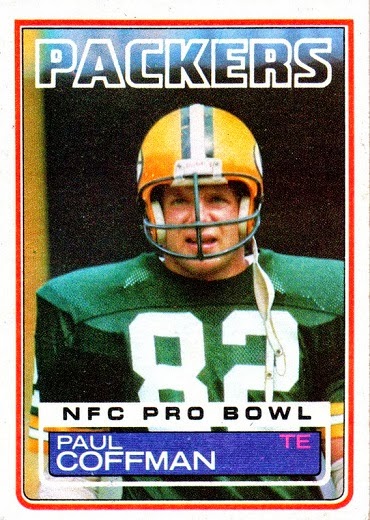
Lynn Dickey completed 17 of 27 passes for 237 yards and three touchdowns along with three interceptions. John Jefferson caught 6 passes for 116 yards before he had to leave the game while Paul Coffman (pictured at left) added 4 receptions for 66 yards and two TDs and James Lofton pulled in 4 passes for 59 yards and a score. Eddie Lee Ivery had a fine performance as he gained 109 yards on 17 carries that included two touchdowns.

For the Rams, Bert Jones was successful on 17 of 31 passes for 202 yards and a TD and the two late interceptions. FB Mike Guman and RB Jewerl Thomas each caught four passes, for 37 and 28 yards, respectively, and WR Willie Miller gained 78 yards on his three receptions. Wendell Tyler paced the running attack with 57 yards on 14 carries that included a TD and added three catches for 32 more yards.

“That’s the greatest comeback I’ve ever witnessed,” said an elated Bart Starr.

“We were very dull in the third quarter,” said Coach Ray Malavasi of the Rams. “That’s my observation.”

After beating the Giants the next week, a players’ strike wiped out the next two months of the season. With the divisions eliminated in an abbreviated nine-game regular season when play resumed, the Packers qualified for the playoffs by finishing third in the NFC with a 5-3-1 record. They won their first postseason game over the Cardinals but lost to Dallas in the next round. The Rams suffered through a dismal 2-7 campaign, ending up at the bottom of the conference and costing Coach Malavasi his job.

Over the course of the short season, Lynn Dickey passed for 1790 yards and 12 touchdowns while averaging a league-leading 14.4 yards per completion and ranking third with 8.2 yards per attempt. James Lofton (35 catches, 696 yards, 19.9 avg.), John Jefferson (27 receptions, 452 yards, 16.7 avg.), and Paul Coffman (23 catches, 287 yards, 12.5 avg.) all were selected to the Pro Bowl. Eddie Lee Ivery stayed healthy and rushed for 453 yards and 9 TDs.

Bert Jones had a disappointing year with Los Angeles, playing in just four games before being sidelined by a neck injury that proved to be career-ending. He threw for just 527 yards with two touchdowns and four interceptions in what was the bitter end to a once-impressive career that was done in by injuries. 

April 2, 2012

1976: Packers Obtain Lynn Dickey from Oilers


On April 2, 1976 a long-delayed trade between the Green Bay Packers and Houston Oilers was announced. The Packers sent QB John Hadl, CB Ken Ellis, and two draft choices (fourth round in ’76, third round in ’77) to Houston for QB Lynn Dickey.

Word of the impending deal had been leaked earlier in the week and it thus came as no surprise. It had been agreed to long before, but an embargo on trades due to litigation involving the allocation of players to the NFL’s two new expansion teams forced a delay. It was thus officially announced on the day that the embargo was lifted.

“After a great deal of consideration and thought, we thought the trade for Lynn Dickey would be in the best interests of the Green Bay Packers or we wouldn't have made it,” Bart Starr, all-time great quarterback and now general manager and head coach of the Packers, said when questioned about the cost to his team. “Any time you make an investment like this it's expensive, but I think if you break it down and analyze it, I think you can justify it.”

There was much critical comment, for the unproven Dickey (pictured above) had been unable to beat out Dan Pastorini in Houston and, considering the Packers had given up a great deal to get Hadl during the 1974 season (five draft choices), this seemed to compound the enormity of that action (that transaction had been swung by Starr’s predecessor as head coach/GM, Dan Devine).

The 6’4”, 210-pound Dickey threw just four passes in 1975. At Kansas State, he had broken most Big Eight passing and total yardage records. He was selected by the Oilers in the third round of the quarterback-rich 1971 draft while Pastorini was the team’s first-round draft choice. Dickey missed all of 1972 due to a broken hip suffered in the preseason and in four years of action had thrown a total of 294 passes, completing 155 of them for 1953 yards with 8 touchdowns and a big 28 interceptions (including 9 of his 57 attempts as a rookie). Dickey lacked mobility but had an outstanding arm and Starr could see his potential.

“I felt all along I could play, but I was told I would probably never get that opportunity,” said Dickey, glad to be away from Houston and with an opportunity to start.

Hadl had been an outstanding quarterback for the San Diego Chargers for 11 seasons, leading the AFL twice and NFL once in passing yards and gaining selection to four AFL All-Star Games and one Pro Bowl. He was dealt to the Rams in 1973, where he had an All-Pro year, but was traded to the Packers during the ’74 season and, at 36, appeared to be on the downside of his career. Dickey, on the other hand, was 26 and backup quarterbacks Don Milan and Carlos Brown were clearly not ready to move up.

The Packers were coming off a 4-10 record in Starr’s first year at the helm. The previously solid running game dropped off badly as star FB John Brockington slumped to just 434 yards on the ground. The team had been in the doldrums since the departure of Vince Lombardi as head coach in 1967, with a division title under Devine in 1972 the only highlight. Even in the division-winning year, quarterback was a problem area for the Packers, and Starr was hired in 1975 to bring the winning habit of the Lombardi era back to Green Bay and, as part of that, to bring improvement behind center. Hadl was hardly someone to rebuild around while Dickey could grow with the offense.

Houston, under Head Coach O.A. “Bum” Phillips, was on the rise and coming off a 10-4 record in 1975. Dan Pastorini was the unquestioned starter at quarterback and swapping Dickey for Hadl brought a savvy veteran who could provide both insurance if Pastorini went down as well as a mentor. Ken Ellis, a two-time Pro Bowl selectee, was 28. He had played out his option and was likely to sign elsewhere. The draft choices were used to take WR Steve Largent of Tulsa in 1976, who was traded in the preseason and went on to a Hall of Fame career with Seattle, and FB Tim Wilson out of Maryland in ’77, a capable player who mostly blocked for star RB Earl Campbell until 1982.

Pastorini slumped during an injury-plagued season, along with the rest of the Oilers, in 1976. The team fell to 5-9 after a promising 4-1 beginning. Hadl (pictured below) ended up starting four games, three of which were losses. He was successful on 60 of 113 pass attempts (53.1 %) for 634 yards with seven touchdowns and eight interceptions. He lasted one more year with the Oilers before retiring, seeing less action in ‘77.


Ellis didn’t remain long in Houston, as he was traded to the injury-depleted Miami Dolphins during the season and was converted to safety (the Oilers picked up two 1977 draft choices as part of the transaction).

As for Lynn Dickey in Green Bay, he showed promise – although performed unevenly – until being knocked out by a shoulder injury ten games into the season. Overall, he completed just 47.3 % of his passes for 1465 yards with 7 TDs and 14 interceptions. The running game was still substandard and the receiving corps nothing special, with WR Ken Payne and TE Rich McGeorge the most reliable of the group. Like the Oilers, the Packers ended up at 5-9.

Dickey’s road proved to be a difficult one in Green Bay. He came back in 1977 but suffered a badly broken leg in Week 9 that was such a severe injury he missed all of ’78 as well. The Packers contended in his absence, going 8-7-1, and a competitor arose in David Whitehurst. When Dickey finally came back in 1979, he was backing up his former backup, but Whitehurst failed to progress, the Packers slipped back into their losing ways, and Dickey outplayed him when he started the final three games.

Dickey finally started a full slate of games in 1980 and set team records in pass attempts (478), completions (278), and yards (3529) although he also was intercepted 25 times while throwing for 15 TDs. WR James Lofton, who arrived in ’78, was an outstanding target (71 receptions, 1226 yards) and TE Paul Coffman emerged to catch 42 passes as well. But the team’s record was only 5-10-1. Another quarterback, Rich Campbell out of California, was taken in the first round of the ’81 draft.


In 1981 the Packers picked up another receiver, WR John Jefferson, spectacular with the Chargers but unhappy with his contract, and paired him with Lofton to allow for a wide-open aerial game (#83 Jefferson & #80 Lofton pictured at left). Dickey finally tossed more touchdown passes (17) than interceptions (15), including five in a game against the Saints. However, he was also sacked 40 times, including nine in one game against the Jets, and missed three contests with a back injury. Still, after starting out a miserable 2-6, Green Bay finished up at 6-2.

In the strike-interrupted ’82 season, the Packers made it to the postseason for the first time in ten years with a 5-3-1 record. Lacking a reliable running game, it came down to Dickey throwing the ball to Lofton, Jefferson, and Coffman while trying to avoid being sacked. He threw four TD passes against the Cardinals for Green Bay’s first postseason win since the 1967 season and for 332 yards in a loss to Dallas in the next round (along with three interceptions).

It set the stage for high expectations that were not met in an 8-8 campaign in 1983, although Dickey passed for 4458 yards (third-highest in NFL history at the time) and 32 touchdowns, offset by a league-leading 29 interceptions. The explosive offense couldn’t overcome the porous defense, however, and it marked the end of Bart Starr’s coaching tenure (he was replaced by another Lombardi-era Packer, Forrest Gregg). Dickey lasted for another two years and remained productive, but an injury that prematurely ended his 1985 season ultimately finished off his career.

Overall, Lynn Dickey played 13 seasons in the NFL, appearing in every game just three times (including the 9-game ’82 season). With the Packers, he passed for 21,369 yards and 133 touchdowns, averaging 7.5 yards per attempt, with 151 interceptions. While the team had only one winning season, deficiencies in the running game, offensive line, and defense played more of a role in Green Bay’s lack of success than Dickey, who when healthy was able to combine with a fine receiving corps in productive fashion. Moreover, despite a string of major injuries that threatened to derail his career at several points, he showed great tenacity and toughness along the way.

September 4, 2011

1983: Dickey Throws 5 TD Passes as Packers Defeat Oilers in Overtime


On the morning of September 4, 1983 it seemed doubtful that Lynn Dickey would start at quarterback for the Green Bay Packers later that day in the season-opening game against the Houston Oilers. During the preseason, he had suffered from back spasms and, more recently, missed practice the preceding Friday due to severe headaches as well as the effects of a virus.

“He looked terrible at breakfast,” said seventeenth-year veteran PK Jan Stenerud. “I didn't think there was any way he could play.”

But when the game started before 44,073 at the Astrodome, the eleventh-year veteran and ex-Oiler was behind center for the Packers. Dickey not only played, but excelled as he completed 18 straight passes to start the game. His first incompletion came on an overthrown pass intended for WR John Jefferson with 1:12 left in the half, but by then he had tossed four touchdown passes.

The first had been a 25-yard completion to TE Paul Coffman in the first quarter. Houston responded with a 49-yard field goal by Florian Kempf and then took the lead with a 47-yard TD pass from QB Archie Manning to WR Tim Smith.

Green Bay dominated the second quarter, though, as Dickey connected with Jefferson twice on scoring passes of five and 13 yards and then with RB Gerry Ellis for an 11-yard touchdown. The Packers were ahead by 28-10, but the lead would prove to not be secure in the second half.

Star RB Earl Campbell scored three touchdowns of his own for the Oilers in the third and fourth quarters. The first came in the third period from seven yards out and was countered by a 46-yard Stenerud field goal. Campbell ran for an eight-yard TD in the fourth quarter, and the home team was now only a touchdown behind at 31-24.

After Dickey threw his only interception of the game, in which LB Robert Abraham gave Houston possession at its own 36, the Oilers tied the score at 31-31 when Campbell scored his third touchdown, from one yard out. Green Bay responded with a 74-yard scoring bomb from Dickey to WR James Lofton to go ahead 38-31 with 3:13 to go in regulation.

With 48 seconds remaining in the fourth quarter, RB Larry Moriarty dove into the end zone from two yards away to cap an 81-yard drive and, with the successful extra point, the contest was again tied at 38-38 and remained so at the end of regulation.

Green Bay’s backup QB David Whitehurst took over for the first overtime possession as Dickey was again suffering from headaches so severe that he needed to leave the field. Starting at the 17, Whitehurst completed a key 10-yard pass to WR Phillip Epps in a third down situation, RB Eddie Lee Ivery had runs of 9, 12, and 8 yards, and the Packers drove to the Houston 24, from where the 40-year-old Stenerud booted the game-winning 42-yard field goal at just under six minutes into the extra period. The high-scoring contest ended with Green Bay on top, 41-38.

The Oilers, playing catchup throughout the second half, outgained the Packers (498 yards to 479) and led in first downs (28 to 22). Overall, the statistics were as close as the final score, with Houston holding a 15-yard edge in rushing (150 to 135) and gaining just four more passing yards (348 to 344). Each team turned the ball over twice.

Lynn Dickey was successful on 27 of 31 passes for 333 yards with five touchdowns and the one interception – the TD passes tied the club record, while the consecutive completions streak of 18 broke the existing standard. James Lofton caught 8 passes for 154 yards and the one long TD, while John Jefferson contributed 6 receptions for 60 yards and two scores. Eddie Lee Ivery paced the running attack with 71 yards on 12 carries.

For the Oilers, Archie Manning went to the air 34 times and completed 22 for 348 yards with a TD and two picked off. Lost in the defeat was Tim Smith’s 8 catches for 197 yards and a touchdown, as well as Earl Campbell’s 123 yards on 27 attempts that included three TDs before he had to leave the game late in the fourth quarter with a bruised knee.

“I'm glad it's over. In the first quarter I was wishing it was over,” said Dickey. “I really don't remember half of it. I never knew anything about a streak. When your line gives you time and your receivers don't drop the ball, you are going to have a good day.”

“It was a great game, gentlemen,” Oilers Coach Ed Biles said to his defeated team. “It's unfortunate we didn't win it but we can't give a better effort. We grew up in the second half.”

For the Packers, it was an encouraging beginning to a season of great expectations following a 5-3-1 record in the strike-shortened ’82 campaign that had the team in the postseason for the first time under Head Coach Bart Starr. Dickey and the passing game had been a big part of that, especially following the arrival of John Jefferson, disgruntled in San Diego, in ’81 to combine with fleet James Lofton and the productive tight end, Paul Coffman.

Alas, any visions of a return to the glory years of the Lombardi era were dashed in what ended up being a disappointing 8-8 season in 1983. Dickey was certainly productive, throwing for a league-leading 4458 yards and 32 touchdowns - however, he also led the NFL with 29 interceptions. Lofton (58 receptions, 1300 yards) and Coffman (54 catches, 814 yards, 11 TDs) were again highly successful, and so was Jefferson (57 receptions, 830 yards) who chafed at being used more as a possession receiver. The defense played poorly, however, and overall the club was as inconsistent as the record indicated. It spelled the end for Starr as head coach after nine years at the helm.

For Houston, the opening-game loss was the team’s eighth consecutive regular season defeat. The Oilers, one of the AFC’s strongest teams under Head Coach Bum Phillips in the late 70s, suffered through a dreadful 1-8 year in 1982 under Biles. With poor play by the offensive line combined with the effects of wear-and-tear from carrying a heavy workload since his rookie season in 1978, Earl Campbell’s production dropped off significantly. His performance against the Packers was heartening, and he went on to rush for 1301 yards and 12 touchdowns in ‘83. But 34-year-old Archie Manning, obtained from New Orleans during the ’82 season, started just three games for the Oilers as the club lost another nine straight contests and finished at a miserable 2-14. By that point, Ed Biles was gone as head coach and Chuck Studley guided the club the rest of the way in the interim.