Showing posts with label Tony Canadeo. Show all posts

March 27, 2016

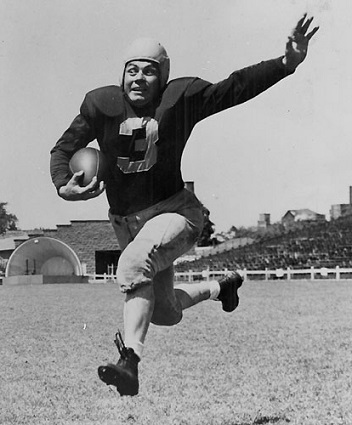
Highlighted Year: Tony Canadeo, 1943

Tailback/Defensive Back, Green Bay Packers


Age: 24
3rd season in pro football & with Packers
College: Gonzaga
Height: 5’11” Weight: 195

Prelude:
“The Gray Ghost of Gonzaga” was an All-West Coast and Little All-American selection in college for his play at halfback. He was chosen by the Packers in the seventh round of the 1941 NFL draft and backed up Cecil Isbell at tailback. His statistical totals were thus modest during his first two seasons as he rushed for a total of 409 yards, caught 10 passes for 66 yards, passed for 364 yards and five touchdowns, and returned 10 kickoffs for a 24.7-yard average and 11 punts for an average of 9.3 yards, and scored six TDs. Canadeo made up for lack of ideal size and speed with determination, savvy, and versatility. With the departure of Isbell, he saw more action in 1943 in combination with rookie Irv Comp.  

1943 Season Summary
Appeared in all 10 games
[Bracketed numbers indicate league rank in Top 20]

Rushing
Attempts – 94 [6]
Yards – 489 [5]
Yards per attempt – 5.2 [3]
TDs – 3 [6, tied with seven others]

Pass Receiving
Receptions – 3
Yards – 31
Yards per catch – 10.3
TDs – 2

Passing
Attempts – 129 [3]
Completions – 56 [3]
Yards – 875 [3]
Completion percentage – 43.4 [4]
Yards per attempt – 6.8 [3]
TD passes – 9 [3, tied with Roy Zimmerman]
Most TD passes, game – 3 vs. Detroit 10/10
Interceptions – 12 [5, tied with Sid Luckman]
Passer rating – 51.0 [3]

Kickoff Returns
Returns – 10 [6]
Yards – 242 [5]
Average per return – 24.2 [3]
TDs – 0
Longest return – 43 yards

Punt Returns
Returns – 8 [12, tied with Lou Brock]
Yards – 93 [12]
Average per return – 11.6
TDs – 0
Longest return – 22 yards

Interceptions
Interceptions – 2 [20, tied with eighteen others]
Return yards – 15
TDs – 0

Punting
Punts – 3
Yards – 102
Average – 34.0
Punts blocked – 0
Longest punt – 39 yards

Scoring
TDs – 5 [10, tied with Tony Bova, Hamp Pool & George Wilson]       
Points – 30 [14, tied with Tony Bova, Hamp Pool & George Wilson]

Awards & Honors:
1st team All-NFL: AP, INS, NY Daily News
2nd team All-NFL: UPI, Pro Football Illustrated, Chicago Herald-American

Packers went 7-2-1 to finish second in the NFL Western Division.

Aftermath:
Canadeo was with the Packers for three games in 1944 before leaving for World War II military duty. Upon his return to the team in ’46, he was utilized more as a halfback. He led Green Bay in rushing for four straight seasons, receiving second-team All-NFL honors from UPI and Pro Football Illustrated in 1948 and first-team recognition from UPI and INS in ’49, a year in which he ran for 1052 yards, becoming the third player in NFL history to cross the thousand-yard rushing threshold and the first to do so without leading the league. Canadeo’s ground-gaining totals dropped off thereafter as HB Billy Grimes took over more of the rushing duties, but he averaged 25.7 yards on a career-high 16 kickoff returns in 1950 and set another high in ’51 with 22 pass receptions for 226 yards. His career, spent entirely with the Packers, finally ended after the 1952 season. Overall, he rushed for a then-team record 4197 yards on 1025 carries (4.1 avg.) with 26 TDs, caught 69 passes for 579 yards and five scores, passed for 1642 yards and 16 touchdowns, returned 46 punts for an 11.2-yard average and averaged 23.1 yards on 75 kickoff returns, and intercepted 9 passes on defense. He scored a total of 31 touchdowns. Canadeo remained active with the Packers following his retirement, as a broadcaster and also a member of the team’s board of directors. The club retired his #3 and he was inducted into the Pro Football Hall of Fame, Class of 1974.

--

Highlighted Years features players who were consensus first-team All-League* selections or league* or conference** leaders in the following statistical categories:

Rushing: Yards, TDs (min. 10)
Passing: Yards, Completion Pct., Yards per Attempt, TDs, Rating
Receiving: Catches, Yards, TDs (min. 10)
Scoring: TDs, Points, Field Goals (min. 5)
All-Purpose: Total Yards
Defense: Interceptions, Sacks
Kickoff Returns: Average
Punt Returns: Average
Punting: Average

*Leagues include NFL (1920 to date), AFL (1926), AFL (1936-37), AAFC (1946-49), AFL (1960-69), WFL (1974-75), USFL (1983-85)

**NFC/AFC since 1970

October 31, 2015

1943: Packers Score 2 TDs in Fourth Quarter to Beat Giants


The Green Bay Packers had a 3-1-1 record and were trying to maintain pace with the Bears in the NFL Western Division as they took on the Giants in New York on October 31, 1943. Head Coach Curly Lambeau’s team was missing a couple of key players in rookie tailback Irv Comp, who was out with a leg injury, and center Charley Brock, due to a recent bout with appendicitis. But other key players, notably tailback Tony Canadeo and end Don Hutson (pictured above), were present.

The Giants, coached by Steve Owen, were 2-1. Rookie FB Bill Paschal was a key addition to the club that already had a solid runner in wingback Ward Cuff. The aging but still able QB Tuffy Leemans and C/LB Mel Hein were also on a roster depleted by wartime. Moreover, the Packers had beaten the Giants only once since 1936, a total of six meetings with two of them having NFL titles on the line.

There were 46,208 fans in attendance at the Polo Grounds. On their second possession of the game, following an exchange of punts, the Packers started off at their own 27. Tony Canadeo threw to Don Hutson for six yards and then ran the ball himself for 12. Another throw to Hutson advanced the ball to the New York 41 and, following a short run by FB Tony Falkenstein, Hutson took the handoff on an end-around and caught the Giants by surprise as he threw an option pass down the middle to end Harry Jacunski for a 38-yard touchdown. Hutson added the extra point for the 7-0 lead.

Following the failure of the Packers to convert a fourth-and-one play on their next series, the Giants took possession at their 43. Tuffy Leemans ran for 14 yards and Ward Cuff for another 14. Cuff caught a pass from Leemans for 12 yards to the Green Bay 17 but the drive stalled at that point as a run was held to no gain and two passes were incomplete. On fourth down, Leemans dropped back and, evading several defenders, threw to Bill Paschal who was alone in the end zone for an 18-yard TD. Cuff’s conversion tied the score at 7-7.


On the last play of the opening period, HB Lou Brock returned the kickoff to the Green Bay 28. Canadeo (pictured at right) and HB Andy Uram had good runs to get the ball into New York territory and, after Brock ran for five yards, Canadeo connected with Hutson for 14 yards and Jacunski for 13. Uram finished the series off with a 12-yard touchdown pass to Canadeo, Hutson added the point after, and the visitors were ahead by 14-7.

Green Bay scored again on its next possession. A Canadeo pass to Hutson gained 19 yards to the New York 21 and, after the tailback ran for four yards, he threw to Hutson again for a 17-yard TD. Hutson added the PAT and the Packers took a 21-7 margin into halftime.

The Giants moved well on offense to start the third quarter, but a promising drive came up empty at the Green Bay 14 when the home team was forced to give the ball up on downs. The Packers had to punt and New York advanced 58 yards and did not come away empty handed. QB Emery Nix threw to Paschal for a gain to the Green Bay 18 and Paschal then carried the ball for another 12 yards. Two plays later, it was Paschal powering through the line for a four-yard touchdown. Cuff converted to make it a seven-point game at 21-14.

On their next series, the Giants again moved effectively, putting together a 65-yard drive. With first-and-goal at the six, however, the Packers held on defense for three plays and Paschal, catching a pass on fourth down, was tackled just a foot short of the goal line. The game now headed into the fourth quarter and the Packers had to punt again, Paschal returning it 17 yards to the Green Bay 28. Nix completed a pass to back Leland Shaffer to the 19 and Paschal ran for seven yards. It was Paschal (pictured below) again finishing off the drive with a dive into the end zone from a yard out. Cuff capped the home team’s comeback with the extra point that tied the score at 21-21.


The Packers reached the New York 36 on their next series but came up empty when Chet Adams was short on a 45-yard field goal attempt. On their next possession, Canadeo connected with Brock for a 40-yard gain but followed up with a pass that was intercepted.

The Giants were now stymied on offense and punted. This time the visitors didn’t fail to score, advancing 66 yards in three plays. Uram faded back and threw long to Jacunski, who caught the ball over his shoulder for a gain of 48 yards to the New York 15. Two plays later, Canadeo fired a pass to Hutson for a 12-yard TD. Hutson added the point after and Green Bay was back in front by 28-21 with four minutes remaining to play.

The Packers got the ball back two minutes later at the New York 40 following Paschal’s punt for the Giants. Canadeo ran for five yards and then broke away on a game-clinching 35-yard touchdown run. Hutson converted and Green Bay came away with a 35-21 win.

The Packers had a big lead in total yards (429 to 288) although the Giants had the edge in first downs (16 to 15). Green Bay both out-rushed (158 to 114) and out-passed (271 to 174) New York, but they also suffered the game’s only turnover.

Tony Canadeo rushed for 122 yards on 18 carries and one touchdown in addition to throwing for two TDs. Don Hutson caught 8 passes for 103 yards and two TDs, passed for a touchdown (the only one of his Hall of Fame career), and with his placekicking added in accounted for a total of 17 points. Harry Jacunski had 5 catches for 124 yards and a touchdown.

Green Bay lost to the Bears the following week and, while they won their remaining games, it was enough to ensure that they would finish in second place in the Western Division with a 7-2-1 record. The Giants tied the Lions in their next game, were thoroughly overwhelmed by the Bears, but then won four straight to close out the schedule and salvage a tie for first place in the Eastern Division with Washington at 6-3-1. They lost the ensuing playoff with the Redskins.

Don Hutson caught 47 passes for 776 yards and 11 touchdowns, all NFL-leading totals. Already the NFL’s career scoring leader, he led the circuit with 117 points. He was a consensus first-team All-NFL selection along with Tony Canadeo, who passed for 875 yards and 9 TDs and rushed for 489 yards and three scores. Bill Paschal was the league’s rushing leader, by a yard over Phil/Pitt’s Jack Hinkle, with 572 yards. He scored a NFL-high 10 TDs on the ground and tied Hutson with 12 touchdowns overall.  

December 5, 2013

1943: Hutson Scores 20 Points as Packers Defeat “Steagles”


The Green Bay Packers finished out their 1943 NFL season on December 5 in a game against a wartime combination of two clubs. The Philadelphia Eagles and Pittsburgh Steelers merged to become the Phil-Pitt Combine, popularly referred to as the “Steagles” due to the World War II manpower shortage plus reduced revenues. Earle “Greasy” Neale of the Eagles and Pittsburgh’s Walt Kiesling acted as co-coaches, and their styles and personalities clashed. Neither team had a history of winning, but the Steagles were in contention in the Eastern Division coming into the final week with a 5-3-1 record. HB Jack Hinkle was in the running for the league rushing title and two rookies, tackle Al Wistert and guard Bucko Kilroy, proved to be good acquisitions.

Head Coach Curly Lambeau’s Packers had a better record than Phil-Pitt, at 6-2-1, but they had already been eliminated by the Bears in the race for the Western Division crown. Star end Don Hutson (pictured above) was having a typically great season and had indicated that this would be his last game (a pronouncement that would prove to be premature). Tailbacks Tony Canadeo and Irv Comp were capable players, replacing the departed Cecil Isbell. Moreover, neither the Eagles nor the Steelers had ever beaten Green Bay (both franchises came into the league in 1933).

There were 34,294 fans in attendance at Philadelphia’s Shibe Park. They saw the Packers score just five plays into the game. The Steagles had first possession and, after a one-yard carry by HB Johnny Butler, Jack Hinkle fumbled and LB Pete Tinsley recovered for Green Bay at the Phil-Pitt 31. Following an incomplete pass on first down, Tony Canadeo took advantage of a big hole and ran 35 yards for a touchdown. Hutson added the extra point and the visitors were in front at just 1:41 into play.

After Hinkle returned the ensuing kickoff to the Phil-Pitt 21, the Steagles scored in four plays. QB Roy Zimmerman threw to Butler for a 37-yard gain and Hinkle ran 38 yards on a sweep for a TD. Zimmerman converted to tie the score.

The Steagles got the ball back when DB Ben Kish intercepted a poorly thrown pass by HB Lou Brock at the Green Bay 41 and returned it five yards. The Packers stifled Phil-Pitt on defense, however, and Zimmerman’s 30-yard field goal try was blocked.

Phil-Pitt advanced to the Green Bay 27 on its next series, but a Zimmerman pass was picked off by Irv Comp, who returned it 41 yards to the Steagles’ 39. Canadeo threw to end Harry Jacunski to get to the 14. HB Bob Thurbon knocked away a throw toward Hutson in the end zone and, following a short run by Canadeo, the Packers were facing third down. Brock got the ball on the next play and ran wide to his left on an apparent sweep, but then turned and threw to Canadeo, who was all alone in the end zone for a 13-yard touchdown. Hutson again converted and the visitors were back in front by 14-7 with less than two minutes to play in the opening period.

The first quarter scoring wasn’t quite over, however. HB Ernie Steele returned the ensuing kickoff 27 yards to the Phil-Pitt 32. Zimmerman passed to Thurbon, who made a leaping catch at his 48 for a 16-yard gain. Following a run by Steele for four yards, Zimmerman went long for end Tony Bova, who outraced Hutson and HB Joe Laws down the middle of the field, gathered the ball in at the Green Bay 15, and reached the end zone for a sensational 48-yard TD. The play, capped by Zimmerman’s extra point, ended the eventful first quarter with the teams tied at 14-14.

Early in the second quarter, Canadeo threw a pass that was almost immediately deflected and grabbed by end Tom Miller to give the Steagles the ball at the Green Bay 14. Jacunski blew through the line and dumped Thurbon for an eleven-yard loss and Phil-Pitt came up empty a few plays later when Zimmerman’s 31-yard field goal attempt sailed wide to the right.

The Packers got a big play when FB Tony Falkenstein took off on a 59-yard carry to the Phil-Pitt 15. The Steagles held from there on defense and Hutson kicked a 25-yard field goal. The score remained 17-14 at the half.

The Packers struck again early in the third quarter when Laws intercepted a Zimmerman pass and returned it to the Phil-Pitt 41. They scored in seven plays with Comp running for the last four yards around end for a TD. Hutson again successfully converted and the visitors led by ten points.

It looked even worse for the Steagles when Hutson intercepted a long throw by Steele and returned it 45 yards to the Phil-Pitt 10 yard line. But the Packers came up empty when, electing to go for the touchdown on fourth down, Comp was instead pulled down for a nine-yard loss and the Steagles regained possession.

Just before the end of the period, Jacunski intercepted a Zimmerman pass at the Phil-Pitt 19. Two plays gained seven yards and then Hutson caught a pass from Comp for a 12-yard touchdown. Hutson added the extra point to make it 31-14 for the visitors.

The Steagles weren’t quite finished, however. After Thurbon returned the kickoff to his 40, Phil-Pitt went 60 yards in six plays, helped by a 15-yard personal foul penalty. QB Allie Sherman threw to Bova for a 13-yard touchdown and Zimmerman added the PAT. Green Bay’s lead was cut to 31-21.

On their next series, the Steagles tallied again as they drove 62 yards. Bova made another outstanding catch, again on a long throw by Zimmerman for a 46-yard gain to the Green Bay four. Hinkle failed to penetrate the line while trying to go up the middle on the next play, but Steele followed up with a carry around end for the needed yardage and a TD. Zimmerman added the extra point and it was suddenly a three-point game with half a period to play.

The crowd was excited, and that excitement increased when the Packers went three-and-out on the next series. However, Hinkle fumbled the ball away at the Phil-Pitt 38. Comp went right to the air, connecting with Falkenstein for 14 yards.  On third down, Comp threw again, this time to Hutson in the end zone for a 23-yard game-clinching touchdown. He converted and the Packers won by a final score of 38-28.

Phil-Pitt had the edge in total yards (318 to 278) and first downs (10 to 8). However, the Steagles hurt themselves by turning the ball over eight times, to two suffered by the Packers.


Don Hutson, with two touchdowns, a field goal, and five extra points, scored a total of 20 points. Tony Bova had a big day catching the ball with three receptions for 106 yards and two touchdowns. Jack Hinkle (pictured at left) rushed for 59 yards in 12 carries in his bid for the league rushing title, although he also had the two critical fumbles.

Green Bay ended up with a 7-2-1 record to place second to the Bears in the Western Division. The defeat knocked Phil-Pitt out of the Eastern Division race as they finished at 5-4-1 and in third place, a game behind the Redskins and Giants, who tied for the division title (Washington won the resulting playoff).

Don Hutson led the NFL in pass receiving for the sixth time with 47 catches, and likewise in receiving yards with 776. He also topped the league with 11 TD receptions and 12 touchdowns overall (tied with Bill Paschal of the Giants) and was the leading scorer with 117 points. He was a consensus first-team All-NFL selection for the sixth consecutive year – and would come back to be so honored twice more before retiring for real in 1945 as the league’s pass receiving and scoring career leader.

Jack Hinkle rushed for 571 yards on 116 carries for a 4.9-yard average, missing out on the NFL rushing title by one yard to Paschal. It was later found that a statistician’s error had apparently deprived him of 37 yards, but the erro remained uncorrected. Tony Bova didn’t catch a lot of passes, although his total of 17 led the Steagles, but he gained 419 yards to average 24.6 yards-per-reception and scored five touchdowns. 

November 13, 2011

1949: Conerly & Roberts Star as Giants Down Packers


The NFL game on November 13, 1949 at Green Bay’s City Stadium featured the Packers (2-5), in what would be their last season under head coach and founder Curly Lambeau, and New York Giants (4-3), a rebuilding club under long-time Head Coach Steve Owen.

The Giants featured second-year QB Charlie Conerly and HB Gene “Choo-Choo” Roberts (pictured above) on offense. Roberts, a good receiver out of the backfield as well as rusher, had a 200-yard receiving performance three weeks earlier (201 on four catches, three of them for TDs, against the Bears).

Green Bay came into the contest as the lowest-scoring team in pro football, averaging just 9.9 points per game. Beyond star HB Tony Canadeo, there wasn’t much talent. The passing game, with Jug Girard and rookie Stan Heath seeing most of the action at quarterback, was dreadful. It was a far cry from the days of Arnie Herber and Cecil Isbell shredding defenses with throws to Don Hutson.

There were 20,151 in attendance at the small venue. Late in the first quarter, the Giants started off the scoring when Conerly threw a pass to Roberts that traveled 20 yards in the air and the third-year halfback ran the remaining 25 for a 45-yard touchdown. Shortly thereafter, LB Don Ettinger intercepted a pass by Heath at the Green Bay 20. The result was a 41-yard Ben Agajanian field goal.

Down 10-0 in the second quarter, the Packers got into the game with a 27-yard field goal by Ted Fritsch and the score remained 10-3 at halftime. However, the Giants took control of the contest with two touchdowns in the third quarter.

In their first possession of the second half, Conerly threw to Roberts for a 44-yard touchdown. The next was set up when tackle Bill Austin recovered a fumble at the Green Bay 32. Again it was Roberts scoring a TD on a Conerly pass, this time from ten yards out.

Visibility was poor late in the game and the lights were turned on. The Packers finally scored a touchdown in the fourth quarter when HB Ralph Earhart returned a punt 57 yards. But end Bill Swiacki added another TD for the Giants, pulling in Conerly’s pass over the heads of two defenders for a 24-yard score. The extra point attempt failed, but it didn’t matter. New York won handily by a final tally of 30-10.

While New York’s edge in first downs was only 19 to 17, the Giants significantly outgained the Packers by 451 yards to 288. Most of New York’s yardage came through the air (352 net passing yards to 99 rushing yards) while Green Bay’s was more evenly distributed (137 rushing, 151 passing). And while the Giants turned the ball over five times, the Packers suffered six turnovers.


Charlie Conerly completed 15 of 29 throws for 345 yards with four touchdown passes, although three were intercepted. Gene Roberts had another two hundred-yard receiving performance as he gained 212 on 7 catches with three TDs. For the Packers, Tony Canadeo ran for 71 yards on 14 carries.

The Giants lost three of their last four games to finish at 6-6 and in third place in the Eastern Division. Green Bay lost all of its remaining contests and ended up at the bottom of the Western Division with a 2-10 record. The team was suffering financially as well as organizationally, and it was a sad end to the Lambeau era for the Packers.

Gene Roberts had an extraordinary season. In addition to becoming the first running back to twice gain 200 receiving yards in a single season, he ranked fourth in rushing in the NFL with 634 yards on 152 carries and nine touchdowns and also placed fourth with his 711 yards on 35 pass receptions that included another eight TDs. His 17 touchdowns and 102 points led the league (the scoring total was tied by Pat Harder of the Cardinals). Roberts also led the NFL with 1345 yards from scrimmage. It was all part of a productive four-season career with the Giants that peaked in 1949 and ’50, and ended abruptly when Roberts jumped to Canada in 1951 and played with Montreal and Ottawa for another four years.

Charlie Conerly played for the Giants far longer (until 1961). In 1949, he ranked third in passing yards (2138) and touchdown passes (17, tied with Bob Waterfield of the Rams), although he also ranked third by tossing 20 interceptions.

Green Bay’s Tony Canadeo (pictured below) had an outstanding season with a bad team as he rushed for 1052 yards on 208 carries for a 5.1-yard average and four TDs. The 30-year-old, in his eighth year out of Gonzaga, ranked second in rushing to Philadelphia’s Steve Van Buren and thus became the first NFL player to rush for a thousand yards in a season without leading the league.