April 17, 2010

1999: Saints Trade All Picks to Draft Ricky Williams


The first round of the 1999 NFL draft was held on April 17, and it was eventful. Early speculation had been that RB Ricky Williams, who had won the Heisman Trophy at Texas while accumulating an NCAA Division I-A-record 6279 yards, would be the hottest commodity. But doubts began to arise as draft weekend approached - there were questions about the 6’0”, 225-pound power runner’s conditioning, attitude, dreadlocked appearance, and introverted nature.

In addition, the quarterback class was considered to be a strong one and the first three teams all went for that position. The newly-reconstituted Cleveland Browns, as an expansion team for the ’99 season, had the first pick and took Tim Couch, a 6’5”, 225-pound signal caller from Kentucky. The Philadelphia Eagles, coming off of a 3-13 season and with a new offense-minded head coach in Andy Reid, chose Donovan McNabb from Syracuse. Cincinnati completed the quarterback trifecta by taking Oregon’s Akili Smith.

Choosing fourth in the first round were the Indianapolis Colts, and having just drafted Peyton Manning the year before, their interest was in a running back (they had also just traded veteran Marshall Faulk to the Rams). However, they passed Williams over for Edgerrin James of Miami, who they felt was a better fit for their offense.

The fifth choice belonged to the Washington Redskins (picked up from Carolina thanks to a trade for DE Sean Gilbert the previous year). In a stunning move, the New Orleans Saints traded their entire draft allotment of six picks in 1999 plus their first and third round choices in 2000 to the Redskins in order to draft Williams. It was a controversial deal from the moment it was announced, and spurred debate for years afterward.

The Saints had gone 6-10 in ’98 and, moreover, had the league’s worst running attack. Mike Ditka, going into the third year of his head coaching comeback in New Orleans, viewed Williams as the centerpiece of his conservative offense and had made clear well in advance of the draft that he considered the Texas back worth the price of the club’s entire draft slate. GM Bill Kuharich went ahead with the deal, despite the misgivings of some in the organization.

Ditka was ecstatic. The day after the draft, he appeared before a group of Saints fans in a Hawaiian shirt and dreadlock wig and shouted, “We are going to win the Super Bowl…We got Ricky, and he’s the final piece of the puzzle. I really believe that.” Ditka and Williams later appeared on the cover of ESPN magazine as a bride and groom, emphasizing the degree to which the coach had gambled his future on the prize running back.

Meanwhile, the Redskins turned around and dealt some of their draft bounty to the Chicago Bears in order to move up to the seventh spot in the first round and select CB Champ Bailey from Georgia. The Bears, trading down in the first round to stockpile picks, took QB Cade McNown of UCLA in the 12th slot (the original draft position of the Saints), just after another quarterback, Daunte Culpepper from Central Florida, was taken by Minnesota in the 11th spot.

Williams signed a comparatively cheap and insentive-laden contract (he made $3.8 million as a rookie, compared with James’ $14.8 million in Indianapolis) and proceeded to have a miserable season. He gained just 884 yards on 253 carries for a paltry 3.5-yard average with two touchdowns as a result of ankle, elbow, and toe injuries. He also alienated teammates and fans alike with his behavior and critical media quotes.

The Saints finished in last place in the NFC West with a 3-13 record, and owner Tom Benson fired Ditka and the rest of the coaching staff, as well as GM Kuharich.

The other teams involved in the deal didn’t fare all that well either. The Redskins ended up trading all but three of the draft picks away, and those three turned out to be LB Nate Stimson in the fourth round of the ’99 draft, LB LaVar Arrington in the first round in 2000, and DB Lloyd Harrison in the third round in 2000. Arrington had a solid career, but Stimson failed to catch on and Harrison bounced from Washington to the Chargers and Dolphins without distinguishing himself over a three-year career.

The deal with the Bears brought the opportunity to draft an outstanding performer in Bailey, but he and Arrington proved to be the only players of value from the dealmaking. The Redskins made the playoffs in 1999 with a 10-6 record, but were mediocre over the course of the ensuing five seasons. GM Charley Casserly was fired following the ’99 campaign, and Head Coach Norv Turner didn’t complete the 2000 season.

McNown was a huge disappointment for the Bears (as was the case with most of the highly-touted 1999 quarterback class), lasting just two mediocre seasons. The other players that Chicago drafted in ‘99 with the Saints picks that had come by way of Washington were WR D’Wayne Bates (third round) and LB Khari Samuel (fifth round). Bates caught a total of 15 passes over three years in Chicago before moving on to Minnesota (he caught 50 passes for 689 yards in 2002, but lasted just one more season). Samuel started one game for the Bears in 1999.

Mark Hatley, the director of player personnel, was fired in 2001 after Chicago, last place finishers in the NFC Central in 1997 and ’98, continued to land at the bottom of the standings in ’99 and 2000.

Washington traded two of the ’99 draft choices to Denver, and the Broncos used them on TE Desmond Clark (sixth round) and WR Billy Miller (seventh round). Ironically, Miller ended up being a reserve with the Saints.

Things did improve for Ricky Williams in New Orleans, where he had back-to-back thousand-yard seasons in 2000 and ’01. However, he never came close to meeting expectations and was dealt to Miami. He led the NFL with 1853 rushing yards in ’02, but drug and behavioral issues hampered his career thereafter.

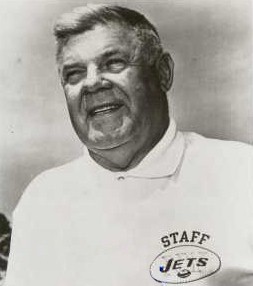
The all-for-one deal of 1999 proved poisonous to the three teams most significantly involved. Almost all of the general managers and coaches who had been part of the trade and its related transactions were fired within two seasons. The Saints suffered most of all, in particular Ditka (pictured below), although he steadfastly defended the trade long afterward.

April 15, 2010

1963: Renamed Jets Hire Weeb Ewbank as Head Coach/GM


On April 15, 1963 the newly-renamed New York Jets took a major step in changing the franchise’s fortunes by hiring Weeb Ewbank as head coach and general manager. That the team had survived to play in a fourth American Football League season was an accomplishment in itself.

The club had started out in 1960 as the New York Titans, owned by the volatile Harry Wismer and playing at the decrepit Polo Grounds. Attendance was sparse (and the numbers often inflated) and money tight, but the club managed to finish at a respectable 7-7 under Head Coach Sammy Baugh’s direction in each of the first two seasons. But by 1962, the team was struggling both on the field and financially. In November, the league took over the team’s finances, Wismer declared bankruptcy, and Commissioner Joe Foss began searching for new ownership.

The new ownership turned out to be a five-man syndicate fronted by entertainment executive David A. “Sonny” Werblin. Werblin took steps to transform the club, changing the name from Titans to Jets and the colors from navy blue and gold to kelly green and white. And he brought in Weeb Ewbank to transform the team on the field.

Ewbank had already proven that he could build a winning team from modest beginnings. A former assistant to Paul Brown at Cleveland, he had taken over as head coach of the Baltimore Colts in 1954, steadily building a team that had been 3-9 in ’53 into a back-to-back NFL champion by 1958 and ’59. However, injuries and aging brought the Colts back to earth over the ensuing three seasons, and Ewbank was let go after a 7-7 finish in 1962.

The refurbished Jets sought to build upon talent already on hand while adding some new arrivals in 1963. Ewbank went with Dick Wood at quarterback, who was lanky (6’5”, 200 pounds) and immobile, but also strong-armed and intelligent. Star split end Art Powell had played out his option and signed with Oakland, but that still left flanker Don Maynard, who had a typically solid season although injuries kept his numbers down (38 receptions for 780 yards with 9 TDs). Split end Bake Turner, a converted halfback who had played for Ewbank with the Colts, was a pleasant surprise in replacing Powell as he caught 71 passes for 1009 yards and six scores. FB Bill Mathis had injury problems, and was supplemented by Mark Smolinski, another former Colt. HB Dick Christy had been a productive all-purpose back, but his numbers dropped off significantly in ’63; the running game was a problem for Ewbank all season. Center Mike Hudock anchored the spotty offensive line which gained the services of rookie OT Winston Hill.

The best of the defensive linemen were ends Bob Watters and LaVerne Torczon, although talented DT Paul Rochester joined the club late in the year. Larry Grantham was considered one of the best outside linebackers in the AFL, but the remainder of linebacking corps was subpar. Clyde Washington was the best of the cornerbacks, while the safeties played well as up-and-coming veteran Dainard Paulson and rookie Bill Baird both intercepted six passes. Punter Curley Johnson was consistently good, although placekicker Dick Guesman was not.

The team went 5-8-1, only marginally better than 1962’s 5-9 tally, finishing third in the Eastern Division. They were still playing at the Polo Grounds, but a highlight of the 1964 season was the move to a fresh venue as the Jets took up residence at brand new Shea Stadium.

FB Matt Snell, a key rookie signee out of Ohio State, was a major addition in ’64, and the arrival of QB Joe Namath in 1965 was a further significant step in building toward a championship (not to mention also bringing publicity to the team). Also joining the team in those years were PK Jim Turner, LB Ralph Baker, G Dave Herman, DE Gerry Philbin, DE Verlon Biggs, C John Schmitt, LB Al Atkinson, DB Jim Hudson, and split end George Sauer - there was also MLB Wahoo McDaniel, who was more a colorful character and fan favorite than cog in an evolving championship team. HB Emerson Boozer and TE Pete Lammons arrived in 1966, DT John Elliott and G Randy Rasmussen in ’67.

It had taken Ewbank five seasons to win a championship in Baltimore, and it would take six years to do the same in New York. But in both instances, he proved his ability as a builder of football teams and delivered titles. From the humble beginnings as the Titans, the Jets became a winning and financially viable franchise over the course of the decade.

April 14, 2010

1984: Gold Overcomes 3-TD Deficit to Defeat Maulers


The Pittsburgh Maulers were one of six new teams in the United States Football League’s second season, and were experiencing plenty of difficulties as they got off to a 2-5 start. Coached by Joe Pendry, the offense was directed by former Cowboys backup QB Glenn Carano and featured rookie Heisman Trophy-winning RB Mike Rozier. However, the defense was mediocre, Rozier got off to a slow start, and Carano struggled (at least, prior to a 388-yard passing performance the week before in a losing effort at New Orleans).

Pittsburgh’s opponent at Three Rivers Stadium on April 14, 1984 was the Denver Gold. Under Head Coach Craig Morton, the Gold had gotten off to a 6-1 start and sat atop the Pacific Division. It hardly seemed likely that the Maulers would mount a strong challenge.

However, at halftime the score was 21-0 in favor of Pittsburgh. Carano had thrown touchdown passes of 21 and 24 yards to WR Greg Anderson and, in between, connected for a 65-yard TD to WR Jackie Flowers.

Denver finally got on the board in the third quarter as QB Craig Penrose threw a 34-yard touchdown pass to WR Kevin Williams. Shortly thereafter, Penrose went down with torn knee ligaments, but reserve QB Bob Gagliano stepped in and narrowed the margin to 21-13 with a 25-yard TD throw to WR Leonard Harris (the extra point attempt failed).

In the fourth quarter, Gagliano connected with Harris for another score, this one from five yards out, and the quarterback ran for a successful two-point conversion to tie the contest. The Gold pulled ahead thanks to an 18-yard touchdown run by Williams on an end-around, and Brian Speelman’s 20-yard field goal with under two minutes to play sealed the 31-21 Denver victory.


The game had been all Pittsburgh in the first half, all Denver in the second. The Maulers outrushed the Gold, 176 yards to 97, and controlled the ball for almost 34 minutes to Denver’s 26. However, Carano (pictured at left) threw three interceptions and was sacked six times (three times apiece by defensive ends Dave Stalls and Bruce Thornton), as opposed to Denver suffering one sack and neither quarterback having a pass picked off. Pittsburgh also committed 12 penalties, adding up to 100 yards, to Denver’s four for 26 yards.

A bright spot for the Maulers was the performance of Rozier, who had his first pro hundred-yard game with 137 yards on 24 carries. Carano’s numbers reflected his inconsistency as he threw three touchdowns, three interceptions, and completed just 14 of 34 passes. Greg Anderson caught 6 passes (for 96 yards) while Jackie Flowers led the team in receiving yards with 125 on three catches.

For Denver, Bob Gagliano’s solid relief performance was summed up by his completing 8 of 9 passes for 90 yards and the two TDs. Prior to that, Craig Penrose was successful on 7 of 16 passes for 106 yards and a score. Leonard Harris was the top receiver with 5 catches for 76 yards and two touchdowns. RB Harry Sydney led the runners with 60 yards on 15 carries.

The win marked the high point of the season for the Gold – they lost their next five contests and won only two more games the rest of the way to finish at 9-9 and in third place in the Pacific Division. Pittsburgh never got on track, ending up at the bottom of the Atlantic Division (along with the Washington Federals) with a 3-15 record. The Maulers folded following the season while the Gold changed ownership and Morton was replaced as coach by Darrell “Mouse” Davis, who had popularized the “run-and-shoot” offense.

April 12, 2010

List of the Day: Best Passing Yardage Seasons, 1960s NFL


Sonny Jurgensen

TOP 10
1- Sonny Jurgensen, 1967 Washington Redskins
3747 yards, 288-508, 56.7 %, 31 TD, 16 INT

2- Sonny Jurgensen, 1961 Philadelphia Eagles
3723 yards, 235-416, 56.5 %, 32 TD, 24 INT

3- Johnny Unitas, 1963 Baltimore Colts
3481 yards, 237-410, 57.8 %, 20 TD, 12 INT

4- Johnny Unitas, 1967 Baltimore Colts
3428 yards, 255-436, 58.5 %, 20 TD, 16 INT

5- Norm Snead, 1967 Philadelphia Eagles
3399 yards, 240-434, 55.3 %, 29 TD, 24 INT

6- Charley Johnson, 1963 St. Louis Cardinals
3280 yards, 222-423, 52.5 %, 28 TD, 21 INT

7- Sonny Jurgensen, 1962 Philadelphia Eagles
3261 yards, 196-366, 53.6 %, 22 TD, 26 INT

8- Y.A. Tittle, 1962 New York Giants
3224 yards, 200-375, 53.3 %, 33 TD, 20 INT

9- Sonny Jurgensen, 1966 Washington Redskins
3209 yards, 254-436, 58.3 %, 28 TD, 19 INT

10-Bill Wade, 1962 Chicago Bears
3172 yards, 225-412, 54.6 %, 18 TD, 24 INT


Johnny Unitas


Norm Snead


Charley Johnson


Y.A. Tittle

BEST BY FRANCHISES NOT IN TOP 10
San Francisco 49ers: John Brodie, 1965
3112 yards, 242-391, 61.9 %, 30 TD, 16 INT

Pittsburgh Steelers: Ed Brown, 1963
2982 yards, 168-362, 46.4 %, 21 TD, 20 INT

Cleveland Browns: Frank Ryan, 1966
2974 yards, 200-382, 52.4 %, 29 TD, 14 INT

Dallas Cowboys: Don Meredith, 1966
2805 yards, 177-344, 51.5 %, 24 TD, 12 INT

Los Angeles Rams: Roman Gabriel, 1967
2779 yards, 196-371, 52.8 %, 25 TD, 13 INT

Detroit Lions: Earl Morrall, 1963
2621 yards, 174-328, 53.0 %, 24 TD, 14 INT

Minnesota Vikings: Fran Tarkenton, 1965
2609 yards, 171-329, 52.0 %, 19 TD, 11 INT

New Orleans Saints: Billy Kilmer, 1969*
2532 yards, 193-360, 53.6 %, 20 TD, 17 INT

Green Bay Packers: Bart Starr, 1962
2438 yards, 178-285, 62.5 %, 12 TD, 9 INT

Atlanta Falcons: Randy Johnson, 1966**
1795 yards, 129-295, 43.7 %, 12 TD, 21 INT

* Saints joined NFL in 1967
** Falcons joined NFL in 1966


Bill Wade


John Brodie


Ed Brown


Frank Ryan

April 11, 2010

1936: Second AFL Awards Eight Franchises


On April 11, 1936 the second pro football organization to be called the American Football League (the first existed for one season in 1926) awarded eight franchises for the inaugural ’36 season.

The prime mover behind the new league was Harry March (pictured below left), an experienced executive both as personnel director for the New York Giants and in the league office of the NFL. Plans had been announced in November of 1935 for the formation of the AFL, which March indicated would be a “players’ league” and would seek to draw talent away from the NFL.


The eight franchises announced on April 11 were in Boston, Cleveland, Jersey City, New York, Philadelphia, Pittsburgh, Providence, and Syracuse. This lineup of clubs was hardly set, however, as three of the franchises (Jersey City, Philadelphia, and Providence) dropped out in August, well before the season commenced. Rochester was granted a franchise, although by early September that team was also gone and Brooklyn entered the circuit.

The league played its first regular season game on September 27 before 6500 fans at New York’s Triborough Stadium, with the New York Yankees defeating the Syracuse Braves, 13-6.

The Yankees were the most successful at raiding the NFL – most notably, they signed back/kicker Ken Strong away from the Giants. They were coached by ex-Giant Jack McBride (pictured at top right) and also had end Les Borden and back Stu Clancy (both also former Giants). Syracuse had star end Red Badgro, who was also a co-coach, but he stayed for just three games and jumped back to the NFL. The Pittsburgh Americans snagged two members of the NFL’s Pirates, end Ben Smith and guard Dave Ribble. Cleveland’s entry, the Rams, signed fullback Damon “Buzz” Wetzel as well as Ohio State’s All-American center, Gomer Jones (pictured below), and an end who would later become far more prominent as a pro head coach, Sid Gillman.


It was the team that accomplished the least in pursuing players from the NFL that ended up having the most success, the Boston Shamrocks. Coached by George Kennedy and splitting their games between Fenway Park and Braves Field, the Shamrocks won the AFL title with an 8-3 record.

The Cleveland Rams went 5-2-2 with the league’s best defense to finish second and draw well at Municipal Stadium. The Yankees, playing at Yankee Stadium (where they hosted the first night football game in that storied venue’s history) as well as Triborough Stadium, were next at 5-3-2. Pittsburgh was a competitive 3-2-1 on the field but drew poorly at Forbes Field, averaging 2500 per home game.

The remaining teams were both uncompetitive and unstable. After losing five straight contests, the Syracuse Braves moved to Rochester, played two more games, and folded with a final record of 1-6. The Brooklyn Tigers, who were in trouble from the start because of the lack of a home stadium, took advantage of the demise of the Braves to take up residence in Rochester; it didn’t help, as the club played just one home game at Red Wing Stadium and failed to win at all, completing the season with a 0-6-1 tally.

Following the season, the Rams were accepted into the NFL for 1937 (two relocations later, they are still there). Another Ohio city, Cincinnati, joined the league in ’37 as well as an independent team that failed to gain entry into the NFL, the Los Angeles Bulldogs. The Bulldogs, considered the first major league sports team to be based on the West Coast, dominated the league in its second (and final) season.

The second AFL lasted just two unstable seasons, but, in the Rams, did field one franchise that survives to this day. They also provided a team name that was revived later, the Cincinnati Bengals – beyond that, the club bears no relation to the 1968 expansion franchise in the fourth AFL that is part of today’s NFL. However, this first Bengals team joined the minor league American Professional Football Association after the league’s demise and became a member of the third AFL in 1940.

April 9, 2010

1983: John Reaves Sets USFL Passing Records as Bandits Defeat Gold in Overtime


33-year-old QB John Reaves was making the most of his new opportunity with the Tampa Bay Bandits of the United States Football League. An outstanding college passer at Florida, he had been the first draft choice of the NFL’s Philadelphia Eagles in 1972. He had started seven games for a very bad Eagles team in his rookie season, but then sat on the bench for two years after veteran Roman Gabriel was obtained from the Rams. Traded to Cincinnati, Reaves backed up Ken Anderson for four years. But after appearing in five games with the Houston Oilers in 1981, it appeared that his career was over. He had become better known for his off-field problems than any on-field accomplishments.

In 1983, a clean and sober Reaves became starting quarterback for the USFL franchise in Tampa Bay, operating Head Coach Steve Spurrier’s air-oriented offense. He led the team to wins in the first four games, but then suffered a disastrous performance against the Chicago Blitz in which he was intercepted four times and pulled in the third quarter.

In the following contest, on April 9, 1983 at Mile High Stadium in Denver, Reaves filled the air with passes as he set single-game league records for passes attempted (63) and completed (38). The Bandits defeated the Denver Gold, 22-16, but it wasn’t easy.

Denver was up 13-3 at halftime thanks to a 56-yard pass play from QB Ken Johnson to RB Harry Sydney and two Brian Speelman field goals. The Bandits had managed only a 36-yard first quarter field goal by Zenon Andrusyshyn.

Reaves led Tampa Bay on a long scoring drive in the third quarter that culminated in a six-yard TD pass to WR Danny Buggs; Denver blocked the ensuing extra point attempt. A one-yard fourth quarter touchdown run by RB Sam Platt put the Bandits ahead by a 16-13 margin, but the Gold fought back as Speelman tied the game with a 33-yard field goal with 45 seconds remaining in regulation.

Reaves directed a 73-yard scoring drive to win the game in overtime, including a key 28-yard pass to WR Eric Truvillion that set up an 11-yard touchdown run by RB Greg Boone.

Reaves’ 38-of-63 performance yielded 357 yards; he threw two interceptions in addition to his one TD pass. Sam Platt caught the most passes for the Bandits with 12 receptions out of the backfield for 87 yards while Danny Buggs led the team with 97 yards on 8 catches. Boone was Tampa Bay’s top rusher with 41 yards on seven carries; Platt contributed another 36 yards on 16 attempts.

For Denver, Harry Sydney was the top rusher with 68 yards on 17 carries. Ken Johnson completed 13 of 23 passes for 157 yards with the lone touchdown and no interceptions. TE Bob Niziolek caught 5 passes, for 27 yards, while Sydney was the receiving yardage leader with 56 thanks to his touchdown reception.

Tampa Bay’s strong start didn’t result in continued success over the course of the season; the Bandits ended up with an 11-7 record and finished in third place in the strong Central Division and out of the postseason. Denver was 7-11 and ended up third in the far weaker Pacific Division.

Reaves suffered a broken right wrist the week after the Denver game and didn’t return until the next-to-last contest of the season (three quarterbacks started in his absence, most notably Jimmy Jordan, a former Florida State star). Thus, his overall numbers were held to 139 completions in 259 attempts (53.7 %) for 1726 yards with 9 touchdowns and 16 interceptions. That he was playing football at all, and in general quite effectively, was the bigger story. He would go on to have his greatest professional season in 1984.

April 7, 2010

1985: Herschel Walker Runs for USFL-Record 233 Yards vs. Houston


Since signing with the United States Football League’s New Jersey Generals as an underclassman in 1983 after a legendary college football career at Georgia, RB Herschel Walker had gained a lot of yards and received his share of plaudits, but had taken criticism along the way as well. The problem was one of immense expectations for a player who had been a dominating force at both the high school and college levels.

While Walker had led the league with 1812 yards in ’83, the Generals had compiled a weak 6-12 record. And while the club went 14-4 and made it to the postseason in 1984, Walker ranked “only” third among the USFL’s rushers with 1339 yards. Moreover, he was criticized for running tentatively and being too quick to head out of bounds rather than challenging defending players for extra yards; in reality, a sore shoulder was hampering him and thus altering his style.

In 1985, the Generals added another Heisman Trophy winner, QB Doug Flutie, who took some of the media attention off of Walker. During the preceding offseason, the star running back had surgery to correct the shoulder problems. He started off slowly, gaining just six yards in the season opening game and averaging 83.3 yards over the first six contests.

But on April 7, 1985 against the Houston Gamblers at Giants Stadium, Walker broke loose for 233 yards, breaking the existing league single-game record of 208. Included were two touchdown runs, one an 88-yard sprint that also was a league high and another with a one-yard plunge on fourth down. Flutie contributed a seven-yard touchdown run as the Generals set a team rushing record of 343 yards and defeated the Gamblers, 31-25.

Houston, having won its first five games, dropped to 5-2 on the way to a 10-8 final record and third place in the Western Conference; the Gamblers lost to Birmingham in the quarterfinal playoff round. New Jersey improved to 4-3 and went on to finish in second place in the Eastern Conference at 11-7, also losing in the quarterfinal round to the eventual champions, the Baltimore Stars.

The record-setting performance spurred Herschel Walker to a record-setting season. Over the course of the 18 games, he accumulated 2411 yards on 438 carries for a 5.5-yard average with 21 touchdowns. He also led the club in pass receiving with 37 catches for 467 yards and a TD. His 22 total touchdowns made him the USFL’s scoring leader with 132 points and he was named MVP by both the league and The Sporting News.

At 6’1” and 222 pounds, Walker ran with both power and speed. While he was criticized for being strictly a straight-ahead runner without great instincts, he still gained 5562 rushing yards in three USFL seasons, and went on to add another 8225 yards in twelve years in the NFL (and that doesn’t count another 11,496 yards when adding pass receptions and kickoff returns). As Generals president Jason Seltzer once said, “No matter what Herschel does, it’s never enough.” But in the game against Houston, and over the course of his career, he did plenty.