February 2, 2011

Past Venue: Atlanta-Fulton County Stadium

Atlanta, GA
aka Atlanta Stadium


Year opened: 1965
Capacity: 60,700

Names:
Atlanta Stadium, 1965-75
Atlanta-Fulton County Stadium, 1976-97

Pro football tenants:
Atlanta Falcons (NFL), 1966-91

Postseason games hosted:
NFC Wild Card playoff, Falcons 14 Eagles 13, Dec. 24, 1978
NFC Divisional playoff, Cowboys 30 Falcons 27, Jan. 4, 1981

Other tenants of note:
Atlanta Crackers (minor league baseball), 1965
Atlanta Braves (MLB – NL), 1966-96
Atlanta Chiefs (NASL), 1967-69, 71-72, 79-81

Notes: Hosted annual Peach Bowl, 1971-91. Used as baseball venue for 1996 Summer Olympics. First pro football game was a preseason contest between the Pittsburgh Steelers and Minnesota Vikings on Aug. 14, 1965.

Fate: Demolished in 1997, the site is now used as a parking lot for Turner Field.

February 1, 2011

2009: Steelers Come Back to Defeat Cardinals in Super Bowl XLIII


That the Pittsburgh Steelers were representing the AFC in Super Bowl XLIII on February 1, 2009 was of little surprise. That their NFC opponent was the Arizona Cardinals came as a shock to many pro football fans. The club had not appeared in a league title game since 1948 and hardly seemed likely to do so in 2008.

The Cardinals, coached by Ken Whisenhunt, had won the AFC West in ‘08, but with a lackluster 9-7 record. Moreover, after taking command of the division at 7-3 midway through November, the team went 2-4 the rest of the way and looked especially bad when blown out at Philadelphia and New England. But in the postseason, where it was greatly anticipated that they would be eliminated quickly, they defeated Atlanta at home in the Wild Card round, dominated the 12-4 Carolina Panthers at Charlotte, and then returned to University of Phoenix Stadium and held off the Eagles to win the NFC title.

37-year-old QB Kurt Warner revived his career in Arizona and had the outstanding wide receiver corps of Larry Fitzgerald, Anquan Boldin, and Steve Breaston to throw to. The defense ranked 28th in the league in points surrendered during the regular season, but stepped up in the playoffs. DT Darnell Dockett, linebackers Karlos Dansby and Gerald Hayes, FS Antrel Rolle, and Pro Bowl SS Adrian Wilson were the featured players on the unit.

The Steelers, under Head Coach Mike Tomlin, were far more formidable in winning the AFC North at 12-4. They beat the Chargers in the Divisional playoff round and then won a hard-hitting battle with division-rival Baltimore for the AFC Championship. QB Ben Roethlisberger’s statistics dropped in 2008, primarily as a result of suffering a shoulder separation in the season-opening game, but he still was able to lift the offense in clutch situations – he guided the Steelers to six game-winning drives during the regular season, either in the fourth quarter or in overtime. The running game was hindered by injuries to veteran RB Willie Parker and rookie Rashard Mendenhall. But WR Santonio Holmes had come on strong late in the regular season and playoffs. The defense was outstanding and included NT Casey Hampton, SS Troy Polamalu, and an excellent group of linebackers led by the NFL Defensive Player of the Year, James Harrison.

There were 70,774 fans in attendance at Raymond James Stadium in Tampa for what was expected to be a classic mismatch. Pittsburgh got the ball first and drove 72 yards in nine plays. Roethlisberger completed passes of 38 yards to WR Hines Ward and 21 yards to TE Heath Miller along the way. The big quarterback (6’5”, 240 pounds) attempted to cap the drive himself by running the final yard on a third-and-goal play, and it initially appeared that he had been successful when a TD was signaled. However, the Cardinals successfully challenged the play and the Steelers settled for an 18-yard Jeff Reed field goal instead.

Arizona punted following its first possession of the game and once again the Steelers put together a long drive that started off with a 25-yard pass completion from Roethlisberger to Holmes. Pittsburgh went 69 yards in 11 plays and, on the second play of the second quarter, scored a touchdown on a one-yard carry by RB Gary Russell to take a 10-0 lead.

The Cardinals came back as Warner completed five short passes and then threw long to Boldin for a 45-yard gain down to the Pittsburgh one yard line. Warner tossed a pass to TE Ben Patrick for the final yard and a TD to again make it a three-point game.

The teams traded punts, until a tipped pass by Roethlisberger was intercepted by Dansby to give Arizona the ball at the Pittsburgh 34 with two minutes remaining in the half. Again Warner completed short passes to move the Cardinals along, and they once more faced a first-and-goal situation at the one yard line. But Warner’s pass that was intended for Boldin was instead intercepted by Harrison at the goal line, who proceeded to return it 100 yards for a touchdown (pictured below), just barely falling across the goal line at the end with no time remaining. The longest (and arguably most thrilling) play in Super Bowl history made the score 17-7 as the teams went into halftime.


Following a punt by the Cardinals, Pittsburgh put together yet another long drive in its first possession of the second half. Moving from their 18 yard line (the Steelers had nearly gotten the ball in Arizona territory upon recovering what was initially ruled a fumble by Warner, but the play was overturned upon challenge), they reached the Cardinals’ nine yard line and kicked a field goal. However, an unnecessary roughness penalty on Adrian Wilson gave Pittsburgh a first down at the Arizona four instead. Parker ran for two yards, but then Roethlisberger threw an incomplete pass and was dropped for the loss of a yard on third down. They ended up settling for a 21-yard field goal by Reed.

The game entered the fourth quarter with the Steelers ahead by 20-7, and the clubs traded punts as time appeared to be running out for the Cardinals. Arizona had not been able to move the ball effectively thus far, and Larry Fitzgerald had been particularly quiet, but that all changed as the Cardinals went into a no-huddle offense and put together a scoring drive. Warner passed on every down and was successful on all eight of his throws, including four to Fitzgerald. A one-yard touchdown pass from Warner to Fitzgerald brought the Cardinals to within six points of the Steelers.

Pittsburgh went three-and-out on the following possession, with the key play being Darnell Dockett’s sack of Roethlisberger for an eight-yard loss. The Cardinals had to punt as well, but pinned the Steelers back at their one yard line. On a third-and-ten play, it appeared that Roethlisberger had completed a 19-yard pass to Holmes to get out of trouble, but a holding penalty in the end zone not only nullified the first down but gave Arizona two more points on a safety.


The Cardinals received the ensuing free kick and, after an incompletion on the first play, Warner fired a short pass to Fitzgerald that resulted in a 64-yard touchdown (pictured at right). With the extra point, Arizona was in the lead at 23-20 and there were just under three minutes remaining in the fourth quarter. They had scored 16 unanswered points in the fourth quarter, and seemed on the verge of a stunning upset.

Following the kickoff, Pittsburgh took over at its 22 yard line. A holding penalty backed the Steelers up to the 12, but Roethlisberger hit Holmes twice with passes covering 14 and 13 yards, and an 11-yard completion to WR Nate Washington got them to midfield. After a four-yard run by Roethlisberger, he again threw to Holmes on a play that covered 40 yards to the Arizona six. On second-and-goal, Roethlisberger went to Holmes once more, throwing high into the end zone at the right corner. Holmes stretched just high enough to catch the ball, kept his toes barely in bounds, and scored the six-yard touchdown that put the Steelers back in front (pictured at top).

The Cardinals had one last chance, taking over with 35 seconds on the clock. Warner threw to Fitzgerald for 20 yards and RB J.J. Arrington for 13, but with the ball now at the Pittsburgh 44, Warner fumbled while being sacked by LB LaMarr Woodley and DE Brett Keisel recovered for the Steelers to end the threat. The Steelers won their sixth Super Bowl by a score of 27-23.

The Cardinals significantly outgained Pittsburgh (407 yards to 292) and had the edge in first downs (23 to 20). The also suffered 11 penalties, at the expense of 106 yards, to 7 flags thrown on the Steelers and gave up two turnovers to Pittsburgh’s one. Neither team mounted much of a running attack, with the Steelers gaining just 58 yard on 26 carries while Arizona ran the ball 12 times for 33 yards.

Ben Roethlisberger completed 21 of 30 passes for 256 yards, including a touchdown and an interception, and was at his best in the game-winning drive. Santonio Holmes, the game’s MVP, caught 9 passes for 131 yards and the TD. Willie Parker was the leading rusher with 53 yards on 19 carries.

For the Cardinals, Kurt Warner (pictured below) went to the air 43 times and completed 31 of those passes for 377 yards, three for touchdowns while one was picked off. Anquan Boldin caught 8 passes for 84 yards and Larry Fitzgerald gained 127 yards on 7 receptions that included two TDs, while Steve Breaston contributed 6 catches for 71 yards. RB Edgerrin James accounted for all 33 rushing yards on 9 attempts.

“Was that a 60-minute game, or what?” exclaimed Steelers LB James Farrior. “It came down to the last play, and we made it.”

The sixth Super Bowl victory for the Pittsburgh franchise pulled it ahead of Dallas and San Francisco, although the Steelers were still short of Green Bay’s total of 12 league titles.

The Steelers slumped to 9-7 in 2009 and missed the playoffs. Kurt Warner came back for one last season in ’09 and led the Cardinals to another NFC West title, but after winning a high-scoring thriller in the Wild Card round of the postseason, they were thrashed by New Orleans in the Divisional round.

January 31, 2011

List of the Day: Progression of Individual Season Rushing Record


Eric Dickerson

NOTE: The NFL first began tracking individual rushing yards in 1932. Information not available for the first three AFLs (1926, 1936-37, 1940-41)

NFL
576- Cliff Battles, Boston Braves, 1932
(148 att., 3.9 avg., 3 TD)

809- Jim Musick, Boston Redskins, 1933
(173 att., 4.7 avg., 5 TD)

1004- Beattie Feathers, Chicago Bears, 1934
(119 att., 8.4 avg., 8 TD)

1008- Steve Van Buren, Philadelphia Eagles, 1947
(217 att., 4.6 avg., 13 TD)

1146- Steve Van Buren, Philadelphia Eagles, 1949
(263 att., 4.4 avg., 11 TD)

1527- Jim Brown, Cleveland Browns, 1958
(257 att., 5.9 avg., 17 TD)

1863- Jim Brown, Cleveland Browns, 1963
(291 att., 6.4 avg., 12 TD)

2003- O.J. Simpson, Buffalo Bills, 1973
(332 att., 6.0 avg., 12 TD)

2105- Eric Dickerson, Los Angeles Rams, 1984
(379 att., 5.6 avg., 14 TD)


Steve Van Buren


Jim Brown


AAFC (1946-49)
709- Spec Sanders, New York Yankees, 1946
(140 att., 5.1 avg., 6 TD)

1432- Spec Sanders, New York Yankees, 1947
(231 att., 6.2 avg., 18 TD)


AFL (1960-69)
875- Abner Haynes, Dallas Texans, 1960
(156 att., 5.6 avg., 9 TD)

948- Billy Cannon, Houston Oilers, 1961
(200 att., 4.7 avg., 6 TD)

1096- Cookie Gilchrist, Buffalo Bills, 1962
(214 att., 5.1 avg., 13 TD)

1099- Clem Daniels, Oakland Raiders, 1963
(215 att., 5.1 avg., 3 TD)

1121- Paul Lowe, San Diego Chargers, 1965
(222 att., 5.0 avg., 6 TD)

1458- Jim Nance, Boston Patriots, 1966
(299 att., 4.9 avg., 11 TD)


Jim Nance


WFL (1974-75)
1576- Tommy Reamon, Florida Blazers, 1974
(386 att., 4.1 avg., 11 TD)


USFL (1983-85)
1812- Herschal Walker, New Jersey Generals, 1983
(412 att., 4.4 avg., 17 TD)

2411- Herschel Walker, New Jersey Generals, 1985
(438 att., 5.5 avg., 21 TD)


XFL (2001)
800- John Avery, Chicago Enforcers
(150 att., 5.3 avg., 5 TD)


Herschel Walker

January 30, 2011

1994: Cowboys Win Back-to-Back Titles With Super Bowl XXVIII Win Over Bills


Super Bowl XXVIII on January 30, 1994 featured a rematch of the last contest’s participants. The Dallas Cowboys had mauled the Buffalo Bills by a 52-17 score, an especially bitter blow for the Bills since it was their third straight Super Bowl defeat.

The Cowboys, under Head Coach Jimmy Johnson, topped the NFC East with a 12-4 record during the ’93 regular season, defeated Green Bay in the Divisional playoff round and then, also for the second straight year, defeated their nemesis, the San Francisco 49ers, to win the conference title. The offense centered most heavily on the nucleus of QB Troy Aikman, RB Emmitt Smith (the consensus league MVP, pictured above), and WR Michael Irvin, but also had outstanding players in FB Daryl “Moose” Johnston and TE Jay Novacek. The defense featured DE Charles Haley (even though hobbled by a disc injury), DT Russell Maryland, MLB Ken Norton, and FS Thomas Everett.


Head Coach Marv Levy’s Bills were also 12-4 in topping the AFC East and had beaten the Raiders and Chiefs to win their fourth consecutive AFC Championship. Like the Cowboys, they had a veteran core on offense that included QB Jim Kelly (pictured at left), RB Thurman Thomas, and WR Andre Reed. The tough defense included All-Pro DE Bruce Smith, NT Jeff Wright, linebackers Darryl Talley and Cornelius Bennett, CB Nate Odomes, SS Henry Jones, and FS Mark Kelso.

The game was played inside the Georgia Dome in Atlanta with 72,817 on hand. The Cowboys scored on their first possession that followed a 50-yard return of the opening kickoff by WR Kevin Williams. Aikman immediately passed for 20 yards to Irvin to get to the Buffalo 28 yard line, and three plays later Eddie Murray kicked a 41-yard field goal.

The Bills responded in kind, driving 43 yards in seven plays. Kelly completed passes of 11 yards to Reed and 24 to Thurman Thomas, but a throw on third-and-seven was dropped by WR Bill Brooks and Buffalo settled for a Super Bowl-record 54-yard field goal by Steve Christie.

Dallas had to punt following its next possession, but Buffalo handed the ball back on its first play as Thomas fumbled after gaining seven yards on a shovel pass from Kelly. Safety Darren Woodson recovered at the 50 and the Cowboys drove to another field goal, this time of 24 yards, with Aikman completing a 24-yard pass to WR Alvin Harper along the way.

The Bills proceeded to put together a long, 17-play drive that extended into the second quarter and was helped along when CB Dave Thomas ran into punter Chris Mohr for a five-yard penalty in a fourth-and-three situation. Kelly completed seven passes and Thurman Thomas ran the ball seven times, including a four-yard touchdown run that put Buffalo back on top at 10-6.

Again Dallas had to punt, but John Jett’s kick was downed at the Buffalo one yard line. The Bills managed to advance to the Cowboys’ 46 in 11 plays and returned the favor when Mohr’s 45-yard punt was downed at the one by special teams star Steve Tasker. But just as Buffalo had, Dallas responded to being pinned back by mounting a long drive, primarily fueled by short throws by Aikman. However, after reaching the Bills’ 37, Aikman’s long pass was intercepted by Odomes, who returned it 41 yards to the Dallas 47.

With just over a minute remaining in the half, the Bills took over and, starting with throws by Kelly of 12 yards to Thomas and 22 to Reed, reached the Dallas nine before Christie kicked a 28-yard field goal to give Buffalo a 13-6 lead at halftime. It seemed as though Buffalo’s Super Bowl luck might be changing, but it was not to be.

On the third play of the second half, Thomas fumbled and FS James Washington (pictured below) recovered and ran 46 yards for a touchdown. With the successful extra point, the game was suddenly tied at 13-13. The Bills went three-and-out on their next possession, and the Cowboys drove 64 yards, virtually all accounted for by Emmitt Smith. The star running back ran the ball six straight times and a total of seven over the course of the drive, gaining 61 yards that included a 15-yard scoring carry. The Cowboys were now ahead 20-13 and just starting to roll.


The Bills got the ball back and drove into Dallas territory, but had to punt. The teams traded punts for the remainder of the third quarter. However, on the first play of the fourth quarter, Washington made another big play for the Cowboys as he intercepted a Kelly pass and returned it 12 yards to the Buffalo 46.

Once again, it was Emmitt Smith fueling the ensuing drive, carrying the ball six times and gaining nine yards on a screen pass. Along the way, Aikman threw to Harper for 16 yards and a first-and-goal at the six. The final run by Smith was for one yard and a TD, and Dallas led by a 27-13 margin with under 10 minutes remaining in the game.

Following another punt by the Bills, the Cowboys put together one last scoring drive, going 49 yards in nine plays, featuring a 35-yard pass play from Aikman to Harper and ending with Murray’s 20-yard field goal.

Buffalo held the ball for 17 plays, nearly using up the remainder of the clock, but could score no more points. Backup QB Bernie Kosar, who had been dealt to the Cowboys by Cleveland during the season, came in to take a knee and run out the last six seconds, participating in a Super Bowl for the only time in his career, and the Cowboys won a second straight title by the score of 30-13.

Dallas outgained the Bills (341 to 314 yards) although Buffalo had more first downs (22 to 20). But Buffalo’s running game was held to 87 yards on 27 carries and the Bills gave up three turnovers, to one suffered by Dallas.


Emmitt Smith, who dominated the second half and was the game’s MVP, ran for 132 yards on 30 carries with two touchdowns. Troy Aikman (pictured at right) completed 19 of 27 passes for 207 yards with no TDs and one interception. Michael Irvin and Jay Novacek caught 5 passes apiece, for 66 and 26 yards respectively, and Alvin Harper gained 75 yards on his three receptions.

For Buffalo, Jim Kelly went to the air 50 times, with 31 completions for 260 yards, and had one picked off. Thurman Thomas gained just 37 yards on 16 carries, including a touchdown, but caught 7 passes for 52 yards, although he also had the two fumbles. Bill Brooks also had 7 catches, for 63 yards, while Andre Reed gained 75 yards on 6 receptions. RB Kenneth Davis was the team’s leading ground gainer with 38 yards on 9 attempts.

The fourth straight Super Bowl loss was the end of the run for Buffalo, as the Bills sank to 7-9 in 1994. It was the end for Jimmy Johnson as well, as he quit the club due to differences with owner Jerry Jones. The Cowboys again went 12-4 in ’94 under Barry Switzer, but finally lost to the 49ers in the NFC title game. They regained the championship throne following the 1995 season.

January 29, 2011

Past Venue: Comiskey Park

Chicago, IL


Year opened: 1910
Capacity: 50,934, up from 32,000 in early 1920s

Names:
Comiskey Park, 1913-61, 76-90
White Sox Park, 1910-12, 62-75

Pro football tenants:
Chicago Cardinals (NFL), 1922-25, 29-30, 38, 40-58
Chicago Bulls (AFL), 1926

Postseason games hosted:
NFL Championship, Cardinals 28 Eagles 21, Dec. 28, 1947

Other tenants of note:
Chicago White Sox (MLB – AL), 1910-90
Chicago American Giants (baseball Negro Leagues), 1941-52
Chicago Mustangs (NASL), 1968
Chicago Sting (NASL), 1980-85

Notes: Also served as a home field for the combined Cardinals-Steelers (Card-Pitt) team in 1944. Site of the boxing match in which Joe Louis defeated James Braddock to become world heavyweight champion, June 22, 1937. The stadium was owned by baseball’s White Sox and named for founding owner Charles A. Comiskey (it was briefly called “Charles A. Comiskey’s Baseball Palace” in 1910).

Fate: Demolished in 1991, the site is now used as a parking lot for the new Comiskey Park/US Cellular Field.

NOTE TO READERS: I'm introducing a new feature today, Past Venues. These will be interspersed among the regular daily entries, along with the Lists of the Day, especially during the offseason months. The stadiums featured, at least initially, will be those that were major pro football venues (i.e., used for at least two seasons as a team's home field) and not currently being used - at least, not by an NFL team.

January 28, 2011

2001: Ravens Throttle Giants in Super Bowl XXXV


Nine weeks into the 2000 NFL season, the Baltimore Ravens were 5-4 and hardly seemed likely to reach the postseason, let alone the Super Bowl. But from that point they won seven straight games to close out the regular season, securing a wild card spot with a 12-4 record that placed them second in the AFC Central. From there they dominated the Broncos at home and the Titans (the club that won the division title) and Raiders on the road to win the AFC title and storm into a Super Bowl matchup against the New York Giants on January 28, 2001 at Raymond James Stadium in Tampa.

Under Head Coach Brian Billick, the Ravens were propelled forward by the defense. At defensive tackle, Pro Bowler Sam Adams and Tony Siragusa effectively plugged the middle of the line. The brilliant All-Pro MLB Ray Lewis (pictured above) led a unit that included Peter Boulware and Jamie Sharper on the outside. Cornerbacks Duane Starks and Chris McAlister were highly effective and joined in the backfield by 35-year-old Pro Bowl FS Rod Woodson and SS Kim Herring. The unit gave up just 165 points over the course of the 16-game season, shutting out four opponents and allowing no more than one TD in 11 contests. If anything, it had stepped up its game in the playoffs.

At midseason, Trent Dilfer took over for Tony Banks at quarterback and provided good leadership as well as a steady hand as game-manager of a conservative, run-oriented offense that kept mistakes at a minimum. Rookie RB Jamal Lewis came on strong in the second half as well, gaining 1364 yards on the ground. 11th-year veteran TE Shannon Sharpe caught 67 passes. OT Jonathan Ogden anchored the offensive line.

The Giants, coached by Jim Fassel, had also gone 12-4 in winning the NFC East, and won more consistently across the course of the season. QB Kerry Collins took every snap and threw for 3610 yards and 22 touchdowns, reviving his career. Running backs Tiki Barber and Ron Dayne combined for 1776 rushing yards and 13 TDs (although Dayne tailed off badly toward the end), and Barber also added 70 pass receptions for 719 yards. Wide receivers Amani Toomer and Ike Hilliard were effective and caught 15 scoring passes between them. The solid defense featured Pro Bowl LB Jessie Armstead, DE Michael Strahan, MLB Mike Barrow, and CB Jason Sehorn. New York defeated the Eagles in the Divisional playoff round and then routed the Vikings for the NFC title.


The game started quietly as neither team was able to generate much offense, although as they exchanged punts, the Ravens were winning the battle for field position. The Giants had the first possession of the game, but the second and third times they had the ball, they started at their own 13 and one yard lines, respectively. Midway through the first quarter, WR Jermaine Lewis (pictured at left) returned a punt 33 yards into New York territory, and while a holding penalty cost the Ravens ten yards, they started in good field position at the 41. Two plays later, Dilfer threw to WR Brandon Stokley for a 38-yard touchdown and 7-0 lead.

The clubs returned to trading punts, with Sharper intercepting a Collins pass in the second quarter that Baltimore was unable to capitalize on, but which stopped New York’s deepest penetration thus far (to midfield). The Giants nearly got a big break when Armstead intercepted a Dilfer pass and returned it for an apparent TD, but a defensive holding penalty on DT Keith Hamilton nullified the play.

With less than four minutes remaining in the half, the Ravens took over at their own 12 following another punt by the Giants, but following a six-yard completion to Stokley and a two-yard run by Jamal Lewis, Dilfer threw a pass to WR Qadry Ismail for a 44-yard gain down the left sideline to the New York 36. Four plays later, Matt Stover kicked a 47-yard field goal.

The Giants, getting the ball back with 1:34 remaining on the clock, briefly created some excitement as Collins completed a 17-yard pass to WR Ron Dixon and Barber took off on a 26-yard run to the Ravens’ 29 yard line. But on the next play, McAlister intercepted a Collins pass to snuff out the threat and Baltimore held a 10-0 lead going into halftime.

Following a punt by the Ravens on the first possession of the third quarter, Collins was again intercepted, this time by Kim Herring. Tony Banks replaced Dilfer at quarterback for this series (Dilfer had suffered a hand injury), but after Baltimore advanced to the New York 24, Stover missed a 41-yard field goal attempt.

The game settled back into a monotony of short possessions ending in punts until suddenly a stunning scoring spree erupted. First, Starks intercepted a Collins pass and returned it 49 yards for a touchdown to stretch Baltimore’s lead to 17-0. However, Dixon returned the ensuing kickoff 97 yards for a TD to make it a 10-point game again. But on the next kickoff, it was Jermaine Lewis responding for the Ravens with an 83-yard touchdown. In just 36 seconds, a Super Bowl-record three touchdowns were scored, and the tally now stood at 24-7 in favor of Baltimore.

After that outburst, the game settled back into a defensive struggle. Baltimore took advantage of a short punt by Brad Maynard from his end zone to start with good field position at the New York 38 and drove to a three-yard touchdown run by Jamal Lewis. A fumble by Dixon on the ensuing kickoff return set up a 34-yard Stover field goal for the game’s final points. New York gained just one first down in its last four possessions and Baltimore came away the winner by a score of 34-7.

The Ravens defense capped a tremendous year by holding the Giants to 152 total yards and 11 first downs, and Ray Lewis was named the game’s MVP (Lewis accounted for 11 tackles, four assists, and four blocked passes). Collins was sacked four times and intercepted four times as well. Baltimore’s offense did little to generate excitement, but gained 244 yards and didn’t turn the ball over (thanks to the negated interception), as opposed to New York’s five turnovers. The teams set a Super Bowl record by punting 21 times (11 by the Giants, 10 by Baltimore).

Trent Dilfer (pictured below) completed 12 of 25 passes for 153 yards and a touchdown. Jamal Lewis ran for 102 yards on 27 carries that included a TD. Brandon Stokley caught three passes for 52 yards and a touchdown and TE Ben Coates added three receptions for 30 yards.


For the Giants, Kerry Collins had a rough outing, completing just 15 of 39 passes for 112 yards and four interceptions. Tiki Barber led the team in rushing with 49 yards on 11 carries and also caught 6 passes for 26 yards. Ike Hilliard’s 30 yards on three receptions led the team.

“We came after them early, set a tempo,” said Baltimore’s defensive coordinator, Marvin Lewis. “We applied pressure to let them know we'll play our defense and keep attacking and not let anyone take us out of our game.”

Speaking of the kickoff return for a TD by Jermaine Lewis that trumped Ron Dixon’s, Brian Billick said, “The emotional swing of the game at that point, you could see it on their side. When Jermaine took it back the other way, it was more dramatic...The emotional flipflop, even though the points were the same, I think had to be devastating to them.”

It was a triumphant return to Tampa for Trent Dilfer, who had spent six disappointing seasons with the Buccaneers before moving on to the Ravens. However, winning the Super Bowl did not guarantee job security and he was released in the offseason, catching on with Seattle.

The Ravens parted ways with Dilfer due to the free agent signing of the more highly-esteemed Elvis Grbac, who had been a Pro Bowl quarterback for the Chiefs. While Grbac ultimately proved to be a disappointment, the team again made it to the postseason in 2001, once more as a wild card, but fell to Pittsburgh in the Divisional round. New York dropped more precipitously, going 7-9 in ’01 before returning to the postseason as a wild card team in 2002 – the Giants would not vie again for a championship until the 2007 season.

January 27, 2011

List of the Day: Just for Fun - Favorite Nicknames

Part 2


"Crazylegs" Hirsch

The second installment of favorite pro football player nicknames.

Elroy “Crazylegs” Hirsch
Hall of Fame end for the Rams who started out as a HB with the AAFC’s Rockets.

“The Mad Bomber”, Daryle Lamonica
Well-suited to Oakland’s downfield passing game after backing up at QB in Buffalo. His career ended in the WFL.

Joe “Turkey” Jones
DE with the Browns, Eagles, and Redskins from 1970-80.

Willie “Flipper” Anderson
WR with four teams from 1988-97, but had his best years early on with the Rams and gained a record 336 receiving yards in a 1989 game.

“Slingshot Davey” O’Brien
The first Heisman Trophy winner to play in the NFL, the 5’7”, 150-pound QB filled the air with passes for two seasons with the dreadful Eagles in 1939-40.

Dave “Deacon” Jones
Hall of Fame DE who had his best seasons with the Rams. The player who coined the term “sack” was one of the best at rushing the passer.

Tom “The Bomb” Tracy
5’9”, 205-pound HB for the Lions, Steelers, and Redskins from 1956-64.

Carnell “Cadillac” Williams
Broke in with a bang with the Bucs in 2005, and has suffered through an injury-plagued career since.

Alan “The Horse” Ameche
Colts FB from 1955-60 after Heisman-winning college career, he led the NFL in rushing as a rookie 1955, scored the sudden-death TD for the Colts in the 1958 title game.

“Automatic Jack” Manders
All-purpose back and premier placekicker of his era with the Bears from 1933-40.


Tom "The Bomb" Tracy


"Turkey" Jones


"Wild Man" Willey

“Bullet Bill” Dudley
Hall of Fame HB with the Steelers, Lions, and Redskins in 1942 and then ’45-53.

Carl “Spider” Lockhart
Spindly 6’2”, 175-pound FS for the Giants from 1965-75.

Bill “Earthquake” Enyart
Otherwise-unmemorable RB/LB with the Bills and Raiders, 1969-71.

Ed “Too Tall” Jones
6’9”, 271-pound DE for the Cowboys, 1974-89, with a year off in ’79 to try his hand at boxing.

“Pitchin’ Paul” Governali
QB with the Boston Yanks and NY Giants, 1946-48.

Norm “Wild Man” Willey
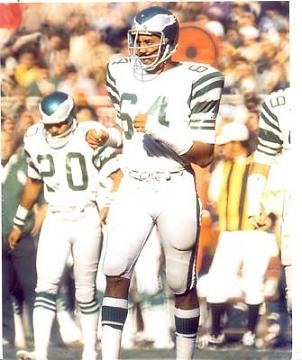
Star DE for the Eagles from 1950-57. The nickname says it all.

“Touchdown Tommy” Wilson
RB with the Rams, Browns, and Vikings from 1956-63 who once held the single-game rushing record.

“Deacon Dan” Towler
The first “Deacon” with the Rams, a FB from 1950-55 who led the NFL in rushing in ’52 and retired to church ministry.

Bob “The Boomer” Brown
6’4”, 280-pound Hall of Fame OT with the Eagles, Rams, and Raiders known as a punishing blocker.

“Mean Joe” Greene
Hall of Fame DT who earned four Super Bowl rings with the Steelers from 1969-81 and made a memorable soft drink commercial.


"Mean Joe" Greene


Bob "The Boomer" Brown


"Too Tall" Jones