March 17, 2011

1965: Happy Chandler Named Commissioner of Continental Football League


With pro football booming in the 1960s and a second major league, the American Football League, providing evidence that there were still untapped markets for pro teams, another venture was launched in 1965. The Continental Football League was made up primarily of franchises from two minor leagues, with five from the defunct United Football League and four that pulled away from the Atlantic Coast Professional Football League.

On March 17, 1965 the new league took a significant step at generating publicity, and at least some credibility, by introducing 66-year-old Albert B. “Happy” Chandler as its first commissioner at a press conference.

The jovial Chandler had been Commissioner of Baseball from 1945 to ’51, succeeding Judge Kenesaw Mountain Landis and presiding over the integration of the major leagues. He was also a two-time Governor of Kentucky (1935-39 and 1955-59) and US Senator (1939-45).

Teams in the new league would play a 14-game schedule, and the 1965 season was to start on August 14 – a month before the NFL and AFL. Games would typically be on Saturday or Sunday nights and, in a move that the NFL would not adopt until 1974, sudden death overtime would decide regular season games that were tied after four quarters.

No television deals had been signed, although Chandler indicated that “we have hopes” (those hopes would ultimately prove to be in vain). Many players were already under contract. Each team had a 36-player roster limit and was allowed to carry a five-player taxi squad. Each had also paid a $5000 franchise fee and posted a $25,000 letter of credit. While there was no college draft for the first season, Chandler hoped that the new league would be able to compete for college talent with the NFL and AFL.

The ten-team league was organized into two divisions, with the East consisting of the Newark Bears (New Jersey), Norfolk Neptunes (originally the Springfield Acorns, from Massachusetts), Philadelphia Bulldogs, Toronto Rifles, and Wheeling Ironmen and the West containing the Charleston Rockets (West Virginia), Ft. Wayne Warriors (Indiana), Hartford Charter Oaks, Rhode Island Indians (Providence), and Richmond Rebels. Newark, Springfield/Norfolk, Richmond, and Hartford had come from the ACFL. Wheeling, Charleston, Toronto, Philadelphia, and Ft. Wayne came out of the UFL. The team in Providence was the only truly new franchise.

While the league belied its name by hardly spanning the continent – there were no clubs west of the Mississippi River or south of Virginia – there was talk of future expansion and Chandler insisted on promoting the enterprise as a new major league. In that spirit, teams were restricted from loaning players to NFL or AFL clubs, or from receiving optioned players from those leagues.

The name Continental League had been consciously lifted from a proposed third major baseball league that had been fronted by the innovative Branch Rickey in the late 50s and was finally nipped in the bud when the two existing leagues agreed to expand in 1961 and ’62. There was speculation that the new football league was a front for franchises looking to receive favorable attention from the AFL, which was due to expand beyond its initial eight clubs.

The Continental Football League got much farther than its baseball namesake, not only playing a complete season in 1965, but lasting for five years, until folding after the ’69 season. However, Chandler, who had been signed to a five-year contract, lasted just ten months as commissioner, resigning in January of 1966 after several teams sought to develop working relationships with NFL and AFL teams, thus abandoning any pretense of being a major league.

Few of the original franchises lasted all five years, with some, such as Ft. Wayne and Newark, relocating by the second year. The Charleston Rockets went a perfect 14-0 in the 1965 regular season and defeated Toronto for the ContFL’s first championship, but folded during the ’68 season. The Philadelphia Bulldogs, who won the ’66 title, weren’t back in 1967. Teams came and went during the league’s five-year run, although it did finally span the continent in 1967, fielding clubs in San Jose, Sacramento, Long Beach (for one game), and Orange County in California as well as Eugene, Oregon, and Orlando, Florida (the relocated Newark franchise). There were even more Canadian teams, the Montreal Beavers (formerly Ft. Wayne) and Victoria Steelers, and, in the last year, one in Monterrey, Mexico, the Golden Aztecs. There were 22 teams in 1969, not all of which completed the season.

Brooklyn hosted a franchise in 1966, but even though it had notable names running the operation – former baseball great Jackie Robinson (pictured below) as general manager and ex-Giant Andy Robustelli at head coach – it failed to draw and was a league-operated road team by the end of the season. It was typical of the instability that characterized the ContFL to the end.

While the Continental Football League never achieved the major league status that was envisioned when Happy Chandler took the helm, it did help launch some NFL playing and coaching careers, including QB Ken Stabler (Spokane Shockers), DE Coy Bacon (Charleston Rockets), DE Otis Sistrunk (Norfolk Neptunes), DB Pete Athas (Norfolk Neptunes), and PK Garo Yepremian (Michigan Arrows). QB John Walton of the Indianapolis Capitals went on to play in the WFL (San Antonio Wings), NFL (Philadelphia Eagles), and USFL (Boston/New Orleans Breakers). Two-time league MVP Don Jonas of the Orlando Panthers went on to become a star quarterback in Canada. And the head coach of the 1967 San Jose Apaches eventually coached at Stanford before entering into a Hall of Fame career as head coach of the NFL’s 49ers: 35-year-old Bill Walsh.

March 16, 2011

Past Venue: Gator Bowl

Jacksonville, FL


Year opened: 1928
Capacity: 62,000, up from 7600 at opening

Names:
Fairfield Stadium, 1928-48
Gator Bowl, 1948-93

Pro football tenants:
Jacksonville Robins (SFL), 1963-65
Jacksonville Jaguars (NAFL), 1966
Jacksonville Sharks/Express (WFL), 1974-75
Jacksonville Bulls (USFL), 1984-85

Postseason games hosted:
None

Other tenants of note:
Jacksonville Tea Men (NASL), 1981-82

Notes: Hosted AFL All-Star Game, Jan. 21, 1968 & Jan. 19, 1969. Hosted annual Gator Bowl football game, 1946-93. Hosted annual Univ. of Georgia vs. Univ. of Florida Football Classic, 1933-93. Originally constructed as home football field for Jacksonville’s three high schools.

Fate: Almost entirely demolished in 1994 and reconstructed as Jacksonville Municipal Stadium (later Alltel Stadium and EverBank Field). Upper deck on west side was the only part of the stadium to be incorporated into the new facility.

[Updated 2/3/14]

March 15, 2011

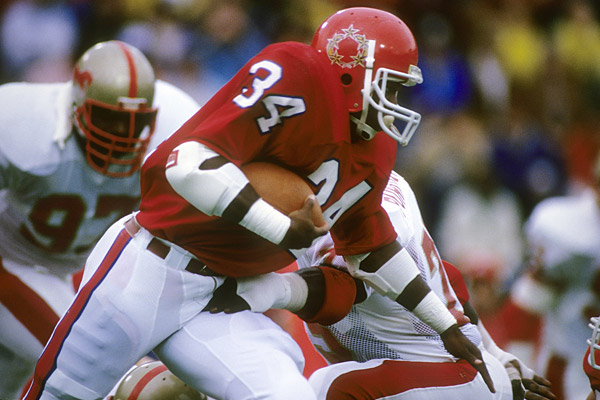
MVP Profile: Herschel Walker, 1985

Running Back, New Jersey Generals


Age: 23 (Mar. 3)
3rd season in pro football & with Generals
College: Georgia
Height: 6’1” Weight: 223

Prelude:
After winning the Heisman Trophy as a junior in 1982, Walker stunned the football world by signing with the Generals of the new USFL for the ’83 spring season. He led the league in rushing (1812 yards) in 1983 and, playing with a sore shoulder in ’84, added another 1339 yards. Was a consensus All-League first-team selection in ’83.

1985 Season Summary
Appeared and started in all 18 games
[Bracketed numbers indicate league rank in Top 20]

Rushing
Attempts – 438 [1]
Most attempts, game - 36 (for 142 yds.) at Denver 5/19
Yards – 2411 [1]
Most yards, game – 233 yards (on 34 carries) vs. Houston 4/7
Average gain – 5.5 [2]
TDs – 21 [1]
200-yard rushing games - 3
100-yard rushing games - 14

Pass Receiving
Receptions – 37
Most receptions, game – 5 (for 35 yds.) vs. Portland 4/14
Yards – 467
Most yards, game - 106 (on 3 catches) at Denver 5/19
Average gain – 12.6
TDs – 1
100-yard receiving games - 1

Scoring
TDs – 22 [1]
Points – 132 [1]

Postseason: 1 G (USFL Quarterfinal playoff vs. Baltimore)
Rushing attempts – 25
Rushing yards – 66
Average gain rushing – 2.6
Rushing TDs – 1

Pass receptions – 4
Pass receiving yards - 44
Average yards per reception – 11.0
Pass Receiving TDs - 0

Awards & Honors:
USFL Player of the Year: League, Sporting News, College & Pro Football Newsweekly
1st team All-USFL: League, Sporting News, College & Pro Football Newsweekly

Generals went 11-7 to place second in USFL Eastern Conference and gain wild card spot in postseason. Lost Quarterfinal playoff game to Baltimore Stars (20-17).

Aftermath:
Following the demise of the USFL, Walker joined the NFL Dallas Cowboys, who had drafted him in the fifth round in 1985 (his first year eligible under the rules then in effect). Splitting time with veteran RB Tony Dorsett, he gained 1574 yards from scrimmage in ’86 and led the league with 1606 yards in ’87. Walker was selected to the Pro Bowl following the 1987 and ’88 seasons – his 1514 rushing yards in ’88 were his NFL career high. Traded to Minnesota during the 1989 season, although still productive, he was unable to fit comfortably into the offense. Moving on to Philadelphia in 1992, he had his only other thousand-yard rushing season in the NFL (1070), and while an effective runner-receiver-kick returner, found himself sharing time in the offensive backfield. Following a 1995 season in which he was primarily used as a kick returner by the New York Giants, Walker returned to the Cowboys for his last two pro seasons.

--

MVP Profiles feature players who were named MVP or Player of the Year in the NFL, AAFC (1946-49), AFL (1960-69), WFL (1974), or USFL (1983-85) by a recognized organization (Associated Press, Pro Football Writers Association, Newspaper Enterprise Association, United Press International, The Sporting News, Maxwell Club – Bert Bell Award, or the league itself).

[Updated 2/15/14]

March 14, 2011

1945: Rams Hire Adam Walsh as Head Coach


On March 14, 1945 the Cleveland Rams signed Adam Walsh to a five-year contract as head coach. Walsh, the line coach at Notre Dame, was the brother of Rams GM Charles “Chile” Walsh and succeeded Aldo “Buff” Donelli, who left to join the Navy.

The 43-year-old Walsh had been on the staff at Notre Dame since mid-1944, when he left Bowdoin, where he had been a successful head coach who turned a losing program around - his teams won the Maine Intercollegiate football championship in seven out of eight years. His overall record was 34-15-6. In 1943, Bowdoin suspended the athletic program for the remainder of World War II, and Walsh was allowed to go on leave of absence to Notre Dame.

Going to Notre Dame was something of a homecoming for Walsh. He played there collegiately and was an All-American center who captained the team in 1924 that contained the legendary starting backfield known as “The Four Horsemen”. After college, and prior to going to Bowdoin, Walsh was head coach and athletic director at Santa Clara from 1925 to ’28 and later served as line coach at both Yale and Harvard.

Walsh was a proponent of the T-formation, which was finding new-found popularity at both the pro and college levels in the 1940s. He was fortunate to have a rookie quarterback out of UCLA, Bob Waterfield, who could run the new offense very effectively. There was also HB Fred Gehrke, returning from a four-year stint in the military, holdover HB Jim Gillette, and rookie FB Don Greenword to handle the running game. End Jim Benton was a proven veteran, and the other starting end, Steve Pritko, had played well in ’44. Two more rookies, tackle Gil Bouley from Boston College and guard/linebacker Milan Lazetich, bolstered the line which also added veteran tackle Eberle Schultz from the Card-Pitt combined team of ’44. Guard Riley Matheson was already there, an established talent who had been a consensus first-team All-Pro in 1942 and ’44.

From a 4-6 record in 1944, the Rams went 9-1 under Walsh in ’45. Waterfield had a MVP season, leading the league with 14 touchdown passes (tied with Sid Luckman of the Bears) and 9.9 yards per attempt. He also showed outstanding toughness (he played one game heavily taped due to torn rib muscles) and leadership to go along with his fine passing, and was an asset on defense (six interceptions, tied for second in the NFL) and as a punter. Benton had a sensational year, catching 45 passes for a league-leading 1067 yards (including 303 in one game) and eight touchdowns. Gehrke, Gillette, and Greenwood all finished in the top ten in rushing and the team was top-ranked in that category. Matheson was again a consensus first-team All-Pro.

The Rams won the Western Division and hosted the Washington Redskins in the NFL Championship game on a bitterly cold day at Municipal Stadium. They won, 15-14, and Walsh had a title in his first year as a pro head coach.

While the franchise performed well on the field, it didn’t do so well at the gate. Owner Daniel F. Reeves lost some $50,000 and petitioned the league to allow him to move the club to Los Angeles. Initially turned down by the other owners, an angry Reeves had threatened to sell the team, but the NFL finally allowed the move.

The Rams went west, and faced the immediate challenge of another team, the Los Angeles Dons of the newly-formed All-America Football Conference (AAFC), competing against them for fans and sharing the massive Memorial Coliseum. Under pressure from the commission that governed the stadium, the Rams added two players – first, HB Kenny Washington, who had been a star at UCLA, and then end Woody Strode, also from UCLA – who became the first two African-Americans in the NFL since 1933. They also added HB Tom Harmon, former Heisman Trophy winner from Michigan.

The team was still very competitive at its new location. Waterfield, returning to the city where he had starred collegiately, led the NFL in passing (although by the modern rating method, he finished second to Luckman) as well as touchdowns (17). Benton again led the league in receiving yards (981) and in pass receptions as well (63, which was 31 more than runner-up Hal Crisler of the Boston Yanks). Gehrke had the top rushing average (5.2 on 71 carries for 371 yards).

The team played respectably but not consistently as they failed to win consecutive games until the last two contests of the year. It made for a second place finish at 6-4-1. In the end, the Rams lost even more money in Los Angeles than in Cleveland. Presaging decades of front office upheaval that would characterize the franchise, GM Walsh fired his brother, Coach Walsh, and was then fired himself by owner Reeves, who chose to act as his own general manager. Bob Snyder was hired as coach for 1947, and the team dropped to fourth place with a 6-6 tally.

Adam Walsh left the Rams with a 15-5-1 record as a pro head coach, and a win in the ’45 NFL title game. He returned to Bowdoin (which had always considered him to still be on leave, even after leaving Notre Dame for pro coaching). While not as successful in his second stint with the team, Walsh stayed from 1947 to ’58 and went 63-67-9 for an overall record at the school of 80-85-11.

Following his retirement from football coaching, Walsh served in the Maine House of Representatives and was later appointed U.S. Marshal for Maine by President Kennedy.

While Walsh’s pro coaching career may have been short, his college playing and coaching career earned him later recognition - he was inducted into the College Football Hall of Fame in 1968 and the Maine Sports Hall of Fame in 1976.

March 13, 2011

Past Venue: RCA Dome

Indianapolis, IN
aka Hoosier Dome


Year opened: 1984
Capacity: 57,980

Names:
Hoosier Dome, 1983-94
RCA Dome, 1994-2008

Pro football tenants:
Indianapolis Colts (NFL), 1984-2007

Postseason games hosted:
AFC Divisional playoff, Titans 19 Colts 16, Jan. 16, 2000
AFC Wild Card playoff, Colts 41 Broncos 10, Jan. 4, 2004
AFC Wild Card playoff, Colts 49 Broncos 24, Jan. 9, 2005
AFC Divisional playoff, Steelers 21 Colts 18, Jan. 15, 2006
AFC Wild Card playoff, Colts 23 Chiefs 8, Jan. 6, 2007
AFC Championship, Colts 38 Patriots 34, Jan. 21, 2007
AFC Divisional playoff, Chargers 28 Colts 24, Jan. 13, 2008

Other tenants of note:
None

Notes: Regularly hosted annual NFL Scouting Combine. Built as part of the Indiana Convention Center with both public and private financing. The roof was made of teflon-coated fiberglass and held up by air pressure inside the building. Hosted NCAA Men’s Basketball Final Four, 1991, 1997, 2000, 2006. Hosted NCAA Women’s Basketball Final Four, 2005. Hosted World Gymnastics Championships, 1991. Original AstroTurf surface was replaced with FieldTurf in 2005.

Fate: Demolished in 2008 to create additional space for the adjoining Indiana Convention Center.

March 12, 2011

1983: Wranglers Mount Late Rally to Stun Blitz


Entering the United States Football League’s first season, the Chicago Blitz were identified as the team most likely to dominate the new league. They had the best-known head coach in George Allen and, following the pattern Allen had established with the teams he coached in the NFL, the club also had much veteran talent on the roster. An easy win over the Washington Federals in the season-opening game only seemed to confirm that Chicago was the team to beat.

The Blitz entered their second game, a Saturday night contest on March 12, 1983, as 13-point favorites against the Arizona Wranglers, a team that had been shut out in Week One. Coached by Doug Shively, the Wranglers seemed to be as bereft of talent as Chicago was loaded with it. As much as could be discerned at such an early point in the USFL’s development, the game appeared to be a classic mismatch. Arizona did make one significant move, however - Todd Krueger started at quarterback in the opening game, and was replaced by Alan Risher (pictured above), a rookie out of LSU, who was given the start against the Blitz.

There were 28,434 in attendance at Sun Devil Stadium in Tempe – far less than the 45,167 present for the opener. For the first three quarters, it seemed as though the Blitz would breeze to another win. While Jim Asmus, who had missed two short field goal attempts the week before and was nearly replaced, booted a 22-yard field goal in the first quarter to start the scoring, Chicago responded with a 15-yard touchdown pass from 15th-year veteran QB Greg Landry to WR Lenny Willis to make the score 7-3.

Frank Corral kicked a 30-yard field goal for the Blitz in the second quarter, and the score was 10-6 at halftime after Asmus kicked another field goal for Arizona, from 35 yards. In the third quarter, it seemed as though Chicago had the game under control. Landry threw another TD pass, of 12 yards to TE Paul Ricker (the extra point attempt failed), and while the Wranglers scored on a six-yard Risher touchdown pass to WR Mike Smith (the PAT attempt was blocked), the Blitz scored again on a one-yard TD run by RB Kevin Long.

It was 23-12 after three quarters, and when Landry threw a third touchdown pass, of 15 yards to Ricker (and despite yet another failed try for an extra point), Chicago held a seemingly insurmountable lead of 29-12 with 11:23 remaining to play.

However, Risher and the Arizona offense dominated the rest of the final period. The Wranglers put together an 85-yard drive that was capped by a 10-yard touchdown pass to WR Jackie Flowers. They went for a two-point conversion, and in a thrilling (and key) play, Risher dropped back some 30 yards while eluding Chicago pass rushers and finally threw to TE Mark Keel, who caught the ball just inside the end zone. The Blitz lead was narrowed to 29-20.

Following a short punt by Corral, the Wranglers regained possession with good field position at the Chicago 45. They took full advantage, with Risher again using his mobility to excellent advantage to frustrate the rush and make plays, and drove to a nine-yard scoring pass from the rookie quarterback to WR Neil Balholm that made it a two-point game.

There were now under three minutes remaining, and in a key defensive series, Arizona prevented the Blitz from controlling the ball. After Landry was sacked for ten yards on a third down play, Corral again got off a short punt and the Wranglers had one last chance.

On the ensuing drive, Risher showed great poise, running 12 yards for a first down at one point and completing passes to Keel of nine and eight yards to set up a last field goal attempt by Asmus. Asmus connected from 33 yards with one second remaining, and Arizona came away with the biggest upset of the new league’s brief history by a score of 30-29.

The game was very sloppy, with a total of 30 penalties called (a whopping 20 on the Wranglers to 10 on Chicago), and between the flags and a total of 77 passes thrown by the teams, it took some four hours to play. Arizona outgained the Blitz both on the ground (151 yards to 90) and through the air (289 to 256), although Chicago had more first downs (26 to 25). Each team turned the ball over one time apiece. But while Jim Asmus made up for his poor kicking performance the week prior, Chicago’s veteran punter/placekicker Frank Corral, who had suffered an injury in practice the day before, missed two extra points and punted poorly, averaging just 32.3 yards on his three kicks.

Alan Risher completed 28 of 40 passes for 269 yards with three touchdowns and no interceptions and ran for 40 yards on six carries. Neil Balholm caught 9 passes for 91 yards and a TD while Mark Keel contributed 6 receptions for 69 yards. RB Steve Howell led the Wranglers in rushing with 49 yards on 11 attempts.

For Chicago, Greg Landry was successful on 24 of 36 passes for 268 yards with three touchdowns and no interceptions. WR Wamon Buggs caught 7 passes for 96 yards. Kevin Long ran for 45 yards on 11 carries while rookie RB Tim Spencer contributed 40 yards on 14 attempts.

“I've been around football 25 years and I've never seen one quite like this,” said Arizona’s Coach Shively. “I actually gave up two or three times.”

“They (the Blitz) kind of classified this as their exhibition game,” Jim Asmus added. “We had to show them.”

“We took off our blitzing because Risher rolled out and hit consistently,” explained George Allen. “If he practiced that two-point play, he couldn't have pulled it off any better.”

Arizona got off to a 4-4 start to contend early in the Pacific Division, but collapsed thereafter, losing 10 straight to close out the schedule. The final result was 4-14 and a last place finish.

Chicago showed a tendency to lose late leads throughout the season, but ended with a 12-6 record to place second in the Central Division and qualify for a wild card spot in the playoffs. The Blitz lost to the Philadelphia Stars in the Semifinal round – in a game in which the Stars came from behind to force a tie and then won in overtime.

Alan Risher ranked sixth among USFL passers for the year, completing 55.7 percent of his 424 passes for 2672 yards and more touchdowns (20) than interceptions (16). While he was bothered by a sore shoulder and showed signs of wear as the season wore on, he proved to be a good addition on offense.

March 11, 2011

MVP Profile: Shaun Alexander, 2005

Running Back, Seattle Seahawks


Age: 28
6th season in pro football & with Seahawks
College: Alabama
Height: 5’11” Weight: 225

Prelude:
Chosen by the Seahawks in the 1st round of the 2000 NFL Draft, Alexander broke into the starting lineup in ’01. He had four straight 1000-yard seasons through 2004, with a high of 1696 in ’04, and led the league with 14 rushing TDs in 2001. He was named to the Pro Bowl following the 2003 and ’04 seasons.

2005 Season Summary
Appeared and started in all 16 games
[Bracketed numbers indicate league rank in Top 20]

Rushing
Attempts – 370 [1]
Most attempts, game - 33 (for 165 yds.) vs. St. Louis 11/13
Yards – 1880 [1]
Most yards, game – 173 yards (on 23 carries) at Arizona 11/6
Average gain – 5.1 [5]
TDs – 27 [1]
100-yard rushing games - 11

Pass Receiving
Receptions – 15
Most receptions, game – 4 (for 20 yds.) vs. San Francisco 12/11
Yards – 78
Most yards, game - 20 (on 4 catches) vs. San Francisco 12/11
Average gain – 5.2
TDs - 1

Scoring
TDs – 28 [1]
Points – 168 [1]

The 28 touchdowns set a NFL single-season record, since broken.

Postseason: 3 G
Rushing attempts – 60
Most rushing attempts, game - 34 vs. Carolina, NFC Championship
Rushing yards – 236
Most rushing yards, game - 132 vs. Carolina, NFC Championship
Average gain rushing – 3.9
Rushing TDs – 2

Pass receptions – 3
Most pass receptions, game - 2 vs. Pittsburgh, Super Bowl
Pass receiving yards - 2
Most pass receiving yards, game - 2 vs. Pittsburgh, Super Bowl
Average yards per reception – 0.7
Pass Receiving TDs - 0

Awards & Honors:
NFL MVP: AP, PFWA, NEA, Bert Bell Award, Sporting News
NFL Offensive Player of the Year: AP
1st team All-NFL: AP, PFWA, Sporting News
1st team All-NFC: Pro Football Weekly
Pro Bowl

Seahawks went 13-3 to win NFC West and gain top playoff seed in conference while leading league in points scored (452) and touchdowns (57). Won Divisional playoff over Washington Redskins (20-10) and NFC Championship over Carolina Panthers (34-14). Lost Super Bowl to Pittsburgh Steelers (21-10)

Aftermath:
Alexander signed an 8-year contract extension but broke his foot three weeks into the 2006 season and was limited to just 10 games, gaining 896 yards rushing, including 201 on 40 carries against Green Bay. After a less productive year in ’07, in which he suffered a series of nagging injuries, he was released. Alexander joined the Redskins during the 2008 season, to provide depth following the loss of backup RB Ladell Betts, and ran the ball just 11 times in four games in his final year at age 31.

--

MVP Profiles feature players who were named MVP or Player of the Year in the NFL, AAFC (1946-49), AFL (1960-69), WFL (1974), or USFL (1983-85) by a recognized organization (Associated Press, Pro Football Writers Association, Newspaper Enterprise Association, United Press International, The Sporting News, Maxwell Club – Bert Bell Award, or the league itself).

[Updated 2/15/14]