February 3, 2015

1991: Kelly Rallies AFC to Win in Pro Bowl


There were 50,345 fans in attendance at Aloha Stadium in Honolulu for the AFC-NFC Pro Bowl on February 3, 1991, where the game was being held for the 12th consecutive year. Coaches were Art Shell of the Raiders for the AFC and San Francisco’s George Seifert for the NFC.

The AFC had the game’s first possession and went 71 yards in eight plays. QB Warren Moon of the Oilers completed a pass to Buffalo WR Andre Reed that covered 38 yards to the NFC 30. A 17-yard run by RB Thurman Thomas of the Bills got the ball to the 13 before the drive stalled and Kansas City’s Nick Lowery kicked a 26-yard field goal.

Later in the period, and following an exchange of punts, the NFC had an opportunity to tie the score on a series highlighted by a pass from Philadelphia QB Randall Cunningham to his Eagles teammate, TE Keith Jackson, who then lateraled to RB Earnest Byner of the Redskins for a total pickup of 59 yards. However, the Nationals came up empty when Morten Andersen of the Saints missed a 40-yard field goal attempt.

Following a long AFC series that extended into the second quarter, Lowery also missed a field goal, from 28 yards. The NFC responded with a long drive of 80 yards in 17 plays. QB Jim Everett of the Rams, an injury replacement for San Francisco’s Joe Montana, completed all six of his passes and rookie RB Johnny Johnson of the Cardinals dove into the end zone from a yard out with 43 seconds left on the clock before halftime. Andersen added the point after and the NFC led by 7-3 at the intermission.

In the third quarter, the NFC had the ball first and put together another promising series. Cunningham, again at quarterback, completed passes to RB Barry Sanders of the Lions for five and 19 yards and 28 yards to Jackson to reach the AFC 15. However, two of the next three plays resulted in sacks and a 48-yard field goal attempt by Andersen was blocked by Buffalo DE Bruce Smith, who had also recorded one of the sacks.

The AFC responded by driving 36 yards in eight plays to a 43-yard field goal by Lowery that narrowed the NFC’s margin to 7-6. Late in the third quarter, and following another exchange of punts, San Francisco WR Jerry Rice caught a pass that was nearly intercepted by CB Rod Woodson of the Steelers and gained 49 yards to the AFC nine yard line. From there, Johnson ran for his second TD and, with the successful extra point by Andersen, the NFC was ahead by 14-6 heading into the final quarter.

Buffalo QB Jim Kelly (pictured at top) threw to WR Anthony Miller of the Chargers for 33 yards on the last play of the third quarter, and as the contest moved into the final period, he combined with other Bills teammates to advance the AFC to another score. Following three straight tosses to Thomas that totaled 20 yards, Kelly completed a 20-yard touchdown pass to Reed, threading the ball between two defenders. Lowery converted and the AFC was down by only a point.

Everett came out throwing for the NFC on the next possession. He connected on three passes to WR Gary Clark of the Redskins, the longest for 19 yards, and Sanders ran for a 22-yard touchdown to cap the 80-yard, 11-play series. Andersen kicked the point after and, with 5:11 to go, the NFC was leading by 21-13.

The AFC came back with another scoring drive, with the big play a pass from Kelly to Cincinnati RB James Brooks that covered 49 yards. Lowery kicked a 34-yard field goal to narrow the margin to 21-16.

The NFC went three-and-out and had to punt. With just over two minutes remaining to play, Kelly threw to TE Ferrell Edmunds of the Dolphins for 27 yards and, two plays later, he completed a 13-yard pass to WR Ernest Givins of the Oilers for a touchdown with the clock down to 1:49. Lowery added the extra point to make it a two-point lead for the AFC.

The NFC still had a chance to win and Everett tossed a third-and-18 pass to TE Steve Jordan that gained 29 yards to get into field goal position. However, Andersen’s 46-yard try with seven seconds on the clock was blocked by Miami DE Jeff Cross to preserve the 23-21 win for the AFC.

The NFC finished with a slight edge in total yards (368 to 358), with both teams gaining 90 yards on the ground, and also had more first downs (22 to 17). There were no turnovers.

Jim Kelly, who was named the game’s MVP, completed 13 of 19 passes for 210 yards and two touchdowns while Warren Moon was 6 of 11 for 72 yards. Thurman Thomas led the AFC with 38 rushing yards on 7 carries and had four catches for 36 yards. James Brooks was right behind in the ground-gaining department with 36 yards on five attempts and Andre Reed also had four pass receptions, gaining 80 yards and scoring a TD.


For the NFC, Jim Everett (pictured at left) was successful on 13 of 18 throws for 138 yards and Randall Cunningham went to the air 11 times, completing 6 for 168 yards. Barry Sanders rushed for 35 yards on 7 attempts and Johnny Johnson gained 32 yards on 10 carries that included the two TDs. Gary Clark caught 6 passes for 65 yards and Jerry Rice gained 62 yards on his three receptions. Morten Andersen had a rough day, having two field goal attempts blocked and missing another from 40 yards.

“Man, I’m glad the kick went our way today,” said Jim Kelly, referencing his team’s one-point loss in the Super Bowl the previous week against the Giants when Scott Norwood missed a potential game-winning field goal at the end.

The win for the AFC was the first in three years and cut the NFC’s advantage to 12-9 since the all-star contest had switched to the AFC vs. NFC format.

February 1, 2015

Highlighted Year: Fred Besana, 1983

Quarterback, Oakland Invaders


Age: 29 (Mar. 9)
6th season in pro football, 1st in USFL & with Invaders
College: California
Height: 6’4”   Weight: 210

Prelude:
Son of a former minor league pitcher and baseball scout, Besana backed up Steve Bartkowski and Joe Roth as a college quarterback. He was chosen by the Buffalo Bills in the fifth round of the 1977 NFL draft. While active for two games during his rookie season, Besana saw no action and was released at the end of the preseason in ’78. He was signed by the New York Giants late in the year and again was active for two games but didn’t play. Released by the Giants during the ’79 preseason, Besana played three years with the Twin Cities Cougars of the minor league California Football League while running a beer distributorship. The Cougars were champions all three seasons and Besana was twice named to the league All-Star team. He threw for 1433 yards and 15 TDs in 1980 and led the circuit in passing in ’82 by throwing for 1767 yards and 19 touchdowns with only four interceptions. Besana was signed by the Invaders of the new USFL just before training camp for their inaugural Spring season.

1983 Season Summary
Appeared in all 18 games
[Bracketed numbers indicate league rank in Top 20]

Passing
Attempts – 550 [2]
Most attempts, game – 47 at Tampa Bay 5/21
Completions – 345 [1]
Most completions, game – 27 at Tampa Bay 5/21
Yards – 3980 [1]
Most yards, game – 341 at Michigan 3/19
Completion percentage – 62.7 [1]
Yards per attempt – 7.2 [4]
TD passes – 21 [2]
Most TD passes, game – 4 vs. Washington 5/16
Interceptions – 16 [6, tied with Alan Risher & John Reaves]
Most interceptions, game – 2 on five occasions
Passer rating – 96.7
300-yard passing games – 2
200-yard passing games – 13

Rushing
Attempts – 41
Most attempts, game – 6 (for 12 yds.) vs. Birmingham 3/13, (for 31 yds.) vs. Tampa Bay 5/8
Yards – 139
Most yards, game – 31 yards (on 6 carries) vs. Tampa Bay 5/8
Yards per attempt – 3.4
TDs – 3

Scoring
TDs – 3
Points – 18

Postseason: 1 G (Semifinal playoff at Michigan)
Pass attempts – 35
Pass completions – 23
Passing yardage – 258
TD passes – 1
Interceptions – 2

Rushing attempts – 1
Rushing yards – 1
Average gain rushing – 1.0
Rushing TDs – 1

Invaders went 9-9 to finish first in the USFL Pacific Division. Lost USFL Semifinal playoff to Michigan Panthers (37-21).

Aftermath:
Following his impressive 1983 season, Besana and the Oakland offense got off to a rough start in ’84. The team was 0-9 before catching fire with a seven-game winning streak. Besana ended up throwing for 2792 yards and 14 touchdowns with 12 interceptions. The Invaders were merged with the Michigan Panthers for 1985 and Besana lost his starting job to Bobby Hebert. He threw just 58 passes, completing 34 for 494 yards and six TDs along with four interceptions. The demise of the USFL brought an end to Besana’s career. For his three USFL seasons, Besana completed 60.3 percent of his passes for 7266 yards and 41 touchdowns while giving up 32 interceptions and being sacked 140 times.

--

Highlighted Years features players who were consensus first-team All-League* selections or league* or conference** leaders in the following statistical categories:

Rushing: Yards, TDs (min. 10)
Passing: Yards, Completion Pct., Yards per Attempt, TDs, Rating
Receiving: Catches, Yards, TDs (min. 10)
Scoring: TDs, Points, Field Goals (min. 5)
All-Purpose: Total Yards
Defense: Interceptions, Sacks
Kickoff Returns: Average
Punt Returns: Average
Punting: Average

*Leagues include NFL (1920 to date), AFL (1926), AFL (1936-37), AAFC (1946-49), AFL (1960-69), WFL (1974-75), USFL (1983-85)

**NFC/AFC since 1970

January 30, 2015

Highlighted Year: Jim “King” Corcoran, 1974

Quarterback, Philadelphia Bell


Age: 31
9th season in pro football, 1st in WFL
College: Maryland
Height: 6’0”   Weight: 205

Prelude:
The flamboyant Corcoran had a long and successful career as a minor league pro quarterback, achieving a near-legendary status due to his performance on the field and eccentric behavior off of it. He spent the better part of his first six seasons in the Atlantic Coast Football League. With Wilmington in 1966, he led the ACFL in pass attempts (247) and with Waterbury in 1967 topped the circuit in attempts (309), completions (141), yards (2065), and TD passes (19). Corcoran was cut by the AFL’s Denver Broncos during both the 1966 and ’67 preseasons and was signed to the New York Jets’ taxi squad. He started the 1968 season with Bridgeport, which acted as a minor league team for the Jets, and after he was sold to another AFL club, the Boston Patriots, continued in the ACFL with Lowell, Boston’s minor league affiliate. Corcoran again led the league in pass attempts (333), completions (166), yards (2158), and TD passes (20). He also played in two games for the Patriots, throwing seven passes, two of which were intercepted. In 1969, after failing to catch on with the Philadelphia Eagles of the NFL, Corcoran joined the Pottstown Firebirds for two seasons and led them to an 11-1 record in ’70, a year in which he topped the ACFL in pass attempts (297), completions (164), completion percentage (55.2), yards (2129), and TD passes (24), although an injury caused him to miss the league championship game, which the Firebirds won. He was named to the ACFL All-Star team. After another failed trial with the Eagles in 1971, Corcoran returned to the ACFL and the Norfolk Neptunes, leading the league in completion percentage (52.6) and TD passes (17) as the club won the championship. He joined the Montreal Alouettes of the CFL for 1972 but quit rather than be a third-string quarterback and moved on to Chambersburg of the Seaboard Football League, but was injured midway through the season. He spent the ’73 season with Flint of the Midwest Football League. Corcoran joined the Bell of the new WFL for 1974, reuniting with Head Coach Ron Waller, who had been an assistant with Pottstown and head coach at Norfolk, as well as a number of other players who had been teammates with both of those clubs.        

1974 Season Summary
Appeared in 19 of 20 games
[Bracketed numbers indicate league rank in Top 20]

Passing
Attempts – 545 [1]
Completions – 280 [1]
Yards – 3631 [2]
Completion percentage – 51.4 [6]
Yards per attempt – 6.7
TD passes – 31 [1]
Interceptions – 30 [1]

Rushing
Attempts – 23
Yards – 26
Yards per attempt – 1.1
TDs – 3

Scoring
TDs – 3
Action Points - 1
Points – 22
(Note: Touchdowns counted for 7 points in the WFL)

Postseason: 1 G (WFL First Round playoff at Florida)
Pass attempts – 32
Pass completions – 11
Passing yardage – 127
TD passes – 0
Interceptions – 2

Bell went 9-11 to finish third in the WFL Eastern Division. Lost WFL First Round playoff to Florida Blazers (18-3).

Aftermath:
Corcoran returned to the Bell in 1975 but lost his starting job to Bob Davis. He completed 45 of 99 passes for 440 yards and three TDs with six intercepted before the WFL folded in October. Corcoran retired, “the minor league Joe Namath” having passed for 14,528 yards and 134 touchdowns over the course of his checkered and colorful career. 

--

Highlighted Years features players who were consensus first-team All-League* selections or league* or conference** leaders in the following statistical categories:

Rushing: Yards, TDs (min. 10)
Passing: Yards, Completion Pct., Yards per Attempt, TDs, Rating
Receiving: Catches, Yards, TDs (min. 10)
Scoring: TDs, Points, Field Goals (min. 5)
All-Purpose: Total Yards
Defense: Interceptions, Sacks
Kickoff Returns: Average
Punt Returns: Average
Punting: Average

*Leagues include NFL (1920 to date), AFL (1926), AFL (1936-37), AAFC (1946-49), AFL (1960-69), WFL (1974-75), USFL (1983-85)

**NFC/AFC since 1970

January 29, 2015

1979: Staubach Rallies NFC to Pro Bowl Win


The AFC-NFC Pro Bowl returned to Los Angeles for the first time in seven years on January 29, 1979. After regularly being played at the Memorial Coliseum for 22 seasons, the annual all-star contest had been held in six different NFL cities since then.  The contest also marked the first time that players wore their respective team helmets rather than helmets with logos designed for the game.

There were 38,333 fans in attendance at the Coliseum on a chilly 45-degree Monday night. Los Angeles Rams season ticket holders had been required to purchase Pro Bowl tickets, and some 13,310 tickets went unused. The first quarter was scoreless, with the AFC failing to convert a fourth-and-seven play at the NFC 36 and Frank Corral of the Rams missing a 37-yard field goal attempt for the NFC.

In the second quarter, after Miami’s Garo Yepremian was short on a 47-yard try for a field goal, the NFC drove 70 yards in 11 plays. QB Archie Manning of the Saints completed four passes and RB Wilbert Montgomery of the Eagles, who had a 17-yard carry along the way, finished the series off at 7:06 into the period with a two-yard touchdown on a fourth down play. However, Corral missed wide on the extra point attempt.

The AFC came right back with a nine-play, 62-yard possession. With less than four minutes remaining in the first half, QB Bob Griese of the Dolphins threw to Seattle WR Steve Largent for back-to-back gains of 27 and 10 yards, and finished off the series with a throw once more to Largent for an eight-yard touchdown. Yepremian added the extra point and the AFC held a 7-6 lead at halftime.

In the third quarter, and following a shanked 16-yard punt by Oakland’s Ray Guy, the NFC was backed up by a holding penalty but then proceeded to advance 55 yards. Dallas QB Roger Staubach (pictured at top), who was ineffective in the first quarter, completed five straight passes in the series. Two were to WR Ahmad Rashad of the Vikings for 15 and 17 yards and, following a six-yard run by Montgomery, Staubach connected with WR Tony Hill, a Dallas teammate, in the corner of the end zone for a 19-yard touchdown with 3:43 remaining in the period. Corral converted this time to give the NFC a six-point advantage, and in the game dominated by defense, that was enough.

The teams traded punts as the contest entered the fourth quarter and a Manning pass was intercepted by SS Bill Thompson of the Broncos at the AFC 16. But following one more AFC possession, the NFC was able to control the ball for the last 6:20. They had an opportunity to add more points in the last minute, reaching the AFC five yard line, but Manning fell on the ball twice to run out the clock. The NFC won the low-scoring contest by a final score of 13-7.

The AFC led in total yards (320 to 296) and also had the edge in first downs (18 to 17). 169 yards of the AFC’s total came on the ground, against 151 passing yards, while the NFC threw for 199 yards and rushed for 97. The NFC turned the ball over twice, to one turnover suffered by the AFC.

Roger Staubach completed 9 of 15 passes for 125 yards and a touchdown while giving up one interception. Archie Manning, who played the second and fourth quarters, was 8 of 17 for 78 yards and also had a pass picked off. Wilbert Montgomery ran for 53 yards on 9 carries and RB Tony Dorsett of the Cowboys gained 27 yards on 7 rushing attempts. Ahmad Rashad had 5 pass receptions for 89 yards and was named Player of the Game. G Tom Mack of the Rams finished off his Hall of Fame career with an 11th Pro Bowl appearance and received a standing ovation from the Los Angeles fans with a minute remaining in the contest.

For the AFC, Terry Bradshaw was successful on 8 of 17 throws for 54 yards and no interceptions. Bob Griese threw 20 times with 10 completions for 122 yards and a TD and also gave up no interceptions. Houston’s star rookie RB Earl Campbell rushed for 66 yards on 12 carries to lead both teams. Steve Largent, the first Seahawk to appear in a Pro Bowl, caught 5 passes for 75 yards and a touchdown, all in the second quarter.


“One of the highlights of my career was just being here,” said Ahmad Rashad (pictured at left) who, along with Steve Largent, set a then-Pro Bowl record for pass receptions. “The Most Valuable Player award was just gravy.”

“I’m not going to go home and stay up all night, but it was disappointing to lose,” said Terry Bradshaw, who had quarterbacked the Steelers to a win over Dallas in the Super Bowl the previous week. “Emotionally, I went into this game drained. I thought I’d be okay but I think I’m still mentally fatigued from the Super Bowl.”

The win gave the NFC a 5-4 lead over the AFC since the restructuring of the Pro Bowl into AFC vs. NFC in 1970. The game moved to Honolulu the following season, leaving the Memorial Coliseum once and for all.

January 27, 2015

1972: Giants Trade Tarkenton Back to Vikings


On January 27, 1972 the Minnesota Vikings swung a deal with the New York Giants that brought QB Fran Tarkenton back to the team he had started his career with, at the cost of three veteran players and two high draft choices. The Vikings received Tarkenton for QB Norm Snead, WR Bob Grim, FB Vince Clements, and the first draft pick for 1972 as well as the second-round choice for ‘73.

Under Head Coach Bud Grant since 1967, the Vikings had won four straight division titles through the ’71 season, advancing to the NFL Championship in 1969 before losing to the AFL’s Kansas City Chiefs in the last pre-merger Super Bowl. The team had a consistently outstanding defense and gave up the fewest points in the league in 1971. The offense, however, was far less impressive and an upgrade at quarterback was considered to be a significant need.

Joe Kapp,a fiery leader which offset his weaknesses as a passer, enjoyed the most success but was gone due to a contract dispute after the 1969 season. Gary Cuozzo had seen the most action since then, but he could not match Kapp as a team leader and his skills were no better than adequate. Norm Snead was brought in to provide competition but it was Bob Lee, a backup who handled the punting, that started in the Divisional-round playoff loss to the Cowboys. Critics insisted that the stodginess of the offense made it difficult for any quarterback to succeed.

The 6’0”, 190-pound Tarkenton, a resident of Atlanta who starred at Georgia and was just short of his 32nd birthday, spent his first six seasons with the Vikings after they drafted him in the third round in their initial season of 1961. He quickly took over as the team’s starting quarterback and played with a distinctive, scrambling style that was exciting but became a source of conflict with Head Coach Norm Van Brocklin. Tarkenton was twice selected to the Pro Bowl during that period, but after a promising 8-5-1 finish in 1964, the club as a whole moved backward. Both Van Brocklin and Tarkenton were gone after the ’66 season, and the scrambling quarterback was chosen to four consecutive Pro Bowls with the Giants from 1967 through ’70, when the club posted a 9-5 record and nearly won the NFC East title.  

Things soured between Tarkenton and the Giants in 1971. First, he upset team president Wellington Mara when he briefly walked out prior to the first preseason game due to a contract dispute. As the team dropped in the standings in 1971, finishing at 4-10, Tarkenton expressed the desire to play for a contending team. The Giants were 33-37 in five years with Tarkenton starting at quarterback, and his last season with the team was easily his worst as he threw just 11 TD passes against 21 interceptions.

New York’s Head Coach Alex Webster expressed the hope that the trade would help the team in 1972 and beyond, thanks to the package of veterans and draft picks received.

Norm Snead had played eleven seasons in the NFL, coming into the league at the same time as Tarkenton. A 1961 first-round draft pick by the Washington Redskins, he started every game as a rookie. Big  at 6’4” and 215 pounds and a classic drop-back passer with a strong arm and slow release, Snead showed early promise but was traded to the Eagles in a celebrated 1964 deal for QB Sonny Jurgensen. Following seven up-and-down years in Philadelphia, he moved on to the Vikings in ’71 and was used sparingly. 

Bob Grim was coming off of his fifth, and easily best, year with the Vikings. He more than doubled his production of the first four seasons with 45 catches and 691 yards in ’71, and earned selection to the Pro Bowl.

Vince Clements was Minnesota’s fourth-round draft choice in 1971. He missed most of his senior year at Connecticut due to a knee injury and left the Vikings after reinjuring the knee during the preseason. However, he had expressed an interest in returning for ’72.

“We are very happy about going to Minnesota…back home, almost, to where we started,” said Tarkenton in reaction to the trade, adding that he enjoyed the time in New York “very much because it’s a great sports city.”

The expectation that adding Tarkenton would bring a championship to Minnesota was dashed in 1972 when the team finished third in the NFC Central with a 7-7 record. While Tarkenton provided the needed upgrade at quarterback, and had an excellent target in Pro Bowl WR John Gilliam, the running game lacked a back with breakaway ability, and the vaunted defense became vulnerable against the run.

The situation improved greatly in 1973. Rookie FB Chuck Foreman was productive both running and catching the ball and the defense, with key players healthy, was strong again. The team won the NFC Championship before falling to the Dolphins in the Super Bowl. It was the first of three trips to the Super Bowl in four years, although they all ended in defeat. Tarkenton was a consensus MVP selection in 1975 and was chosen to the Pro Bowl three times in his second stint with the Vikings. He led the league in completions on three occasions, completion percentage twice, and passing yards and touchdown passes once. In 1978, his last season, he achieved career highs in pass attempts (572), completions (345), and yards (3468), although also in interceptions (32). Upon his retirement, he was the NFL career leader in rushing yards by a quarterback (3674) as well as pass attempts (6467), completions (3686), passing yards (47,003), and touchdowns (342).


The Giants were 8-6 in 1972 and Norm Snead (pictured at left) had an outstanding year as he led the NFL in completion percentage (60.3) while throwing for 2307 yards and 17 touchdowns against 12 interceptions. He was named to the Pro Bowl. But both Snead and the Giants collapsed in ’73, with the team dropping to 2-11-1 and the quarterback leading the league with 22 interceptions. Snead was traded to the 49ers during the 1974 season and returned to New York as a backup in his final season of 1976.

Bob Grim caught just five passes in 1972 but had a total of 65 for 1059 yards and four touchdowns in 1973 and ’74 before moving on to the Bears and returning to the Vikings in 1976. Vince Clements played for two years with the Giants and rushed for 435 yards and added 24 pass receptions for another 247 yards, but appeared in just 16 games due to nagging injuries that ultimately curtailed his career.

The two draft choices obtained for Tarkenton were used to take DE Larry Jacobson from Nebraska with the 24th pick in the first round in 1972 and Michigan State LB Brad Van Pelt in the second round of the ’73 draft. Jacobson started nine games as a rookie but lasted just three seasons and had little impact. Van Pelt was far more successful – and was the player obtained through the Tarkenton deal that was most useful to the Giants for the longest amount of time – playing 11 seasons with the club and gaining selection to the Pro Bowl five straight times, from 1976 to ’80.

For the Vikings, the acquisition of Tarkenton did help the team and played a significant role in advancing to three NFC Championships. For the Giants, the deal brought only short-term relief in a slump for the franchise that started in 1964 and lasted until 1981.

January 26, 2015

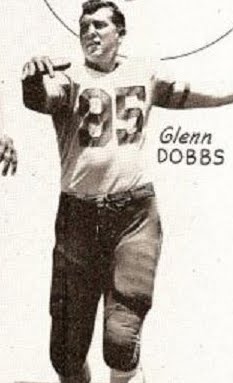
Highlighted Year: Glenn Dobbs, 1948

Tailback/Defensive Back, Los Angeles Dons


Age:  28
3rd season in pro football, 2nd with Dons
College: Tulsa
Height: 6’4”   Weight: 210

Prelude:
A star tailback and punter in college, Dobbs was chosen by the Chicago Cardinals in the first round of the 1943 NFL draft, but went into the military instead. After starring in service football, he joined the Dodgers of the new AAFC in 1946, a club that utilized a single-wing attack. Brooklyn went only 3-10-1, but Dobbs led the circuit in passing yards (1886) as well as punting (47.8 avg.) and was named MVP by the league. In a major trade early in the 1947 season, Dobbs was dealt to the Los Angeles Dons. Playing quarterback in the T-formation, his performance suffered, but in ’48 a new head coach, Jimmy Phelan, created a new offense (the Phelan spread) in order to more fully utilize Dobbs’ talents.

1948 Season Summary
Appeared in all 14 games
[Bracketed numbers indicate league rank in Top 20]

Passing
Attempts – 369 [1]
Completions – 185 [1]
Yards – 2403 [4]
Completion percentage – 50.1 [5]
Yards per attempt – 6.5 [7]
TD passes – 21 [3]
Most TD passes, game – 4 vs. Chicago 10/8
Interceptions – 20 [2]
Passer rating – 67.4 [5]

Rushing
Attempts – 91 [14]
Yards – 539 [11]
Yards per attempt – 5.9 [5]
TDs – 4 [13, tied with four others]

Pass Receiving
Receptions – 2
Yards – 11
Yards per catch – 5.5
TDs - 0

Punting
Punts – 68 [1]
Yards – 3336 [1]
Average – 49.1 [1]
Punts blocked – 3 [1]

Interceptions
Interceptions – 1
Return yards – 32
TDs – 0

Kickoff Returns
Returns – 2  
Yards – 38
Average per return – 19.0
TDs – 0

Scoring
TDs – 4         
Points – 24

Awards & Honors:
2nd team All-NFL/AAFC: Sporting News
2nd team All-AAFC: League, UPI, NY Daily News

Dons went 7-7 to finish third in the AAFC Western Division.

Aftermath:
Injuries significantly diminished Dobbs’ performance in 1949, and with the demise of the AAFC following that season, he retired from pro football. After an absence of a year, in which he was a sportscaster in Tulsa, Dobbs joined the Saskatchewan Roughriders in Canada, playing three more seasons (and winning MVP honors in the Western league, the WIFU, in ’51) before further injuries set in, and serving as a player/coach. Overall, in the AAFC he passed for 5876 yards and 45 TDs, rushed for 1039 yards and 12 TDs, and had a 46.4 punting average. In Canada, Dobbs passed for 5196 yards and 51 TDs, rushed for 241 yards and 7 TDs, and had a 44.7 punting average. He returned to his alma mater, Tulsa, where he was athletic director and head football coach. 

--

Highlighted Years features players who were consensus first-team All-League* selections or league* or conference** leaders in the following statistical categories:

Rushing: Yards, TDs (min. 10)
Passing: Yards, Completion Pct., Yards per Attempt, TDs, Rating
Receiving: Catches, Yards, TDs (min. 10)
Scoring: TDs, Points, Field Goals (min. 5)
All-Purpose: Total Yards
Defense: Interceptions, Sacks
Kickoff Returns: Average
Punt Returns: Average
Punting: Average

*Leagues include NFL (1920 to date), AFL (1926), AFL (1936-37), AAFC (1946-49), AFL (1960-69), WFL (1974-75), USFL (1983-85)

**NFC/AFC since 1970

January 24, 2015

1971: Renfro TDs Lift NFC to Big Win in Pro Bowl


The 21st Pro Bowl on January 24, 1971 was played under a new format. The annual all-star game that came into being following the 1950 NFL season (an earlier version of the game, called the Pro All-Star Game, was played following the 1938 to ‘42 seasons) had featured a pairing of Eastern vs. Western players. With the merger between the AFL and NFL having come to full fruition for the 1970 season, expanding the league from 16 to 26 teams, the participants now represented the new American and National conferences.  Coaches for the two squads were from the losing teams in the conference championship games, which were John Madden of the Oakland Raiders for the AFC and San Francisco’s Dick Nolan for the NFC.

There was a disappointing crowd of 48,222 fans in attendance at the Memorial Coliseum in Los Angeles. They saw the defenses dominate the first half. Following a scoreless first quarter, the AFC got on the board first on a 37-yard field goal by Kansas City’s Jan Stenerud. The NFC responded with a 13-yard field goal by Fred Cox of the Vikings and the score remained tied at 3-3 at halftime.

Early in the third quarter, with San Francisco’s John Brodie at quarterback, the NFC put together a six-play, 84-yard drive. Brodie completed a pass to WR Gene Washington of the Vikings for 31 yards and then connected with his 49er teammate, also a wide receiver named Gene Washington, for 24 yards. That set up a throw to Minnesota HB Dave Osborn, who was open for a 23-yard touchdown. Cox added the extra point.

The NFC got a break on defense when CB Mel Renfro of the Cowboys tipped a Lamonica pass that Green Bay LB Fred Carr intercepted, and that led to a 35-yard field goal by Cox to extend the NFC lead to 13-3. Later in the period, a fumble by Chicago WR Cecil Turner on a punt return gave the AFC favorable field position, and they nearly cashed in when Lamonica threw to Oakland WR Fred Biletnikoff, who caught the ball in the end zone but was ruled to have come down out of bounds.  They were forced to settle for a field goal by Stenerud from 16 yards.

Prior to Turner’s fumble, he and Renfro stood side by side on punt returns, but afterward Coach Nolan told Renfro to handle deep kicks and Turner to move forward. It paid off significantly when, a minute into the fourth quarter, Renfro (pictured at top) returned a punt by Kansas City’s Jerrel Wilson 82 yards for a TD. Forced to hurry his kick due to the rush, Wilson booted a line drive that bounced before Renfro grabbed it and headed down the field, cutting to his left and getting a good block by Chicago LB Dick Butkus on CB Zeke Moore of the Oilers. With Cox adding the extra point, the sensational return opened up a 20-6 lead for the NFC.

That was it until, with five minutes remaining, Renfro fielded another punt by Wilson and ran 56 yards for a touchdown. Again Cox converted and that provided the final tally in a 27-6 win for the NFC.

The NFC had more total yards (337 to 146) and first downs (17 to 11) in what was largely a defensive show. There were a total of seven turnovers, four by the AFC.


John Brodie completed 10 of 26 passes for 156 yards and a touchdown and Fran Tarkenton was 8 of 13 for 69 yards, giving up an interception. Dave Osborn (pictured at left) led in rushing with 45 yards on 10 carries and in receiving yards with 58 on four catches that included a TD. Gene Washington of the 49ers was right behind with 57 yards on two receptions while TE Charlie Sanders of Detroit pulled in five passes for 44 yards. Mel Renfro, with his two punt return touchdowns as well as good play on defense, was named the outstanding back of the game and Fred Carr the game’s outstanding lineman.

Daryle Lamonica, who was harassed heavily by the tough NFC defensive line, had an especially rough passing day, successful on just four of 21 throws for 50 yards, and he was picked off twice. Bob Griese was better with 9 completions in 14 passes for 86 yards, but he was also sacked five times for losses totaling 56 yards. Larry Csonka topped the AFC with 44 rushing yards on six attempts. Marlin Briscoe had three catches for 35 yards and Miami WR Paul Warfield was right behind with 32 yards on his two receptions.

“Actually, it was a pretty even game,” said Coach Nolan of the NFC. “Renfro’s great punt returns were obviously the key things, but I thought Brodie and Fran Tarkenton both called a good game.”

Following the NFC’s win in the first AFC-NFC Pro Bowl, the AFC won the next three. The AFC vs. NFC format for the game remained until the 2013 season, when it was altered again to have the selected players divided up by appointed team captains rather than play for their conferences.