Showing posts with label 1948 AAFC season. Show all posts

August 27, 2015

Highlighted Year: Billy Hillenbrand, 1948

Halfback, Baltimore Colts


Age: 26
3rd season in pro football, 2nd with Colts
College: Indiana
Height: 6’0”   Weight: 188

Prelude:
Hillenbrand was a consensus first-team All-American in 1942 and was chosen by the New York Giants in the first round of the 1944 NFL draft. However, he went into the military for two years during World War II and played service football. The versatile halfback signed with the Chicago Rockets of the new AAFC in 1946 and had a good year for a poor team, gaining 490 yards from scrimmage, intercepting three passes on defense, and returning both a punt and kickoff for touchdowns. He moved on to the Colts in 1948 and further developed as a receiver out of the backfield, catching 39 passes for 702 yards (18.0 avg.) and seven TDs and, adding in kick returns, he gained 1573 all-purpose yards.

1948 Season Summary
Appeared in all 14 games
[Bracketed numbers indicate league rank in Top 20]

Rushing
Attempts – 100 [10, tied with Edgar Jones]
Yards – 510 [12]
Most yards, game – 112 yards (on 12 carries) at Brooklyn 11/28
Average gain – 5.1 [9]
TDs – 7 [5, tied with Lou Tomasetti]

Pass Receiving
Receptions – 50 [3, tied with Fay King]
Yards – 970 [1]
Average gain – 19.4 [2]
TDs – 6 [8, tied with Jack Russell]

Kickoff Returns
Returns – 16 [4]
Yards – 356 [5]
Average per return – 22.3 [4]
TDs – 0
Longest return – N/A

Punt Returns
Returns – 18 [4]
Yards – 231 [6]
Average per return – 12.8 [5]
TDs – 0
Longest return – N/A

All-Purpose yards – 2067 [2]

Scoring
TDs – 13 [3]
Points – 78 [4]

Postseason: 1 G (Eastern Division playoff vs. Buffalo)
Rushing attempts – 6
Rushing yards – 5
Average gain rushing – 0.8
Rushing TDs – 0

Pass receptions – 7
Receiving yards – 75
Average yards per reception – 10.7
Pass receiving TDs – 0

Kickoff returns – 3
Kickoff return yards – 35
Average yards per return – 11.7
Kickoff return TDs – 0

Punt returns – 1
Punt return yards – 0
Punt return TDs – 0

Awards & Honors:
2nd team All-AAFC: League, UPI, NY Daily News

Colts went 7-7 to tie for first in the AAFC Eastern Division while leading the league in passing yards (2899). Lost Eastern Division playoff to Buffalo Bills (28-17).

Aftermath:
Hillenbrand’s outstanding 1948 season turned out to be his last. He retired, having caught 110 passes for 1987 yards (18.1 avg.) and 17 touchdowns, rushed for 889 yards on 216 carries (4.1 avg.) and another 11 TDs, returned 44 punts for a 13.9 average and a TD and 42 kickoffs for a 24.8-yard average and two scores. Overall, he scored 31 touchdowns in his three seasons.

--

Highlighted Years features players who were consensus first-team All-League* selections or league* or conference** leaders in the following statistical categories:

Rushing: Yards, TDs (min. 10)
Passing: Yards, Completion Pct., Yards per Attempt, TDs, Rating
Receiving: Catches, Yards, TDs (min. 10)
Scoring: TDs, Points, Field Goals (min. 5)
All-Purpose: Total Yards
Defense: Interceptions, Sacks
Kickoff Returns: Average
Punt Returns: Average
Punting: Average

*Leagues include NFL (1920 to date), AFL (1926), AFL (1936-37), AAFC (1946-49), AFL (1960-69), WFL (1974-75), USFL (1983-85)

**NFC/AFC since 1970

May 10, 2015

Highlighted Year: Rex Grossman, 1948

Fullback/Linebacker/Placekicker, Baltimore Colts


Age: 24
1st season in pro football
College: Indiana
Height: 6’1”   Weight: 215

Prelude:
Grossman’s college years, which started in 1942, were interrupted by three years of military service in World War II, after which he returned to play fullback, linebacker and kicker in 1946 and quarterback in ‘47. He chose to give up his final year of eligibility and turned pro. The Philadelphia Eagles picked him in the 29th round of the NFL draft, but he signed with the Colts of the AAFC.

1948 Season Summary
Appeared in all 14 games
[Bracketed numbers indicate league rank in Top 20]

Kicking
Field goals – 10 [1]
Most field goals, game – 2 at New York 9/16, at Los Angeles 10/15
Field goal attempts – 18 [2]
Field goal percentage – 55.6 [1]
PATs – 43 [3]
PAT attempts – 43 [3]
Longest field goal – 51 yards vs. New York 9/5

Rushing
Attempts – 8
Yards – -3
Average gain – -0.4
TDs – 0

Interceptions
Interceptions – 2
Int. return yards – 13
Int. TDs – 0

Scoring
Field Goals – 10
PATs – 43
Points – 73 [6]

Postseason: 1 G (AAFC Eastern Division Playoff at Buffalo)
Field goals – 1
Field goal attempts – 2
PATs – 2
PAT attempts – 2
Longest field goal – 16 yards

Colts went 7-7 to tie for first in the AAFC Eastern Division while leading the league in passing yards (2899) and field goals (10). Lost Divisional playoff to Buffalo Bills (28-17).

Aftermath:
Grossman followed up in 1949 by hitting on six of 11 field goal attempts as well as all 19 tries for extra point and also punted 28 times for a 38.8-yard average. He moved on to the NFL along with the Colts in ’50 and was dealt to Detroit during the season. Traded to the Cleveland Browns in 1951, he chose to retire instead. Overall, Grossman kicked 16 field goals in 32 attempts plus 78 extra points, for a total of 126 points. He was inducted into the Indiana Football Hall of Fame. His grandson of the same name has played quarterback in the NFL, primarily with the Bears and Redskins.

--

Highlighted Years features players who were consensus first-team All-League* selections or league* or conference** leaders in the following statistical categories:

Rushing: Yards, TDs (min. 10)
Passing: Yards, Completion Pct., Yards per Attempt, TDs, Rating
Receiving: Catches, Yards, TDs (min. 10)
Scoring: TDs, Points, Field Goals (min. 5)
All-Purpose: Total Yards
Defense: Interceptions, Sacks
Kickoff Returns: Average
Punt Returns: Average
Punting: Average

*Leagues include NFL (1920 to date), AFL (1926), AFL (1936-37), AAFC (1946-49), AFL (1960-69), WFL (1974-75), USFL (1983-85)

**NFC/AFC since 1970

January 26, 2015

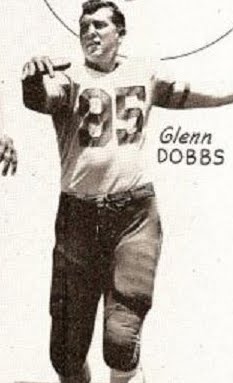
Highlighted Year: Glenn Dobbs, 1948

Tailback/Defensive Back, Los Angeles Dons


Age:  28
3rd season in pro football, 2nd with Dons
College: Tulsa
Height: 6’4”   Weight: 210

Prelude:
A star tailback and punter in college, Dobbs was chosen by the Chicago Cardinals in the first round of the 1943 NFL draft, but went into the military instead. After starring in service football, he joined the Dodgers of the new AAFC in 1946, a club that utilized a single-wing attack. Brooklyn went only 3-10-1, but Dobbs led the circuit in passing yards (1886) as well as punting (47.8 avg.) and was named MVP by the league. In a major trade early in the 1947 season, Dobbs was dealt to the Los Angeles Dons. Playing quarterback in the T-formation, his performance suffered, but in ’48 a new head coach, Jimmy Phelan, created a new offense (the Phelan spread) in order to more fully utilize Dobbs’ talents.

1948 Season Summary
Appeared in all 14 games
[Bracketed numbers indicate league rank in Top 20]

Passing
Attempts – 369 [1]
Completions – 185 [1]
Yards – 2403 [4]
Completion percentage – 50.1 [5]
Yards per attempt – 6.5 [7]
TD passes – 21 [3]
Most TD passes, game – 4 vs. Chicago 10/8
Interceptions – 20 [2]
Passer rating – 67.4 [5]

Rushing
Attempts – 91 [14]
Yards – 539 [11]
Yards per attempt – 5.9 [5]
TDs – 4 [13, tied with four others]

Pass Receiving
Receptions – 2
Yards – 11
Yards per catch – 5.5
TDs - 0

Punting
Punts – 68 [1]
Yards – 3336 [1]
Average – 49.1 [1]
Punts blocked – 3 [1]

Interceptions
Interceptions – 1
Return yards – 32
TDs – 0

Kickoff Returns
Returns – 2  
Yards – 38
Average per return – 19.0
TDs – 0

Scoring
TDs – 4         
Points – 24

Awards & Honors:
2nd team All-NFL/AAFC: Sporting News
2nd team All-AAFC: League, UPI, NY Daily News

Dons went 7-7 to finish third in the AAFC Western Division.

Aftermath:
Injuries significantly diminished Dobbs’ performance in 1949, and with the demise of the AAFC following that season, he retired from pro football. After an absence of a year, in which he was a sportscaster in Tulsa, Dobbs joined the Saskatchewan Roughriders in Canada, playing three more seasons (and winning MVP honors in the Western league, the WIFU, in ’51) before further injuries set in, and serving as a player/coach. Overall, in the AAFC he passed for 5876 yards and 45 TDs, rushed for 1039 yards and 12 TDs, and had a 46.4 punting average. In Canada, Dobbs passed for 5196 yards and 51 TDs, rushed for 241 yards and 7 TDs, and had a 44.7 punting average. He returned to his alma mater, Tulsa, where he was athletic director and head football coach. 

--

Highlighted Years features players who were consensus first-team All-League* selections or league* or conference** leaders in the following statistical categories:

Rushing: Yards, TDs (min. 10)
Passing: Yards, Completion Pct., Yards per Attempt, TDs, Rating
Receiving: Catches, Yards, TDs (min. 10)
Scoring: TDs, Points, Field Goals (min. 5)
All-Purpose: Total Yards
Defense: Interceptions, Sacks
Kickoff Returns: Average
Punt Returns: Average
Punting: Average

*Leagues include NFL (1920 to date), AFL (1926), AFL (1936-37), AAFC (1946-49), AFL (1960-69), WFL (1974-75), USFL (1983-85)

**NFC/AFC since 1970

December 12, 2013

1948: Bills Rally Past Colts in AAFC East Division Playoff


The Baltimore Colts hosted the Buffalo Bills on December 12, 1948 in a playoff to determine the winner of the All-America Football Conference’s Eastern Division. The Colts had forced the playoff a week earlier by defeating the Bills soundly by a score of 35-15 in the regular season finale, with the clubs thus finishing in a dead heat at 7-7. The records were mediocre, to be sure, and they benefited from the collapse of the New York Yankees, who dominated the division in the AAFC’s first two seasons. But it still meant a chance to play in the league championship game – even if that meant facing off against the powerful, and undefeated, Cleveland Browns.

The Bills, coached by Red Dawson, actually had a better record in 1947, when they finished second to New York. QB George Ratterman (pictured above) was the key player on offense and had a productive receiver in end Al Baldwin, who caught 54 passes during the regular season. HB Chet Mutryn was an outstanding all-purpose back who led the AAFC with 2288 total yards and 96 points and FB Lou Tomasetti ran effectively between the tackles.

Baltimore, under Head Coach Cecil Isbell, was the more surprising participant in the contest. The Colts were coming off a 2-11-1 campaign in ’47. Added to holdover HB Billy Hillenbrand and end Lamar Davis were a fine rookie crop that included QB Y.A. Tittle, HB Bob Pfohl, DHB Jack Leight, and FB/PK Rex Grossman. The team had won three of its last four games, including the convincing win over Buffalo, and appeared to have the momentum heading into the playoff.

There were 27, 327 fans on hand at Babe Ruth Stadium. The Colts took the early lead on a 16-yard field goal by Rex Grossman in the first quarter. George Ratterman tossed a five-yard jump-pass to end Bill O’Connor to give Buffalo the lead at 7-3, which was the score at halftime as the defenses controlled the game.

The Colts appeared to take command in the third quarter. A 71-yard drive ended with FB Bus Mertes running for a touchdown from nine yards out. Baltimore then put together an 88-yard series that also ended with a Mertes TD, this from a yard. Both were followed by Grossman extra points and the home team was up by 17-7 heading into the final period.

Five minutes into the fourth quarter, Buffalo’s Ratterman passed to HB Bill Gompers, who was all alone for a 66-yard touchdown, and with Graham Armstrong’s PAT, that narrowed the score to 17-14.

A key play occurred with five minutes left on the clock when Chet Mutryn caught a short pass from Ratterman, but then dropped the ball. Tackle John Mellus recovered what he – and many of those present – thought was a fumble for the Colts, but sideline judge Tommy Whelan ruled it an incomplete pass. Six plays later, with the Baltimore defense reeling following the disputed incompletion, the Bills scored when Ratterman connected with Al Baldwin for a 25-yard touchdown. Armstrong tacked on the extra point.

Buffalo’s lead was padded when LB Ed “Buckets” Hirsch intercepted a Tittle pass and returned it 20 yards for a TD. The final score was 28-17 as the Bills won the Eastern Division title.

Police had to escort the officials to the locker room after the game due to the partisan crowd that was angered over the incomplete pass call. The AAFC’s deputy commissioner, O.O. Kessing, spoke with the official, Whelan, afterward and quoted him as saying of the disputed call, “That’s the way I saw it and I’d call it that way seven days a week.”

The Colts outgained Buffalo (393 yards to 297) and had far more first downs (24 to 11). Both teams were productive on the ground, with the Colts rushing for 176 yards to Buffalo’s 162. Each team turned the ball over three times – although a turnover-that-wasn’t was the most discussed play of the game.

George Ratterman completed 10 of 18 passes for 135 yards and three touchdowns with one interception, and was at his best with the game on the line in the late going. Lou Tomasetti led the Bills with 56 rushing yards on 12 attempts and Chet Mutryn was right behind with 54 yards on 11 carries. Bill Gompers had 52 yards on 14 rushes and, with his 66-yard scoring catch, led the club in pass receiving yards. Al Baldwin and Bill O’Connor each caught three passes, for 21 and 20 yards, respectively, and one TD apiece.

For the Colts, Y.A. Tittle was successful on 17 of 36 throws for 217 yards with no TDs and one intercepted. Bus Mertes, who scored the two third quarter touchdowns, ran for 73 yards on 15 attempts and Bob Pfohl contributed 63 yards on 16 carries. Billy Hillenbrand, who ran six times for five yards, was the top receiver with 7 catches for 75 yards. Lamar Davis had 73 yards on his 5 pass receptions.

The come-from-behind win over the Colts did not translate into an upset in the AAFC Championship game for Buffalo. As expected, the Bills were routed by the Browns, 49-7, who won their third consecutive league title. Buffalo went 5-5-2 in 1949 and made the postseason again in the restructured league’s final season, again falling to the Browns in the first playoff round. Baltimore, however, dropped to the cellar with a 1-11 record. 

May 20, 2013

MVP Profile: Otto Graham, 1948

Quarterback, Cleveland Browns


Age:  27 (Dec. 6)
3rd season in pro football & with Browns
College: Northwestern
Height: 6’1”   Weight: 190

Prelude:
A single-wing tailback in college, Graham chose to sign with the Browns of the new AAFC rather than the NFL Detroit Lions, who had drafted him in the first round in 1944, after coming out of the Navy. An outstanding athlete, he first played pro basketball before joining the Browns for the 1946 season. Mobile and an accurate passer, Graham threw for 1834 yards as a rookie and led the AAFC with 17 TD passes as the Browns won the league championship. He was the league’s MVP for the first time in ’47 as he led the AAFC in overall passing as well as completion percentage (60.6), yards (2753), TD passes (25), and yards per attempt (10.2) and the Browns again won the title.

1948 Season Summary
Appeared in all 14 games
[Bracketed numbers indicate league rank in Top 20]

Passing
Attempts – 333 [3]
Completions – 173 [2]
Yards – 2713 [1]
Completion percentage – 52.0 [3]
Yards per attempt – 8.1 [3]
TD passes – 25 [2]
Most TD passes, game – 4 vs. NY Yankees 10/24, at San Francisco 11/28
Interceptions – 15 [4, tied with Bob Chappuis, Bob Hoernschemeyer & Sam Vacanti]
Passer rating – 85.6 [3]

Rushing
Attempts – 23
Yards – 146
Yards per attempt – 6.3
TDs – 6 [7, tied with Mickey Colmer & Julie Rykovich]

Interceptions
Interceptions – 1
Return yards – 0
TDs – 0

Punt Returns
Returns – 1  
Yards – 12
Average per return – 12.0
TDs – 0

Scoring
TDs – 6 [18, tied with Bob Pfohl, Jack Russell & Julie Rykovich]      
Points – 36

Postseason: 1 G (vs. Buffalo Bills, AAFC Championship)
Pass attempts – 24
Pass completions – 11
Passing yardage – 118
TD passes – 1
Interceptions – 1

Rushing attempts – 1
Rushing yards – 0
Average gain rushing – 0.0
Rushing TDs – 0

Kickoff returns – 1
Kickoff ret. Yards – 46
Kickoff ret. TDs – 0

Awards & Honors:
AAFC MVP: League (co-winner)
1st team All-AAFC: League, AP, UPI
2nd team All-NFL/AAFC: Sporting News
2nd team All-AAFC: NY Daily News

Browns went 14-0 to finish first in the Western Division. Defeated Buffalo Bills for AAFC Championship (49-7).

Aftermath:
The Browns won the AAFC title once more in 1949, and Graham led the league in passing yards (2713). He was a consensus first-team All-AAFC selection. The Browns moved to the NFL in 1950 and won another championship. They lost title games in 1951 and ’52, but Graham was a consensus first-team All-Pro in ’51 and led the league in pass attempts (364), completions (181), yards (2816), and TD passes (20) as well as interceptions (24). Cleveland won the Championship games following the 1954 and ’55 seasons (the latter after Graham was coaxed out of retirement to play one more year) and he led the league in completion percentage in each of his last three years as well as yards (2722) and yards per attempt (10.6) in 1953, and TD percentage (8.1) and yards per attempt (9.3) in ’55. Altogether, over 10 seasons (four in the AAFC, 6 in the NFL) Graham averaged 9.0 yards per attempt (a record 8.6 in the NFL alone) while throwing for 23,584 yards (10,085 in AAFC, 13,499 in NFL) with 174 TDs (86 in AAFC, 88 in NFL). He also ran for 882 yards and scored 44 TDs, with a high of 8 in 1954. He was a first-team All-league selection three times in the AAFC as well as three more times in the NFL and was chosen for the first five Pro Bowls. Perhaps most significantly of all, he quarterbacked Cleveland to a championship game in all ten years, winning seven of them. The Browns retired his #14 and he was inducted into the Pro Football Hall of Fame, Class of 1965.

[Updated 6/14/13]

--

MVP Profiles feature players who were named MVP or Player of the Year in the NFL, AAFC (1946-49), AFL (1960-69), WFL (1974), or USFL (1983-85) by a recognized organization (Associated Press, Pro Football Writers Association, Newspaper Enterprise Association, United Press International, The Sporting News, Maxwell Club – Bert Bell Award, or the league itself). 

October 15, 2011

1948: Colts Score 15 Points in 4th Quarter to Pull Away from Dons


The Los Angeles Dons were two-touchdown favorites coming into their All-America Football Conference game against the Baltimore Colts on October 15, 1948. Jimmy Phelan, who was in his first year as head coach of the Dons, had developed an offensive formation, the Phelan Spread, in an effort to better utilize star passing tailback Glenn Dobbs. Dobbs, the AAFC’s MVP in 1946 with Brooklyn, had come to Los Angeles in a celebrated trade early in the ’47 season and was a disappointment. Further efforts had been made to revamp the team, which was caught in a struggle with the NFL’s Rams for fan support and revenue, and new players included rookies Herm Wedemeyer, a halfback out of St. Mary’s of California, and end Len Ford from Michigan. LA had a 4-2 record coming into the game, having won their previous two contests.

The visiting Colts, coached by Cecil Isbell, had been 2-11-1 in ’47 but were improved, most notably thanks to the performance of rookie QB Y.A. Tittle out of LSU. They routed the New York Yankees, who had dominated the Eastern Division in each of the AAFC’s first two seasons, in the opening game in which Tittle threw four scoring passes and beat them again two games later, but were 3-3 following a 56-14 loss to the 49ers the previous week.

There was a crowd of 40,019 in attendance on a Friday night at the LA Memorial Coliseum. HB Bill Reinhard scored first by intercepting a deflected Tittle pass and running it back for a 10-yard touchdown.

In the second quarter, and with the ball on the one foot line on a drive helped along by a pass interference penalty, Dobbs surprised the Colts by throwing for a touchdown to end Joe Aguirre, who was all alone in the end zone. Down 14-0, Tittle threw a touchdown pass of 40 yards to end Lamar Davis to make the score 14-7 at halftime. LA’s defensive line, featuring Ford and tackle Butch Levy, dominated for much of the first half – but the tables would turn in the second half.

Wedemeyer and FB John Kimbrough both were injured early, hurting LA’s offense, but then the Colts suffered a blow when Tittle was lost to an injury in the third quarter. Charley O’Rourke, formerly a quarterback for the Dons, entered the game for Baltimore.

O’Rourke engineered a drive that led to a 26-yard TD pass to end Windell Williams that tied the game at 14-14 going into the final period. From there, the Colts proceeded to dominate the fourth quarter.

HB Billy Hillenbrand put Baltimore ahead with a one-yard run and Rex Grossman (grandfather of the modern NFL quarterback of the same name) extended the lead to 24-14 with a 23-yard field goal. The defense added a safety when Dobbs was tackled in his end zone. Grossman kicked his second field goal, from 20 yards, and the Colts came away with a convincing 29-14 win.

Baltimore rolled up 438 total yards and 19 first downs, to 235 yards and 9 first downs for the Dons. FB Buzz Mertes, another ex-Don, led a running game for the Colts that accounted for 169 of that yardage total. Tittle and O’Rourke combined for 269 net passing yards.


The Colts defensive line put heavy pressure on Dobbs, already hurting from an injured hip, who was sacked for a total of 91 yards in losses, including the safety. Dobbs completed just 10 of 28 passes for 173 yards.

Baltimore lost its next three games, all on the road, but won three of the last four and, while that meant finishing with a 7-7 record, it was enough to put the Colts in a tie atop the mediocre Eastern Division with the Buffalo Bills; they lost the resulting playoff. The Dons remained an inconsistent team and also ended up at 7-7 which, in the tough Western Division, meant third place.

Y.A. Tittle ended up as the third-ranked passer in the AAFC and was also third with 2522 passing yards. His 16 TD passes tied for fourth with Buffalo’s George Ratterman, and he also ranked fourth in attempts (289) and completions (161). He threw just nine interceptions. It was a promising start to a Hall of Fame career.

Glenn Dobbs led the league in pass attempts (369) and completions (185), was third in touchdown passes (21), and fourth in passing yards (2403). However, his 20 interceptions placed second. The versatile Dobbs also led the team in rushing with 539 yards on 91 carries (5.9 avg.) and was the AAFC’s top punter with a 49.1 average.

Rex Grossman led the league in field goals with 10, out of 18 attempts. Billy Hillenbrand, who put the Colts ahead to stay against the Dons, accumulated 2067 all-purpose yards, including 510 by rushing and an AAFC-leading 970 yards on his 50 pass receptions. LA’s Len Ford was outstanding on both sides of the ball and caught 31 passes for 598 yards (19.3 avg.) and seven touchdowns. While he performed well again on offense in 1949, with the demise of the league he joined the Cleveland Browns in the NFL and was used exclusively on defense in an outstanding career that was honored, like Tittle’s, with enshrinement in the Pro Football Hall of Fame.

August 27, 2011

1948: Sanders Leads Yankees to Win Over Brooklyn


The All-America Football Conference kicked off its 1948 season with games in Brooklyn and Chicago on August 27. The contest in Brooklyn featured the league’s two New York City-based teams, the Brooklyn Dodgers and New York Yankees. Both operated out of single-wing offenses, but the similarities ended there.

The Dodgers had struggled during the AAFC’s first two seasons, losing money while posting identical 3-10-1 records. The franchise had been purchased by the baseball Dodgers at the suggestion of Branch Rickey, the pioneering major league executive who hoped to prove equally adept at operating a pro football team. The Dodgers had a new head coach, Carl Voyles, and a star rookie tailback in Bob Chappuis from Michigan to join holdover Bob Hoernschemeyer.

The Yankees had been much more successful under Head Coach Ray Flaherty, who had led the NFL Redskins to championships, dominating the Eastern Division in 1946 and ’47 while posting a combined 21-5-2 regular season tally. They had lost the league championship game in both instances to the Cleveland Browns, but were a talented team that included small (5’5”, 170-pound) but quick HB Buddy Young, ends Jack Russell and Bruce Alford, and most significantly, tailback Orban (Spec) Sanders (pictured above), an all-around talent who led the AAFC in rushing in each of the first two seasons, including 1432 yards and 19 touchdowns in ’47.

There were 16,411 fans in attendance at Ebbets Field for the game played on a Friday night in 92-degree heat. That it felt far more like baseball than football weather was enhanced by those in attendance who were listening to the game between the baseball Dodgers and Cincinnati Reds on portable radios.

Brooklyn outplayed the Yankees in the first half, although both teams appeared sluggish in the heat. Chappuis and Hoernschemeyer led the passing attack, but the Dodgers managed to score only once, on a 17-yard Lee Tevis field goal in the second quarter to hold a 3-0 lead at halftime.

New York’s offense came alive in the third quarter, and it was Sanders who keyed the rally. Four minutes into the second half, he gained 27 yards on consecutive carries, including an eight-yard run for a touchdown as he powered into the end zone with DB Carl Allen on his back.

Following Brooklyn’s next possession, the Yankees moved the ball to their 40 yard line and Sanders ran off tackle and went untouched for a 60-yard TD. In sudden fashion, New York had taken a 14-3 lead and control of the game.

While Sanders keyed the offense and with the game still in the third quarter, rookie tailback Tom Casey came up with the most sensational play of all when he returned a punt an AAFC-record 94 yards for a touchdown. Harvey Johnson followed with his third extra point of the game, giving him a total of 43 straight to break his own prior record of 42.

There was no further scoring, but the three-touchdown outburst in the third quarter was more than enough to propel the Yankees to a 21-3 win.

New York outgained the Dodgers, 333 yards to 233, with 250 of that total coming on the ground. The Yankees also accumulated 15 first downs, to Brooklyn’s 11. Spec Sanders carried the ball just 11 times, but gained 147 yards and scored two touchdowns.

The opening win was not a prelude of another division-winning season for the Yankees, however. They lost their next four games, by which point the highly-regarded Flaherty was gone and replaced by Red Strader. While the team rallied somewhat in the second half of the year, it could not overcome the 2-6 start and finished in third place at 6-8 – still only a game behind the Buffalo Bills and Baltimore Colts, who tied for the division title at 7-7 (the Bills won the playoff, thus earning the dubious honor of being the team thrashed by the undefeated Browns in the title game).

Despite Branch Rickey’s efforts, the Dodgers finished last with their worst record of all, 2-12. The baseball Dodgers sold the franchise back to the league, and it was merged with the Yankees for the AAFC’s last season in 1949.

Running into injury problems over the course of the season, Spec Sanders didn’t lead the league in rushing in ’48, but finished fourth with 759 yards on 169 carries that included nine TDs. Adding in 918 passing yards, Sanders generated 1677 yards of total offense to rank seventh in the league (just behind Brooklyn’s Chappuis with 310 yards on the ground and 1402 through the air for a total of 1712). A knee injury knocked him out of the 1949 season, but he returned to play for the New York Yanks of the NFL in 1950 and, as a defensive back, led the league with 13 interceptions.

March 1, 2011

MVP Profile: Frankie Albert, 1948

Quarterback, San Francisco 49ers


Age: 28
4rd season in pro football, 3rd in AAFC & with 49ers
College: Stanford
Height: 5’10” Weight: 166

Prelude:
After excelling as a T-formation quarterback at Stanford under Head Coach Clark Shaughnessy, Albert served four years in the Navy during World War II and saw action with the Los Angeles Bulldogs of the Pacific Coast Football League in 1945. He then joined the 49ers of the new All-America Football Conference (he had also been drafted by the NFL Chicago Bears). What he lacked in height and arm strength, he made up for in ball-handling skill and passing accuracy, particularly on roll-outs. The 49ers went 17-9-2 in their first two seasons, and Albert established himself as one of the AAFC’s best quarterbacks.

1948 Season Summary
Appeared in all 14 games
[Bracketed numbers indicate league rank in Top 20]

Passing
Attempts – 264 [5]
Completions – 154 [5]
Yards – 1990 [5]
Completion percentage – 58.3 [1]
Yards per attempt – 7.5 [5]
TD passes – 29 [1]
Most TD passes, game – 4 at Brooklyn 11/21
Interceptions – 10 [9]
Passer rating – 102.9 [1]

Rushing
Attempts – 69
Yards – 349 [18]
Yards per attempt – 5.1
TDs – 8 [4]

Pass Receiving
Receptions – 1
Yards – 1
Average gain – 1.0
TDs - 0

Punting
Punts – 35 [8]
Yards – 1568 [8]
Average – 44.8 [2]
Punts blocked – 0

Scoring
TDs – 8 [10, tied with Al Baldwin & Lou Tomasetti]
PATs - 1
Points - 49 [13]

Awards & Honors:
AAFC MVP: League (co-winner)
1st team All-NFL/AAFC: Sporting News
1st team All-AAFC: NY Daily News
2nd team All-AAFC: League, UPI

The 49ers went 12-2 to finish second in the AAFC Western Division, and were the league’s highest-scoring team (495 points).

Aftermath:
Albert again led the AAFC in TD passes in the league’s last season (1949) and was selected to the first Pro Bowl when the club moved over to the NFL in 1950. However, he also had his lowest-rated pro passing season in ’50 and his production dropped off in his last two years in San Francisco (1951 and ‘52). He played one year with Calgary of the CFL before retiring, returning to the 49ers as head coach from 1956 to '58.

--

MVP Profiles feature players who were named MVP or Player of the Year in the NFL, AAFC (1946-49), AFL (1960-69), WFL (1974), or USFL (1983-85) by a recognized organization (Associated Press, Pro Football Writers Association, Newspaper Enterprise Association, United Press International, The Sporting News, Maxwell Club – Bert Bell Award, or the league itself).

[Updated 2/15/14]
[Updated 1/5/15]

November 7, 2010

1948: Buffalo’s Running Game Prevails Over Brooklyn’s Passing Attack


The November 7, 1948 All-America Football Conference (AAFC) game at Brooklyn’s Ebbets Field featured a matchup between two Eastern Division teams, the host Dodgers and visiting Buffalo Bills.

Brooklyn had done well neither on the field nor at the gate in its first two seasons, going 3-10-1 in each and averaging just over 11,000 fans per home game in ‘47. For 1948, the team had been purchased by its baseball counterpart and was run by Branch Rickey, an outstanding major league baseball executive.

Rickey believed that the key to football success was speed and a good passing game, and to that end the Dodgers outbid the NFL’s Pittsburgh Steelers for Bob Chappuis, an All-American passing tailback who had just led Michigan to a smashing Rose Bowl triumph over USC (Rickey also had to trade three draft choices to the Cleveland Browns for the rights to Chappuis, who had been drafted by the Browns in the AAFC’s draft of college talent).


Chappuis (pictured at left) seemed a good choice to operate in Brooklyn’s single-wing attack. However, he was three weeks late reporting to the team due to participation in the annual College All-Star game and encountered injury problems early on that limited his playing time. While third-year tailback Bob Hoernschemeyer played well, the Dodgers had a 2-7 record (their only two wins coming against the even-more-dreadful Chicago Rockets) coming into the game with Buffalo and Rickey was expressing concern that he had not gotten much return on his $55,000, two-year investment in Chappuis.

The Bills were 4-5 under Head Coach Red Dawson, but in the mediocre Eastern Division that was enough to put them in contention. Second-year QB George Ratterman ran their T-formation offense, which had performed well in wins the previous two weeks, most notably due to the young quarterback’s passing and the play of HB Chet Mutryn (pictured at top).

There was a typically sparse crowd of 7805 at Ebbets Field as Buffalo moved out to an early lead. Mutryn started off the scoring with a 68-yard touchdown run in the first quarter, and FB Lou Tomasetti added a 15-yard carry for a TD. The extra point attempt failed after the first score, but not the second, and the Bills were up by 13-0 after the opening period.

Brooklyn narrowed the margin in the second quarter to 13-7 as FB Mickey Colmer, another of the few bright spots on the club, ran for a two-yard touchdown. Buffalo extended its lead to 19-7 in the third quarter as Mutryn ran for a second touchdown, of nine yards, although again the extra point attempt failed.

The game ultimately came down to a contest between Buffalo’s relentless ground attack against Brooklyn’s aerial assault in a bid to keep up. The Bills added another seven points in the fourth quarter, taking advantage of the Dodgers’ need to go to the air, when DB Carl Schuette returned an interception 55 yards and lateraled to end Vince Mazza, who ran the last five yards to score. However, Chappuis filled the air with passes and connected with end Saxon Judd for a touchdown. Wingback Ray Ramsey returned a punt 70 yards for a TD as well, but ultimately the Bills held on and prevailed by a score of 26-21.

George Ratterman completed only 3 of 13 passes for the Bills, but it hardly mattered as Buffalo gained 419 yards on the ground. Chet Mutryn gained 185 yards on 17 carries with two touchdowns and Lou Tomasetti had 141 yards on 15 attempts, including a TD.

The Dodgers went to the air a total of 53 times and had only 15 rushing plays. Bob Chappuis was the headliner in defeat as he completed 26 of 51 passes, both AAFC records (previously set by Glenn Dobbs, also with Brooklyn, in 1946). He accounted for all but 12 of the team’s 265 total yards, with 211 passing and 42 rushing on four carries, and threw for one TD. He played in all but 10 minutes of the game, his best pro performance to date.

“That was as fine an individual performance I have ever seen on a football field," Dodgers Head Coach Carl Voyles said after the game regarding Chappuis.

With the win, the Bills took the lead in the Eastern Division at 5-5, on the way to a 7-7 finish and tie with the Baltimore Colts for first place. Buffalo came from behind to defeat the Colts in the resulting playoff, but was decimated by the undefeated Cleveland Browns, the Western Division champions, in the AAFC Championship game.

Brooklyn finished a dismal 2-12 to rank last in the Eastern Division. Branch Rickey and the baseball Dodgers threw in the towel and sold the franchise back to the league, which in turn combined the team with the New York Yankees for the 1949 season.

Bob Chappuis ended up completing 100 of 213 passes for 1402 yards with 8 touchdowns and 15 interceptions in ’48 while splitting time with Hoernschemeyer (who had identical totals for TDs and INTs with fewer pass attempts). The records he set for attempts and completions against the Bills were broken a few weeks later by Dobbs, now with the Los Angeles Dons. With the demise of the Dodgers, he and Hoernschemeyer both played for the Chicago Hornets (the re-named Rockets) in 1949. Chappuis saw little action with the 4-8 Hornets behind Hoernschemeyer and Johnny Clements and, with the team and league going out of existence following the season, retired from pro football (Hoernschemeyer went on to have a successful career as a halfback with the NFL’s Detroit Lions).

Chet Mutryn ended up ranking third in the AAFC in rushing with 823 yards on 147 carries for a 5.6-yard average and a league-leading 10 touchdowns (tied with San Francisco’s Joe Perry). Lou Tomasetti was fifth with 716 yards on 134 attempts (5.3 avg.) with seven TDs. Despite his poor passing effort against the Dodgers, George Ratterman placed second in the league in passing yards (2577), and while he tossed 16 TD passes, he also led the AAFC with 22 interceptions.